Uruguay Juice Market Report: Trends, Growth and Forecast (2026-2032)
By Category (100% Juice (Not from Concentrate, Reconstituted), Juice Drinks (up to 24% Juice), Nectars (High Concentration (40% to 50% fruit content), Medium Concentration (30% to 39% fruit content), Low Concentration (25% to 29% fruit content)), Vegetable Juice, Fruit and Vegetable Blends), By Nature (Conventional, Organic), By Packaging Material (Plastic, Glass, Metal, Others), By Packaging Type (PET Bottles, Aseptic Packages (Cartons), Glass Bottles, Metal Cans, Disposable Cups & Pouches), By Sales Channel (Off-Trade (Hypermarkets/ Supermarkets, Retail Outlets, Convenience Stores, Online Platforms), On-Trade) ... Read more

|
Major Players
|
Uruguay Juice Market Statistics and Insights, 2026
- Market Size Statistics
- Juice market size in Uruguay was estimated at USD 220 million in 2025.
- The market size is expected to grow to USD 270 million by 2032.
- Market to register a CAGR of around 2.97% during 2026-32.
- Category Shares
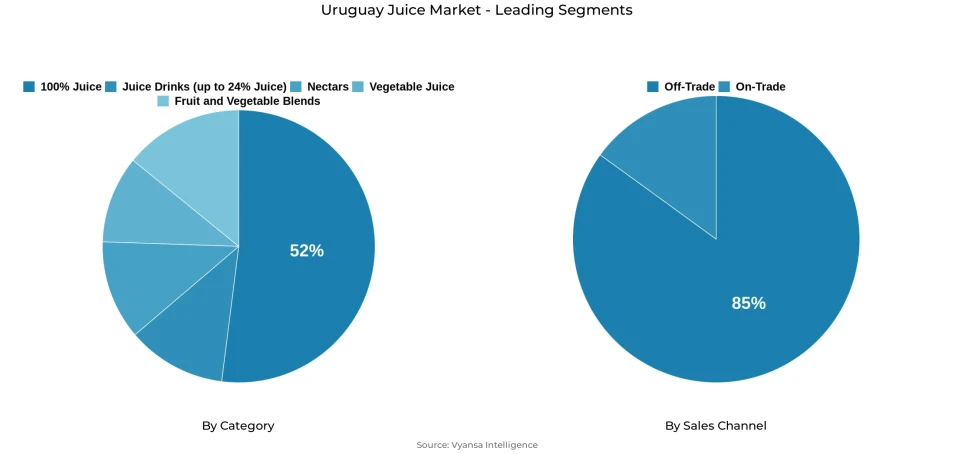
- 100% juice grabbed market share of 52%.
- Competition
- More than 10 companies are actively engaged in producing juice in Uruguay.
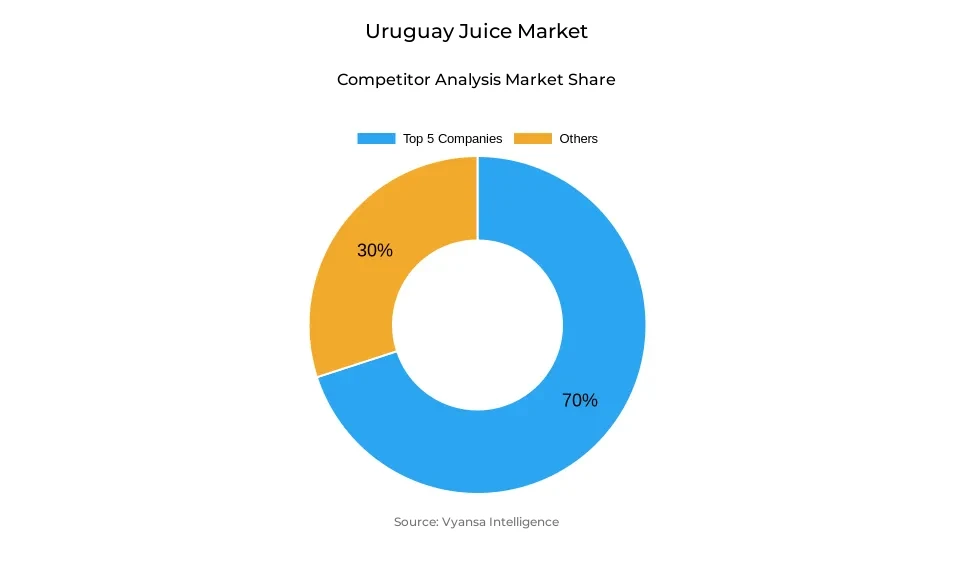
- Top 5 companies acquired around 70% of the market share.
- Danone Uruguay SA, Van Dam SA, Leopoldo Gross & Asoc SA, Cooperativa Nacional de Productores de Leche, Frigorífico Modelo SA etc., are few of the top companies.
- Sales Channel
- Off-trade grabbed 85% of the market.
Uruguay Juice Market Outlook
The Uruguay juice market is experiencing a major revitalisation with consumers shifting their focus off powder concentrates and flavoured waters to more natural and high quality products. The market is estimated to grow to USD 220 million in 2025 and USD 270 million in 2032 with a compound annual growth rate (CAGR) of about 2.97% in the 2026-32 period. This expansion is entrenched in increased awareness of healthy eating, which has been accelerated by the pandemic and strengthened by the continued lack of trust in tap water due to recent utility crises.
The main sources of this growth are health and wellness. The Uruguayans are more and more demanding additive-free and sugar-free products, and this tendency forces the brands to expand their 100% juice lines and low-sugar ones. To stay afloat in the face of increasing fruit prices, especially of oranges due to climate fluctuations, manufacturers are implementing innovative tactics, such as the emergence of vegetable-fruit combinations like beetroot and apple or carrot and orange, which will move out of the niche health stores into the mainstream because of their higher nutritional content.
Although the premium products are performing well, the market is price-sensitive. The economic issues are the motivators of the need to have low priced juice drinks as they are a low-cost entry point to low-income families. The industry is also experiencing a boom in popularity of larger value packs and multipacks to sustain value propositions. This two-market system, with premium 100% juices targeting health-seeking consumers and low-end juice beverages targeting the mass market, is likely to shape the industry landscape until 2032.
sales channel is being digitalized and physicalized. Despite the fact that off-trade channels control 85% of the market, consumer shopping habits are changing. The retail giants of the modern world like Ta-Ta and Tienda Inglesa are acquiring local chains and expanding into the interior, and retail e-commerce is the fastest-growing channel. Collaborations with last-mile delivery apps like Rappi and platforms like Mercado Libre are making it possible to deliver even fresh and high-quality juices to homes in a reliable and fast manner.
Uruguay Juice Market Growth DriverClean-Label Trade-Up Strengthens Demand
There is a significant shift in the juice industry in Uruguay towards healthier and more natural juices. The shift towards powdered concentrates and flavored waters is being replaced by products that indicate safety and purity, specifically 100% juice with no added sugar and limited additives. This repositioning is also supported by increased consumer awareness about healthy eating habits and continuous worries about the quality of tap water, which keeps the attention on packaged hydration options.
The shift towards beverages that are not sugar-intensive is supported by public health pressure. According to the Pan American Health Organization, the 2024 obesity action roadmap in Uruguay shows that 64.9% of adults are overweight, and 36.3% of adolescents aged 13 to 15 are overweight or obese. These figures support the importance of sugar minimization and clean-label decisions, which helps to facilitate the applicability of natural juice products in everyday consumption habits.
Uruguay Juice Market ChallengeSeasonality and Tourism Drive Volatility
Juice, especially 100% versions, has a strong summer bias in Uruguay, and its consumption increases with warmer weather and vacation habits. This seasonality makes it harder to stabilize volume over the year and forces brands and retailers to deal with peaks and troughs in promotions, inventory and chilled sales channel. It also restricts the effects of new product launches in case they fail to hit the high-demand window.
Tourism adds another dimension of volatility to this trend. According to the Ministry of Tourism of Uruguay, the country received 3,604,488 visitors in 2025, which is 8% more than in 2024, and the tourism foreign-exchange income amounted to USD 2.04 billion. On-trade and impulse purchases are sensitive to changes in the number of visitors or their expenditure, so they fluctuate quickly, posing a structural challenge to the consistent year-round demand of juice.
Unlock Market Intelligence
Explore the market potential with our data-driven report
Uruguay Juice Market TrendCitrus Volatility Pushes Blend Reformulation
The supply of citrus is changing and that strain is reflected in national production. The Ministry of Livestock, Agriculture and Fisheries of Uruguay estimates the total citrus production at 304,839 tonnes in the 2024 harvest and 274,000 tonnes in the 2025 harvest. The area under citrus also decreased to 13,294 hectares in 2025 compared to 13,477 hectares in 2024, further constraining the supply base of orange- and lemon-based juices.
With the increasing prices of orange and less predictable harvests, brands are changing their juice formulations. Some of the products dilute the orange content and substitute it with other fruits like peach, passion fruit and strawberry, and still manage to keep the products affordable but retain a natural positioning. This movement to flexible fruit bases is a definite structural trend in portfolio planning and sourcing approaches.
Uruguay Juice Market OpportunityValue Packs Protect Volume and Trust
Households are still wary of day-to-day expenditure and this opens up the prospects of low-cost juice options that still constitute an improvement over powders. According to the National Institute of Statistics of Uruguay, consumer prices increased by 5.49% in 2024. This price pressure favors value choices that lower the price per serving.
This can be translated into growth by brands through larger formats and multipacks in juice drinks and reconstituted 100% juice, and through clear price promotions. Multi-unit packages or bigger bottles with resealable lids are packaging that can be used to help families plan their consumption on a weekly basis, which is in line with budget control and decreases the frequency of shopping. Associating these value formats with straightforward claims like no added sugar can be used to protect the category against inferior quality alternatives.
Unlock Market Intelligence
Explore the market potential with our data-driven report
Uruguay Juice Market Segmentation Analysis
By Category
- 100% Juice
- Not from Concentrate
- Reconstituted
- Juice Drinks (up to 24% Juice)
- Nectars
- High Concentration (40% to 50% fruit content)
- Medium Concentration (30% to 39% fruit content)
- Low Concentration (25% to 29% fruit content)
- Vegetable Juice
- Fruit and Vegetable Blends
The highest share in the category of the Uruguay juice market is 100% juice which has a market share of 52%. This segment is the obvious leader, as it enjoys a national preference of natural products that do not contain any additives or added sugar. Although consumption is very seasonal, with the highest levels in summer and tourism playing a major role, the category has shown steady growth in both high-end not-from-concentrate imports such as the Citric brand and lower-end reconstituted products.
In order to cushion this 52% share against the increasing prices of raw materials, brands are diversifying their fruit bases. With the fluctuating harvests, which cause the prices of oranges to rise, manufacturers redesign blends to include more peach, passion fruit, and strawberry. This strategic component moving, together with the introduction of new vegetable-infused blends, will keep the 100% juice segment on the leading edge of the market as health consciousness keeps increasing.
By Sales Channel
- Off-Trade
- Hypermarkets/ Supermarkets
- Retail Outlets
- Convenience Stores
- Online Platforms
- On-Trade
Off-trade is the largest segment of the sales channel, which occupies 85% of the market. This channel is the core of the juice sales channel in Uruguay, historically dominated by small local grocers who have the advantage of being close to the neighbourhood consumers. These shops are still the main option when it comes to buying juice on a daily basis, especially to be consumed immediately, which is a crucial connection between large brands like Conaprole and the population.
The 85% share is however undergoing internal change as supermarkets and hypermarkets are rapidly increasing their geographical presence. These bigger stores are buying up smaller grocery chains and expanding their reach into smaller cities, introducing more of their own-label products and intensive advertising campaigns to middle-income households. Together with an ever-expanding e-commerce industry that provides direct-to-consumer delivery, the off-trade channel is more accessible than ever, which makes it the leading force in the market.
List of Companies Covered in Uruguay Juice Market
The companies listed below are highly influential in the Uruguay juice market, with a significant market share and a strong impact on industry developments.
- Danone Uruguay SA
- Van Dam SA
- Leopoldo Gross & Asoc SA
- Cooperativa Nacional de Productores de Leche
- Frigorífico Modelo SA
- Montevideo Refrescos SA
- Sebamar SA
- Milotur SA
- Patagonia Beverage SRL
Competitive Landscape
Uruguay juice market is led by Cooperativa Nacional de Productores de Leche (Conaprole), which leverages strong nationwide distribution and brand equity to anchor both mainstream and 100% juice segments, while Frigorífico Modelo (Dairco) remains a key established competitor. Danone Uruguay is the most dynamic challenger, gaining share in premium not-from-concentrate 100% juice through its imported Citric brand, targeting health-conscious consumers trading up. Private label is expanding via supermarket consolidation, intensifying price competition in value tiers. Smaller local brands are strengthening direct-to-consumer and e-commerce capabilities to defend margins. Strategic gaps exist in scalable vegetable-fruit blends, affordable low-sugar reformulations amid rising orange costs, and omnichannel execution. Players that balance premium health positioning with value-pack formats are best placed to capture bifurcated demand.
Frequently Asked Questions
Related Report
- Market Segmentation
- Research Scope
- Research Methodology
- Definitions and Assumptions
- Executive Summary
- Uruguay Juice Market Policies, Regulations, and Standards
- Uruguay Juice Market Dynamics
- Growth Factors
- Challenges
- Trends
- Opportunities
- Uruguay Juice Market Statistics, 2022-2032F
- Market Size & Growth Outlook
- By Revenues in USD Million
- By Quantity Sold in Million Litres
- Market Segmentation & Growth Outlook
- By Category
- 100% Juice- Market Insights and Forecast 2022-2032, USD Million
- Not from Concentrate- Market Insights and Forecast 2022-2032, USD Million
- Reconstituted- Market Insights and Forecast 2022-2032, USD Million
- Juice Drinks (up to 24% Juice)- Market Insights and Forecast 2022-2032, USD Million
- Nectars- Market Insights and Forecast 2022-2032, USD Million
- High Concentration (40% to 50% fruit content)- Market Insights and Forecast 2022-2032, USD Million
- Medium Concentration (30% to 39% fruit content)- Market Insights and Forecast 2022-2032, USD Million
- Low Concentration (25% to 29% fruit content)- Market Insights and Forecast 2022-2032, USD Million
- Vegetable Juice- Market Insights and Forecast 2022-2032, USD Million
- Fruit and Vegetable Blends- Market Insights and Forecast 2022-2032, USD Million
- 100% Juice- Market Insights and Forecast 2022-2032, USD Million
- By Nature
- Conventional- Market Insights and Forecast 2022-2032, USD Million
- Organic- Market Insights and Forecast 2022-2032, USD Million
- By Packaging Material
- Plastic- Market Insights and Forecast 2022-2032, USD Million
- Glass- Market Insights and Forecast 2022-2032, USD Million
- Metal- Market Insights and Forecast 2022-2032, USD Million
- Others- Market Insights and Forecast 2022-2032, USD Million
- By Packaging Type
- PET Bottles- Market Insights and Forecast 2022-2032, USD Million
- Aseptic Packages (Cartons)- Market Insights and Forecast 2022-2032, USD Million
- Glass Bottles- Market Insights and Forecast 2022-2032, USD Million
- Metal Cans- Market Insights and Forecast 2022-2032, USD Million
- Disposable Cups & Pouches- Market Insights and Forecast 2022-2032, USD Million
- By Sales Channel
- Off-Trade- Market Insights and Forecast 2022-2032, USD Million
- Hypermarkets/ Supermarkets - Market Insights and Forecast 2022-2032, USD Million
- Retail Outlets - Market Insights and Forecast 2022-2032, USD Million
- Convenience Stores- Market Insights and Forecast 2022-2032, USD Million
- Online Platforms- Market Insights and Forecast 2022-2032, USD Million
- On-Trade- Market Insights and Forecast 2022-2032, USD Million
- Off-Trade- Market Insights and Forecast 2022-2032, USD Million
- By Competitors
- Competition Characteristics
- Market Share & Analysis
- By Category
- Market Size & Growth Outlook
- Uruguay 100% Juice Market Statistics, 2022-2032
- Market Size & Growth Outlook
- By Revenues in USD Million
- By Quantity Sold in Million Litres
- Market Segmentation & Growth Outlook
- By Nature- Market Insights and Forecast 2022-2032, USD Million
- By Packaging Material- Market Insights and Forecast 2022-2032, USD Million
- By Packaging Type- Market Insights and Forecast 2022-2032, USD Million
- By Sales Channel- Market Insights and Forecast 2022-2032, USD Million
- Market Size & Growth Outlook
- Uruguay Juice Drinks (up to 24% Juice) Market Statistics, 2022-2032
- Market Size & Growth Outlook
- By Revenues in USD Million
- By Quantity Sold in Million Litres
- Market Segmentation & Growth Outlook
- By Nature- Market Insights and Forecast 2022-2032, USD Million
- By Packaging Material- Market Insights and Forecast 2022-2032, USD Million
- By Packaging Type- Market Insights and Forecast 2022-2032, USD Million
- By Sales Channel- Market Insights and Forecast 2022-2032, USD Million
- Market Size & Growth Outlook
- Uruguay Nectars Market Statistics, 2022-2032
- Market Size & Growth Outlook
- By Revenues in USD Million
- By Quantity Sold in Million Litres
- Market Segmentation & Growth Outlook
- By Nature- Market Insights and Forecast 2022-2032, USD Million
- By Packaging Material- Market Insights and Forecast 2022-2032, USD Million
- By Packaging Type- Market Insights and Forecast 2022-2032, USD Million
- By Sales Channel- Market Insights and Forecast 2022-2032, USD Million
- Market Size & Growth Outlook
- Uruguay Vegetable Juice Market Statistics, 2022-2032
- Market Size & Growth Outlook
- By Revenues in USD Million
- By Quantity Sold in Million Litres
- Market Segmentation & Growth Outlook
- By Nature- Market Insights and Forecast 2022-2032, USD Million
- By Packaging Material- Market Insights and Forecast 2022-2032, USD Million
- By Packaging Type- Market Insights and Forecast 2022-2032, USD Million
- By Sales Channel- Market Insights and Forecast 2022-2032, USD Million
- Market Size & Growth Outlook
- Uruguay Fruit and Vegetable Blends Market Statistics, 2022-2032
- Market Size & Growth Outlook
- By Revenues in USD Million
- By Quantity Sold in Million Litres
- Market Segmentation & Growth Outlook
- By Nature- Market Insights and Forecast 2022-2032, USD Million
- By Packaging Material- Market Insights and Forecast 2022-2032, USD Million
- By Packaging Type- Market Insights and Forecast 2022-2032, USD Million
- By Sales Channel- Market Insights and Forecast 2022-2032, USD Million
- Market Size & Growth Outlook
- Competitive Outlook
- Company Profiles
- Cooperativa Nacional de Productores de Leche
- Business Description
- Product Portfolio
- Collaborations & Alliances
- Recent Developments
- Financial Details
- Others
- Frigorífico Modelo SA
- Business Description
- Product Portfolio
- Collaborations & Alliances
- Recent Developments
- Financial Details
- Others
- Montevideo Refrescos SA
- Business Description
- Product Portfolio
- Collaborations & Alliances
- Recent Developments
- Financial Details
- Others
- Sebamar SA
- Business Description
- Product Portfolio
- Collaborations & Alliances
- Recent Developments
- Financial Details
- Others
- Milotur SA
- Business Description
- Product Portfolio
- Collaborations & Alliances
- Recent Developments
- Financial Details
- Others
- Danone Uruguay SA
- Business Description
- Product Portfolio
- Collaborations & Alliances
- Recent Developments
- Financial Details
- Others
- Van Dam SA
- Business Description
- Product Portfolio
- Collaborations & Alliances
- Recent Developments
- Financial Details
- Others
- Leopoldo Gross & Asoc SA
- Business Description
- Product Portfolio
- Collaborations & Alliances
- Recent Developments
- Financial Details
- Others
- Patagonia Beverage SRL
- Business Description
- Product Portfolio
- Collaborations & Alliances
- Recent Developments
- Financial Details
- Others
- Cooperativa Nacional de Productores de Leche
- Company Profiles
- Disclaimer
| Segment | Sub-Segment |
|---|---|
| By Category |
|
| By Nature |
|
| By Packaging Material |
|
| By Packaging Type |
|
| By Sales Channel |
|
Research Methodology
This study followed a structured approach comprising four key phases to assess the size and scope of the electro-oxidation market. The process began with thorough secondary research to collect data on the target market, related markets, and broader industry context. These findings, along with preliminary assumptions and estimates, were then validated through extensive primary research involving industry experts from across the value chain. To calculate the overall market size, both top-down and bottom-up methodologies were employed. Finally, market segmentation and data triangulation techniques were applied to refine and validate segment-level estimations.
Secondary Research
The secondary research phase involved gathering data from a wide range of credible and published sources. This step helped in identifying industry trends, defining market segmentation, and understanding the market landscape and value chain.
Sources consulted during this phase included:
- Company annual reports, investor presentations, and press releases
- Industry white papers and certified publications
- Trade directories and market-recognized databases
- Articles from authoritative authors and reputable journals
- Gold and silver standard websites
Secondary research was critical in mapping out the industry's value chain and monetary flow, identifying key market segments, understanding regional variations, and tracking significant industry developments.
Other key sources:
- Financial disclosures
- Industry associations and trade bodies
- News outlets and business magazines
- Academic journals and research studies
- Paid industry databases
Primary Research
To validate secondary data and gain deeper market insights, primary research was conducted with key stakeholders across both the supply and demand sides of the market.
On the demand side, participants included decision-makers and influencers from end-user industries—such as CIOs, CTOs, and CSOs—who provided first-hand perspectives on market needs, product usage, and future expectations.
On the supply side, interviews were conducted with manufacturers, industry associations, and institutional participants to gather insights into current offerings, product pipelines, and market challenges.
Primary interviews provided critical inputs such as:
- Market size and revenue data
- Product and service breakdowns
- Market forecasts
- Regional and application-specific trends
Stakeholders consulted included:
- Leading OEM and solution providers
- Channel and distribution partners
- End users across various applications
- Independent consultants and industry specialists
Market Size Estimation and Data Triangulation
- Identifying Key Market Participants (Secondary Research)
- Goal: To identify the major players or companies in the target market. This typically involves using publicly available data sources such as industry reports, market research publications, and financial statements of companies.
- Tools: Reports from firms like Gartner, Forrester, Euromonitor, Statista, IBISWorld, and others. Public financial statements, news articles, and press releases from top market players.
- Extracting Earnings of Key Market Participants
- Goal: To estimate the earnings generated from the product or service being analyzed. This step helps in understanding the revenue potential of each market player in a specific geography.
- Methods: Earnings data can be gathered from:
- Publicly available financial reports (for listed companies).
- Interviews and primary data sources from professionals, such as Directors, VPs, SVPs, etc. This is especially useful for understanding more nuanced, internal data that isn't publicly disclosed.
- Annual reports and investor presentations of key players.
- Data Collation and Development of a Relevant Data Model
- Goal: To collate inputs from both primary and secondary sources into a structured, data-driven model for market estimation. This model will incorporate key market KPIs and any independent variables relevant to the market.
- Key KPIs: These could include:
- Market size, growth rate, and demand drivers.
- Industry-specific metrics like market share, average revenue per customer (ARPC), or average deal size.
- External variables, such as economic growth rates, inflation rates, or commodity prices, that could affect the market.
- Data Modeling: Based on this data, the market forecasts are developed for the next 5 years. A combination of trend analysis, scenario modeling, and statistical regression might be used to generate projections.
- Scenario Analysis
- Goal: To test different assumptions and validate how sensitive the market is to changes in key variables (e.g., market demand, regulatory changes, technological disruptions).
- Types of Scenarios:
- Base Case: Based on current assumptions and historical data.
- Best-Case Scenario: Assuming favorable market conditions, regulatory environments, and technological advancements.
- Worst-Case Scenario: Accounting for adverse factors, such as economic downturns, stricter regulations, or unexpected disruptions.












