UK Ice Cream Market Report: Trends, Growth and Forecast (2026-2032)
By Product Base (Dairy-Based, Plant-Based/Non-Dairy, Others), By Consumption Type (Impulse Ice Cream, Take-Home Ice Cream, Others), By Serving Format (Cups, Cones, Sticks/Bars, Tubs, Bricks/Blocks, Ice Cream Sandwiches, Others), By Flavor (Vanilla, Chocolate, Fruit-Based, Caramel & Dessert-Based, Nut-Based, Others), By Sales Channel (Retail Offline (Supermarkets & Hypermarkets, Convenience Stores, Ice Cream Parlours, Cafés & Restaurants, Others), Retail Online (Online Grocery Platforms, E-Commerce Platforms, Food Delivery Platforms, Others)), By Region (England, Scotland, Wales, Northern Ireland) ... Read more

|
Major Players
|
UK Ice Cream Market Overview
The UK ice cream market represents the commercial ecosystem encompassing the production, branding, distribution, and consumption of dairy- and plant-based frozen desserts across retail, foodservice, hospitality, and leisure channels. Projected to grow at a CAGR of around 6.4% during 2026–2032, the market is evolving through premiumization, flavor innovation, diversified dietary offerings, and expanding omnichannel accessibility.
Key Highlights of the UK Ice Cream Market:
- The market was valued at USD 3.81 billion in 2025 and USD 4.12 billion in 2026, with revenue projected to reach USD 5.88 billion by 2032.
- The industry is projected to witness steady growth at a CAGR of 6.4% during 2026–2032.
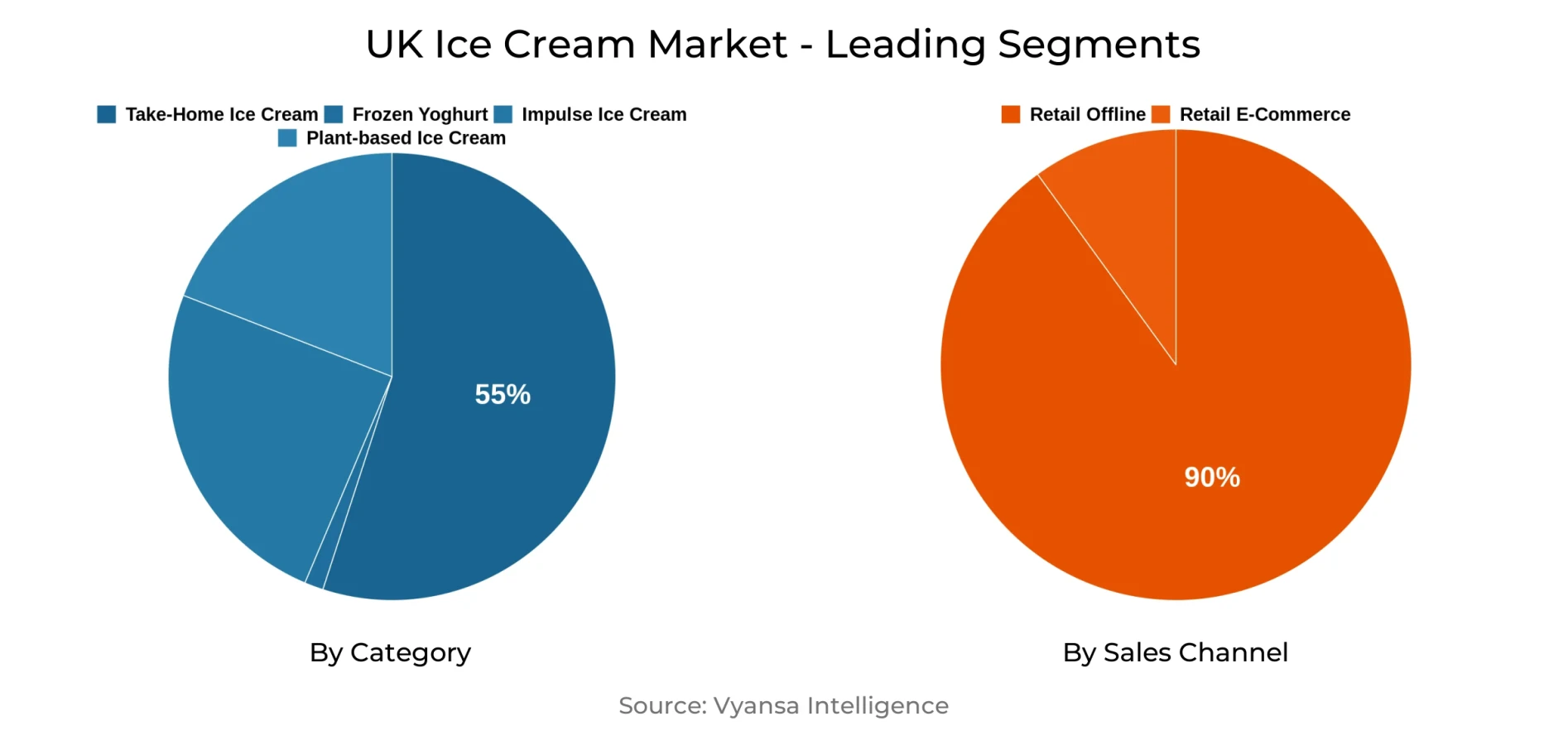
- Dairy-based ice cream leads the product type segment with a 70% share in 2026.
- Meanwhile, plant-based and non-dairy ice cream is projected to grow at a CAGR of 12.02% during 2026–2032.
- Take-home ice cream leads consumption type with a 45% share in 2026.
- However, impulse ice cream is projected to record continued growth at a CAGR of 5.04% during 2026–2032.
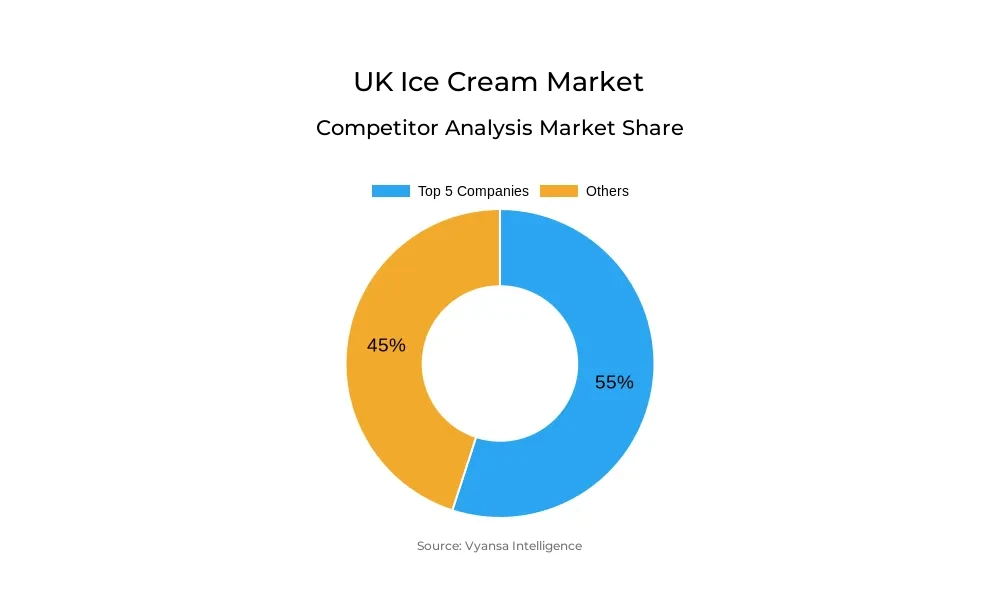
- The five leading participants hold an estimated 35% of market revenue, indicating a moderately fragmented structure.
The ice cream industry in the UK is witnessing significant growth supported by resilient household expenditure, the affordability of ice cream as an indulgent treat, increasing premiumization, and continuous flavor and format innovation. According to the UK Office for National Statistics (ONS), average household expenditure increased from USD 835.22 per week in FY2024 to USD 906.64 in FY2025, representing a nominal increase of around 9% and a real-terms increase of approximately 5%. This improvement in consumer spending capacity is expected to support discretionary demand for take-home ice cream, premium multipacks, impulse products, and out-of-home desserts.
Additionally, younger consumers are strengthening demand for experiential and visually distinctive frozen desserts. The expansion of dessert cafés reflects this behavioral shift, with nearly 700 dessert parlors established across the UK during the past decade and the segment generating more than USD 670 million. These venues attract children, families, non-drinkers, and particularly consumers aged 18–35, creating additional demand for gelato, sundaes, ice cream-based desserts, and premium flavor combinations.
Moreover, social-media-led flavor trends are accelerating product innovation. Pistachio has emerged as a prominent premium flavor, encouraging manufacturers to introduce products featuring layered textures and globally inspired ingredients. In 2026, Magnum introduced its Signature range, including La Pistache and La Pêche. The products incorporate pistachio- and peach-based shells, gelato centers, textured inclusions, and premium coatings, extending innovation beyond conventional chocolate-covered ice cream formats.
Furthermore, increasing demand for premium experiences, limited-edition flavors, plant-based alternatives, portion-controlled products, and affordable private-label offerings is expected to broaden consumption across household and out-of-home occasions. Consequently, the convergence of improving consumer expenditure, younger consumers’ preference for experience-led desserts, and frequent product innovation is anticipated to accelerate market value growth through 2032.
Government Regulations and Compliance Influencing the UK Ice Cream Market
The ice cream industry in the United Kingdom is increasingly influenced by regulations governing HFSS promotions, advertising, food labelling, allergen disclosure, and food safety. Under the Food (Promotion and Placement) (England) Regulations 2021, qualifying ice cream products high in fat, sugar, or salt are restricted from prominent retail locations, including checkouts, store entrances, aisle ends, and equivalent high-visibility positions online. Furthermore, restrictions on volume-price promotions, including “buy one, get one free” and “3-for-2” offers, became effective on October 1, 2025, influencing promotional strategies for high-sugar and high-fat ice cream products.
Additionally, the Advertising (Less Healthy Food Definitions and Exemptions) Regulations 2024, supported by the Communications Act 2003 (Restrictions on the Advertising of Less Healthy Food) (Effective Date) (Amendment) Regulations 2025, introduced UK-wide advertising restrictions from January 2026. These regulations restrict identifiable less-healthy ice cream advertisements on television before 9:00 p.m. and prohibit paid online advertisements for such products throughout the day.
Moreover, manufacturers must comply with the Food Information Regulations 2014, which require accurate ingredient, nutrition, durability, and allergen information. Compliance with the Food Safety Act 1990 and food hygiene regulations also requires manufacturers and foodservice operators to maintain product safety, temperature control, traceability, and hygienic handling. Collectively, these regulations are encouraging lower-sugar formulations, portion-controlled offerings, transparent labelling, responsible advertising, and stronger allergen-management practices.
Drivers
Warm Weather and Social Occasions Increase Ice Cream Consumption
Rising summer temperatures and the growing frequency of warm-weather social activities are significantly increasing ice cream consumption across the UK. According to the UK Met Office, summer 2025 was the country’s warmest on record, with an average temperature of approximately 16.1°C, exceeding the previous record of 15.76°C registered in 2018. The UK experienced four heatwaves during the season, while temperatures peaked at approximately 35.8°C. Furthermore, several regions recorded mean summer temperatures more than 2°C above the long-term average, creating favorable conditions for increased demand for refreshing frozen products.
Higher temperatures encourage consumers to purchase impulse ice cream products, including cones, sticks, bars, cups, and ice lollies, particularly during visits to beaches, parks, festivals, tourist attractions, leisure venues, and outdoor events. Warm weather also increases footfall across convenience stores, forecourts, ice cream parlours, cafés, and mobile ice cream vendors, supporting higher sales of portable and immediately consumable products.
Additionally, social occasions, including family gatherings, picnics, barbecues, holidays, birthdays, and outdoor celebrations, are strengthening demand for take-home tubs, multipacks, and shareable ice cream formats. The increasing occurrence of warmer summers may extend the traditional seasonal sales period and support more frequent purchases beyond peak summer months. Consequently, the convergence of rising temperatures, outdoor leisure participation, and social consumption occasions is expected to increase both impulse and take-home ice cream sales, thereby accelerating the growth of the United Kingdom ice cream market through 2032.
Challenges
Rising Manufacturing Costs and Margin Pressure
Rising manufacturing and operating costs represent a significant challenge for the UK ice cream market, as producers must manage increasing expenditure across ingredients, packaging, energy, cold storage, refrigerated transportation, labor, and regulatory compliance. Ice cream production is particularly cost-intensive because uninterrupted temperature-controlled operations are required throughout manufacturing, warehousing, distribution, and retail to maintain product quality and prevent melting or spoilage.
According to the UK Office for National Statistics (ONS), producer input prices increased by 7.7% year-on-year in April 2026, accelerating from a revised increase of 5.3% in March 2026. During the same period, factory-gate output prices increased by 4.0%, indicating that input-cost growth exceeded the rate at which manufacturers increased selling prices. This difference may compress operating margins, particularly for small and medium-sized ice cream producers with limited purchasing power and lower production volumes.
Furthermore, fluctuations in the prices of milk, cream, sugar, cocoa, fruit preparations, flavorings, and packaging materials complicate procurement planning and product-cost forecasting. The financial impact is amplified by the continuous electricity requirements of freezing equipment, cold-storage facilities, refrigerated vehicles, and retail freezers. However, intense competition among branded products and private-label alternatives limits manufacturers’ ability to transfer the full increase in costs to consumers.
Consequently, manufacturers may increase retail prices, reduce pack sizes, limit promotional discounts, reformulate products, delay new launches, or absorb additional expenses. These measures may weaken price competitiveness, constrain profitability, and restrict investment in product innovation and production expansion.
Recent Trends
Consumers Shift Toward Premium and Multi-Texture Ice Cream
Consumer preferences in the UK ice cream market are increasingly shifting toward premium products that combine distinctive flavors, layered fillings, contrasting textures, and visually appealing formats. Rather than focusing solely on traditional vanilla, chocolate, and fruit flavors, consumers are showing greater interest in products featuring gelato centers, crunchy inclusions, sauces, premium chocolate coatings, and globally inspired ingredients. This shift is encouraging manufacturers to compete through enhanced sensory experiences and higher-value product offerings.
Additionally, pistachios have emerged as a prominent premium flavor, supported by social-media-driven food trends and increasing consumer interest in nut-based and internationally inspired flavors. In response, manufacturers are expanding their portfolios with products designed to deliver multiple flavors and textures within a single serving.
In 2026, Magnum introduced its Signature range in the UK, comprising Signature Pistachio and Signature Peach in 3 × 90 ml multipacks. Signature Pistachio combines a pistachio-flavored shell, cracking chocolate, caramelized salted pistachio pieces, smooth ice cream, and a pistachio gelato center. Signature Peach similarly incorporates layered fruit flavors, textured components, chocolate coatings, and a gelato center. The launch reflects the industry’s increasing focus on premium ingredients, multi-layered formats, and differentiated sensory experiences.
Furthermore, premium and multi-texture products enable manufacturers to strengthen brand differentiation, encourage consumer trial, and support higher price positioning. Consequently, continued innovation in layered textures, indulgent inclusions, and trend-led flavors is expected to increase category value and shape product development in the UK ice cream market through 2032.
Future Opportunities
Mainstream Expansion of Plant-Based and Dairy-Free Ice Cream
The increasing adoption of plant-based dairy products presents a significant growth opportunity for the UK ice cream market by expanding demand beyond committed vegan consumers. According to The Vegan Society’s 2025 survey of 2,000 UK adults, approximately one-third of respondents regularly consumed dairy alternatives, indicating growing acceptance among flexitarian consumers, dairy-reducing individuals, and mixed-diet households. Increasing consumer focus on dietary suitability, environmental considerations, taste, and product variety is creating opportunities for dairy-free ice cream to transition from a specialist segment into a mainstream frozen dessert category.
Additionally, manufacturers are expanding product portfolios to improve the availability and appeal of dairy-free alternatives. In 2025, Ben & Jerry’s introduced a new oat-based non-dairy ice cream range in the UK, replacing its earlier sunflower-based formulation. The range included popular flavours such as Chocolate Fudge Brownie, Cookies on Cookie Dough, and Berry Revolutionary Sundae, providing plant-based consumers with alternatives based on familiar mainstream flavours. The launch demonstrates increasing industry investment in improving the creaminess, texture, and sensory quality of dairy-free ice cream.
Furthermore, manufacturers can capture future opportunities by expanding plant-based products across family tubs, multipacks, cones, sticks, bars, cups, and foodservice formats. Wider supermarket, convenience-store, and online availability, combined with improvements in flavour, scoopability, melting performance, and price competitiveness, can increase consumer trial and repeat purchases. Consequently, continued product innovation and broader retail accessibility are expected to support the mainstream expansion of plant-based ice cream through 2032.
Unlock Market Intelligence
Explore the market potential with our data-driven report
Segmentation Analysis
By Product Base
- Dairy-Based
- Plant-Based/Non-Dairy
- Others
Dairy-Based Ice Cream Leads, While Plant-Based Alternatives Expand Faster
Dairy-based ice cream is estimated to dominate the United Kingdom ice cream market with a significant share of approximately 70% in 2026. Its leading position is supported by established consumer familiarity, widespread household acceptance, rich taste, creamy texture, and extensive availability across supermarkets, convenience stores, ice cream parlours, cafés, restaurants, and other foodservice outlets.
Dairy-based formulations are also available across a broad range of formats, including tubs, cones, cups, sticks, bars, sandwiches, and multipacks. This extensive product and format diversity enables manufacturers to address multiple consumer groups and price segments, ranging from value-oriented family products to standard and premium offerings. Consequently, dairy-based ice cream maintains strong penetration across household, impulse, leisure, and foodservice consumption occasions throughout the UK.
Meanwhile, plant-based ice cream is projected to register a modelled CAGR of approximately 12.02% during 2026–2032, supported by increasing demand from vegan, flexitarian, dairy-reducing, and lactose-avoiding consumers. Expanding retail freezer space and improvements in oat-, coconut-, soy-, and nut-based formulations are enhancing product creaminess, flavor, texture, and overall consumer acceptance. Although plant-based ice cream currently represents a smaller market base, its relatively low penetration provides substantial scope for future expansion. Greater product availability, familiar flavor offerings, improved sensory performance, and wider distribution are expected to support the transition of dairy-free ice cream from a specialist category toward broader household and mainstream retail consumption.
By Product Type
- Impulse Ice Cream
- Take-Home Ice Cream
- Others
Take-Home Ice Cream Leads, While Impulse Products Record Continued Growth
Take-home ice cream is estimated to lead the UK ice cream market with a modelled share of approximately 45% in 2026. Its dominant position is supported by planned grocery purchases, regular household freezer stocking, family dessert occasions, and repeated at-home consumption. Product formats such as tubs, bricks, blocks, and multipacks provide convenience and typically offer a lower cost per serving than individually packaged products, enabling households to manage portions across multiple consumption occasions. Furthermore, extensive availability through supermarkets and online grocery platforms strengthens segment growth by providing consumers with broad branded and private-label assortments, promotional offers, multiple pack sizes, and convenient freezer replenishment throughout the year.
Meanwhile, impulse ice cream is projected to register a modelled CAGR of approximately 5.04% during 2026–2032. Products such as cones, cups, sticks, bars, ice cream sandwiches, and lollies are designed for immediate, convenient, and single-serve consumption. Demand is supported by widespread availability across convenience stores, petrol stations, ice cream parlors, cafés, leisure destinations, tourist attractions, travel routes, and food delivery platforms. Moreover, the continued innovation in premium coatings, layered textures, distinctive flavors, and portion-controlled formats is expected to support segment expansion during the forecast period.
Unlock Market Intelligence
Explore the market potential with our data-driven report
Competitive Landscape
The UK ice cream industry is moderately fragmented, with the five leading participants accounting for an estimated 35% of market revenue. The remaining share is distributed among regional manufacturers, private-label suppliers, artisanal producers, ice cream parlours, and specialist plant-based brands. Competition is shaped by freezer visibility, product range, pricing, brand recognition, retailer relationships, distribution coverage, manufacturing reliability, and stock availability during short seasonal peaks.
Prominent Companies
- Magnum ICC UK Ltd
- Froneri Ice Cream UK Limited
- General Mills UK Limited
- Mars Chocolate Drinks and Treats
- V&H Limited
- Mackie’s Limited
- Yeo Valley Farms Production Limited
- Irma Management Limited
- Remeo Gelato Ltd
- The Booja-Booja Company Ltd
Recent Developments and Updates
- In March 2026, Remeo Gelato Ltd launched Amarena Cherry Gelato in a 462ml jar. The Italy-made product uses natural ingredients and became available through Ocado and Waitrose, expanding the company’s premium take-home gelato range for UK household dessert occasions.
Frequently Asked Questions
Related Report
- Market Segmentation
- Research Scope
- Research Methodology
- Definitions and Assumptions
- Executive Summary
- UK Ice Cream Market Policies, Regulations, and Standards
- UK Ice Cream Market Dynamics
- Growth Factors
- Challenges
- Trends
- Opportunities
- UK Ice Cream Market Statistics, 2022-2032
- Market Size & Growth Outlook
- By Revenues in USD Million
- By Quantity Sold in Million Litres
- Market Segmentation & Growth Outlook
- By Product Base
- Dairy-Based- Market Insights and Forecast 2022-2032, USD Million
- Plant-Based/Non-Dairy- Market Insights and Forecast 2022-2032, USD Million
- Others- Market Insights and Forecast 2022-2032, USD Million
- By Consumption Type
- Impulse Ice Cream- Market Insights and Forecast 2022-2032, USD Million
- Take-Home Ice Cream- Market Insights and Forecast 2022-2032, USD Million
- Others- Market Insights and Forecast 2022-2032, USD Million
- By Serving Format
- Cups- Market Insights and Forecast 2022-2032, USD Million
- Cones- Market Insights and Forecast 2022-2032, USD Million
- Sticks/Bars- Market Insights and Forecast 2022-2032, USD Million
- Tubs- Market Insights and Forecast 2022-2032, USD Million
- Bricks/Blocks- Market Insights and Forecast 2022-2032, USD Million
- Ice Cream Sandwiches- Market Insights and Forecast 2022-2032, USD Million
- Others- Market Insights and Forecast 2022-2032, USD Million
- By Flavor
- Vanilla- Market Insights and Forecast 2022-2032, USD Million
- Chocolate- Market Insights and Forecast 2022-2032, USD Million
- Fruit-Based- Market Insights and Forecast 2022-2032, USD Million
- Caramel & Dessert-Based- Market Insights and Forecast 2022-2032, USD Million
- Nut-Based- Market Insights and Forecast 2022-2032, USD Million
- Others- Market Insights and Forecast 2022-2032, USD Million
- By Sales Channel
- Retail Offline- Market Insights and Forecast 2022-2032, USD Million
- Supermarkets & Hypermarkets- Market Insights and Forecast 2022-2032, USD Million
- Convenience Stores- Market Insights and Forecast 2022-2032, USD Million
- Ice Cream Parlours- Market Insights and Forecast 2022-2032, USD Million
- Cafés & Restaurants- Market Insights and Forecast 2022-2032, USD Million
- Others- Market Insights and Forecast 2022-2032, USD Million
- Retail Online- Market Insights and Forecast 2022-2032, USD Million
- Online Grocery Platforms- Market Insights and Forecast 2022-2032, USD Million
- E-Commerce Platforms- Market Insights and Forecast 2022-2032, USD Million
- Food Delivery Platforms- Market Insights and Forecast 2022-2032, USD Million
- Others- Market Insights and Forecast 2022-2032, USD Million
- Retail Offline- Market Insights and Forecast 2022-2032, USD Million
- By Region
- England- Market Insights and Forecast 2022-2032, USD Million
- Scotland- Market Insights and Forecast 2022-2032, USD Million
- Wales- Market Insights and Forecast 2022-2032, USD Million
- Northern Ireland- Market Insights and Forecast 2022-2032, USD Million
- By Competitors
- Competition Characteristics
- Market Share & Analysis
- By Product Base
- Market Size & Growth Outlook
- UK Dairy-Based Ice Cream Market Statistics, 2022-2032
- Market Size & Growth Outlook
- By Revenues in USD Million
- By Quantity Sold in Million Litres
- Market Segmentation & Growth Outlook
- By Consumption Type- Market Insights and Forecast 2022-2032, USD Million
- By Serving Format- Market Insights and Forecast 2022-2032, USD Million
- By Flavor- Market Insights and Forecast 2022-2032, USD Million
- By Sales Channel- Market Insights and Forecast 2022-2032, USD Million
- By Region- Market Insights and Forecast 2022-2032, USD Million
- Market Size & Growth Outlook
- UK Plant-Based/Non-Dairy Ice Cream Market Statistics, 2022-2032
- Market Size & Growth Outlook
- By Revenues in USD Million
- By Quantity Sold in Million Litres
- Market Segmentation & Growth Outlook
- By Consumption Type- Market Insights and Forecast 2022-2032, USD Million
- By Serving Format- Market Insights and Forecast 2022-2032, USD Million
- By Flavor- Market Insights and Forecast 2022-2032, USD Million
- By Sales Channel- Market Insights and Forecast 2022-2032, USD Million
- By Region- Market Insights and Forecast 2022-2032, USD Million
- Market Size & Growth Outlook
- Competitive Outlook
- Company Profiles
- Magnum ICC UK Limited
- Business Description
- Product Portfolio
- Collaborations & Alliances
- Recent Developments
- Financial Details
- Others
- Froneri Ice cream UK Limited
- Business Description
- Product Portfolio
- Collaborations & Alliances
- Recent Developments
- Financial Details
- Others
- General Mills UK Limited (Häagen-Dazs)
- Business Description
- Product Portfolio
- Collaborations & Alliances
- Recent Developments
- Financial Details
- Others
- Mars Chocolate Drinks and Treats
- Business Description
- Product Portfolio
- Collaborations & Alliances
- Recent Developments
- Financial Details
- Others
- V&H Limited (Little Moons)
- Business Description
- Product Portfolio
- Collaborations & Alliances
- Recent Developments
- Financial Details
- Others
- MACKIE'S LIMITED (Mackie’s of Scotland)
- Business Description
- Product Portfolio
- Collaborations & Alliances
- Recent Developments
- Financial Details
- Others
- Yeo Valley Farms (Production) Limited (Yeo Valley Organic)
- Business Description
- Product Portfolio
- Collaborations & Alliances
- Recent Developments
- Financial Details
- Others
- IRMA MANAGEMENT LIMITED (Jude’s)
- Business Description
- Product Portfolio
- Collaborations & Alliances
- Recent Developments
- Financial Details
- Others
- REMEO GELATO LTD
- Business Description
- Product Portfolio
- Collaborations & Alliances
- Recent Developments
- Financial Details
- Others
- The Booja-Booja Company Ltd (Booja Booja)
- Business Description
- Product Portfolio
- Collaborations & Alliances
- Recent Developments
- Financial Details
- Others
- Magnum ICC UK Limited
- Company Profiles
- Disclaimer
| Segment | Sub-Segment |
|---|---|
| By Product Base |
|
| By Consumption Type |
|
| By Serving Format |
|
| By Flavor |
|
| By Sales Channel |
|
| By Region |
|
Research Methodology
This study followed a structured approach comprising four key phases to assess the size and scope of the electro-oxidation market. The process began with thorough secondary research to collect data on the target market, related markets, and broader industry context. These findings, along with preliminary assumptions and estimates, were then validated through extensive primary research involving industry experts from across the value chain. To calculate the overall market size, both top-down and bottom-up methodologies were employed. Finally, market segmentation and data triangulation techniques were applied to refine and validate segment-level estimations.
Secondary Research
The secondary research phase involved gathering data from a wide range of credible and published sources. This step helped in identifying industry trends, defining market segmentation, and understanding the market landscape and value chain.
Sources consulted during this phase included:
- Company annual reports, investor presentations, and press releases
- Industry white papers and certified publications
- Trade directories and market-recognized databases
- Articles from authoritative authors and reputable journals
- Gold and silver standard websites
Secondary research was critical in mapping out the industry's value chain and monetary flow, identifying key market segments, understanding regional variations, and tracking significant industry developments.
Other key sources:
- Financial disclosures
- Industry associations and trade bodies
- News outlets and business magazines
- Academic journals and research studies
- Paid industry databases
Primary Research
To validate secondary data and gain deeper market insights, primary research was conducted with key stakeholders across both the supply and demand sides of the market.
On the demand side, participants included decision-makers and influencers from end-user industries—such as CIOs, CTOs, and CSOs—who provided first-hand perspectives on market needs, product usage, and future expectations.
On the supply side, interviews were conducted with manufacturers, industry associations, and institutional participants to gather insights into current offerings, product pipelines, and market challenges.
Primary interviews provided critical inputs such as:
- Market size and revenue data
- Product and service breakdowns
- Market forecasts
- Regional and application-specific trends
Stakeholders consulted included:
- Leading OEM and solution providers
- Channel and distribution partners
- End users across various applications
- Independent consultants and industry specialists
Market Size Estimation and Data Triangulation
- Identifying Key Market Participants (Secondary Research)
- Goal: To identify the major players or companies in the target market. This typically involves using publicly available data sources such as industry reports, market research publications, and financial statements of companies.
- Tools: Reports from firms like Gartner, Forrester, Euromonitor, Statista, IBISWorld, and others. Public financial statements, news articles, and press releases from top market players.
- Extracting Earnings of Key Market Participants
- Goal: To estimate the earnings generated from the product or service being analyzed. This step helps in understanding the revenue potential of each market player in a specific geography.
- Methods: Earnings data can be gathered from:
- Publicly available financial reports (for listed companies).
- Interviews and primary data sources from professionals, such as Directors, VPs, SVPs, etc. This is especially useful for understanding more nuanced, internal data that isn't publicly disclosed.
- Annual reports and investor presentations of key players.
- Data Collation and Development of a Relevant Data Model
- Goal: To collate inputs from both primary and secondary sources into a structured, data-driven model for market estimation. This model will incorporate key market KPIs and any independent variables relevant to the market.
- Key KPIs: These could include:
- Market size, growth rate, and demand drivers.
- Industry-specific metrics like market share, average revenue per customer (ARPC), or average deal size.
- External variables, such as economic growth rates, inflation rates, or commodity prices, that could affect the market.
- Data Modeling: Based on this data, the market forecasts are developed for the next 5 years. A combination of trend analysis, scenario modeling, and statistical regression might be used to generate projections.
- Scenario Analysis
- Goal: To test different assumptions and validate how sensitive the market is to changes in key variables (e.g., market demand, regulatory changes, technological disruptions).
- Types of Scenarios:
- Base Case: Based on current assumptions and historical data.
- Best-Case Scenario: Assuming favorable market conditions, regulatory environments, and technological advancements.
- Worst-Case Scenario: Accounting for adverse factors, such as economic downturns, stricter regulations, or unexpected disruptions.












