Turkey Juice Market Report: Trends, Growth and Forecast (2026-2032)
By Category (100% Juice (Not from Concentrate, Reconstituted), Juice Drinks (up to 24% Juice), Nectars (High Concentration (40% to 50% fruit content), Medium Concentration (30% to 39% fruit content), Low Concentration (25% to 29% fruit content)), Vegetable Juice, Fruit and Vegetable Blends), By Nature (Conventional, Organic), By Packaging Material (Plastic, Glass, Metal, Others), By Packaging Type (PET Bottles, Aseptic Packages (Cartons), Glass Bottles, Metal Cans, Disposable Cups & Pouches), By Sales Channel (Off-Trade (Hypermarkets/ Supermarkets, Retail Outlets, Convenience Stores, Online Platforms), On-Trade) ... Read more
|
Major Players
|
Turkey Juice Market Statistics and Insights, 2026
- Market Size Statistics
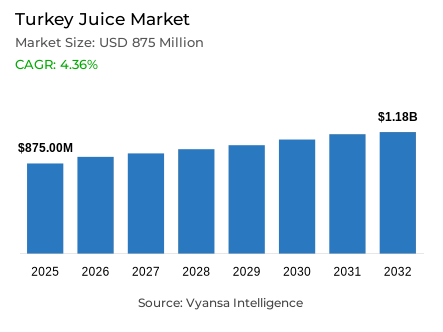
- Juice market size in Turkey was estimated at USD 875 million in 2025.
- The market size is expected to grow to USD 1.18 billion by 2032.
- Market to register a CAGR of around 4.36% during 2026-32.
- Category Shares
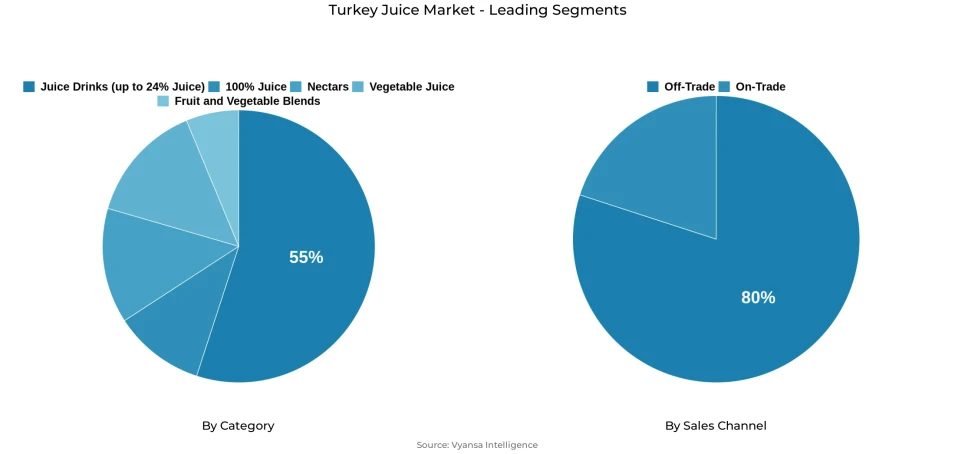
- Juice drinks (up to 24% juice) grabbed market share of 55%.
- Competition
- More than 15 companies are actively engaged in producing juice in Turkey.
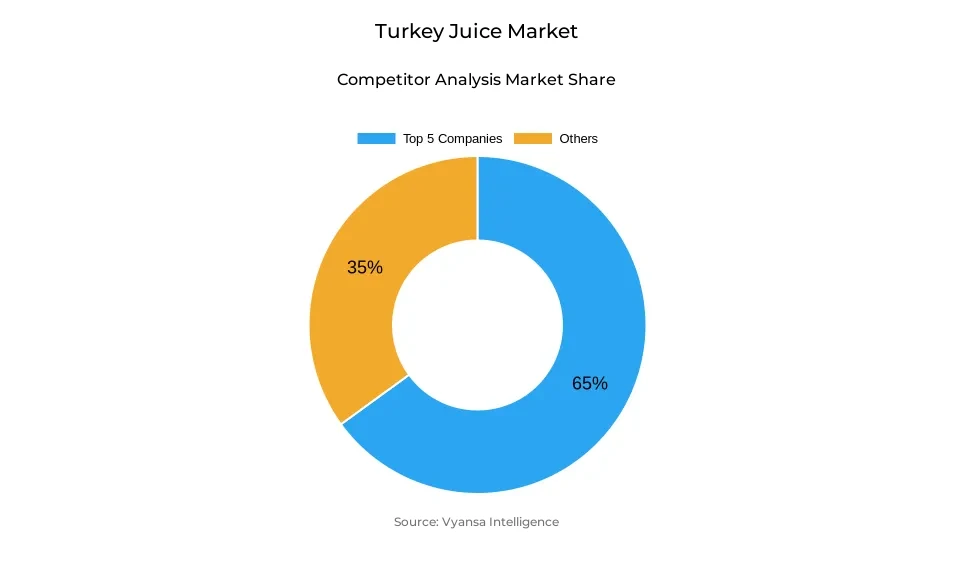
- Top 5 companies acquired around 65% of the market share.
- Capri Sun Group Holding AG, Yildiz Holding AS, Pinar Süt Mamülleri San ve Tic AS, Coca-Cola Içecek AS, Dimes Gida San ve Ticaret AS etc., are few of the top companies.
- Sales Channel
- Off-trade grabbed 80% of the market.
Turkey Juice Market Outlook
The Turkey juice market is experiencing a dynamic shift with consumers striking a balance between the growing desire to be health-conscious and premiumise and affordability. The market is estimated to be USD 875 million in 2025 and is expected to increase to USD 1.18 billion in 2032 with a compound annual growth rate (CAGR) of about 4.36% in the 2026-32 period. This consistent growth is driven by the increase in disposable incomes which are shifting the demand towards high-fruit-content and functional drinks.
The industry is characterized by a two-track trend. On the one hand, 100% juice continues to be a value-creating powerhouse, appealing to high-income families with not-from-concentrate (NFC) and organic-certified products. Conversely, price-sensitive consumers are attracted to juice drinks with innovative refreshing flavours like hibiscus and ginger at reduced unit prices. Meanwhile, the traditional nectar segment is losing its ground because of poorer health perceptions and growing competition on both the value and premium ends of the spectrum.
The future development will be more dependent on health and functionality factors. Manufacturers are putting a lot of money into formulations that do not just provide hydration but also include added vitamins, minerals, antioxidants, and probiotics. These are value-added juices that are aimed at younger generations who want to use them as skin-enhancing or immune-boosting products. Also, the trend towards sustainable production, such as automation, water recycling, and organic sourcing of agriculture, is turning into a competitive requirement of brands that want to be in line with global environmental standards.
The sales channel is also becoming modern, with off-trade channels taking 80% of the market. Supermarkets and discounters are at the forefront of this change, using their national presence and strong portfolios of their own-labeled products to attract price-sensitive consumers. Although Coca-Cola İçecek AS is the market leader, local brands like Dimes and Uludağ are making a lot of headway by exploiting local taste and the emerging consumerism trend of patronising local businesses.
Turkey Juice Market Growth DriverHealth-Led Premiumisation Lifts 100% Juice
Juice is becoming a better option among health-conscious consumers who are moving towards 100% juice that is being promoted as natural and additive-free. Premium, not-from-concentrate and organic-certified lines are on the rise, which means that wellness signals and product differentiation are now as important as price factors in the buying decision.
This change is facilitated by a wider movement towards certified, high-quality inputs. According to the Ministry of Agriculture and Forestry, in 2024, organic plant production was 1,301,248 tons and organic farming area was 241,490 hectares, and 36,412 producers were active. The same update shows that the total organic support payments amounted to 100.9 million Turkey lira in 2025, which will help to expand the range of organic-certified ingredients to premium juice lines.
Turkey Juice Market ChallengeInflation Squeezes Mid-Tier Nectars
Nectars are in a middle ground between low-cost juice beverages and high-end 100% juice, but they have problems because customers doubt their healthiness at the same time as they view them as costly compared to their product. Poorer health perceptions, high prices, and poor marketing support are some of the major factors that have led to the diminishing market momentum of nectar.
This difficulty is magnified by wider inflation in retail budgets. The Presidency of Strategy and Budget of Türkiye reported that consumer inflation in the country was 30.89% in December 2025, with food and non-alcoholic beverages increasing by 1.99% in the same month. As household expenditure rises at this pace, shoppers switch to less expensive, highly advertised products, thus forcing mid-end nectars to squeeze and brands to lose the capacity to charge a price premium or invest in long-term communication.
Unlock Market Intelligence
Explore the market potential with our data-driven report
Turkey Juice Market TrendSustainable, Efficient Production Becomes Standard
To lower costs and improve environmental performance, manufacturers are linking juice innovation to cleaner operations, focusing on automation, use of renewable energy, and better water management. The increased attention to renewable energy, water recycling, composting, biogas, and packaging recycling is noticeable, as well as the transition to organic practices and sustainable certification in sourcing.
The feasibility of this operational change is explained by national energy indicators. According to the Ministry of Energy and Natural Resources of Türkiye, as of October 2025, installed power capacity was 122,519 megawatts, of which 24,709 megawatts was wind and 19,550 megawatts was solar. As renewables already make up a significant portion of the grid, manufacturers can more effectively incorporate renewable electricity into factories and cold chains, which strengthens sustainability as a structural industry trend instead of a niche project.
Turkey Juice Market OpportunityFunctional Fortification Drives Trade-Up
Juice brands can create significant value by combining recognizable fruit profiles with functional value, such as added vitamins, minerals, antioxidants, and probiotics. Consumers are demanding high-quality, not-from-concentrate products and reacting to flavour innovation, thus providing a platform to product lines that explicitly convey particular wellness results.
The statistics of public health show why such a positioning can be effective. According to a World Health Organization Europe release on the 2023 Türkiye STEPS survey, 87.9% of adults eat less than five portions of fruits and vegetables daily, and the prevalence of obesity is 25.4%. In this context, functional juice beverages where sugar and ingredient decisions are transparent and where targeted fortification is used can appeal to health-conscious consumers who do not need to switch to pharmaceutical-like solutions.
Unlock Market Intelligence
Explore the market potential with our data-driven report
Turkey Juice Market Segmentation Analysis
By Category
- 100% Juice
- Not from Concentrate
- Reconstituted
- Juice Drinks (up to 24% Juice)
- Nectars
- High Concentration (40% to 50% fruit content)
- Medium Concentration (30% to 39% fruit content)
- Low Concentration (25% to 29% fruit content)
- Vegetable Juice
- Fruit and Vegetable Blends
The highest share in the category in the Turkey juice market is occupied by juice drinks (up to 24% juice content), which have a market share of 55%. The dominance of this segment can be largely explained by its aggressive pricing and high levels of marketing support. Juice drinks have become the main option of low-income households, especially at the peak of seasons like the hot summer of 2025 when lemonade-like beverages saw a massive boost.
In addition to price factors, the 55% share is maintained through speedy flavour innovation. To keep categories fresh and interesting to younger consumers, manufacturers are adding exotic and locally inspired ingredients, including hibiscus and ginger. This mass market is the point of entry of the majority of shoppers, and it offers a dependable foundation to the industry, while high-end segments like 100% juice aim to create value by targeting health-conscious wealthy groups.
By Sales Channel
- Off-Trade
- Hypermarkets/ Supermarkets
- Retail Outlets
- Convenience Stores
- Online Platforms
- On-Trade
Off-trade is the most share-intensive segment of the sales channel, which occupies 80% of the market. This high concentration indicates that Turkey consumers prefer to buy beverages in modern retail outlets, such as supermarkets and discounters. These channels have increased their national presence, leveraging strategic in-store merchandising and intensive promotional efforts to make juice a household item in the weekly grocery list.
Among this 80% share, the most dynamic sub-channel has been discounters. Their emphasis on low prices and quality of their own-label products has appealed to shoppers who want value without sacrificing taste. With retail e-commerce also starting to show uplift through home-delivery services, the off-trade market will continue to dominate by offering the most convenient and affordable access to a wide variety of juice products in Turkey.
List of Companies Covered in Turkey Juice Market
The companies listed below are highly influential in the Turkey juice market, with a significant market share and a strong impact on industry developments.
- Capri Sun Group Holding AG
- Yildiz Holding AS
- Pinar Süt Mamülleri San ve Tic AS
- Coca-Cola Içecek AS
- Dimes Gida San ve Ticaret AS
- Erbak-Uludag Mesrubatlari AS
- BIM Birlesik Magazacilik AS
- Tamek Gida ve Konsantre Sanayi AS
- Doganay Gida Tarim ve Hayvancilik San Tic AS
- Exotic Gida San ve Tic AS
Competitive Landscape
Turkey juice market is led by Coca-Cola İçecek through Cappy, which maintains overall leadership but is losing share amid boycott effects and intensifying competition from domestic players. Dimes Gıda is the fastest-growing competitor, strengthening its position across 100% juice, juice drinks and nectars through quality positioning, rapid fruit processing and broader portfolio coverage, while Uludağ is gaining traction in lemonade-style juice drinks via strong brand visibility and flavour-led innovation. Structurally, competition is bifurcated: premium 100% not-from-concentrate and organic lines target affluent, health-conscious consumers, whereas affordable juice drinks drive volume through price and marketing support; nectars are squeezed in the middle with weak differentiation. Key opportunities lie in functional fortification, exotic and local flavour blends, sustainable production credentials, and private label partnerships within fast-growing discounter channels.
Frequently Asked Questions
Related Report
- Market Segmentation
- Research Scope
- Research Methodology
- Definitions and Assumptions
- Executive Summary
- Turkey Juice Market Policies, Regulations, and Standards
- Turkey Juice Market Dynamics
- Growth Factors
- Challenges
- Trends
- Opportunities
- Turkey Juice Market Statistics, 2022-2032F
- Market Size & Growth Outlook
- By Revenues in USD Million
- By Quantity Sold in Million Litres
- Market Segmentation & Growth Outlook
- By Category
- 100% Juice- Market Insights and Forecast 2022-2032, USD Million
- Not from Concentrate- Market Insights and Forecast 2022-2032, USD Million
- Reconstituted- Market Insights and Forecast 2022-2032, USD Million
- Juice Drinks (up to 24% Juice)- Market Insights and Forecast 2022-2032, USD Million
- Nectars- Market Insights and Forecast 2022-2032, USD Million
- High Concentration (40% to 50% fruit content)- Market Insights and Forecast 2022-2032, USD Million
- Medium Concentration (30% to 39% fruit content)- Market Insights and Forecast 2022-2032, USD Million
- Low Concentration (25% to 29% fruit content)- Market Insights and Forecast 2022-2032, USD Million
- Vegetable Juice- Market Insights and Forecast 2022-2032, USD Million
- Fruit and Vegetable Blends- Market Insights and Forecast 2022-2032, USD Million
- 100% Juice- Market Insights and Forecast 2022-2032, USD Million
- By Nature
- Conventional- Market Insights and Forecast 2022-2032, USD Million
- Organic- Market Insights and Forecast 2022-2032, USD Million
- By Packaging Material
- Plastic- Market Insights and Forecast 2022-2032, USD Million
- Glass- Market Insights and Forecast 2022-2032, USD Million
- Metal- Market Insights and Forecast 2022-2032, USD Million
- Others- Market Insights and Forecast 2022-2032, USD Million
- By Packaging Type
- PET Bottles- Market Insights and Forecast 2022-2032, USD Million
- Aseptic Packages (Cartons)- Market Insights and Forecast 2022-2032, USD Million
- Glass Bottles- Market Insights and Forecast 2022-2032, USD Million
- Metal Cans- Market Insights and Forecast 2022-2032, USD Million
- Disposable Cups & Pouches- Market Insights and Forecast 2022-2032, USD Million
- By Sales Channel
- Off-Trade- Market Insights and Forecast 2022-2032, USD Million
- Hypermarkets/ Supermarkets - Market Insights and Forecast 2022-2032, USD Million
- Retail Outlets - Market Insights and Forecast 2022-2032, USD Million
- Convenience Stores- Market Insights and Forecast 2022-2032, USD Million
- Online Platforms- Market Insights and Forecast 2022-2032, USD Million
- On-Trade- Market Insights and Forecast 2022-2032, USD Million
- Off-Trade- Market Insights and Forecast 2022-2032, USD Million
- By Competitors
- Competition Characteristics
- Market Share & Analysis
- By Category
- Market Size & Growth Outlook
- Turkey 100% Juice Market Statistics, 2022-2032
- Market Size & Growth Outlook
- By Revenues in USD Million
- By Quantity Sold in Million Litres
- Market Segmentation & Growth Outlook
- By Nature- Market Insights and Forecast 2022-2032, USD Million
- By Packaging Material- Market Insights and Forecast 2022-2032, USD Million
- By Packaging Type- Market Insights and Forecast 2022-2032, USD Million
- By Sales Channel- Market Insights and Forecast 2022-2032, USD Million
- Market Size & Growth Outlook
- Turkey Juice Drinks (up to 24% Juice) Market Statistics, 2022-2032
- Market Size & Growth Outlook
- By Revenues in USD Million
- By Quantity Sold in Million Litres
- Market Segmentation & Growth Outlook
- By Nature- Market Insights and Forecast 2022-2032, USD Million
- By Packaging Material- Market Insights and Forecast 2022-2032, USD Million
- By Packaging Type- Market Insights and Forecast 2022-2032, USD Million
- By Sales Channel- Market Insights and Forecast 2022-2032, USD Million
- Market Size & Growth Outlook
- Turkey Nectars Market Statistics, 2022-2032
- Market Size & Growth Outlook
- By Revenues in USD Million
- By Quantity Sold in Million Litres
- Market Segmentation & Growth Outlook
- By Nature- Market Insights and Forecast 2022-2032, USD Million
- By Packaging Material- Market Insights and Forecast 2022-2032, USD Million
- By Packaging Type- Market Insights and Forecast 2022-2032, USD Million
- By Sales Channel- Market Insights and Forecast 2022-2032, USD Million
- Market Size & Growth Outlook
- Turkey Vegetable Juice Market Statistics, 2022-2032
- Market Size & Growth Outlook
- By Revenues in USD Million
- By Quantity Sold in Million Litres
- Market Segmentation & Growth Outlook
- By Nature- Market Insights and Forecast 2022-2032, USD Million
- By Packaging Material- Market Insights and Forecast 2022-2032, USD Million
- By Packaging Type- Market Insights and Forecast 2022-2032, USD Million
- By Sales Channel- Market Insights and Forecast 2022-2032, USD Million
- Market Size & Growth Outlook
- Turkey Fruit and Vegetable Blends Market Statistics, 2022-2032
- Market Size & Growth Outlook
- By Revenues in USD Million
- By Quantity Sold in Million Litres
- Market Segmentation & Growth Outlook
- By Nature- Market Insights and Forecast 2022-2032, USD Million
- By Packaging Material- Market Insights and Forecast 2022-2032, USD Million
- By Packaging Type- Market Insights and Forecast 2022-2032, USD Million
- By Sales Channel- Market Insights and Forecast 2022-2032, USD Million
- Market Size & Growth Outlook
- Competitive Outlook
- Company Profiles
- Coca-Cola Içecek AS
- Business Description
- Product Portfolio
- Collaborations & Alliances
- Recent Developments
- Financial Details
- Others
- Dimes Gida San ve Ticaret AS
- Business Description
- Product Portfolio
- Collaborations & Alliances
- Recent Developments
- Financial Details
- Others
- Erbak-Uludag Mesrubatlari AS
- Business Description
- Product Portfolio
- Collaborations & Alliances
- Recent Developments
- Financial Details
- Others
- BIM Birlesik Magazacilik AS
- Business Description
- Product Portfolio
- Collaborations & Alliances
- Recent Developments
- Financial Details
- Others
- Tamek Gida ve Konsantre Sanayi AS
- Business Description
- Product Portfolio
- Collaborations & Alliances
- Recent Developments
- Financial Details
- Others
- Capri Sun Group Holding AG
- Business Description
- Product Portfolio
- Collaborations & Alliances
- Recent Developments
- Financial Details
- Others
- Yildiz Holding AS
- Business Description
- Product Portfolio
- Collaborations & Alliances
- Recent Developments
- Financial Details
- Others
- Pinar Süt Mamülleri San ve Tic AS
- Business Description
- Product Portfolio
- Collaborations & Alliances
- Recent Developments
- Financial Details
- Others
- Doganay Gida Tarim ve Hayvancilik San Tic AS
- Business Description
- Product Portfolio
- Collaborations & Alliances
- Recent Developments
- Financial Details
- Others
- Exotic Gida San ve Tic AS
- Business Description
- Product Portfolio
- Collaborations & Alliances
- Recent Developments
- Financial Details
- Others
- Coca-Cola Içecek AS
- Company Profiles
- Disclaimer
| Segment | Sub-Segment |
|---|---|
| By Category |
|
| By Nature |
|
| By Packaging Material |
|
| By Packaging Type |
|
| By Sales Channel |
|
Research Methodology
This study followed a structured approach comprising four key phases to assess the size and scope of the electro-oxidation market. The process began with thorough secondary research to collect data on the target market, related markets, and broader industry context. These findings, along with preliminary assumptions and estimates, were then validated through extensive primary research involving industry experts from across the value chain. To calculate the overall market size, both top-down and bottom-up methodologies were employed. Finally, market segmentation and data triangulation techniques were applied to refine and validate segment-level estimations.
Secondary Research
The secondary research phase involved gathering data from a wide range of credible and published sources. This step helped in identifying industry trends, defining market segmentation, and understanding the market landscape and value chain.
Sources consulted during this phase included:
- Company annual reports, investor presentations, and press releases
- Industry white papers and certified publications
- Trade directories and market-recognized databases
- Articles from authoritative authors and reputable journals
- Gold and silver standard websites
Secondary research was critical in mapping out the industry's value chain and monetary flow, identifying key market segments, understanding regional variations, and tracking significant industry developments.
Other key sources:
- Financial disclosures
- Industry associations and trade bodies
- News outlets and business magazines
- Academic journals and research studies
- Paid industry databases
Primary Research
To validate secondary data and gain deeper market insights, primary research was conducted with key stakeholders across both the supply and demand sides of the market.
On the demand side, participants included decision-makers and influencers from end-user industries—such as CIOs, CTOs, and CSOs—who provided first-hand perspectives on market needs, product usage, and future expectations.
On the supply side, interviews were conducted with manufacturers, industry associations, and institutional participants to gather insights into current offerings, product pipelines, and market challenges.
Primary interviews provided critical inputs such as:
- Market size and revenue data
- Product and service breakdowns
- Market forecasts
- Regional and application-specific trends
Stakeholders consulted included:
- Leading OEM and solution providers
- Channel and distribution partners
- End users across various applications
- Independent consultants and industry specialists
Market Size Estimation and Data Triangulation
- Identifying Key Market Participants (Secondary Research)
- Goal: To identify the major players or companies in the target market. This typically involves using publicly available data sources such as industry reports, market research publications, and financial statements of companies.
- Tools: Reports from firms like Gartner, Forrester, Euromonitor, Statista, IBISWorld, and others. Public financial statements, news articles, and press releases from top market players.
- Extracting Earnings of Key Market Participants
- Goal: To estimate the earnings generated from the product or service being analyzed. This step helps in understanding the revenue potential of each market player in a specific geography.
- Methods: Earnings data can be gathered from:
- Publicly available financial reports (for listed companies).
- Interviews and primary data sources from professionals, such as Directors, VPs, SVPs, etc. This is especially useful for understanding more nuanced, internal data that isn't publicly disclosed.
- Annual reports and investor presentations of key players.
- Data Collation and Development of a Relevant Data Model
- Goal: To collate inputs from both primary and secondary sources into a structured, data-driven model for market estimation. This model will incorporate key market KPIs and any independent variables relevant to the market.
- Key KPIs: These could include:
- Market size, growth rate, and demand drivers.
- Industry-specific metrics like market share, average revenue per customer (ARPC), or average deal size.
- External variables, such as economic growth rates, inflation rates, or commodity prices, that could affect the market.
- Data Modeling: Based on this data, the market forecasts are developed for the next 5 years. A combination of trend analysis, scenario modeling, and statistical regression might be used to generate projections.
- Scenario Analysis
- Goal: To test different assumptions and validate how sensitive the market is to changes in key variables (e.g., market demand, regulatory changes, technological disruptions).
- Types of Scenarios:
- Base Case: Based on current assumptions and historical data.
- Best-Case Scenario: Assuming favorable market conditions, regulatory environments, and technological advancements.
- Worst-Case Scenario: Accounting for adverse factors, such as economic downturns, stricter regulations, or unexpected disruptions.












