US Iris Recognition Market Report: Trends, Growth and Forecast (2026-2032)
By Component (Hardware, Software), By Product Type (Iris Scanners, Access Control & Time Attendance Terminals, Border Control Kiosks/eGates, Smartphones, Embedded/OEM Iris Modules, Others), By Application (Identity Management & Access Control, Border Control & Immigration, Time Monitoring, E-Payment, Others), By End Use (Government, Military & Defense, BFSI, Healthcare, Consumer Electronics, Travel & Immigration, Automotive, Others), By Region (West, Midwest, South, North, Northeast) ... Read more
|
Major Players
|
The US Iris Recognition Market Statistics and Insights, 2026
- Market Size Statistics
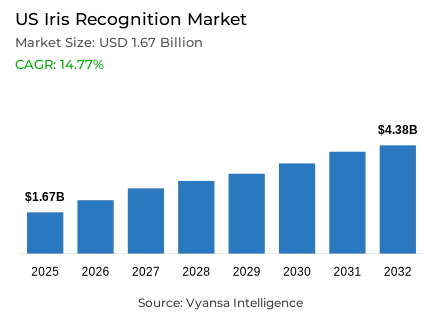
- Iris recognition market size in The US was valued at USD 1.67 billion in 2025 and is estimated at USD 1.73 billion in 2026.
- The market size is expected to grow to USD 4.38 billion by 2032.
- Market to register a CAGR of around 14.77% during 2026-32.
- Application Shares
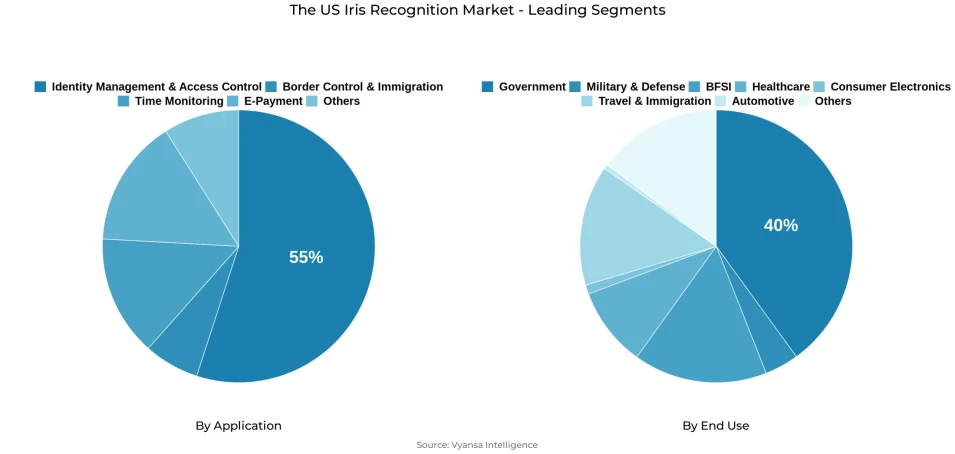
- Identity management & access control grabbed market share of 55%.
- Competition
- Iris recognition in The US is currently being catered to by more than 10 companies.
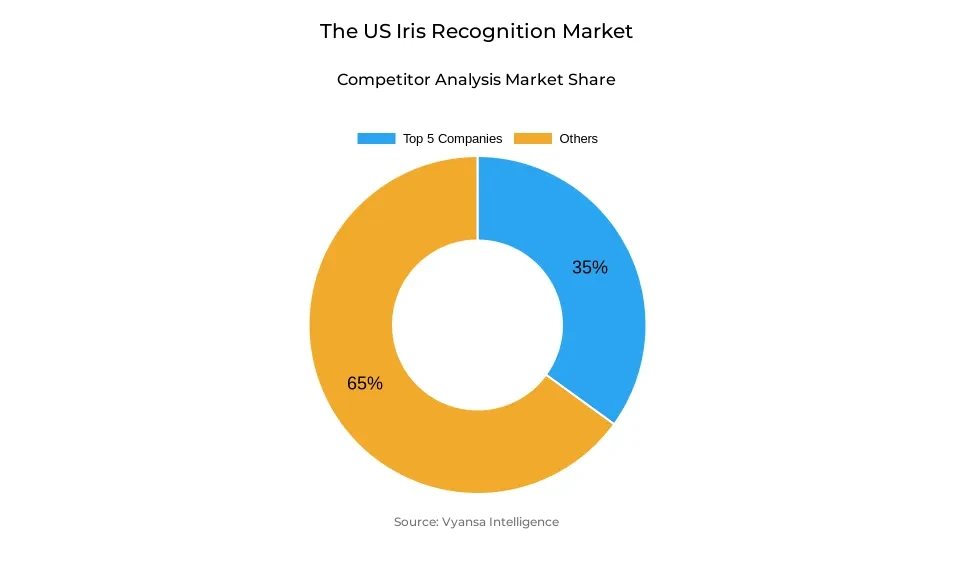
- Top 5 companies acquired around 35% of the market share in 2026.
- Princeton Identity Inc., Aware Inc., IriTech Inc., IDEMIA Identity & Security USA LLC, NEC Corporation of America etc., are few of the top companies.
- End Use
- Government grabbed 40% of the market.
The US Iris Recognition Market Outlook
The US iris recognition market covers hardware, software, embedded modules, terminals, eGates, and matching platforms used for biometric identity verification across government, defense, BFSI, healthcare, travel, and enterprise security. The US iris recognition market was valued at USD 1.67 billion in 2025 and reaches USD 1.73 billion in 2026, advancing toward USD 4.38 billion by 2032 at a CAGR of 14.77%. The US iris recognition industry is becoming a high-assurance layer within digital identity verification and critical access ecosystems across federal and commercial security domains.
Operational demand is supported by public safety databases, secure facility authentication, and contactless biometric authentication. The US iris recognition market benefits from NIST’s IREX 10 program, which remains open and allows developers to submit iris matching software at any time, while flagship deployments support prison management, border security, duplicate detection, and expedited processing. The US iris recognition industry therefore gains procurement confidence from independent algorithm evaluation and standards visibility for standardized deployment.
Economic impact is strongest where identity errors create security, compliance, or workflow costs. The US iris recognition market supports faster enrollment, lower credential sharing, and stronger authentication for agencies and high-security enterprises. The US iris recognition industry also strengthens supplier positioning for iris scanners, biometric authentication software, multimodal biometrics, and managed identity platforms because buyers increasingly evaluate accuracy, interoperability, liveness protection, and privacy controls before deployment.
Contactless identity infrastructure is moving from isolated pilots toward integrated procurement across access control, criminal justice, travel security, and enterprise access control. The US iris recognition market is shaped by suppliers that can combine AI-based iris recognition, edge capture devices, cloud-managed enrollment, and biometric privacy compliance. The US iris recognition industry in 2026 is positioned around operational reliability, policy-fit deployment, and faster authentication across controlled environments, especially where identity risk carries regulatory exposure.
The US Iris Recognition Market Growth Driver
Secure Identity Mandates Expand Adoption
High-assurance identity verification is accelerating adoption where passwords, cards, and manual checks no longer satisfy security or throughput requirements. The US iris recognition market gains traction in identity management and access control because iris patterns enable contactless verification, stable biometric matching, and low-friction authentication in sensitive locations. Demand is strongest in environments requiring rapid identity proofing, biometric access management, and auditable user authentication without increasing checkpoint congestion.
Recent FBI NGI data indicates that April 2026 biometric counts included 6,725,305 iris records, with 4,869,340 unique UCNs in the matcher. This operational repository supports law enforcement biometrics and strengthens the US iris recognition industry by showing sustained institutional use, creating downstream demand for compliant capture devices, enrollment workflows, image-quality controls, and iris matching algorithms across criminal justice agencies and public safety networks across the country at scale, with lower operational friction overall.
The US Iris Recognition Market Challenge
Privacy Rules Raise Deployment Complexity
Biometric privacy compliance remains a major constraint because iris scan data is treated as sensitive personal information across several state-level frameworks. The US iris recognition market faces longer sales cycles when buyers require written notices, consent workflows, retention policies, encryption standards, and vendor liability reviews before commercial deployment. These requirements increase implementation cost for iris access control systems and biometric identity verification platforms, particularly across multi-state enterprise and healthcare environments.
Illinois legislation in 2025 proposed changes to BIPA definitions and security-purpose exemptions while continuing to reference retina or iris scans as biometric identifiers. This regulatory activity affects deployment by requiring suppliers to design consent, deletion, template-protection, and audit capabilities into products, narrowing participation for vendors that cannot support privacy-by-design procurement standards or evidence retention requirements while preserving a consistent enrollment layer. This favors suppliers with legal, technical, and systems-integration support embedded into every implementation and post-deployment audit readiness during procurements.
Unlock Market Intelligence
Explore the market potential with our data-driven report
The US Iris Recognition Market Trend
Multimodal Platforms Redefine Authentication
Iris and face fusion is reshaping product design as buyers seek higher assurance without slowing user movement. The US iris recognition market is shifting toward multimodal biometric terminals that combine iris scan authentication, facial recognition, cards, mobile credentials, PINs, and QR codes. This trend supports secure facility authentication because operators can adjust authentication strength by risk level, traffic flow, and compliance requirements while preserving a consistent enrollment layer.
Iris ID’s ISC West 2025 update stated that IrisAccess iA1000 uses dual iris and face cameras, AES 256-bit encryption, Presentation Attack Defense, and capture distance of 30 to 60 cm. This product direction strengthens adoption by giving integrators a single device architecture for access control, public security, and time attendance workflows, reducing hardware fragmentation across mixed-security sites and reducing integrator training burdens across distributed deployments. It also supports phased migration from card-only access toward risk-tiered biometric authentication at enterprise scale programs securely.
The US Iris Recognition Market Opportunity
Airport and Enterprise Identity Networks Open New Routes
Airport biometric screening and workplace identity networks create underpenetrated expansion space for iris scanner vendors, software providers, and system integrators. The US iris recognition market can capture demand where trusted identity programs, staff access, visitor management, and secure worksite authentication require stronger assurance than badge-based systems. Digital identity verification at physical checkpoints also creates cross-selling potential for enrollment software, lifecycle management, and recurring support services across travel and enterprise estates with measurable identity assurance benefits.
CLEAR’s 2026 privacy policy lists biometric data including faceprints, fingerprints, iris scans, and digital images or video of eyes, fingers, and face. This signals continuing commercial infrastructure for biometric enrollment and identity verification, supporting operational uptake for vendors that can meet consent, data governance, and high-throughput authentication expectations in public-facing access environments where speed and consent management must operate together across multiple locations. This favors integrators that bundle deployment, consent, and support services nationally efficiently.
Unlock Market Intelligence
Explore the market potential with our data-driven report
The US Iris Recognition Market Segmentation Analysis
By Application
- Identity Management & Access Control
- Border Control & Immigration
- Time Monitoring
- E-Payment
- Others
Identity Management & Access Control holds 55% share under By Application because buyers prioritize secure entry, employee authentication, facility protection, and credential replacement before lower-frequency use cases. The US iris recognition market benefits from this concentration because access control creates repeatable demand for readers, matching software, enrollment stations, maintenance contracts, and integration with physical identity systems. High-security offices, data centers, public buildings, hospitals, and laboratories prefer contactless biometric verification when accuracy and auditability are critical.
Princeton Identity lists Access200w for outdoor iris and facial recognition with card, mobile, PIN, QR, and configurable MFA, while Access550 supports passport-scanner integration for border control. These product capabilities support segment leadership by expanding deployment flexibility across secure building access, time attendance, point-of-sale identity checks, and traveler identity verification, improving supplier relevance across both fixed and high-volume checkpoints without requiring separate device families for every deployment setting. This improves replacement cycles and integration stickiness for suppliers.
By End Use
- Government
- Military & Defense
- BFSI
- Healthcare
- Consumer Electronics
- Travel & Immigration
- Automotive
- Others
Government holds 40% share under By End Use because criminal justice, public safety, immigration, defense, and secure facility operations require high-assurance identity systems with documented performance and controlled data handling. The US iris recognition industry benefits from public-sector procurement because agencies value contactless identification, interoperability, evidence-grade enrollment, and standards-linked system performance. Government demand also influences vendor roadmaps for certified capture, matching speed, encryption, audit trails, and multimodal biometric authentication.
FBI BioSpecs describes NGI Iris Services as a fast, accurate, contactless biometric identification option for law enforcement and criminal justice users using an iris image repository within NGI. This operational role reinforces government leadership by tying iris recognition technology directly to public safety workflows, repository searching, and agency-grade identification infrastructure, strengthening recurring demand for compliant systems, software upgrades, image-quality testing, and lifecycle support services. This keeps procurement oriented toward proven, interoperable platforms rather than standalone authentication tools for mission environments nationally.
List of Companies Covered in The US Iris Recognition Market
The companies listed below are highly influential in the The US iris recognition market, with a significant market share and a strong impact on industry developments.
- Princeton Identity Inc.
- Aware Inc.
- IriTech Inc.
- IDEMIA Identity & Security USA LLC
- NEC Corporation of America
- Iris ID Systems Inc.
- THALES DIS USA INC.
- HID Global Corporation
- Tascent Inc.
- M2SYS Technology
Market News & Updates
- IDEMIA Identity & Security USA LLC, 2025:
IDEMIA Public Security North America showcased OneLook Gen2 at Identity Week America in Washington, DC. The multi-biometric solution offers at-distance face and iris capture in less than two seconds for traveler and access-management workflows. The update supports U.S. border, airport, and secure-facility programs that need faster high-assurance identity capture.
- IriTech Inc., 2025:
IriTech launched IriAegis-BK from Fairfax, Virginia as a binocular iris scanner for large-scale identity programs. The device adds simultaneous dual-eye iris capture in under three seconds, advanced liveness detection, SDK compatibility, and field-ready hardware design. The launch supports U.S. government, border, voter registration, and enterprise identity verification deployments.
Frequently Asked Questions
Related Report
- Market Segmentation
- Research Scope
- Research Methodology
- Definitions and Assumptions
- Executive Summary
- The US Iris Recognition Market Policies, Regulations, and Standards
- The US Iris Recognition Market Dynamics
- Growth Factors
- Challenges
- Trends
- Opportunities
- The US Iris Recognition Market Statistics, 2022-2032F
- Market Size & Growth Outlook
- By Revenues in USD Million
- Market Segmentation & Growth Outlook
- By Component
- Hardware- Market Insights and Forecast 2022-2032, USD Million
- Software- Market Insights and Forecast 2022-2032, USD Million
- By Product Type
- Iris Scanners- Market Insights and Forecast 2022-2032, USD Million
- Access Control & Time Attendance Terminals- Market Insights and Forecast 2022-2032, USD Million
- Border Control Kiosks/eGates- Market Insights and Forecast 2022-2032, USD Million
- Smartphones- Market Insights and Forecast 2022-2032, USD Million
- Embedded/OEM Iris Modules- Market Insights and Forecast 2022-2032, USD Million
- Others- Market Insights and Forecast 2022-2032, USD Million
- By Application
- Identity Management & Access Control- Market Insights and Forecast 2022-2032, USD Million
- Border Control & Immigration- Market Insights and Forecast 2022-2032, USD Million
- Time Monitoring- Market Insights and Forecast 2022-2032, USD Million
- E-Payment- Market Insights and Forecast 2022-2032, USD Million
- Others- Market Insights and Forecast 2022-2032, USD Million
- By End Use
- Government- Market Insights and Forecast 2022-2032, USD Million
- Military & Defense- Market Insights and Forecast 2022-2032, USD Million
- BFSI- Market Insights and Forecast 2022-2032, USD Million
- Healthcare- Market Insights and Forecast 2022-2032, USD Million
- Consumer Electronics- Market Insights and Forecast 2022-2032, USD Million
- Travel & Immigration- Market Insights and Forecast 2022-2032, USD Million
- Automotive- Market Insights and Forecast 2022-2032, USD Million
- Others- Market Insights and Forecast 2022-2032, USD Million
- By Region
- West- Market Insights and Forecast 2022-2032, USD Million
- Midwest- Market Insights and Forecast 2022-2032, USD Million
- South- Market Insights and Forecast 2022-2032, USD Million
- North- Market Insights and Forecast 2022-2032, USD Million
- Northeast- Market Insights and Forecast 2022-2032, USD Million
- By Competitors
- Competition Characteristics
- Market Share & Analysis
- By Component
- Market Size & Growth Outlook
- The US Identity Management & Access Control Market Statistics, 2022-2032
- Market Size & Growth Outlook
- By Revenues in USD Million
- Market Segmentation & Growth Outlook
- By Product Type- Market Insights and Forecast 2022-2032, USD Million
- By Application- Market Insights and Forecast 2022-2032, USD Million
- By End Use- Market Insights and Forecast 2022-2032, USD Million
- By Region- Market Insights and Forecast 2022-2032, USD Million
- Market Size & Growth Outlook
- The US Border Control & Immigration Market Statistics, 2022-2032
- Market Size & Growth Outlook
- By Revenues in USD Million
- Market Segmentation & Growth Outlook
- By Product Type- Market Insights and Forecast 2022-2032, USD Million
- By Application- Market Insights and Forecast 2022-2032, USD Million
- By End Use- Market Insights and Forecast 2022-2032, USD Million
- By Region- Market Insights and Forecast 2022-2032, USD Million
- Market Size & Growth Outlook
- The US Time Monitoring Market Statistics, 2022-2032
- Market Size & Growth Outlook
- By Revenues in USD Million
- Market Segmentation & Growth Outlook
- By Product Type- Market Insights and Forecast 2022-2032, USD Million
- By Application- Market Insights and Forecast 2022-2032, USD Million
- By End Use- Market Insights and Forecast 2022-2032, USD Million
- By Region- Market Insights and Forecast 2022-2032, USD Million
- Market Size & Growth Outlook
- The US E-Payment Market Statistics, 2022-2032
- Market Size & Growth Outlook
- By Revenues in USD Million
- Market Segmentation & Growth Outlook
- By Product Type- Market Insights and Forecast 2022-2032, USD Million
- By Application- Market Insights and Forecast 2022-2032, USD Million
- By End Use- Market Insights and Forecast 2022-2032, USD Million
- By Region- Market Insights and Forecast 2022-2032, USD Million
- Market Size & Growth Outlook
- Competitive Outlook
- Company Profiles
- IDEMIA Identity & Security USA LLC
- Business Description
- Product Portfolio
- Collaborations & Alliances
- Recent Developments
- Financial Details
- Others
- NEC Corporation of America
- Business Description
- Product Portfolio
- Collaborations & Alliances
- Recent Developments
- Financial Details
- Others
- Iris ID Systems Inc.
- Business Description
- Product Portfolio
- Collaborations & Alliances
- Recent Developments
- Financial Details
- Others
- THALES DIS USA INC.
- Business Description
- Product Portfolio
- Collaborations & Alliances
- Recent Developments
- Financial Details
- Others
- HID Global Corporation
- Business Description
- Product Portfolio
- Collaborations & Alliances
- Recent Developments
- Financial Details
- Others
- Princeton Identity Inc.
- Business Description
- Product Portfolio
- Collaborations & Alliances
- Recent Developments
- Financial Details
- Others
- Aware Inc.
- Business Description
- Product Portfolio
- Collaborations & Alliances
- Recent Developments
- Financial Details
- Others
- IriTech Inc.
- Business Description
- Product Portfolio
- Collaborations & Alliances
- Recent Developments
- Financial Details
- Others
- Tascent Inc.
- Business Description
- Product Portfolio
- Collaborations & Alliances
- Recent Developments
- Financial Details
- Others
- M2SYS Technology
- Business Description
- Product Portfolio
- Collaborations & Alliances
- Recent Developments
- Financial Details
- Others
- IDEMIA Identity & Security USA LLC
- Company Profiles
- Disclaimer
| Segment | Sub-Segment |
|---|---|
| By Component |
|
| By Product Type |
|
| By Application |
|
| By End Use |
|
| By Region |
|
Research Methodology
This study followed a structured approach comprising four key phases to assess the size and scope of the electro-oxidation market. The process began with thorough secondary research to collect data on the target market, related markets, and broader industry context. These findings, along with preliminary assumptions and estimates, were then validated through extensive primary research involving industry experts from across the value chain. To calculate the overall market size, both top-down and bottom-up methodologies were employed. Finally, market segmentation and data triangulation techniques were applied to refine and validate segment-level estimations.
Secondary Research
The secondary research phase involved gathering data from a wide range of credible and published sources. This step helped in identifying industry trends, defining market segmentation, and understanding the market landscape and value chain.
Sources consulted during this phase included:
- Company annual reports, investor presentations, and press releases
- Industry white papers and certified publications
- Trade directories and market-recognized databases
- Articles from authoritative authors and reputable journals
- Gold and silver standard websites
Secondary research was critical in mapping out the industry's value chain and monetary flow, identifying key market segments, understanding regional variations, and tracking significant industry developments.
Other key sources:
- Financial disclosures
- Industry associations and trade bodies
- News outlets and business magazines
- Academic journals and research studies
- Paid industry databases
Primary Research
To validate secondary data and gain deeper market insights, primary research was conducted with key stakeholders across both the supply and demand sides of the market.
On the demand side, participants included decision-makers and influencers from end-user industries—such as CIOs, CTOs, and CSOs—who provided first-hand perspectives on market needs, product usage, and future expectations.
On the supply side, interviews were conducted with manufacturers, industry associations, and institutional participants to gather insights into current offerings, product pipelines, and market challenges.
Primary interviews provided critical inputs such as:
- Market size and revenue data
- Product and service breakdowns
- Market forecasts
- Regional and application-specific trends
Stakeholders consulted included:
- Leading OEM and solution providers
- Channel and distribution partners
- End users across various applications
- Independent consultants and industry specialists
Market Size Estimation and Data Triangulation
- Identifying Key Market Participants (Secondary Research)
- Goal: To identify the major players or companies in the target market. This typically involves using publicly available data sources such as industry reports, market research publications, and financial statements of companies.
- Tools: Reports from firms like Gartner, Forrester, Euromonitor, Statista, IBISWorld, and others. Public financial statements, news articles, and press releases from top market players.
- Extracting Earnings of Key Market Participants
- Goal: To estimate the earnings generated from the product or service being analyzed. This step helps in understanding the revenue potential of each market player in a specific geography.
- Methods: Earnings data can be gathered from:
- Publicly available financial reports (for listed companies).
- Interviews and primary data sources from professionals, such as Directors, VPs, SVPs, etc. This is especially useful for understanding more nuanced, internal data that isn't publicly disclosed.
- Annual reports and investor presentations of key players.
- Data Collation and Development of a Relevant Data Model
- Goal: To collate inputs from both primary and secondary sources into a structured, data-driven model for market estimation. This model will incorporate key market KPIs and any independent variables relevant to the market.
- Key KPIs: These could include:
- Market size, growth rate, and demand drivers.
- Industry-specific metrics like market share, average revenue per customer (ARPC), or average deal size.
- External variables, such as economic growth rates, inflation rates, or commodity prices, that could affect the market.
- Data Modeling: Based on this data, the market forecasts are developed for the next 5 years. A combination of trend analysis, scenario modeling, and statistical regression might be used to generate projections.
- Scenario Analysis
- Goal: To test different assumptions and validate how sensitive the market is to changes in key variables (e.g., market demand, regulatory changes, technological disruptions).
- Types of Scenarios:
- Base Case: Based on current assumptions and historical data.
- Best-Case Scenario: Assuming favorable market conditions, regulatory environments, and technological advancements.
- Worst-Case Scenario: Accounting for adverse factors, such as economic downturns, stricter regulations, or unexpected disruptions.












