UAE Iris Recognition Market Report: Trends, Growth and Forecast (2026-2032)
By Component (Hardware, Software), By Product Type (Iris Scanners, Access Control & Time Attendance Terminals, Border Control Kiosks/eGates, Smartphones, Embedded/OEM Iris Modules, Others), By Application (Identity Management & Access Control, Border Control & Immigration, Time Monitoring, E-Payment, Others), By End Use (Government, Military & Defense, BFSI, Healthcare, Consumer Electronics, Travel & Immigration, Automotive, Others), By Region (Dubai, Abu Dhabi, Sharjah, Northern Emirates) ... Read more
|
Major Players
|
The UAE Iris Recognition Market Statistics and Insights, 2026
- Market Size Statistics
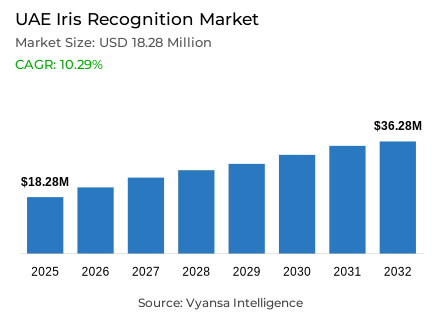
- Iris recognition market size in The UAE was valued at USD 18.28 million in 2025 and is estimated at USD 19.21 million in 2026.
- The market size is expected to grow to USD 36.28 million by 2032.
- Market to register a CAGR of around 10.29% during 2026-32.
- Application Shares
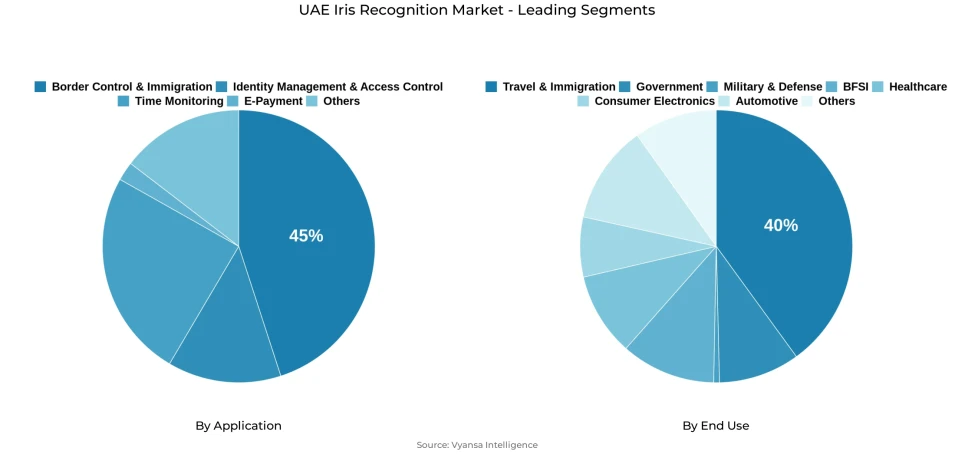
- Border control & immigration grabbed market share of 45%.
- Competition
- Iris recognition in The UAE is currently being catered to by more than 10 companies.
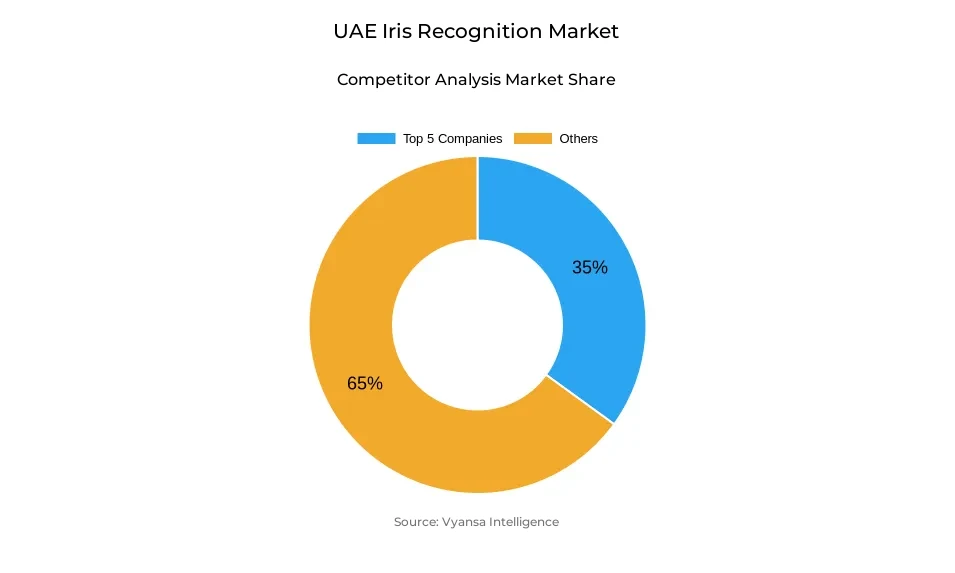
- Top 5 companies acquired around 35% of the market share in 2026.
- HANGZHOU HIKVISION DIGITAL TECHNOLOGY CO. LTD. (Hikvision), Thales S.A., CMITECH CO. LTD., IDEMIA Middle East FZE, Emarat Technology Solutions FZ LLC (emaratech) etc., are few of the top companies.
- End Use
- Travel & immigration grabbed 40% of the market.
The UAE Iris Recognition Market Outlook
The UAE iris recognition market covers iris scanners, biometric software, smart gates, access terminals, and identity verification systems used across immigration, government, defense, banking, healthcare, and enterprise security. It was valued at USD 18.28 million in 2025, reaches USD 19.21 million in 2026, and is projected at USD 36.28 million by 2032, growing at a CAGR of 10.29% during 2026-32. Border automation anchors demand, while the UAE iris recognition industry benefits from national digital identity modernization.
Airport and immigration infrastructure remain the strongest adoption catalysts for the UAE iris recognition market. Dubai Airports states that DXB handled 95.2 million guests in 2025, while GDRFA-linked smart gates allow registered travelers to complete passport control through contactless biometric processing. Abu Dhabi’s biometric Smart Travel project also integrates biometric authentication across security and operations touchpoints, reinforcing iris biometrics as part of wider passenger identity modernization across high-volume arrival and departure corridors.
Economic impact is visible through reduced manual processing, higher passenger throughput, stronger fraud prevention, and better compliance visibility across border and high-security environments. The UAE iris recognition industry supports procurement for sensors, cameras, matching algorithms, identity databases, and system integration services. As adoption expands, suppliers with proven border-control credentials gain stronger positioning, while local authorities improve operating resilience without proportionate expansion of inspection counters or manual staffing across primary national security checkpoints and control centers.
Supplier positioning in 2026 is shaped by airport expansion, smart-government authentication, and rising demand for contactless verification. The UAE iris recognition market is moving from standalone iris scanning toward multimodal systems combining iris, face, document, and database checks. The UAE iris recognition industry is therefore expected to prioritize interoperability, template security, anti-spoofing performance, and integration with government identity repositories, strengthening demand for platforms that can support high-volume verification at airports, ports, public facilities, and secure enterprises.
The UAE Iris Recognition Market Growth Driver
Airport Automation and Identity Assurance Accelerate Demand
High-volume passenger processing is accelerating demand for the UAE iris recognition market as airports, immigration counters, and airline touchpoints shift from manual document checks to automated biometric clearance. Border agencies need faster throughput without weakening identity assurance, and iris recognition supports this requirement because it offers stable, contactless matching for repeat travelers, residents, and security-screened passenger groups. The UAE iris recognition industry therefore gains demand from capacity pressure rather than discretionary technology upgrades.
Dubai Media Office reported that Emirates invested AED 85 million in 2025 to install more than 200 biometrics-enabled cameras across Terminal 3 at DXB, with GDRFAD collaboration allowing registered users to move through biometric zones and smart gates. This operational investment supports procurement for biometric cameras, matching software, enrollment workflows, and database-linked verification, strengthening supplier access to airport, immigration, and secure passenger-processing contracts. It also raises replacement demand for higher-accuracy iris-capable terminals across regulated passenger environments nationally.
The UAE Iris Recognition Market Challenge
Biometric Data Governance Raises Deployment Complexity
Biometric data governance is creating adoption friction for the UAE iris recognition market because iris templates require secure capture, storage, transmission, consent management, and access controls across government, aviation, and enterprise systems. Buyers must evaluate not only device accuracy but also encryption, database segregation, auditability, retention policies, and breach-response procedures. The UAE iris recognition industry therefore faces longer procurement cycles when systems touch sensitive identity repositories or interoperate with national databases.
The Official UAE Government Portal, updated in 2025, states that the Personal Data Protection Law sets controls for processing personal data and obligations for entities that hold such data. For iris deployments, this raises compliance requirements around biometric template protection, third-party processing, data residency, and vendor accountability, which can slow rollout schedules and increase implementation costs for airports, banks, healthcare facilities, and high-security premises. These controls favor experienced integrators with mature privacy and cybersecurity governance across strategic accounts nationally.
Unlock Market Intelligence
Explore the market potential with our data-driven report
The UAE Iris Recognition Market Trend
Multimodal Verification Becomes the New Deployment Standard
Multimodal identity orchestration is reshaping the UAE iris recognition market as airports and border operators combine iris, face, documents, watchlist checks, and passenger records into a single verification flow. Iris recognition is no longer procured only as a standalone scanner; it is increasingly evaluated as a high-assurance layer within automated border control, digital identity, and passenger facilitation platforms. The UAE iris recognition industry gains strategic value when iris matching strengthens broader biometric fusion.
Abu Dhabi Media Office stated in 2024 that the Biometric Smart Travel project at Zayed International Airport would integrate biometric authentication across all security and operations touchpoints, with service time reduced from 25 seconds to seven seconds. This shift strengthens adoption of interoperable biometric engines, smart gates, enrollment databases, and identity orchestration software that can support larger passenger flows with lower manual intervention. It also improves vendor differentiation in airport automation and national identity programs across UAE.
The UAE Iris Recognition Market Opportunity
Digital Identity Expansion Opens Higher-Assurance Use Cases
Digital identity extension creates a sizable adjacency for the UAE iris recognition market as high-assurance authentication moves beyond airports into e-government access, banking onboarding, healthcare identity, workforce authentication, and critical-facility entry. Iris systems can address use cases where stronger assurance is required than basic mobile login or card-based access. The UAE iris recognition industry can capture demand by integrating iris templates with eKYC workflows, secure access control, and identity assurance platforms.
The Official UAE Government Portal states that UAE Pass uses biometric face recognition to create a verified account in less than five minutes, compared with earlier verification that required service-center visits. This digital identity behavior expands supplier opportunities for iris-capable authentication layers where government agencies, financial institutions, and regulated enterprises need stronger assurance, lower impersonation risk, and higher confidence in remote or unattended identity verification. It also supports premium positioning for vendors offering encrypted biometric template management in procurement.
Unlock Market Intelligence
Explore the market potential with our data-driven report
The UAE Iris Recognition Market Segmentation Analysis
By Application
- Identity Management & Access Control
- Border Control & Immigration
- Time Monitoring
- E-Payment
- Others
Border Control & Immigration holds 45% share under By Application because immigration checkpoints, airport smart gates, seaport controls, and national entry-exit systems concentrate the highest value of iris-enabled deployment. The segment benefits from high verification frequency, mission-critical identity assurance, and continuous throughput requirements. Within the UAE iris recognition market, border operators also require systems that can connect biometric capture devices with passport data, watchlists, and national identity databases.
Dubai Airports states that Smart Gates at DXB and DWC allow eligible arriving and departing passengers to pass through passport control within seconds through enhanced contactless processing, while registered users can pass by looking at the green light without scanning documents. This operating model supports demand for iris-capable smart gates, biometric enrollment, secure databases, and identity-matching software across border-control and immigration environments. It also reinforces procurement for redundant verification infrastructure, maintenance support, and integration services at high-volume passenger touchpoints across UAE airports nationally.
By End Use
- Government
- Military & Defense
- BFSI
- Healthcare
- Consumer Electronics
- Travel & Immigration
- Automotive
- Others
Travel & Immigration holds 40% share under By End Use because airport passengers, residents, visa-on-arrival travelers, transit users, and border agencies generate the most frequent need for fast identity authentication. Iris recognition fits this environment because traveler verification requires speed, accuracy, repeatability, and database-linked assurance. The UAE iris recognition market therefore remains weighted toward aviation-led immigration rather than lower-frequency enterprise or healthcare deployments.
Abu Dhabi Media Office reported that Abu Dhabi Airports handled more than 15.8 million passengers in H1 2025, while Zayed International Airport accounted for 15.5 million passengers and recorded 13.2% year-on-year growth. That traffic concentration increases demand for biometric smart gates, identity capture, passenger facilitation systems, and secure verification infrastructure, giving travel and immigration buyers stronger influence over product design, procurement priorities, and vendor qualification. It also sustains aftermarket demand for device maintenance, software updates, and high-availability integration at airport checkpoints across national travel corridors nationally.
List of Companies Covered in The UAE Iris Recognition Market
The companies listed below are highly influential in the The UAE iris recognition market, with a significant market share and a strong impact on industry developments.
- HANGZHOU HIKVISION DIGITAL TECHNOLOGY CO. LTD. (Hikvision)
- Thales S.A.
- CMITECH CO. LTD.
- IDEMIA Middle East FZE
- Emarat Technology Solutions FZ LLC (emaratech)
- AMADEUS IT GROUP S.A. (Vision-Box)
- IrisGuard UK Ltd
- Iris ID Systems Inc.
- ZKTECO CO. LTD.
- Xthings Inc. (Anviz)
Competitive Landscape
Competitive intensity in the UAE iris recognition market is shaped by a mix of global biometric identity specialists, airport automation providers, border-control system integrators, and access-control technology suppliers. IDEMIA Middle East FZE, Emarat Technology Solutions FZ LLC (emaratech), AMADEUS IT GROUP, S.A. through Vision-Box, IrisGuard UK Ltd, and Iris ID Systems, Inc. hold the strongest competitive positions, supported by their exposure to immigration modernization, smart gates, eBorders, biometric passenger processing, and high-security identity verification. Competition is increasingly shifting from standalone iris scanners toward integrated multimodal platforms that combine iris, facial recognition, document authentication, identity databases, and real-time verification software. Hardware-focused suppliers such as Hikvision, CMITECH, ZKTeco, and Anviz compete mainly in access control, time attendance, and enterprise security applications, while border and airport specialists retain higher value capture due to larger deployment scale, systems integration requirements, and long-term service contracts.
Frequently Asked Questions
Related Report
- Market Segmentation
- Research Scope
- Research Methodology
- Definitions and Assumptions
- Executive Summary
- The UAE Iris Recognition Market Policies, Regulations, and Standards
- The UAE Iris Recognition Market Dynamics
- Growth Factors
- Challenges
- Trends
- Opportunities
- The UAE Iris Recognition Market Statistics, 2022-2032F
- Market Size & Growth Outlook
- By Revenues in USD Million
- Market Segmentation & Growth Outlook
- By Component
- Hardware- Market Insights and Forecast 2022-2032, USD Million
- Software- Market Insights and Forecast 2022-2032, USD Million
- By Product Type
- Iris Scanners- Market Insights and Forecast 2022-2032, USD Million
- Access Control & Time Attendance Terminals- Market Insights and Forecast 2022-2032, USD Million
- Border Control Kiosks/eGates- Market Insights and Forecast 2022-2032, USD Million
- Smartphones- Market Insights and Forecast 2022-2032, USD Million
- Embedded/OEM Iris Modules- Market Insights and Forecast 2022-2032, USD Million
- Others- Market Insights and Forecast 2022-2032, USD Million
- By Application
- Identity Management & Access Control- Market Insights and Forecast 2022-2032, USD Million
- Border Control & Immigration- Market Insights and Forecast 2022-2032, USD Million
- Time Monitoring- Market Insights and Forecast 2022-2032, USD Million
- E-Payment- Market Insights and Forecast 2022-2032, USD Million
- Others- Market Insights and Forecast 2022-2032, USD Million
- By End Use
- Government- Market Insights and Forecast 2022-2032, USD Million
- Military & Defense- Market Insights and Forecast 2022-2032, USD Million
- BFSI- Market Insights and Forecast 2022-2032, USD Million
- Healthcare- Market Insights and Forecast 2022-2032, USD Million
- Consumer Electronics- Market Insights and Forecast 2022-2032, USD Million
- Travel & Immigration- Market Insights and Forecast 2022-2032, USD Million
- Automotive- Market Insights and Forecast 2022-2032, USD Million
- Others- Market Insights and Forecast 2022-2032, USD Million
- By Region
- Dubai- Market Insights and Forecast 2022-2032, USD Million
- Abu Dhabi- Market Insights and Forecast 2022-2032, USD Million
- Sharjah- Market Insights and Forecast 2022-2032, USD Million
- Northern Emirates- Market Insights and Forecast 2022-2032, USD Million
- By Competitors
- Competition Characteristics
- Market Share & Analysis
- By Component
- Market Size & Growth Outlook
- The UAE Identity Management & Access Control Market Statistics, 2022-2032
- Market Size & Growth Outlook
- By Revenues in USD Million
- Market Segmentation & Growth Outlook
- By Product Type- Market Insights and Forecast 2022-2032, USD Million
- By Application- Market Insights and Forecast 2022-2032, USD Million
- By End Use- Market Insights and Forecast 2022-2032, USD Million
- By Region- Market Insights and Forecast 2022-2032, USD Million
- Market Size & Growth Outlook
- The UAE Border Control & Immigration Market Statistics, 2022-2032
- Market Size & Growth Outlook
- By Revenues in USD Million
- Market Segmentation & Growth Outlook
- By Product Type- Market Insights and Forecast 2022-2032, USD Million
- By Application- Market Insights and Forecast 2022-2032, USD Million
- By End Use- Market Insights and Forecast 2022-2032, USD Million
- By Region- Market Insights and Forecast 2022-2032, USD Million
- Market Size & Growth Outlook
- The UAE Time Monitoring Market Statistics, 2022-2032
- Market Size & Growth Outlook
- By Revenues in USD Million
- Market Segmentation & Growth Outlook
- By Product Type- Market Insights and Forecast 2022-2032, USD Million
- By Application- Market Insights and Forecast 2022-2032, USD Million
- By End Use- Market Insights and Forecast 2022-2032, USD Million
- By Region- Market Insights and Forecast 2022-2032, USD Million
- Market Size & Growth Outlook
- The UAE E-Payment Market Statistics, 2022-2032
- Market Size & Growth Outlook
- By Revenues in USD Million
- Market Segmentation & Growth Outlook
- By Product Type- Market Insights and Forecast 2022-2032, USD Million
- By Application- Market Insights and Forecast 2022-2032, USD Million
- By End Use- Market Insights and Forecast 2022-2032, USD Million
- By Region- Market Insights and Forecast 2022-2032, USD Million
- Market Size & Growth Outlook
- Competitive Outlook
- Company Profiles
- IDEMIA Middle East FZE
- Business Description
- Product Portfolio
- Collaborations & Alliances
- Recent Developments
- Financial Details
- Others
- Emarat Technology Solutions FZ LLC (emaratech)
- Business Description
- Product Portfolio
- Collaborations & Alliances
- Recent Developments
- Financial Details
- Others
- AMADEUS IT GROUP S.A. (Vision-Box)
- Business Description
- Product Portfolio
- Collaborations & Alliances
- Recent Developments
- Financial Details
- Others
- IrisGuard UK Ltd
- Business Description
- Product Portfolio
- Collaborations & Alliances
- Recent Developments
- Financial Details
- Others
- Iris ID Systems Inc.
- Business Description
- Product Portfolio
- Collaborations & Alliances
- Recent Developments
- Financial Details
- Others
- HANGZHOU HIKVISION DIGITAL TECHNOLOGY CO. LTD. (Hikvision)
- Business Description
- Product Portfolio
- Collaborations & Alliances
- Recent Developments
- Financial Details
- Others
- Thales S.A.
- Business Description
- Product Portfolio
- Collaborations & Alliances
- Recent Developments
- Financial Details
- Others
- CMITECH CO. LTD.
- Business Description
- Product Portfolio
- Collaborations & Alliances
- Recent Developments
- Financial Details
- Others
- ZKTECO CO. LTD.
- Business Description
- Product Portfolio
- Collaborations & Alliances
- Recent Developments
- Financial Details
- Others
- Xthings Inc. (Anviz)
- Business Description
- Product Portfolio
- Collaborations & Alliances
- Recent Developments
- Financial Details
- Others
- IDEMIA Middle East FZE
- Company Profiles
- Disclaimer
| Segment | Sub-Segment |
|---|---|
| By Component |
|
| By Product Type |
|
| By Application |
|
| By End Use |
|
| By Region |
|
Research Methodology
This study followed a structured approach comprising four key phases to assess the size and scope of the electro-oxidation market. The process began with thorough secondary research to collect data on the target market, related markets, and broader industry context. These findings, along with preliminary assumptions and estimates, were then validated through extensive primary research involving industry experts from across the value chain. To calculate the overall market size, both top-down and bottom-up methodologies were employed. Finally, market segmentation and data triangulation techniques were applied to refine and validate segment-level estimations.
Secondary Research
The secondary research phase involved gathering data from a wide range of credible and published sources. This step helped in identifying industry trends, defining market segmentation, and understanding the market landscape and value chain.
Sources consulted during this phase included:
- Company annual reports, investor presentations, and press releases
- Industry white papers and certified publications
- Trade directories and market-recognized databases
- Articles from authoritative authors and reputable journals
- Gold and silver standard websites
Secondary research was critical in mapping out the industry's value chain and monetary flow, identifying key market segments, understanding regional variations, and tracking significant industry developments.
Other key sources:
- Financial disclosures
- Industry associations and trade bodies
- News outlets and business magazines
- Academic journals and research studies
- Paid industry databases
Primary Research
To validate secondary data and gain deeper market insights, primary research was conducted with key stakeholders across both the supply and demand sides of the market.
On the demand side, participants included decision-makers and influencers from end-user industries—such as CIOs, CTOs, and CSOs—who provided first-hand perspectives on market needs, product usage, and future expectations.
On the supply side, interviews were conducted with manufacturers, industry associations, and institutional participants to gather insights into current offerings, product pipelines, and market challenges.
Primary interviews provided critical inputs such as:
- Market size and revenue data
- Product and service breakdowns
- Market forecasts
- Regional and application-specific trends
Stakeholders consulted included:
- Leading OEM and solution providers
- Channel and distribution partners
- End users across various applications
- Independent consultants and industry specialists
Market Size Estimation and Data Triangulation
- Identifying Key Market Participants (Secondary Research)
- Goal: To identify the major players or companies in the target market. This typically involves using publicly available data sources such as industry reports, market research publications, and financial statements of companies.
- Tools: Reports from firms like Gartner, Forrester, Euromonitor, Statista, IBISWorld, and others. Public financial statements, news articles, and press releases from top market players.
- Extracting Earnings of Key Market Participants
- Goal: To estimate the earnings generated from the product or service being analyzed. This step helps in understanding the revenue potential of each market player in a specific geography.
- Methods: Earnings data can be gathered from:
- Publicly available financial reports (for listed companies).
- Interviews and primary data sources from professionals, such as Directors, VPs, SVPs, etc. This is especially useful for understanding more nuanced, internal data that isn't publicly disclosed.
- Annual reports and investor presentations of key players.
- Data Collation and Development of a Relevant Data Model
- Goal: To collate inputs from both primary and secondary sources into a structured, data-driven model for market estimation. This model will incorporate key market KPIs and any independent variables relevant to the market.
- Key KPIs: These could include:
- Market size, growth rate, and demand drivers.
- Industry-specific metrics like market share, average revenue per customer (ARPC), or average deal size.
- External variables, such as economic growth rates, inflation rates, or commodity prices, that could affect the market.
- Data Modeling: Based on this data, the market forecasts are developed for the next 5 years. A combination of trend analysis, scenario modeling, and statistical regression might be used to generate projections.
- Scenario Analysis
- Goal: To test different assumptions and validate how sensitive the market is to changes in key variables (e.g., market demand, regulatory changes, technological disruptions).
- Types of Scenarios:
- Base Case: Based on current assumptions and historical data.
- Best-Case Scenario: Assuming favorable market conditions, regulatory environments, and technological advancements.
- Worst-Case Scenario: Accounting for adverse factors, such as economic downturns, stricter regulations, or unexpected disruptions.












