Asia-Pacific Network Automation Market Report: Trends, Growth and Forecast (2026-2032)
By Component (Software, Services), By Deployment Mode (On-Premises, Cloud-Based), By Network Environment (Data Center Networks, Campus & Branch Networks, WAN & SD-WAN, Service Provider Networks, Cloud & Multi-Cloud Networks, Others), By End User (Telecommunications, IT, BFSI, Manufacturing, Government & Public Sector, Retail & E-commerce, Healthcare, Others), By Country (China, Japan, India, South Korea, Australia, Rest of Asia Pacific) ... Read more
|
Major Players
|
Asia-Pacific Network Automation Market Overview
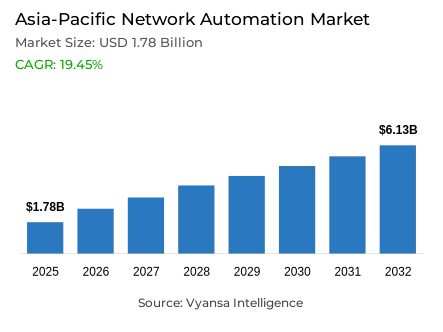
Network automation uses software to automatically manage, monitor, and secure network infrastructure, reducing manual work and improving network performance. Growing demand for faster, more reliable, and efficient network management is driving the Asia-Pacific network automation market, which is projected to grow at a CAGR of 19.45% during 2026–2032.
Key Highlights of the Asia-Pacific Network Automation Market:
- The Asia-Pacific network automation market was valued at USD 1.78 billion in 2025 and USD 2.11 billion in 2026, and is projected to reach USD 6.13 billion by 2032.
- The market is expected to grow at a CAGR of 19.45% during 2026–2032.
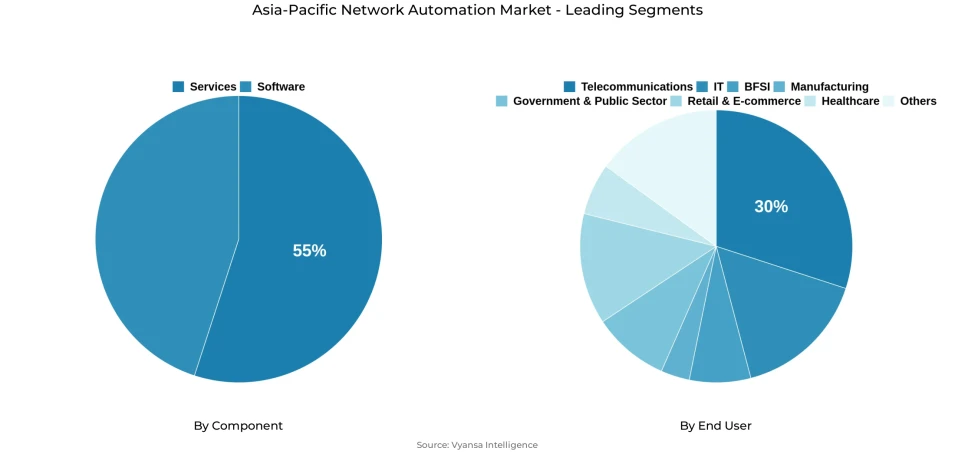
- Services led the component segment with a 55% market share in 2026.
- However, software is projected to record the fastest growth, at a CAGR of 17.61% during 2026–2032.
- Telecommunications dominated the end-user segment with a 30% market share in 2026.
- Meanwhile, the IT segment is expected to witness the fastest growth, at a CAGR of 24.66% during 2026–2032.
- China accounted for 38% of the regional market in 2026.
- However, India is projected to be the fastest-growing country, registering a CAGR of 25.32% during 2026–2032.
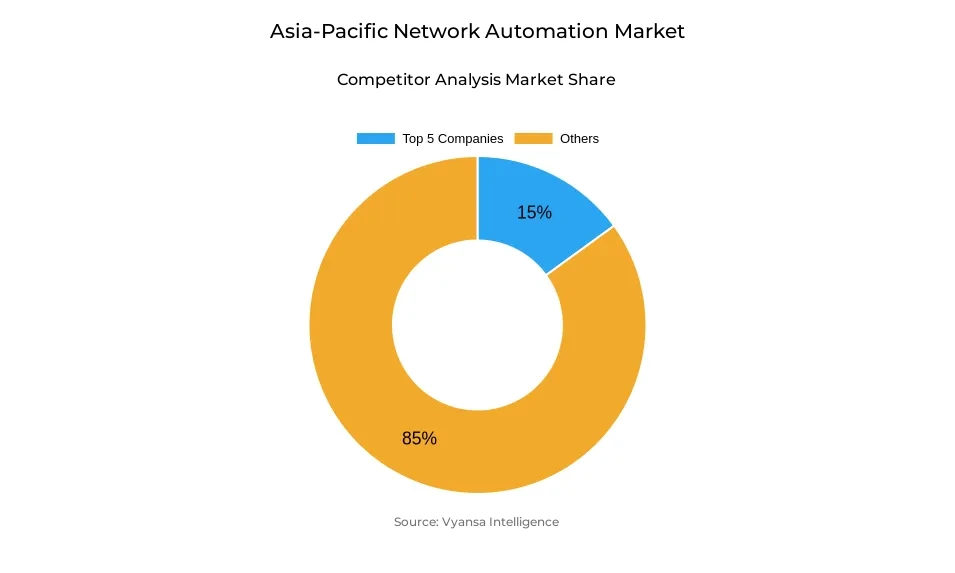
- The top five companies collectively held around 15% of market revenue, indicating a highly fragmented competitive landscape.
The network automation industry in Asia-Pacific is experiencing steady growth as organizations increasingly rely on digital networks to support business operations, cloud-based applications, and customer-facing services. As enterprise networks expand across data centers, cloud platforms, branch offices, and campus environments, managing them manually has become more complex and resource-intensive. Network automation enables organizations to automate configuration, monitoring, security, and lifecycle management, improving operational efficiency while ensuring consistent network performance and reliability.
The rapid expansion of digital connectivity is further accelerating market demand. According to the International Telecommunication Union (ITU), 5.5 billion people—68% of the global population- used the Internet in 2024, with nearly 66% of the Asia-Pacific population connected online. This surge in internet users, connected devices, and digital services is driving the need for centralized and intelligent network management solutions. Additionally, the OECD Digital Government Outlook 2026 reports that 86% of OECD countries have implemented shared cloud computing environments, while 83% have adopted shared cloud storage initiatives, reflecting the continued expansion of digital infrastructure.
As enterprises, telecom operators, financial institutions, healthcare providers, manufacturers, governments, retailers, and educational organizations modernize their IT ecosystems, network automation is becoming a critical enabler of secure, scalable, and resilient network operations across the Asia-Pacific region.
Government Regulations Shaping the Asia-Pacific Network Automation Market
China – MIIT Artificial Intelligence + Information and Communications Implementation Plan (2026–2028)
China's Ministry of Industry and Information Technology (MIIT) issued the Artificial Intelligence + Information and Communications Implementation Plan (2026–2028) to accelerate AI integration into telecommunications by promoting intelligent network operations, autonomous management, and AI-enabled network infrastructure. The regulation addresses rising network complexity caused by expanding 5G, cloud computing, and AI services, which make manual network management inefficient. By encouraging operators to deploy AI-driven automation, orchestration, and self-optimizing networks, the policy is expected to increase investments in advanced network automation technologies, supporting sustained market growth throughout the forecast period.
India – Telecommunications Act, 2023
India's Telecommunications Act, 2023 establishes a modern regulatory framework for telecommunications by strengthening spectrum management, licensing, network security, and digital communication infrastructure. Replacing decades-old telecom legislation, the Act supports the continued expansion of 5G networks, cloud connectivity, and next-generation digital communications while improving regulatory clarity for infrastructure development. As telecom operators expand and modernize increasingly complex network environments, the need for centralized, automated, and scalable network management solutions is expected to grow. By enabling the development of advanced digital infrastructure and secure communication networks, the legislation creates a favorable environment for greater adoption of network automation solutions, contributing to sustained market growth across India and the broader Asia-Pacific region.
Asia-Pacific Network Automation Market Drivers
Rapid Expansion of 5G and Digital Infrastructure Is Accelerating Network Automation Adoption
The rapid expansion of digital infrastructure across the Asia-Pacific region is significantly increasing the complexity of enterprise and telecommunications networks. Organizations are accelerating the deployment of 5G, cloud computing, artificial intelligence (AI), Internet of Things (IoT), and edge computing to support digital transformation, enhance customer experiences, and improve operational efficiency. As these technologies become increasingly interconnected, managing network configuration, performance, security, and service availability through manual processes is becoming inefficient, driving organizations toward intelligent network automation solutions.
The transition is reinforced by the GSMA Mobile Economy Asia-Pacific 2025, which estimates that mobile network operators will invest approximately USD 254 billion in network infrastructure between 2025 and 2030, primarily to expand 5G coverage and modernize network capabilities. The report also projects that 5G will account for 50% of all mobile connections in Asia-Pacific by 2030, creating larger, more distributed, and highly dynamic network environments that require automated management and orchestration. As network scale and complexity continue to grow, enterprises and telecom operators are increasingly adopting network automation platforms to streamline operations, improve network resilience, reduce manual intervention, and ensure consistent service performance, thereby driving the growth of the Asia-Pacific Network Automation Market.
Asia-Pacific Network Automation Market Restraints
Legacy Infrastructure and Multivendor Network Environments Complicate Automation Deployment
The presence of legacy infrastructure and multivendor network environments remains a significant challenge for the Asia-Pacific Network Automation Market. Many enterprises continue to operate networks built on a combination of legacy routers, switches, proprietary management platforms, and manually configured systems that have evolved over several years. Integrating these heterogeneous environments with modern automation platforms is often hindered by incompatible protocols, limited API support, inconsistent data models, and vendor-specific configurations. As a result, organizations frequently experience longer deployment timelines, higher implementation costs, and increased operational risks when transitioning to automated network operations.
The challenge is further reflected in Cisco's 2024 Global Networking Trends Report, which highlights that organizations continue to modernize their networking architectures to address growing operational complexity. The study found that 72% of IT leaders expect to adopt a network platform architecture, while 60% plan to implement AI-enabled predictive network automation within the next two years, demonstrating that many organizations are still progressing through network modernization before achieving large-scale automation. As enterprises continue balancing legacy infrastructure with next-generation networking technologies, integration complexity and interoperability challenges are expected to remain key barriers to broader adoption of network automation solutions across the Asia-Pacific region.
Asia-Pacific Network Automation Market Recent Trends
Intent-Based Networking Is Strengthening Intelligent Network Operations
The Asia-Pacific network automation industry is experiencing growing adoption of Intent-Based Networking (IBN) as enterprises modernize increasingly complex digital infrastructures. By translating business policies into automated network configurations, IBN enables continuous monitoring, policy enforcement, and real-time optimization without extensive manual intervention. This approach improves network agility, strengthens operational consistency, and supports scalable management across enterprise, cloud, and telecom environments.
According to the OECD Digital Economy Outlook 2024, cloud computing is adopted by an average of 49% of enterprises with 10 or more employees across OECD countries, with adoption ranging from 16% to 78% depending on the economy. As organizations expand hybrid cloud deployments and digital applications, demand for policy-driven, programmable, and software-defined networking continues to increase.
Consequently, enterprises are accelerating investments in intelligent automation platforms that simplify network operations, improve service reliability, and enhance infrastructure scalability. This growing shift toward Intent-Based Networking is expected to strengthen demand for advanced automation solutions and support the sustained growth of the Asia-Pacific network automation market.
Asia-Pacific Network Automation Market Future Opportunities
Expansion of Private 5G Networks Creates New Opportunities for Intelligent Network Automation
The accelerating adoption of private 5G networks across manufacturing plants, logistics hubs, ports, airports, utilities, mining sites, and enterprise campuses is creating a new avenue for growth in the Asia-Pacific Network Automation Market. Unlike public mobile networks, private 5G deployments are owned and managed by enterprises to support mission-critical applications, industrial automation, autonomous systems, and low-latency communications. Operating these dedicated networks requires automated provisioning, policy-based orchestration, continuous performance monitoring, security enforcement, and lifecycle management to ensure reliable and uninterrupted connectivity.
According to the GSMA Destination Growth: The Journey to Complete 5G (2025) report, the number of private LTE and 5G network deployments worldwide is projected to increase from approximately 2,900 in 2023 to nearly 11,900 by 2028, representing a CAGR of around 33%, with the Asia-Pacific region emerging as one of the fastest-growing enterprise adoption markets. As organizations increasingly invest in dedicated wireless infrastructure to support Industry 4.0, smart manufacturing, and digital transformation initiatives, demand for AI-driven network automation, centralized orchestration, and autonomous network management solutions is expected to rise significantly. This transition presents substantial long-term growth opportunities for network automation vendors across the Asia-Pacific region.
Unlock Market Intelligence
Explore the market potential with our data-driven report
Asia-Pacific Network Automation Market Segmentation Analysis
By Component
- Software
- Services
- Professional Services
- Consulting & Advisory
- Deployment & Integration
- Training, Support & Maintenance
- Managed Services
- Professional Services
Services Lead, While Software Records Faster Growth
Services led the component segment with a 55% market share in 2026 as organizations increasingly require specialized expertise to implement network automation solutions. Growing demand for consulting, deployment, integration, training, maintenance, and ongoing technical support continues to drive service adoption across enterprises modernizing complex network environments. Additionally, organizations integrating automation with legacy infrastructure, multivendor networks, cloud platforms, and security systems depend on professional services to reduce implementation risks, accelerate deployment, improve operational efficiency, and maximize long-term business value across industries.
However, software is projected to grow at the fastest CAGR of 17.61% during 2026–2032 as enterprises increase investments in orchestration platforms, network controllers, observability tools, analytics, policy management, and assurance software. Rising demand for scalable, subscription-based solutions, open APIs, modular deployment, cloud-native architectures, and AI-enabled capabilities enables organizations to modernize network operations without replacing existing infrastructure. Consequently, stronger software adoption will improve automation scalability, operational agility, network visibility, service reliability, and long-term digital transformation across the Asia-Pacific market forecast.
By End User
- Telecommunications
- IT
- BFSI
- Manufacturing
- Government & Public Sector
- Retail & E-commerce
- Healthcare
- Others
Telecommunications Retains Leadership as IT Adoption Accelerates
Telecommunications accounted for the largest end-user share, capturing 30% of the Asia-Pacific network automation market in 2026, as operators continue expanding 5G, fibre, and broadband infrastructure across the region. Growing network complexity is increasing demand for automated provisioning, configuration management, fault detection, capacity optimization, and service assurance solutions. Additionally, telecom operators are investing in multivendor automation platforms to improve network performance, reduce operational costs, strengthen policy compliance, and deliver consistent customer experiences across increasingly large and distributed communication networks throughout the region.
However, the IT segment is projected to grow at the fastest CAGR of 24.66% during 2026–2032, driven by rising investments in hybrid cloud, multicloud, AI workloads, and digital services. Organizations increasingly require automated network provisioning, policy management, observability, configuration compliance, and rapid incident response to support expanding digital infrastructure. Consequently, growing adoption of cloud-native technologies, DevOps practices, API-based integration, and subscription-driven software is expected to accelerate network automation demand and support long-term market growth across the Asia-Pacific region.
Unlock Market Intelligence
Explore the market potential with our data-driven report
Asia-Pacific Network Automation Market Regional Analysis
By Country
- China
- Japan
- India
- South Korea
- Australia
- Rest of Asia-Pacific
China accounts for 38% of regional demand, supported by extensive carrier, fiber, data-center, cloud, industrial Internet, and computing infrastructure. The Asia-Pacific network automation industry benefits from 4.838 million 5G base stations recorded at the end of 2025, creating continuous provisioning, optimization, assurance, and cross-domain coordination requirements. Domestic vendors, major operators, cloud platforms, and enterprise digitization programs reinforce adoption. Demand extends beyond telecommunications into financial services, manufacturing, government, transport, and internet companies requiring policy consistency, security, availability, and performance across large distributed networks.
India is projected to be the fastest-growing country at a CAGR of 25.32% during 2026-2032. By October 2025, operators had installed 5.08 lakh 5G base transceiver stations, while services reached 99.9% of districts and 85% population coverage. Rapid telecom deployment, cloud investment, public digital infrastructure, and enterprise connectivity increase requirements for automated configuration, energy optimization, fault isolation, and service assurance. Suppliers can capture growth through affordable subscriptions, interoperable platforms, local integration partnerships, managed services, and practical workforce training.
Asia-Pacific Network Automation Market Competitive Landscape
The Asia-Pacific network automation industry is highly fragmented, with the top five companies collectively accounting for 15% of revenue. The top companies comprise, Huawei Technologies Co. Ltd., Cisco Systems Inc., Hewlett Packard Enterprise Company, Nokia Corporation, and International Business Machines Corporation.
Key Companies in the Asia-Pacific Network Automation Market
- Huawei Technologies Co. Ltd.
- Cisco Systems Inc.
- Hewlett Packard Enterprise Company
- Nokia Corporation
- International Business Machines Corporation
- Telefonaktiebolaget LM Ericsson
- Arista Networks Inc.
- Fortinet Inc.
- Broadcom Inc. (VMware by Broadcom)
- Palo Alto Networks Inc.
- Ciena Corporation
- Extreme Networks Inc.
Company Profiles
The following profiles assess direct participation in the Asia-Pacific network automation market, relevant platforms, deployment capabilities, and the factors supporting repeat software, integration, support, or managed-service demand.
Huawei Technologies Co. Ltd: Huawei Technologies Co. Ltd. participates through its Autonomous Driving Network portfolio and iMaster NCE platforms covering carrier, campus, data-center, IP, and optical operations. These solutions combine management, control, analytics, and AI to translate operational intent into configurations, support predictive maintenance, and coordinate service assurance. Huawei’s regional equipment footprint and operator relationships strengthen integration opportunities. Consumers can align network hardware, automation software, technical support, and lifecycle services across complex transformation programs involving multiple domains and operating requirements.
Cisco Systems Inc: Cisco Systems Inc. addresses enterprise and service-provider automation through Cisco Crosswork, Catalyst Center, Network Services Orchestrator, SD-WAN, and assurance capabilities. Crosswork supports programmable infrastructure, operational-data access, multivendor control, and closed-loop workflows across cloud and on-premises environments. Cisco’s broad routing, switching, wireless, security, and data-center installed base supports repeat adoption. Open APIs, certified partners, implementation services, and integrated networking portfolios help customers connect automation investments with existing infrastructure while reducing migration and operational risk.
Hewlett Packard Enterprise Company: Hewlett Packard Enterprise Company participates through HPE Aruba Networking Central and its broader networking portfolio. Aruba Central provides AI-native management, automated operations, security, and assurance across switching, Wi-Fi, SD-WAN, campus, and branch environments, with flexible deployment options. The platform addresses customers requiring unified visibility, access-policy integration, data control, and lifecycle management. HPE’s portfolio breadth, channel network, technical services, and enterprise relationships support recurring software, implementation, support, and modernization demand across distributed organizations.
Nokia Corporation: Nokia Corporation supplies automation across telecom IP, optical, mobile, data-center, and service-management domains through Network Services Platform and its autonomous-network capabilities. NSP combines service management, assurance, configuration, resource control, and multivendor visibility. Nokia’s telecom-domain expertise supports operators pursuing closed-loop operations while retaining policy boundaries, security controls, and explainability. Carrier relationships, network-transformation programs, technical support, and lifecycle services strengthen its position in complex environments requiring coordination across infrastructure, operational systems, and customer services.
International Business Machines Corporation: International Business Machines Corporation participates through IBM SevOne Network Performance Management and automated network observability capabilities. SevOne provides real-time monitoring, application-centric visibility, capacity management, service-level analysis, and workflow automation across hybrid-cloud, SD-WAN, Wi-Fi, and enterprise environments. IBM’s software and consulting relationships support integration with IT operations, incident management, and hybrid-cloud governance. Customers can expand deployments as continuous observability, reusable automation, root-cause analysis, and operational insights become embedded within broader service-management processes.
Recent Developments in the Asia-Pacific Network Automation Industry
- June 2026: Nokia introduced an agentic AI framework in Network Services Platform, enabling AI agents to reason over real network context and take guided actions within defined policy and security boundaries. The enhancement strengthens explainable, human-governed automation for multivendor IP operations.
- March 2026: Huawei Technologies Co. Ltd. launched its AN L4 Phase 2 solution to address cross-domain integration and cross-scenario coordination in large-scale autonomous-network deployments. The release advances operations from isolated automation use cases toward coordinated agent-based network management.
Frequently Asked Questions
Related Report
- Market Segmentation
- Research Scope
- Research Methodology
- Definitions and Assumptions
- Executive Summary
- Asia Pacific IT Spending 2022-2032
- By Country
- By Module
- Asia Pacific Network Automation Market Policies, Regulations, and Standards
- Asia Pacific Network Automation Market Dynamics
- Growth Factors
- Challenges
- Trends
- Opportunities
- Asia Pacific Network Automation Market Statistics, 2022-2032F
- Market Size & Growth Outlook
- By Revenues in USD Million
- Market Segmentation & Growth Outlook
- By Component
- Software- Market Insights and Forecast 2022-2032, USD Million
- Services- Market Insights and Forecast 2022-2032, USD Million
- Professional Services- Market Insights and Forecast 2022-2032, USD Million
- Consulting & Advisory- Market Insights and Forecast 2022-2032, USD Million
- Deployment & Integration- Market Insights and Forecast 2022-2032, USD Million
- Training, Support & Maintenance- Market Insights and Forecast 2022-2032, USD Million
- Managed Services- Market Insights and Forecast 2022-2032, USD Million
- Professional Services- Market Insights and Forecast 2022-2032, USD Million
- By Deployment Mode
- On-Premises- Market Insights and Forecast 2022-2032, USD Million
- Cloud-Based- Market Insights and Forecast 2022-2032, USD Million
- By Network Environment
- Data Center Networks- Market Insights and Forecast 2022-2032, USD Million
- Campus & Branch Networks- Market Insights and Forecast 2022-2032, USD Million
- WAN & SD-WAN- Market Insights and Forecast 2022-2032, USD Million
- Service Provider Networks- Market Insights and Forecast 2022-2032, USD Million
- Cloud & Multi-Cloud Networks- Market Insights and Forecast 2022-2032, USD Million
- Others- Market Insights and Forecast 2022-2032, USD Million
- By End User
- Telecommunications- Market Insights and Forecast 2022-2032, USD Million
- IT- Market Insights and Forecast 2022-2032, USD Million
- BFSI- Market Insights and Forecast 2022-2032, USD Million
- Manufacturing- Market Insights and Forecast 2022-2032, USD Million
- Government & Public Sector- Market Insights and Forecast 2022-2032, USD Million
- Retail & E-commerce- Market Insights and Forecast 2022-2032, USD Million
- Healthcare- Market Insights and Forecast 2022-2032, USD Million
- Others- Market Insights and Forecast 2022-2032, USD Million
- By Country
- China
- Japan
- India
- South Korea
- Australia
- Rest of Asia Pacific
- By Competitors
- Competition Characteristics
- Market Share & Analysis
- By Component
- Market Size & Growth Outlook
- China Network Automation Market Statistics, 2022-2032F
- Market Size & Growth Outlook
- By Revenues in USD Million
- Market Segmentation & Growth Outlook
- By Component- Market Insights and Forecast 2022-2032, USD Million
- By Deployment Mode- Market Insights and Forecast 2022-2032, USD Million
- By Network Environment- Market Insights and Forecast 2022-2032, USD Million
- By End User- Market Insights and Forecast 2022-2032, USD Million
- Market Size & Growth Outlook
- Japan Network Automation Market Statistics, 2022-2032F
- Market Size & Growth Outlook
- By Revenues in USD Million
- Market Segmentation & Growth Outlook
- By Component- Market Insights and Forecast 2022-2032, USD Million
- By Deployment Mode- Market Insights and Forecast 2022-2032, USD Million
- By Network Environment- Market Insights and Forecast 2022-2032, USD Million
- By End User- Market Insights and Forecast 2022-2032, USD Million
- Market Size & Growth Outlook
- India Network Automation Market Statistics, 2022-2032F
- Market Size & Growth Outlook
- By Revenues in USD Million
- Market Segmentation & Growth Outlook
- By Component- Market Insights and Forecast 2022-2032, USD Million
- By Deployment Mode- Market Insights and Forecast 2022-2032, USD Million
- By Network Environment- Market Insights and Forecast 2022-2032, USD Million
- By End User- Market Insights and Forecast 2022-2032, USD Million
- Market Size & Growth Outlook
- South Korea Network Automation Market Statistics, 2022-2032F
- Market Size & Growth Outlook
- By Revenues in USD Million
- Market Segmentation & Growth Outlook
- By Component- Market Insights and Forecast 2022-2032, USD Million
- By Deployment Mode- Market Insights and Forecast 2022-2032, USD Million
- By Network Environment- Market Insights and Forecast 2022-2032, USD Million
- By End User- Market Insights and Forecast 2022-2032, USD Million
- Market Size & Growth Outlook
- Australia Network Automation Market Statistics, 2022-2032F
- Market Size & Growth Outlook
- By Revenues in USD Million
- Market Segmentation & Growth Outlook
- By Component- Market Insights and Forecast 2022-2032, USD Million
- By Deployment Mode- Market Insights and Forecast 2022-2032, USD Million
- By Network Environment- Market Insights and Forecast 2022-2032, USD Million
- By End User- Market Insights and Forecast 2022-2032, USD Million
- Market Size & Growth Outlook
- Competitive Outlook
- Company Profiles
- Huawei Technologies Co. Ltd.
- Business Description
- Service Portfolio
- Collaborations & Alliances
- Recent Developments
- Financial Details
- Others
- Cisco Systems Inc.
- Business Description
- Service Portfolio
- Collaborations & Alliances
- Recent Developments
- Financial Details
- Others
- Hewlett Packard Enterprise Company
- Business Description
- Service Portfolio
- Collaborations & Alliances
- Recent Developments
- Financial Details
- Others
- Nokia Corporation
- Business Description
- Service Portfolio
- Collaborations & Alliances
- Recent Developments
- Financial Details
- Others
- International Business Machines Corporation
- Business Description
- Service Portfolio
- Collaborations & Alliances
- Recent Developments
- Financial Details
- Others
- Telefonaktiebolaget LM Ericsson
- Business Description
- Service Portfolio
- Collaborations & Alliances
- Recent Developments
- Financial Details
- Others
- Arista Networks Inc.
- Business Description
- Service Portfolio
- Collaborations & Alliances
- Recent Developments
- Financial Details
- Others
- Fortinet Inc.
- Business Description
- Service Portfolio
- Collaborations & Alliances
- Recent Developments
- Financial Details
- Others
- Broadcom Inc. (VMware yy Broadcom)
- Business Description
- Service Portfolio
- Collaborations & Alliances
- Recent Developments
- Financial Details
- Others
- Palo Alto Networks Inc.
- Business Description
- Service Portfolio
- Collaborations & Alliances
- Recent Developments
- Financial Details
- Others
- Ciena Corporation
- Business Description
- Service Portfolio
- Collaborations & Alliances
- Recent Developments
- Financial Details
- Others
- Extreme Networks Inc.
- Business Description
- Service Portfolio
- Collaborations & Alliances
- Recent Developments
- Financial Details
- Others
- Huawei Technologies Co. Ltd.
- Company Profiles
- Disclaimer
| Segment | Sub-Segment |
|---|---|
| By Component |
|
| By Deployment Mode |
|
| By Network Environment |
|
| By End User |
|
| By Country |
|
Research Methodology
This study followed a structured approach comprising four key phases to assess the size and scope of the electro-oxidation market. The process began with thorough secondary research to collect data on the target market, related markets, and broader industry context. These findings, along with preliminary assumptions and estimates, were then validated through extensive primary research involving industry experts from across the value chain. To calculate the overall market size, both top-down and bottom-up methodologies were employed. Finally, market segmentation and data triangulation techniques were applied to refine and validate segment-level estimations.
Secondary Research
The secondary research phase involved gathering data from a wide range of credible and published sources. This step helped in identifying industry trends, defining market segmentation, and understanding the market landscape and value chain.
Sources consulted during this phase included:
- Company annual reports, investor presentations, and press releases
- Industry white papers and certified publications
- Trade directories and market-recognized databases
- Articles from authoritative authors and reputable journals
- Gold and silver standard websites
Secondary research was critical in mapping out the industry's value chain and monetary flow, identifying key market segments, understanding regional variations, and tracking significant industry developments.
Other key sources:
- Financial disclosures
- Industry associations and trade bodies
- News outlets and business magazines
- Academic journals and research studies
- Paid industry databases
Primary Research
To validate secondary data and gain deeper market insights, primary research was conducted with key stakeholders across both the supply and demand sides of the market.
On the demand side, participants included decision-makers and influencers from end-user industries—such as CIOs, CTOs, and CSOs—who provided first-hand perspectives on market needs, product usage, and future expectations.
On the supply side, interviews were conducted with manufacturers, industry associations, and institutional participants to gather insights into current offerings, product pipelines, and market challenges.
Primary interviews provided critical inputs such as:
- Market size and revenue data
- Product and service breakdowns
- Market forecasts
- Regional and application-specific trends
Stakeholders consulted included:
- Leading OEM and solution providers
- Channel and distribution partners
- End users across various applications
- Independent consultants and industry specialists
Market Size Estimation and Data Triangulation
- Identifying Key Market Participants (Secondary Research)
- Goal: To identify the major players or companies in the target market. This typically involves using publicly available data sources such as industry reports, market research publications, and financial statements of companies.
- Tools: Reports from firms like Gartner, Forrester, Euromonitor, Statista, IBISWorld, and others. Public financial statements, news articles, and press releases from top market players.
- Extracting Earnings of Key Market Participants
- Goal: To estimate the earnings generated from the product or service being analyzed. This step helps in understanding the revenue potential of each market player in a specific geography.
- Methods: Earnings data can be gathered from:
- Publicly available financial reports (for listed companies).
- Interviews and primary data sources from professionals, such as Directors, VPs, SVPs, etc. This is especially useful for understanding more nuanced, internal data that isn't publicly disclosed.
- Annual reports and investor presentations of key players.
- Data Collation and Development of a Relevant Data Model
- Goal: To collate inputs from both primary and secondary sources into a structured, data-driven model for market estimation. This model will incorporate key market KPIs and any independent variables relevant to the market.
- Key KPIs: These could include:
- Market size, growth rate, and demand drivers.
- Industry-specific metrics like market share, average revenue per customer (ARPC), or average deal size.
- External variables, such as economic growth rates, inflation rates, or commodity prices, that could affect the market.
- Data Modeling: Based on this data, the market forecasts are developed for the next 5 years. A combination of trend analysis, scenario modeling, and statistical regression might be used to generate projections.
- Scenario Analysis
- Goal: To test different assumptions and validate how sensitive the market is to changes in key variables (e.g., market demand, regulatory changes, technological disruptions).
- Types of Scenarios:
- Base Case: Based on current assumptions and historical data.
- Best-Case Scenario: Assuming favorable market conditions, regulatory environments, and technological advancements.
- Worst-Case Scenario: Accounting for adverse factors, such as economic downturns, stricter regulations, or unexpected disruptions.












