Taiwan Semiconductor Production Equipment Market Report: Trends, Growth and Forecast (2026-2032)
By Equipment Type (Wafer Fabrication Equipment (Lithography Equipment, Etching Equipment, Deposition & Epitaxy Equipment, Metrology, Inspection & Process Control Equipment, Others), Assembly & Packaging Equipment (Dicing & Singulation Equipment, Die Bonding Equipment, Wire Bonding & Flip-Chip Bonding Equipment, Molding, Encapsulation & Advanced Packaging Equipment, Others), Semiconductor Test Equipment (Wafer Probing Equipment, Automated Test Equipment, Burn-in & Reliability Test Equipment, Final Test & System-Level Test Equipment, Others)), By Wafer Size (300 mm, 200 mm, 150 mm, Others), By Technology Node (Leading-Edge Nodes (≤5 nm), Advanced Nodes (>5 nm to 14 nm), Mature Nodes (>14 nm to 90 nm), Legacy Nodes (>90 nm), Others), By Semiconductor Device Type (Logic & Micro component Devices, Memory Devices, Analog & Mixed-Signal ICs, Discrete, Power & Optoelectronic Devices, MEMS & Sensor Devices, Others), By End User (Foundries, Integrated Device Manufacturers, OSAT Companies, Research Institutes & Universities, Others), By Region (North, East, West, South) ... Read more
|
Major Players
|
Taiwan Semiconductor Production Equipment Market Overview
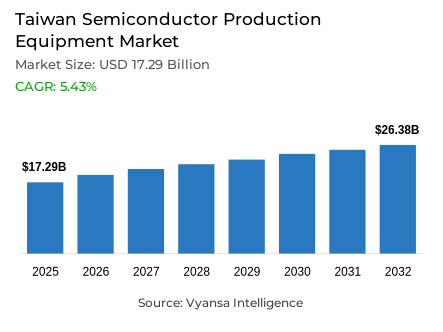
Semiconductor production equipment includes wafer fabrication tools, assembly and packaging systems, and semiconductor test equipment used to process wafers, build integrated circuits, package devices, inspect defects, control process quality, and validate chip performance before shipment. These systems support foundries, device manufacturers, OSAT companies, research institutes, universities, pilot fabs, and advanced packaging lines across Taiwan during commercial qualification and ramp-up cycles. The semiconductor production equipment market in Taiwan is forecast to grow at a 5.43% CAGR during 2026-2032.
Key Highlights of the Taiwan Semiconductor Production Equipment Market
- Taiwan semiconductor production equipment market stood at USD 17.29 billion in 2025 and reached USD 19.21 billion in 2026, with value expected to reach USD 26.38 billion by 2032.
- The market is forecast to grow at a 5.43% CAGR during 2026-2032.
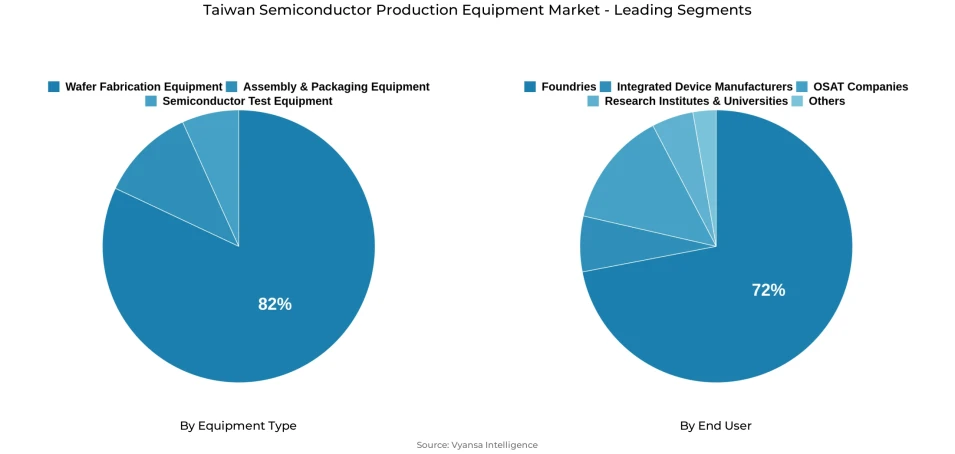
- Based on equipment type, wafer fabrication equipment leads the industry with 82% share in 2026.
- However, semiconductor test equipment is the fastest-growing equipment type, with a 9% CAGR during 2026-2032.
- By end user, foundries lead the market with 72% share in 2026.
- Meanwhile, OSAT companies are considered the fastest-growing end-user segment, with a 4.03% CAGR during 2026-2032.
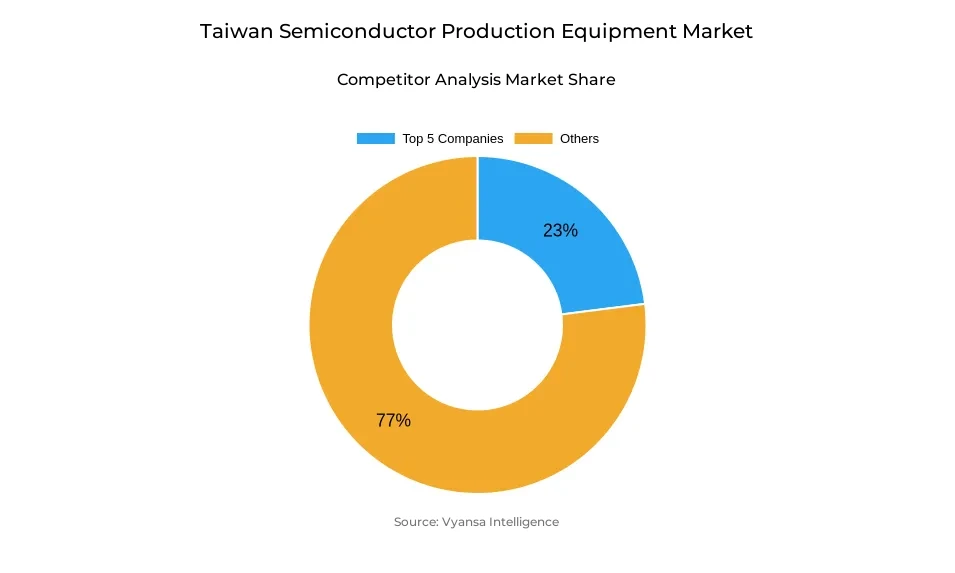
- Top-five company share is 31%, indicating that the industry remains moderately concentrated across leading semiconductor equipment suppliers and technology-driven manufacturing partners.
The industry is expected to witness significant growth, driven by sustained investments in advanced semiconductor manufacturing, rising demand for AI accelerators and high-performance computing (HPC) chips, and continued capacity expansion for 3 nm, 2 nm, and advanced packaging technologies. As one of the world's leading semiconductor manufacturing hubs, Taiwan continues to strengthen its position through ongoing foundry expansion, technology migration, and production-tool upgrades that support both domestic manufacturing and export-oriented semiconductor programs.
Foundries constitute the largest source of equipment demand, reflecting Taiwan's globally dominant contract manufacturing ecosystem. The market encompasses a broad range of front-end fabrication equipment, including lithography, etching, deposition, cleaning, metrology, inspection, and process control systems that enable advanced wafer manufacturing. Simultaneously, the expansion of chiplet architectures, heterogeneous integration, and high-bandwidth memory (HBM) packaging is driving strong demand among outsourced semiconductor assembly and test (OSAT) providers for back-end equipment such as dicing, die bonding, molding, probing, reliability testing, and final test systems. Consequently, investments continue to accelerate across both wafer fabrication facilities and advanced packaging operations.
Government policy is further reinforcing long-term market growth. Under Taiwan's Five Trusted Industry Sectors Promotion Plan, semiconductors have been identified as a strategic priority for strengthening technological resilience, supply chain security, and global competitiveness. As a result, semiconductor manufacturers increasingly prioritize equipment suppliers capable of delivering high-precision tools supported by secure software architectures, localized engineering expertise, rapid spare-parts availability, and comprehensive lifecycle maintenance services to maximize fab productivity and operational reliability.
Looking ahead, competitive differentiation within the Taiwan semiconductor production equipment industry is expected to be increasingly influenced by equipment uptime, process repeatability, cleanroom compatibility, field-service capabilities, and customer-specific process qualification support. With accelerating demand for AI processors, HPC devices, advanced packaging technologies, and increasingly stringent testing requirements, the market is well positioned to experience sustained growth through 2032, supported by continued investments in both front-end wafer fabrication and back-end assembly and testing across Taiwan's globally integrated semiconductor manufacturing ecosystem.
Taiwan Semiconductor Production Equipment Market Surveys and Key Insights
SEMI reported in April 2026 that global semiconductor manufacturing equipment growth increased 15% to USD 135.1 billion in 2025, while Taiwan equipment spending rose 90% year-on-year to USD 31.5 billion. This validates strong local demand for lithography, deposition, etching, inspection, metrology, packaging, and test systems across advanced fabs and OSAT operations during capacity ramp-up cycles and shows why suppliers prioritise Taiwan-based service, calibration, training, refurbishment, and uptime support during tool installation, process qualification, urgent repair, and production recovery cycles locally.
The U.S. International Trade Administration reported Taiwan’s HS8486 equipment imports at USD 17.57 billion in 2024 and USD 14.19 billion during the first half of 2025. The data support strong import dependence for precision tools, while local service, calibration, and maintenance remain critical for supplier qualification in the Taiwan semiconductor manufacturing tools market and advanced-node operations across fabs, packaging sites, and procurement teams requiring customs-ready documentation, spare parts, software support, and field engineers locally during qualification, audits, and urgent maintenance.
Government Regulations Shaping the Taiwan Semiconductor Production Equipment Market
Taiwan’s equipment suppliers operate under strategic high-tech export controls, cybersecurity standards, and trusted-industry policy support. Planned controls on advanced semiconductor equipment would require export licenses for selected tools, raising documentation and end-use screening needs. SEMI E187 also sets cybersecurity expectations for fab equipment, including secure operating systems, patch management, access control, hardening, and log management, making compliance a direct supplier-qualification factor for the Taiwan semiconductor processing equipment market during procurement audits and international customer reviews across fabs and OSAT facilities.
Taiwan Semiconductor Production Equipment Market Drivers
Advanced Foundry Expansion Strengthening Wafer-Fab Tool Demand
Advanced foundry expansion is the substantial demand driver for the Taiwan semiconductor wafer fabrication equipment market. Foundries require lithography, etching, deposition, cleaning, metrology, and process-control tools to shift from pilot output to commercial wafer production. Each node migration increases process steps, overlay requirements, defect sensitivity, and yield-learning complexity. As fabs add capacity, equipment demand becomes structural through new installations, tool replacement, process qualification, recurring maintenance, field engineering, and spare-parts support for high-volume lines serving AI and HPC customers efficiently worldwide.
TSMC’s technology roadmap converts this driver into measurable equipment demand. The company states that N2P volume production is scheduled for the second half of 2026, extending its 2nm technology family. Such transitions require tighter patterning control, advanced deposition, etch precision, in-line inspection, and high-resolution metrology. Before commercial wafer output scales, fabs must qualify production tools, calibrate processes, and secure maintenance capacity for continuous operations in the Taiwan chip production equipment Market across advanced foundry campuses and nearby support facilities reliably.
Taiwan Semiconductor Production Equipment Market Restraints
High Tool Cost, Export Controls, and Qualification Complexity
High tool cost, restricted technology access, and long qualification cycles restrain the Taiwan semiconductor production equipment Market. EUV lithography, advanced etch, deposition, metrology, inspection, and automated test systems require controlled components, cleanroom installation, proprietary software, skilled field engineers, and fab-specific calibration. These requirements raise procurement cost and slow supplier onboarding, especially for smaller participants that lack proven reliability data, cybersecurity documentation, and long-term service infrastructure for advanced fabs and OSAT customers in Taiwan’s demanding supply base and process-specific validation standards.
Export-control tightening increases commercial friction for the Taiwan semiconductor manufacturing tools Market. Taiwan’s planned revision would add advanced semiconductor equipment to the strategic high-tech product list and require export licenses for selected items. This raises screening, end-use verification, customer documentation, shipment planning, and re-export governance. Suppliers face longer delivery cycles, higher compliance staffing needs, and greater risk-management pressure when supporting multinational fab networks through Taiwan-based entities and cross-border tool service arrangements across customer locations and affiliates worldwide during maintenance programs.
Taiwan Semiconductor Production Equipment Market Recent Trends
Local Support and Faster Tool Uptime Becoming Significant Priorities
The demand preference is shifting toward suppliers with local engineering, refurbishment, spare-parts, and training capabilities. Advanced fabs operate under strict utilization targets, so delayed tool recovery can affect wafer output, yield learning, and customer delivery commitments. The semiconductor production equipment market in Taiwan therefore places greater value on lifecycle service quality, response time, preventive maintenance, software support, and close collaboration with fab process teams during continuous production cycles and ramp-ups for local advanced-node and packaging lines serving AI and HPC customers globally.
Key players in semiconductor production equipment market are responding by deepening Taiwan-based service infrastructure. ASML states that it has four customer-support offices, DUV and EUV training centers, and two production plants in Taiwan. Its engineers work with customers, including TSMC, to install, develop, and maintain lithography systems. This strengthens competition around local support depth, field engineering availability, tool refurbishment, and faster uptime restoration in the Taiwan Semiconductor Capital Equipment Market as fabs prioritize reliable production continuity and fast ramp-up execution for advanced devices and packages locally.
Advanced Test, Metrology, and Cyber Secure Tools Gaining Importance
Technical demand is shifting toward advanced test, metrology, inspection, and cyber secure production systems. AI chips, HBM integration, and heterogeneous packaging raise validation intensity because defects, interconnect variation, thermal behavior, and package-level reliability become harder to control. The Taiwan integrated circuit manufacturing equipment industry needs higher-resolution inspection, tighter process control, secure tool connectivity, and automated data capture across fabrication and packaging lines to protect yield, uptime, and customer qualification in increasingly complex device architectures and production networks securely and efficiently onsite.
SEMI reported that semiconductor test equipment billings surged 55% year-on-year in 2025 as AI devices and HBM increased performance requirements and test intensity. It also reported that assembly and packaging equipment sales rose 21% due to advanced packaging adoption. These indicators support faster demand for wafer probing, automated test equipment, burn-in systems, reliability tools, and final system-level test platforms in the Taiwan semiconductor assembly and testing equipment market as OSAT and foundry workloads expand across high-value chips and modules globally.
Taiwan Semiconductor Production Equipment Market Future Opportunities
Advanced Packaging and Test Infrastructure Creating Growth Space
Advanced packaging and test infrastructure create the strongest future opportunity. AI accelerators and HPC processors increasingly rely on chiplets, high-bandwidth memory, and package-level integration, shifting value toward back-end tools. The Taiwan back-end semiconductor equipment market can benefit from unmet needs in wafer probing, automated test, burn-in, reliability validation, thermal performance testing, and high-density interconnect inspection as device architectures become more complex and packaging capacity expands across foundries and OSAT facilities during 2026-2032 through localized support and automation platforms in Taiwan.
TSMC’s February 2026 approval of approximately USD 44.96 billion in capital appropriations for advanced technology capacity, advanced packaging, mature and specialty technology capacity, fab construction, and fab facility systems strengthens monetization potential. Suppliers can capture this opportunity through packaging-specific platforms, local service centers, cybersecurity readiness, calibration support, OSAT partnerships, and integrated maintenance models that reduce downtime in the semiconductor production equipment industry and improve customer qualification speed across production lines and support premium tool adoption from 2026 onward commercially.
Unlock Market Intelligence
Explore the market potential with our data-driven report
Taiwan Semiconductor Production Equipment Market Segmentation Analysis
By Equipment Type
- Wafer Fabrication Equipment
- Lithography Equipment
- Etching Equipment
- Deposition & Epitaxy Equipment
- Metrology, Inspection & Process Control Equipment
- Others
- Assembly & Packaging Equipment
- Dicing & Singulation Equipment
- Die Bonding Equipment
- Wire Bonding & Flip-Chip Bonding Equipment
- Molding, Encapsulation & Advanced Packaging Equipment
- Others
- Semiconductor Test Equipment
- Wafer Probing Equipment
- Automated Test Equipment
- Burn-in & Reliability Test Equipment
- Final Test & System-Level Test Equipment
- Others
Wafer-Fab Leadership and Test Equipment Acceleration
Wafer Fabrication Equipment led by equipment type with 82% share in 2026. Its dominance reflects Taiwan’s advanced wafer manufacturing base, where lithography, etching, deposition, epitaxy, metrology, inspection, and process-control tools represent the largest capital requirement. The market benefits from foundry preference for tools that improve patterning precision, throughput, yield stability, defect control, and advanced-node migration readiness across high-volume fabs, pilot lines, cleanrooms, and tool-qualified process modules supporting AI, HPC, automotive, and smartphone chips for global customers.
Semiconductor test equipment is the fastest-growing equipment type, with a CAGR of 9% during 2026-2032. The industry is expanding in test because AI processors, HBM, chiplets, and advanced packaging require stronger wafer-level, package-level, burn-in, reliability, and final system validation. Test tools grow faster than wafer fabrication tools because device complexity increases verification workload after chips leave front-end fabrication and enter packaging, module assembly, and customer qualification stages across end users and foundries during commercial ramp-up cycles.
By End User
- Foundries
- Integrated Device Manufacturers
- OSAT Companies
- Research Institutes & Universities
- Others
Foundry Leadership and OSAT Growth
Foundries led by end user with 72% share in 2026. Their dominance reflects Taiwan’s advanced contract manufacturing base and continuous investment in wafer output, process migration, and customer-specific capacity. The market depends heavily on foundries because they require large tool fleets across lithography, etching, deposition, cleaning, inspection, and metrology to control yield, overlay, defect density, throughput, and repeatability across nodes, customer programs, high-volume cycles, and capacity ramps, where production losses directly affect customer delivery schedules globally.
OSAT Companies are the fastest-growing end-user segment, with a CAGR of 4.03% during 2026-2032. The industry is gaining from advanced packaging, chiplet integration, HBM-related assembly, wafer probing, and final testing requirements. Compared with foundries, OSAT companies start from a smaller spending base, but their tool intensity rises as more chip value shifts into package-level integration, reliability testing, thermal performance validation, and high-density interconnect inspection for AI and HPC modules worldwide across customers and applications.
Unlock Market Intelligence
Explore the market potential with our data-driven report
Taiwan Semiconductor Production Equipment Market Competitive Landscape
The Taiwan Semiconductor Capital Equipment Market is moderately consolidated in high-end front-end tools and more diversified across packaging, test, refurbishment, and service support. Competition is shaped by precision, process repeatability, installed-base support, uptime, cybersecurity documentation, cleanroom integration, customer qualification, and advanced-node readiness. Multinational suppliers dominate critical tool categories, while local service depth, spare-parts availability, and Taiwan-based engineering teams influence supplier preference among foundries and OSAT companies operating continuous high-utilization production lines across major science parks and clusters under commercial pressure.
Company Profiling
The profiles below provide a comparative assessment of the leading companies in the Taiwan semiconductor production equipment market, focusing on their semiconductor manufacturing equipment portfolios, technological capabilities, local service and manufacturing presence, strategic initiatives, customer support infrastructure, and competitive strengths.
- ASML Taiwan Ltd./ASML Technology Taiwan Ltd.
- Applied Materials Taiwan, Ltd.
- Lam Research Manufacturing, Ltd.
- KLA Corporation
- Tokyo Electron Taiwan Ltd.
- ASM International N.V.
- SCREEN SPE TAIWAN CO., Ltd.
- Advantest Taiwan Inc.
- Teradyne Taiwan LLC
- ASMPT Technology Limited Taiwan Branch, ASMPT Semiconductor Solutions
ASML Taiwan Ltd./ASML Technology Taiwan Ltd.
ASML Taiwan Ltd. and ASML Technology Taiwan Ltd. operate as Taiwan entities of ASML Holding N.V., supporting lithography systems, metrology, inspection, refurbishment, training, and customer service. ASML states that Taiwan has four customer-support offices, DUV and EUV training centers, and two production plants. Its engineers collaborate with customers, including TSMC, to install, develop, and maintain systems, positioning ASML as a technology-led lithography and installed-base support participant with strong local engineering depth for advanced foundry customers and production continuity locally onsite.
Applied Materials Taiwan, Ltd.
Applied Materials Taiwan, Ltd. operates as part of Applied Materials, Inc., a materials-engineering equipment supplier for semiconductor and advanced display manufacturing. Applied offers metrology, inspection, and review systems for FEOL and BEOL applications, including optical capabilities and algorithms for EUV layers, mask qualification, and emerging 3D architectures. In Taiwan, its relevance spans deposition, process modules, eBeam metrology, inspection, and advanced packaging support, positioning it as a broad process-equipment supplier for complex device scaling, yield control, and advanced packaging production locally.
Lam Research Manufacturing, Ltd.
Lam Research Manufacturing, Ltd. is a wholly owned subsidiary of Lam Research located in Taoyuan, Taiwan. Lam states that the entity was founded in 2016 to support customer proximity and is equipped with modern production cleanroom facilities. The facility serves as Lam’s global refurbishment center, supporting semiconductor equipment lifecycle needs. Its relevance is tied to wafer processing, refurbishment, service support, and advanced chip-processing tools, positioning Lam as an etch and processing specialist with localized refurbishment and customer support strength locally.
KLA Corporation
KLA Corporation participates through process-control, inspection, metrology, and yield-management systems used in semiconductor production. KLA states that it uses advanced inspection tools, metrology systems, and computational analytics. Its Taiwan presence includes offices in Hsinchu, Taoyuan, Taichung, and Tainan. These capabilities support defect detection, process quality, wafer inspection, packaging inspection, and analytics, positioning KLA as a yield-improvement specialist for fabs requiring rapid defect learning, tighter control, and stable production performance across advanced nodes and high-volume production ramps in Taiwan onsite reliably.
Tokyo Electron Taiwan Ltd.
Tokyo Electron Taiwan Ltd. is the Taiwan subsidiary of Tokyo Electron Limited, with its head office in Hsinchu Science Park. TEL states that the Taiwan business provides service and sales support and conducts R&D for semiconductor production equipment. Its office network includes Hsinchu, Taichung, Tainan, Kaohsiung, and a training center. The company supports deposition, coating, developing, etching, cleaning, and testing-related systems, positioning TEL as a broad technical-support participant with local service coverage near major fab clusters and science parks locally.
Recent Developments and Updates
- February 2026. TSMC’s board approved approximately USD 44.96 billion in capital appropriations for advanced technology capacity, advanced packaging, mature and specialty technology capacity, fab construction, and fab facility systems. This supports future equipment installation, tool upgrades, cleanroom systems, and supplier demand across advanced semiconductor manufacturing operations.
- February 2025. Tokyo Electron Taiwan announced the opening of its Tainan Operation Center in Tainan Science Park. The facility strengthens service and sales support near advanced-node fabs and improves response capability for equipment repair, production-efficiency support, and customer operations in southern Taiwan.
Frequently Asked Questions
Related Report
- Market Segmentation
- Research Scope
- Research Methodology
- Definitions and Assumptions
- Executive Summary
- Taiwan Semiconductor Production Equipment Market Policies, Regulations, and Standards
- Taiwan Semiconductor Production Equipment Market Dynamics
- Growth Factors
- Challenges
- Trends
- Opportunities
- Taiwan Semiconductor Production Equipment Market Statistics, 2022-2032F
- Market Size & Growth Outlook
- By Revenues in USD Million
- Market Segmentation & Growth Outlook
- By Equipment Type
- Wafer Fabrication Equipment- Market Insights and Forecast 2022-2032, USD Million
- Lithography Equipment- Market Insights and Forecast 2022-2032, USD Million
- Etching Equipment- Market Insights and Forecast 2022-2032, USD Million
- Deposition & Epitaxy Equipment- Market Insights and Forecast 2022-2032, USD Million
- Metrology, Inspection & Process Control Equipment- Market Insights and Forecast 2022-2032, USD Million
- Others- Market Insights and Forecast 2022-2032, USD Million
- Assembly & Packaging Equipment- Market Insights and Forecast 2022-2032, USD Million
- Dicing & Singulation Equipment- Market Insights and Forecast 2022-2032, USD Million
- Die Bonding Equipment- Market Insights and Forecast 2022-2032, USD Million
- Wire Bonding & Flip-Chip Bonding Equipment- Market Insights and Forecast 2022-2032, USD Million
- Molding, Encapsulation & Advanced Packaging Equipment- Market Insights and Forecast 2022-2032, USD Million
- Others- Market Insights and Forecast 2022-2032, USD Million
- Semiconductor Test Equipment- Market Insights and Forecast 2022-2032, USD Million
- Wafer Probing Equipment- Market Insights and Forecast 2022-2032, USD Million
- Automated Test Equipment- Market Insights and Forecast 2022-2032, USD Million
- Burn-in & Reliability Test Equipment- Market Insights and Forecast 2022-2032, USD Million
- Final Test & System-Level Test Equipment- Market Insights and Forecast 2022-2032, USD Million
- Others- Market Insights and Forecast 2022-2032, USD Million
- Wafer Fabrication Equipment- Market Insights and Forecast 2022-2032, USD Million
- By Wafer Size
- 300 mm- Market Insights and Forecast 2022-2032, USD Million
- 200 mm- Market Insights and Forecast 2022-2032, USD Million
- 150 mm- Market Insights and Forecast 2022-2032, USD Million
- Others- Market Insights and Forecast 2022-2032, USD Million
- By Technology Node
- Leading-Edge Nodes (≤5 nm)- Market Insights and Forecast 2022-2032, USD Million
- Advanced Nodes (>5 nm to 14 nm)- Market Insights and Forecast 2022-2032, USD Million
- Mature Nodes (>14 nm to 90 nm)- Market Insights and Forecast 2022-2032, USD Million
- Legacy Nodes (>90 nm)- Market Insights and Forecast 2022-2032, USD Million
- Others- Market Insights and Forecast 2022-2032, USD Million
- By Semiconductor Device Type
- Logic & Micro component Devices- Market Insights and Forecast 2022-2032, USD Million
- Memory Devices- Market Insights and Forecast 2022-2032, USD Million
- Analog & Mixed-Signal ICs- Market Insights and Forecast 2022-2032, USD Million
- Discrete, Power & Optoelectronic Devices- Market Insights and Forecast 2022-2032, USD Million
- MEMS & Sensor Devices- Market Insights and Forecast 2022-2032, USD Million
- Others- Market Insights and Forecast 2022-2032, USD Million
- By End User
- Foundries- Market Insights and Forecast 2022-2032, USD Million
- Integrated Device Manufacturers- Market Insights and Forecast 2022-2032, USD Million
- OSAT Companies- Market Insights and Forecast 2022-2032, USD Million
- Research Institutes & Universities- Market Insights and Forecast 2022-2032, USD Million
- Others- Market Insights and Forecast 2022-2032, USD Million
- By Region
- North- Market Insights and Forecast 2022-2032, USD Million
- East- Market Insights and Forecast 2022-2032, USD Million
- West- Market Insights and Forecast 2022-2032, USD Million
- South- Market Insights and Forecast 2022-2032, USD Million
- By Competitors
- Competition Characteristics
- Market Share & Analysis
- By Equipment Type
- Market Size & Growth Outlook
- Taiwan Wafer Fabrication Equipment Market Statistics, 2022-2032
- Market Size & Growth Outlook
- By Revenues in USD Million
- Market Segmentation & Growth Outlook
- By Wafer Size- Market Insights and Forecast 2022-2032, USD Million
- By Technology Node- Market Insights and Forecast 2022-2032, USD Million
- By Semiconductor Device Type- Market Insights and Forecast 2022-2032, USD Million
- By End User- Market Insights and Forecast 2022-2032, USD Million
- By Region- Market Insights and Forecast 2022-2032, USD Million
- Market Size & Growth Outlook
- Taiwan Assembly & Packaging Equipment Market Statistics, 2022-2032
- Market Size & Growth Outlook
- By Revenues in USD Million
- Market Segmentation & Growth Outlook
- By Wafer Size- Market Insights and Forecast 2022-2032, USD Million
- By Technology Node- Market Insights and Forecast 2022-2032, USD Million
- By Semiconductor Device Type- Market Insights and Forecast 2022-2032, USD Million
- By End User- Market Insights and Forecast 2022-2032, USD Million
- By Region- Market Insights and Forecast 2022-2032, USD Million
- Market Size & Growth Outlook
- Taiwan Semiconductor Test Equipment Market Statistics, 2022-2032
- Market Size & Growth Outlook
- By Revenues in USD Million
- Market Segmentation & Growth Outlook
- By Wafer Size- Market Insights and Forecast 2022-2032, USD Million
- By Technology Node- Market Insights and Forecast 2022-2032, USD Million
- By Semiconductor Device Type- Market Insights and Forecast 2022-2032, USD Million
- By End User- Market Insights and Forecast 2022-2032, USD Million
- By Region- Market Insights and Forecast 2022-2032, USD Million
- Market Size & Growth Outlook
- Competitive Outlook
- Company Profiles
- ASML Taiwan Ltd./ASML Technology Taiwan Ltd.
- Business Description
- Product Portfolio
- Collaborations & Alliances
- Recent Developments
- Financial Details
- Others
- Applied Materials Taiwan, Ltd.
- Business Description
- Product Portfolio
- Collaborations & Alliances
- Recent Developments
- Financial Details
- Others
- Lam Research Manufacturing, Ltd.
- Business Description
- Product Portfolio
- Collaborations & Alliances
- Recent Developments
- Financial Details
- Others
- KLA Corporation
- Business Description
- Product Portfolio
- Collaborations & Alliances
- Recent Developments
- Financial Details
- Others
- Tokyo Electron Taiwan Ltd.
- Business Description
- Product Portfolio
- Collaborations & Alliances
- Recent Developments
- Financial Details
- Others
- ASM International N.V.
- Business Description
- Product Portfolio
- Collaborations & Alliances
- Recent Developments
- Financial Details
- Others
- SCREEN SPE TAIWAN CO., Ltd.
- Business Description
- Product Portfolio
- Collaborations & Alliances
- Recent Developments
- Financial Details
- Others
- Advantest Taiwan Inc.
- Business Description
- Product Portfolio
- Collaborations & Alliances
- Recent Developments
- Financial Details
- Others
- Teradyne Taiwan LLC
- Business Description
- Product Portfolio
- Collaborations & Alliances
- Recent Developments
- Financial Details
- Others
- ASMPT Technology Limited Taiwan Branch (ASMPT Semiconductor Solutions)
- Business Description
- Product Portfolio
- Collaborations & Alliances
- Recent Developments
- Financial Details
- Others
- ASML Taiwan Ltd./ASML Technology Taiwan Ltd.
- Company Profiles
- Disclaimer
| Segment | Sub-Segment |
|---|---|
| By Equipment Type |
|
| By Wafer Size |
|
| By Technology Node |
|
| By Semiconductor Device Type |
|
| By End User |
|
| By Region |
|
Research Methodology
This study followed a structured approach comprising four key phases to assess the size and scope of the electro-oxidation market. The process began with thorough secondary research to collect data on the target market, related markets, and broader industry context. These findings, along with preliminary assumptions and estimates, were then validated through extensive primary research involving industry experts from across the value chain. To calculate the overall market size, both top-down and bottom-up methodologies were employed. Finally, market segmentation and data triangulation techniques were applied to refine and validate segment-level estimations.
Secondary Research
The secondary research phase involved gathering data from a wide range of credible and published sources. This step helped in identifying industry trends, defining market segmentation, and understanding the market landscape and value chain.
Sources consulted during this phase included:
- Company annual reports, investor presentations, and press releases
- Industry white papers and certified publications
- Trade directories and market-recognized databases
- Articles from authoritative authors and reputable journals
- Gold and silver standard websites
Secondary research was critical in mapping out the industry's value chain and monetary flow, identifying key market segments, understanding regional variations, and tracking significant industry developments.
Other key sources:
- Financial disclosures
- Industry associations and trade bodies
- News outlets and business magazines
- Academic journals and research studies
- Paid industry databases
Primary Research
To validate secondary data and gain deeper market insights, primary research was conducted with key stakeholders across both the supply and demand sides of the market.
On the demand side, participants included decision-makers and influencers from end-user industries—such as CIOs, CTOs, and CSOs—who provided first-hand perspectives on market needs, product usage, and future expectations.
On the supply side, interviews were conducted with manufacturers, industry associations, and institutional participants to gather insights into current offerings, product pipelines, and market challenges.
Primary interviews provided critical inputs such as:
- Market size and revenue data
- Product and service breakdowns
- Market forecasts
- Regional and application-specific trends
Stakeholders consulted included:
- Leading OEM and solution providers
- Channel and distribution partners
- End users across various applications
- Independent consultants and industry specialists
Market Size Estimation and Data Triangulation
- Identifying Key Market Participants (Secondary Research)
- Goal: To identify the major players or companies in the target market. This typically involves using publicly available data sources such as industry reports, market research publications, and financial statements of companies.
- Tools: Reports from firms like Gartner, Forrester, Euromonitor, Statista, IBISWorld, and others. Public financial statements, news articles, and press releases from top market players.
- Extracting Earnings of Key Market Participants
- Goal: To estimate the earnings generated from the product or service being analyzed. This step helps in understanding the revenue potential of each market player in a specific geography.
- Methods: Earnings data can be gathered from:
- Publicly available financial reports (for listed companies).
- Interviews and primary data sources from professionals, such as Directors, VPs, SVPs, etc. This is especially useful for understanding more nuanced, internal data that isn't publicly disclosed.
- Annual reports and investor presentations of key players.
- Data Collation and Development of a Relevant Data Model
- Goal: To collate inputs from both primary and secondary sources into a structured, data-driven model for market estimation. This model will incorporate key market KPIs and any independent variables relevant to the market.
- Key KPIs: These could include:
- Market size, growth rate, and demand drivers.
- Industry-specific metrics like market share, average revenue per customer (ARPC), or average deal size.
- External variables, such as economic growth rates, inflation rates, or commodity prices, that could affect the market.
- Data Modeling: Based on this data, the market forecasts are developed for the next 5 years. A combination of trend analysis, scenario modeling, and statistical regression might be used to generate projections.
- Scenario Analysis
- Goal: To test different assumptions and validate how sensitive the market is to changes in key variables (e.g., market demand, regulatory changes, technological disruptions).
- Types of Scenarios:
- Base Case: Based on current assumptions and historical data.
- Best-Case Scenario: Assuming favorable market conditions, regulatory environments, and technological advancements.
- Worst-Case Scenario: Accounting for adverse factors, such as economic downturns, stricter regulations, or unexpected disruptions.












