UAE Connected Fleet Telematics Market Report: Trends, Growth and Forecast (2026-2032)
By Offering (Solutions (Embedded, Portable, Smartphone-based), Services (Professional Services, Managed Services)), By Connectivity Technology (4G/LTE, 5G, Satellite, Wi-Fi/Bluetooth, LPWAN), By Vehicle Type (Light Commercial Vehicles, Medium and Heavy Commercial Vehicles, Passenger Car Fleets, Buses and Coaches, Off-highway Vehicles), By Application (Fleet Tracking & Visibility, Driver Behavior Monitoring, Vehicle Health & Predictive Maintenance, Compliance & Regulatory Management, Fuel and Energy Management, Usage-Based Insurance (UBI), Route Optimization & Dispatch), By End Users (Transportation & Logistics, Construction, Mining, Oil & Gas, Utilities, Public Transportation, Government Fleets, Rental & Leasing), By Fleet Size (Small Fleets (1–50 Vehicles), Medium Fleets (51–500 Vehicles), Large Fleets (>500 Vehicles)), By Propulsion (ICE Fleets, Hybrid Fleets, Electric Fleets), By Deployment Type (Cloud, On-Premises), By Region (Dubai, Abu Dhabi, Sharjah, Northern Emirates) ... Read more
|
Major Players
|
The UAE Connected Fleet Telematics Market Statistics and Insights, 2026
- Market Size Statistics
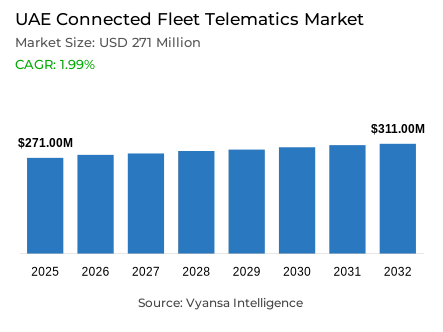
- Connected fleet telematics market size in The UAE was valued at USD 271 million in 2025 and is estimated at USD 273 million in 2026.
- The market size is expected to grow to USD 311 million by 2032.
- Market to register a CAGR of around 1.99% during 2026-32.
- Offering Shares
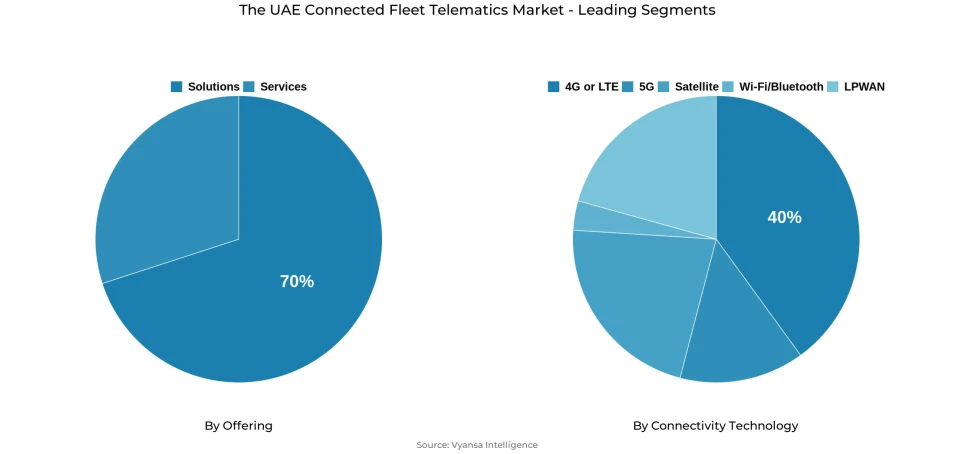
- Solutions grabbed market share of 70%.
- Competition
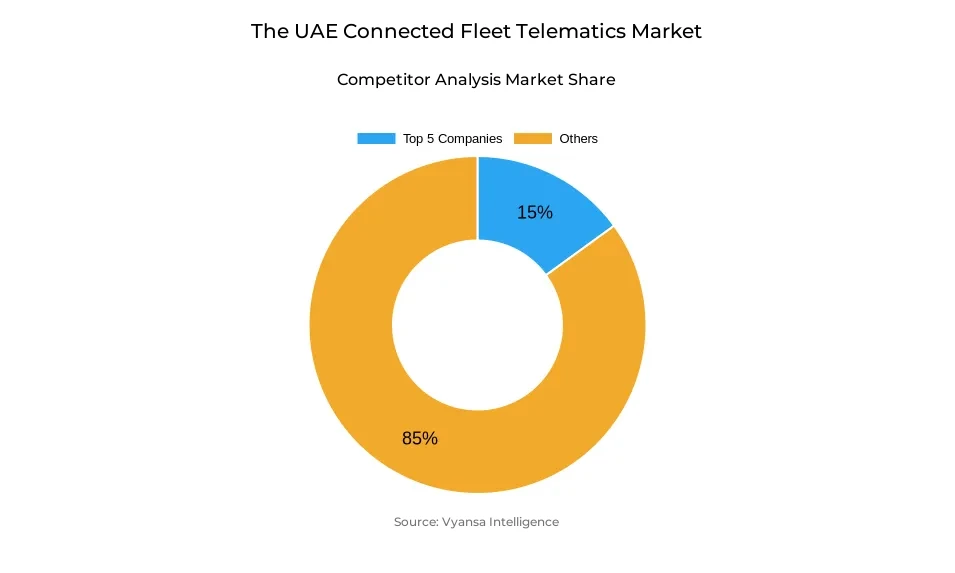
- More than 10 companies are actively engaged in producing connected fleet telematics in The UAE.
- Top 5 companies acquired around 15% of the market share in 2026.
- Microlise Group plc, Powerfleet Inc. (including brands), Inseego Corp., Telematics Wireless Ltd., Geotab Inc. etc., are few of the top companies.
- Connectivity Technology
- 4g/lte grabbed 40% of the market.
The UAE Connected Fleet Telematics Market Outlook
The UAE Connected Fleet Telematics Market size was valued at USD 271 million in 2025 and is projected to grow from USD 273 million in 2026 to USD 311 million by 2032, exhibiting a CAGR of 1.99% during the forecast period. Market growth is being supported by increasing digital transformation across transportation and logistics operations, rising demand for real-time fleet visibility, and growing adoption of connected vehicle technologies. Fleet operators are increasingly investing in telematics platforms to improve route planning, optimize vehicle utilization, enhance driver safety, and reduce operating costs across commercial transportation activities.
According to the World Bank Logistics Performance Index, the United Arab Emirates ranked 7th globally in logistics performance, reflecting the country's advanced transportation infrastructure and highly developed supply chain ecosystem. The strength of the logistics sector continues to create favorable conditions for telematics adoption across commercial transportation, logistics, and mobility operations.
Solutions account for 70% of the Offering segment, while 4G/LTE represents 40% of the Connectivity Technology segment. These shares demonstrate the growing preference for integrated fleet management platforms and reliable communication technologies that support vehicle tracking, route optimization, maintenance scheduling, diagnostics, and operational analytics. Demand remains concentrated around technologies capable of delivering greater operational visibility and efficiency improvements.
The Connected Fleet Telematics Market continues to benefit from investments in smart mobility initiatives, transportation modernization programs, and digital infrastructure development. Growing deployment of AI-enabled analytics, cloud-based fleet platforms, IoT technologies, and connected vehicle ecosystems is expected to support long-term market expansion across logistics, construction, utilities, government fleets, and commercial transportation sectors.
The UAE Connected Fleet Telematics Market Growth Driver
Smart Mobility Transformation Drives Fleet Digitalization
Government-led transportation modernization initiatives continue to support growth in the connected fleet telematics market. According to the US Department of Commerce's UAE Smart and Sustainable Mobility Country Commercial Guide, Dubai aims for 25% of all transportation trips to be autonomous by 2030. The initiative is accelerating investments in connected transportation infrastructure, intelligent mobility platforms, vehicle communication technologies, and advanced fleet management systems across the country.
The connected fleet telematics market benefits from increasing deployment of connected vehicle technologies that support real-time monitoring, route optimization, predictive maintenance, driver performance tracking, and operational analytics. As transportation operators modernize fleet operations and adopt smart mobility solutions, demand for telematics platforms is expected to increase across logistics, commercial transportation, utilities, and government fleet applications.
The UAE Connected Fleet Telematics Market Challenge
Integration Complexity of Advanced Mobility Technologies
The integration of advanced mobility technologies remains a key challenge for the connected fleet telematics market. Fleet operators increasingly need to connect telematics platforms with vehicle sensors, cloud-based management systems, AI-driven analytics tools, and broader transportation infrastructure. Ensuring seamless communication among multiple technologies and systems can be complex, particularly for organizations operating large and diverse vehicle fleets. Differences in hardware configurations, software platforms, and communication protocols can create interoperability challenges and increase deployment timelines.
The connected fleet telematics market must also address the growing complexity associated with managing large volumes of real-time operational data while maintaining system reliability and performance. Fleet operators require telematics solutions that can support continuous connectivity, accurate data transmission, predictive analytics, and remote monitoring across various operating environments. As connected mobility ecosystems continue to evolve, ensuring smooth integration between vehicles, fleet management platforms, and intelligent transportation infrastructure remains a significant challenge for market participants.
Unlock Market Intelligence
Explore the market potential with our data-driven report
The UAE Connected Fleet Telematics Market Trend
Smart Mobility Investments Accelerate Technology Adoption
Ongoing investments in digital transportation infrastructure are reshaping the connected fleet telematics market. According to the International Telecommunication Union (ITU), internet penetration exceeded 99% in 2024, making the country one of the most digitally connected markets globally. Strong digital infrastructure provides a solid foundation for the deployment of connected transportation solutions and advanced fleet management technologies.
The connected fleet telematics market is increasingly benefiting from applications such as predictive maintenance, fleet analytics, driver behavior monitoring, AI-powered route optimization, real-time diagnostics, and intelligent dispatch systems. Integration of AI, IoT, cloud computing, and advanced connectivity technologies is enabling fleet operators to improve decision-making capabilities and operational efficiency. Continued modernization of transportation networks is expected to support broader adoption of connected fleet solutions across commercial vehicle operations.
The UAE Connected Fleet Telematics Market Opportunity
Smart Mobility Ecosystem Creates New Growth Opportunities
Government-led investments in autonomous transportation, intelligent infrastructure, and connected mobility solutions continue to create favorable opportunities for the connected fleet telematics market. The UAE is actively advancing smart mobility initiatives that encourage the adoption of connected vehicles, intelligent transportation systems, digital fleet management platforms, and advanced mobility technologies across commercial transportation networks.
The connected fleet telematics market supports smart mobility ecosystems through capabilities such as vehicle tracking, dispatch optimization, route planning, remote diagnostics, asset utilization management, and operational analytics. As transportation operators continue adopting connected and data-driven mobility solutions, demand for advanced telematics platforms is expected to increase. Continued investments in intelligent transportation infrastructure and digital mobility ecosystems are expected to create substantial growth opportunities for telematics providers throughout the forecast period.
Unlock Market Intelligence
Explore the market potential with our data-driven report
The UAE Connected Fleet Telematics Market Segmentation Analysis
By Offering
- Solutions
- Embedded
- Portable
- Smartphone-based
- Services
- Professional Services
- Managed Services
Solutions account for 70% of the offering segment, making them the largest category within the connected fleet telematics market. The segment's leadership is supported by growing demand for integrated platforms that combine vehicle tracking, route optimization, maintenance scheduling, driver monitoring, compliance management, and operational analytics within a centralized environment. Fleet operators increasingly prefer comprehensive solutions that simplify management processes while improving visibility across transportation operations.
The connected fleet telematics market continues to experience strong adoption of software-driven solutions because they provide actionable insights that support productivity improvements, operational efficiency, and cost optimization initiatives. These platforms help organizations improve fuel efficiency, strengthen safety performance, reduce downtime, and enhance overall fleet utilization. As transportation companies accelerate digital transformation strategies and seek greater operational intelligence, solutions are expected to maintain their dominant position across commercial fleet management environments.
By Connectivity Technology
- 4G/LTE
- 5G
- Satellite
- Wi-Fi/Bluetooth
- LPWAN
4G/LTE represents 40% of the connectivity technology segment, establishing it as the leading connectivity platform within the connected fleet telematics market. The segment benefits from extensive network coverage, proven reliability, and the ability to support continuous communication between vehicles and fleet management systems. These characteristics make it well suited for transmitting telematics data, diagnostics information, route updates, and operational metrics in real time.
The connected fleet telematics market continues to rely heavily on 4G/LTE infrastructure because of its compatibility with existing telematics hardware and fleet management software platforms. Fleet operators value its scalability, reliability, and cost-effectiveness when deploying connected technologies across diverse vehicle fleets. Although next-generation connectivity solutions are gradually gaining traction, 4G/LTE is expected to remain a core enabler of fleet telematics operations throughout the forecast period.
List of Companies Covered in The UAE Connected Fleet Telematics Market
The companies listed below are highly influential in the The UAE connected fleet telematics market, with a significant market share and a strong impact on industry developments.
- Microlise Group plc
- Powerfleet Inc. (including brands)
- Inseego Corp.
- Telematics Wireless Ltd.
- Geotab Inc.
- Verizon Connect Inc.
- Samsara Inc.
- Trimble Inc. (including brands)
- Frotcom International S.A.
- Wialon (Gurtam)
Market News & Updates
- Powerfleet Inc., 2025:
Powerfleet expanded its Unity ecosystem following the integration of MiX Telematics, enhancing capabilities in fleet telematics, vehicle tracking, driver safety monitoring, and asset intelligence. The platform combines real-time fleet visibility, AI-powered analytics, compliance management, and operational intelligence into a unified solution. The development strengthens Powerfleet's ability to support fleet operators across the Middle East, including the UAE, where demand for connected fleet management technologies continues to increase.
- Microlise Group plc, 2025:
Microlise announced the continued expansion of its fleet management and telematics platform across international markets during 2025, including enhancements to fleet visibility, driver performance monitoring, route optimization, and compliance management capabilities. The company introduced additional AI-enabled analytics and transport intelligence features designed to improve operational efficiency and fleet utilization. These developments support growing adoption of connected fleet telematics solutions among transportation, logistics, and commercial fleet operators in the UAE.
Frequently Asked Questions
Related Report
- Market Segmentation
- Research Scope
- Research Methodology
- Definitions and Assumptions
- Executive Summary
- The UAE Connected Fleet Telematics Market Policies, Regulations, and Standards
- The UAE Connected Fleet Telematics Market Dynamics
- Growth Factors
- Challenges
- Trends
- Opportunities
- The UAE Connected Fleet Telematics Market Statistics, 2022-2032F
- Market Size & Growth Outlook
- By Revenues in USD Million
- Market Segmentation & Growth Outlook
- By Offering
- Solutions- Market Insights and Forecast 2022-2032, USD Million
- Embedded- Market Insights and Forecast 2022-2032, USD Million
- Portable- Market Insights and Forecast 2022-2032, USD Million
- Smartphone-based- Market Insights and Forecast 2022-2032, USD Million
- Services- Market Insights and Forecast 2022-2032, USD Million
- Professional Services- Market Insights and Forecast 2022-2032, USD Million
- Managed Services- Market Insights and Forecast 2022-2032, USD Million
- Solutions- Market Insights and Forecast 2022-2032, USD Million
- By Connectivity Technology
- 4G/LTE- Market Insights and Forecast 2022-2032, USD Million
- 5G- Market Insights and Forecast 2022-2032, USD Million
- Satellite- Market Insights and Forecast 2022-2032, USD Million
- Wi-Fi/Bluetooth- Market Insights and Forecast 2022-2032, USD Million
- LPWAN- Market Insights and Forecast 2022-2032, USD Million
- By Vehicle Type
- Light Commercial Vehicles- Market Insights and Forecast 2022-2032, USD Million
- Medium and Heavy Commercial Vehicles- Market Insights and Forecast 2022-2032, USD Million
- Passenger Car Fleets- Market Insights and Forecast 2022-2032, USD Million
- Buses and Coaches- Market Insights and Forecast 2022-2032, USD Million
- Off-highway Vehicles- Market Insights and Forecast 2022-2032, USD Million
- By Application
- Fleet Tracking & Visibility- Market Insights and Forecast 2022-2032, USD Million
- Driver Behavior Monitoring- Market Insights and Forecast 2022-2032, USD Million
- Vehicle Health & Predictive Maintenance- Market Insights and Forecast 2022-2032, USD Million
- Compliance & Regulatory Management- Market Insights and Forecast 2022-2032, USD Million
- Fuel and Energy Management- Market Insights and Forecast 2022-2032, USD Million
- Usage-Based Insurance (UBI)- Market Insights and Forecast 2022-2032, USD Million
- Route Optimization & Dispatch- Market Insights and Forecast 2022-2032, USD Million
- By End Users
- Transportation & Logistics- Market Insights and Forecast 2022-2032, USD Million
- Construction- Market Insights and Forecast 2022-2032, USD Million
- Mining- Market Insights and Forecast 2022-2032, USD Million
- Oil & Gas- Market Insights and Forecast 2022-2032, USD Million
- Utilities- Market Insights and Forecast 2022-2032, USD Million
- Public Transportation- Market Insights and Forecast 2022-2032, USD Million
- Government Fleets- Market Insights and Forecast 2022-2032, USD Million
- Rental & Leasing- Market Insights and Forecast 2022-2032, USD Million
- By Fleet Size
- Small Fleets (1–50 Vehicles)- Market Insights and Forecast 2022-2032, USD Million
- Medium Fleets (51–500 Vehicles)- Market Insights and Forecast 2022-2032, USD Million
- Large Fleets (>500 Vehicles)- Market Insights and Forecast 2022-2032, USD Million
- By Propulsion
- ICE Fleets- Market Insights and Forecast 2022-2032, USD Million
- Hybrid Fleets- Market Insights and Forecast 2022-2032, USD Million
- Electric Fleets- Market Insights and Forecast 2022-2032, USD Million
- By Deployment Type
- Cloud- Market Insights and Forecast 2022-2032, USD Million
- On-Premises- Market Insights and Forecast 2022-2032, USD Million
- By Region
- Dubai- Market Insights and Forecast 2022-2032, USD Million
- Abu Dhabi- Market Insights and Forecast 2022-2032, USD Million
- Sharjah- Market Insights and Forecast 2022-2032, USD Million
- Northern Emirates- Market Insights and Forecast 2022-2032, USD Million
- By Competitors
- Competition Characteristics
- Market Share & Analysis
- By Offering
- Market Size & Growth Outlook
- The UAE Solutions Market Statistics, 2022-2032
- Market Size & Growth Outlook
- By Revenues in USD Million
- Market Segmentation & Growth Outlook
- By Connectivity Technology- Market Insights and Forecast 2022-2032, USD Million
- By Vehicle Type- Market Insights and Forecast 2022-2032, USD Million
- By Application- Market Insights and Forecast 2022-2032, USD Million
- By End Users- Market Insights and Forecast 2022-2032, USD Million
- By Fleet Size- Market Insights and Forecast 2022-2032, USD Million
- By Propulsion- Market Insights and Forecast 2022-2032, USD Million
- By Deployment Type- Market Insights and Forecast 2022-2032, USD Million
- By Region- Market Insights and Forecast 2022-2032, USD Million
- Market Size & Growth Outlook
- The UAE Services Market Statistics, 2022-2032
- Market Size & Growth Outlook
- By Revenues in USD Million
- Market Segmentation & Growth Outlook
- By Connectivity Technology- Market Insights and Forecast 2022-2032, USD Million
- By Vehicle Type- Market Insights and Forecast 2022-2032, USD Million
- By Application- Market Insights and Forecast 2022-2032, USD Million
- By End Users- Market Insights and Forecast 2022-2032, USD Million
- By Fleet Size- Market Insights and Forecast 2022-2032, USD Million
- By Propulsion- Market Insights and Forecast 2022-2032, USD Million
- By Deployment Type- Market Insights and Forecast 2022-2032, USD Million
- By Region- Market Insights and Forecast 2022-2032, USD Million
- Market Size & Growth Outlook
- Competitive Outlook
- Company Profiles
- Telematics Wireless Ltd.
- Business Description
- Product Portfolio
- Collaborations & Alliances
- Recent Developments
- Financial Details
- Others
- Geotab Inc.
- Business Description
- Product Portfolio
- Collaborations & Alliances
- Recent Developments
- Financial Details
- Others
- Verizon Connect Inc.
- Business Description
- Product Portfolio
- Collaborations & Alliances
- Recent Developments
- Financial Details
- Others
- Samsara Inc.
- Business Description
- Product Portfolio
- Collaborations & Alliances
- Recent Developments
- Financial Details
- Others
- Trimble Inc. (including brands)
- Business Description
- Product Portfolio
- Collaborations & Alliances
- Recent Developments
- Financial Details
- Others
- Microlise Group plc
- Business Description
- Product Portfolio
- Collaborations & Alliances
- Recent Developments
- Financial Details
- Others
- Powerfleet Inc. (including brands)
- Business Description
- Product Portfolio
- Collaborations & Alliances
- Recent Developments
- Financial Details
- Others
- Inseego Corp.
- Business Description
- Product Portfolio
- Collaborations & Alliances
- Recent Developments
- Financial Details
- Others
- Frotcom International S.A.
- Business Description
- Product Portfolio
- Collaborations & Alliances
- Recent Developments
- Financial Details
- Others
- Wialon (Gurtam)
- Business Description
- Product Portfolio
- Collaborations & Alliances
- Recent Developments
- Financial Details
- Others
- Telematics Wireless Ltd.
- Company Profiles
- Disclaimer
| Segment | Sub-Segment |
|---|---|
| By Offering |
|
| By Connectivity Technology |
|
| By Vehicle Type |
|
| By Application |
|
| By End Users |
|
| By Fleet Size |
|
| By Propulsion |
|
| By Deployment Type |
|
| By Region |
|
Research Methodology
This study followed a structured approach comprising four key phases to assess the size and scope of the electro-oxidation market. The process began with thorough secondary research to collect data on the target market, related markets, and broader industry context. These findings, along with preliminary assumptions and estimates, were then validated through extensive primary research involving industry experts from across the value chain. To calculate the overall market size, both top-down and bottom-up methodologies were employed. Finally, market segmentation and data triangulation techniques were applied to refine and validate segment-level estimations.
Secondary Research
The secondary research phase involved gathering data from a wide range of credible and published sources. This step helped in identifying industry trends, defining market segmentation, and understanding the market landscape and value chain.
Sources consulted during this phase included:
- Company annual reports, investor presentations, and press releases
- Industry white papers and certified publications
- Trade directories and market-recognized databases
- Articles from authoritative authors and reputable journals
- Gold and silver standard websites
Secondary research was critical in mapping out the industry's value chain and monetary flow, identifying key market segments, understanding regional variations, and tracking significant industry developments.
Other key sources:
- Financial disclosures
- Industry associations and trade bodies
- News outlets and business magazines
- Academic journals and research studies
- Paid industry databases
Primary Research
To validate secondary data and gain deeper market insights, primary research was conducted with key stakeholders across both the supply and demand sides of the market.
On the demand side, participants included decision-makers and influencers from end-user industries—such as CIOs, CTOs, and CSOs—who provided first-hand perspectives on market needs, product usage, and future expectations.
On the supply side, interviews were conducted with manufacturers, industry associations, and institutional participants to gather insights into current offerings, product pipelines, and market challenges.
Primary interviews provided critical inputs such as:
- Market size and revenue data
- Product and service breakdowns
- Market forecasts
- Regional and application-specific trends
Stakeholders consulted included:
- Leading OEM and solution providers
- Channel and distribution partners
- End users across various applications
- Independent consultants and industry specialists
Market Size Estimation and Data Triangulation
- Identifying Key Market Participants (Secondary Research)
- Goal: To identify the major players or companies in the target market. This typically involves using publicly available data sources such as industry reports, market research publications, and financial statements of companies.
- Tools: Reports from firms like Gartner, Forrester, Euromonitor, Statista, IBISWorld, and others. Public financial statements, news articles, and press releases from top market players.
- Extracting Earnings of Key Market Participants
- Goal: To estimate the earnings generated from the product or service being analyzed. This step helps in understanding the revenue potential of each market player in a specific geography.
- Methods: Earnings data can be gathered from:
- Publicly available financial reports (for listed companies).
- Interviews and primary data sources from professionals, such as Directors, VPs, SVPs, etc. This is especially useful for understanding more nuanced, internal data that isn't publicly disclosed.
- Annual reports and investor presentations of key players.
- Data Collation and Development of a Relevant Data Model
- Goal: To collate inputs from both primary and secondary sources into a structured, data-driven model for market estimation. This model will incorporate key market KPIs and any independent variables relevant to the market.
- Key KPIs: These could include:
- Market size, growth rate, and demand drivers.
- Industry-specific metrics like market share, average revenue per customer (ARPC), or average deal size.
- External variables, such as economic growth rates, inflation rates, or commodity prices, that could affect the market.
- Data Modeling: Based on this data, the market forecasts are developed for the next 5 years. A combination of trend analysis, scenario modeling, and statistical regression might be used to generate projections.
- Scenario Analysis
- Goal: To test different assumptions and validate how sensitive the market is to changes in key variables (e.g., market demand, regulatory changes, technological disruptions).
- Types of Scenarios:
- Base Case: Based on current assumptions and historical data.
- Best-Case Scenario: Assuming favorable market conditions, regulatory environments, and technological advancements.
- Worst-Case Scenario: Accounting for adverse factors, such as economic downturns, stricter regulations, or unexpected disruptions.












