Thailand Juice Market Report: Trends, Growth and Forecast (2026-2032)
By Category (100% Juice (Not from Concentrate, Reconstituted), Juice Drinks (up to 24% Juice), Nectars (High Concentration (40% to 50% fruit content), Medium Concentration (30% to 39% fruit content), Low Concentration (25% to 29% fruit content)), Vegetable Juice, Fruit and Vegetable Blends), By Nature (Conventional, Organic), By Packaging Material (Plastic, Glass, Metal, Others), By Packaging Type (PET Bottles, Aseptic Packages (Cartons), Glass Bottles, Metal Cans, Disposable Cups & Pouches), By Sales Channel (Off-Trade (Hypermarkets/ Supermarkets, Retail Outlets, Convenience Stores, Online Platforms), On-Trade) ... Read more

|
Major Players
|
Thailand Juice Market Statistics and Insights, 2026
- Market Size Statistics
- Juice market size in Thailand was estimated at USD 745 million in 2025.
- The market size is expected to grow to USD 875 million by 2032.
- Market to register a CAGR of around 2.32% during 2026-32.
- Category Shares
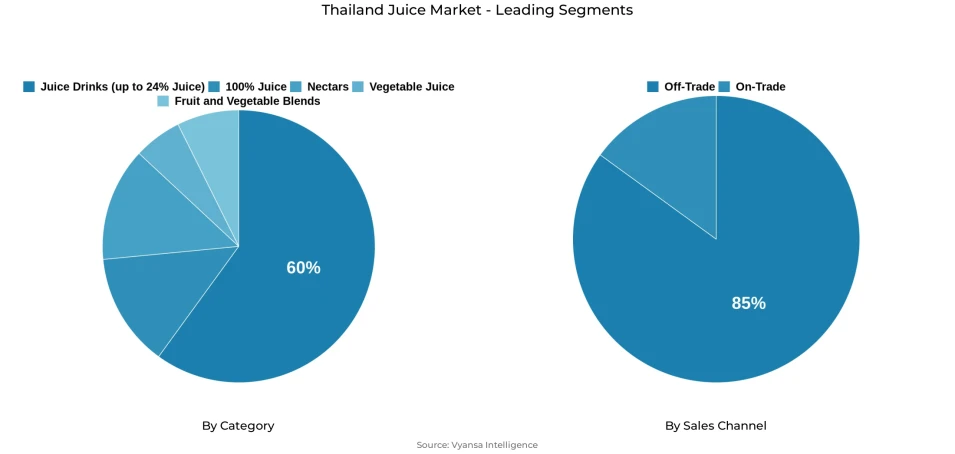
- Juice drinks (up to 24% juice) grabbed market share of 60%.
- Competition
- More than 15 companies are actively engaged in producing juice in Thailand.
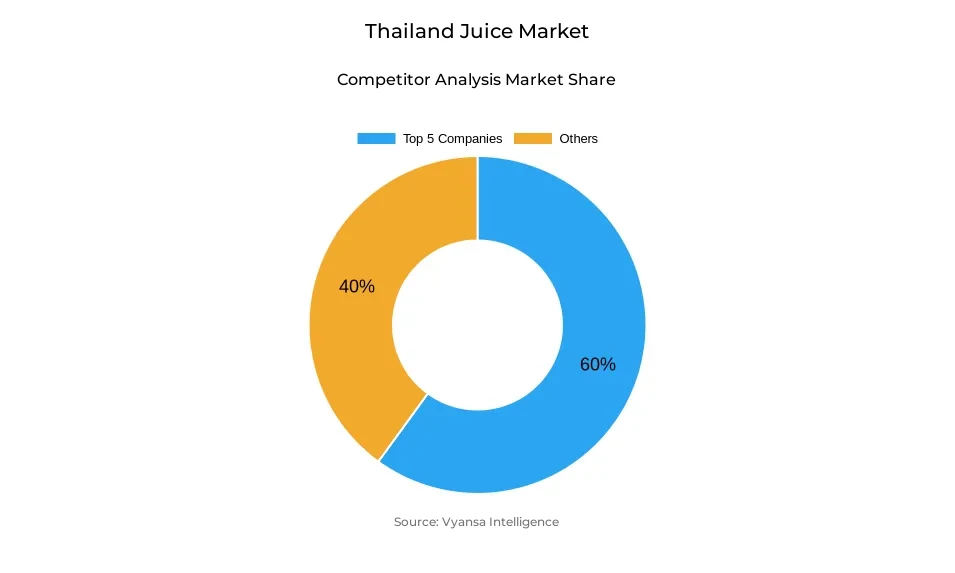
- Top 5 companies acquired around 60% of the market share.
- Doi Kham Food Product Co Ltd, Uni-President (Thailand) Co Ltd, Sappe Plc Co Ltd, Coca-Cola (Thailand) Ltd, FoodStar Inc etc., are few of the top companies.
- Sales Channel
- Off-trade grabbed 85% of the market.
Thailand Juice Market Outlook
The Thailand Juice Market size was valued at USD 745 million in 2025 and is projected to grow from USD 762 million in 2026 to USD 875 million by 2032, exhibiting a CAGR of approximately 2.32% during the forecast period. While the sector faced stagnant volume growth in 2025 due to economic uncertainty and unseasonably cool weather, the outlook remains cautiously optimistic as brands pivot toward health-focused innovation and premiumisation to navigate shifting consumer priorities.
Consumer preferences are increasingly leaning toward value-added products, even as juice drinks (up to 24% juice) grabbed market share of 60%. This dominant segment is currently being reshaped by the final phase of Thailand’s sugar excise tax, which implemented stricter thresholds in April 2025. In response, manufacturers are actively reformulating these popular beverages with reduced sugar and natural sweeteners to maintain affordability while appealing to health-conscious buyers.
The distribution landscape remains highly concentrated in retail, where off-trade grabbed 85% of the market. Small local grocers and convenience stores like 7-Eleven continue to serve as the primary channels for mass-market products, though modern trade and e-commerce are gaining ground as premium hubs. These channels allow brands like Malee and Tipco to showcase functional juice offerings that feature added micronutrients, such as vitamin C and lycopene, to justify higher price points.
Future growth will be driven by structural shifts toward wellness-oriented categories, particularly coconut and plant-based waters. As the era of "just fruit juice" recedes, success will depend on integrating functional benefits and innovative packaging that resonates with the identity of modern Thai consumers. By reframing juice as a daily supplement rather than a simple refreshment, the industry is poised to achieve selective value expansion despite ongoing demographic and regulatory challenges.
Thailand Juice Market Growth DriverSugar Tax Forces Low-Sugar Reformulation
The excise policy on sugary drinks in Thailand requires juice producers to reduce the amount of sugar in their products to save money. The tax was introduced in 2017 and is tiered based on sugar concentration: beverages with less than 6g of sugar per 100ml are free; those with 6-14g of sugar per 100ml are taxed at a low rate; those with 14g of sugar per 100ml are taxed at a moderate rate. The policy extends to fruit and vegetable juices and other ready-to-drink products, which forces producers to redesign their recipes to avoid paying increased levies.
This scheme includes fruit and vegetable juices and other ready-to-drink products, and thus producers re-formulate recipes to evade increased levies. Thailand has these tiered thresholds in the last phase effective April 2025. Manufacturers have already moved to low-sugar formulations; high-sugar items have been virtually eliminated. This validates the reaction of manufacturers to the policy and a market shift to lower-sugar juice products.
Thailand Juice Market ChallengeHigh Household Debt Limits Spending
The high household debt limits the spending capacity and makes juice a luxury that can be easily sacrificed. According to the Bank of Thailand, household debt was estimated at about 90.7% of GDP in mid-2023, far exceeding the 80% mark that BIS studies have found to be sufficient to severely hinder long-run growth. This debt load restricts the ability to make frequent purchases of more expensive juices and higher quality versions.
Indications of financial constraint can be observed in larger consumption. According to the Financial Stability Report (2024) by the BoT, the purchasing power of low-income households has been on the decline, and already shoppers are downsizing or switching to less expensive drinks. Juice does not compete as well in this environment compared to value-heavy products like RTD tea or energy drinks purchased to get an immediate refreshment.
Unlock Market Intelligence
Explore the market potential with our data-driven report
Thailand Juice Market TrendE-Commerce Enables Premium Discovery
Retail online shopping is also growing in Thailand, which makes digital channels more and more topical when it comes to beverages that depend on assortment and convenience, but not only on price. In 2022, e-transactions amounted to 5.43 trillion baht and continue to increase. Mobile and e-wallet payments are the new standard. Although local grocery and convenience stores still control the mass sale of juices, retail online and modern-trade channels are necessary in the premium segments.
In the case of juice, this trend favors high-end and utility SKUs that are not able to compete in convenience-store refrigerators. Digital shelves enable more products, limited editions, and customized wellness bundles, and focused promotions and subscriptions speed up discovery and trial. With end users adopting fast delivery and cashless payment, the premium juice brands can use retail online presence to create repeat sales, and then roll out successful products to supermarkets and specialty stores at a higher price point.
Thailand Juice Market OpportunityPlant Waters Capture Wellness Shift
The health issues of sugar are changing the beverage choices to the lighter ones. The average Thai, according to AP News, eats 21 teaspoons of sugar daily, more than three times the six teaspoons recommended by the WHO. As approximately 45% of Thai adults are now obese and 10% diabetic (2025 data), the market is growing in demand of lower-sugar hydration beverages.
Coconut and other plant waters are in line with this change. They are generally viewed as healthy, more natural, and healthier substitutes to sweet soft drinks and sports drinks. In May 2025, the trade promotion agency of Thailand pointed out that the highest rated coconut-water brands in U.S. taste tests are sourced in Thailand. Juice brands can premiumise the coconut-water lines by highlighting Thai provenance, clean labels, and functional benefits like electrolytes and vitamins and tap into the growing wellness-oriented market.
Unlock Market Intelligence
Explore the market potential with our data-driven report
Thailand Juice Market Segmentation Analysis
By Category
- 100% Juice
- Not from Concentrate
- Reconstituted
- Juice Drinks (up to 24% Juice)
- Nectars
- High Concentration (40% to 50% fruit content)
- Medium Concentration (30% to 39% fruit content)
- Low Concentration (25% to 29% fruit content)
- Vegetable Juice
- Fruit and Vegetable Blends
The segment with highest market share under Category is juice-drink (up to 24% juice) , with about 60% of the market share. This supremacy is mostly fueled by the accessibility of the mass-market and the high presence of brands like FoodStar (Deedo). These are casual refreshment products that enjoy deep distribution in the neighbourhood convenience stores and local grocers where price sensitivity and immediate availability are the key determinants of end user preference.
This 60% share segment will be a key testing ground of new sensory experiences as the market matures through 2032. These lower-percentage juices are likely to have manufacturers adding textures like jellies or bits of fruit to keep end users interested in them as competition increases with RTD teas and energy drinks. Although 100% juice and plant waters target the high-end wellness market, the juice-drink segment is the volume driver as it offers affordable and flavourful diversity to the larger Thai market.
By Sales Channel
- Off-Trade
- Hypermarkets/ Supermarkets
- Retail Outlets
- Convenience Stores
- Online Platforms
- On-Trade
The Off-Trade segment that captured 85% of the market is the largest share in the sales channel. The power of this channel lies in the bifurcated retail environment of Thailand, where convenience stores and small local grocers are the main points of contact when it comes to daily refreshment. These stores are needed to support the high-volume, low-percentage juice beverages that depend on frequency and impulse purchases, particularly in areas not in the major urban centres where traditional trade is the staple of the economy.
In the Off-Trade sector, the new trade channels like the supermarkets and the fast expanding retail retail online market are taking over the premiumisation engines. These platforms enable brands to emphasize practical advantages and quality ingredients, which can help them to maintain a value-added positioning that resonates with urban, health-conscious end users. Although mass channels will keep the volume, the transition to discovery-based shopping in the contemporary retail is what will allow the Off-Trade segment to retain its leading 85% share as the end user preferences shift towards wellness.
List of Companies Covered in Thailand Juice Market
The companies listed below are highly influential in the Thailand juice market, with a significant market share and a strong impact on industry developments.
- Doi Kham Food Product Co Ltd
- Uni-President (Thailand) Co Ltd
- Sappe Plc Co Ltd
- Coca-Cola (Thailand) Ltd
- FoodStar Inc
- House Osotspa Food Co Ltd
- Malee Sampran Plc
- Tipco Foods (Thailand) PCL
- General Beverage Co Ltd
- Nongkhai Power Drink Co Ltd
Competitive Landscape
Thailand’s juice market is bifurcated between mass and premium strategies amid stagnant volumes. FoodStar leads overall through its Deedo brand in juice drinks up to 24% juice, competing on accessibility and scale in small grocers and convenience stores. Malee is gaining share via premiumisation and R&D-led health positioning, while Tipco differentiates through wellness branding, no added sugar lines, and lifestyle collaborations. Asiatic Agro’s CocoMax is the most dynamic player, capitalising on rapid growth in coconut and plant waters aligned with hydration and wellness trends, while Chabaa pivots toward emotional rebranding for broader appeal. Indirect competition from RTD tea and energy drinks remains intense. Differentiation opportunities centre on functional fortification, sugar tax compliant reformulation, hybrid sparkling formats, and identity driven packaging innovation.
Frequently Asked Questions
Related Report
- Market Segmentation
- Research Scope
- Research Methodology
- Definitions and Assumptions
- Executive Summary
- Thailand Juice Market Policies, Regulations, and Standards
- Thailand Juice Market Dynamics
- Growth Factors
- Challenges
- Trends
- Opportunities
- Thailand Juice Market Statistics, 2022-2032F
- Market Size & Growth Outlook
- By Revenues in USD Million
- By Quantity Sold in Million Litres
- Market Segmentation & Growth Outlook
- By Category
- 100% Juice- Market Insights and Forecast 2022-2032, USD Million
- Not from Concentrate- Market Insights and Forecast 2022-2032, USD Million
- Reconstituted- Market Insights and Forecast 2022-2032, USD Million
- Juice Drinks (up to 24% Juice)- Market Insights and Forecast 2022-2032, USD Million
- Nectars- Market Insights and Forecast 2022-2032, USD Million
- High Concentration (40% to 50% fruit content)- Market Insights and Forecast 2022-2032, USD Million
- Medium Concentration (30% to 39% fruit content)- Market Insights and Forecast 2022-2032, USD Million
- Low Concentration (25% to 29% fruit content)- Market Insights and Forecast 2022-2032, USD Million
- Vegetable Juice- Market Insights and Forecast 2022-2032, USD Million
- Fruit and Vegetable Blends- Market Insights and Forecast 2022-2032, USD Million
- 100% Juice- Market Insights and Forecast 2022-2032, USD Million
- By Nature
- Conventional- Market Insights and Forecast 2022-2032, USD Million
- Organic- Market Insights and Forecast 2022-2032, USD Million
- By Packaging Material
- Plastic- Market Insights and Forecast 2022-2032, USD Million
- Glass- Market Insights and Forecast 2022-2032, USD Million
- Metal- Market Insights and Forecast 2022-2032, USD Million
- Others- Market Insights and Forecast 2022-2032, USD Million
- By Packaging Type
- PET Bottles- Market Insights and Forecast 2022-2032, USD Million
- Aseptic Packages (Cartons)- Market Insights and Forecast 2022-2032, USD Million
- Glass Bottles- Market Insights and Forecast 2022-2032, USD Million
- Metal Cans- Market Insights and Forecast 2022-2032, USD Million
- Disposable Cups & Pouches- Market Insights and Forecast 2022-2032, USD Million
- By Sales Channel
- Off-Trade- Market Insights and Forecast 2022-2032, USD Million
- Hypermarkets/ Supermarkets - Market Insights and Forecast 2022-2032, USD Million
- Retail Outlets - Market Insights and Forecast 2022-2032, USD Million
- Convenience Stores- Market Insights and Forecast 2022-2032, USD Million
- Online Platforms- Market Insights and Forecast 2022-2032, USD Million
- On-Trade- Market Insights and Forecast 2022-2032, USD Million
- Off-Trade- Market Insights and Forecast 2022-2032, USD Million
- By Competitors
- Competition Characteristics
- Market Share & Analysis
- By Category
- Market Size & Growth Outlook
- Thailand 100% Juice Market Statistics, 2022-2032
- Market Size & Growth Outlook
- By Revenues in USD Million
- By Quantity Sold in Million Litres
- Market Segmentation & Growth Outlook
- By Nature- Market Insights and Forecast 2022-2032, USD Million
- By Packaging Material- Market Insights and Forecast 2022-2032, USD Million
- By Packaging Type- Market Insights and Forecast 2022-2032, USD Million
- By Sales Channel- Market Insights and Forecast 2022-2032, USD Million
- Market Size & Growth Outlook
- Thailand Juice Drinks (up to 24% Juice) Market Statistics, 2022-2032
- Market Size & Growth Outlook
- By Revenues in USD Million
- By Quantity Sold in Million Litres
- Market Segmentation & Growth Outlook
- By Nature- Market Insights and Forecast 2022-2032, USD Million
- By Packaging Material- Market Insights and Forecast 2022-2032, USD Million
- By Packaging Type- Market Insights and Forecast 2022-2032, USD Million
- By Sales Channel- Market Insights and Forecast 2022-2032, USD Million
- Market Size & Growth Outlook
- Thailand Nectars Market Statistics, 2022-2032
- Market Size & Growth Outlook
- By Revenues in USD Million
- By Quantity Sold in Million Litres
- Market Segmentation & Growth Outlook
- By Nature- Market Insights and Forecast 2022-2032, USD Million
- By Packaging Material- Market Insights and Forecast 2022-2032, USD Million
- By Packaging Type- Market Insights and Forecast 2022-2032, USD Million
- By Sales Channel- Market Insights and Forecast 2022-2032, USD Million
- Market Size & Growth Outlook
- Thailand Vegetable Juice Market Statistics, 2022-2032
- Market Size & Growth Outlook
- By Revenues in USD Million
- By Quantity Sold in Million Litres
- Market Segmentation & Growth Outlook
- By Nature- Market Insights and Forecast 2022-2032, USD Million
- By Packaging Material- Market Insights and Forecast 2022-2032, USD Million
- By Packaging Type- Market Insights and Forecast 2022-2032, USD Million
- By Sales Channel- Market Insights and Forecast 2022-2032, USD Million
- Market Size & Growth Outlook
- Thailand Fruit and Vegetable Blends Market Statistics, 2022-2032
- Market Size & Growth Outlook
- By Revenues in USD Million
- By Quantity Sold in Million Litres
- Market Segmentation & Growth Outlook
- By Nature- Market Insights and Forecast 2022-2032, USD Million
- By Packaging Material- Market Insights and Forecast 2022-2032, USD Million
- By Packaging Type- Market Insights and Forecast 2022-2032, USD Million
- By Sales Channel- Market Insights and Forecast 2022-2032, USD Million
- Market Size & Growth Outlook
- Competitive Outlook
- Company Profiles
- Coca-Cola (Thailand) Ltd
- Business Description
- Product Portfolio
- Collaborations & Alliances
- Recent Developments
- Financial Details
- Others
- FoodStar Inc
- Business Description
- Product Portfolio
- Collaborations & Alliances
- Recent Developments
- Financial Details
- Others
- House Osotspa Food Co Ltd
- Business Description
- Product Portfolio
- Collaborations & Alliances
- Recent Developments
- Financial Details
- Others
- Malee Sampran Plc
- Business Description
- Product Portfolio
- Collaborations & Alliances
- Recent Developments
- Financial Details
- Others
- Tipco Foods (Thailand) PCL
- Business Description
- Product Portfolio
- Collaborations & Alliances
- Recent Developments
- Financial Details
- Others
- Doi Kham Food Product Co Ltd
- Business Description
- Product Portfolio
- Collaborations & Alliances
- Recent Developments
- Financial Details
- Others
- Uni-President (Thailand) Co Ltd
- Business Description
- Product Portfolio
- Collaborations & Alliances
- Recent Developments
- Financial Details
- Others
- Sappe Plc Co Ltd
- Business Description
- Product Portfolio
- Collaborations & Alliances
- Recent Developments
- Financial Details
- Others
- General Beverage Co Ltd
- Business Description
- Product Portfolio
- Collaborations & Alliances
- Recent Developments
- Financial Details
- Others
- Nongkhai Power Drink Co Ltd
- Business Description
- Product Portfolio
- Collaborations & Alliances
- Recent Developments
- Financial Details
- Others
- Coca-Cola (Thailand) Ltd
- Company Profiles
- Disclaimer
| Segment | Sub-Segment |
|---|---|
| By Category |
|
| By Nature |
|
| By Packaging Material |
|
| By Packaging Type |
|
| By Sales Channel |
|
Research Methodology
This study followed a structured approach comprising four key phases to assess the size and scope of the electro-oxidation market. The process began with thorough secondary research to collect data on the target market, related markets, and broader industry context. These findings, along with preliminary assumptions and estimates, were then validated through extensive primary research involving industry experts from across the value chain. To calculate the overall market size, both top-down and bottom-up methodologies were employed. Finally, market segmentation and data triangulation techniques were applied to refine and validate segment-level estimations.
Secondary Research
The secondary research phase involved gathering data from a wide range of credible and published sources. This step helped in identifying industry trends, defining market segmentation, and understanding the market landscape and value chain.
Sources consulted during this phase included:
- Company annual reports, investor presentations, and press releases
- Industry white papers and certified publications
- Trade directories and market-recognized databases
- Articles from authoritative authors and reputable journals
- Gold and silver standard websites
Secondary research was critical in mapping out the industry's value chain and monetary flow, identifying key market segments, understanding regional variations, and tracking significant industry developments.
Other key sources:
- Financial disclosures
- Industry associations and trade bodies
- News outlets and business magazines
- Academic journals and research studies
- Paid industry databases
Primary Research
To validate secondary data and gain deeper market insights, primary research was conducted with key stakeholders across both the supply and demand sides of the market.
On the demand side, participants included decision-makers and influencers from end-user industries—such as CIOs, CTOs, and CSOs—who provided first-hand perspectives on market needs, product usage, and future expectations.
On the supply side, interviews were conducted with manufacturers, industry associations, and institutional participants to gather insights into current offerings, product pipelines, and market challenges.
Primary interviews provided critical inputs such as:
- Market size and revenue data
- Product and service breakdowns
- Market forecasts
- Regional and application-specific trends
Stakeholders consulted included:
- Leading OEM and solution providers
- Channel and distribution partners
- End users across various applications
- Independent consultants and industry specialists
Market Size Estimation and Data Triangulation
- Identifying Key Market Participants (Secondary Research)
- Goal: To identify the major players or companies in the target market. This typically involves using publicly available data sources such as industry reports, market research publications, and financial statements of companies.
- Tools: Reports from firms like Gartner, Forrester, Euromonitor, Statista, IBISWorld, and others. Public financial statements, news articles, and press releases from top market players.
- Extracting Earnings of Key Market Participants
- Goal: To estimate the earnings generated from the product or service being analyzed. This step helps in understanding the revenue potential of each market player in a specific geography.
- Methods: Earnings data can be gathered from:
- Publicly available financial reports (for listed companies).
- Interviews and primary data sources from professionals, such as Directors, VPs, SVPs, etc. This is especially useful for understanding more nuanced, internal data that isn't publicly disclosed.
- Annual reports and investor presentations of key players.
- Data Collation and Development of a Relevant Data Model
- Goal: To collate inputs from both primary and secondary sources into a structured, data-driven model for market estimation. This model will incorporate key market KPIs and any independent variables relevant to the market.
- Key KPIs: These could include:
- Market size, growth rate, and demand drivers.
- Industry-specific metrics like market share, average revenue per customer (ARPC), or average deal size.
- External variables, such as economic growth rates, inflation rates, or commodity prices, that could affect the market.
- Data Modeling: Based on this data, the market forecasts are developed for the next 5 years. A combination of trend analysis, scenario modeling, and statistical regression might be used to generate projections.
- Scenario Analysis
- Goal: To test different assumptions and validate how sensitive the market is to changes in key variables (e.g., market demand, regulatory changes, technological disruptions).
- Types of Scenarios:
- Base Case: Based on current assumptions and historical data.
- Best-Case Scenario: Assuming favorable market conditions, regulatory environments, and technological advancements.
- Worst-Case Scenario: Accounting for adverse factors, such as economic downturns, stricter regulations, or unexpected disruptions.












