Thailand Energy Drink Market Report: Trends, Growth and Forecast (2025-2030)
By Product Type (Alcoholic, Non-Alcoholic), By Consumption (Drinks, Shots, Mixers), By Nature (Conventional, Natural/Organic), By Flavour (Flavoured, Unflavoured), By Packaging (Bottles, Metal Cans, Pouches, Others), By Packaging Size (Small, Medium, Large), By End User (Teenagers, Adults, Geriatric), By Sales Channel (On-Trade, Off-Trade) ... Read more
|
Major Players
|
Thailand Energy Drink Market Statistics, 2025
- Market Size Statistics
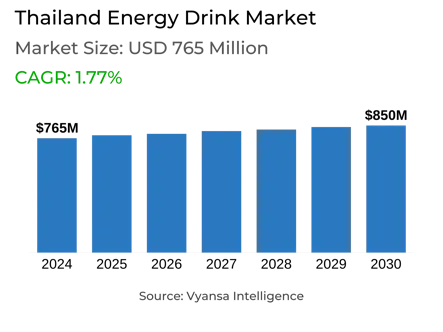
- Energy Drink in Thailand is estimated at $ 765 Million.
- The market size is expected to grow to $ 850 Million by 2030.
- Market to register a CAGR of around 1.77% during 2025-30.
- Product Shares
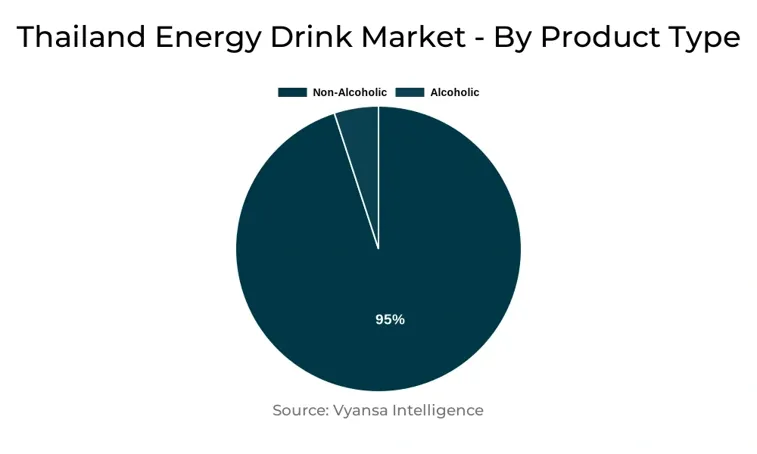
- Non Alcoholic Energy Drinks grabbed market share of 95%.
- Non Alcoholic Energy Drinks to witness a volume CAGR of around 1.03%.
- Competition
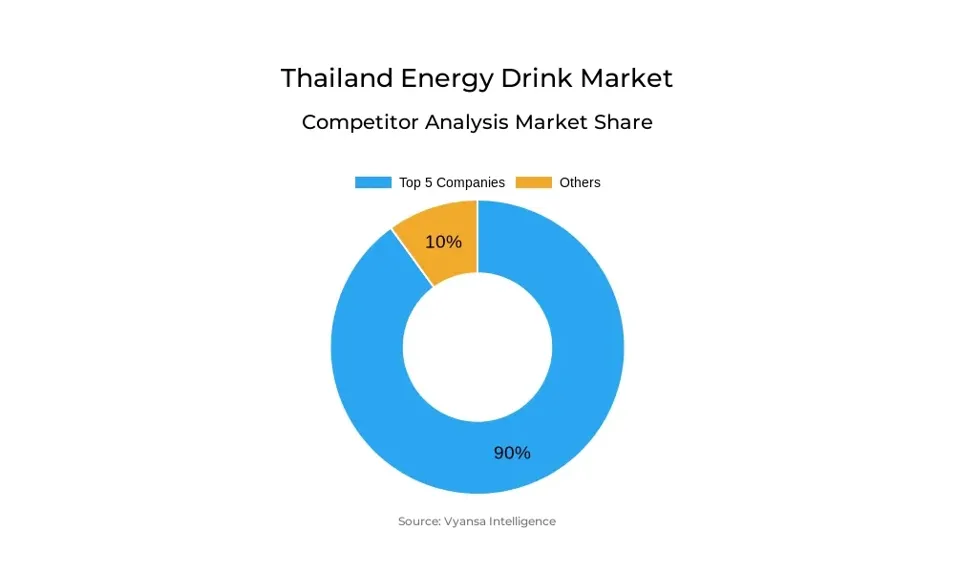
- More than 5 companies are actively engaged in producing Energy Drink in Thailand.
- Top 5 companies acquired 90% of the market share.
- TC Pharmaceutical Industry Co Ltd, Siam Winery Co Ltd, Thai Beverage PCL, Osotspa Co Ltd, Carabao Tawandang Co Ltd etc., are few of the top companies.
- Sales Channel
- Off-Trade grabbed 75% of the market.
Thailand Energy Drink Market Outlook
The Thai energy drinks market will be expected to experience steady growth during 2025-2030, with energy drinks being rebranded and appealing to new customer segments in a continuing drive. Historically linked to blue-collar workers, energy drinks are being repositioned using lifestyle marketing, new packaging sizes, and health-linked ingredients. Brands are attempting to counteract unfavourable health perceptions by introducing reduced-sugar and functional versions, hoping to appeal to office workers, older people, and health-oriented consumers.
Packaging innovation is at the forefront of this revolution. As glass bottles remain serving the premium and economy segments, the trend towards metal cans and PET bottles is on the increase. Players such as Carabao, M-150, and Sting have engaged with new formats of packaging to distinguish their products and uplift their shelf presence. Additionally, projects such as the TCP Legacy Museum are assisting in informing consumers and promoting brand image, which may extend the market beyond its existing niche.
Pricing strategies continue to be at the heart of brand competitiveness, particularly with the new Phase 4 sugar tax in 2025. Brands that keep prices at or below THB10 are likely to do better in volume sales, such as Carabao, TCP, and Ichitan's TAN Power. Conversely, price hikes by M-150 have lifted market value but restrained volume growth, highlighting the need for price stability.
Besides competition in the category, energy drinks also encounter increasing competition from functional drinks like energy-infused water and juices. Yet, sustained innovation in flavours, health benefits, and packaging will continue to keep energy drinks in the limelight and sustain modest yet consistent growth in Thailand until 2030.
Thailand Energy Drink Market Growth Driver
The introduction of phase four of the sugar tax in 2025 is forcing profound shifts in the energy drinks sector. With standard rates of taxation on products with 8% to 14% sugar, manufacturers are facing mounting pressure to recalculate formulas and control cost increases. The two-yearly hikes in taxation rates have prompted brands to launch lower sugar alternatives, especially within the premium category, as a way to stay in line while maintaining profitability.
As this response, pricing strategy has emerged as an important competitive weapon. Players such as Carabao and TCP have kept their prices flat at THB10 in the face of inflation and rising production costs, allowing them to increase volume. Ichitan has also come into the segment with TAN Power for THB10, aiming to expand nationwide. Conversely, M-150's incremental price hikes have contributed to market value growth but not volume, demonstrating the strength of price stability in sustaining consumer demand.
Thailand Energy Drink Market Trend
Energy drink manufacturers are turning towards innovation to address the increasing demand for healthier alternatives. Ready has launched premium products such as Ready Blink with lemon-lychee flavor, which includes added vitamin E and collagen for maintaining skin health. This goes in line with increased consumer interest in beauty and wellness. Likewise, Carabao launched Kanzo in 2022, focusing on liver health with chicken liver extract and subsequently reformulated its core product Carabao Dang with four times the vitamin B12 for greater functionality.
Health issues and the incoming phase of sugar tax are compelling brands to embrace lower sugar versions. G-Beat now has beverages with 0% sugar and green tea natural caffeine, and vitamins are added. Other companies such as Rockstar, Red Bull, and Ready are also launching sugar-free alternatives to tap into changing tastes. This emphasis on functional and healthier products will influence product plans throughout the forecast period.
Unlock Market Intelligence
Explore the market potential with our data-driven report
| Report Coverage | Details |
|---|---|
| Market Forecast | 2025-30 |
| USD Value 2024 | $ 765 Million |
| USD Value 2030 | $ 850 Million |
| CAGR 2025-2030 | 1.77% |
| Largest Category | Non Alcoholic Energy Drinks segment leads with 95% market share |
| Top Drivers | Sugar Tax Phase Fuels Innovation and Strategic Pricing Among Energy Drink Players |
| Top Trends | Functional Innovation and Reduced Sugar Variants Drive Product Development |
| Key Players | TC Pharmaceutical Industry Co Ltd, Siam Winery Co Ltd, Thai Beverage PCL, Osotspa Co Ltd, Carabao Tawandang Co Ltd, Coca-Cola (Thailand) LTD, Taisho Pharmaceutical (Thailand) Co., Ltd, Serm Suk Public Company Limited and Others. |
Unlock Market Intelligence
Explore the market potential with our data-driven report
Thailand Energy Drink Market Segmentation Analysis
The most market-share holding segment under the packaging segment in the Thailand Energy Drinks Market is Metal Cans. This transition shows how the brands are embracing intense competition by going away from conventional packaging styles. Previously, energy drinks used to be sold in small-sized glass bottles targeting both economy and premium consumers. But the introduction of Carabao's premium energy drink in a metal can was the game-changer, raising the bar in the industry.
In line with this trend, major players such as M-150 also ventured into their premium variants in metal cans, contributing to the competitive force. While new entrants such as Sting first introduced their product in PET bottles, emphasizing further experimentation in packaging. This ongoing innovation in packaging will most probably continue, as companies seek to differentiate and appeal to a broader audience. Packaging innovation is a core strategy to achieve a market advantage.
Top Companies in Thailand Energy Drink Market
The top companies operating in the market include TC Pharmaceutical Industry Co Ltd, Siam Winery Co Ltd, Thai Beverage PCL, Osotspa Co Ltd, Carabao Tawandang Co Ltd, Coca-Cola (Thailand) LTD, Taisho Pharmaceutical (Thailand) Co., Ltd, Serm Suk Public Company Limited, etc., are the top players operating in the Thailand Energy Drink Market.
Frequently Asked Questions
Related Report
1. Market Segmentation
1.1. Research Scope
1.2. Research Methodology
1.3. Definitions and Assumptions
2. Executive Summary
3. Thailand Energy Drinks Market Policies, Regulations, and Standards
4. Thailand Energy Drinks Market Dynamics
4.1. Growth Factors
4.2. Challenges
4.3. Trends
4.4. Opportunities
5. Thailand Energy Drinks Market Statistics, 2020-2030F
5.1. Market Size & Growth Outlook
5.1.1.By Revenues in US$ Million
5.1.2.By Quantity Sold (Million Liters)
5.2. Market Segmentation & Growth Outlook
5.2.1.By Product Type
5.2.1.1. Alcoholic- Market Insights and Forecast 2020-2030, USD Million
5.2.1.2. Non-Alcoholic- Market Insights and Forecast 2020-2030, USD Million
5.2.2.By Consumption
5.2.2.1. Drinks- Market Insights and Forecast 2020-2030, USD Million
5.2.2.2. Shots- Market Insights and Forecast 2020-2030, USD Million
5.2.2.3. Mixers- Market Insights and Forecast 2020-2030, USD Million
5.2.3.By Nature
5.2.3.1. Conventional- Market Insights and Forecast 2020-2030, USD Million
5.2.3.2. Natural/Organic- Market Insights and Forecast 2020-2030, USD Million
5.2.4.By Flavour
5.2.4.1. Flavoured- Market Insights and Forecast 2020-2030, USD Million
5.2.4.2. Unflavoured- Market Insights and Forecast 2020-2030, USD Million
5.2.5.By Packaging
5.2.5.1. Bottles- Market Insights and Forecast 2020-2030, USD Million
5.2.5.1.1. PET Bottles- Market Insights and Forecast 2020-2030, USD Million
5.2.5.1.2. Glass Bottles- Market Insights and Forecast 2020-2030, USD Million
5.2.5.2. Metal Cans- Market Insights and Forecast 2020-2030, USD Million
5.2.5.3. Pouches- Market Insights and Forecast 2020-2030, USD Million
5.2.5.4. Others- Market Insights and Forecast 2020-2030, USD Million
5.2.6.By Packaging Size
5.2.6.1. Small- Market Insights and Forecast 2020-2030, USD Million
5.2.6.2. Medium- Market Insights and Forecast 2020-2030, USD Million
5.2.6.3. Large- Market Insights and Forecast 2020-2030, USD Million
5.2.7.By End User
5.2.7.1. Teenagers- Market Insights and Forecast 2020-2030, USD Million
5.2.7.2. Adults- Market Insights and Forecast 2020-2030, USD Million
5.2.7.3. Geriatric- Market Insights and Forecast 2020-2030, USD Million
5.2.8.By Sales Channel
5.2.8.1. On-Trade- Market Insights and Forecast 2020-2030, USD Million
5.2.8.2. Off-Trade- Market Insights and Forecast 2020-2030, USD Million
5.2.9.By Competitors
5.2.9.1. Competition Characteristics
5.2.9.2. Market Share & Analysis
6. Thailand Alcoholic Energy Drinks Market Outlook, 2020-2030F
6.1. Market Size & Growth Outlook
6.1.1.By Revenues in US$ Million
6.1.2.By Quantity Sold (Million Liters)
6.2. Market Segmentation & Growth Outlook
6.2.1.By Consumption- Market Insights and Forecast 2020-2030, USD Million
6.2.2.By Nature- Market Insights and Forecast 2020-2030, USD Million
6.2.3.By Flavour- Market Insights and Forecast 2020-2030, USD Million
6.2.4.By Packaging- Market Insights and Forecast 2020-2030, USD Million
6.2.5.By Packaging Size- Market Insights and Forecast 2020-2030, USD Million
6.2.6.By End Users- Market Insights and Forecast 2020-2030, USD Million
6.2.7.By Sales Channel- Market Insights and Forecast 2020-2030, USD Million
7. Thailand Non-Alcoholic Energy Drinks Market Outlook, 2020-2030F
7.1. Market Size & Growth Outlook
7.1.1.By Revenues in US$ Million
7.1.2.By Quantity Sold (Million Liters)
7.2. Market Segmentation & Growth Outlook
7.2.1.By Consumption- Market Insights and Forecast 2020-2030, USD Million
7.2.2.By Nature- Market Insights and Forecast 2020-2030, USD Million
7.2.3.By Flavour- Market Insights and Forecast 2020-2030, USD Million
7.2.4.By Packaging- Market Insights and Forecast 2020-2030, USD Million
7.2.5.By Packaging Size- Market Insights and Forecast 2020-2030, USD Million
7.2.6.By End Users- Market Insights and Forecast 2020-2030, USD Million
7.2.7.By Sales Channel- Market Insights and Forecast 2020-2030, USD Million
8. Competitive Outlook
8.1. Company Profiles
8.1.1.Osotspa Co Ltd
8.1.1.1. Business Description
8.1.1.2. Product Portfolio
8.1.1.3. Collaborations & Alliances
8.1.1.4. Recent Developments
8.1.1.5. Financial Details
8.1.1.6. Others
8.1.2.Carabao Tawandang Co Ltd
8.1.2.1. Business Description
8.1.2.2. Product Portfolio
8.1.2.3. Collaborations & Alliances
8.1.2.4. Recent Developments
8.1.2.5. Financial Details
8.1.2.6. Others
8.1.3.TC Pharmaceutical Industry Co Ltd
8.1.3.1. Business Description
8.1.3.2. Product Portfolio
8.1.3.3. Collaborations & Alliances
8.1.3.4. Recent Developments
8.1.3.5. Financial Details
8.1.3.6. Others
8.1.4.Siam Winery Co Ltd
8.1.4.1. Business Description
8.1.4.2. Product Portfolio
8.1.4.3. Collaborations & Alliances
8.1.4.4. Recent Developments
8.1.4.5. Financial Details
8.1.4.6. Others
8.1.5.Thai Beverage PCL
8.1.5.1. Business Description
8.1.5.2. Product Portfolio
8.1.5.3. Collaborations & Alliances
8.1.5.4. Recent Developments
8.1.5.5. Financial Details
8.1.5.6. Others
8.1.6.Coca-Cola (Thailand) LTD
8.1.6.1. Business Description
8.1.6.2. Product Portfolio
8.1.6.3. Collaborations & Alliances
8.1.6.4. Recent Developments
8.1.6.5. Financial Details
8.1.6.6. Others
8.1.7.Taisho Pharmaceutical (Thailand) Co., Ltd
8.1.7.1. Business Description
8.1.7.2. Product Portfolio
8.1.7.3. Collaborations & Alliances
8.1.7.4. Recent Developments
8.1.7.5. Financial Details
8.1.7.6. Others
8.1.8.Serm Suk Public Company Limited
8.1.8.1. Business Description
8.1.8.2. Product Portfolio
8.1.8.3. Collaborations & Alliances
8.1.8.4. Recent Developments
8.1.8.5. Financial Details
8.1.8.6. Others
8.1.9.Company 9
8.1.9.1. Business Description
8.1.9.2. Product Portfolio
8.1.9.3. Collaborations & Alliances
8.1.9.4. Recent Developments
8.1.9.5. Financial Details
8.1.9.6. Others
8.1.10. Company 10
8.1.10.1. Business Description
8.1.10.2. Product Portfolio
8.1.10.3. Collaborations & Alliances
8.1.10.4. Recent Developments
8.1.10.5. Financial Details
8.1.10.6. Others
9. Disclaimer
| Segment | Sub-Segment |
|---|---|
| By Product Type |
|
| By Consumption |
|
| By Nature |
|
| By Flavour |
|
| By Packaging |
|
| By Packaging Size |
|
| By End User |
|
| By Sales Channel |
|
Research Methodology
This study followed a structured approach comprising four key phases to assess the size and scope of the electro-oxidation market. The process began with thorough secondary research to collect data on the target market, related markets, and broader industry context. These findings, along with preliminary assumptions and estimates, were then validated through extensive primary research involving industry experts from across the value chain. To calculate the overall market size, both top-down and bottom-up methodologies were employed. Finally, market segmentation and data triangulation techniques were applied to refine and validate segment-level estimations.
Secondary Research
The secondary research phase involved gathering data from a wide range of credible and published sources. This step helped in identifying industry trends, defining market segmentation, and understanding the market landscape and value chain.
Sources consulted during this phase included:
- Company annual reports, investor presentations, and press releases
- Industry white papers and certified publications
- Trade directories and market-recognized databases
- Articles from authoritative authors and reputable journals
- Gold and silver standard websites
Secondary research was critical in mapping out the industry's value chain and monetary flow, identifying key market segments, understanding regional variations, and tracking significant industry developments.
Other key sources:
- Financial disclosures
- Industry associations and trade bodies
- News outlets and business magazines
- Academic journals and research studies
- Paid industry databases
Primary Research
To validate secondary data and gain deeper market insights, primary research was conducted with key stakeholders across both the supply and demand sides of the market.
On the demand side, participants included decision-makers and influencers from end-user industries—such as CIOs, CTOs, and CSOs—who provided first-hand perspectives on market needs, product usage, and future expectations.
On the supply side, interviews were conducted with manufacturers, industry associations, and institutional participants to gather insights into current offerings, product pipelines, and market challenges.
Primary interviews provided critical inputs such as:
- Market size and revenue data
- Product and service breakdowns
- Market forecasts
- Regional and application-specific trends
Stakeholders consulted included:
- Leading OEM and solution providers
- Channel and distribution partners
- End users across various applications
- Independent consultants and industry specialists
Market Size Estimation and Data Triangulation
- Identifying Key Market Participants (Secondary Research)
- Goal: To identify the major players or companies in the target market. This typically involves using publicly available data sources such as industry reports, market research publications, and financial statements of companies.
- Tools: Reports from firms like Gartner, Forrester, Euromonitor, Statista, IBISWorld, and others. Public financial statements, news articles, and press releases from top market players.
- Extracting Earnings of Key Market Participants
- Goal: To estimate the earnings generated from the product or service being analyzed. This step helps in understanding the revenue potential of each market player in a specific geography.
- Methods: Earnings data can be gathered from:
- Publicly available financial reports (for listed companies).
- Interviews and primary data sources from professionals, such as Directors, VPs, SVPs, etc. This is especially useful for understanding more nuanced, internal data that isn't publicly disclosed.
- Annual reports and investor presentations of key players.
- Data Collation and Development of a Relevant Data Model
- Goal: To collate inputs from both primary and secondary sources into a structured, data-driven model for market estimation. This model will incorporate key market KPIs and any independent variables relevant to the market.
- Key KPIs: These could include:
- Market size, growth rate, and demand drivers.
- Industry-specific metrics like market share, average revenue per customer (ARPC), or average deal size.
- External variables, such as economic growth rates, inflation rates, or commodity prices, that could affect the market.
- Data Modeling: Based on this data, the market forecasts are developed for the next 5 years. A combination of trend analysis, scenario modeling, and statistical regression might be used to generate projections.
- Scenario Analysis
- Goal: To test different assumptions and validate how sensitive the market is to changes in key variables (e.g., market demand, regulatory changes, technological disruptions).
- Types of Scenarios:
- Base Case: Based on current assumptions and historical data.
- Best-Case Scenario: Assuming favorable market conditions, regulatory environments, and technological advancements.
- Worst-Case Scenario: Accounting for adverse factors, such as economic downturns, stricter regulations, or unexpected disruptions.












