Sweden Plant-Based Dairy Market Report: Trends, Growth and Forecast (2026-2032)
By Product Type (Plant-Based Milk (Soy Drinks, Almond, Blends, Coconut, Oat, Rice, Other Plant-Based Milk), Plant-Based Yoghurt, Plant-Based Cheese), By Sales Channel (Offline (Grocery Retailers, Convenience Retailers, Supermarkets, Hypermarkets), Online) ... Read more

|
Major Players
|
Sweden Plant-Based Dairy Market Statistics and Insights, 2026
- Market Size Statistics
- Plant-based dairy in Sweden is estimated at USD 140 million in 2025.
- The market size is expected to grow to USD 165 million by 2032.
- Market to register a cagr of around 2.37% during 2026-32.
- Product Type Shares
- Plant-based milk grabbed market share of 75%.
- Competition
- More than 10 companies are actively engaged in producing plant-based dairy in Sweden.
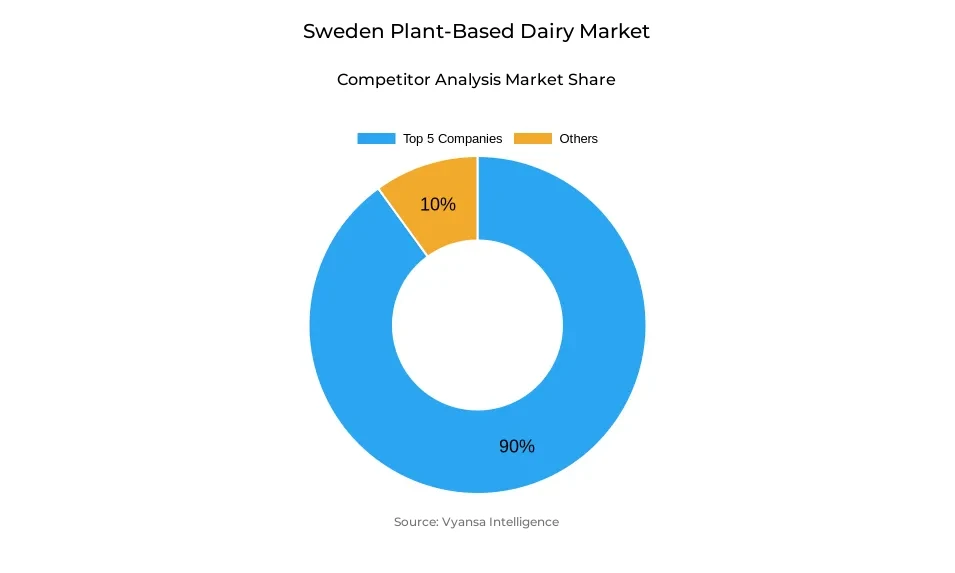
- Top 5 companies acquired around 90% of the market share.
- Sproud International AB; Coop Sverige AB; Fazer Kvarn AB; Oatly AB; Midsona Sverige AB etc., are few of the top companies.
- Sales Channel
- Retail offline grabbed 95% of the market.
Sweden Plant-Based Dairy Market Outlook
The Sweden plant-based dairy market is estimated at $140 million in 2025 and is expected to grow to $165 million by 2032, registering a CAGR of around 2.37% during 2026-32. Growth will be driven by increasing health awareness, environmental concerns, and evolving lifestyles. End user are choosing plant-based alternatives for reasons such as lactose intolerance, lower-calorie and low-cholesterol diets, and reduced environmental impact. Plant-based milk remains the dominant segment, capturing around 75% of the market, while fortified, low-fat, and functional variants are expected to gain traction over the forecast period.Innovation across dairy categories will continue to support market growth.
Beverage companies have developed many new beverages over the past several years, and they're now expanding their offerings to include a variety of new plant-based milk alternatives to the traditional beverages such as dairy products, yogurt, cream, etc. These functional products usually have an extra amount of vitamins/minerals and protein per serving; therefore, end user are very interested in purchasing these types of items. In addition to this ongoing trend toward seasonally produced products, beverage companies such as Oatly, Arla Jörd, and Fazer Aito will likely continue to release innovative products mixing nutrition-enhancing properties with fun and convenience.
Retail offline will continue to be the largest source of sales, generating an estimated 95 percent of total sales. Supermarkets will maintain their position as the primary distribution method, benefiting from accessibility, edge locations, and extensive product ranges. On the other hand, large-format warehouse clubs and similar types of store formats are expected to become even more important to end user looking for bulk purchases and value-based offerings. retail online will continue to grow rapidly, providing end user with access to a greater variety of products and niche market offerings in addition to providing convenience.
Sweden plant-based dairy market has many potential opportunities for future growth due to the constant development of new products and innovative uses of plant-based dairy products, as well as sourcing ingredients locally. The demand for products with an emphasis on sustainable production methods, healthy/nutritious ingredients, versatility in recipe options, a focus on local origin or using domestic-based ingredients, clean label products and enriched products. All this collectively will continue to help increase the popularity and culture of plant-based dairy in Sweden.
Sweden Plant-Based Dairy Market Growth Driver
Growing Health Consciousness Driving Market Expansion
The increasing focus on health by end users in Sweden has helped to increase the growth and popularity of the plant-based dairy market. End users increasing choice of these items stems from their lactose intolerant nature, their reduced calorie content, and lower levels of cholesterol. The perception of health-derived benefits from plant-based dairy will continue to drive increased consumption of plant-based dairy as part of daily diets. Functional and fortification-derived items containing vitamins, fibres, and minerals will also increase end user demand from a health perspective as well as from a demand perspective due to the combination of taste and convenience.
Brands are responding with innovative and unique products that combine health benefits and day-to-day usability. Brands such as Oatly and Alpro have created products that provide health benefits while being a substitute for traditional dairy products that are often higher in fat. The continued alignment of health priorities with product innovation will continue to lead to increased adoption of the products as a preferred item for Swedish Families who want to live a healthier lifestyle.
Sweden Plant-Based Dairy Market Trend
Fortified and Low-Fat Innovations Strengthening Market Appeal
The growing trend towards fortified and functional innovations in Sweden plant-based dairy market can be seen across a number of brands, who are using more nutrients in their products to meet end user health and wellness requirements. One example is Arla, who produce a range of oat-based products called Jörd, which are made using Swedish oats and have added fibre, vitamin D and folic acid. Another example is Fazer, whose Aito Sunshine Oat Drink has immune system benefits. As a result of rising interest in functional nutrition and health, we will likely see continued growth in this market in the future.
At the same time, with the increasing familiarity and access to plant-based milks through improved packaging and fat level labelling, as well as Alpro’s Creamy Oat Drink, end user are more likely to be able to choose plant-based dairy as an everyday staple. Similarly, there is a growing interest in the low-fat and fortified pieces of plant-based dairy, providing further opportunities for Sweden’s plant-based dairy market to grow into a more mainstream product for end user.
Unlock Market Intelligence
Explore the market potential with our data-driven report
Sweden Plant-Based Dairy Market Opportunity
Innovation and Domestic Sourcing to Create Future Growth Opportunities
Opportunities abound in the Swedn plant-based dairy market. There are many ways for manufacturers to create unique new products incorporating both fortified ingredients and those sourced from within the borders of Sweden. Some plants around the country are producing nutrient dense plant-based dairy items, using locally sourced Swedish ingredients, creating a sense of Swedish end user pride and building end user trust in the quality of these products due to their use of Swedish-made products. The increasing demand for health, functional, and multi-purpose beverages are evidenced by the recent introduction of a variety of organic oat-based barista milk products, along with a line of traditional, oat drinks.
Additionally, it is anticipated that these manufacturers will be able to draw in environmentally responsible end users through their commitment to sustainability and traceability. These manufacturers will have significant competitive advantages over companies that do not incorporate functional ingredients into their products, and source their raw materials domestically to strengthen their positioning in the marketplace. In response to the growing end user demand for transparency, health, and eco-responsibility in products, it can be expected that there will be an increasing number of opportunities for continued growth and development within the Swedish plant-based beverage market.
Unlock Market Intelligence
Explore the market potential with our data-driven report
Sweden Plant-Based Dairy Market Segmentation Analysis
By Product Type
- Plant-Based Milk
- Plant-Based Yoghurt
- Plant-Based Cheese
The segment with highest market share under product type is plant-based milk, with approximately 75% share. end user continue to purchase many plant-based beverages. Oat milk accounts for the majority of plant-based milk sales, followed by almond milk and a mixture of other plant-based milks. Major companies, including Oatly AB, Alpro, and Fazer Aito, provide numerous plant-based milk choices, including those that are fortified, reduced, and barista-style, which appeal to end user based on taste, nutrition, and ease of use.
As end user increasingly demand innovative products, the product category will continue to evolve as it grows beyond beverage use into dairy-free creams, yogurts, and other dairy substitutes. New technology is adding to end user interest and increasing plants-based milk's contribution to retail sales. Its wide distribution in multiple retail locations in Sweden means plant-based milk will continue to be a major player in the Swedish marketplace.

By Sales Channel
- Offline
- Online
The segment with highest market share under sales channel is retail offline which account for around 95% of share. The biggest players in terms of retail store distribution are supermarkets they provide the best locations in major city centre areas, with a good selection of the largest brands. They also have very good shelf presence for both established brands and private label offerings.Due to the convenient accessibility of traditional retail stores and end users’ familiarity with shopping in these environments, these outlets continue to sustain strong sales of both branded and private-label products.
Warehouse clubs continue to gain in popularity; online retail generally provides convenience and the opportunity to buy niche products that are not available in a store. Traditional retail continues to be the dominant retail channel for the sale of plant-based dairy products and thus provides end user with the most access to these types of products.
List of Companies Covered in Sweden Plant-Based Dairy Market
The companies listed below are highly influential in the Sweden plant-based dairy market, with a significant market share and a strong impact on industry developments.
- Sproud International AB
- Coop Sverige AB
- Fazer Kvarn AB
- Oatly AB
- Midsona Sverige AB
- Valio Sverige AB
- Upfield Sweden AB
- ICA Sverige AB
- Havredals Biodevelop AB
- Veg of Lund AB
Frequently Asked Questions
Related Report
1. Market Segmentation
1.1. Research Scope
1.2. Research Methodology
1.3. Definitions and Assumptions
2. Executive Summary
3. Sweden Plant Based Dairy Market Policies, Regulations, and Standards
4. Sweden Plant Based Dairy Market Dynamics
4.1. Growth Factors
4.2. Challenges
4.3. Trends
4.4. Opportunities
5. Sweden Plant Based Dairy Market Statistics, 2020-2030F
5.1. Market Size & Growth Outlook
5.1.1.By Revenues in USD Million
5.2. Market Segmentation & Growth Outlook
5.2.1.By Product Type
5.2.1.1. Plant-Based Milk- Market Insights and Forecast 2020-2030, USD Million
5.2.1.1.1. Soy Drinks- Market Insights and Forecast 2020-2030, USD Million
5.2.1.1.2. Almond- Market Insights and Forecast 2020-2030, USD Million
5.2.1.1.3. Blends- Market Insights and Forecast 2020-2030, USD Million
5.2.1.1.4. Coconut- Market Insights and Forecast 2020-2030, USD Million
5.2.1.1.5. Oat- Market Insights and Forecast 2020-2030, USD Million
5.2.1.1.6. Rice- Market Insights and Forecast 2020-2030, USD Million
5.2.1.1.7. Other Plant-Based Milk- Market Insights and Forecast 2020-2030, USD Million
5.2.1.2. Plant-Based Yoghurt- Market Insights and Forecast 2020-2030, USD Million
5.2.1.3. Plant-Based Cheese- Market Insights and Forecast 2020-2030, USD Million
5.2.2.By Sales Channel
5.2.2.1. Offline- Market Insights and Forecast 2020-2030, USD Million
5.2.2.1.1. Grocery Retailers- Market Insights and Forecast 2020-2030, USD Million
5.2.2.1.2. Convenience Retailers- Market Insights and Forecast 2020-2030, USD Million
5.2.2.1.3. Supermarkets- Market Insights and Forecast 2020-2030, USD Million
5.2.2.1.4. Hypermarkets- Market Insights and Forecast 2020-2030, USD Million
5.2.2.2. Online- Market Insights and Forecast 2020-2030, USD Million
5.2.3.By Competitors
5.2.3.1. Competition Characteristics
5.2.3.2. Market Share & Analysis
6. Sweden Plant-Based Milk Market Outlook, 2020-2030F
6.1. Market Size & Growth Outlook
6.1.1.By Revenues in USD Million
6.2. Market Segmentation & Growth Outlook
6.2.1.By Sales Channel- Market Insights and Forecast 2020-2030, USD Million
7. Sweden Plant-Based Yoghurt Market Outlook, 2020-2030F
7.1. Market Size & Growth Outlook
7.1.1.By Revenues in USD Million
7.2. Market Segmentation & Growth Outlook
7.2.1.By Sales Channel- Market Insights and Forecast 2020-2030, USD Million
8. Sweden Plant-Based Cheese Market Outlook, 2020-2030F
8.1. Market Size & Growth Outlook
8.1.1.By Revenues in USD Million
8.2. Market Segmentation & Growth Outlook
8.2.1.By Sales Channel- Market Insights and Forecast 2020-2030, USD Million
9. Competitive Outlook
9.1. Company Profiles
9.1.1.Oatly AB
9.1.1.1. Business Description
9.1.1.2. Product Portfolio
9.1.1.3. Collaborations & Alliances
9.1.1.4. Recent Developments
9.1.1.5. Financial Details
9.1.1.6. Others
9.1.2.Midsona Sverige AB
9.1.2.1. Business Description
9.1.2.2. Product Portfolio
9.1.2.3. Collaborations & Alliances
9.1.2.4. Recent Developments
9.1.2.5. Financial Details
9.1.2.6. Others
9.1.3.Valio Sverige AB
9.1.3.1. Business Description
9.1.3.2. Product Portfolio
9.1.3.3. Collaborations & Alliances
9.1.3.4. Recent Developments
9.1.3.5. Financial Details
9.1.3.6. Others
9.1.4.Upfield Sweden AB
9.1.4.1. Business Description
9.1.4.2. Product Portfolio
9.1.4.3. Collaborations & Alliances
9.1.4.4. Recent Developments
9.1.4.5. Financial Details
9.1.4.6. Others
9.1.5.ICA Sverige AB
9.1.5.1. Business Description
9.1.5.2. Product Portfolio
9.1.5.3. Collaborations & Alliances
9.1.5.4. Recent Developments
9.1.5.5. Financial Details
9.1.5.6. Others
9.1.6.Sproud International AB
9.1.6.1. Business Description
9.1.6.2. Product Portfolio
9.1.6.3. Collaborations & Alliances
9.1.6.4. Recent Developments
9.1.6.5. Financial Details
9.1.6.6. Others
9.1.7.Coop Sverige AB
9.1.7.1. Business Description
9.1.7.2. Product Portfolio
9.1.7.3. Collaborations & Alliances
9.1.7.4. Recent Developments
9.1.7.5. Financial Details
9.1.7.6. Others
9.1.8.Fazer Kvarn AB
9.1.8.1. Business Description
9.1.8.2. Product Portfolio
9.1.8.3. Collaborations & Alliances
9.1.8.4. Recent Developments
9.1.8.5. Financial Details
9.1.8.6. Others
9.1.9.Havredals Biodevelop AB
9.1.9.1. Business Description
9.1.9.2. Product Portfolio
9.1.9.3. Collaborations & Alliances
9.1.9.4. Recent Developments
9.1.9.5. Financial Details
9.1.9.6. Others
9.1.10. Veg of Lund AB
9.1.10.1. Business Description
9.1.10.2. Product Portfolio
9.1.10.3. Collaborations & Alliances
9.1.10.4. Recent Developments
9.1.10.5. Financial Details
9.1.10.6. Others
10. Disclaimer
| Segment | Sub-Segment |
|---|---|
| By Product Type |
|
| By Sales Channel |
|
Research Methodology
This study followed a structured approach comprising four key phases to assess the size and scope of the electro-oxidation market. The process began with thorough secondary research to collect data on the target market, related markets, and broader industry context. These findings, along with preliminary assumptions and estimates, were then validated through extensive primary research involving industry experts from across the value chain. To calculate the overall market size, both top-down and bottom-up methodologies were employed. Finally, market segmentation and data triangulation techniques were applied to refine and validate segment-level estimations.
Secondary Research
The secondary research phase involved gathering data from a wide range of credible and published sources. This step helped in identifying industry trends, defining market segmentation, and understanding the market landscape and value chain.
Sources consulted during this phase included:
- Company annual reports, investor presentations, and press releases
- Industry white papers and certified publications
- Trade directories and market-recognized databases
- Articles from authoritative authors and reputable journals
- Gold and silver standard websites
Secondary research was critical in mapping out the industry's value chain and monetary flow, identifying key market segments, understanding regional variations, and tracking significant industry developments.
Other key sources:
- Financial disclosures
- Industry associations and trade bodies
- News outlets and business magazines
- Academic journals and research studies
- Paid industry databases
Primary Research
To validate secondary data and gain deeper market insights, primary research was conducted with key stakeholders across both the supply and demand sides of the market.
On the demand side, participants included decision-makers and influencers from end-user industries—such as CIOs, CTOs, and CSOs—who provided first-hand perspectives on market needs, product usage, and future expectations.
On the supply side, interviews were conducted with manufacturers, industry associations, and institutional participants to gather insights into current offerings, product pipelines, and market challenges.
Primary interviews provided critical inputs such as:
- Market size and revenue data
- Product and service breakdowns
- Market forecasts
- Regional and application-specific trends
Stakeholders consulted included:
- Leading OEM and solution providers
- Channel and distribution partners
- End users across various applications
- Independent consultants and industry specialists
Market Size Estimation and Data Triangulation
- Identifying Key Market Participants (Secondary Research)
- Goal: To identify the major players or companies in the target market. This typically involves using publicly available data sources such as industry reports, market research publications, and financial statements of companies.
- Tools: Reports from firms like Gartner, Forrester, Euromonitor, Statista, IBISWorld, and others. Public financial statements, news articles, and press releases from top market players.
- Extracting Earnings of Key Market Participants
- Goal: To estimate the earnings generated from the product or service being analyzed. This step helps in understanding the revenue potential of each market player in a specific geography.
- Methods: Earnings data can be gathered from:
- Publicly available financial reports (for listed companies).
- Interviews and primary data sources from professionals, such as Directors, VPs, SVPs, etc. This is especially useful for understanding more nuanced, internal data that isn't publicly disclosed.
- Annual reports and investor presentations of key players.
- Data Collation and Development of a Relevant Data Model
- Goal: To collate inputs from both primary and secondary sources into a structured, data-driven model for market estimation. This model will incorporate key market KPIs and any independent variables relevant to the market.
- Key KPIs: These could include:
- Market size, growth rate, and demand drivers.
- Industry-specific metrics like market share, average revenue per customer (ARPC), or average deal size.
- External variables, such as economic growth rates, inflation rates, or commodity prices, that could affect the market.
- Data Modeling: Based on this data, the market forecasts are developed for the next 5 years. A combination of trend analysis, scenario modeling, and statistical regression might be used to generate projections.
- Scenario Analysis
- Goal: To test different assumptions and validate how sensitive the market is to changes in key variables (e.g., market demand, regulatory changes, technological disruptions).
- Types of Scenarios:
- Base Case: Based on current assumptions and historical data.
- Best-Case Scenario: Assuming favorable market conditions, regulatory environments, and technological advancements.
- Worst-Case Scenario: Accounting for adverse factors, such as economic downturns, stricter regulations, or unexpected disruptions.












