Global Supply Chain Management Software Market Report: Trends, Growth and Forecast (2026-2032)
By Component (Software, Services), By Deployment Mode (Cloud-Based, On-Premises, Hybrid), By Solution Type (Supply Chain Planning, Procurement and Sourcing, Manufacturing and Production Management, Inventory and Warehouse Management, Transportation and Logistics Management, Order Management and Fulfillment, Supplier Collaboration and Network Management, Product Lifecycle Management, Supply Chain Analytics and Visibility, Others), By Enterprise Size (Small and Medium-Sized Enterprises, Large Enterprises), By Industry Vertical (Retail and E-Commerce, Consumer Goods, Automotive, Industrial Manufacturing, High-Tech and Electronics, Healthcare and Life Sciences, Food and Beverages, Transportation and Logistics, Aerospace and Defense, Chemicals, Energy and Utilities, Others), By Region (North America, South America, Europe, Middle East and Africa, Asia Pacific) ... Read more
|
Major Players
|
Global Supply Chain Management Software Market Statistics and Insights, 2026
- Market Size Statistics
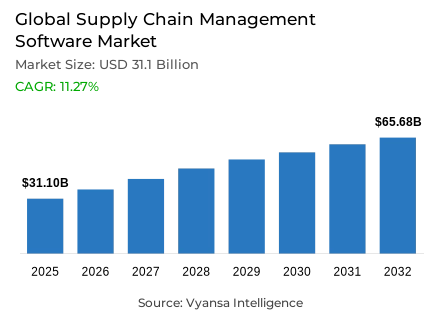
- Supply Chain Management Software market size was valued at USD 31.1 billion in 2025 and is estimated at USD 36.04 billion in 2026.
- The market size is expected to grow to USD 65.68 billion by 2032.
- Market to register a CAGR of around 11.27% during 2026-32.
- Solution Type Shares
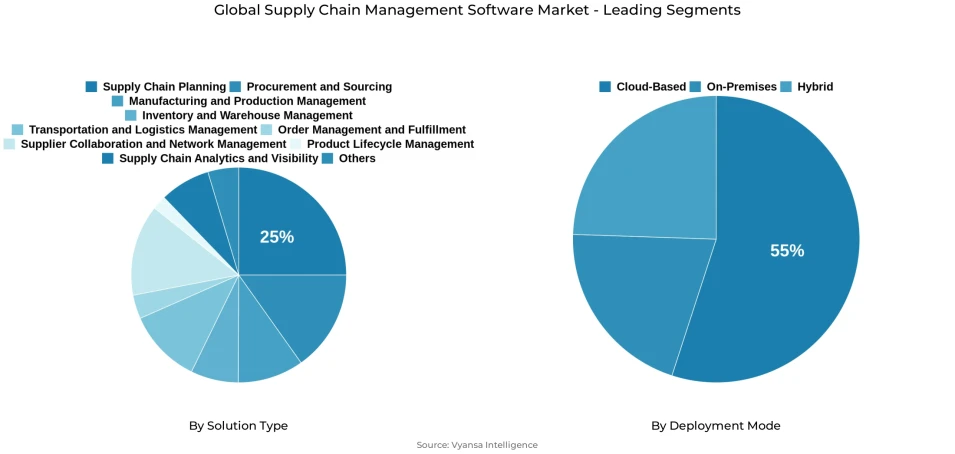
- Supply chain planning grabbed market share of 25%.
- Competition
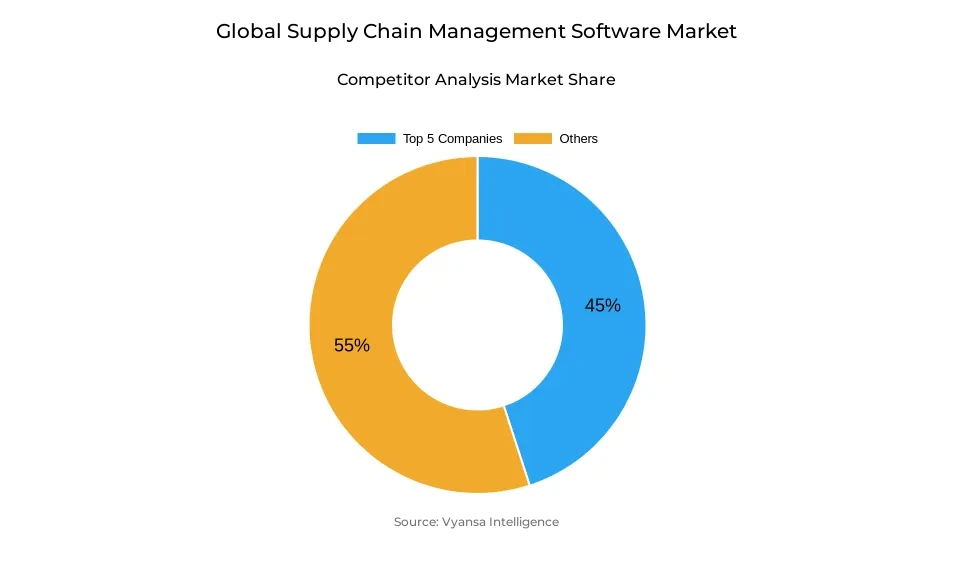
- Global supply chain management software market is currently being catered to by more than 25 companies.
- Top 5 companies acquired around 45% of the market share.
- SPS Commerce Inc., Microsoft Corporation, Kinaxis Inc., SAP SE, WiseTech Global Limited etc., are few of the top companies.
- Deployment Mode
- Cloud-based grabbed 55% of the market.
- Region
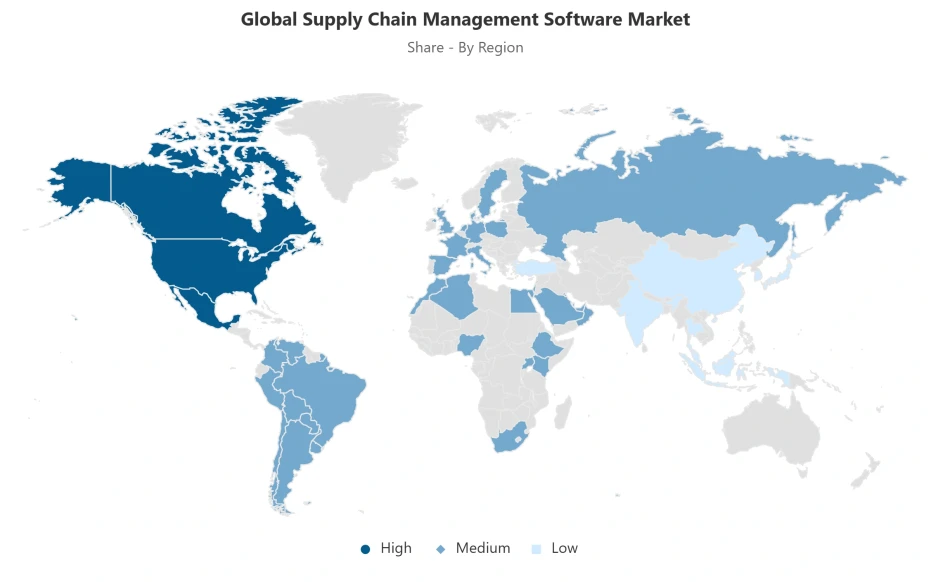
- North America leads with a 30% share of the global market.
Global Supply Chain Management Software Market Outlook
Global supply chain management (SCM) software market covers platforms that coordinate planning, sourcing, manufacturing, logistics, inventory, warehouse, transportation, order fulfillment, supplier collaboration, and analytics across enterprise networks. The market is valued at USD 31.1 billion in 2025 and USD 36.04 billion in 2026, and is projected to reach USD 65.68 billion by 2032, growing at a CAGR of 11.27% during 2026-2032. Primary end users include manufacturers, retailers, logistics providers, healthcare distributors, high-tech companies, food and beverage firms, automotive suppliers, and industrial operators that need synchronized data across demand, production, sourcing, and distribution across major industry segments.
Operational pressure is shifting the global supply chain management (SCM) software industry from transactional process support toward real-time decision orchestration. Enterprises are prioritizing supply chain visibility software, demand forecasting software, inventory optimization software, and logistics management software because volatile lead times, supplier exposure, and fulfillment complexity require faster planning cycles and tighter execution control across distributed production and distribution networks. This supports supply chain software market demand where procurement teams need scenario-based supplier decisions and production planners need faster constraint resolution.
Economic value creation in the global supply chain management (SCM) software market is linked to reduced working-capital lockup, higher service levels, improved procurement visibility, and stronger compliance readiness. The global supply chain management (SCM) software industry strengthens competitive positioning by connecting procurement management software, warehouse management software, transportation management software, and supply chain analytics software with enterprise resource planning integration.
AI-enabled planning, cloud deployment, and supplier-network orchestration are defining the 2026 trajectory. The global supply chain management (SCM) software market is moving toward platform consolidation as buyers seek integrated control towers, API connectivity, and embedded automation. The global supply chain management (SCM) software industry is positioned for higher operational uptake as vendors expand AI-powered supply chain software across planning, execution, and resilience workflows.
Global Supply Chain Management Software Market Growth Driver
Visibility-Led Planning Demand Accelerates Adoption
Real-time operating complexity is increasing demand for SCM software where enterprises must align suppliers, production lines, warehouses, carriers, and customer orders through one control layer. The global supply chain management (SCM) software market benefits from this shift as buyers move beyond isolated planning tools toward connected platforms that reduce disruption exposure, improve inventory accuracy, support logistics automation, and accelerate fulfillment decisions across volatile operating networks. It also raises software priority in digital transformation budgets and operating models for large enterprises and regional hubs alike.
SAP states that its supply chain management software supports planning, procurement, manufacturing, logistics, enterprise asset management, and business networks, while using AI and data to sense, analyze, and act in real time. This validates demand for integrated supply chain management solutions and strengthens adoption across the global supply chain management (SCM) software industry as enterprises prioritize visibility, supplier collaboration software, execution synchronization, and resilient network coordination.
Global Supply Chain Management Software Market Challenge
Integration Complexity Pressures Deployment Economics
Integration complexity and data-governance gaps are slowing deployment cycles as enterprises connect legacy ERP, warehouse systems, transportation tools, supplier portals, and analytics layers. The global supply chain management (SCM) software market faces adoption friction when fragmented master data, inconsistent supplier records, and cybersecurity requirements raise implementation effort, service dependence, and change-management pressure. These barriers are sharper in multinational networks where localization, customs data, and plant-level workflows differ across operating units.
ENISA’s 2025 NIS2 technical guidance states that EU cybersecurity requirements are defined through Commission Implementing Regulation 2024/2690 for digital infrastructure, ICT service management, and digital providers. This compliance direction increases vendor due-diligence, access-control, incident-reporting, and supplier-risk obligations, affecting the global supply chain management (SCM) software industry through longer procurement reviews, stronger platform-security expectations, and higher demand for validated integration documentation. It also raises buyer preference for auditable workflows, role controls, and secure supplier connectivity before large rollouts proceed.
Unlock Market Intelligence
Explore the market potential with our data-driven report
Global Supply Chain Management Software Market Trend
Agentic Automation Reshapes Platform Roadmaps
Agentic AI is shifting SCM software from dashboard-based monitoring toward guided execution, exception handling, and autonomous workflow assistance. The global supply chain management (SCM) software market is increasingly shaped by planning assistants, procurement advisors, maintenance guidance, and fulfillment optimization tools that convert supply chain data into faster operational action rather than static reporting. This advances predictive supply chain analytics and supply chain control tower software adoption.
Oracle announced in October 2025 that new AI agents embedded in Oracle Fusion Cloud Applications help supply chain leaders automate processes, optimize planning and fulfillment, and make faster data-driven decisions. This product direction strengthens the global supply chain management (SCM) software industry by embedding agentic AI in SCM software, improving decision velocity, and sharpening competitive differentiation among enterprise SCM platform providers seeking platform-wide automation across planning, production, inventory, sourcing, logistics, and service workflows where exceptions require rapid, policy-aligned decisions securely at enterprise operating scale.
Global Supply Chain Management Software Market Opportunity
Underpenetrated Digital Networks Create Upgrade Space
Digital trade networks and public-private logistics data exchanges create expansion space for SCM vendors that can integrate external capacity signals with enterprise planning systems. The global supply chain management (SCM) software market can capture underpenetrated demand from shippers, ports, carriers, warehouses, and importers that need better forecasting, disruption management, and cross-party data sharing across logistics operations. This opportunity improves demand capture where enterprise teams need external signals beside internal orders, forecasts, and inventory records.
The 2026 Federal Register notice for USDOT’s FLOW program states that participants contribute data on import and export containers, purchase orders, cargo bookings, terminal space, truck dispatch capacity, chassis availability, and warehouse capacity. This infrastructure signal expands opportunity for the global supply chain management (SCM) software industry by supporting data connectors, logistics orchestration, network design software, and supply chain risk management software for platform operators and integration partners serving freight networks and regional supply chains.
Global Supply Chain Management Software Market Regional Analysis
By Region
- North America
- South America
- Europe
- Middle East and Africa
- Asia Pacific
North America holds 30% share, supported by mature enterprise software procurement, large manufacturing and retail networks, advanced logistics infrastructure, and early adoption of data-driven supply chain modernization. The global supply chain management (SCM) software market benefits from this regional base because US and Canadian enterprises require integrated planning, logistics visibility, supplier coordination, and compliance-ready workflows across domestic and cross-border operations. Strong cloud capacity, established systems integrators, and enterprise security practices further support regional uptake.
USDOT’s FLOW program is a public-private partnership that builds a forward-looking, integrated view of US supply chain conditions and helps participants forecast how capacity and throughput will perform against future demand. This regional data-infrastructure model strengthens market demand by encouraging interoperable platforms, supply chain visibility software, and analytics-led decision support across freight, warehousing, port, and carrier ecosystems, while improving procurement confidence for scalable SCM software deployments across enterprise supply chain networks and logistics hubs regionally.
Unlock Market Intelligence
Explore the market potential with our data-driven report
Global Supply Chain Management Software Market Segmentation Analysis
By Solution Type
- Supply Chain Planning
- Procurement and Sourcing
- Manufacturing and Production Management
- Inventory and Warehouse Management
- Transportation and Logistics Management
- Order Management and Fulfillment
- Supplier Collaboration and Network Management
- Product Lifecycle Management
- Supply Chain Analytics and Visibility
- Others
Supply Chain Planning leads the solution type segment with 25% market share because enterprises prioritize demand sensing, supply planning, sales and operations planning, inventory balancing, and production scheduling before downstream execution can stabilize. The global supply chain management (SCM) software market gains the strongest functional pull from this segment as planning modules guide procurement timing, capacity allocation, fulfillment commitments, and disruption response across multi-site networks with constrained resources.
Oracle’s official Supply Chain Planning page highlights AI capabilities including Supply Chain Collaboration Policy Advisor and Supply Chain Planning AI Advisor, which summarize data quality issues and help planners resolve supply-plan problems with less effort. This supports supply chain planning software adoption because planning remains the command layer for scenario modeling, constraint management, and service-level protection across procurement, manufacturing, and logistics, while improving forecast discipline and cross-functional accountability for supply, demand, inventory, and production decisions across high-variance enterprise operating environments and regional hubs.
By Deployment Mode
- Cloud-Based
- On-Premises
- Hybrid
Cloud-Based deployment holds 55% share because enterprises require scalable access, faster upgrades, lower infrastructure burden, and easier integration across distributed supply chain teams. The global supply chain management (SCM) software market is therefore shaped by cloud-based SCM software demand from multinational manufacturers, retailers, logistics operators, and healthcare networks seeking standardized workflows across plants, suppliers, warehouses, and transportation partners. This deployment mode also improves implementation flexibility for enterprise supply chain software across multi-country operations.
Microsoft’s 2026 release wave 1 plan for Dynamics 365 Supply Chain Management covers new functionality planned for April 2026 through September 2026, reinforcing cloud update cycles as a platform advantage. This supports cloud SCM adoption by enabling faster feature delivery, AI integration, warehouse optimization, and procurement workflow modernization without heavy on-premise upgrade cycles, strengthening competitive positioning for software vendors serving fast-changing fulfillment, sourcing, production, and compliance requirements across complex global enterprise networks and supplier ecosystems securely.
Market Players in Global Supply Chain Management Software Market
These market players maintain a significant presence in the Global supply chain management software market and contribute to its ongoing evolution.
- SPS Commerce Inc.
- Microsoft Corporation
- Kinaxis Inc.
- SAP SE
- WiseTech Global Limited
- Oracle Corporation
- Blue Yonder Inc.
- Manhattan Associates Inc.
- The Descartes Systems Group Inc.
- Infor Equity Holdings LLC (Infor)
- Coupa Software Inc.
- Epicor Software Corporation
- Dassault Systèmes S.E.
- Aptean Inc.
- Infios US Inc. (Infios)
Market News & Updates
- Kinaxis Inc., 2026:
Kinaxis introduced Maestro Agent Studio for supply chain orchestration teams. The no-code environment allows users to compose AI agents grounded in operating context, workflows, and planning data already used by supply chain teams. The update expands Kinaxis’ SCM software capability around agentic planning, decision support, and supply chain workflow automation.
- Manhattan Associates Inc., 2026:
Manhattan Associates announced commercial availability of its AI Agents. The agents are designed for modern retail and supply chain operations, supporting faster decision-making, productivity improvement, and role-based assistance across Manhattan Active solutions. The update strengthens Manhattan’s AI-powered supply chain execution platform for warehouse, transportation, inventory, and omnichannel operations.
Frequently Asked Questions
Related Report
- Market Segmentation
- Research Scope
- Research Methodology
- Definitions and Assumptions
- Executive Summary
- Global Supply Chain Management (SCM) Software Market Policies, Regulations, and Standards
- Global Supply Chain Management (SCM) Software Market Dynamics
- Growth Factors
- Challenges
- Trends
- Opportunities
- Global Supply Chain Management (SCM) Software Market Statistics, 2022-2032F
- Market Size & Growth Outlook
- By Revenues in USD Million
- Market Segmentation & Growth Outlook
- By Component
- Software- Market Insights and Forecast 2022-2032, USD Million
- Services- Market Insights and Forecast 2022-2032, USD Million
- By Deployment Mode
- Cloud-Based- Market Insights and Forecast 2022-2032, USD Million
- On-Premises- Market Insights and Forecast 2022-2032, USD Million
- Hybrid- Market Insights and Forecast 2022-2032, USD Million
- By Solution Type
- Supply Chain Planning- Market Insights and Forecast 2022-2032, USD Million
- Procurement and Sourcing- Market Insights and Forecast 2022-2032, USD Million
- Manufacturing and Production Management- Market Insights and Forecast 2022-2032, USD Million
- Inventory and Warehouse Management- Market Insights and Forecast 2022-2032, USD Million
- Transportation and Logistics Management- Market Insights and Forecast 2022-2032, USD Million
- Order Management and Fulfillment- Market Insights and Forecast 2022-2032, USD Million
- Supplier Collaboration and Network Management- Market Insights and Forecast 2022-2032, USD Million
- Product Lifecycle Management- Market Insights and Forecast 2022-2032, USD Million
- Supply Chain Analytics and Visibility- Market Insights and Forecast 2022-2032, USD Million
- Others- Market Insights and Forecast 2022-2032, USD Million
- By Enterprise Size
- Small and Medium-Sized Enterprises- Market Insights and Forecast 2022-2032, USD Million
- Large Enterprises- Market Insights and Forecast 2022-2032, USD Million
- By Industry Vertical
- Retail and E-Commerce- Market Insights and Forecast 2022-2032, USD Million
- Consumer Goods- Market Insights and Forecast 2022-2032, USD Million
- Automotive- Market Insights and Forecast 2022-2032, USD Million
- Industrial Manufacturing- Market Insights and Forecast 2022-2032, USD Million
- High-Tech and Electronics- Market Insights and Forecast 2022-2032, USD Million
- Healthcare and Life Sciences- Market Insights and Forecast 2022-2032, USD Million
- Food and Beverages- Market Insights and Forecast 2022-2032, USD Million
- Transportation and Logistics- Market Insights and Forecast 2022-2032, USD Million
- Aerospace and Defense- Market Insights and Forecast 2022-2032, USD Million
- Chemicals- Market Insights and Forecast 2022-2032, USD Million
- Energy and Utilities- Market Insights and Forecast 2022-2032, USD Million
- Others- Market Insights and Forecast 2022-2032, USD Million
- By Region
- North America
- South America
- Europe
- Middle East and Africa
- Asia Pacific
- By Competitors
- Competition Characteristics
- Market Share & Analysis
- By Component
- Market Size & Growth Outlook
- North America Supply Chain Management (SCM) Software Market Statistics, 2022-2032F
- Market Size & Growth Outlook
- By Revenues in USD Million
- Market Segmentation & Growth Outlook
- By Component- Market Insights and Forecast 2022-2032, USD Million
- By Deployment Mode- Market Insights and Forecast 2022-2032, USD Million
- By Solution Type- Market Insights and Forecast 2022-2032, USD Million
- By Enterprise Size- Market Insights and Forecast 2022-2032, USD Million
- By Industry Vertical- Market Insights and Forecast 2022-2032, USD Million
- By Country
- The US
- Canada
- Mexico
- Rest of North America
- The US Supply Chain Management (SCM) Software Market Statistics, 2022-2032F
- Market Size & Growth Outlook
- By Revenues in USD Million
- Market Segmentation & Growth Outlook
- By Component- Market Insights and Forecast 2022-2032, USD Million
- By Deployment Mode- Market Insights and Forecast 2022-2032, USD Million
- By Solution Type- Market Insights and Forecast 2022-2032, USD Million
- By Enterprise Size- Market Insights and Forecast 2022-2032, USD Million
- By Industry Vertical- Market Insights and Forecast 2022-2032, USD Million
- Market Size & Growth Outlook
- Canada Supply Chain Management (SCM) Software Market Statistics, 2022-2032F
- Market Size & Growth Outlook
- By Revenues in USD Million
- Market Segmentation & Growth Outlook
- By Component- Market Insights and Forecast 2022-2032, USD Million
- By Deployment Mode- Market Insights and Forecast 2022-2032, USD Million
- By Solution Type- Market Insights and Forecast 2022-2032, USD Million
- By Enterprise Size- Market Insights and Forecast 2022-2032, USD Million
- By Industry Vertical- Market Insights and Forecast 2022-2032, USD Million
- Market Size & Growth Outlook
- Mexico Supply Chain Management (SCM) Software Market Statistics, 2022-2032F
- Market Size & Growth Outlook
- By Revenues in USD Million
- Market Segmentation & Growth Outlook
- By Component- Market Insights and Forecast 2022-2032, USD Million
- By Deployment Mode- Market Insights and Forecast 2022-2032, USD Million
- By Solution Type- Market Insights and Forecast 2022-2032, USD Million
- By Enterprise Size- Market Insights and Forecast 2022-2032, USD Million
- By Industry Vertical- Market Insights and Forecast 2022-2032, USD Million
- Market Size & Growth Outlook
- Market Size & Growth Outlook
- South America Supply Chain Management (SCM) Software Market Statistics, 2022-2032F
- Market Size & Growth Outlook
- By Revenues in USD Million
- Market Segmentation & Growth Outlook
- By Component- Market Insights and Forecast 2022-2032, USD Million
- By Deployment Mode- Market Insights and Forecast 2022-2032, USD Million
- By Solution Type- Market Insights and Forecast 2022-2032, USD Million
- By Enterprise Size- Market Insights and Forecast 2022-2032, USD Million
- By Industry Vertical- Market Insights and Forecast 2022-2032, USD Million
- By Country
- Brazil
- Argentina
- Rest of South America
- Brazil Supply Chain Management (SCM) Software Market Statistics, 2022-2032F
- Market Size & Growth Outlook
- By Revenues in USD Million
- Market Segmentation & Growth Outlook
- By Component- Market Insights and Forecast 2022-2032, USD Million
- By Deployment Mode- Market Insights and Forecast 2022-2032, USD Million
- By Solution Type- Market Insights and Forecast 2022-2032, USD Million
- By Enterprise Size- Market Insights and Forecast 2022-2032, USD Million
- By Industry Vertical- Market Insights and Forecast 2022-2032, USD Million
- Market Size & Growth Outlook
- Argentina Supply Chain Management (SCM) Software Market Statistics, 2022-2032F
- Market Size & Growth Outlook
- By Revenues in USD Million
- Market Segmentation & Growth Outlook
- By Component- Market Insights and Forecast 2022-2032, USD Million
- By Deployment Mode- Market Insights and Forecast 2022-2032, USD Million
- By Solution Type- Market Insights and Forecast 2022-2032, USD Million
- By Enterprise Size- Market Insights and Forecast 2022-2032, USD Million
- By Industry Vertical- Market Insights and Forecast 2022-2032, USD Million
- Market Size & Growth Outlook
- Market Size & Growth Outlook
- Europe Supply Chain Management (SCM) Software Market Statistics, 2022-2032F
- Market Size & Growth Outlook
- By Revenues in USD Million
- Market Segmentation & Growth Outlook
- By Component- Market Insights and Forecast 2022-2032, USD Million
- By Deployment Mode- Market Insights and Forecast 2022-2032, USD Million
- By Solution Type- Market Insights and Forecast 2022-2032, USD Million
- By Enterprise Size- Market Insights and Forecast 2022-2032, USD Million
- By Industry Vertical- Market Insights and Forecast 2022-2032, USD Million
- By Country
- Germany
- France
- The UK
- Italy
- Spain
- Russia
- Rest of Europe
- Germany Supply Chain Management (SCM) Software Market Statistics, 2022-2032F
- Market Size & Growth Outlook
- By Revenues in USD Million
- Market Segmentation & Growth Outlook
- By Component- Market Insights and Forecast 2022-2032, USD Million
- By Deployment Mode- Market Insights and Forecast 2022-2032, USD Million
- By Solution Type- Market Insights and Forecast 2022-2032, USD Million
- By Enterprise Size- Market Insights and Forecast 2022-2032, USD Million
- By Industry Vertical- Market Insights and Forecast 2022-2032, USD Million
- Market Size & Growth Outlook
- France Supply Chain Management (SCM) Software Market Statistics, 2022-2032F
- Market Size & Growth Outlook
- By Revenues in USD Million
- Market Segmentation & Growth Outlook
- By Component- Market Insights and Forecast 2022-2032, USD Million
- By Deployment Mode- Market Insights and Forecast 2022-2032, USD Million
- By Solution Type- Market Insights and Forecast 2022-2032, USD Million
- By Enterprise Size- Market Insights and Forecast 2022-2032, USD Million
- By Industry Vertical- Market Insights and Forecast 2022-2032, USD Million
- Market Size & Growth Outlook
- The UK Supply Chain Management (SCM) Software Market Statistics, 2022-2032F
- Market Size & Growth Outlook
- By Revenues in USD Million
- Market Segmentation & Growth Outlook
- By Component- Market Insights and Forecast 2022-2032, USD Million
- By Deployment Mode- Market Insights and Forecast 2022-2032, USD Million
- By Solution Type- Market Insights and Forecast 2022-2032, USD Million
- By Enterprise Size- Market Insights and Forecast 2022-2032, USD Million
- By Industry Vertical- Market Insights and Forecast 2022-2032, USD Million
- Market Size & Growth Outlook
- Italy Supply Chain Management (SCM) Software Market Statistics, 2022-2032F
- Market Size & Growth Outlook
- By Revenues in USD Million
- Market Segmentation & Growth Outlook
- By Component- Market Insights and Forecast 2022-2032, USD Million
- By Deployment Mode- Market Insights and Forecast 2022-2032, USD Million
- By Solution Type- Market Insights and Forecast 2022-2032, USD Million
- By Enterprise Size- Market Insights and Forecast 2022-2032, USD Million
- By Industry Vertical- Market Insights and Forecast 2022-2032, USD Million
- Market Size & Growth Outlook
- Spain Supply Chain Management (SCM) Software Market Statistics, 2022-2032F
- Market Size & Growth Outlook
- By Revenues in USD Million
- Market Segmentation & Growth Outlook
- By Component- Market Insights and Forecast 2022-2032, USD Million
- By Deployment Mode- Market Insights and Forecast 2022-2032, USD Million
- By Solution Type- Market Insights and Forecast 2022-2032, USD Million
- By Enterprise Size- Market Insights and Forecast 2022-2032, USD Million
- By Industry Vertical- Market Insights and Forecast 2022-2032, USD Million
- Market Size & Growth Outlook
- Russia Supply Chain Management (SCM) Software Market Statistics, 2022-2032F
- Market Size & Growth Outlook
- By Revenues in USD Million
- Market Segmentation & Growth Outlook
- By Component- Market Insights and Forecast 2022-2032, USD Million
- By Deployment Mode- Market Insights and Forecast 2022-2032, USD Million
- By Solution Type- Market Insights and Forecast 2022-2032, USD Million
- By Enterprise Size- Market Insights and Forecast 2022-2032, USD Million
- By Industry Vertical- Market Insights and Forecast 2022-2032, USD Million
- Market Size & Growth Outlook
- Market Size & Growth Outlook
- Middle East and Africa Supply Chain Management (SCM) Software Market Statistics, 2022-2032F
- Market Size & Growth Outlook
- By Revenues in USD Million
- Market Segmentation & Growth Outlook
- By Component- Market Insights and Forecast 2022-2032, USD Million
- By Deployment Mode- Market Insights and Forecast 2022-2032, USD Million
- By Solution Type- Market Insights and Forecast 2022-2032, USD Million
- By Enterprise Size- Market Insights and Forecast 2022-2032, USD Million
- By Industry Vertical- Market Insights and Forecast 2022-2032, USD Million
- By Country
- Saudi Arabia
- The UAE
- South Africa
- Iran
- Rest of Middle East and Africa
- Saudi Arabia Supply Chain Management (SCM) Software Market Statistics, 2022-2032F
- Market Size & Growth Outlook
- By Revenues in USD Million
- Market Segmentation & Growth Outlook
- By Component- Market Insights and Forecast 2022-2032, USD Million
- By Deployment Mode- Market Insights and Forecast 2022-2032, USD Million
- By Solution Type- Market Insights and Forecast 2022-2032, USD Million
- By Enterprise Size- Market Insights and Forecast 2022-2032, USD Million
- By Industry Vertical- Market Insights and Forecast 2022-2032, USD Million
- Market Size & Growth Outlook
- The UAE Supply Chain Management (SCM) Software Market Statistics, 2022-2032F
- Market Size & Growth Outlook
- By Revenues in USD Million
- Market Segmentation & Growth Outlook
- By Component- Market Insights and Forecast 2022-2032, USD Million
- By Deployment Mode- Market Insights and Forecast 2022-2032, USD Million
- By Solution Type- Market Insights and Forecast 2022-2032, USD Million
- By Enterprise Size- Market Insights and Forecast 2022-2032, USD Million
- By Industry Vertical- Market Insights and Forecast 2022-2032, USD Million
- Market Size & Growth Outlook
- South Africa Supply Chain Management (SCM) Software Market Statistics, 2022-2032F
- Market Size & Growth Outlook
- By Revenues in USD Million
- Market Segmentation & Growth Outlook
- By Component- Market Insights and Forecast 2022-2032, USD Million
- By Deployment Mode- Market Insights and Forecast 2022-2032, USD Million
- By Solution Type- Market Insights and Forecast 2022-2032, USD Million
- By Enterprise Size- Market Insights and Forecast 2022-2032, USD Million
- By Industry Vertical- Market Insights and Forecast 2022-2032, USD Million
- Market Size & Growth Outlook
- Iran Supply Chain Management (SCM) Software Market Statistics, 2022-2032F
- Market Size & Growth Outlook
- By Revenues in USD Million
- Market Segmentation & Growth Outlook
- By Component- Market Insights and Forecast 2022-2032, USD Million
- By Deployment Mode- Market Insights and Forecast 2022-2032, USD Million
- By Solution Type- Market Insights and Forecast 2022-2032, USD Million
- By Enterprise Size- Market Insights and Forecast 2022-2032, USD Million
- By Industry Vertical- Market Insights and Forecast 2022-2032, USD Million
- Market Size & Growth Outlook
- Market Size & Growth Outlook
- Asia Pacific Supply Chain Management (SCM) Software Market Statistics, 2022-2032F
- Market Size & Growth Outlook
- By Revenues in USD Million
- Market Segmentation & Growth Outlook
- By Component- Market Insights and Forecast 2022-2032, USD Million
- By Deployment Mode- Market Insights and Forecast 2022-2032, USD Million
- By Solution Type- Market Insights and Forecast 2022-2032, USD Million
- By Enterprise Size- Market Insights and Forecast 2022-2032, USD Million
- By Industry Vertical- Market Insights and Forecast 2022-2032, USD Million
- By Country
- China
- India
- Japan
- South Korea
- Thailand
- Rest of Asia Pacific
- China Supply Chain Management (SCM) Software Market Statistics, 2022-2032F
- Market Size & Growth Outlook
- By Revenues in USD Million
- Market Segmentation & Growth Outlook
- By Component- Market Insights and Forecast 2022-2032, USD Million
- By Deployment Mode- Market Insights and Forecast 2022-2032, USD Million
- By Solution Type- Market Insights and Forecast 2022-2032, USD Million
- By Enterprise Size- Market Insights and Forecast 2022-2032, USD Million
- By Industry Vertical- Market Insights and Forecast 2022-2032, USD Million
- Market Size & Growth Outlook
- India Supply Chain Management (SCM) Software Market Statistics, 2022-2032F
- Market Size & Growth Outlook
- By Revenues in USD Million
- Market Segmentation & Growth Outlook
- By Component- Market Insights and Forecast 2022-2032, USD Million
- By Deployment Mode- Market Insights and Forecast 2022-2032, USD Million
- By Solution Type- Market Insights and Forecast 2022-2032, USD Million
- By Enterprise Size- Market Insights and Forecast 2022-2032, USD Million
- By Industry Vertical- Market Insights and Forecast 2022-2032, USD Million
- Market Size & Growth Outlook
- Japan Supply Chain Management (SCM) Software Market Statistics, 2022-2032F
- Market Size & Growth Outlook
- By Revenues in USD Million
- Market Segmentation & Growth Outlook
- By Component- Market Insights and Forecast 2022-2032, USD Million
- By Deployment Mode- Market Insights and Forecast 2022-2032, USD Million
- By Solution Type- Market Insights and Forecast 2022-2032, USD Million
- By Enterprise Size- Market Insights and Forecast 2022-2032, USD Million
- By Industry Vertical- Market Insights and Forecast 2022-2032, USD Million
- Market Size & Growth Outlook
- South Korea Supply Chain Management (SCM) Software Market Statistics, 2022-2032F
- Market Size & Growth Outlook
- By Revenues in USD Million
- Market Segmentation & Growth Outlook
- By Component- Market Insights and Forecast 2022-2032, USD Million
- By Deployment Mode- Market Insights and Forecast 2022-2032, USD Million
- By Solution Type- Market Insights and Forecast 2022-2032, USD Million
- By Enterprise Size- Market Insights and Forecast 2022-2032, USD Million
- By Industry Vertical- Market Insights and Forecast 2022-2032, USD Million
- Market Size & Growth Outlook
- Thailand Supply Chain Management (SCM) Software Market Statistics, 2022-2032F
- Market Size & Growth Outlook
- By Revenues in USD Million
- Market Segmentation & Growth Outlook
- By Component- Market Insights and Forecast 2022-2032, USD Million
- By Deployment Mode- Market Insights and Forecast 2022-2032, USD Million
- By Solution Type- Market Insights and Forecast 2022-2032, USD Million
- By Enterprise Size- Market Insights and Forecast 2022-2032, USD Million
- By Industry Vertical- Market Insights and Forecast 2022-2032, USD Million
- Market Size & Growth Outlook
- Market Size & Growth Outlook
- Competitive Outlook
- Company Profiles
- SAP SE
- Business Description
- Service Portfolio
- Collaborations & Alliances
- Recent Developments
- Financial Details
- Others
- WiseTech Global Limited
- Business Description
- Service Portfolio
- Collaborations & Alliances
- Recent Developments
- Financial Details
- Others
- Oracle Corporation
- Business Description
- Service Portfolio
- Collaborations & Alliances
- Recent Developments
- Financial Details
- Others
- Blue Yonder Inc.
- Business Description
- Service Portfolio
- Collaborations & Alliances
- Recent Developments
- Financial Details
- Others
- Manhattan Associates Inc.
- Business Description
- Service Portfolio
- Collaborations & Alliances
- Recent Developments
- Financial Details
- Others
- SPS Commerce Inc.
- Business Description
- Service Portfolio
- Collaborations & Alliances
- Recent Developments
- Financial Details
- Others
- Microsoft Corporation
- Business Description
- Service Portfolio
- Collaborations & Alliances
- Recent Developments
- Financial Details
- Others
- Kinaxis Inc.
- Business Description
- Service Portfolio
- Collaborations & Alliances
- Recent Developments
- Financial Details
- Others
- The Descartes Systems Group Inc.
- Business Description
- Service Portfolio
- Collaborations & Alliances
- Recent Developments
- Financial Details
- Others
- Infor Equity Holdings LLC (Infor)
- Business Description
- Service Portfolio
- Collaborations & Alliances
- Recent Developments
- Financial Details
- Others
- Coupa Software Inc.
- Business Description
- Service Portfolio
- Collaborations & Alliances
- Recent Developments
- Financial Details
- Others
- Epicor Software Corporation
- Business Description
- Service Portfolio
- Collaborations & Alliances
- Recent Developments
- Financial Details
- Others
- Dassault Systèmes S.E.
- Business Description
- Service Portfolio
- Collaborations & Alliances
- Recent Developments
- Financial Details
- Others
- Aptean Inc.
- Business Description
- Service Portfolio
- Collaborations & Alliances
- Recent Developments
- Financial Details
- Others
- Infios US Inc. (Infios)
- Business Description
- Service Portfolio
- Collaborations & Alliances
- Recent Developments
- Financial Details
- Others
- SAP SE
- Company Profiles
- Disclaimer
| Segment | Sub-Segment |
|---|---|
| By Component |
|
| By Deployment Mode |
|
| By Solution Type |
|
| By Enterprise Size |
|
| By Industry Vertical |
|
| By Region |
|
Research Methodology
This study followed a structured approach comprising four key phases to assess the size and scope of the electro-oxidation market. The process began with thorough secondary research to collect data on the target market, related markets, and broader industry context. These findings, along with preliminary assumptions and estimates, were then validated through extensive primary research involving industry experts from across the value chain. To calculate the overall market size, both top-down and bottom-up methodologies were employed. Finally, market segmentation and data triangulation techniques were applied to refine and validate segment-level estimations.
Secondary Research
The secondary research phase involved gathering data from a wide range of credible and published sources. This step helped in identifying industry trends, defining market segmentation, and understanding the market landscape and value chain.
Sources consulted during this phase included:
- Company annual reports, investor presentations, and press releases
- Industry white papers and certified publications
- Trade directories and market-recognized databases
- Articles from authoritative authors and reputable journals
- Gold and silver standard websites
Secondary research was critical in mapping out the industry's value chain and monetary flow, identifying key market segments, understanding regional variations, and tracking significant industry developments.
Other key sources:
- Financial disclosures
- Industry associations and trade bodies
- News outlets and business magazines
- Academic journals and research studies
- Paid industry databases
Primary Research
To validate secondary data and gain deeper market insights, primary research was conducted with key stakeholders across both the supply and demand sides of the market.
On the demand side, participants included decision-makers and influencers from end-user industries—such as CIOs, CTOs, and CSOs—who provided first-hand perspectives on market needs, product usage, and future expectations.
On the supply side, interviews were conducted with manufacturers, industry associations, and institutional participants to gather insights into current offerings, product pipelines, and market challenges.
Primary interviews provided critical inputs such as:
- Market size and revenue data
- Product and service breakdowns
- Market forecasts
- Regional and application-specific trends
Stakeholders consulted included:
- Leading OEM and solution providers
- Channel and distribution partners
- End users across various applications
- Independent consultants and industry specialists
Market Size Estimation and Data Triangulation
- Identifying Key Market Participants (Secondary Research)
- Goal: To identify the major players or companies in the target market. This typically involves using publicly available data sources such as industry reports, market research publications, and financial statements of companies.
- Tools: Reports from firms like Gartner, Forrester, Euromonitor, Statista, IBISWorld, and others. Public financial statements, news articles, and press releases from top market players.
- Extracting Earnings of Key Market Participants
- Goal: To estimate the earnings generated from the product or service being analyzed. This step helps in understanding the revenue potential of each market player in a specific geography.
- Methods: Earnings data can be gathered from:
- Publicly available financial reports (for listed companies).
- Interviews and primary data sources from professionals, such as Directors, VPs, SVPs, etc. This is especially useful for understanding more nuanced, internal data that isn't publicly disclosed.
- Annual reports and investor presentations of key players.
- Data Collation and Development of a Relevant Data Model
- Goal: To collate inputs from both primary and secondary sources into a structured, data-driven model for market estimation. This model will incorporate key market KPIs and any independent variables relevant to the market.
- Key KPIs: These could include:
- Market size, growth rate, and demand drivers.
- Industry-specific metrics like market share, average revenue per customer (ARPC), or average deal size.
- External variables, such as economic growth rates, inflation rates, or commodity prices, that could affect the market.
- Data Modeling: Based on this data, the market forecasts are developed for the next 5 years. A combination of trend analysis, scenario modeling, and statistical regression might be used to generate projections.
- Scenario Analysis
- Goal: To test different assumptions and validate how sensitive the market is to changes in key variables (e.g., market demand, regulatory changes, technological disruptions).
- Types of Scenarios:
- Base Case: Based on current assumptions and historical data.
- Best-Case Scenario: Assuming favorable market conditions, regulatory environments, and technological advancements.
- Worst-Case Scenario: Accounting for adverse factors, such as economic downturns, stricter regulations, or unexpected disruptions.












