Spain Skin Care Market Report: Trends, Growth and Forecast (2025-2030)
By Product (Body Care, Facial Care, Hand Care, Skin Care Sets/Kits), By Category (Premium, Mass), By Gender (Men, Women, Unisex), By End User (Adults, Teenagers, Children), By Packaging (Tubes, Bottles, Jars, Others), By Sales Channel (Online, Offline) ... Read more
|
Major Players
|
Spain Skin Care Market Statistics, 2025
- Market Size Statistics
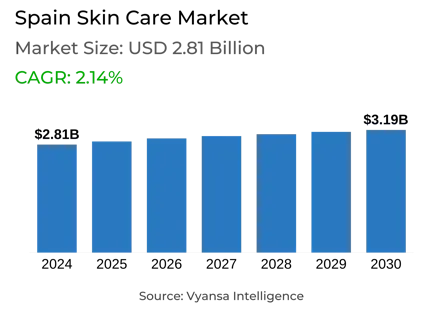
- Skin Care in Spain is estimated at $ 2.81 Billion.
- The market size is expected to grow to $ 3.19 Billion by 2030.
- Market to register a CAGR of around 2.14% during 2025-30.
- Product Shares
- Facial Care grabbed market share of 70%.
- Competition
- More than 20 companies are actively engaged in producing Skin Care in Spain.
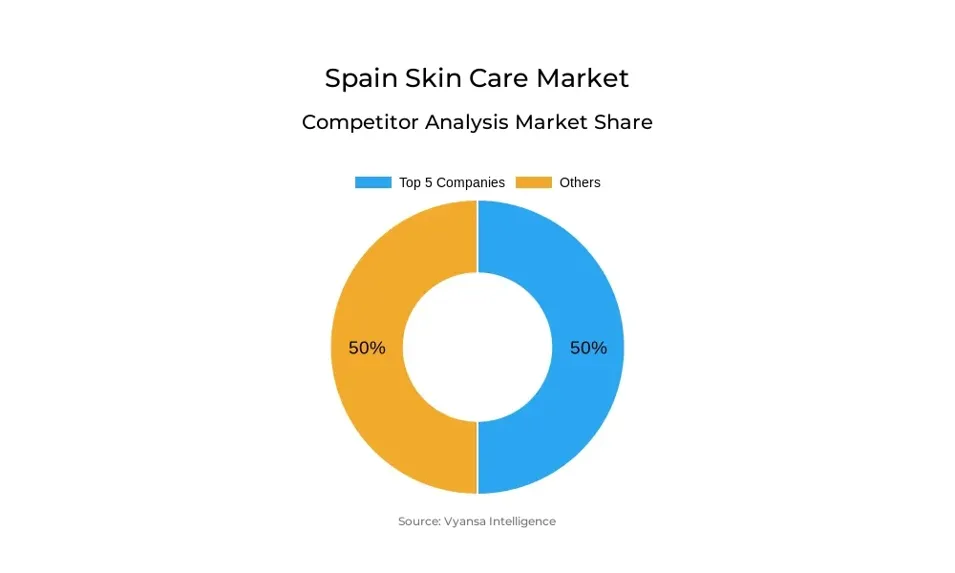
- Top 5 companies acquired 50% of the market share.
- Centros Comerciales, Freshly Cosmetics Sl, Unilever España SA, Grupo, L'Oréal España SA, Beiersdorf SA Spain etc., are few of the top companies.
- Sales Channel
- Retail Offline grabbed 75% of the market.
Spain Skin Care Market Outlook
Spain skin care market will continue to develop steadily in 2025–2030 despite the persistent uncertainty in the economy. Most consumers nowadays have come to treat skin care as a part of their everyday regimen, hence less inclined to reduce expenditure on it. Although consumers are still price-sensitive, the need for high-quality products that yield noticeable outcomes keeps the demand across the board going.
Facial care, particularly simple moisturisers, is expected to be the best-performing category. Social media sites such as TikTok are shaping younger consumers' tendencies towards taking on multi-step routines and looking for ingredient-driven products. This growth is broadening customer bases to a new younger group looking to explore skin care at an early age in life.
The increased demand for value-for-money substitutes is likely to drive mass-market and private label products. "Dupes" or cheap alternatives of high-end products are becoming more popular, particularly when marketed online with slogans such as "If you like this, try this." This may undermine the expansion of premium brands but lead to more chance for low-priced labels from discounters and supermarkets.
New product introductions and brand debuts are also expected to stay strong. Companies across many sectors, including the fashion sector, are venturing into skin care because of the strong margins and increasing demand. Emerging trends in the future are expected to be centered around health and wellness, especially microbiome-friendly products, as consumers become increasingly conscious of the connection between skin health and overall health.
Spain Skin Care Market Growth Driver
In spite of continued economic pressures, the market for skin care products continues to be robust. Consumers increasingly see skin care as a part of their daily personal care and are not willing to compromise on product quality for a lower price. Though higher budget consciousness is most probable in the next few years, value-for-money products are likely to influence buying behavior. Consequently, the skin care category will continue to exhibit steady growth in sales, even as other non-grocery items are trimmed by consumers.
Social media sites such as TikTok are also playing an important part in broadening the consumer base of skin care products, particularly among young consumers. The trend is promoting more elaborate skin care regimens and boosting demand for products such as facial care and simple moisturisers. As a response, new international and local brands such as Thayers, Isdin, Origins, and Drunk Elephant are introducing more products catering to young skin types.
Spain Skin Care Market Trend
The increasing power of "skinification" and the wider health and wellness trend is poised to drive the next generation of trends in the Spain skin care sector. Greater focus is increasingly being put on skin health over appearance. This change is driving brands to investigate formulations that challenge deeper biological issues associated with the skin's natural balance and functioning.
One of the areas attracting special focus is microbiome health. In a survey, it was stated that a healthy balance in skin or gut microbiome is essential because imbalances (dysbiosis) can impact the immune system and cause diseases such as eczema. Therefore, future innovations in skin care will be placing greater emphasis on promoting microbiome balance, making this an essential aspect of product formulation in 2025-30.
Unlock Market Intelligence
Explore the market potential with our data-driven report
| Report Coverage | Details |
|---|---|
| Market Forecast | 2025-30 |
| USD Value 2024 | $ 2.81 Billion |
| USD Value 2030 | $ 3.19 Billion |
| CAGR 2025-2030 | 2.14% |
| Largest Category | Facial Care segment leads with 70% market share |
| Top Drivers | Rising Skin Care Adoption Amid Economic Uncertainty |
| Top Trends | Growing Focus on Microbiome Health Driving Skin Care Innovation |
| Key Players | Centros Comerciales, Freshly Cosmetics Sl, Unilever España SA, Grupo, L'Oréal España SA, Beiersdorf SA Spain, Mercadona SA, Estée Lauder SA, Pierre Fabre Ibérica SA, Henkel Ibérica SA, BrandCare Est 2014 SL and Others. |
Unlock Market Intelligence
Explore the market potential with our data-driven report
Spain Skin Care Market Segmentation Analysis

The most penetrated segment in the Spain Skin Care Market under the sales channel is Retail Offline, dominated by supermarkets. Supermarkets remain dominant because of the formidable presence of private label brands, particularly Mercadona's Deliplus. The channel is most favored by the consumers because of its price and convenience. Yet it is increasingly facing competition from discounters like Lidl whose Cien brand appeals to budget consumers. The move towards cheaper alternatives, particularly amidst economic downturns, also supplemented the expansion of discounters and value product lines in offline retail.
Beauty experts also hold a strong position in the offline market, serving consumers looking for premium and high-efficacy products. At the same time, online is expanding significantly as the second-largest channel. Online platforms were preferred by Spain consumers in 2024 when searching for the best offers and broader product ranges, a survey shows. Easy browsing, frequent promotions, and at-home delivery contributed to its popularity.
Top Companies in Spain Skin Care Market
The top companies operating in the market include Centros Comerciales, Freshly Cosmetics Sl, Unilever España SA, Grupo, L'Oréal España SA, Beiersdorf SA Spain, Mercadona SA, Estée Lauder SA, Pierre Fabre Ibérica SA, Henkel Ibérica SA, BrandCare Est 2014 SL, etc., are the top players operating in the Spain Skin Care Market.
Frequently Asked Questions
Related Report
1. Market Segmentation
1.1. Research Scope
1.2. Research Methodology
1.3. Definitions and Assumptions
2. Executive Summary
3. Spain Skin Care Market Policies, Regulations, and Standards
4. Spain Skin Care Market Dynamics
4.1. Growth Factors
4.2. Challenges
4.3. Trends
4.4. Opportunities
5. Spain Skin Care Market Statistics, 2020-2030F
5.1. Market Size & Growth Outlook
5.1.1.By Revenues in US$ Million
5.2. Market Segmentation & Growth Outlook
5.2.1.By Product
5.2.1.1. Body Care- Market Insights and Forecast 2020-2030, USD Million
5.2.1.1.1. Firming Body Care- Market Insights and Forecast 2020-2030, USD Million
5.2.1.1.2. General Purpose Body Care- Market Insights and Forecast 2020-2030, USD Million
5.2.1.2. Facial Care- Market Insights and Forecast 2020-2030, USD Million
5.2.1.2.1. Acne Treatments- Market Insights and Forecast 2020-2030, USD Million
5.2.1.2.2. Face Masks- Market Insights and Forecast 2020-2030, USD Million
5.2.1.2.3. Facial Cleansers- Market Insights and Forecast 2020-2030, USD Million
5.2.1.2.3.1. Liquid- Market Insights and Forecast 2020-2030, USD Million
5.2.1.2.3.2. Cream- Market Insights and Forecast 2020-2030, USD Million
5.2.1.2.3.3. Gel- Market Insights and Forecast 2020-2030, USD Million
5.2.1.2.3.4. Bar Cleansers- Market Insights and Forecast 2020-2030, USD Million
5.2.1.2.3.5. Facial Cleansing Wipes- Market Insights and Forecast 2020-2030, USD Million
5.2.1.2.4. Moisturisers and Treatments- Market Insights and Forecast 2020-2030, USD Million
5.2.1.2.4.1. Basic Moisturisers- Market Insights and Forecast 2020-2030, USD Million
5.2.1.2.4.2. Anti-Agers- Market Insights and Forecast 2020-2030, USD Million
5.2.1.2.5. Lip Care- Market Insights and Forecast 2020-2030, USD Million
5.2.1.2.6. Toners- Market Insights and Forecast 2020-2030, USD Million
5.2.1.3. Hand Care- Market Insights and Forecast 2020-2030, USD Million
5.2.1.4. Skin Care Sets/Kits- Market Insights and Forecast 2020-2030, USD Million
5.2.2.By Category
5.2.2.1. Premium- Market Insights and Forecast 2020-2030, USD Million
5.2.2.2. Mass- Market Insights and Forecast 2020-2030, USD Million
5.2.3.By Gender
5.2.3.1. Men- Market Insights and Forecast 2020-2030, USD Million
5.2.3.2. Women- Market Insights and Forecast 2020-2030, USD Million
5.2.3.3. Unisex- Market Insights and Forecast 2020-2030, USD Million
5.2.4.By End User
5.2.4.1. Adults- Market Insights and Forecast 2020-2030, USD Million
5.2.4.2. Teenagers- Market Insights and Forecast 2020-2030, USD Million
5.2.4.3. Children- Market Insights and Forecast 2020-2030, USD Million
5.2.5.By Packaging
5.2.5.1. Tubes- Market Insights and Forecast 2020-2030, USD Million
5.2.5.2. Bottles- Market Insights and Forecast 2020-2030, USD Million
5.2.5.3. Jars- Market Insights and Forecast 2020-2030, USD Million
5.2.5.4. Others- Market Insights and Forecast 2020-2030, USD Million
5.2.6.By Sales Channel
5.2.6.1. Online- Market Insights and Forecast 2020-2030, USD Million
5.2.6.2. Offline- Market Insights and Forecast 2020-2030, USD Million
5.2.7.By Competitors
5.2.7.1. Competition Characteristics
5.2.7.2. Market Share & Analysis
6. Spain Body Care Market Statistics, 2020-2030F
6.1. Market Size & Growth Outlook
6.1.1.By Revenues in US$ Million
6.2. Market Segmentation & Growth Outlook
6.2.1.By Product- Market Insights and Forecast 2020-2030, USD Million
6.2.2.By Category- Market Insights and Forecast 2020-2030, USD Million
6.2.3.By Gender- Market Insights and Forecast 2020-2030, USD Million
6.2.4.By End User- Market Insights and Forecast 2020-2030, USD Million
6.2.5.By Packaging- Market Insights and Forecast 2020-2030, USD Million
6.2.6.By Sales Channel- Market Insights and Forecast 2020-2030, USD Million
7. Spain Facial Care Market Statistics, 2020-2030F
7.1. Market Size & Growth Outlook
7.1.1.By Revenues in US$ Million
7.2. Market Segmentation & Growth Outlook
7.2.1.By Product- Market Insights and Forecast 2020-2030, USD Million
7.2.2.By Category- Market Insights and Forecast 2020-2030, USD Million
7.2.3.By Gender- Market Insights and Forecast 2020-2030, USD Million
7.2.4.By End User- Market Insights and Forecast 2020-2030, USD Million
7.2.5.By Packaging- Market Insights and Forecast 2020-2030, USD Million
7.2.6.By Sales Channel- Market Insights and Forecast 2020-2030, USD Million
8. Spain Hand Care Market Statistics, 2020-2030F
8.1. Market Size & Growth Outlook
8.1.1.By Revenues in US$ Million
8.2. Market Segmentation & Growth Outlook
8.2.1.By Category- Market Insights and Forecast 2020-2030, USD Million
8.2.2.By Gender- Market Insights and Forecast 2020-2030, USD Million
8.2.3.By End User- Market Insights and Forecast 2020-2030, USD Million
8.2.4.By Packaging- Market Insights and Forecast 2020-2030, USD Million
8.2.5.By Sales Channel- Market Insights and Forecast 2020-2030, USD Million
9. Spain Skin Care Sets/Kits Market Statistics, 2020-2030F
9.1. Market Size & Growth Outlook
9.1.1.By Revenues in US$ Million
9.2. Market Segmentation & Growth Outlook
9.2.1.By Category- Market Insights and Forecast 2020-2030, USD Million
9.2.2.By Gender- Market Insights and Forecast 2020-2030, USD Million
9.2.3.By End User- Market Insights and Forecast 2020-2030, USD Million
9.2.4.By Packaging- Market Insights and Forecast 2020-2030, USD Million
9.2.5.By Sales Channel- Market Insights and Forecast 2020-2030, USD Million
10. Competitive Outlook
10.1. Company Profiles
10.1.1. L'Oréal España SA
10.1.1.1. Business Description
10.1.1.2. Product Portfolio
10.1.1.3. Collaborations & Alliances
10.1.1.4. Recent Developments
10.1.1.5. Financial Details
10.1.1.6. Others
10.1.2. Beiersdorf SA Spain
10.1.2.1. Business Description
10.1.2.2. Product Portfolio
10.1.2.3. Collaborations & Alliances
10.1.2.4. Recent Developments
10.1.2.5. Financial Details
10.1.2.6. Others
10.1.3. Mercadona SA
10.1.3.1. Business Description
10.1.3.2. Product Portfolio
10.1.3.3. Collaborations & Alliances
10.1.3.4. Recent Developments
10.1.3.5. Financial Details
10.1.3.6. Others
10.1.4. Estée Lauder SA
10.1.4.1. Business Description
10.1.4.2. Product Portfolio
10.1.4.3. Collaborations & Alliances
10.1.4.4. Recent Developments
10.1.4.5. Financial Details
10.1.4.6. Others
10.1.5. Pierre Fabre Ibérica SA
10.1.5.1. Business Description
10.1.5.2. Product Portfolio
10.1.5.3. Collaborations & Alliances
10.1.5.4. Recent Developments
10.1.5.5. Financial Details
10.1.5.6. Others
10.1.6. Centros Comerciales
10.1.6.1. Business Description
10.1.6.2. Product Portfolio
10.1.6.3. Collaborations & Alliances
10.1.6.4. Recent Developments
10.1.6.5. Financial Details
10.1.6.6. Others
10.1.7. Freshly Cosmetics Sl
10.1.7.1. Business Description
10.1.7.2. Product Portfolio
10.1.7.3. Collaborations & Alliances
10.1.7.4. Recent Developments
10.1.7.5. Financial Details
10.1.7.6. Others
10.1.8. Unilever España SA, Grupo
10.1.8.1. Business Description
10.1.8.2. Product Portfolio
10.1.8.3. Collaborations & Alliances
10.1.8.4. Recent Developments
10.1.8.5. Financial Details
10.1.8.6. Others
10.1.9. Henkel Ibérica SA
10.1.9.1. Business Description
10.1.9.2. Product Portfolio
10.1.9.3. Collaborations & Alliances
10.1.9.4. Recent Developments
10.1.9.5. Financial Details
10.1.9.6. Others
10.1.10. BrandCare Est 2014 SL
10.1.10.1.Business Description
10.1.10.2.Product Portfolio
10.1.10.3.Collaborations & Alliances
10.1.10.4.Recent Developments
10.1.10.5.Financial Details
10.1.10.6.Others
11. Disclaimer
| Segment | Sub-Segment |
|---|---|
| By Product |
|
| By Category |
|
| By Gender |
|
| By End User |
|
| By Packaging |
|
| By Sales Channel |
|
Research Methodology
This study followed a structured approach comprising four key phases to assess the size and scope of the electro-oxidation market. The process began with thorough secondary research to collect data on the target market, related markets, and broader industry context. These findings, along with preliminary assumptions and estimates, were then validated through extensive primary research involving industry experts from across the value chain. To calculate the overall market size, both top-down and bottom-up methodologies were employed. Finally, market segmentation and data triangulation techniques were applied to refine and validate segment-level estimations.
Secondary Research
The secondary research phase involved gathering data from a wide range of credible and published sources. This step helped in identifying industry trends, defining market segmentation, and understanding the market landscape and value chain.
Sources consulted during this phase included:
- Company annual reports, investor presentations, and press releases
- Industry white papers and certified publications
- Trade directories and market-recognized databases
- Articles from authoritative authors and reputable journals
- Gold and silver standard websites
Secondary research was critical in mapping out the industry's value chain and monetary flow, identifying key market segments, understanding regional variations, and tracking significant industry developments.
Other key sources:
- Financial disclosures
- Industry associations and trade bodies
- News outlets and business magazines
- Academic journals and research studies
- Paid industry databases
Primary Research
To validate secondary data and gain deeper market insights, primary research was conducted with key stakeholders across both the supply and demand sides of the market.
On the demand side, participants included decision-makers and influencers from end-user industries—such as CIOs, CTOs, and CSOs—who provided first-hand perspectives on market needs, product usage, and future expectations.
On the supply side, interviews were conducted with manufacturers, industry associations, and institutional participants to gather insights into current offerings, product pipelines, and market challenges.
Primary interviews provided critical inputs such as:
- Market size and revenue data
- Product and service breakdowns
- Market forecasts
- Regional and application-specific trends
Stakeholders consulted included:
- Leading OEM and solution providers
- Channel and distribution partners
- End users across various applications
- Independent consultants and industry specialists
Market Size Estimation and Data Triangulation
- Identifying Key Market Participants (Secondary Research)
- Goal: To identify the major players or companies in the target market. This typically involves using publicly available data sources such as industry reports, market research publications, and financial statements of companies.
- Tools: Reports from firms like Gartner, Forrester, Euromonitor, Statista, IBISWorld, and others. Public financial statements, news articles, and press releases from top market players.
- Extracting Earnings of Key Market Participants
- Goal: To estimate the earnings generated from the product or service being analyzed. This step helps in understanding the revenue potential of each market player in a specific geography.
- Methods: Earnings data can be gathered from:
- Publicly available financial reports (for listed companies).
- Interviews and primary data sources from professionals, such as Directors, VPs, SVPs, etc. This is especially useful for understanding more nuanced, internal data that isn't publicly disclosed.
- Annual reports and investor presentations of key players.
- Data Collation and Development of a Relevant Data Model
- Goal: To collate inputs from both primary and secondary sources into a structured, data-driven model for market estimation. This model will incorporate key market KPIs and any independent variables relevant to the market.
- Key KPIs: These could include:
- Market size, growth rate, and demand drivers.
- Industry-specific metrics like market share, average revenue per customer (ARPC), or average deal size.
- External variables, such as economic growth rates, inflation rates, or commodity prices, that could affect the market.
- Data Modeling: Based on this data, the market forecasts are developed for the next 5 years. A combination of trend analysis, scenario modeling, and statistical regression might be used to generate projections.
- Scenario Analysis
- Goal: To test different assumptions and validate how sensitive the market is to changes in key variables (e.g., market demand, regulatory changes, technological disruptions).
- Types of Scenarios:
- Base Case: Based on current assumptions and historical data.
- Best-Case Scenario: Assuming favorable market conditions, regulatory environments, and technological advancements.
- Worst-Case Scenario: Accounting for adverse factors, such as economic downturns, stricter regulations, or unexpected disruptions.












