South Korea Small Cooking Appliances Market Report: Trends, Growth and Forecast (2026-2032)
By Appliances (Breadmakers, Coffee Machines (Standard Coffee Machines (Espresso Coffee Machines, Filter Coffee Machines), Pod Coffee Machines (Hard Pods, Soft Pods)), Coffee Mills, Fryers (Air Fryers, Oil Based Fryers), Electric Grills, Electric Steamers, Freestanding Hobs (Gas, Induction, Standard Electric, Mixed, Vitroceramic), Kettles, Rice Cookers, Slow Cookers, Others), By Sales Channel (Retail Offline (Grocery Retailers (Hypermarkets), Non-Grocery Retailers (General Merchandise Stores, Department Stores, Variety Stores, Appliances and Electronics Specialists, Home Products Specialists)), Retail Online) ... Read more

|
Major Players
|
South Korea Small Cooking Appliances Market Statistics and Insights, 2026
- Market Size Statistics
- Small cooking appliances market size in South Korea was valued at USD 1.09 billion in 2025 and is estimated at USD 1.12 million in 2026.
- The market size is expected to grow to USD 1.19 billion by 2032.
- Market to register a CAGR of around 1.26% during 2026-32.
- Appliances Shares
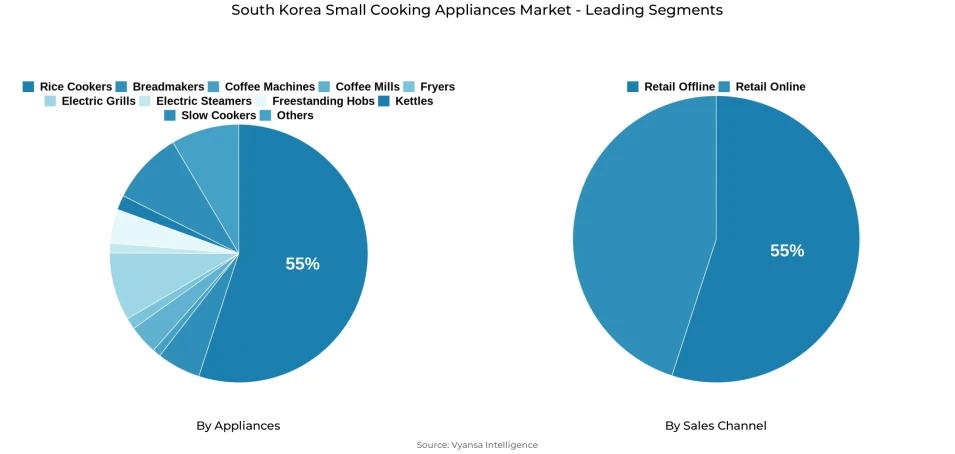
- Rice cookers grabbed market share of 55%.
- Competition
- More than 20 companies are actively engaged in producing small cooking appliances in South Korea.
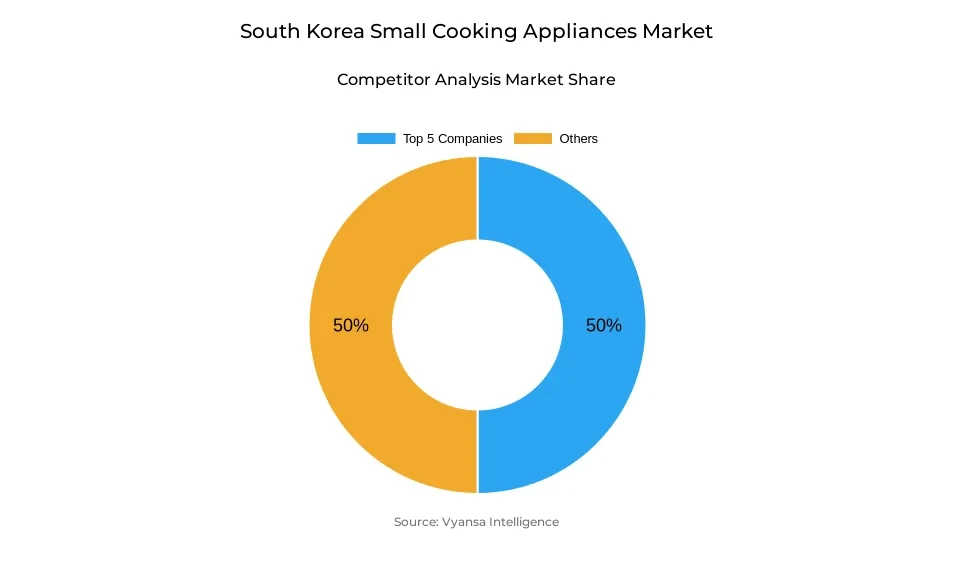
- Top 5 companies acquired around 50% of the market share.
- SK Magic Inc, Rinnai Korea Co Ltd, NUC Electronics Co Ltd, Cuckoo Electronics Co Ltd, Lihom-Cuchen Co Ltd etc., are few of the top companies.
- Sales Channel
- Retail offline grabbed 55% of the market.
South Korea Small Cooking Appliances Market Outlook
South Korea small cooking appliances market size was valued at USD 1.09 billion in 2025 and is projected to grow from USD 1.12 billion in 2026 to USD 1.19 billion by 2032, exhibiting a CAGR of 1.26% during the forecast period. The renewed interest in high quality home coffee experiences, increased demand in compact appliances, and increased preference of products that provide convenience, less noise and better fit in the modern urban lifestyle contribute to growth.
The products that are associated with more common everyday use and greater convenience at home are still in the highest demand. In small cooking appliances, rice cookers hold the highest share at 55%, supported by their long standing role in household food preparation and continued product upgrades with quieter operation, compact designs, and more premium features. Meanwhile, the resurgence of interest in home based coffee in the form of cafes is also contributing to the resurgence of espresso machines and high end standard coffee makers as more consumers are willing to seek higher quality brewing experiences.
At the same time, small cooking appliances are also being shaped by changing eating habits and household structures. The demand of some traditional appliances is decreasing due to lower frequency of cooking rice at home, increasing popularity of instant rice and delivery food, and increasing popularity of western style meals. Nonetheless, smaller and less noisy products are gaining popularity, particularly with the growing number of smaller homes and smaller families requiring appliances that can save space and yet provide useful daily functionality.
The sales channel continues to be led by retail offline, accounting for 55% of the market. Many consumers still prefer in person product experience when buying small cooking appliances, especially for coffee machines and rice cookers with more premium or specialised features. Experiential pop-up stores and branded experience spaces are doing best within the top sales channel and are backed by live product trials, espresso masterclasses, tastings, and promotional activities that assist brands in drawing visitors and maintaining consumer interest high despite the ongoing growth of retail online.
South Korea Small Cooking Appliances Market Growth DriverPremium Home Coffee Lifts Replacement Demand
Renewed interest in café-style coffee at home is supporting demand for small cooking appliances in South Korea. Customers are also moving towards more premium brewing experiences and espresso based beverages, which is contributing to the resurgence of espresso machines and higher end standard coffee makers. This is particularly applicable since coffee is still strongly associated with contemporary everyday life and home cafe culture.
This shift is supported by the improvement of household finances. According to the 2025 Survey of Household Finances and Living Conditions, the mean household income in South Korea is KRW 74.27 million, and the disposable income is KRW 60.32 million. This increased base of spending helps in consumer willingness to revert to higher value coffee appliances and superior quality home brewing products.
South Korea Small Cooking Appliances Market ChallengeConvenience Eating Reduces Rice Cooker Usage
Lower frequency of cooking rice at home is becoming an obstacle for small cooking appliances in South Korea. Instant rice, delivery food, and meals that need less preparation are being preferred by more consumers. This is undermining the demand of rice cookers particularly because some households are no longer finding it necessary to cook rice on a daily basis. The category is also being pressured by the wider shifts in eating patterns and the increased popularity of western style meals.
This pressure is supported by household structure. Statistics Korea reports that one person households account for 36.1% of general households in 2024, up from 35.5% in 2023. It also states that one person and two person households together make up 65.1% of general households. Smaller families tend to prefer ready to heat meal options in portions rather than preparing rice in bulk.
Unlock Market Intelligence
Explore the market potential with our data-driven report
South Korea Small Cooking Appliances Market TrendExperiential Retail Is Gaining More Attention
Experiential retail is becoming a stronger trend in South Korea’s small cooking appliances space. The popularity of pop-up stores is on the rise due to the opportunity to see, touch, and learn more about products in real life. This is particularly helpful with products like espresso machines and rice cookers where customers usually need more assurance before they buy and are responsive to practical demonstrations.
This trend is being strengthened by retail online growth. Statistics Korea reports that online shopping transaction value reaches KRW 22.4 trillion in March 2025, while mobile shopping accounts for 76.9% of that value. With the rise of retail online, brands are relying on pop-up spaces, tastings, and masterclasses to make real life interaction and become more visible.
South Korea Small Cooking Appliances Market OpportunityQuiet Compact Designs Open New Room for Growth
Small and silent appliances are developing a good opportunity in South Korea. Consumers are becoming more appreciative of products that are smaller in size, less noisy, and yet can be used in their daily lives. This is fueling the demand of quieter rice cookers, portable cooking products and compact appliances that are more comfortable, convenient and more appropriate to the modern urban lifestyle.
This space is supported by housing and household patterns. Statistics Korea states that the average household size falls to 2.19 persons, and 53.9% of general households live in apartments. These factors render smaller and less noisy appliances more applicable, particularly in situations where the kitchen area is small and customers desire products that are more convenient to operate in smaller living spaces.
Unlock Market Intelligence
Explore the market potential with our data-driven report
South Korea Small Cooking Appliances Market Segmentation Analysis
By Appliances
- Breadmakers
- Coffee Machines
- Standard Coffee Machines
- Espresso Coffee Machines
- Filter Coffee Machines
- Pod Coffee Machines
- Hard Pods
- Soft Pods
- Standard Coffee Machines
- Coffee Mills
- Fryers
- Air Fryers
- Oil Based Fryers
- Electric Grills
- Electric Steamers
- Freestanding Hobs
- Gas
- Induction
- Standard Electric
- Mixed
- Vitroceramic
- Kettles
- Rice Cookers
- Slow Cookers
- Others
The segment with the highest share around segment under the appliance category is rice cookers, accounting for around 55% of the market. This dominance is attributed to the fact that rice has been a part of daily food preparation in South Korea and the high household ownership of rice cookers. Although the sales have been under pressure, the category is still very visible since rice cookers are still being viewed as a common and useful kitchen tool.
Rice cookers also remain on top since brands keep updating the category with less noise, smaller designs, and more high end features. New low noise models keep consumer interest in the category. These factors support rice cookers in maintaining the leading position across small cooking appliances in South Korea.
By Sales Channel
- Retail Offline
- Grocery Retailers
- Hypermarkets
- Non-Grocery Retailers
- General Merchandise Stores
- Department Stores
- Variety Stores
- Appliances and Electronics Specialists
- Home Products Specialists
- Grocery Retailers
- Retail Online
The segment with the highest share around segment under the sales channel is retail offline, holding around 55% of the market. This dominance is attributed to the fact that the face-to-face product experience remains significant, particularly in those categories where consumers desire to know how it works, compare quality, and test usability before purchasing. This is especially applicable to coffee machines and rice cookers that have higher quality or specialised features.
In the retail offline, branded experience spaces and experiential pop-up stores are doing best in drawing engagement. To attract more visitors, brands are increasing these spaces by offering live product trials, weekly espresso masterclasses, tastings, and prize winning games. This helps retail offline stay relevant even as retail online grows, with online shopping transaction value reaching KRW 22.4 trillion in March 2025 and mobile shopping accounting for 76.9%
List of Companies Covered in South Korea Small Cooking Appliances Market
The companies listed below are highly influential in the South Korea small cooking appliances market, with a significant market share and a strong impact on industry developments.
- SK Magic Inc
- Rinnai Korea Co Ltd
- NUC Electronics Co Ltd
- Cuckoo Electronics Co Ltd
- Lihom-Cuchen Co Ltd
- Philips Korea Ltd
- Groupe SEB Korea Ltd
- Nestle Korea Ltd
- LG Electronics Inc
- Shinil Electronics Co Ltd
Competitive Landscape
In 2025, small cooking appliances in South Korea showed signs of gradual stabilisation despite earlier declines, supported by emerging innovation in premium coffee machines, low-noise appliances, and evolving consumer preferences towards convenience and quality, which helped create pockets of growth and renewed interest in the category; within this improving environment, Cuckoo Electronics Co Ltd continued to lead the market, while Lihom-Cuchen Co Ltd followed in second place, with both companies leveraging strong brand equity, continuous product innovation, and diversification strategies to capitalise on recovery opportunities and sustain their competitive positions.
Frequently Asked Questions
Related Report
- Market Segmentation
- Research Scope
- Research Methodology
- Definitions and Assumptions
- Executive Summary
- South Korea Small Cooking Appliances Market Policies, Regulations, and Standards
- South Korea Small Cooking Appliances Market Dynamics
- Growth Factors
- Challenges
- Trends
- Opportunities
- South Korea Small Cooking Appliances Market Statistics, 2022-2032F
- Market Size & Growth Outlook
- By Revenues in USD Million
- Market Segmentation & Growth Outlook
- By Appliances
- Breadmakers- Market Insights and Forecast 2022-2032, USD Million
- Coffee Machines- Market Insights and Forecast 2022-2032, USD Million
- Standard Coffee Machines- Market Insights and Forecast 2022-2032, USD Million
- Espresso Coffee Machines- Market Insights and Forecast 2022-2032, USD Million
- Filter Coffee Machines- Market Insights and Forecast 2022-2032, USD Million
- Pod Coffee Machines- Market Insights and Forecast 2022-2032, USD Million
- Hard Pods- Market Insights and Forecast 2022-2032, USD Million
- Soft Pods- Market Insights and Forecast 2022-2032, USD Million
- Standard Coffee Machines- Market Insights and Forecast 2022-2032, USD Million
- Coffee Mills- Market Insights and Forecast 2022-2032, USD Million
- Fryers- Market Insights and Forecast 2022-2032, USD Million
- Air Fryers- Market Insights and Forecast 2022-2032, USD Million
- Oil Based Fryers- Market Insights and Forecast 2022-2032, USD Million
- Electric Grills- Market Insights and Forecast 2022-2032, USD Million
- Electric Steamers- Market Insights and Forecast 2022-2032, USD Million
- Freestanding Hobs- Market Insights and Forecast 2022-2032, USD Million
- Gas- Market Insights and Forecast 2022-2032, USD Million
- Induction- Market Insights and Forecast 2022-2032, USD Million
- Standard Electric- Market Insights and Forecast 2022-2032, USD Million
- Mixed- Market Insights and Forecast 2022-2032, USD Million
- Vitroceramic- Market Insights and Forecast 2022-2032, USD Million
- Kettles- Market Insights and Forecast 2022-2032, USD Million
- Rice Cookers- Market Insights and Forecast 2022-2032, USD Million
- Slow Cookers- Market Insights and Forecast 2022-2032, USD Million
- Others- Market Insights and Forecast 2022-2032, USD Million
- By Sales Channel
- Retail Offline- Market Insights and Forecast 2022-2032, USD Million
- Grocery Retailers- Market Insights and Forecast 2022-2032, USD Million
- Hypermarkets- Market Insights and Forecast 2022-2032, USD Million
- Non-Grocery Retailers- Market Insights and Forecast 2022-2032, USD Million
- General Merchandise Stores- Market Insights and Forecast 2022-2032, USD Million
- Department Stores- Market Insights and Forecast 2022-2032, USD Million
- Variety Stores- Market Insights and Forecast 2022-2032, USD Million
- Appliances and Electronics Specialists- Market Insights and Forecast 2022-2032, USD Million
- Home Products Specialists- Market Insights and Forecast 2022-2032, USD Million
- Grocery Retailers- Market Insights and Forecast 2022-2032, USD Million
- Retail Online- Market Insights and Forecast 2022-2032, USD Million
- Retail Offline- Market Insights and Forecast 2022-2032, USD Million
- By Competitors
- Competition Characteristics
- Market Share & Analysis
- By Appliances
- Market Size & Growth Outlook
- South Korea Breadmakers Market Statistics, 2022-2032
- Market Size & Growth Outlook
- By Revenues in USD Million
- Market Segmentation & Growth Outlook
- By Sales Channel- Market Insights and Forecast 2022-2032, USD Million
- Market Size & Growth Outlook
- South Korea Coffee Machines Market Statistics, 2022-2032
- Market Size & Growth Outlook
- By Revenues in USD Million
- Market Segmentation & Growth Outlook
- By Sales Channel- Market Insights and Forecast 2022-2032, USD Million
- Market Size & Growth Outlook
- South Korea Coffee Mills Market Statistics, 2022-2032
- Market Size & Growth Outlook
- By Revenues in USD Million
- Market Segmentation & Growth Outlook
- By Sales Channel- Market Insights and Forecast 2022-2032, USD Million
- Market Size & Growth Outlook
- South Korea Fryers Market Statistics, 2022-2032
- Market Size & Growth Outlook
- By Revenues in USD Million
- Market Segmentation & Growth Outlook
- By Sales Channel- Market Insights and Forecast 2022-2032, USD Million
- Market Size & Growth Outlook
- South Korea Electric Grills Market Statistics, 2022-2032
- Market Size & Growth Outlook
- By Revenues in USD Million
- Market Segmentation & Growth Outlook
- By Sales Channel- Market Insights and Forecast 2022-2032, USD Million
- Market Size & Growth Outlook
- South Korea Electric Steamers Market Statistics, 2022-2032
- Market Size & Growth Outlook
- By Revenues in USD Million
- Market Segmentation & Growth Outlook
- By Sales Channel- Market Insights and Forecast 2022-2032, USD Million
- Market Size & Growth Outlook
- South Korea Freestanding Hobs Market Statistics, 2022-2032
- Market Size & Growth Outlook
- By Revenues in USD Million
- Market Segmentation & Growth Outlook
- By Sales Channel- Market Insights and Forecast 2022-2032, USD Million
- Market Size & Growth Outlook
- South Korea Kettles Market Statistics, 2022-2032
- Market Size & Growth Outlook
- By Revenues in USD Million
- Market Segmentation & Growth Outlook
- By Sales Channel- Market Insights and Forecast 2022-2032, USD Million
- Market Size & Growth Outlook
- South Korea Rice Cookers Market Statistics, 2022-2032
- Market Size & Growth Outlook
- By Revenues in USD Million
- Market Segmentation & Growth Outlook
- By Sales Channel- Market Insights and Forecast 2022-2032, USD Million
- Market Size & Growth Outlook
- South Korea Slow Cookers Market Statistics, 2022-2032
- Market Size & Growth Outlook
- By Revenues in USD Million
- Market Segmentation & Growth Outlook
- By Sales Channel- Market Insights and Forecast 2022-2032, USD Million
- Market Size & Growth Outlook
- Competitive Outlook
- Company Profiles
- Cuckoo Electronics Co Ltd
- Business Description
- Product Portfolio
- Collaborations & Alliances
- Recent Developments
- Financial Details
- Others
- Lihom-Cuchen Co Ltd
- Business Description
- Product Portfolio
- Collaborations & Alliances
- Recent Developments
- Financial Details
- Others
- Groupe SEB Korea Ltd
- Business Description
- Product Portfolio
- Collaborations & Alliances
- Recent Developments
- Financial Details
- Others
- Philips Korea Ltd
- Business Description
- Product Portfolio
- Collaborations & Alliances
- Recent Developments
- Financial Details
- Others
- SK Magic Inc
- Business Description
- Product Portfolio
- Collaborations & Alliances
- Recent Developments
- Financial Details
- Others
- Nestle Korea Ltd
- Business Description
- Product Portfolio
- Collaborations & Alliances
- Recent Developments
- Financial Details
- Others
- Rinnai Korea Co Ltd
- Business Description
- Product Portfolio
- Collaborations & Alliances
- Recent Developments
- Financial Details
- Others
- NUC Electronics Co Ltd
- Business Description
- Product Portfolio
- Collaborations & Alliances
- Recent Developments
- Financial Details
- Others
- LG Electronics Inc
- Business Description
- Product Portfolio
- Collaborations & Alliances
- Recent Developments
- Financial Details
- Others
- Shinil Electronics Co Ltd
- Business Description
- Product Portfolio
- Collaborations & Alliances
- Recent Developments
- Financial Details
- Others
- Cuckoo Electronics Co Ltd
- Company Profiles
- Disclaimer
| Segment | Sub-Segment |
|---|---|
| By Appliances |
|
| By Sales Channel |
|
Research Methodology
This study followed a structured approach comprising four key phases to assess the size and scope of the electro-oxidation market. The process began with thorough secondary research to collect data on the target market, related markets, and broader industry context. These findings, along with preliminary assumptions and estimates, were then validated through extensive primary research involving industry experts from across the value chain. To calculate the overall market size, both top-down and bottom-up methodologies were employed. Finally, market segmentation and data triangulation techniques were applied to refine and validate segment-level estimations.
Secondary Research
The secondary research phase involved gathering data from a wide range of credible and published sources. This step helped in identifying industry trends, defining market segmentation, and understanding the market landscape and value chain.
Sources consulted during this phase included:
- Company annual reports, investor presentations, and press releases
- Industry white papers and certified publications
- Trade directories and market-recognized databases
- Articles from authoritative authors and reputable journals
- Gold and silver standard websites
Secondary research was critical in mapping out the industry's value chain and monetary flow, identifying key market segments, understanding regional variations, and tracking significant industry developments.
Other key sources:
- Financial disclosures
- Industry associations and trade bodies
- News outlets and business magazines
- Academic journals and research studies
- Paid industry databases
Primary Research
To validate secondary data and gain deeper market insights, primary research was conducted with key stakeholders across both the supply and demand sides of the market.
On the demand side, participants included decision-makers and influencers from end-user industries—such as CIOs, CTOs, and CSOs—who provided first-hand perspectives on market needs, product usage, and future expectations.
On the supply side, interviews were conducted with manufacturers, industry associations, and institutional participants to gather insights into current offerings, product pipelines, and market challenges.
Primary interviews provided critical inputs such as:
- Market size and revenue data
- Product and service breakdowns
- Market forecasts
- Regional and application-specific trends
Stakeholders consulted included:
- Leading OEM and solution providers
- Channel and distribution partners
- End users across various applications
- Independent consultants and industry specialists
Market Size Estimation and Data Triangulation
- Identifying Key Market Participants (Secondary Research)
- Goal: To identify the major players or companies in the target market. This typically involves using publicly available data sources such as industry reports, market research publications, and financial statements of companies.
- Tools: Reports from firms like Gartner, Forrester, Euromonitor, Statista, IBISWorld, and others. Public financial statements, news articles, and press releases from top market players.
- Extracting Earnings of Key Market Participants
- Goal: To estimate the earnings generated from the product or service being analyzed. This step helps in understanding the revenue potential of each market player in a specific geography.
- Methods: Earnings data can be gathered from:
- Publicly available financial reports (for listed companies).
- Interviews and primary data sources from professionals, such as Directors, VPs, SVPs, etc. This is especially useful for understanding more nuanced, internal data that isn't publicly disclosed.
- Annual reports and investor presentations of key players.
- Data Collation and Development of a Relevant Data Model
- Goal: To collate inputs from both primary and secondary sources into a structured, data-driven model for market estimation. This model will incorporate key market KPIs and any independent variables relevant to the market.
- Key KPIs: These could include:
- Market size, growth rate, and demand drivers.
- Industry-specific metrics like market share, average revenue per customer (ARPC), or average deal size.
- External variables, such as economic growth rates, inflation rates, or commodity prices, that could affect the market.
- Data Modeling: Based on this data, the market forecasts are developed for the next 5 years. A combination of trend analysis, scenario modeling, and statistical regression might be used to generate projections.
- Scenario Analysis
- Goal: To test different assumptions and validate how sensitive the market is to changes in key variables (e.g., market demand, regulatory changes, technological disruptions).
- Types of Scenarios:
- Base Case: Based on current assumptions and historical data.
- Best-Case Scenario: Assuming favorable market conditions, regulatory environments, and technological advancements.
- Worst-Case Scenario: Accounting for adverse factors, such as economic downturns, stricter regulations, or unexpected disruptions.












