South Korea Skin Toner Market Report: Trends, Growth and Forecast (2026-2032)
By Form (Fluid Toner, Mist Toner, Toner Pads), By Product Type (Hydrating Toners, Exfoliating Toners, Astringent Toners, Soothing Toners, Brightening Toners), By Product Nature (Conventional, Organic, Alcohol-Free), By Skin Type (Oily Skin, Dry Skin, Sensitive Skin, Combination Skin, Normal Skin), By End User (Women, Men, Unisex), By Sales Channel (Supermarkets and Hypermarkets, Specialty Beauty Stores, Pharmacies and Drugstores, Convenience Stores, E-commerce, Brand-Owned Stores, Others) ... Read more
|
Major Players
|
South Korea Skin Toner Market Statistics and Insights, 2026
- Market Size Statistics
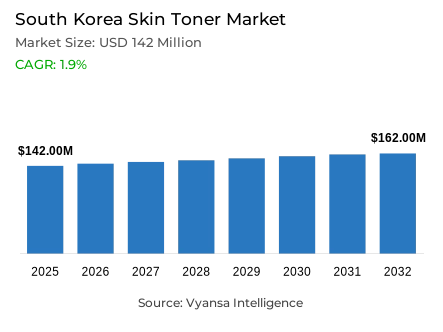
- Skin toner market size in South Korea was valued at USD 142 million in 2025 and is estimated at USD 145 million in 2026.
- The market size is expected to grow to USD 162 million by 2032.
- Market to register a CAGR of around 1.9% during 2026-32.
- Form Shares
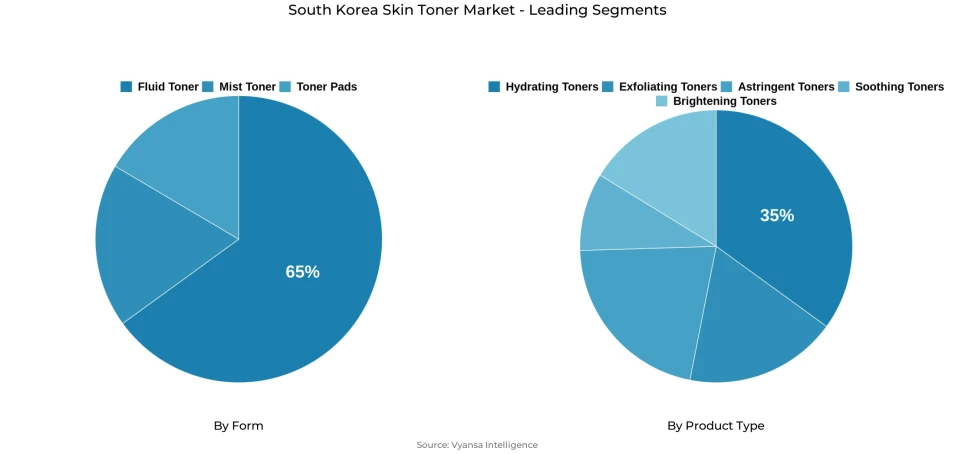
- Fluid toner grabbed market share of 65%.
- Competition
- More than 10 companies are actively engaged in producing skin toner in South Korea.
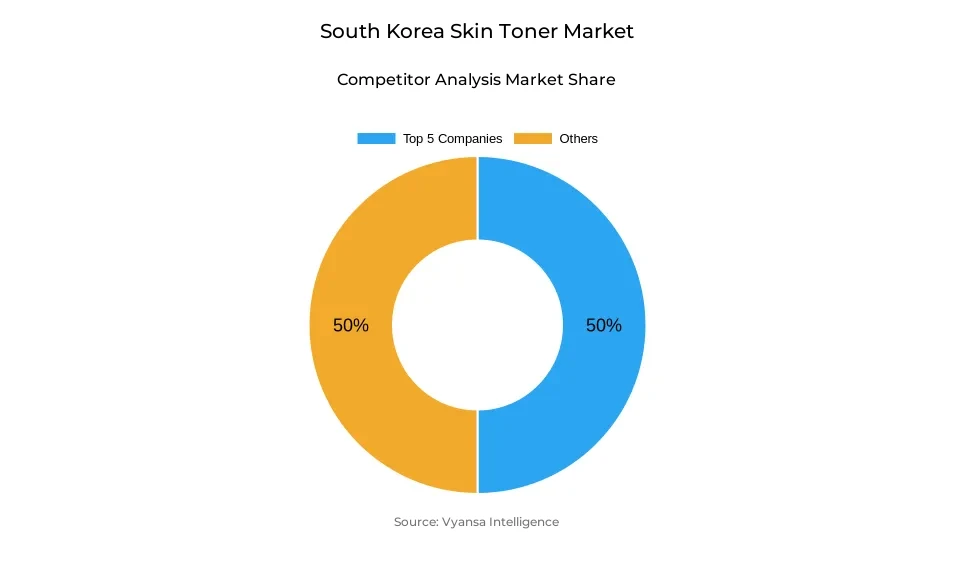
- Top 5 companies acquired around 50% of the market share.
- APR Corporation, Gowoonsesang Cosmetics Co., Ltd., ABLE C&C Co. Ltd., Amorepacific Corporation, LG H&H Co. Ltd. etc., are few of the top companies.
- Product Type
- Hydrating toners grabbed 35% of the market.
South Korea Skin Toner Market Outlook
The South Korea Skin Toner Market covers fluid, milky, exfoliating, balancing, soothing, and hydrating toner formats used after cleansing and before serum or moisturizer. It serves mass, premium, derma, clean beauty, and export-oriented K-beauty users through pharmacies, health and beauty chains, brand stores, ecommerce, and cross-border retail, with repeat purchase shaped by daily routine frequency. The market is valued at USD 142 million in 2025 and USD 145 million in 2026, reaching USD 162 million by 2032 at a CAGR of 1.90% from 2026 to 2032.
Regional demand is increasingly shaped by Korea’s role as a skincare innovation exporter. According to Yonhap News Agency, South Korean cosmetics reached 202 importing countries in 2025, up from 172 in 2024, while shipments to Europe, the Middle East, Southwest Asia, and Latin America continued to expand. This broader reach supports the Korean skin toner market by reducing dependence on China and strengthening procurement links across North America, Europe, MEA, Asia-Pacific, and South America, while improving overseas distributor confidence.
The market’s economic impact is tied to formulation velocity, OEM and ODM capacity, ingredient sourcing, retail competition, and export compliance. Fluid toners support frequent usage and replenishment, while hydrating toners strengthen premium positioning through barrier-care, sensitive-skin, and multi-step routine claims. Top five companies together hold 50% share, indicating moderate concentration but leaving room for indie brands, dermocosmetic labels, and specialty exporters to capture demand within the K-beauty toner market.
The 2026 trajectory is anchored in hydration-led routines, low-irritation formulas, refillable packaging, and regulatory readiness. Suppliers are prioritizing lightweight textures, ceramide systems, hyaluronic acid blends, and skin-barrier claims to improve demand capture. Brands with strong documentation, rapid reformulation cycles, localized claims, dermatologist-aligned positioning, and diversified export distribution are better placed to defend shelf space against imported skincare and Korean skincare toner brands across offline and digital channels.
South Korea Skin Toner Market Growth Driver
Moisture-Led Routine Adoption Accelerates Demand
Demand is being pushed by Korea’s skincare routine architecture, where toner functions as a first treatment layer rather than a basic cleansing residue step. Consumers use toners to prepare skin, reduce dryness after cleansing, and support subsequent absorption of essences, serums, and moisturizers. This creates recurring consumption because lightweight fluid and hydrating formulas are applied daily, often morning and evening, increasing replacement frequency across drugstore, premium, and online channels.
According to Yonhap News Agency, South Korea’s cosmetics exports rose 19% year on year to a record USD 3.1 billion in January to March 2026, based on Ministry of Finance and Economy data compiled from MFDS. This export momentum strengthens South Korea Skin Toner Market growth by widening buyer exposure to Korean skincare systems, encouraging brands to expand hydration, barrier-care, and low-irritation toner ranges for domestic retail and overseas procurement. It also supports faster SKU rotation as retailers seek proven K-beauty routine anchors globally.
South Korea Skin Toner Market Challenge
Safety Documentation Pressure Raises Entry Barriers
Rising compliance obligations are increasing the participation threshold for domestic and imported toner brands. Toners are leave-on facial products, so ingredient safety, claim substantiation, allergen control, microbial quality, and responsible-seller documentation directly affect market access. Smaller indie toner brands may face higher testing, formulation review, and documentation costs as Korea moves toward stricter lifecycle safety oversight, especially for products positioned around sensitive skin, derma care, functional skincare toner Korea, or functional benefits.
According to the International Trade Administration, MFDS proposed that all cosmetics responsible sellers prepare and retain safety assessment reports before product launch, with pilots planned for 2026 to 2027, phased implementation from 2028, and full enforcement by 2031. This raises the participation threshold, strengthens compliance procurement, and may slow launches for brands without internal regulatory teams or qualified third-party assessment support. The result is tighter supplier screening by retailers, distributors, and export partners before products move into wider retail distribution cycles nationwide.
Unlock Market Intelligence
Explore the market potential with our data-driven report
South Korea Skin Toner Market Trend
Barrier-Care Formulations Reshape Product Positioning
Barrier-care and hydration-first formulations are reshaping toner positioning across Korea’s skincare category. Korean toner positioning increasingly emphasizes gentle application, pH balance, moisture replenishment, sebum control, and sensorial textures such as watery, silky, viscous, and milky liquids. This supports premiumization because buyers assess toners as treatment-adjacent skincare, not only as a low-value preparatory product.
According to Allure, Korean toners are commonly positioned to hydrate, balance pH, control sebum, and support absorption of later skincare steps through gentle formulas. This South Korea Skin Toner Market trend strengthens adoption by allowing brands to compete through skin-barrier language, fragrance-free claims, ceramide systems, and dermatologist-adjacent positioning, while retailers can merchandise toners across dry, sensitive, dull, acne-prone, and combination-skin need states. It also encourages texture-led line extensions, including milky toners, toner pads South Korea, and essence-toner hybrids.
South Korea Skin Toner Market Opportunity
Export Diversification Opens Specialist Brand White Space
Export-ready specialist toner development is opening stronger demand capture opportunities for Korean brands. Korean toner suppliers can improve demand capture by tailoring texture, packaging, claim language, and ingredient systems for overseas buyers that want K-beauty routines but require stronger regulatory documentation and localized channel execution. Indie brands can scale if they combine fast formulation cycles with proof-based claims, especially in hydrating toner South Korea and sensitive-skin product lines.
According to The Asia Business Daily, KOTRA arranged consultations between participating Korean companies and 83 buyers from 26 countries at Cosmoprof Bologna in 2026 and operated an EU cosmetics regulatory webinar plus a K-Indie Brand Showcase. This improves market access for toner makers by connecting Korean suppliers with distributors seeking differentiated, compliant, and export-ready skincare ranges. For toner brands, these buyer interfaces support faster listing discussions, packaging adaptation, and channel validation before larger production commitments across European beauty retail and digital distribution channels.
Unlock Market Intelligence
Explore the market potential with our data-driven report
South Korea Skin Toner Market Segmentation Analysis
By Form
- Fluid Toner
- Mist Toner
- Toner Pads
Fluid Toner leads the By Form segmentation with 65% share, supported by its compatibility with Korea’s layered skincare routine and its operational fit across mass and premium price bands. The format is easy to dispense, quick to absorb, and suitable for cotton-pad use, hand application, and multi-layer hydration routines. Its low-viscosity profile also supports refill pouches, larger bottles, and travel miniatures, improving SKU flexibility for brands and retailers across the South Korea facial toner market.
According to Laneige International, Cream Skin Cerapeptide Toner & Moisturizer is offered as a 170 ml milky cream-to-toner formula with ceramides and peptides for hydrated, visibly firm skin. This product specification shows how fluid toner formats support hybrid positioning, enabling suppliers to merge toner, essence, and light moisturizer benefits while protecting the segment’s high-frequency consumption base. It strengthens supply planning because a single fluid base can be adapted into calming, brightening, exfoliating, and barrier-care variants without disrupting existing filling and labeling systems significantly.
By Product Type
- Hydrating Toners
- Exfoliating Toners
- Astringent Toners
- Soothing Toners
- Brightening Toners
Hydrating Toners lead the By Product Type segmentation with 35% share because moisture repair is central to Korean facial-care routines. The segment benefits from recurring use after cleansing, compatibility with sensitive-skin claims, and strong alignment with barrier-care messaging. Hydrating toners also support premium ingredient positioning through hyaluronic acid, panthenol, ceramides, peptides, mineral water, and botanical extracts, helping brands defend price points despite intense competition.
According to Round Lab, the 1025 Dokdo Line uses deep sea water drawn from 5,000 feet below the East Sea and is positioned to deliver intense hydration and mineral balance. This supports South Korea Skin Toner Market share in hydration-led formats by showing how portfolios can use source-specific ingredient stories, soothing claims, and routine bundles to improve differentiation and repeat adoption. For suppliers, the segment creates formulation pathways into toner pads, essence waters, mist toners, and cream-toner hybrids while preserving product differentiation in crowded online assortments and stores.
List of Companies Covered in South Korea Skin Toner Market
The companies listed below are highly influential in the South Korea skin toner market, with a significant market share and a strong impact on industry developments.
- APR Corporation
- Gowoonsesang Cosmetics Co., Ltd.
- ABLE C&C Co. Ltd.
- Amorepacific Corporation
- LG H&H Co. Ltd.
- Seorin Company Co. Ltd.
- The Founders Inc.
- COSRX Inc.
- L&P Cosmetic Co. Ltd.
- Clio Cosmetics Co. Ltd.
Market News & Updates
- The Founders Inc.(Anua), 2026:
Anua listed PDRN 100 Hyaluronic Booster Toner within its official Korea toner and pad portfolio. The product lineup also includes PDRN hyaluronic mist formats and renewed heartleaf hyaluronic soothing toner products on the Korean store. The update expands Anua’s domestic toner range around PDRN, hyaluronic acid, and hydration-led positioning.
- L&P Cosmetic Co. Ltd.(MEDIHEAL), 2026:
MEDIHEAL listed new 14-sheet toner pad formats on its official Korean shop, including Teatree Trouble Calming, PDRN Pore Elasticity, Hyaluronic Moisture, Madecassoside Blemish, Vitamin C Toning, and Phyto-Enzyme Peeling toner pads. The update adds smaller trial and portable toner pad formats for South Korean skincare consumers.
Frequently Asked Questions
Related Report
- Market Segmentation
- Research Scope
- Research Methodology
- Definitions and Assumptions
- Executive Summary
- South Korea Skin Toner Market Policies, Regulations, and Standards
- South Korea Toner Market Pricing Analysis 2022-2032
- South Korea Skin Toner Market Trend (USD) 2022-2032
- South Korea Skin Toner Market Trend (USD) By Form 2022-2032
- Fluid Toner
- Mist Toner
- Toner Pads
- South Korea Skin Toner Market Dynamics
- Growth Factors
- Challenges
- Trends
- Opportunities
- South Korea Skin Toner Market Statistics, 2022-2032F
- Market Size & Growth Outlook
- By Revenues in USD Million
- Market Segmentation & Growth Outlook
- By Form
- Fluid Toner- Market Insights and Forecast 2022-2032, USD Million
- Mist Toner- Market Insights and Forecast 2022-2032, USD Million
- Toner Pads- Market Insights and Forecast 2022-2032, USD Million
- By Product Type
- Hydrating Toners- Market Insights and Forecast 2022-2032, USD Million
- Exfoliating Toners- Market Insights and Forecast 2022-2032, USD Million
- Astringent Toners- Market Insights and Forecast 2022-2032, USD Million
- Soothing Toners- Market Insights and Forecast 2022-2032, USD Million
- Brightening Toners- Market Insights and Forecast 2022-2032, USD Million
- By Product Nature
- Conventional- Market Insights and Forecast 2022-2032, USD Million
- Organic- Market Insights and Forecast 2022-2032, USD Million
- Alcohol-Free- Market Insights and Forecast 2022-2032, USD Million
- By Skin Type
- Oily Skin- Market Insights and Forecast 2022-2032, USD Million
- Dry Skin- Market Insights and Forecast 2022-2032, USD Million
- Sensitive Skin- Market Insights and Forecast 2022-2032, USD Million
- Combination Skin- Market Insights and Forecast 2022-2032, USD Million
- Normal Skin- Market Insights and Forecast 2022-2032, USD Million
- By End User
- Women- Market Insights and Forecast 2022-2032, USD Million
- Men- Market Insights and Forecast 2022-2032, USD Million
- Unisex- Market Insights and Forecast 2022-2032, USD Million
- By Sales Channel
- Supermarkets and Hypermarkets- Market Insights and Forecast 2022-2032, USD Million
- Specialty Beauty Stores- Market Insights and Forecast 2022-2032, USD Million
- Pharmacies and Drugstores- Market Insights and Forecast 2022-2032, USD Million
- Convenience Stores- Market Insights and Forecast 2022-2032, USD Million
- E-commerce- Market Insights and Forecast 2022-2032, USD Million
- Brand-Owned Stores- Market Insights and Forecast 2022-2032, USD Million
- Others- Market Insights and Forecast 2022-2032, USD Million
- By Competitors
- Competition Characteristics
- Market Share & Analysis
- By Form
- Market Size & Growth Outlook
- South Korea Fluid Toner Market Statistics, 2022-2032
- Market Size & Growth Outlook
- By Revenues in USD Million
- Market Segmentation & Growth Outlook
- By Product Type- Market Insights and Forecast 2022-2032, USD Million
- By Product Nature- Market Insights and Forecast 2022-2032, USD Million
- By Skin Type- Market Insights and Forecast 2022-2032, USD Million
- By End User- Market Insights and Forecast 2022-2032, USD Million
- By Sales Channel- Market Insights and Forecast 2022-2032, USD Million
- Market Size & Growth Outlook
- South Korea Mist Toner Market Statistics, 2022-2032
- Market Size & Growth Outlook
- By Revenues in USD Million
- Market Segmentation & Growth Outlook
- By Product Type- Market Insights and Forecast 2022-2032, USD Million
- By Product Nature- Market Insights and Forecast 2022-2032, USD Million
- By Skin Type- Market Insights and Forecast 2022-2032, USD Million
- By End User- Market Insights and Forecast 2022-2032, USD Million
- By Sales Channel- Market Insights and Forecast 2022-2032, USD Million
- Market Size & Growth Outlook
- South Korea Toner Pads Market Statistics, 2022-2032
- Market Size & Growth Outlook
- By Revenues in USD Million
- Market Segmentation & Growth Outlook
- By Product Type- Market Insights and Forecast 2022-2032, USD Million
- By Product Nature- Market Insights and Forecast 2022-2032, USD Million
- By Skin Type- Market Insights and Forecast 2022-2032, USD Million
- By End User- Market Insights and Forecast 2022-2032, USD Million
- By Sales Channel- Market Insights and Forecast 2022-2032, USD Million
- Market Size & Growth Outlook
- Competitive Outlook
- Company Profiles
- Amorepacific Corporation
- Business Description
- Product Portfolio
- Collaborations & Alliances
- Recent Developments
- Financial Details
- Others
- LG H&H Co. Ltd.
- Business Description
- Product Portfolio
- Collaborations & Alliances
- Recent Developments
- Financial Details
- Others
- Seorin Company Co. Ltd.
- Business Description
- Product Portfolio
- Collaborations & Alliances
- Recent Developments
- Financial Details
- Others
- The Founders Inc.
- Business Description
- Product Portfolio
- Collaborations & Alliances
- Recent Developments
- Financial Details
- Others
- COSRX Inc.
- Business Description
- Product Portfolio
- Collaborations & Alliances
- Recent Developments
- Financial Details
- Others
- APR Corporation
- Business Description
- Product Portfolio
- Collaborations & Alliances
- Recent Developments
- Financial Details
- Others
- Gowoonsesang Cosmetics Co., Ltd.
- Business Description
- Product Portfolio
- Collaborations & Alliances
- Recent Developments
- Financial Details
- Others
- ABLE C&C Co. Ltd.
- Business Description
- Product Portfolio
- Collaborations & Alliances
- Recent Developments
- Financial Details
- Others
- L&P Cosmetic Co. Ltd.
- Business Description
- Product Portfolio
- Collaborations & Alliances
- Recent Developments
- Financial Details
- Others
- Clio Cosmetics Co. Ltd.
- Business Description
- Product Portfolio
- Collaborations & Alliances
- Recent Developments
- Financial Details
- Others
- Amorepacific Corporation
- Company Profiles
- Disclaimer
| Segment | Sub-Segment |
|---|---|
| By Form |
|
| By Product Type |
|
| By Product Nature |
|
| By Skin Type |
|
| By End User |
|
| By Sales Channel |
|
Research Methodology
This study followed a structured approach comprising four key phases to assess the size and scope of the electro-oxidation market. The process began with thorough secondary research to collect data on the target market, related markets, and broader industry context. These findings, along with preliminary assumptions and estimates, were then validated through extensive primary research involving industry experts from across the value chain. To calculate the overall market size, both top-down and bottom-up methodologies were employed. Finally, market segmentation and data triangulation techniques were applied to refine and validate segment-level estimations.
Secondary Research
The secondary research phase involved gathering data from a wide range of credible and published sources. This step helped in identifying industry trends, defining market segmentation, and understanding the market landscape and value chain.
Sources consulted during this phase included:
- Company annual reports, investor presentations, and press releases
- Industry white papers and certified publications
- Trade directories and market-recognized databases
- Articles from authoritative authors and reputable journals
- Gold and silver standard websites
Secondary research was critical in mapping out the industry's value chain and monetary flow, identifying key market segments, understanding regional variations, and tracking significant industry developments.
Other key sources:
- Financial disclosures
- Industry associations and trade bodies
- News outlets and business magazines
- Academic journals and research studies
- Paid industry databases
Primary Research
To validate secondary data and gain deeper market insights, primary research was conducted with key stakeholders across both the supply and demand sides of the market.
On the demand side, participants included decision-makers and influencers from end-user industries—such as CIOs, CTOs, and CSOs—who provided first-hand perspectives on market needs, product usage, and future expectations.
On the supply side, interviews were conducted with manufacturers, industry associations, and institutional participants to gather insights into current offerings, product pipelines, and market challenges.
Primary interviews provided critical inputs such as:
- Market size and revenue data
- Product and service breakdowns
- Market forecasts
- Regional and application-specific trends
Stakeholders consulted included:
- Leading OEM and solution providers
- Channel and distribution partners
- End users across various applications
- Independent consultants and industry specialists
Market Size Estimation and Data Triangulation
- Identifying Key Market Participants (Secondary Research)
- Goal: To identify the major players or companies in the target market. This typically involves using publicly available data sources such as industry reports, market research publications, and financial statements of companies.
- Tools: Reports from firms like Gartner, Forrester, Euromonitor, Statista, IBISWorld, and others. Public financial statements, news articles, and press releases from top market players.
- Extracting Earnings of Key Market Participants
- Goal: To estimate the earnings generated from the product or service being analyzed. This step helps in understanding the revenue potential of each market player in a specific geography.
- Methods: Earnings data can be gathered from:
- Publicly available financial reports (for listed companies).
- Interviews and primary data sources from professionals, such as Directors, VPs, SVPs, etc. This is especially useful for understanding more nuanced, internal data that isn't publicly disclosed.
- Annual reports and investor presentations of key players.
- Data Collation and Development of a Relevant Data Model
- Goal: To collate inputs from both primary and secondary sources into a structured, data-driven model for market estimation. This model will incorporate key market KPIs and any independent variables relevant to the market.
- Key KPIs: These could include:
- Market size, growth rate, and demand drivers.
- Industry-specific metrics like market share, average revenue per customer (ARPC), or average deal size.
- External variables, such as economic growth rates, inflation rates, or commodity prices, that could affect the market.
- Data Modeling: Based on this data, the market forecasts are developed for the next 5 years. A combination of trend analysis, scenario modeling, and statistical regression might be used to generate projections.
- Scenario Analysis
- Goal: To test different assumptions and validate how sensitive the market is to changes in key variables (e.g., market demand, regulatory changes, technological disruptions).
- Types of Scenarios:
- Base Case: Based on current assumptions and historical data.
- Best-Case Scenario: Assuming favorable market conditions, regulatory environments, and technological advancements.
- Worst-Case Scenario: Accounting for adverse factors, such as economic downturns, stricter regulations, or unexpected disruptions.












