South Korea Skin Care Market Report: Trends, Growth and Forecast (2025-2030)
By Product (Body Care, Facial Care, Hand Care, Skin Care Sets/Kits), By Category (Premium, Mass), By Gender (Men, Women, Unisex), By End User (Adults, Teenagers, Children), By Packaging (Tubes, Bottles, Jars, Others), By Sales Channel (Online, Offline) ... Read more
|
Major Players
|
South Korea Skin Care Market Statistics, 2025
- Market Size Statistics
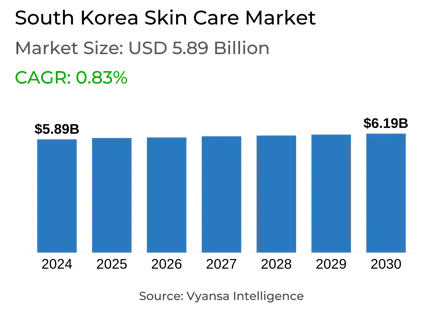
- Skin Care in South Korea is estimated at $ 5.89 Billion.
- The market size is expected to grow to $ 6.19 Billion by 2030.
- Market to register a CAGR of around 0.83% during 2025-30.
- Product Shares
- Facial Care grabbed market share of 70%.
- Competition
- More than 20 companies are actively engaged in producing Skin Care in South Korea.
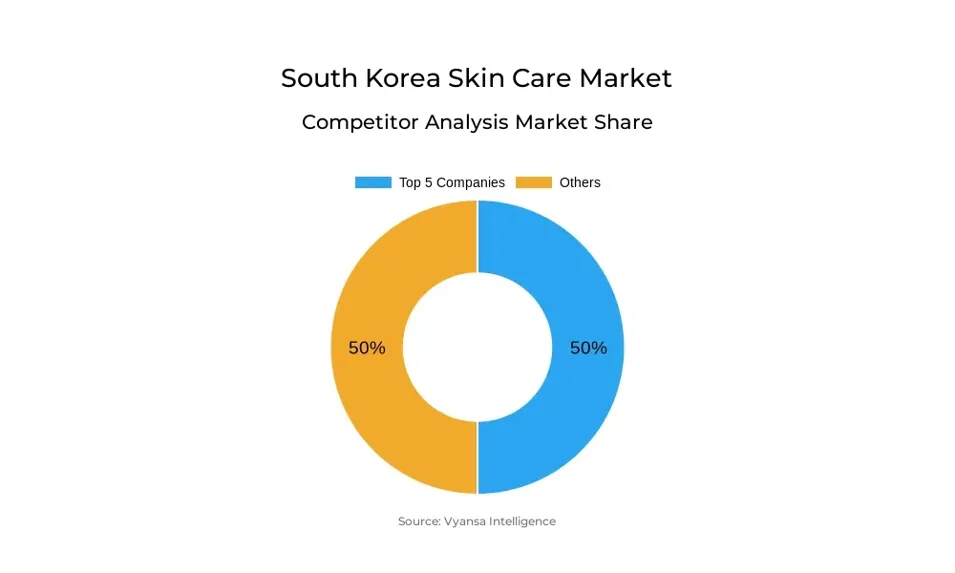
- Top 5 companies acquired 50% of the market share.
- Chanel Korea Co Ltd, Amway Korea Co Ltd, Innisfree Corp, LG Household & Health Care Ltd, AmorePacific Corp etc., are few of the top companies.
- Sales Channel
- Retail Ecommerce grabbed 65% of the market.
South Korea Skin Care Market Outlook
South Korea skin care market will also see steady growth over 2025–2030, led by changing consumer needs and ongoing innovation. Even though mature, the market still gets a boost from the increased demand for anti-ageing and slow-ageing products. Slow-ageing products are becoming more appealing to younger consumers, helped along by retailers such as Olive Young actively championing slow-ageing trends. Facial care is still the largest category in sales, with anti-agers driving growth, while segments such as face masks and cleansers continue to pick up momentum through new textures and formats.
Retail e-commerce will continue to be the greatest distribution channel, growing in sales share. Variety stores like Daiso are making a significant contribution, particularly among youth, with fashion and low-cost skin care products. Health and personal care stores like Olive Young are also significant players, both online and offline. Offline delivery of online orders is one of the new retail approaches that contribute to brands' visibility across channels.
Non-traditional players are also redefining the market as they enter skin care. Food and supplement companies are entering the beauty space because they have high margins and high repurchase rates. For example, fermented milk business hy entered skin care with Fredit Beauty and is expanding its product base. Meanwhile, pharmaceutical company dermocosmetics are winning trust and acceptability as their science-based benefits win over consumers.
However, the premium skin care segment is troubled by consumers' growing migration towards mass-market products with similar ingredients at a lower cost. Intense price rivalry in the mass segment could contain value growth despite rising demand. Brands are likely to step up collaboration with celebrities, characters, and artists in order to differentiate themselves and gain emotional connections and brand loyalty.
South Korea Skin Care Market Challenge
The skin care category's maturity will in the future create obstacles to further development, particularly for premium. Results from a survey indicate that top brands like The Whoo and Sulwhasoo witnessed stagnant or even negative sales towards the end of the review period. This deceleration has influenced the entire category's performance and indicates the difficulties in maintaining growth in an advanced market.
In addition, more consumers are turning to mass skin care products. These products are now perceived to be as effective as premium products because they usually contain the same ingredients but at lower prices. In this competitive mass market, firms are employing aggressive price strategies, and this may also constrain potential for value growth in the next few years.
South Korea Skin Care Market Trend
Pharmaceutical manufacturers are now moving their scientific knowledge into the realm of skin care with the introduction of dermocosmetics, dermo-inspired, and dermo-adjacent products. Although pharma-dermocosmetics have existed for a while, their market penetration is now beginning to increase with such products becoming more apparent on store shelves. Supported by robust science credentials, these products are gaining credibility with consumers and poised to drive future category growth.
Pharmaceutical skin care's share of sales is increasing continuously and will further increase even more rapidly in the years to come. Among such brand leaders driving the trend is Centellian24 by DongKook Pharmaceutical. It is formulated around Madecassol, the firm's renowned wound healing agent, which has been at the helm of maintaining customer confidence and fueling pharma-backed skin care solution demand.
Unlock Market Intelligence
Explore the market potential with our data-driven report
South Korea Skin Care Market Opportunity
Among the most significant opportunities for the market in the next few years is the increasing diversity of skin care offerings. Even beauty and personal care companies who previously had no skin care focus are now introducing new products to capitalize on increasing demand. Furthermore, companies not typically associated with beauty, like food, dietary supplement, and liquor companies, are also getting into the business, further diversifying the product assortment.
For instance, hy, which is well-known primarily for its fermented milk, expanded its business to beauty under its brand Fredit Beauty. Following the introduction of its NK7714 Hyper Boosting Ampoules in 2023, the company expanded its skin care line in 2024. Skin care is not only a niche with high profit margins and repeat buys but also a desirable category for companies that are not from the conventional beauty industry, a survey said.
| Report Coverage | Details |
|---|---|
| Market Forecast | 2025-30 |
| USD Value 2024 | $ 5.89 Billion |
| USD Value 2030 | $ 6.19 Billion |
| CAGR 2025-2030 | 0.83% |
| Largest Category | Facial Care segment leads with 70% market share |
| Top Challenges | Market Maturity and Price Competition to Hinder Market Growth |
| Top Trends | Pharmaceutical Expertise Fueling Demand for Dermocosmetics |
| Top Opportunities | Rising Cross-Industry Participation Boosting Product Availability |
| Key Players | Chanel Korea Co Ltd, Amway Korea Co Ltd, Innisfree Corp, LG Household & Health Care Ltd, AmorePacific Corp, L'Oréal Korea Co Ltd, Elca Korea Co Ltd, Estée Lauder Cos Inc, Procter & Gamble Korea Inc, Carver Korea Co Ltd and Others. |
Unlock Market Intelligence
Explore the market potential with our data-driven report
South Korea Skin Care Market Segmentation Analysis

The most significant market share under the product type in the South Korea Skin Care Market is Facial Care. Facial care dominated the category in 2024, primarily as a result of high performance by basic moisturisers among moisturisers and treatments. Concurrently, anti-ageing products recorded even greater growth on the back of increasing popularity for the "slow ageing" trend. This trend is all about naturally slowing down the ageing process of the body and has been picked up by younger consumers. Olive Young, which is South Korea's largest health and beauty specialist, cited slow ageing as a highlight in 2023, said a survey. It registered a 30% increase in sales of slow-ageing products, from 16,500 units in 2023 to 22,000 in 2024.
Furthermore, facial cleansers and face masks also saw better-than-average value growth throughout 2024. The increases were led by mass-market products, with new textures and up-and-coming brands proving popular. For instance, Biodance introduced a hydrogel mask with a jelly-like, refreshing texture, and the TLS Pack Cleanser released a gelato-like texture, both contributing to increased consumer interest.
Top Companies in South Korea Skin Care Market
The top companies operating in the market include Chanel Korea Co Ltd, Amway Korea Co Ltd, Innisfree Corp, LG Household & Health Care Ltd, AmorePacific Corp, L'Oréal Korea Co Ltd, Elca Korea Co Ltd, Estée Lauder Cos Inc, Procter & Gamble Korea Inc, Carver Korea Co Ltd, etc., are the top players operating in the South Korea Skin Care Market.
Frequently Asked Questions
Related Report
1. Market Segmentation
1.1. Research Scope
1.2. Research Methodology
1.3. Definitions and Assumptions
2. Executive Summary
3. South Korea Skin Care Market Policies, Regulations, and Standards
4. South Korea Skin Care Market Dynamics
4.1. Growth Factors
4.2. Challenges
4.3. Trends
4.4. Opportunities
5. South Korea Skin Care Market Statistics, 2020-2030F
5.1. Market Size & Growth Outlook
5.1.1.By Revenues in US$ Million
5.2. Market Segmentation & Growth Outlook
5.2.1.By Product
5.2.1.1. Body Care- Market Insights and Forecast 2020-2030, USD Million
5.2.1.1.1. Firming Body Care- Market Insights and Forecast 2020-2030, USD Million
5.2.1.1.2. General Purpose Body Care- Market Insights and Forecast 2020-2030, USD Million
5.2.1.2. Facial Care- Market Insights and Forecast 2020-2030, USD Million
5.2.1.2.1. Acne Treatments- Market Insights and Forecast 2020-2030, USD Million
5.2.1.2.2. Face Masks- Market Insights and Forecast 2020-2030, USD Million
5.2.1.2.3. Facial Cleansers- Market Insights and Forecast 2020-2030, USD Million
5.2.1.2.3.1. Liquid- Market Insights and Forecast 2020-2030, USD Million
5.2.1.2.3.2. Cream- Market Insights and Forecast 2020-2030, USD Million
5.2.1.2.3.3. Gel- Market Insights and Forecast 2020-2030, USD Million
5.2.1.2.3.4. Bar Cleansers- Market Insights and Forecast 2020-2030, USD Million
5.2.1.2.3.5. Facial Cleansing Wipes- Market Insights and Forecast 2020-2030, USD Million
5.2.1.2.4. Moisturisers and Treatments- Market Insights and Forecast 2020-2030, USD Million
5.2.1.2.4.1. Basic Moisturisers- Market Insights and Forecast 2020-2030, USD Million
5.2.1.2.4.2. Anti-Agers- Market Insights and Forecast 2020-2030, USD Million
5.2.1.2.5. Lip Care- Market Insights and Forecast 2020-2030, USD Million
5.2.1.2.6. Toners- Market Insights and Forecast 2020-2030, USD Million
5.2.1.3. Hand Care- Market Insights and Forecast 2020-2030, USD Million
5.2.1.4. Skin Care Sets/Kits- Market Insights and Forecast 2020-2030, USD Million
5.2.2.By Category
5.2.2.1. Premium- Market Insights and Forecast 2020-2030, USD Million
5.2.2.2. Mass- Market Insights and Forecast 2020-2030, USD Million
5.2.3.By Gender
5.2.3.1. Men- Market Insights and Forecast 2020-2030, USD Million
5.2.3.2. Women- Market Insights and Forecast 2020-2030, USD Million
5.2.3.3. Unisex- Market Insights and Forecast 2020-2030, USD Million
5.2.4.By End User
5.2.4.1. Adults- Market Insights and Forecast 2020-2030, USD Million
5.2.4.2. Teenagers- Market Insights and Forecast 2020-2030, USD Million
5.2.4.3. Children- Market Insights and Forecast 2020-2030, USD Million
5.2.5.By Packaging
5.2.5.1. Tubes- Market Insights and Forecast 2020-2030, USD Million
5.2.5.2. Bottles- Market Insights and Forecast 2020-2030, USD Million
5.2.5.3. Jars- Market Insights and Forecast 2020-2030, USD Million
5.2.5.4. Others- Market Insights and Forecast 2020-2030, USD Million
5.2.6.By Sales Channel
5.2.6.1. Online- Market Insights and Forecast 2020-2030, USD Million
5.2.6.2. Offline- Market Insights and Forecast 2020-2030, USD Million
5.2.7.By Competitors
5.2.7.1. Competition Characteristics
5.2.7.2. Market Share & Analysis
6. South Korea Body Care Market Statistics, 2020-2030F
6.1. Market Size & Growth Outlook
6.1.1.By Revenues in US$ Million
6.2. Market Segmentation & Growth Outlook
6.2.1.By Product- Market Insights and Forecast 2020-2030, USD Million
6.2.2.By Category- Market Insights and Forecast 2020-2030, USD Million
6.2.3.By Gender- Market Insights and Forecast 2020-2030, USD Million
6.2.4.By End User- Market Insights and Forecast 2020-2030, USD Million
6.2.5.By Packaging- Market Insights and Forecast 2020-2030, USD Million
6.2.6.By Sales Channel- Market Insights and Forecast 2020-2030, USD Million
7. South Korea Facial Care Market Statistics, 2020-2030F
7.1. Market Size & Growth Outlook
7.1.1.By Revenues in US$ Million
7.2. Market Segmentation & Growth Outlook
7.2.1.By Product- Market Insights and Forecast 2020-2030, USD Million
7.2.2.By Category- Market Insights and Forecast 2020-2030, USD Million
7.2.3.By Gender- Market Insights and Forecast 2020-2030, USD Million
7.2.4.By End User- Market Insights and Forecast 2020-2030, USD Million
7.2.5.By Packaging- Market Insights and Forecast 2020-2030, USD Million
7.2.6.By Sales Channel- Market Insights and Forecast 2020-2030, USD Million
8. South Korea Hand Care Market Statistics, 2020-2030F
8.1. Market Size & Growth Outlook
8.1.1.By Revenues in US$ Million
8.2. Market Segmentation & Growth Outlook
8.2.1.By Category- Market Insights and Forecast 2020-2030, USD Million
8.2.2.By Gender- Market Insights and Forecast 2020-2030, USD Million
8.2.3.By End User- Market Insights and Forecast 2020-2030, USD Million
8.2.4.By Packaging- Market Insights and Forecast 2020-2030, USD Million
8.2.5.By Sales Channel- Market Insights and Forecast 2020-2030, USD Million
9. South Korea Skin Care Sets/Kits Market Statistics, 2020-2030F
9.1. Market Size & Growth Outlook
9.1.1.By Revenues in US$ Million
9.2. Market Segmentation & Growth Outlook
9.2.1.By Category- Market Insights and Forecast 2020-2030, USD Million
9.2.2.By Gender- Market Insights and Forecast 2020-2030, USD Million
9.2.3.By End User- Market Insights and Forecast 2020-2030, USD Million
9.2.4.By Packaging- Market Insights and Forecast 2020-2030, USD Million
9.2.5.By Sales Channel- Market Insights and Forecast 2020-2030, USD Million
10. Competitive Outlook
10.1. Company Profiles
10.1.1. LG Household & Health Care Ltd
10.1.1.1. Business Description
10.1.1.2. Product Portfolio
10.1.1.3. Collaborations & Alliances
10.1.1.4. Recent Developments
10.1.1.5. Financial Details
10.1.1.6. Others
10.1.2. AmorePacific Corp
10.1.2.1. Business Description
10.1.2.2. Product Portfolio
10.1.2.3. Collaborations & Alliances
10.1.2.4. Recent Developments
10.1.2.5. Financial Details
10.1.2.6. Others
10.1.3. L'Oréal Korea Co Ltd
10.1.3.1. Business Description
10.1.3.2. Product Portfolio
10.1.3.3. Collaborations & Alliances
10.1.3.4. Recent Developments
10.1.3.5. Financial Details
10.1.3.6. Others
10.1.4. Elca Korea Co Ltd
10.1.4.1. Business Description
10.1.4.2. Product Portfolio
10.1.4.3. Collaborations & Alliances
10.1.4.4. Recent Developments
10.1.4.5. Financial Details
10.1.4.6. Others
10.1.5. Estée Lauder Cos Inc
10.1.5.1. Business Description
10.1.5.2. Product Portfolio
10.1.5.3. Collaborations & Alliances
10.1.5.4. Recent Developments
10.1.5.5. Financial Details
10.1.5.6. Others
10.1.6. Chanel Korea Co Ltd
10.1.6.1. Business Description
10.1.6.2. Product Portfolio
10.1.6.3. Collaborations & Alliances
10.1.6.4. Recent Developments
10.1.6.5. Financial Details
10.1.6.6. Others
10.1.7. Amway Korea Co Ltd
10.1.7.1. Business Description
10.1.7.2. Product Portfolio
10.1.7.3. Collaborations & Alliances
10.1.7.4. Recent Developments
10.1.7.5. Financial Details
10.1.7.6. Others
10.1.8. Innisfree Corp
10.1.8.1. Business Description
10.1.8.2. Product Portfolio
10.1.8.3. Collaborations & Alliances
10.1.8.4. Recent Developments
10.1.8.5. Financial Details
10.1.8.6. Others
10.1.9. Procter & Gamble Korea Inc
10.1.9.1. Business Description
10.1.9.2. Product Portfolio
10.1.9.3. Collaborations & Alliances
10.1.9.4. Recent Developments
10.1.9.5. Financial Details
10.1.9.6. Others
10.1.10. Carver Korea Co Ltd
10.1.10.1.Business Description
10.1.10.2.Product Portfolio
10.1.10.3.Collaborations & Alliances
10.1.10.4.Recent Developments
10.1.10.5.Financial Details
10.1.10.6.Others
11. Disclaimer
| Segment | Sub-Segment |
|---|---|
| By Product |
|
| By Category |
|
| By Gender |
|
| By End User |
|
| By Packaging |
|
| By Sales Channel |
|
Research Methodology
This study followed a structured approach comprising four key phases to assess the size and scope of the electro-oxidation market. The process began with thorough secondary research to collect data on the target market, related markets, and broader industry context. These findings, along with preliminary assumptions and estimates, were then validated through extensive primary research involving industry experts from across the value chain. To calculate the overall market size, both top-down and bottom-up methodologies were employed. Finally, market segmentation and data triangulation techniques were applied to refine and validate segment-level estimations.
Secondary Research
The secondary research phase involved gathering data from a wide range of credible and published sources. This step helped in identifying industry trends, defining market segmentation, and understanding the market landscape and value chain.
Sources consulted during this phase included:
- Company annual reports, investor presentations, and press releases
- Industry white papers and certified publications
- Trade directories and market-recognized databases
- Articles from authoritative authors and reputable journals
- Gold and silver standard websites
Secondary research was critical in mapping out the industry's value chain and monetary flow, identifying key market segments, understanding regional variations, and tracking significant industry developments.
Other key sources:
- Financial disclosures
- Industry associations and trade bodies
- News outlets and business magazines
- Academic journals and research studies
- Paid industry databases
Primary Research
To validate secondary data and gain deeper market insights, primary research was conducted with key stakeholders across both the supply and demand sides of the market.
On the demand side, participants included decision-makers and influencers from end-user industries—such as CIOs, CTOs, and CSOs—who provided first-hand perspectives on market needs, product usage, and future expectations.
On the supply side, interviews were conducted with manufacturers, industry associations, and institutional participants to gather insights into current offerings, product pipelines, and market challenges.
Primary interviews provided critical inputs such as:
- Market size and revenue data
- Product and service breakdowns
- Market forecasts
- Regional and application-specific trends
Stakeholders consulted included:
- Leading OEM and solution providers
- Channel and distribution partners
- End users across various applications
- Independent consultants and industry specialists
Market Size Estimation and Data Triangulation
- Identifying Key Market Participants (Secondary Research)
- Goal: To identify the major players or companies in the target market. This typically involves using publicly available data sources such as industry reports, market research publications, and financial statements of companies.
- Tools: Reports from firms like Gartner, Forrester, Euromonitor, Statista, IBISWorld, and others. Public financial statements, news articles, and press releases from top market players.
- Extracting Earnings of Key Market Participants
- Goal: To estimate the earnings generated from the product or service being analyzed. This step helps in understanding the revenue potential of each market player in a specific geography.
- Methods: Earnings data can be gathered from:
- Publicly available financial reports (for listed companies).
- Interviews and primary data sources from professionals, such as Directors, VPs, SVPs, etc. This is especially useful for understanding more nuanced, internal data that isn't publicly disclosed.
- Annual reports and investor presentations of key players.
- Data Collation and Development of a Relevant Data Model
- Goal: To collate inputs from both primary and secondary sources into a structured, data-driven model for market estimation. This model will incorporate key market KPIs and any independent variables relevant to the market.
- Key KPIs: These could include:
- Market size, growth rate, and demand drivers.
- Industry-specific metrics like market share, average revenue per customer (ARPC), or average deal size.
- External variables, such as economic growth rates, inflation rates, or commodity prices, that could affect the market.
- Data Modeling: Based on this data, the market forecasts are developed for the next 5 years. A combination of trend analysis, scenario modeling, and statistical regression might be used to generate projections.
- Scenario Analysis
- Goal: To test different assumptions and validate how sensitive the market is to changes in key variables (e.g., market demand, regulatory changes, technological disruptions).
- Types of Scenarios:
- Base Case: Based on current assumptions and historical data.
- Best-Case Scenario: Assuming favorable market conditions, regulatory environments, and technological advancements.
- Worst-Case Scenario: Accounting for adverse factors, such as economic downturns, stricter regulations, or unexpected disruptions.












