South Korea Juice Market Report: Trends, Growth and Forecast (2026-2032)
By Category (100% Juice (Not from Concentrate, Reconstituted), Juice Drinks (up to 24% Juice), Nectars (High Concentration (40% to 50% fruit content), Medium Concentration (30% to 39% fruit content), Low Concentration (25% to 29% fruit content)), Vegetable Juice, Fruit and Vegetable Blends), By Nature (Conventional, Organic), By Packaging Material (Plastic, Glass, Metal, Others), By Packaging Type (PET Bottles, Aseptic Packages (Cartons), Glass Bottles, Metal Cans, Disposable Cups & Pouches), By Sales Channel (Off-Trade (Hypermarkets/ Supermarkets, Retail Outlets, Convenience Stores, Online Platforms), On-Trade) ... Read more
|
Major Players
|
South Korea Juice Market Statistics and Insights, 2026
- Market Size Statistics
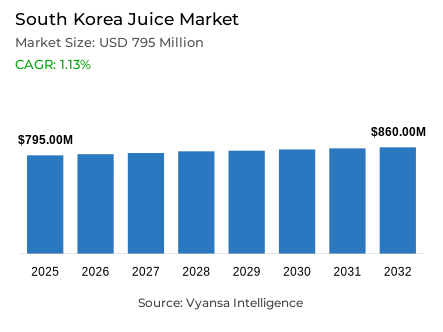
- Juice market size in South Korea was estimated at USD 795 million in 2025.
- The market size is expected to grow to USD 860 million by 2032.
- Market to register a CAGR of around 1.13% during 2026-32.
- Category Shares
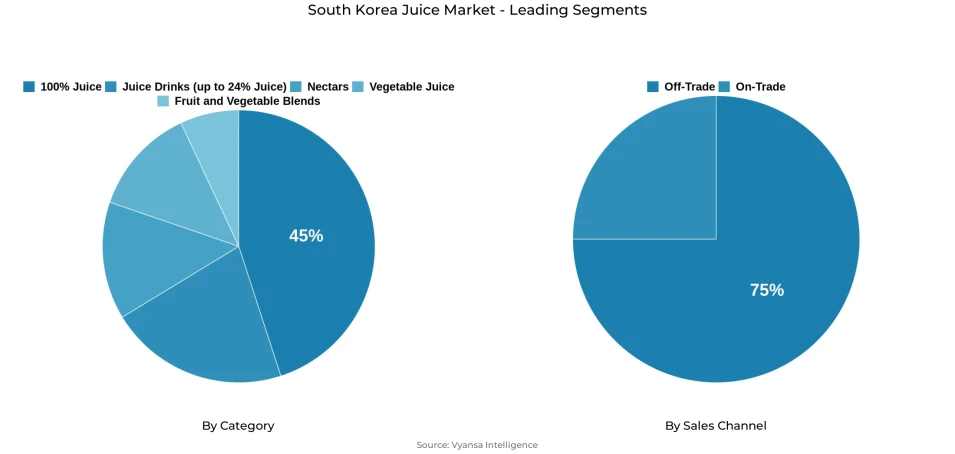
- 100% juice grabbed market share of 45%.
- Competition
- More than 15 companies are actively engaged in producing juice in South Korea.
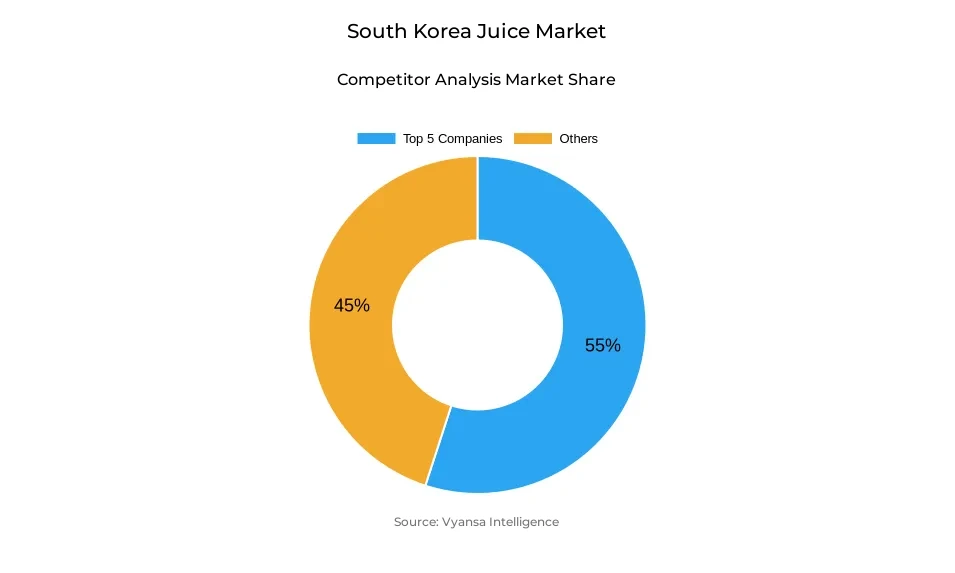
- Top 5 companies acquired around 55% of the market share.
- Seoul Dairy Cooperative, Binggrae Co Ltd, Sappe Plc Co Ltd, Lotte Chilsung Beverage Co Ltd, Paldo Co Ltd etc., are few of the top companies.
- Sales Channel
- Off-trade grabbed 75% of the market.
South Korea Juice Market Outlook
The South Korea juice market is experiencing a major shift with healthconscious end user shifting towards sugar. The market is estimated to be USD 795 million in 2025 and USD 860 million in 2032 with a CAGR of about 1.13% in the 2026-32 period. As the market is experiencing maturity and headwinds due to increasing costs of imports, the zerosugar trend and the emergence of functional drinkable supplements are changing the landscape.
The main driver of growth is a need to have highquality, nutrientrich products that do not lose the natural advantages of whole foods. The 100% juice segment is one of the pillars of the industry with a current market share of 45%. New products like coldpressed juices and vegetable blends, including kale and celery, are softening the fall of traditional fruit juices, as end user perceive them as healthier, lowerfructose options to lose weight and improve gut health.
Demographic changes are also crucial the recent increase in birth rates has rejuvenated the children juice market, with the market leaders like Paldo and Woongjin launching zerosugar, vitaminenriched products. Moreover, the increase in singleperson households is driving the need to have convenient formats, including frozen watermelon juice by Kim’s Club, which has a long shelf life due to the use of highpressure processing (HPP) technology. The offtrade channel dominates the sales channel network and it took 75% of the market. The most vibrant force in this space is retail ecommerce, especially with the subscription models that make juice part of everyday health practices.
Although convenience stores are still the secondlargest channel because of impulse buying, the future of the industry is digital accessibility and functional innovation, with the leading players being Lotte Chilsung.
South Korea Juice Market Growth DriverBirth-Rate Rebound Reinforcing Children’s Juice Demand and Fortified Format Growth
The recent increase in births in South Korea has increased the demand of children juice drinks and fortified drinks. Statistics Korea reported 238,300 live births in 2024, 8,300 or 3.6% higher than in 2023, and firstchild births increased by 7,700 or 5.6%. In January 2025, the same agency recorded 23,947 live births, an increase of 11.6% over the previous year, indicating a greater number of young end user in the near future. This population shift creates a longterm need of pediatricbased beverage formats following years of decreasing birth rates.
The increased number of children leads to increased household buying of kidfriendly beverages that are meant to be used in school and at home. It also forces manufacturers to keep on innovating lowsugar recipes and added nutrients, use smaller packs and character branding to create preference in stores and online baskets. This need base underpins a continued emphasis on pediatric nutrition and convenience, maintaining category relevance despite the softening of adult juice demand. The birth rebound creates favourable structural conditions to the growth of the children juice segment, which opens the possibilities of fortified formulations, educational marketing, and familyoriented packaging strategies to support the longterm category growth by demographic renewal.
South Korea Juice Market ChallengeIntensifying Sugar Intake Scrutiny Undermining Traditional Juice Credibility and Raising Reformulation Costs
The increasing health issues with sugar pose structural problems to juice, with end user increasingly perceiving fruit sugars as a threat, not as a benefit. According to an analysis of the national health survey conducted by Korea Disease Control and Prevention Agency, the average daily sugar consumption per person in 2023 was 59.8 gram, and 16.9% of the population had a higher sugar intake than the healthy limit where sugar constitutes more than 20% of the total energy intake. This increased consumption creates publichealth strains that affect beverage choice criteria and regulatory review.
Here, the conventional fruit juice is getting harder to justify, especially in singleserving and conveniencebased buying where customers are likely to make a quick comparison of labels. The same report shows that beverages and tea are the biggest contributors of sugar to individuals with excessive consumption habits, which supports the questioning of sweetened drinks. This makes reformulation to zero or lowersugar recipes costly and complex, and the continued discussion of alternative sweeteners keeps consumer confidence shaky. Sugar scrutiny poses basic category issues that require significant investment in reformulation technologies, alternative sweetening options, and open communication strategies. Within the context of healthconscious beverage market in South Korea, manufacturers have to negotiate consumer health awareness, regulatory pressures, and taste expectations without losing natural positioning and nutritional credibility.
Unlock Market Intelligence
Explore the market potential with our data-driven report
South Korea Juice Market TrendMobile-Dominant E-Commerce Scaling Subscription-Led Routine Beverage Purchasing
Retail online shopping of beverages is becoming increasingly significant, and mobilebased ordering is becoming a standard. According to Statistics Korea, the value of online shopping transaction was 21.8977 trillion won in June 2025, and mobile shopping constituted 77.8% of the value. The online transaction value of food and beverages increased 11.0% year on year and food services increased 12.9%. Mobile dominance essentially transforms the buying processes, focusing on convenience, personalisation, and smooth transactional experiences.
This change helps to sell juice by convenience and repeatpurchase devices. Autopayment and subscription models will decrease the reordering friction, allowing coldpressed and functional collections to be part of the weekly routine of end user. Push notifications and curated bundles are also used by brands to stimulate impulse topups and discovery. To manufacturers, online shelves enable a greater selection and focused advertising, which can bring highquality juices to end user who are actively seeking healthier choices online. The mobile ecommerce trend is a core channel transformation, which allows subscription, personalised recommendations, and frictionless replenishment that facilitate premium product positioning and direct consumer relationships. This opens up opportunities to brands that are highly mobile optimised, digitally marketed and logistically equipped to facilitate smooth online shopping experiences.
South Korea Juice Market OpportunityDrinkable Supplement Culture Unlocking Premium Headroom for Functional Juice Shots
The high supplement culture in South Korea presents a great potential to juice to transform into functional and drinkable nutrition. According to the Korea Health Functional Food Association, 83.2% of Korean end user bought health functional foods in 2024. According to the same source, 358 functional ingredients are recognised separately by the Ministry of Food and Drug Safety as of December 2024, and 57 health claims are approved. This regulatory framework facilitates advanced functional positioning and claim substantiation.
This setting presents a distinct chance of focused vegetable and fruit combinations as beverages in the form of supplements. Smallformat shots and coldpressed options can be used by juice manufacturers to emphasise compounds like lycopene or betacarotene, but with lowsugar profiles. Effective products are concerned with clear labeling, quantified functional assertions, and convenient packaging that fits into everyday lives, particularly among younger healthconscious customers. The functional supplement opportunity allows premium positioning by clinical validation, controlled health claims, and conveniencebased formats. Brands with proven authentic functional efficacy, regulatory compliance, and novel delivery formats are strategically placed to attract the supplementsavvy consumer segments in South Korea that are seeking convenient, scientificallyproven nutritional solutions in the juice category.
Unlock Market Intelligence
Explore the market potential with our data-driven report
South Korea Juice Market Segmentation Analysis
By Category
- 100% Juice
- Not from Concentrate
- Reconstituted
- Juice Drinks (up to 24% Juice)
- Nectars
- High Concentration (40% to 50% fruit content)
- Medium Concentration (30% to 39% fruit content)
- Low Concentration (25% to 29% fruit content)
- Vegetable Juice
- Fruit and Vegetable Blends
The segment has the highest share around the category in the South Korean juice market, where 100% Juice grabbed a market share of 45%. Despite an overall volume decline in the broader category, 100% juice remains the most resilient segment as end user prioritize products with natural nutrients over processed alternatives. This segment is evolving quickly, with a notable shift toward vegetable juices and blends that are perceived as lower in sugar and more functional for wellness.
To navigate supply chain pressures and the global orange shortage, manufacturers are innovating within this highshare segment by introducing tangerinebased or highly concentrated "supplement" styles. Products like Maeil Dairy’s highconcentrate range exemplify this trend, packing multiple whole vegetables into small servings to offer lycopene and betacarotene. This focus on premium, nutrientrich 100% juice allows the segment to maintain its leading position even as end user scrutinize natural sugar content.
By Sales Channel
- Off-Trade
- Hypermarkets/ Supermarkets
- Retail Outlets
- Convenience Stores
- Online Platforms
- On-Trade
The segment has the highest share around the Sales Channel is the OffTrade, which grabbed 75% of the market. This dominance is led by retail ecommerce and convenience stores, which have successfully adapted to the fastpaced lifestyles of South Korean end user. Ecommerce, in particular, has seen significant growth through automated subscription services, such as those offered by Pulmuone, which remove the administrative burden of reordering and help end user maintain consistent health routines.
Convenience stores remain the secondlargest pillar of the offtrade channel, capturing essential impulse sales through strategic placement and promotional partnerships. Brands like Lotte Chilsung target younger demographics in these stores with zerocalorie juice varieties and "retro" branding. By combining the rapid delivery of digital platforms with the high visibility of convenience retail, the offtrade segment continues to be the primary engine for juice sales channel across the country.
List of Companies Covered in South Korea Juice Market
The companies listed below are highly influential in the South Korea juice market, with a significant market share and a strong impact on industry developments.
- Seoul Dairy Cooperative
- Binggrae Co Ltd
- Sappe Plc Co Ltd
- Lotte Chilsung Beverage Co Ltd
- Paldo Co Ltd
- Woongjin Food Co Ltd
- Coca-Cola Korea Co Ltd
- LG H&H Co Ltd
- Nongshim Co Ltd
- Maeil Dairies Co Ltd
Competitive Landscape
South Korea juice market remains under structural pressure as rising sugar aversion reshapes consumption patterns, although category leaders continue adapting through functional and low-sugar innovation. Lotte Chilsung Beverage Co Ltd retains leadership in off-trade volume despite a slight share decline, leveraging brands such as Del Monte and expanding into zero-calorie variants targeting younger demographics. Meanwhile, Paldo Co Ltd records the strongest growth, supported by its Pororo children’s range and a rebound in birth rates, strengthening its third-place position. Woongjin Food Co Ltd also remains competitive through zero-sugar and functional offerings. Retail e-commerce, particularly subscription-based cold-pressed models, continues to lead distribution, while convenience stores retain strategic importance for impulse-driven sales.
Frequently Asked Questions
Related Report
- Market Segmentation
- Research Scope
- Research Methodology
- Definitions and Assumptions
- Executive Summary
- South Korea Juice Market Policies, Regulations, and Standards
- South Korea Juice Market Dynamics
- Growth Factors
- Challenges
- Trends
- Opportunities
- South Korea Juice Market Statistics, 2022-2032F
- Market Size & Growth Outlook
- By Revenues in USD Million
- By Quantity Sold in Million Litres
- Market Segmentation & Growth Outlook
- By Category
- 100% Juice- Market Insights and Forecast 2022-2032, USD Million
- Not from Concentrate- Market Insights and Forecast 2022-2032, USD Million
- Reconstituted- Market Insights and Forecast 2022-2032, USD Million
- Juice Drinks (up to 24% Juice)- Market Insights and Forecast 2022-2032, USD Million
- Nectars- Market Insights and Forecast 2022-2032, USD Million
- High Concentration (40% to 50% fruit content)- Market Insights and Forecast 2022-2032, USD Million
- Medium Concentration (30% to 39% fruit content)- Market Insights and Forecast 2022-2032, USD Million
- Low Concentration (25% to 29% fruit content)- Market Insights and Forecast 2022-2032, USD Million
- Vegetable Juice- Market Insights and Forecast 2022-2032, USD Million
- Fruit and Vegetable Blends- Market Insights and Forecast 2022-2032, USD Million
- 100% Juice- Market Insights and Forecast 2022-2032, USD Million
- By Nature
- Conventional- Market Insights and Forecast 2022-2032, USD Million
- Organic- Market Insights and Forecast 2022-2032, USD Million
- By Packaging Material
- Plastic- Market Insights and Forecast 2022-2032, USD Million
- Glass- Market Insights and Forecast 2022-2032, USD Million
- Metal- Market Insights and Forecast 2022-2032, USD Million
- Others- Market Insights and Forecast 2022-2032, USD Million
- By Packaging Type
- PET Bottles- Market Insights and Forecast 2022-2032, USD Million
- Aseptic Packages (Cartons)- Market Insights and Forecast 2022-2032, USD Million
- Glass Bottles- Market Insights and Forecast 2022-2032, USD Million
- Metal Cans- Market Insights and Forecast 2022-2032, USD Million
- Disposable Cups & Pouches- Market Insights and Forecast 2022-2032, USD Million
- By Sales Channel
- Off-Trade- Market Insights and Forecast 2022-2032, USD Million
- Hypermarkets/ Supermarkets - Market Insights and Forecast 2022-2032, USD Million
- Retail Outlets - Market Insights and Forecast 2022-2032, USD Million
- Convenience Stores- Market Insights and Forecast 2022-2032, USD Million
- Online Platforms- Market Insights and Forecast 2022-2032, USD Million
- On-Trade- Market Insights and Forecast 2022-2032, USD Million
- Off-Trade- Market Insights and Forecast 2022-2032, USD Million
- By Competitors
- Competition Characteristics
- Market Share & Analysis
- By Category
- Market Size & Growth Outlook
- South Korea 100% Juice Market Statistics, 2022-2032
- Market Size & Growth Outlook
- By Revenues in USD Million
- By Quantity Sold in Million Litres
- Market Segmentation & Growth Outlook
- By Nature- Market Insights and Forecast 2022-2032, USD Million
- By Packaging Material- Market Insights and Forecast 2022-2032, USD Million
- By Packaging Type- Market Insights and Forecast 2022-2032, USD Million
- By Sales Channel- Market Insights and Forecast 2022-2032, USD Million
- Market Size & Growth Outlook
- South Korea Juice Drinks (up to 24% Juice) Market Statistics, 2022-2032
- Market Size & Growth Outlook
- By Revenues in USD Million
- By Quantity Sold in Million Litres
- Market Segmentation & Growth Outlook
- By Nature- Market Insights and Forecast 2022-2032, USD Million
- By Packaging Material- Market Insights and Forecast 2022-2032, USD Million
- By Packaging Type- Market Insights and Forecast 2022-2032, USD Million
- By Sales Channel- Market Insights and Forecast 2022-2032, USD Million
- Market Size & Growth Outlook
- South Korea Nectars Market Statistics, 2022-2032
- Market Size & Growth Outlook
- By Revenues in USD Million
- By Quantity Sold in Million Litres
- Market Segmentation & Growth Outlook
- By Nature- Market Insights and Forecast 2022-2032, USD Million
- By Packaging Material- Market Insights and Forecast 2022-2032, USD Million
- By Packaging Type- Market Insights and Forecast 2022-2032, USD Million
- By Sales Channel- Market Insights and Forecast 2022-2032, USD Million
- Market Size & Growth Outlook
- South Korea Vegetable Juice Market Statistics, 2022-2032
- Market Size & Growth Outlook
- By Revenues in USD Million
- By Quantity Sold in Million Litres
- Market Segmentation & Growth Outlook
- By Nature- Market Insights and Forecast 2022-2032, USD Million
- By Packaging Material- Market Insights and Forecast 2022-2032, USD Million
- By Packaging Type- Market Insights and Forecast 2022-2032, USD Million
- By Sales Channel- Market Insights and Forecast 2022-2032, USD Million
- Market Size & Growth Outlook
- South Korea Fruit and Vegetable Blends Market Statistics, 2022-2032
- Market Size & Growth Outlook
- By Revenues in USD Million
- By Quantity Sold in Million Litres
- Market Segmentation & Growth Outlook
- By Nature- Market Insights and Forecast 2022-2032, USD Million
- By Packaging Material- Market Insights and Forecast 2022-2032, USD Million
- By Packaging Type- Market Insights and Forecast 2022-2032, USD Million
- By Sales Channel- Market Insights and Forecast 2022-2032, USD Million
- Market Size & Growth Outlook
- Competitive Outlook
- Company Profiles
- Lotte Chilsung Beverage Co Ltd
- Business Description
- Product Portfolio
- Collaborations & Alliances
- Recent Developments
- Financial Details
- Others
- Paldo Co Ltd
- Business Description
- Product Portfolio
- Collaborations & Alliances
- Recent Developments
- Financial Details
- Others
- Woongjin Food Co Ltd
- Business Description
- Product Portfolio
- Collaborations & Alliances
- Recent Developments
- Financial Details
- Others
- Coca-Cola Korea Co Ltd
- Business Description
- Product Portfolio
- Collaborations & Alliances
- Recent Developments
- Financial Details
- Others
- LG H&H Co Ltd
- Business Description
- Product Portfolio
- Collaborations & Alliances
- Recent Developments
- Financial Details
- Others
- Seoul Dairy Cooperative
- Business Description
- Product Portfolio
- Collaborations & Alliances
- Recent Developments
- Financial Details
- Others
- Binggrae Co Ltd
- Business Description
- Product Portfolio
- Collaborations & Alliances
- Recent Developments
- Financial Details
- Others
- Sappe Plc Co Ltd
- Business Description
- Product Portfolio
- Collaborations & Alliances
- Recent Developments
- Financial Details
- Others
- Nongshim Co Ltd
- Business Description
- Product Portfolio
- Collaborations & Alliances
- Recent Developments
- Financial Details
- Others
- Maeil Dairies Co Ltd
- Business Description
- Product Portfolio
- Collaborations & Alliances
- Recent Developments
- Financial Details
- Others
- Lotte Chilsung Beverage Co Ltd
- Company Profiles
- Disclaimer
| Segment | Sub-Segment |
|---|---|
| By Category |
|
| By Nature |
|
| By Packaging Material |
|
| By Packaging Type |
|
| By Sales Channel |
|
Research Methodology
This study followed a structured approach comprising four key phases to assess the size and scope of the electro-oxidation market. The process began with thorough secondary research to collect data on the target market, related markets, and broader industry context. These findings, along with preliminary assumptions and estimates, were then validated through extensive primary research involving industry experts from across the value chain. To calculate the overall market size, both top-down and bottom-up methodologies were employed. Finally, market segmentation and data triangulation techniques were applied to refine and validate segment-level estimations.
Secondary Research
The secondary research phase involved gathering data from a wide range of credible and published sources. This step helped in identifying industry trends, defining market segmentation, and understanding the market landscape and value chain.
Sources consulted during this phase included:
- Company annual reports, investor presentations, and press releases
- Industry white papers and certified publications
- Trade directories and market-recognized databases
- Articles from authoritative authors and reputable journals
- Gold and silver standard websites
Secondary research was critical in mapping out the industry's value chain and monetary flow, identifying key market segments, understanding regional variations, and tracking significant industry developments.
Other key sources:
- Financial disclosures
- Industry associations and trade bodies
- News outlets and business magazines
- Academic journals and research studies
- Paid industry databases
Primary Research
To validate secondary data and gain deeper market insights, primary research was conducted with key stakeholders across both the supply and demand sides of the market.
On the demand side, participants included decision-makers and influencers from end-user industries—such as CIOs, CTOs, and CSOs—who provided first-hand perspectives on market needs, product usage, and future expectations.
On the supply side, interviews were conducted with manufacturers, industry associations, and institutional participants to gather insights into current offerings, product pipelines, and market challenges.
Primary interviews provided critical inputs such as:
- Market size and revenue data
- Product and service breakdowns
- Market forecasts
- Regional and application-specific trends
Stakeholders consulted included:
- Leading OEM and solution providers
- Channel and distribution partners
- End users across various applications
- Independent consultants and industry specialists
Market Size Estimation and Data Triangulation
- Identifying Key Market Participants (Secondary Research)
- Goal: To identify the major players or companies in the target market. This typically involves using publicly available data sources such as industry reports, market research publications, and financial statements of companies.
- Tools: Reports from firms like Gartner, Forrester, Euromonitor, Statista, IBISWorld, and others. Public financial statements, news articles, and press releases from top market players.
- Extracting Earnings of Key Market Participants
- Goal: To estimate the earnings generated from the product or service being analyzed. This step helps in understanding the revenue potential of each market player in a specific geography.
- Methods: Earnings data can be gathered from:
- Publicly available financial reports (for listed companies).
- Interviews and primary data sources from professionals, such as Directors, VPs, SVPs, etc. This is especially useful for understanding more nuanced, internal data that isn't publicly disclosed.
- Annual reports and investor presentations of key players.
- Data Collation and Development of a Relevant Data Model
- Goal: To collate inputs from both primary and secondary sources into a structured, data-driven model for market estimation. This model will incorporate key market KPIs and any independent variables relevant to the market.
- Key KPIs: These could include:
- Market size, growth rate, and demand drivers.
- Industry-specific metrics like market share, average revenue per customer (ARPC), or average deal size.
- External variables, such as economic growth rates, inflation rates, or commodity prices, that could affect the market.
- Data Modeling: Based on this data, the market forecasts are developed for the next 5 years. A combination of trend analysis, scenario modeling, and statistical regression might be used to generate projections.
- Scenario Analysis
- Goal: To test different assumptions and validate how sensitive the market is to changes in key variables (e.g., market demand, regulatory changes, technological disruptions).
- Types of Scenarios:
- Base Case: Based on current assumptions and historical data.
- Best-Case Scenario: Assuming favorable market conditions, regulatory environments, and technological advancements.
- Worst-Case Scenario: Accounting for adverse factors, such as economic downturns, stricter regulations, or unexpected disruptions.












