South Korea Beer Market Report: Trends, Growth and Forecast (2026-2032)
Product Type (Dark Beer (Ale, Sorghum Beer, Weissbier/Weizen/Wheat Beer), Lager (Flavoured/Mixed Lager, Standard Lager (Premium Lager (Domestic Premium Lager, Imported Premium Lager), Mid-Priced Lager (Domestic Mid-Priced Lager, Imported Mid-Priced Lager), Economy Lager (Domestic Economy Lager, Imported Economy Lager))), Non/Low Alcohol Beer (Low Alcohol Beer, Non Alcoholic Beer), Stout, Others (Porter, Malt etc.)), Production (Macro Brewery, Micro Brewery, Craft Brewery), Packaging Type (Bottles, Cans, Others), Sales Channel (On-Trade, Off-Trade) ... Read more
|
Major Players
|
South Korea Beer Market Statistics and Insights, 2026
- Market Size Statistics
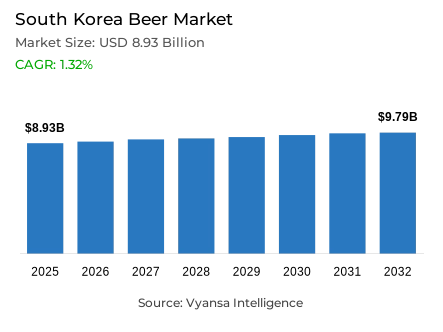
- Beer in South Korea is estimated at USD 8.93 billion.
- The market size is expected to grow to USD 9.79 billion by 2032.
- Market to register a cagr of around 1.32% during 2026-32.
- Product Type Shares
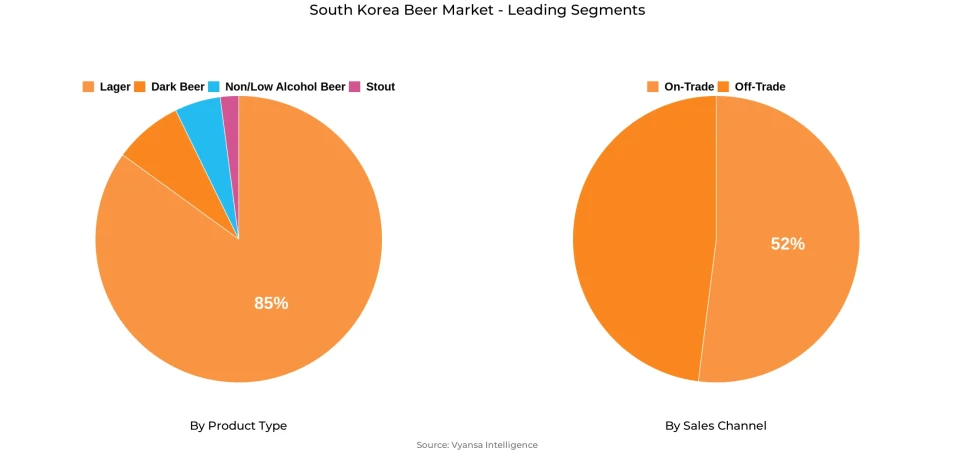
- Lager grabbed market share of 85%.
- Competition
- More than 10 companies are actively engaged in producing beer in South Korea.
- Top 5 companies acquired around 85% of the market share.
- BK Co Ltd; Diageo Korea Co Ltd; Jeju Beer Co; Oriental Brewery Co Ltd; Hite Jinro Co Ltd etc., are few of the top companies.
- Sales Channel
- On-trade grabbed 52% of the market.
South Korea Beer Market Outlook
South Korea beer market stands at $8.93 billion in 2025 and is expected to grow to $9.79 billion by 2032 with a CAGR of around 1.32% during 2026–2032. The market will be driven by changing consumption patterns, health consciousness, and economic drivers influencing end users behavior. Although the total beer category is predicted to experience modest growth, end users are moving more towards considerate drinking and high-end experiences, opting for lower volume but higher quality products.
Lager, with an almost 85% share of aggregate market volume, will remain the leader, thanks to ingrained popularity and extensive price segmentation. Local mid-price lagers including Cass, Terra, and Kloud Krush will maintain volume demand on the back of affordability and high brand recognition. Imported premium lagers including Budweiser and Heineken will, however, find their way into the pockets of affluent urban end-users looking for global tastes and premium experiences even as overall consumption slows.
The market will continue to be highly concentrated, and the top five players would have a combined share of around 85% of overall sales. Top brews like Oriental Brewery, Hite Jinro, and Lotte Chilsung would prefer product diversification, especially in non-alcoholic and low-ABV categories, to suit increasing health-aware tastes. Brewing technology advancements and clean-label strategy would continue to increase the appeal of products across segments.
Distribution-wise, the on-trade channel dominated with almost 52% of the overall market but is expected to gradually lose share as the home drinking culture grows in strength. Off-trade channels, particularly convenience stores, will gain from their convenience, single-serve packaging, and promotions. Health-led innovations and changing consumption patterns throughout the forecast period are anticipated to drive steady, moderate growth for South Korea beer market.

South Korea Beer Market Growth DriverLaunches of new domestic products bolster Market Engagement
The South Korea Beer Market is compelled by ongoing innovation and growth of local brands. Domestic brewers like Hite Jinro and Lotte Chilsung are actively revamping their offerings with introductions such as Kelly and Kloud Krush. The new beers with lighter textures and contemporary tastes are successfully appealing to end users who demand freshness and value in the beverage they drink. This increasing popularity of mid-range lagers has boosted local competitiveness and aided category resilience amid economic uncertainty.
In addition, the resurgence of local lagers is bolstering brand loyalty and driving regular sales. Enhanced taste quality and greater availability are assisting local brands in gaining back end users who have moved away from high-end imports. Collectively, the rollouts have bolstered engagement in the market, driving sustained growth and validating local players grip on South Korea changing beer space.
South Korea Beer Market TrendHealth-Focused Drinking Reshapes end users Preferences
Growing focus on health and wellness is reshaping drinking habits across South Korea. End users, especially the younger generation, are increasingly conscious about drinking and opting for products that fit into better lifestyles. This trend has boosted demand for low- and non-alcoholic beers, backed by changing social norms that discourage over-consumption.
Brewers are reacting by innovating in better formulation, natural ingredients, and functional beer with moderation messages. These products are being positioned not only as substitutes but as upscale lifestyle drinks. Growing awareness about wellness and moderation is impacting product innovation and communication across the market. With conscious drinking catching increasing attention, health-focused beers are poised to be at the forefront of determining South Korea future consumption patterns.
Unlock Market Intelligence
Explore the market potential with our data-driven report
South Korea Beer Market OpportunityPremiumisation and Functional Beers Generate Growth Potential
Rising demand for premium offerings and health-focused innovations is set to shape the growth trajectory of South Korea’s beer market during the forecast period. With more discerning end users, there will be increasing demand for premium-quality beers that provide increased taste as well as lifestyle appeal. Imported premium lagers and domestic craft products are likely to appeal to end users who value superior experiences over quantity.
However, low-alcohol and functional beers will become promising fronts for growth. As breweries invest in improved formulations, natural brewing techniques, and health-conscious promotion, the products will appeal to changing tastes for moderation and balance. Combining high quality with functional value will forge new value segments, and both local and international players will be well-positioned to reap future growth prospects within South Korea changing beer market.
Unlock Market Intelligence
Explore the market potential with our data-driven report
South Korea Beer Market Segmentation Analysis
By Product Type
- Dark Beer
- Lager
- Non/Low Alcohol Beer
- Stout
The segment with highest market share under Product Type is Lager, which commands a share of about 85% of the South Korea Beer Market. Lager is leading because of its taste, high availability, and strong presence in all price segments. Local mid-priced lagers like Cass, Terra, and Kloud Krush continue to pull a wide range of end-users. The launch of such innovative products as Kloud Krush has further rejuvenated the category, appealing to younger end users looking for lighter, trendier alternatives.
Ongoing enhancements in flavour profiles and packaging have consolidated lager's popularity, and its flexibility makes it ideal for numerous occasions and environments. Backed by regular marketing efforts and its well-established brand image, lager is the end users' choice of choice in South Korea, sustaining healthy demand and retaining dominance in the domestic beer market.
By Sales Channel
- On-Trade
- Off-Trade
The segment with highest market share under Sales Channel is On-Trade accounts for around 52% of the South Korea Beer Market. Beer consumption at bars, pubs, and restaurants remains crucial in the nation beverage culture. The On-trade channel prospers as it provides an experience and social environment in which end users can savor newly served beers and try varied flavors.
Numerous breweries partner with hospitality outlets to drive brand exposure through specialty promotions and taproom activities. The sustained popularity of draught beer and specialist experience supports the resilience of on-trade sales. Even in the face of changing consumption patterns, the on-trade sector continues to be a pillar of the beer industry by virtue of its lively ambiance and the long-term end users appeal of social drinking experiences.
List of Companies Covered in South Korea Beer Market
The companies listed below are highly influential in the South Korea beer market, with a significant market share and a strong impact on industry developments.
- BK Co Ltd
- Diageo Korea Co Ltd
- Jeju Beer Co
- Oriental Brewery Co Ltd
- Hite Jinro Co Ltd
- Lotte Chilsung Beverage Co Ltd
- Lotte Asahi Liquor Co Ltd
- Heineken Korea Co Ltd
- M's Beverage Co Ltd
- Golden Blue Co Ltd
Frequently Asked Questions
Related Report
1. Market Segmentation
1.1. Research Scope
1.2. Research Methodology
1.3. Definitions and Assumptions
2. Executive Summary
3. South Korea Beer Market Policies, Regulations, and Standards
4. South Korea Beer Market Dynamics
4.1. Growth Factors
4.2. Challenges
4.3. Trends
4.4. Opportunities
5. South Korea Beer Market Statistics, 2022-2032F
5.1. Market Size & Growth Outlook
5.1.1.By Revenues in US$ Million
5.1.2.By Quantity Sold in Million Litres
5.2. Market Segmentation & Growth Outlook
5.2.1.By Product Type
5.2.1.1. Dark Beer- Market Insights and Forecast 2022-2032, USD Million
5.2.1.1.1. Ale- Market Insights and Forecast 2022-2032, USD Million
5.2.1.1.2. Sorghum Beer- Market Insights and Forecast 2022-2032, USD Million
5.2.1.1.3. Weissbier/Weizen/Wheat Beer- Market Insights and Forecast 2022-2032, USD Million
5.2.1.2. Lager- Market Insights and Forecast 2022-2032, USD Million
5.2.1.2.1. Flavoured/Mixed Lager- Market Insights and Forecast 2022-2032, USD Million
5.2.1.2.2. Standard Lager- Market Insights and Forecast 2022-2032, USD Million
5.2.1.2.2.1. Premium Lager- Market Insights and Forecast 2022-2032, USD Million
5.2.1.2.2.1.1. Domestic Premium Lager- Market Insights and Forecast 2022-2032, USD Million
5.2.1.2.2.1.2. Imported Premium Lager- Market Insights and Forecast 2022-2032, USD Million
5.2.1.2.2.2. Mid-Priced Lager- Market Insights and Forecast 2022-2032, USD Million
5.2.1.2.2.2.1. Domestic Mid-Priced Lager- Market Insights and Forecast 2022-2032, USD Million
5.2.1.2.2.2.2. Imported Mid-Priced Lager- Market Insights and Forecast 2022-2032, USD Million
5.2.1.2.2.3. Economy Lager- Market Insights and Forecast 2022-2032, USD Million
5.2.1.2.2.3.1. Domestic Economy Lager- Market Insights and Forecast 2022-2032, USD Million
5.2.1.2.2.3.2. Imported Economy Lager- Market Insights and Forecast 2022-2032, USD Million
5.2.1.3. Non/Low Alcohol Beer- Market Insights and Forecast 2022-2032, USD Million
5.2.1.3.1. Low Alcohol Beer- Market Insights and Forecast 2022-2032, USD Million
5.2.1.3.2. Non Alcoholic Beer- Market Insights and Forecast 2022-2032, USD Million
5.2.1.4. Stout- Market Insights and Forecast 2022-2032, USD Million
5.2.1.5. Others (Porter, Malt etc.) - Market Insights and Forecast 2022-2032, USD Million
5.2.2.By Production
5.2.2.1. Macro Brewery- Market Insights and Forecast 2022-2032, USD Million
5.2.2.2. Micro Brewery- Market Insights and Forecast 2022-2032, USD Million
5.2.2.3. Craft Brewery- Market Insights and Forecast 2022-2032, USD Million
5.2.3.By Packaging Type
5.2.3.1. Bottles- Market Insights and Forecast 2022-2032, USD Million
5.2.3.2. Cans- Market Insights and Forecast 2022-2032, USD Million
5.2.3.3. Others- Market Insights and Forecast 2022-2032, USD Million
5.2.4.By Sales Channel
5.2.4.1. On-Trade- Market Insights and Forecast 2022-2032, USD Million
5.2.4.2. Off-Trade- Market Insights and Forecast 2022-2032, USD Million
5.2.5.By Competitors
5.2.5.1. Competition Characteristics
5.2.5.2. Market Share & Analysis
6. South Korea Dark Beer Market Statistics, 2022-2032F
6.1. Market Size & Growth Outlook
6.1.1.By Revenues in US$ Million
6.1.2.By Quantity Sold in Million Litres
6.2. Market Segmentation & Growth Outlook
6.2.1.By Product Type- Market Insights and Forecast 2022-2032, USD Million
6.2.2.By Production- Market Insights and Forecast 2022-2032, USD Million
6.2.3.By Packaging Type- Market Insights and Forecast 2022-2032, USD Million
6.2.4.By Sales Channel- Market Insights and Forecast 2022-2032, USD Million
7. South Korea Lager Beer Market Statistics, 2022-2032F
7.1. Market Size & Growth Outlook
7.1.1.By Revenues in US$ Million
7.1.2.By Quantity Sold in Million Litres
7.2. Market Segmentation & Growth Outlook
7.2.1.By Product Type- Market Insights and Forecast 2022-2032, USD Million
7.2.2.By Production- Market Insights and Forecast 2022-2032, USD Million
7.2.3.By Packaging Type- Market Insights and Forecast 2022-2032, USD Million
7.2.4.By Sales Channel- Market Insights and Forecast 2022-2032, USD Million
8. South Korea Non/Low Alcohol Beer Market Statistics, 2022-2032F
8.1. Market Size & Growth Outlook
8.1.1.By Revenues in US$ Million
8.1.2.By Quantity Sold in Million Litres
8.2. Market Segmentation & Growth Outlook
8.2.1.By Production- Market Insights and Forecast 2022-2032, USD Million
8.2.2.By Packaging Type- Market Insights and Forecast 2022-2032, USD Million
8.2.3.By Sales Channel- Market Insights and Forecast 2022-2032, USD Million
9. South Korea Stout Beer Market Statistics, 2022-2032F
9.1. Market Size & Growth Outlook
9.1.1.By Revenues in US$ Million
9.1.2.By Quantity Sold in Million Litres
9.2. Market Segmentation & Growth Outlook
9.2.1.By Production- Market Insights and Forecast 2022-2032, USD Million
9.2.2.By Packaging Type- Market Insights and Forecast 2022-2032, USD Million
9.2.3.By Sales Channel- Market Insights and Forecast 2022-2032, USD Million
10. Competitive Outlook
10.1. Company Profiles
10.1.1. Oriental Brewery Co Ltd
10.1.1.1. Business Description
10.1.1.2. Product Portfolio
10.1.1.3. Collaborations & Alliances
10.1.1.4. Recent Developments
10.1.1.5. Financial Details
10.1.1.6. Others
10.1.2. Hite Jinro Co Ltd
10.1.2.1. Business Description
10.1.2.2. Product Portfolio
10.1.2.3. Collaborations & Alliances
10.1.2.4. Recent Developments
10.1.2.5. Financial Details
10.1.2.6. Others
10.1.3. Lotte Chilsung Beverage Co Ltd
10.1.3.1. Business Description
10.1.3.2. Product Portfolio
10.1.3.3. Collaborations & Alliances
10.1.3.4. Recent Developments
10.1.3.5. Financial Details
10.1.3.6. Others
10.1.4. Lotte Asahi Liquor Co Ltd
10.1.4.1. Business Description
10.1.4.2. Product Portfolio
10.1.4.3. Collaborations & Alliances
10.1.4.4. Recent Developments
10.1.4.5. Financial Details
10.1.4.6. Others
10.1.5. Heineken Korea Co Ltd
10.1.5.1. Business Description
10.1.5.2. Product Portfolio
10.1.5.3. Collaborations & Alliances
10.1.5.4. Recent Developments
10.1.5.5. Financial Details
10.1.5.6. Others
10.1.6. BK Co Ltd
10.1.6.1. Business Description
10.1.6.2. Product Portfolio
10.1.6.3. Collaborations & Alliances
10.1.6.4. Recent Developments
10.1.6.5. Financial Details
10.1.6.6. Others
10.1.7. Diageo Korea Co Ltd
10.1.7.1. Business Description
10.1.7.2. Product Portfolio
10.1.7.3. Collaborations & Alliances
10.1.7.4. Recent Developments
10.1.7.5. Financial Details
10.1.7.6. Others
10.1.8. Jeju Beer Co
10.1.8.1. Business Description
10.1.8.2. Product Portfolio
10.1.8.3. Collaborations & Alliances
10.1.8.4. Recent Developments
10.1.8.5. Financial Details
10.1.8.6. Others
10.1.9. M's Beverage Co Ltd
10.1.9.1. Business Description
10.1.9.2. Product Portfolio
10.1.9.3. Collaborations & Alliances
10.1.9.4. Recent Developments
10.1.9.5. Financial Details
10.1.9.6. Others
10.1.10. Golden Blue Co Ltd
10.1.10.1.Business Description
10.1.10.2.Product Portfolio
10.1.10.3.Collaborations & Alliances
10.1.10.4.Recent Developments
10.1.10.5.Financial Details
10.1.10.6.Others
11. Disclaimer
| Segment | Sub-Segment |
|---|---|
| By Product Type |
|
| By Production |
|
| By Packaging Type |
|
| By Sales Channel |
|
Research Methodology
This study followed a structured approach comprising four key phases to assess the size and scope of the electro-oxidation market. The process began with thorough secondary research to collect data on the target market, related markets, and broader industry context. These findings, along with preliminary assumptions and estimates, were then validated through extensive primary research involving industry experts from across the value chain. To calculate the overall market size, both top-down and bottom-up methodologies were employed. Finally, market segmentation and data triangulation techniques were applied to refine and validate segment-level estimations.
Secondary Research
The secondary research phase involved gathering data from a wide range of credible and published sources. This step helped in identifying industry trends, defining market segmentation, and understanding the market landscape and value chain.
Sources consulted during this phase included:
- Company annual reports, investor presentations, and press releases
- Industry white papers and certified publications
- Trade directories and market-recognized databases
- Articles from authoritative authors and reputable journals
- Gold and silver standard websites
Secondary research was critical in mapping out the industry's value chain and monetary flow, identifying key market segments, understanding regional variations, and tracking significant industry developments.
Other key sources:
- Financial disclosures
- Industry associations and trade bodies
- News outlets and business magazines
- Academic journals and research studies
- Paid industry databases
Primary Research
To validate secondary data and gain deeper market insights, primary research was conducted with key stakeholders across both the supply and demand sides of the market.
On the demand side, participants included decision-makers and influencers from end-user industries—such as CIOs, CTOs, and CSOs—who provided first-hand perspectives on market needs, product usage, and future expectations.
On the supply side, interviews were conducted with manufacturers, industry associations, and institutional participants to gather insights into current offerings, product pipelines, and market challenges.
Primary interviews provided critical inputs such as:
- Market size and revenue data
- Product and service breakdowns
- Market forecasts
- Regional and application-specific trends
Stakeholders consulted included:
- Leading OEM and solution providers
- Channel and distribution partners
- End users across various applications
- Independent consultants and industry specialists
Market Size Estimation and Data Triangulation
- Identifying Key Market Participants (Secondary Research)
- Goal: To identify the major players or companies in the target market. This typically involves using publicly available data sources such as industry reports, market research publications, and financial statements of companies.
- Tools: Reports from firms like Gartner, Forrester, Euromonitor, Statista, IBISWorld, and others. Public financial statements, news articles, and press releases from top market players.
- Extracting Earnings of Key Market Participants
- Goal: To estimate the earnings generated from the product or service being analyzed. This step helps in understanding the revenue potential of each market player in a specific geography.
- Methods: Earnings data can be gathered from:
- Publicly available financial reports (for listed companies).
- Interviews and primary data sources from professionals, such as Directors, VPs, SVPs, etc. This is especially useful for understanding more nuanced, internal data that isn't publicly disclosed.
- Annual reports and investor presentations of key players.
- Data Collation and Development of a Relevant Data Model
- Goal: To collate inputs from both primary and secondary sources into a structured, data-driven model for market estimation. This model will incorporate key market KPIs and any independent variables relevant to the market.
- Key KPIs: These could include:
- Market size, growth rate, and demand drivers.
- Industry-specific metrics like market share, average revenue per customer (ARPC), or average deal size.
- External variables, such as economic growth rates, inflation rates, or commodity prices, that could affect the market.
- Data Modeling: Based on this data, the market forecasts are developed for the next 5 years. A combination of trend analysis, scenario modeling, and statistical regression might be used to generate projections.
- Scenario Analysis
- Goal: To test different assumptions and validate how sensitive the market is to changes in key variables (e.g., market demand, regulatory changes, technological disruptions).
- Types of Scenarios:
- Base Case: Based on current assumptions and historical data.
- Best-Case Scenario: Assuming favorable market conditions, regulatory environments, and technological advancements.
- Worst-Case Scenario: Accounting for adverse factors, such as economic downturns, stricter regulations, or unexpected disruptions.












