South Korea Bags and Luggage Market Report: Trends, Growth and Forecast (2026-2032)
By Category (Bags (Cross Body Bags, Bags and Backpacks, Business Bags, Duffle Bags, Clutches, Others), Luggage (Soft Luggage, Hard Luggage, Wheeled Luggage, Non-Wheeled Luggage)), By Sales Channel (Retail Offline, Retail Online), By Material Type (Soft Case (Nylon, Polyester, Ballistic Nylon), Hard Case (Polycarbonate, ABS (Acrylonitrile Butadiene Styrene), Polypropylene)), By Price Category (Luxury, Mass/Economy, Premium), By Application (Travel, Business) ... Read more
|
Major Players
|
South Korea Bags and Luggage Market Statistics and Insights, 2026
- Market Size Statistics
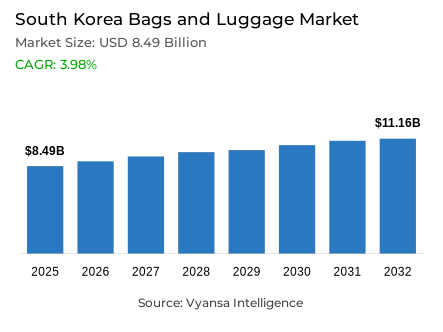
- Bags and luggage market size in South Korea was estimated at USD 8.49 billion in 2025.
- The market size is expected to grow to USD 11.16 billion by 2032.
- Market to register a CAGR of around 3.98% during 2026-32.
- Category Shares
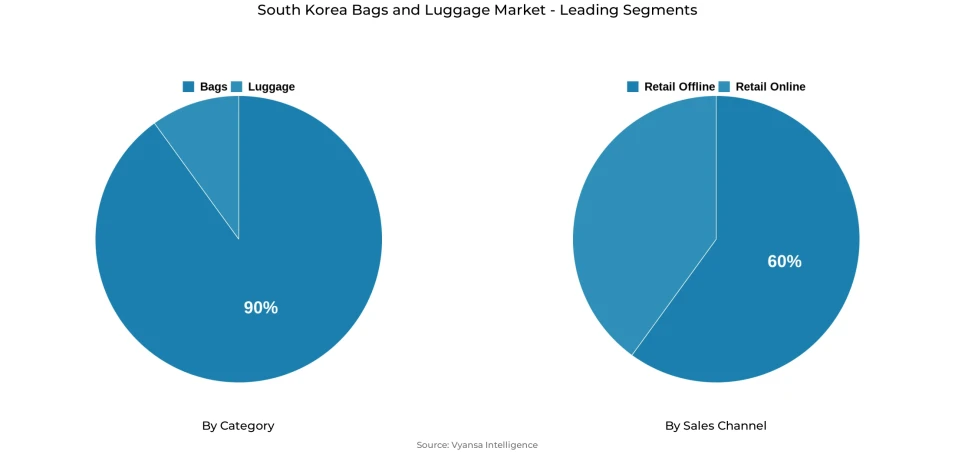
- Bags grabbed market share of 90%.
- Competition
- More than 20 companies are actively engaged in producing bags and luggage in South Korea.
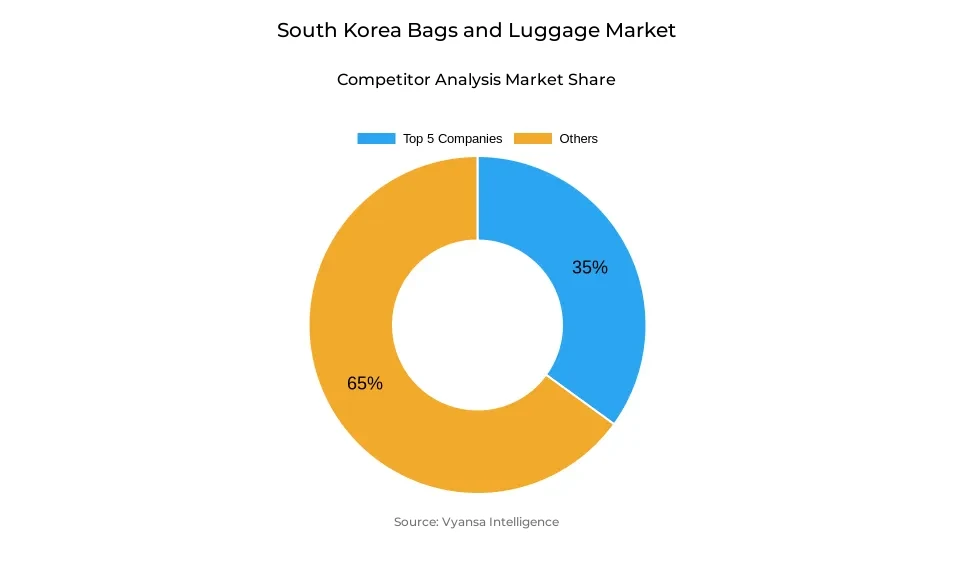
- Top 5 companies acquired around 35% of the market share.
- Samsonite Korea Ltd, Christian Dior Couture Korea Ltd, Prada Korea Ltd, Louis Vuitton Korea Ltd, Hermes Korea Ltd etc., are few of the top companies.
- Sales Channel
- Retail offline grabbed 60% of the market.
South Korea Bags and Luggage Market Outlook
The South Korea bags and luggage market is estimated at USD 8.49 billion in 2025 and is expected to grow to USD 11.16 billion by 2032 with a compound annual growth rate of about 3.98% in 2026–32. The growth in the forecast period will be largely value-based because the volume growth will be moderate in the post-pandemic recovery after market saturation. The product differentiation, brand strength, and perceived long-term value will have an increasing impact on consumer demand instead of purchase frequency.
Bags will still prevail in the market, with about 90% of the total value, supported by their high positioning as lifestyle and fashion-oriented products. Though luxury handbags will still record positive growth, growth is expected to slow down compared to previous levels, with some of the high-income earners shifting discretionary income to watches and jewellery. However, the increased availability via online platforms and parallel imports will likely keep the younger consumer base stable.
Luggage is expected to be the fastest-growing category throughout the forecast period, supported by the continued outbound travel and favourable holiday schedules. Large, hard-case luggage related to long-haul travel will be in particular demand, and innovation and multifunctionality will drive replacement purchases. Brands that meet practical travel needs and offer differentiated designs will perform better.
The offline retail will remain the dominant sales channel with about 60% market share, which is led by department stores and brand boutiques that offer authentication, service, and experience. However, retail retail online will keep gaining prominence as end user demand broader selections and price transparency, which will strengthen an ever more omnichannel market structure.
South Korea Bags and Luggage Market Growth Driver
Travel Recovery Sustains Luggage-Led Momentum
The strong recovery in the travel business remains a major growth driver of bags and luggage in South Korea, especially in supporting the luggage demand. Even after surpassing pre-pandemic levels in 2023, luggage has seen a double-digit growth in 2024, as overseas travel returns to scale. The long-distance flights to North America and Europe increase the need to have large and hard-case luggage, thus supporting the replacement and upgrade cycles of frequent travellers.
Brand performance also reflects this travel-based demand. Rimowa consolidates its market share in the luggage industry, and Samsonite Korea maintains its leadership due to its diversified brand portfolio, which comprises of American Tourister, Samsonite, and Tumi. Firms that match product innovation to realistic travelling needs, including multifunctional and family-friendly luggage designs, enjoy the advantage of end user focusing on convenience and durability when travelling to multiple destinations over a long period.
South Korea Bags and Luggage Market Challenge
Cooling Luxury Demand and Spending Diversion Weigh on Bags
The slowdown in the luxury bag purchases is a major threat to the market. After the boom in revenge shopping in 2021–2022, demand has stabilised in 2024 with many end user already having made big purchases of luxury handbags. The demand of luxury bags is being overtaken by watches and jewellery among the wealthy end user, thus decreasing the incremental demand of high-end handbags.
The decline is reflected in the performance of department stores. The growth rate of Shinsegae Department Store dropped to 11% in 2024, compared to 47% in 2021, and Lotte Department Store dropped to 5 to 35, and Hyundai Department Store dropped to 12 to 38. The more the department stores expand their jewellery floor space in reaction, the less the shelf visibility of bags. Moreover, international travel pulls discretionary expenditure out of domestic luxury goods, further limiting growth.
Unlock Market Intelligence
Explore the market potential with our data-driven report
South Korea Bags and Luggage Market Trend
Sustainability and Functional Innovation Shape Product Direction
The South Korea bags and luggage market is increasingly being influenced by sustainability and functionality in product development. Recycled materials, zero-waste processes, and long-life use models are introduced to brands to meet the increasing environmental awareness of end user. Pleats Mama is an example of this shift as it started to make bags out of recycled PET bottles since 2020 and has begun to use materials based on discarded fishing nets, thus directly responding to the issue of marine pollution.
Functional innovation has also gained importance beyond sustainability. Engineered products that are designed to perform more than one daily task, as opposed to being designed to perform only one task, which is travel, have been on the rise despite high prices. Ideas like detachable, multi-purpose luggage with child-mobility options highlight the importance of convenience and functionality to end user. These trends are an indication of a structural change to bags and luggage that combine sustainability, design, and daily functionality, instead of concentrating on the aesthetic value.
South Korea Bags and Luggage Market Opportunity
Premium Segments and Alternative Ownership Models Create Upside
Luxury handbags and luggage still have growth opportunities in the medium term despite the recent softness. Despite the fact that the individual consumption tax on luxury bags with prices exceeding KRW 2 million has risen by 16.7% in 2023, online stores have expanded the availability of luxury goods at relatively lower prices. This has made it more affordable to younger end user and forms the basis of revitalized demand of high-end bags via online platforms.
At the same time, the second-hand luxury market is becoming a major opportunity. Trenbe, and other platforms, are able to reduce losses by moving into the pre-owned luxury goods market, which is indicative of a change in consumer mentality towards value-based and environmentally-friendly consumption. Second-hand channels increase the availability of luxury bags and luggage with authenticity assurances that increase trust. In addition, retro brand resurgences, supported by K-pop partnerships and the opening of new offline stores, also diversify the sources of demand.
Unlock Market Intelligence
Explore the market potential with our data-driven report
South Korea Bags and Luggage Market Segmentation Analysis
By Category
- Bags
- Cross Body Bags
- Bags and Backpacks
- Business Bags
- Duffle Bags
- Clutches
- Others
- Luggage
- Soft Luggage
- Hard Luggage
- Wheeled Luggage
- Non-Wheeled Luggage
The segment with highest market share under category is Bags, with about 90% of the South Korea bags and luggage market. Bags enjoy the advantages of high replacement rates, high conformity to fashion, and their status-seeking and investment nature. Premiumisation and sustainability-based innovation also support demand, especially in the luxury and premium segments.
During the forecast period, bags will continue to be the major source of market value growth, despite relatively moderate growth rates. Their economic cycle resilience and strong presence in both offline and online platforms will further strengthen their dominance.
By Sales Channel
- Retail Offline
- Retail Online
Retail offline is the channel that has the highest share of about 60% of the total sales. Department stores remain at the centre of the luxury bag and high-quality luggage buying process, where end user are more focused on product inspection, assurance of authenticity, and personalised service.
Although retail offline will continue to lead, retail retail online will gradually increase its presence, especially in luxury and high-end products. The increased credibility of the platform and the increased acceptance of online luxury purchases will likely increase the strategic value of the channel during the forecast period.
List of Companies Covered in South Korea Bags and Luggage Market
The companies listed below are highly influential in the South Korea bags and luggage market, with a significant market share and a strong impact on industry developments.
- Samsonite Korea Ltd
- Christian Dior Couture Korea Ltd
- Prada Korea Ltd
- Louis Vuitton Korea Ltd
- Hermes Korea Ltd
- Chanel Korea Co Ltd
- Gucci Korea Ltd
- Bottega Veneta Korea Ltd
- Yves Saint Laurent Korea Ltd
- Sun Trading Co Ltd
Competitive Landscape
South Korea bags and luggage market is led by global luxury houses and established luggage specialists, although competitive dynamics are shifting in 2024. Luxury brands such as Chanel, Louis Vuitton, and Hermès remain influential, but growth in luxury bags has moderated as some consumers redirect spending toward watches and jewellery and reduce “open run” purchases. In luggage, Samsonite Korea Ltd retains leadership through its diversified portfolio including Samsonite, American Tourister, and Tumi, while Rimowa continues to strengthen its brand position amid strong long-haul travel demand. Niche innovators such as Tago Gayo Luggage are gaining visibility through multifunctional designs tailored to family travel needs. Meanwhile, sustainability-focused brands like Pleats Mama are differentiating themselves through recycled materials and zero-waste practices, adding a new competitive dimension to the market.
Frequently Asked Questions
Related Report
1. Market Segmentation
1.1. Research Scope
1.2. Research Methodology
1.3. Definitions and Assumptions
2. Executive Summary
3. South Korea Bags and Luggage Market Policies, Regulations, and Standards
4. South Korea Bags and Luggage Market Dynamics
4.1. Growth Factors
4.2. Challenges
4.3. Trends
4.4. Opportunities
5. South Korea Bags and Luggage Market Statistics, 2022-2032F
5.1. Market Size & Growth Outlook
5.1.1.By Revenues in USD Million
5.1.2.By Units Sold in Thousand Units
5.2. Market Segmentation & Growth Outlook
5.2.1.By Category
5.2.1.1. Bags- Market Insights and Forecast 2022-2032, USD Million
5.2.1.1.1. Cross Body Bags- Market Insights and Forecast 2022-2032, USD Million
5.2.1.1.2. Bags and Backpacks- Market Insights and Forecast 2022-2032, USD Million
5.2.1.1.3. Business Bags- Market Insights and Forecast 2022-2032, USD Million
5.2.1.1.4. Duffle Bags- Market Insights and Forecast 2022-2032, USD Million
5.2.1.1.5. Clutches- Market Insights and Forecast 2022-2032, USD Million
5.2.1.1.6. Others- Market Insights and Forecast 2022-2032, USD Million
5.2.1.2. Luggage- Market Insights and Forecast 2022-2032, USD Million
5.2.1.2.1. Soft Luggage- Market Insights and Forecast 2022-2032, USD Million
5.2.1.2.2. Hard Luggage- Market Insights and Forecast 2022-2032, USD Million
5.2.1.2.3. Wheeled Luggage- Market Insights and Forecast 2022-2032, USD Million
5.2.1.2.4. Non-Wheeled Luggage- Market Insights and Forecast 2022-2032, USD Million
5.2.2.By Sales Channel
5.2.2.1. Retail Offline- Market Insights and Forecast 2022-2032, USD Million
5.2.2.2. Retail Online- Market Insights and Forecast 2022-2032, USD Million
5.2.3.By Material Type
5.2.3.1. Soft Case- Market Insights and Forecast 2022-2032, USD Million
5.2.3.1.1. Nylon- Market Insights and Forecast 2022-2032, USD Million
5.2.3.1.2. Polyester- Market Insights and Forecast 2022-2032, USD Million
5.2.3.1.3. Ballistic Nylon- Market Insights and Forecast 2022-2032, USD Million
5.2.3.2. Hard Case- Market Insights and Forecast 2022-2032, USD Million
5.2.3.2.1. Polycarbonate- Market Insights and Forecast 2022-2032, USD Million
5.2.3.2.2. ABS (Acrylonitrile Butadiene Styrene)- Market Insights and Forecast 2022-2032, USD Million
5.2.3.2.3. Polypropylene- Market Insights and Forecast 2022-2032, USD Million
5.2.4.By Price Category
5.2.4.1. Luxury- Market Insights and Forecast 2022-2032, USD Million
5.2.4.2. Mass/Economy- Market Insights and Forecast 2022-2032, USD Million
5.2.4.3. Premium- Market Insights and Forecast 2022-2032, USD Million
5.2.5.By Application
5.2.5.1. Travel- Market Insights and Forecast 2022-2032, USD Million
5.2.5.2. Business- Market Insights and Forecast 2022-2032, USD Million
5.2.6.By Competitors
5.2.6.1. Competition Characteristics
5.2.6.2. Market Share & Analysis
6. South Korea Bags Market Statistics, 2022-2032
6.1. Market Size & Growth Outlook
6.1.1.By Revenues in USD Million
6.1.2.By Units Sold in Thousand Units
6.2. Market Segmentation & Growth Outlook
6.2.1.By Category- Market Insights and Forecast 2022-2032, USD Million
6.2.2.By Sales Channel- Market Insights and Forecast 2022-2032, USD Million
6.2.3.By Material Type- Market Insights and Forecast 2022-2032, USD Million
6.2.4.By Price Category- Market Insights and Forecast 2022-2032, USD Million
6.2.5.By Application- Market Insights and Forecast 2022-2032, USD Million
7. South Korea Luggage Market Statistics, 2022-2032
7.1. Market Size & Growth Outlook
7.1.1.By Revenues in USD Million
7.1.2.By Units Sold in Thousand Units
7.2. Market Segmentation & Growth Outlook
7.2.1.By Category- Market Insights and Forecast 2022-2032, USD Million
7.2.2.By Sales Channel- Market Insights and Forecast 2022-2032, USD Million
7.2.3.By Material Type- Market Insights and Forecast 2022-2032, USD Million
7.2.4.By Price Category- Market Insights and Forecast 2022-2032, USD Million
7.2.5.By Application- Market Insights and Forecast 2022-2032, USD Million
8. Competitive Outlook
8.1. Company Profiles
8.1.1.Louis Vuitton Korea Ltd
8.1.1.1. Business Description
8.1.1.2. Product Portfolio
8.1.1.3. Collaborations & Alliances
8.1.1.4. Recent Developments
8.1.1.5. Financial Details
8.1.1.6. Others
8.1.2.Hermes Korea Ltd
8.1.2.1. Business Description
8.1.2.2. Product Portfolio
8.1.2.3. Collaborations & Alliances
8.1.2.4. Recent Developments
8.1.2.5. Financial Details
8.1.2.6. Others
8.1.3.Chanel Korea Co Ltd
8.1.3.1. Business Description
8.1.3.2. Product Portfolio
8.1.3.3. Collaborations & Alliances
8.1.3.4. Recent Developments
8.1.3.5. Financial Details
8.1.3.6. Others
8.1.4.Gucci Korea Ltd
8.1.4.1. Business Description
8.1.4.2. Product Portfolio
8.1.4.3. Collaborations & Alliances
8.1.4.4. Recent Developments
8.1.4.5. Financial Details
8.1.4.6. Others
8.1.5.Bottega Veneta Korea Ltd
8.1.5.1. Business Description
8.1.5.2. Product Portfolio
8.1.5.3. Collaborations & Alliances
8.1.5.4. Recent Developments
8.1.5.5. Financial Details
8.1.5.6. Others
8.1.6.Samsonite Korea Ltd
8.1.6.1. Business Description
8.1.6.2. Product Portfolio
8.1.6.3. Collaborations & Alliances
8.1.6.4. Recent Developments
8.1.6.5. Financial Details
8.1.6.6. Others
8.1.7.Christian Dior Couture Korea Ltd
8.1.7.1. Business Description
8.1.7.2. Product Portfolio
8.1.7.3. Collaborations & Alliances
8.1.7.4. Recent Developments
8.1.7.5. Financial Details
8.1.7.6. Others
8.1.8.Prada Korea Ltd
8.1.8.1. Business Description
8.1.8.2. Product Portfolio
8.1.8.3. Collaborations & Alliances
8.1.8.4. Recent Developments
8.1.8.5. Financial Details
8.1.8.6. Others
8.1.9.Yves Saint Laurent Korea Ltd
8.1.9.1. Business Description
8.1.9.2. Product Portfolio
8.1.9.3. Collaborations & Alliances
8.1.9.4. Recent Developments
8.1.9.5. Financial Details
8.1.9.6. Others
8.1.10. Sun Trading Co Ltd
8.1.10.1. Business Description
8.1.10.2. Product Portfolio
8.1.10.3. Collaborations & Alliances
8.1.10.4. Recent Developments
8.1.10.5. Financial Details
8.1.10.6. Others
9. Disclaimer
| Segment | Sub-Segment |
|---|---|
| By Category |
|
| By Sales Channel |
|
| By Material Type |
|
| By Price Category |
|
| By Application |
|
Research Methodology
This study followed a structured approach comprising four key phases to assess the size and scope of the electro-oxidation market. The process began with thorough secondary research to collect data on the target market, related markets, and broader industry context. These findings, along with preliminary assumptions and estimates, were then validated through extensive primary research involving industry experts from across the value chain. To calculate the overall market size, both top-down and bottom-up methodologies were employed. Finally, market segmentation and data triangulation techniques were applied to refine and validate segment-level estimations.
Secondary Research
The secondary research phase involved gathering data from a wide range of credible and published sources. This step helped in identifying industry trends, defining market segmentation, and understanding the market landscape and value chain.
Sources consulted during this phase included:
- Company annual reports, investor presentations, and press releases
- Industry white papers and certified publications
- Trade directories and market-recognized databases
- Articles from authoritative authors and reputable journals
- Gold and silver standard websites
Secondary research was critical in mapping out the industry's value chain and monetary flow, identifying key market segments, understanding regional variations, and tracking significant industry developments.
Other key sources:
- Financial disclosures
- Industry associations and trade bodies
- News outlets and business magazines
- Academic journals and research studies
- Paid industry databases
Primary Research
To validate secondary data and gain deeper market insights, primary research was conducted with key stakeholders across both the supply and demand sides of the market.
On the demand side, participants included decision-makers and influencers from end-user industries—such as CIOs, CTOs, and CSOs—who provided first-hand perspectives on market needs, product usage, and future expectations.
On the supply side, interviews were conducted with manufacturers, industry associations, and institutional participants to gather insights into current offerings, product pipelines, and market challenges.
Primary interviews provided critical inputs such as:
- Market size and revenue data
- Product and service breakdowns
- Market forecasts
- Regional and application-specific trends
Stakeholders consulted included:
- Leading OEM and solution providers
- Channel and distribution partners
- End users across various applications
- Independent consultants and industry specialists
Market Size Estimation and Data Triangulation
- Identifying Key Market Participants (Secondary Research)
- Goal: To identify the major players or companies in the target market. This typically involves using publicly available data sources such as industry reports, market research publications, and financial statements of companies.
- Tools: Reports from firms like Gartner, Forrester, Euromonitor, Statista, IBISWorld, and others. Public financial statements, news articles, and press releases from top market players.
- Extracting Earnings of Key Market Participants
- Goal: To estimate the earnings generated from the product or service being analyzed. This step helps in understanding the revenue potential of each market player in a specific geography.
- Methods: Earnings data can be gathered from:
- Publicly available financial reports (for listed companies).
- Interviews and primary data sources from professionals, such as Directors, VPs, SVPs, etc. This is especially useful for understanding more nuanced, internal data that isn't publicly disclosed.
- Annual reports and investor presentations of key players.
- Data Collation and Development of a Relevant Data Model
- Goal: To collate inputs from both primary and secondary sources into a structured, data-driven model for market estimation. This model will incorporate key market KPIs and any independent variables relevant to the market.
- Key KPIs: These could include:
- Market size, growth rate, and demand drivers.
- Industry-specific metrics like market share, average revenue per customer (ARPC), or average deal size.
- External variables, such as economic growth rates, inflation rates, or commodity prices, that could affect the market.
- Data Modeling: Based on this data, the market forecasts are developed for the next 5 years. A combination of trend analysis, scenario modeling, and statistical regression might be used to generate projections.
- Scenario Analysis
- Goal: To test different assumptions and validate how sensitive the market is to changes in key variables (e.g., market demand, regulatory changes, technological disruptions).
- Types of Scenarios:
- Base Case: Based on current assumptions and historical data.
- Best-Case Scenario: Assuming favorable market conditions, regulatory environments, and technological advancements.
- Worst-Case Scenario: Accounting for adverse factors, such as economic downturns, stricter regulations, or unexpected disruptions.












