South Africa Pet Care Market Report: Trends, Growth and Forecast (2026-2032)
By Product (Pet Food (Dry Food, Wet Food, Treats & Mixers), Pet Products (Cat Litter, Pet Healthcare (Veterinary Diets, Probiotics and Supplements, Tele-health Services)), Services (Veterinary Clinics, Pet Insurance, Boarding, Day-Care, and Training), Grooming and Hygiene (Shampoos and Conditioners, Brushes and Combs, Clippers and Scissors)), By Pet Type (Dog, Cat, Others), By Sales Channel (Retail Offline, Retail E-Commerce, Veterinary Clinics) ... Read more
|
Major Players
|
South Africa Pet Care Market Statistics and Insights, 2026
- Market Size Statistics
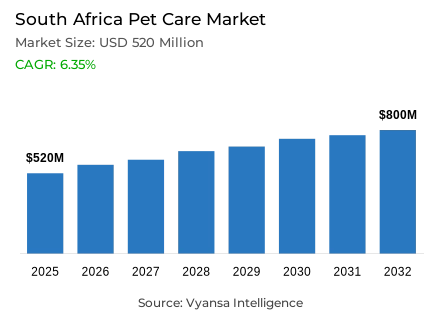
- Pet Care in South Africa is estimated at $ 520 Million.
- The market size is expected to grow to $ 800 Million by 2032.
- Market to register a CAGR of around 6.35% during 2026-32.
- Product Shares
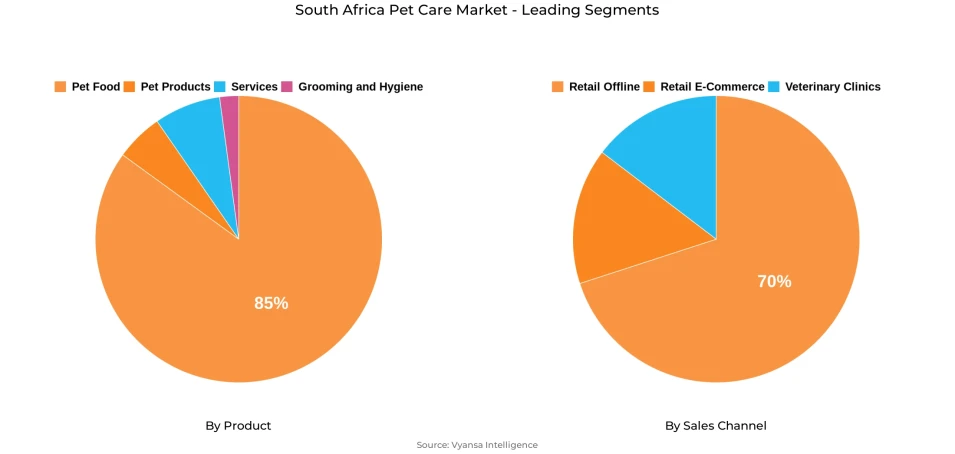
- Pet Food grabbed market share of 85%.
- Pet Food to witness a volume CAGR of around 3.39%.
- Competition
- More than 10 companies are actively engaged in producing Pet Care in South Africa.
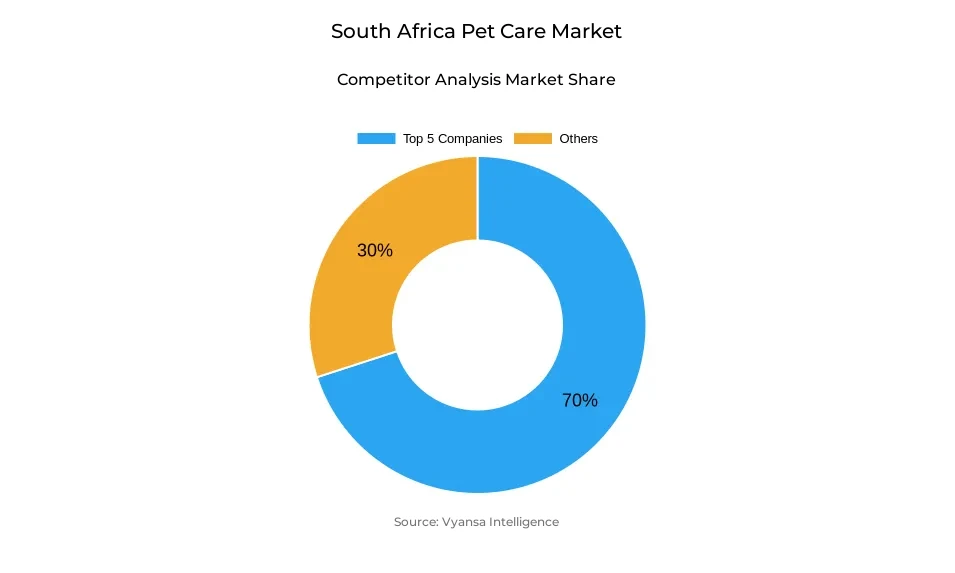
- Top 5 companies acquired 70% of the market share.
- Hill's Pet Nutrition Inc, Promeal (Pty) Ltd, Cube Route Pty Ltd, RCL Foods Ltd, Martin & Martin (Pty) Ltd etc., are few of the top companies.
- Sales Channel
- Retail Offline grabbed 70% of the market.
South Africa Pet Care Market Outlook
The South Africa pet care market, estimated to be approximately $520 million in 2025, is expected to expand steadily to almost $800 million by 2032. The expansion will be fueled by increased adoption of pets, especially cats and dogs, with increased urbanisation rates as well as increased pet humanisation. Consumers are increasingly viewing pets as members of the family, fueling greater demand for quality food and healthcare products. Economic stabilisation and better infrastructure, which have survived despite earlier problems like inflation, high interest rates, and loadshedding, are laying the ground for better long-term market performance.
Pet food will be the biggest and most significant category, with a volume CAGR of around 3.39% during the forecast period. Dog food will remain the leading category as the nation has a high number of dogs, particularly bigger breeds maintained for companionship and protection purposes. Economy dry dog food will have the largest share, but owners are increasingly spending money on superior-quality and health-oriented products. Premiumisation will be on the rise, but prices will be such that needs for low-cost solutions will be strong as well, indicating both value and quality demand.
The competitive market will remain dominated by Martin & Martin (Pty) Ltd, with its local manufacturing strength and established brands such as Bob Martin, Husky, and Pamper. Local manufacturing provides price competitiveness and confidence, and the international and premium brands vie for the increasing middle- and high-income bands. This blend is generating a differentiated market where premium and economy products will increase their slice.
As for distribution, retail offline generates close to 70% of sales, with supermarkets outpacing the rest due to ease and affordability. Yet, Retai e-commerce is forecast to register the highest growth, influenced by younger, technologically inclined consumers opting for convenience and same-day delivery. Services such as Checkers Sixty60 and online pet shops are spreading their wings, demonstrating how digital retail will complement offline supremacy and shape future consumer behaviour.
South Africa Pet Care Market Growth Driver
Increased Urbanisation Fuelling Pet Adoption
Urbanization is a prime force behind the pet care market in South Africa. As urbanization increases, with more individuals relocating to cities, there is a growing acceptance of pets, especially cats and dogs. This new lifestyle is leading to a greater demand for a range of goods that support the needs of pets within smaller-sized households and sophisticated city life. The increased number of pets in urban areas is increasingly driving retail volume and value growth in the market.
In addition to this, urban consumers are increasingly inclined towards premium and special products that benefit the well-being of their pets. With increased exposure to modern retail and changing lifestyles, the demand for premium food, treats, and healthcare services is on the rise. Thus, urbanisation not only raises the number of pets but also influences consumer preferences, facilitating the long-term growth of the pet care market.
South Africa Pet Care Market Trend
Growing Interest in Pet Health and Well-being
The consumption habits of end users in South Africa are changing, with increased emphasis on products that contribute to improved health and overall well-being for pets. Pet owners are increasingly discerning, seeking solutions that are value for money yet still deliver robust health benefits and claims. This is part of a broader trend of pet humanisation, whereby pets are considered part of the family, and their health is accorded higher priority.
One of the striking trends here is how willing end users are to pay extra for more nutritious, more expensive dog food. This trend is prompted by growing concern regarding pet health and well-being, with more consumers developing a growing interest in products that offer targeted health benefits. As word gets out, demand for specialized and health-oriented pet care continues to solidify, driving the overall growth and trajectory of the market.
Unlock Market Intelligence
Explore the market potential with our data-driven report
South Africa Pet Care Market Opportunity
Widening Reach of Retai e-commerce Platforms
Retail e-commerce will present a significant opportunity for development in South Africa pet care market. As necessities such as pet food need regular replenishment, end users will increasingly gravitate towards online platforms that offer rapid and even same-day delivery. This convenience will prove highly appealing to busy homes, as well as those looking to gain access to specialist brands and veterinary products not always stocked by conventional outlets. While more pet owners embrace shopping online, the digital channel is expected to register the quickest growth among distribution channels.
Millennials and Generation Z will lead this opportunity, as they spend a lot of time on digital mediums and enjoy interactive online experiences. They are also more likely to adopt subscription models and bundled deals, which have the potential to create loyalty and repeat business. This transition will provide a solid avenue for businesses to tap into an expanding number of digital-first pet owners.
Unlock Market Intelligence
Explore the market potential with our data-driven report
South Africa Pet Care Market Segmentation Analysis
By Product
- Pet Food
- Pet Products
- Services
- Grooming and Hygiene
The most market share leading segment among the product channel is Pet Food, which had almost 85% of the market. Dog food leads the way in this market, given the country greater number of dogs versus cats and other domestic pets. Historically, dogs have been prized as home guards, even the larger breeds, and consequently, the demand for dog food specific to their requirements has remained strong. In this, economy dry dog food has the highest market share because most households seek cheap feeding solutions that suit their budget.
The high dependence on dog food keeps Pet Food as the market-leading category, benefiting from stable demand from urban and rural homes.For the future, the segment is forecast to experience steady volume growth, reflecting consistent demand. The rationale will come from the ongoing dominance of local homes by dogs and the convenience value of affordable dry food.
By Sales Channel
- Retail Offline
- Retail E-Commerce
- Veterinary Clinics
The most dominant segment within the sales channel is Retail Offline with a market share of almost 70%. Supermarkets continue to dominate this segment in South Africa due to their convenience and affordability. They offer one-stop shopping, where pet owners can purchase pet care products together with their groceries on a daily basis, thus saving effort and time. This convenience makes supermarkets the most preferred among various consumers.
In addition to supermarkets, pet shops and superstores are also well-positioned in the offline retail space. In recent years, supermarkets have also made moves to increase their coverage by adding or forming alliances with pet shops, for example, Woolworths' acquisition of Absolute Pets and Food Lover's Market's alliance with VetSmart. These actions are indicative of increased rivalry among retailers and enable supermarkets to leverage their scale against the expert knowledge and customer loyalty of pet shops and thus provide more integrated pet care solutions.
Top Companies in South Africa Pet Care Market
The top companies operating in the market include Hill's Pet Nutrition Inc, Promeal (Pty) Ltd, Cube Route Pty Ltd, RCL Foods Ltd, Martin & Martin (Pty) Ltd, Montego Pet Nutrition (Pty) Ltd, Mars Africa (Pty) Ltd, Afrique Pet Food (Pty) Ltd, Gourmet Pet Industries (Pty) Ltd, Marltons Pets & Products (Pty) Ltd, etc., are the top players operating in the South Africa Pet Care Market.
Frequently Asked Questions
Related Report
1. Market Segmentation
1.1. Research Scope
1.2. Research Methodology
1.3. Definitions and Assumptions
2. Executive Summary
3. South Africa Pet Care Market Policies, Regulations, and Standards
4. South Africa Pet Care Market Dynamics
4.1. Growth Factors
4.2. Challenges
4.3. Trends
4.4. Opportunities
5. South Africa Pet Care Market Statistics, 2022-2032F
5.1. Market Size & Growth Outlook
5.1.1.By Revenues in US$ Million
5.2. Market Segmentation & Growth Outlook
5.2.1.By Product
5.2.1.1. Pet Food- Market Insights and Forecast 2022-2032, USD Million
5.2.1.1.1. Dry Food- Market Insights and Forecast 2022-2032, USD Million
5.2.1.1.2. Wet Food- Market Insights and Forecast 2022-2032, USD Million
5.2.1.1.3. Treats & Mixers- Market Insights and Forecast 2022-2032, USD Million
5.2.1.2. Pet Products- Market Insights and Forecast 2022-2032, USD Million
5.2.1.2.1. Cat Litter- Market Insights and Forecast 2022-2032, USD Million
5.2.1.2.2. Pet Healthcare- Market Insights and Forecast 2022-2032, USD Million
5.2.1.2.2.1. Veterinary Diets- Market Insights and Forecast 2022-2032, USD Million
5.2.1.2.2.2. Probiotics and Supplements- Market Insights and Forecast 2022-2032, USD Million
5.2.1.2.2.3. Tele-health Services- Market Insights and Forecast 2022-2032, USD Million
5.2.1.3. Services- Market Insights and Forecast 2022-2032, USD Million
5.2.1.3.1. Veterinary Clinics- Market Insights and Forecast 2022-2032, USD Million
5.2.1.3.2. Pet Insurance- Market Insights and Forecast 2022-2032, USD Million
5.2.1.3.3. Boarding, Day-Care, and Training- Market Insights and Forecast 2022-2032, USD Million
5.2.1.4. Grooming and Hygiene- Market Insights and Forecast 2022-2032, USD Million
5.2.1.4.1. Shampoos and Conditioners- Market Insights and Forecast 2022-2032, USD Million
5.2.1.4.2. Brushes and Combs- Market Insights and Forecast 2022-2032, USD Million
5.2.1.4.3. Clippers and Scissors- Market Insights and Forecast 2022-2032, USD Million
5.2.2.By Pet Type
5.2.2.1. Dog- Market Insights and Forecast 2022-2032, USD Million
5.2.2.2. Cat- Market Insights and Forecast 2022-2032, USD Million
5.2.2.3. Others- Market Insights and Forecast 2022-2032, USD Million
5.2.3.By Sales Channel
5.2.3.1. Retail Offline- Market Insights and Forecast 2022-2032, USD Million
5.2.3.2. Retail E-Commerce- Market Insights and Forecast 2022-2032, USD Million
5.2.3.3. Veterinary Clinics- Market Insights and Forecast 2022-2032, USD Million
5.2.4.By Competitors
5.2.4.1. Competition Characteristics
5.2.4.2. Market Share & Analysis
6. South Africa Pet Food Market Statistics, 2022-2032F
6.1. Market Size & Growth Outlook
6.1.1.By Revenues in US$ Million
6.1.2.By Quantity Sold in Kilo Tons
6.2. Market Segmentation & Growth Outlook
6.2.1.By Product- Market Insights and Forecast 2022-2032, USD Million
6.2.2.By Pet Type- Market Insights and Forecast 2022-2032, USD Million
6.2.3.By Sales Channel- Market Insights and Forecast 2022-2032, USD Million
7. South Africa Pet Product Market Statistics, 2022-2032F
7.1. Market Size & Growth Outlook
7.1.1.By Revenues in US$ Million
7.2. Market Segmentation & Growth Outlook
7.2.1.By Product- Market Insights and Forecast 2022-2032, USD Million
7.2.2.By Pet Type- Market Insights and Forecast 2022-2032, USD Million
7.2.3.By Sales Channel- Market Insights and Forecast 2022-2032, USD Million
8. South Africa Pet Care Service Market Statistics, 2022-2032F
8.1. Market Size & Growth Outlook
8.1.1.By Revenues in US$ Million
8.2. Market Segmentation & Growth Outlook
8.2.1.By Services- Market Insights and Forecast 2022-2032, USD Million
8.2.2.By Pet Type- Market Insights and Forecast 2022-2032, USD Million
8.2.3.By Sales Channel- Market Insights and Forecast 2022-2032, USD Million
9. South Africa Grooming and Hygiene Pet Care Market Statistics, 2022-2032F
9.1. Market Size & Growth Outlook
9.1.1.By Revenues in US$ Million
9.2. Market Segmentation & Growth Outlook
9.2.1.By Product- Market Insights and Forecast 2022-2032, USD Million
9.2.2.By Pet Type- Market Insights and Forecast 2022-2032, USD Million
9.2.3.By Sales Channel- Market Insights and Forecast 2022-2032, USD Million
10. Competitive Outlook
10.1. Company Profiles
10.1.1. RCL Foods Ltd
10.1.1.1. Business Description
10.1.1.2. Product Portfolio
10.1.1.3. Collaborations & Alliances
10.1.1.4. Recent Developments
10.1.1.5. Financial Details
10.1.1.6. Others
10.1.2. Martin & Martin (Pty) Ltd
10.1.2.1. Business Description
10.1.2.2. Product Portfolio
10.1.2.3. Collaborations & Alliances
10.1.2.4. Recent Developments
10.1.2.5. Financial Details
10.1.2.6. Others
10.1.3. Montego Pet Nutrition (Pty) Ltd
10.1.3.1. Business Description
10.1.3.2. Product Portfolio
10.1.3.3. Collaborations & Alliances
10.1.3.4. Recent Developments
10.1.3.5. Financial Details
10.1.3.6. Others
10.1.4. Mars Africa (Pty) Ltd
10.1.4.1. Business Description
10.1.4.2. Product Portfolio
10.1.4.3. Collaborations & Alliances
10.1.4.4. Recent Developments
10.1.4.5. Financial Details
10.1.4.6. Others
10.1.5. Afrique Pet Food (Pty) Ltd
10.1.5.1. Business Description
10.1.5.2. Product Portfolio
10.1.5.3. Collaborations & Alliances
10.1.5.4. Recent Developments
10.1.5.5. Financial Details
10.1.5.6. Others
10.1.6. Hill's Pet Nutrition Inc
10.1.6.1. Business Description
10.1.6.2. Product Portfolio
10.1.6.3. Collaborations & Alliances
10.1.6.4. Recent Developments
10.1.6.5. Financial Details
10.1.6.6. Others
10.1.7. Promeal (Pty) Ltd
10.1.7.1. Business Description
10.1.7.2. Product Portfolio
10.1.7.3. Collaborations & Alliances
10.1.7.4. Recent Developments
10.1.7.5. Financial Details
10.1.7.6. Others
10.1.8. Marltons Pets & Products (Pty) Ltd
10.1.8.1. Business Description
10.1.8.2. Product Portfolio
10.1.8.3. Collaborations & Alliances
10.1.8.4. Recent Developments
10.1.8.5. Financial Details
10.1.8.6. Others
10.1.9. Cube Route Pty Ltd
10.1.9.1. Business Description
10.1.9.2. Product Portfolio
10.1.9.3. Collaborations & Alliances
10.1.9.4. Recent Developments
10.1.9.5. Financial Details
10.1.9.6. Others
10.1.10. Brennco Feeds Mills (Pty) Ltd
10.1.10.1.Business Description
10.1.10.2.Product Portfolio
10.1.10.3.Collaborations & Alliances
10.1.10.4.Recent Developments
10.1.10.5.Financial Details
10.1.10.6.Others
11. Disclaimer
| Segment | Sub-Segment |
|---|---|
| By Product |
|
| By Pet Type |
|
| By Sales Channel |
|
Research Methodology
This study followed a structured approach comprising four key phases to assess the size and scope of the electro-oxidation market. The process began with thorough secondary research to collect data on the target market, related markets, and broader industry context. These findings, along with preliminary assumptions and estimates, were then validated through extensive primary research involving industry experts from across the value chain. To calculate the overall market size, both top-down and bottom-up methodologies were employed. Finally, market segmentation and data triangulation techniques were applied to refine and validate segment-level estimations.
Secondary Research
The secondary research phase involved gathering data from a wide range of credible and published sources. This step helped in identifying industry trends, defining market segmentation, and understanding the market landscape and value chain.
Sources consulted during this phase included:
- Company annual reports, investor presentations, and press releases
- Industry white papers and certified publications
- Trade directories and market-recognized databases
- Articles from authoritative authors and reputable journals
- Gold and silver standard websites
Secondary research was critical in mapping out the industry's value chain and monetary flow, identifying key market segments, understanding regional variations, and tracking significant industry developments.
Other key sources:
- Financial disclosures
- Industry associations and trade bodies
- News outlets and business magazines
- Academic journals and research studies
- Paid industry databases
Primary Research
To validate secondary data and gain deeper market insights, primary research was conducted with key stakeholders across both the supply and demand sides of the market.
On the demand side, participants included decision-makers and influencers from end-user industries—such as CIOs, CTOs, and CSOs—who provided first-hand perspectives on market needs, product usage, and future expectations.
On the supply side, interviews were conducted with manufacturers, industry associations, and institutional participants to gather insights into current offerings, product pipelines, and market challenges.
Primary interviews provided critical inputs such as:
- Market size and revenue data
- Product and service breakdowns
- Market forecasts
- Regional and application-specific trends
Stakeholders consulted included:
- Leading OEM and solution providers
- Channel and distribution partners
- End users across various applications
- Independent consultants and industry specialists
Market Size Estimation and Data Triangulation
- Identifying Key Market Participants (Secondary Research)
- Goal: To identify the major players or companies in the target market. This typically involves using publicly available data sources such as industry reports, market research publications, and financial statements of companies.
- Tools: Reports from firms like Gartner, Forrester, Euromonitor, Statista, IBISWorld, and others. Public financial statements, news articles, and press releases from top market players.
- Extracting Earnings of Key Market Participants
- Goal: To estimate the earnings generated from the product or service being analyzed. This step helps in understanding the revenue potential of each market player in a specific geography.
- Methods: Earnings data can be gathered from:
- Publicly available financial reports (for listed companies).
- Interviews and primary data sources from professionals, such as Directors, VPs, SVPs, etc. This is especially useful for understanding more nuanced, internal data that isn't publicly disclosed.
- Annual reports and investor presentations of key players.
- Data Collation and Development of a Relevant Data Model
- Goal: To collate inputs from both primary and secondary sources into a structured, data-driven model for market estimation. This model will incorporate key market KPIs and any independent variables relevant to the market.
- Key KPIs: These could include:
- Market size, growth rate, and demand drivers.
- Industry-specific metrics like market share, average revenue per customer (ARPC), or average deal size.
- External variables, such as economic growth rates, inflation rates, or commodity prices, that could affect the market.
- Data Modeling: Based on this data, the market forecasts are developed for the next 5 years. A combination of trend analysis, scenario modeling, and statistical regression might be used to generate projections.
- Scenario Analysis
- Goal: To test different assumptions and validate how sensitive the market is to changes in key variables (e.g., market demand, regulatory changes, technological disruptions).
- Types of Scenarios:
- Base Case: Based on current assumptions and historical data.
- Best-Case Scenario: Assuming favorable market conditions, regulatory environments, and technological advancements.
- Worst-Case Scenario: Accounting for adverse factors, such as economic downturns, stricter regulations, or unexpected disruptions.












