Saudi Arabia Footwear Market Report: Trends, Growth and Forecast (2026-2032)
By Category (Children's Footwear (Infants (0-9 Months) Foot Length (CM) (8.3-8.9, 9.2-9.5, 10.1-10.5), Toddlers (9 Months - 4 Years) Foot Length (CM) (10.8, 11.4-11.7, 12.1-12.7, 13.0-13.3, 14.0-14.3, 14.6-15.2, 15.6-15.9, 16.5), Little Kids (4-7 Years) Foot Length (CM) (16.8, 17.1-17.8, 18.1-18.4, 19.1-19.4, 19.7-20.6, 21.0-21.6), Big Kids (7-12 Years) Foot Length (CM) (21.9, 22.2-23.5, 24.1-24.8)), Women's Footwear (Foot Length (CM) (20.8, 21.3-21.6, 22.2-22.5, 23.0-23.8, 24.1-24.6, 25.1-25.9, 26.2-26.7, 27.6)), Men's Footwear (Foot Length (CM) (23.5, 24.1-24.8, 25.4-25.7, 26.0-26.7, 27.0-27.9, 28.3-28.6, 29.4, 30.2, 31.0-31.8))), By Product Type (Casual, Athletic/Sports, Formal, Others), By Sales Channel (Retail Online, Retail Offline), By Material (Leather, Textile, Rubber, Synthetic, Canvas), By Price (Mass, Premium), By Footwear Type (Shoes (Sneakers, Boots), Sandals & Slippers (Flip-Flops)), By Application (Conventional Footwear (Daily Wear, Work/Office Wear, Outdoor & Adventure, Sports & Fitness, Party/Occasion Wear), Functional/Therapeutic Footwear (Therapeutic/Orthopedic, Medicated Slippers, Acupressure Slippers)) ... Read more
|
Major Players
|
Saudi Arabia Footwear Market Statistics and Insights, 2026
- Market Size Statistics
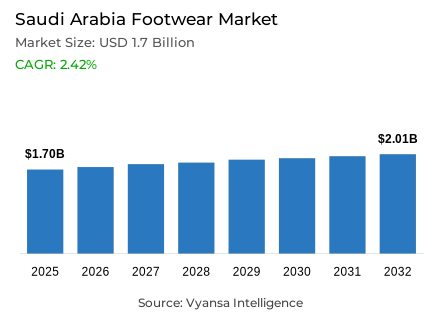
- Footwear in Saudi Arabia is estimated at USD 1.7 billion in 2025.
- The market size is expected to grow to USD 2.01 billion by 2032.
- Market to register a cagr of around 2.42% during 2026-32.
- Category Shares
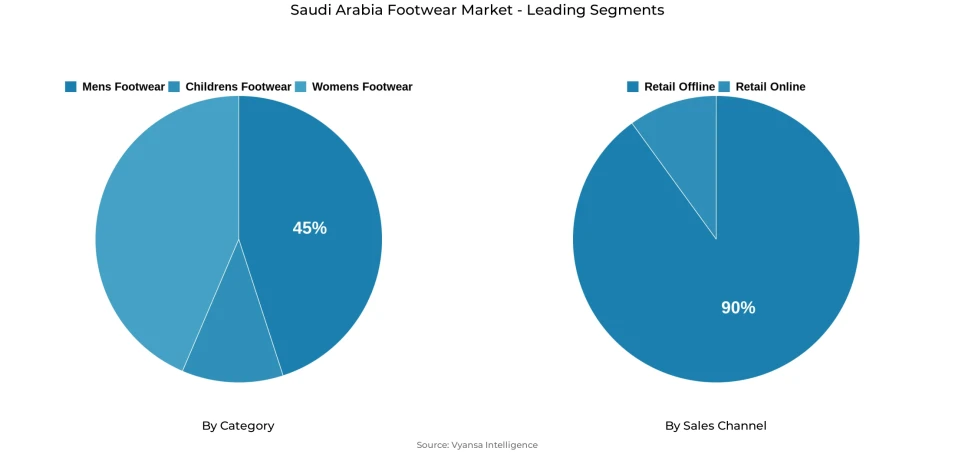
- Men's footwear grabbed market share of 45%.
- Competition
- More than 20 companies are actively engaged in producing footwear in Saudi Arabia.
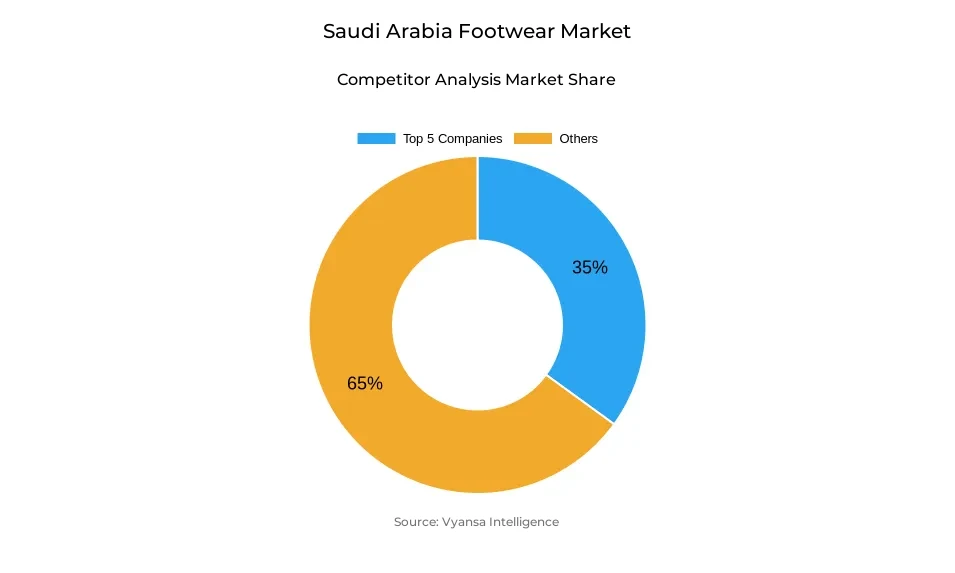
- Top 5 companies acquired around 35% of the market share.
- BMA International FZE, M H Alshaya Co, Al Othaim Group, Al Bandar Trading Co, adidas Group etc., are few of the top companies.
- Sales Channel
- Retail offline grabbed 90% of the market.
Saudi Arabia Footwear Market Outlook
Saudi Arabia footwear market is expected to record a consistent growth throughout the forecast period due to strong demographic trends and structural economic forces. The market is projected to grow to a valuation of around USD 2.01 billion by 2032, with a compound annual growth rate of about 2.42%, having a market valuation of US 1.7 billion in 2025. One of the main drivers of this growth is the fact that the sports market in the country is booming, and Vision 2030 efforts have significantly strengthened it. These programmes have encouraged more people to engage in fitness, marathon events and organized sporting activities among the various demographic groups. The government-funded programs, especially those aimed at youth involvement in sports, are promoting long-term fitness behaviours among the population, thus turning sports and athleisure footwear into a necessity good rather than a niche product.
In the category landscape, men footwear is still the most dominant segment with an approximate market value of 45%. This popularity can be primarily explained by the long-term demand of casual designs, sport-based aesthetics, and practical everyday footwear solutions. At the same time, the growing power of digital media platforms is increasing the consumption of footwear. Social networking platforms, such as Instagram and Tik Tok, have a significant impact on end user preferences, particularly among younger Saudi groups, as they combine the features of performance-footwear with the styling of modern streetwear. This online presence speeds up the trend-adoption process and creates a greater demand in multi-purpose footwear that can be used in casual, social and sporting situations.
Competitively, Al Bandar Trading Co. is the market leader and its Max brand is performing better in comparison to major global sports-wear companies like adidas, Nike, and Puma in terms of market value. The competitive advantage of the company lies in the wide retail distribution networks and positioning based on strategic value. However, the competitive environment is getting increasingly tougher with international sports retailers increasing their physical presence and digital footprint, which increases the number of brand choices and innovation that Saudi end user have.
In the future, the economic diversification efforts and the increased rates of female workforce participation that Vision 2030 will bring are expected to give further momentum to the footwear demand, and especially to the footwear category of women. Although offline retail channels now represent about 90% of the total sales volume, physical store formats are expected to continue playing a central role in end user buying behavior. The evolution of the market is likely to be influenced by strategic changes in sustainability practices, joint branding, and culturally-oriented marketing campaigns, which will guarantee stable and opportunity-driven growth until 2032.
Saudi Arabia Footwear Market Growth Driver
Sports participation supported by Vision 2030 initiatives
High rates of sports activity are one of the core factors of footwear demand in the Saudi Arabia market. Statistics released by the General Authority for Statistics show that the percentage of Saudi adults who practice physical activity on a weekly basis was 48.2% in 2023, which proves the practical effect of Vision 2030 health and sports development programmes. The government-led programs that encourage the involvement in fitness activities among demographic groups, including organized youth sports and community-based events, are directly influencing the rise in the demand of athletic and leisure footwear categories.
This growing sporting culture enables faster replacement of footwear, especially in the running and training shoe markets. With the increasing involvement of the youth and working-age groups in the participation, end user buying trends are increasingly moving towards performance-based and sport-inspired footwear designs.
Saudi Arabia Footwear Market Challenge
Intensifying competition and brand saturation
The Saudi Arabia footwear market is facing mounting competitive forces as international sportswear brands are increasing their presence with the already established domestic market players. As the statistics of the Saudi Ministry of Investment show, the wholesale and retail trade market has been growing at a rate of more than 8% annually in 2023, which has led to a rise in the inflow of foreign brands into the market. Although this is a positive development in terms of end user choice, it also increases price-based competition and increases the marketing spending needs of players in the existing market.
The growth of international retail operators and the growth of online distribution channels are putting pressure on profit margins and retail productivity measures. Brands are therefore compelled to ensure that they keep investing in promotional campaigns, customer loyalty schemes, and experiential retailing schemes in order to retain market share in an ever saturated competitive market
Unlock Market Intelligence
Explore the market potential with our data-driven report
Saudi Arabia Footwear Market Trend
Social media shaping youth-led footwear consumption
Digital media platforms are increasingly shaping footwear trends across the Saudi Arabia market, emerging as a central influence on design preferences, brand visibility, and end-user purchasing behaviour. According to the statistics provided by the Saudi Communications, Space and Technology Commission, more than 97% of Saudi Arabia internet users are active social media users, and the highest rates of social media use are recorded among the age groups of 18–34 years. Social media such as Instagram and Tik Tok have a significant impact on fashion discovery and the decision to purchase.
This high level of engagement drives the need of streetwear-inspired and multifunctional footwear products that are marketed via influencer networks, athletes, and content creators in the fitness market. The exposure created by the social media platforms hastens the trend-adoption cycles and shortens the product lifecycle, thus strengthening the need to have constantly updated footwear collections.
Saudi Arabia Footwear Market Opportunity
Rising female workforce participation and spending power
The expanding participation of women in the labour force is expected to create meaningful growth opportunities for stakeholders across the footwear market. According to GASTAT data, the labour-force participation of women in Saudi Arabia has improved to 36.2% in 2023, as compared to 17% in 2017, which is the result of the major structural changes that were made in the country as part of Vision 2030.
The improved economic involvement will be translated into higher disposable income and demand in the diversified footwear product categories, including professional, casual, and leisure uses. With the ongoing changes in cultural norms, female end user are showing growing interest in fashion-oriented but practical footwear solutions, prompting brands to increase women-specific product lines and drive category development.
Unlock Market Intelligence
Explore the market potential with our data-driven report
Saudi Arabia Footwear Market Segmentation Analysis
By Category
- Children's Footwear
- Infants (0-9 Months) Foot Length (CM)
- 8.3-8.9
- 9.2-9.5
- 10.1-10.5
- Toddlers (9 Months - 4 Years) Foot Length (CM)
- 10.8
- 11.4-11.7
- 12.1-12.7
- 13.0-13.3
- 14.0-14.3
- 14.6-15.2
- 15.6-15.9
- 16.5
- Little Kids (4-7 Years) Foot Length (CM)
- 16.8
- 17.1-17.8
- 18.1-18.4
- 19.1-19.4
- 19.7-20.6
- 21.0-21.6
- Big Kids (7-12 Years) Foot Length (CM)
- 21.9
- 22.2-23.5
- 24.1-24.8
- Infants (0-9 Months) Foot Length (CM)
- Women's Footwear
- Foot Length (CM)
- 20.8
- 21.3-21.6
- 22.2-22.5
- 23.0-23.8
- 24.1-24.6
- 25.1-25.9
- 26.2-26.7
- 27.6
- Foot Length (CM)
- Men's Footwear
- Foot Length (CM)
- 23.5
- 24.1-24.8
- 25.4-25.7
- 26.0-26.7
- 27.0-27.9
- 28.3-28.6
- 29.4
- 30.2
- 31.0-31.8
- Foot Length (CM)
Men's footwear constitutes the largest segment within the category classification, accounting for approximately 45% of total footwear market value in Saudi Arabia. This market dominance is intrinsically linked to the Kingdom's ongoing sports and fitness expansion under the Vision 2030 framework. Increased participation in activities including football, running, gymnasium-based training, and organized sporting competitions has generated substantial demand for athletic and sports-inspired footwear among male end user. Furthermore, the pronounced popularity of athleisure styling has diminished traditional distinctions between sports and casual footwear, thereby encouraging frequent purchases of versatile products suitable for both daily wear and physical activity contexts.
The men's footwear segment additionally benefits from robust brand engagement strategies, with sports and lifestyle brands actively deploying social media marketing, influencer partnerships, and event sponsorship initiatives to target younger male demographic cohorts. As fitness culture becomes progressively embedded within everyday lifestyle patterns, men's footwear is projected to sustain its leadership position throughout the 2026–32 forecast period, supported by ongoing innovation in comfort technologies, performance-enhancing features, and aesthetically appealing designs that align with active lifestyle preferences.
By Sales Channel
- Retail Online
- Retail Offline
Retail offline is the most prominent category under sales channel, with around 90% of the total footwear sales in Saudi Arabia. Retail offline continues to be the most preferred destination for shopping, thanks to the end user's strong preference for tangible product evaluation, especially in terms of comfort, fit, and quality checks before making an immediate purchase. Large-format footwear retail stores, shopping mall outlets, and branded stores continue to enjoy high foot traffic, especially in the urban commercial hubs and retail destinations with a lifestyle orientation.
Retail offline infrastructure also plays a pivotal role in brand awareness enhancement and experiential shopping. Many footwear brands continue to invest heavily in retail offline promotional activities, customer loyalty programs, and seasonal marketing campaigns to enhance sales performance. Although online distribution channels are witnessing a gradual increase, especially among the younger and more tech-savvy end user segments, retail offline is expected to retain its leading market share position during the forecast period from 2026 to 2032, driven by the mall-based retail culture in Saudi Arabia and the continued growth of retail offline infrastructure in the Kingdom.
List of Companies Covered in Saudi Arabia Footwear Market
The companies listed below are highly influential in the Saudi Arabia footwear market, with a significant market share and a strong impact on industry developments.
- BMA International FZE
- M H Alshaya Co
- Al Othaim Group
- Al Bandar Trading Co
- adidas Group
- Nike Inc
- Beside Group
- Cenomi Retail
- Skechers USA Inc
- Rubaiyat Co
Competitive Landscape
Saudi Arabia footwear market is led by Al Bandar Trading Co, whose Max brand maintains leadership through strong value positioning and an extensive retail network across the Kingdom. Its dominance is reinforced by loyalty programmes and high-visibility promotional campaigns. However, competition remains intense as global sportswear brands such as adidas, Nike, and Puma continue expanding their physical and digital presence, capitalising on the country’s growing sports culture and youth engagement. The recent entry of JD Sports is further intensifying rivalry, particularly within sports-inspired and athleisure footwear. As social media influence, event sponsorships, and Vision 2030-aligned initiatives increase, competition is increasingly shaped by brand visibility, lifestyle relevance, and the ability to connect with young and female consumers seeking both performance and style.
Frequently Asked Questions
Related Report
1. Market Segmentation
1.1. Research Scope
1.2. Research Methodology
1.3. Definitions and Assumptions
2. Executive Summary
3. Saudi Arabia Footwear Market Policies, Regulations, and Standards
4. Saudi Arabia Footwear Market Dynamics
4.1. Growth Factors
4.2. Challenges
4.3. Trends
4.4. Opportunities
5. Saudi Arabia Footwear Market Statistics, 2022-2032F
5.1. Market Size & Growth Outlook
5.1.1.By Revenues in USD Million
5.1.2.By Units Sold in Thousand Units
5.2. Market Segmentation & Growth Outlook
5.2.1.By Category
5.2.1.1. Children's Footwear- Market Insights and Forecast 2022-2032, USD Million
5.2.1.1.1. Infants (0-9 Months) Foot Length (CM)- Market Insights and Forecast 2022-2032, USD Million
5.2.1.1.1.1. 8.3-8.9- Market Insights and Forecast 2022-2032, USD Million
5.2.1.1.1.2. 9.2-9.5- Market Insights and Forecast 2022-2032, USD Million
5.2.1.1.1.3. 10.1-10.5- Market Insights and Forecast 2022-2032, USD Million
5.2.1.1.2. Toddlers (9 Months - 4 Years) Foot Length (CM)- Market Insights and Forecast 2022-2032, USD Million
5.2.1.1.2.1. 10.8- Market Insights and Forecast 2022-2032, USD Million
5.2.1.1.2.2. 11.4-11.7- Market Insights and Forecast 2022-2032, USD Million
5.2.1.1.2.3. 12.1-12.7- Market Insights and Forecast 2022-2032, USD Million
5.2.1.1.2.4. 13.0-13.3- Market Insights and Forecast 2022-2032, USD Million
5.2.1.1.2.5. 14.0-14.3- Market Insights and Forecast 2022-2032, USD Million
5.2.1.1.2.6. 14.6-15.2- Market Insights and Forecast 2022-2032, USD Million
5.2.1.1.2.7. 15.6-15.9- Market Insights and Forecast 2022-2032, USD Million
5.2.1.1.2.8. 16.5- Market Insights and Forecast 2022-2032, USD Million
5.2.1.1.3. Little Kids (4-7 Years) Foot Length (CM)- Market Insights and Forecast 2022-2032, USD Million
5.2.1.1.3.1. 16.8- Market Insights and Forecast 2022-2032, USD Million
5.2.1.1.3.2. 17.1-17.8- Market Insights and Forecast 2022-2032, USD Million
5.2.1.1.3.3. 18.1-18.4- Market Insights and Forecast 2022-2032, USD Million
5.2.1.1.3.4. 19.1-19.4- Market Insights and Forecast 2022-2032, USD Million
5.2.1.1.3.5. 19.7-20.6- Market Insights and Forecast 2022-2032, USD Million
5.2.1.1.3.6. 21.0-21.6- Market Insights and Forecast 2022-2032, USD Million
5.2.1.1.4. Big Kids (7-12 Years) Foot Length (CM)- Market Insights and Forecast 2022-2032, USD Million
5.2.1.1.4.1. 21.9- Market Insights and Forecast 2022-2032, USD Million
5.2.1.1.4.2. 22.2-23.5- Market Insights and Forecast 2022-2032, USD Million
5.2.1.1.4.3. 24.1-24.8- Market Insights and Forecast 2022-2032, USD Million
5.2.1.2. Women's Footwear- Market Insights and Forecast 2022-2032, USD Million
5.2.1.2.1. Foot Length (CM)- Market Insights and Forecast 2022-2032, USD Million
5.2.1.2.1.1. 20.8- Market Insights and Forecast 2022-2032, USD Million
5.2.1.2.1.2. 21.3-21.6- Market Insights and Forecast 2022-2032, USD Million
5.2.1.2.1.3. 22.2-22.5- Market Insights and Forecast 2022-2032, USD Million
5.2.1.2.1.4. 23.0-23.8- Market Insights and Forecast 2022-2032, USD Million
5.2.1.2.1.5. 24.1-24.6- Market Insights and Forecast 2022-2032, USD Million
5.2.1.2.1.6. 25.1-25.9- Market Insights and Forecast 2022-2032, USD Million
5.2.1.2.1.7. 26.2-26.7- Market Insights and Forecast 2022-2032, USD Million
5.2.1.2.1.8. 27.6- Market Insights and Forecast 2022-2032, USD Million
5.2.1.3. Men's Footwear- Market Insights and Forecast 2022-2032, USD Million
5.2.1.3.1. Foot Length (CM)- Market Insights and Forecast 2022-2032, USD Million
5.2.1.3.1.1. 23.5- Market Insights and Forecast 2022-2032, USD Million
5.2.1.3.1.2. 24.1-24.8- Market Insights and Forecast 2022-2032, USD Million
5.2.1.3.1.3. 25.4-25.7- Market Insights and Forecast 2022-2032, USD Million
5.2.1.3.1.4. 26.0-26.7- Market Insights and Forecast 2022-2032, USD Million
5.2.1.3.1.5. 27.0-27.9- Market Insights and Forecast 2022-2032, USD Million
5.2.1.3.1.6. 28.3-28.6- Market Insights and Forecast 2022-2032, USD Million
5.2.1.3.1.7. 29.4- Market Insights and Forecast 2022-2032, USD Million
5.2.1.3.1.8. 30.2- Market Insights and Forecast 2022-2032, USD Million
5.2.1.3.1.9. 31.0-31.8- Market Insights and Forecast 2022-2032, USD Million
5.2.2.By Product Type
5.2.2.1. Casual- Market Insights and Forecast 2022-2032, USD Million
5.2.2.2. Athletic/Sports- Market Insights and Forecast 2022-2032, USD Million
5.2.2.3. Formal- Market Insights and Forecast 2022-2032, USD Million
5.2.2.4. Others- Market Insights and Forecast 2022-2032, USD Million
5.2.3.By Sales Channel
5.2.3.1. Retail Online- Market Insights and Forecast 2022-2032, USD Million
5.2.3.2. Retail Offline- Market Insights and Forecast 2022-2032, USD Million
5.2.4.By Material
5.2.4.1. Leather- Market Insights and Forecast 2022-2032, USD Million
5.2.4.2. Textile- Market Insights and Forecast 2022-2032, USD Million
5.2.4.3. Rubber- Market Insights and Forecast 2022-2032, USD Million
5.2.4.4. Synthetic- Market Insights and Forecast 2022-2032, USD Million
5.2.4.5. Canvas- Market Insights and Forecast 2022-2032, USD Million
5.2.5.By Price
5.2.5.1. Mass- Market Insights and Forecast 2022-2032, USD Million
5.2.5.2. Premium- Market Insights and Forecast 2022-2032, USD Million
5.2.6.By Footwear Type
5.2.6.1. Shoes- Market Insights and Forecast 2022-2032, USD Million
5.2.6.1.1. Sneakers- Market Insights and Forecast 2022-2032, USD Million
5.2.6.1.2. Boots- Market Insights and Forecast 2022-2032, USD Million
5.2.6.2. Sandals & Slippers- Market Insights and Forecast 2022-2032, USD Million
5.2.6.2.1. Flip-Flops- Market Insights and Forecast 2022-2032, USD Million
5.2.7.By Application
5.2.7.1. Conventional Footwear- Market Insights and Forecast 2022-2032, USD Million
5.2.7.1.1. Daily Wear- Market Insights and Forecast 2022-2032, USD Million
5.2.7.1.2. Work/Office Wear- Market Insights and Forecast 2022-2032, USD Million
5.2.7.1.3. Outdoor & Adventure- Market Insights and Forecast 2022-2032, USD Million
5.2.7.1.4. Sports & Fitness- Market Insights and Forecast 2022-2032, USD Million
5.2.7.1.5. Party/Occasion Wear- Market Insights and Forecast 2022-2032, USD Million
5.2.7.2. Functional/Therapeutic Footwear- Market Insights and Forecast 2022-2032, USD Million
5.2.7.2.1. Therapeutic/Orthopedic- Market Insights and Forecast 2022-2032, USD Million
5.2.7.2.2. Medicated Slippers- Market Insights and Forecast 2022-2032, USD Million
5.2.7.2.3. Acupressure Slippers- Market Insights and Forecast 2022-2032, USD Million
5.2.8.By Competitors
5.2.8.1. Competition Characteristics
5.2.8.2. Market Share & Analysis
6. Saudi Arabia Children's Footwear Market Statistics, 2022-2032
6.1. Market Size & Growth Outlook
6.1.1.By Revenues in USD Million
6.1.2.By Units Sold in Thousand Units
6.2. Market Segmentation & Growth Outlook
6.2.1.By Category- Market Insights and Forecast 2022-2032, USD Million
6.2.2.By Product Type- Market Insights and Forecast 2022-2032, USD Million
6.2.3.By Sales Channel- Market Insights and Forecast 2022-2032, USD Million
6.2.4.By Material- Market Insights and Forecast 2022-2032, USD Million
6.2.5.By Price- Market Insights and Forecast 2022-2032, USD Million
6.2.6.By Footwear Type- Market Insights and Forecast 2022-2032, USD Million
6.2.7.By Application- Market Insights and Forecast 2022-2032, USD Million
7. Saudi Arabia Women's Footwear Market Statistics, 2022-2032
7.1. Market Size & Growth Outlook
7.1.1.By Revenues in USD Million
7.1.2.By Units Sold in Thousand Units
7.2. Market Segmentation & Growth Outlook
7.2.1.By Category- Market Insights and Forecast 2022-2032, USD Million
7.2.2.By Product Type- Market Insights and Forecast 2022-2032, USD Million
7.2.3.By Sales Channel- Market Insights and Forecast 2022-2032, USD Million
7.2.4.By Material- Market Insights and Forecast 2022-2032, USD Million
7.2.5.By Price- Market Insights and Forecast 2022-2032, USD Million
7.2.6.By Footwear Type- Market Insights and Forecast 2022-2032, USD Million
7.2.7.By Application- Market Insights and Forecast 2022-2032, USD Million
8. Saudi Arabia Men's Footwear Market Statistics, 2022-2032
8.1. Market Size & Growth Outlook
8.1.1.By Revenues in USD Million
8.1.2.By Units Sold in Thousand Units
8.2. Market Segmentation & Growth Outlook
8.2.1.By Category- Market Insights and Forecast 2022-2032, USD Million
8.2.2.By Product Type- Market Insights and Forecast 2022-2032, USD Million
8.2.3.By Sales Channel- Market Insights and Forecast 2022-2032, USD Million
8.2.4.By Material- Market Insights and Forecast 2022-2032, USD Million
8.2.5.By Price- Market Insights and Forecast 2022-2032, USD Million
8.2.6.By Footwear Type- Market Insights and Forecast 2022-2032, USD Million
8.2.7.By Application- Market Insights and Forecast 2022-2032, USD Million
9. Competitive Outlook
9.1. Company Profiles
9.1.1.Al Bandar Trading Co
9.1.1.1. Business Description
9.1.1.2. Product Portfolio
9.1.1.3. Collaborations & Alliances
9.1.1.4. Recent Developments
9.1.1.5. Financial Details
9.1.1.6. Others
9.1.2.adidas Group
9.1.2.1. Business Description
9.1.2.2. Product Portfolio
9.1.2.3. Collaborations & Alliances
9.1.2.4. Recent Developments
9.1.2.5. Financial Details
9.1.2.6. Others
9.1.3.Nike Inc
9.1.3.1. Business Description
9.1.3.2. Product Portfolio
9.1.3.3. Collaborations & Alliances
9.1.3.4. Recent Developments
9.1.3.5. Financial Details
9.1.3.6. Others
9.1.4.Beside Group
9.1.4.1. Business Description
9.1.4.2. Product Portfolio
9.1.4.3. Collaborations & Alliances
9.1.4.4. Recent Developments
9.1.4.5. Financial Details
9.1.4.6. Others
9.1.5.Cenomi Retail
9.1.5.1. Business Description
9.1.5.2. Product Portfolio
9.1.5.3. Collaborations & Alliances
9.1.5.4. Recent Developments
9.1.5.5. Financial Details
9.1.5.6. Others
9.1.6.BMA International FZE
9.1.6.1. Business Description
9.1.6.2. Product Portfolio
9.1.6.3. Collaborations & Alliances
9.1.6.4. Recent Developments
9.1.6.5. Financial Details
9.1.6.6. Others
9.1.7.M H Alshaya Co
9.1.7.1. Business Description
9.1.7.2. Product Portfolio
9.1.7.3. Collaborations & Alliances
9.1.7.4. Recent Developments
9.1.7.5. Financial Details
9.1.7.6. Others
9.1.8.Al Othaim Group
9.1.8.1. Business Description
9.1.8.2. Product Portfolio
9.1.8.3. Collaborations & Alliances
9.1.8.4. Recent Developments
9.1.8.5. Financial Details
9.1.8.6. Others
9.1.9.Skechers USA Inc
9.1.9.1. Business Description
9.1.9.2. Product Portfolio
9.1.9.3. Collaborations & Alliances
9.1.9.4. Recent Developments
9.1.9.5. Financial Details
9.1.9.6. Others
9.1.10. Rubaiyat Co
9.1.10.1. Business Description
9.1.10.2. Product Portfolio
9.1.10.3. Collaborations & Alliances
9.1.10.4. Recent Developments
9.1.10.5. Financial Details
9.1.10.6. Others
10. Disclaimer
| Segment | Sub-Segment |
|---|---|
| By Category |
|
| By Product Type |
|
| By Sales Channel |
|
| By Material |
|
| By Price |
|
| By Footwear Type |
|
| By Application |
|
Research Methodology
This study followed a structured approach comprising four key phases to assess the size and scope of the electro-oxidation market. The process began with thorough secondary research to collect data on the target market, related markets, and broader industry context. These findings, along with preliminary assumptions and estimates, were then validated through extensive primary research involving industry experts from across the value chain. To calculate the overall market size, both top-down and bottom-up methodologies were employed. Finally, market segmentation and data triangulation techniques were applied to refine and validate segment-level estimations.
Secondary Research
The secondary research phase involved gathering data from a wide range of credible and published sources. This step helped in identifying industry trends, defining market segmentation, and understanding the market landscape and value chain.
Sources consulted during this phase included:
- Company annual reports, investor presentations, and press releases
- Industry white papers and certified publications
- Trade directories and market-recognized databases
- Articles from authoritative authors and reputable journals
- Gold and silver standard websites
Secondary research was critical in mapping out the industry's value chain and monetary flow, identifying key market segments, understanding regional variations, and tracking significant industry developments.
Other key sources:
- Financial disclosures
- Industry associations and trade bodies
- News outlets and business magazines
- Academic journals and research studies
- Paid industry databases
Primary Research
To validate secondary data and gain deeper market insights, primary research was conducted with key stakeholders across both the supply and demand sides of the market.
On the demand side, participants included decision-makers and influencers from end-user industries—such as CIOs, CTOs, and CSOs—who provided first-hand perspectives on market needs, product usage, and future expectations.
On the supply side, interviews were conducted with manufacturers, industry associations, and institutional participants to gather insights into current offerings, product pipelines, and market challenges.
Primary interviews provided critical inputs such as:
- Market size and revenue data
- Product and service breakdowns
- Market forecasts
- Regional and application-specific trends
Stakeholders consulted included:
- Leading OEM and solution providers
- Channel and distribution partners
- End users across various applications
- Independent consultants and industry specialists
Market Size Estimation and Data Triangulation
- Identifying Key Market Participants (Secondary Research)
- Goal: To identify the major players or companies in the target market. This typically involves using publicly available data sources such as industry reports, market research publications, and financial statements of companies.
- Tools: Reports from firms like Gartner, Forrester, Euromonitor, Statista, IBISWorld, and others. Public financial statements, news articles, and press releases from top market players.
- Extracting Earnings of Key Market Participants
- Goal: To estimate the earnings generated from the product or service being analyzed. This step helps in understanding the revenue potential of each market player in a specific geography.
- Methods: Earnings data can be gathered from:
- Publicly available financial reports (for listed companies).
- Interviews and primary data sources from professionals, such as Directors, VPs, SVPs, etc. This is especially useful for understanding more nuanced, internal data that isn't publicly disclosed.
- Annual reports and investor presentations of key players.
- Data Collation and Development of a Relevant Data Model
- Goal: To collate inputs from both primary and secondary sources into a structured, data-driven model for market estimation. This model will incorporate key market KPIs and any independent variables relevant to the market.
- Key KPIs: These could include:
- Market size, growth rate, and demand drivers.
- Industry-specific metrics like market share, average revenue per customer (ARPC), or average deal size.
- External variables, such as economic growth rates, inflation rates, or commodity prices, that could affect the market.
- Data Modeling: Based on this data, the market forecasts are developed for the next 5 years. A combination of trend analysis, scenario modeling, and statistical regression might be used to generate projections.
- Scenario Analysis
- Goal: To test different assumptions and validate how sensitive the market is to changes in key variables (e.g., market demand, regulatory changes, technological disruptions).
- Types of Scenarios:
- Base Case: Based on current assumptions and historical data.
- Best-Case Scenario: Assuming favorable market conditions, regulatory environments, and technological advancements.
- Worst-Case Scenario: Accounting for adverse factors, such as economic downturns, stricter regulations, or unexpected disruptions.












