Saudi Arabia Colour Cosmetics Market Report: Trends, Growth and Forecast (2026-2032)
By Category (Eye Make-Up (Eye Liner/Pencil, Eye Shadow, Mascara, Others), Facial Make-Up (BB/CC Creams, Blusher/Bronzer/Highlighter, Foundation/Concealer, Powder, Others), Lip Products (Lip Gloss, Lip Liner/Pencil, Lipstick, Others), Nail Products (Nail Polish, Nail Treatments/Strengthener, Polish Remover, Others), Colour Cosmetics Sets/Kits), By Price (Premium, Mass), By Gender (Men, Women, Unisex), By Packaging Type (Travel/Mini Size, Standard Size, Professional/Salon Size), By Form (Creams/Gels, Lotions, Sprays, Solid, Others), By Nature (Organic, Inorganic), By Sales Channel (Retail Offline, Retail Online) ... Read more
|
Major Players
|
Saudi Arabia Colour Cosmetics Market Statistics and Insights, 2026
- Market Size Statistics
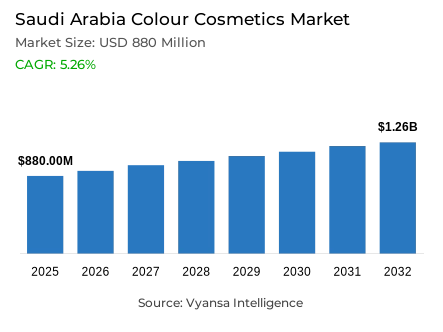
- Colour cosmetics in Saudi Arabia is estimated at USD 880 million in 2025.
- The market size is expected to grow to USD 1.26 billion by 2032.
- Market to register a cagr of around 5.26% during 2026-32.
- Category Shares
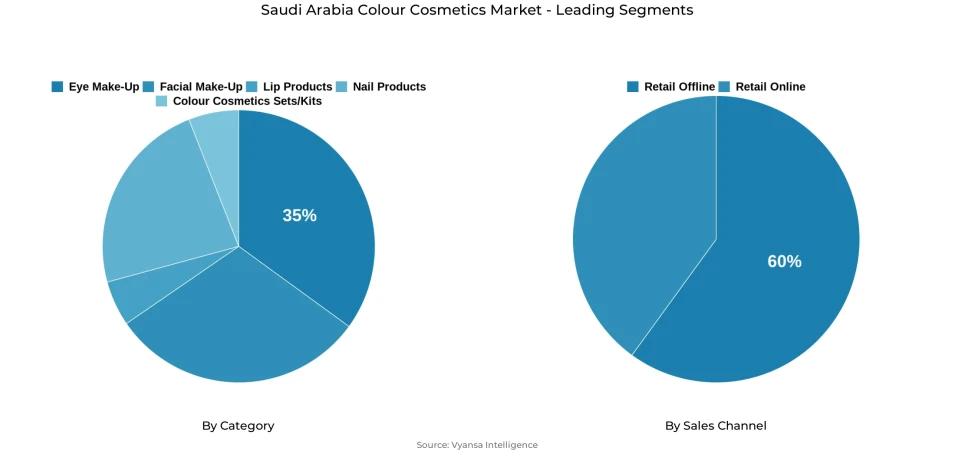
- Eye make-up grabbed market share of 35%.
- Competition
- More than 20 companies are actively engaged in producing colour cosmetics in Saudi Arabia.
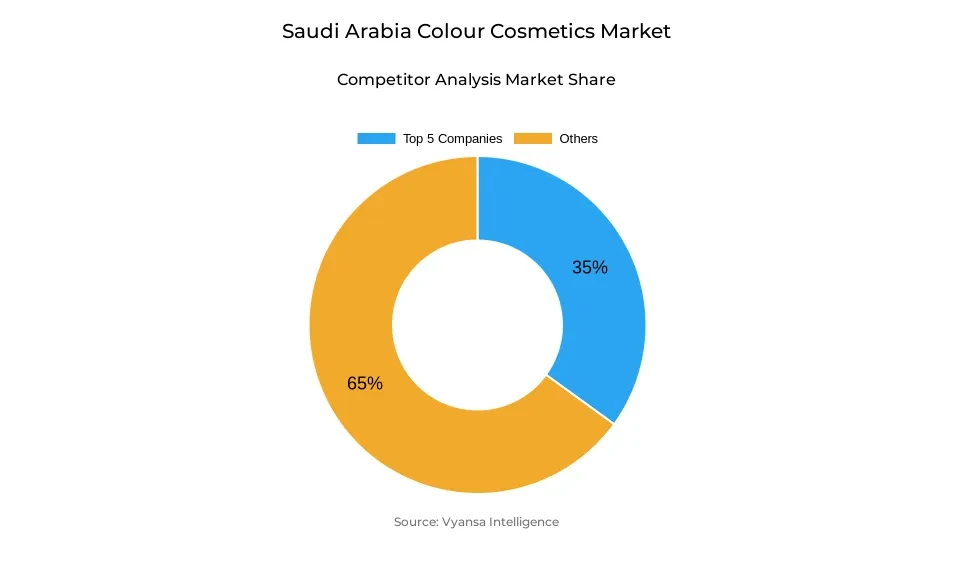
- Top 5 companies acquired around 35% of the market share.
- Coty Middle East FZCO; Estée Lauder Cos Inc; Kiko Milano Middle East; Make Up For Ever Paris; LVMH Moët Hennessy Louis Vuitton SA etc., are few of the top companies.
- Sales Channel
- Retail offline grabbed 60% of the market.
Saudi Arabia Colour Cosmetics Market Outlook
The Saudi Arabia colour cosmetics market is expected to witness steady growth during 2026–2032, supported by evolving end-user behaviour, a rising emphasis on personal grooming, and continual enhancements in retail and shopping experiences.
This market is estimated to be valued for USD 880 million in 2025 and is set to rise to USD 1.26 billion by the end of 2032, showing a compound annual growth rate of approximately 5.26 % during that period of time, which is driven by a rise in demand for products that have a combination of both cosmetic and skin care qualities, such as foundations with concealers that have a demand for a radiant and natural skin look, as demanded by Social Media trends In the segment, eye makeup represents about 35 % of the total share, which indicates a high demand of expressive and visually effective products.
The retail distribution is still largely controlled by the traditional channels, with offline retail taking up about 60 % of the total sales. Retailers of beauty-specialists, mono-brand stores, and other specialist stores remain as crucial settings of personalized consultation, product testing, and expert advice. At the same time, the concept of omnichannel retailing is becoming more popular as brands are incorporating retail online platforms, mobile apps, and digital engagement tools to serve convenience-focused and digitally-aware customers.
The competitive environment is defined by established global brands that strengthen their presence and high-end players that increase retail presence in major urban markets. Local and global brands are also coming up with multifunctional formulations that address consumer needs of hydration, sun protection, and skin-health in cosmetic products. With the modernisation of lifestyles and the growing emphasis of end user on convenience, personalisation, and improved shopping experiences, the colour cosmetics market in Saudi Arabia is poised to continue its growth until 2032.
Saudi Arabia Colour Cosmetics Market Growth DriverIncreasing Female Workforce Participation Enhancing Demand
The increasing participation of women in the workforce is emerging as a key factor driving the expansion of the Saudi Arabia colour cosmetics market. As the General Authority for Statistics reports, the labour force participation of women in 2024 was 36.2 %, which is a sign of a significant socioeconomic change and an increase in income-earning opportunities among women. This expansion of the workforce is a critical end-user group with increased purchasing power and an increased emphasis on professional presentation and personal grooming habits.
With an increasing number of women joining the paid labour force, there has been an increase in demand of daily make-up items that allow a professional and confidence-boosting look, such as foundations, concealers, and multi-purpose colour cosmetics. This trend is also supported by the general national reforms through programs like Vision 2030, which promote the economic empowerment of women and their involvement in the labour-market. The growth in financial freedom also contributes to higher spending on high-end, quality, and fashionable cosmetic products, which reinforces the demand in the market.
Saudi Arabia Colour Cosmetics Market ChallengePrice Sensitivity Amid Economic Shifts and Retail Costs
The Saudi Arabia colour cosmetics market faces increasing pressure to sustain growth in the context of shifting economic conditions and rising operational and retail costs. With the modernisation of operations and the expansion of digital integration by retailers to maintain competitiveness, cost structures can increase, which can result in higher end-user prices. This environment can therefore increase price sensitivity in low-end segments, especially the younger end user, and can influence the frequency of purchase or brand preference.
Moreover, changes in lifestyle spending to entertainment, leisure and social experiences create competition to discretionary budgets forcing beauty purchases to compete with other consumer priorities. These forces highlight the importance of brands striking a balance between pricing, perceived value, and product differentiation as they respond to a shifting retail and economic environment.
Unlock Market Intelligence
Explore the market potential with our data-driven report
Saudi Arabia Colour Cosmetics Market TrendDigital Influence and Social Media Shaping Preferences
The Saudi Arabia colour cosmetics market is increasingly shaped by the growing influence of digital platforms and social media on beauty preferences and purchasing behaviour. The younger demographics, especially Gen Z and the new generation of Gen Alpha, are very active on social media, especially on Tik Tok and Instagram, where influencers promote new products, creative makeup demonstrations, and application methods. This exposure promotes experimentation and increases the demand of innovative and trend-based cosmetic products.
Social media also enhances brand engagement through tutorials, peer reviews, and user-created content, which further enhances engagement and loyalty. Brands that invest in a strong digital presence, partnerships with influencers, and interactive online experiences, such as virtual try-on and immersive content, are in a better place to draw attention and drive conversion.
Saudi Arabia Colour Cosmetics Market OpportunityGrowth Through Hybrid Products and Local Cultural Tailoring
The main market growth opportunity is in the creation of hybrid cosmetic products and services that are adapted to local cultural tastes. end user are becoming more and more attracted to products that offer both make-up functionality and skincare benefits, including hydrating lip balms, multi-functional colour sticks, and foundations with protective or nourishing ingredients, so that they can achieve both aesthetic and skin well-being in one application.
The brands that incorporate the regional beauty identity and cultural relevance in product positioning will most likely increase resonance in the market. Ideas that resonate with the Arab beauty ideals, as well as recipes that are based on the locally treasured ingredients or design elements, can reinforce brand loyalty and brand differentiation. With regional and international players growing curated collections and focused promotional efforts to Saudi end user, the opportunities are likely to expand in both the mass and premium segments.
Unlock Market Intelligence
Explore the market potential with our data-driven report
Saudi Arabia Colour Cosmetics Market Segmentation Analysis
By Category
- Eye Make-Up
- Eye Liner/Pencil
- Eye Shadow
- Mascara
- Others
- Facial Make-Up
- BB/CC Creams
- Blusher/Bronzer/Highlighter
- Foundation/Concealer
- Powder
- Others
- Lip Products
- Lip Gloss
- Lip Liner/Pencil
- Lipstick
- Others
- Nail Products
- Nail Polish
- Nail Treatments/Strengthener
- Polish Remover
- Others
- Colour Cosmetics Sets/Kits
The segment with highest market share under category is Eye Make-Up, accounting for approximately 35% of the Saudi Arabia colour cosmetics market. Strong demand for mascaras, eyeliners, and eyeshadow palettes reflects consumer preference for expressive eye definition, which plays a central role in contemporary beauty routines and social-occasion looks.
The segment benefits from broad relevance across age groups and from sustained innovation in textures, finishes, and shade diversity. Its continued prominence is further supported by high engagement among digitally active users who favour visually striking yet versatile eye-makeup styles.
By Sales Channel
- Retail Offline
- Retail Online
The segment with highest market share under sales channel is retail offline, accounting for around 60% of total market sales in Saudi Arabia. Beauty specialists, mono-brand stores, and specialist retail environments remain the core purchasing destinations due to the value placed on in-person consultation, product trial, and expert guidance.
These channels provide immersive shopping experiences, extensive assortments, and personalised service, all of which reinforce consumer confidence and loyalty. While retail online and hybrid retail formats are expanding rapidly, offline retail continues to anchor purchasing behaviour, particularly within premium and specialist cosmetic segments, due to its role in discovery, consultation, and immediate product access.
List of Companies Covered in Saudi Arabia Colour Cosmetics Market
The companies listed below are highly influential in the Saudi Arabia colour cosmetics market, with a significant market share and a strong impact on industry developments.
- Coty Middle East FZCO
- Estée Lauder Cos Inc
- Kiko Milano Middle East
- Make Up For Ever Paris
- LVMH Moët Hennessy Louis Vuitton SA
- L'Oréal Middle East FZE
- Cosnova GmbH
- Jamjoom & Chalhoub Group
- Kamal Osman Jamjoom Trading LLC
- Fawaz Abdulaziz Al Hokair & Co
Competitive Landscape
Saudi Arabia’s Colour Cosmetics Market remains highly competitive, led by Make Up For Ever, which holds a narrow lead thanks to strong distribution across mono-brand stores, beauty specialists, and e-commerce, reinforced by frequent promotions and a robust pipeline of product launches. LVMH-affiliated brands and premium players such as Charlotte Tilbury are expanding their physical presence and elevating in-store experiences through personalised, immersive retail concepts, strengthening their appeal among affluent and aspirational shoppers. Competition is further intensified by beauty specialist retailers like Sephora and Flormar, whose expanding store networks enhance brand visibility, while pharmacies and rapidly growing online platforms broaden market access through hybrid retail models, digital integration, and value-driven offerings that cater to convenience-seeking and experience-oriented consumers.
Frequently Asked Questions
Related Report
1. Market Segmentation
1.1. Research Scope
1.2. Research Methodology
1.3. Definitions and Assumptions
2. Executive Summary
3. Saudi Arabia Colour Cosmetics Market Policies, Regulations, and Standards
4. Saudi Arabia Colour Cosmetics Market Dynamics
4.1. Growth Factors
4.2. Challenges
4.3. Trends
4.4. Opportunities
5. Saudi Arabia Colour Cosmetics Market Statistics, 2022-2032F
5.1. Market Size & Growth Outlook
5.1.1.By Revenues in USD Million
5.2. Market Segmentation & Growth Outlook
5.2.1.By Category
5.2.1.1. Eye Make-Up- Market Insights and Forecast 2022-2032, USD Million
5.2.1.1.1. Eye Liner/Pencil- Market Insights and Forecast 2022-2032, USD Million
5.2.1.1.2. Eye Shadow- Market Insights and Forecast 2022-2032, USD Million
5.2.1.1.3. Mascara- Market Insights and Forecast 2022-2032, USD Million
5.2.1.1.4. Others- Market Insights and Forecast 2022-2032, USD Million
5.2.1.2. Facial Make-Up- Market Insights and Forecast 2022-2032, USD Million
5.2.1.2.1. BB/CC Creams- Market Insights and Forecast 2022-2032, USD Million
5.2.1.2.2. Blusher/Bronzer/Highlighter- Market Insights and Forecast 2022-2032, USD Million
5.2.1.2.3. Foundation/Concealer- Market Insights and Forecast 2022-2032, USD Million
5.2.1.2.4. Powder- Market Insights and Forecast 2022-2032, USD Million
5.2.1.2.5. Others- Market Insights and Forecast 2022-2032, USD Million
5.2.1.3. Lip Products- Market Insights and Forecast 2022-2032, USD Million
5.2.1.3.1. Lip Gloss- Market Insights and Forecast 2022-2032, USD Million
5.2.1.3.2. Lip Liner/Pencil- Market Insights and Forecast 2022-2032, USD Million
5.2.1.3.3. Lipstick- Market Insights and Forecast 2022-2032, USD Million
5.2.1.3.4. Others- Market Insights and Forecast 2022-2032, USD Million
5.2.1.4. Nail Products- Market Insights and Forecast 2022-2032, USD Million
5.2.1.4.1. Nail Polish- Market Insights and Forecast 2022-2032, USD Million
5.2.1.4.2. Nail Treatments/Strengthener- Market Insights and Forecast 2022-2032, USD Million
5.2.1.4.3. Polish Remover- Market Insights and Forecast 2022-2032, USD Million
5.2.1.4.4. Others- Market Insights and Forecast 2022-2032, USD Million
5.2.1.5. Colour Cosmetics Sets/Kits- Market Insights and Forecast 2022-2032, USD Million
5.2.2.By Price
5.2.2.1. Premium- Market Insights and Forecast 2022-2032, USD Million
5.2.2.2. Mass- Market Insights and Forecast 2022-2032, USD Million
5.2.3.By Gender
5.2.3.1. Men- Market Insights and Forecast 2022-2032, USD Million
5.2.3.2. Women- Market Insights and Forecast 2022-2032, USD Million
5.2.3.3. Unisex- Market Insights and Forecast 2022-2032, USD Million
5.2.4.By Packaging Type
5.2.4.1. Travel/Mini Size - Market Insights and Forecast 2022-2032, USD Million
5.2.4.2. Standard Size - Market Insights and Forecast 2022-2032, USD Million
5.2.4.3. Professional/Salon Size- Market Insights and Forecast 2022-2032, USD Million
5.2.5.By Form
5.2.5.1. Creams/Gels- Market Insights and Forecast 2022-2032, USD Million
5.2.5.2. Lotions- Market Insights and Forecast 2022-2032, USD Million
5.2.5.3. Sprays- Market Insights and Forecast 2022-2032, USD Million
5.2.5.4. Solid- Market Insights and Forecast 2022-2032, USD Million
5.2.5.5. Others- Market Insights and Forecast 2022-2032, USD Million
5.2.6.By Nature
5.2.6.1. Organic- Market Insights and Forecast 2022-2032, USD Million
5.2.6.2. Inorganic- Market Insights and Forecast 2022-2032, USD Million
5.2.7.By Sales Channel
5.2.7.1. Retail Offline- Market Insights and Forecast 2022-2032, USD Million
5.2.7.2. Retail Online- Market Insights and Forecast 2022-2032, USD Million
5.2.8.By Competitors
5.2.8.1. Competition Characteristics
5.2.8.2. Market Share & Analysis
6. Saudi Arabia Eye Make-Up Colour Cosmetics Market Statistics, 2022-2032
6.1. Market Size & Growth Outlook
6.1.1.By Revenues in USD Million
6.2. Market Segmentation & Growth Outlook
6.2.1.By Category- Market Insights and Forecast 2022-2032, USD Million
6.2.2.By Price- Market Insights and Forecast 2022-2032, USD Million
6.2.3.By Gender- Market Insights and Forecast 2022-2032, USD Million
6.2.4.By Packaging Type- Market Insights and Forecast 2022-2032, USD Million
6.2.5.By Form- Market Insights and Forecast 2022-2032, USD Million
6.2.6.By Nature- Market Insights and Forecast 2022-2032, USD Million
6.2.7.By Sales Channel- Market Insights and Forecast 2022-2032, USD Million
7. Saudi Arabia Facial Make-Up Colour Cosmetics Market Statistics, 2022-2032
7.1. Market Size & Growth Outlook
7.1.1.By Revenues in USD Million
7.2. Market Segmentation & Growth Outlook
7.2.1.By Category- Market Insights and Forecast 2022-2032, USD Million
7.2.2.By Price- Market Insights and Forecast 2022-2032, USD Million
7.2.3.By Gender- Market Insights and Forecast 2022-2032, USD Million
7.2.4.By Packaging Type- Market Insights and Forecast 2022-2032, USD Million
7.2.5.By Form- Market Insights and Forecast 2022-2032, USD Million
7.2.6.By Nature- Market Insights and Forecast 2022-2032, USD Million
7.2.7.By Sales Channel- Market Insights and Forecast 2022-2032, USD Million
8. Saudi Arabia Lip Products Colour Cosmetics Market Statistics, 2022-2032
8.1. Market Size & Growth Outlook
8.1.1.By Revenues in USD Million
8.2. Market Segmentation & Growth Outlook
8.2.1.By Category- Market Insights and Forecast 2022-2032, USD Million
8.2.2.By Price- Market Insights and Forecast 2022-2032, USD Million
8.2.3.By Gender- Market Insights and Forecast 2022-2032, USD Million
8.2.4.By Packaging Type- Market Insights and Forecast 2022-2032, USD Million
8.2.5.By Form- Market Insights and Forecast 2022-2032, USD Million
8.2.6.By Nature- Market Insights and Forecast 2022-2032, USD Million
8.2.7.By Sales Channel- Market Insights and Forecast 2022-2032, USD Million
9. Saudi Arabia Nail Products Colour Cosmetics Market Statistics, 2022-2032
9.1. Market Size & Growth Outlook
9.1.1.By Revenues in USD Million
9.2. Market Segmentation & Growth Outlook
9.2.1.By Category- Market Insights and Forecast 2022-2032, USD Million
9.2.2.By Price- Market Insights and Forecast 2022-2032, USD Million
9.2.3.By Gender- Market Insights and Forecast 2022-2032, USD Million
9.2.4.By Packaging Type- Market Insights and Forecast 2022-2032, USD Million
9.2.5.By Form- Market Insights and Forecast 2022-2032, USD Million
9.2.6.By Nature- Market Insights and Forecast 2022-2032, USD Million
9.2.7.By Sales Channel- Market Insights and Forecast 2022-2032, USD Million
10. Saudi Arabia Colour Cosmetics Sets/Kits Colour Cosmetics Market Statistics, 2022-2032
10.1. Market Size & Growth Outlook
10.1.1. By Revenues in USD Million
10.2. Market Segmentation & Growth Outlook
10.2.1. By Price- Market Insights and Forecast 2022-2032, USD Million
10.2.2. By Gender- Market Insights and Forecast 2022-2032, USD Million
10.2.3. By Packaging Type- Market Insights and Forecast 2022-2032, USD Million
10.2.4. By Form- Market Insights and Forecast 2022-2032, USD Million
10.2.5. By Nature- Market Insights and Forecast 2022-2032, USD Million
10.2.6. By Sales Channel- Market Insights and Forecast 2022-2032, USD Million
11. Competitive Outlook
11.1. Company Profiles
11.1.1. Make Up For Ever Paris
11.1.1.1. Business Description
11.1.1.2. Product Portfolio
11.1.1.3. Collaborations & Alliances
11.1.1.4. Recent Developments
11.1.1.5. Financial Details
11.1.1.6. Others
11.1.2. LVMH Moët Hennessy Louis Vuitton SA
11.1.2.1. Business Description
11.1.2.2. Product Portfolio
11.1.2.3. Collaborations & Alliances
11.1.2.4. Recent Developments
11.1.2.5. Financial Details
11.1.2.6. Others
11.1.3. L’Oréal Middle East FZE
11.1.3.1. Business Description
11.1.3.2. Product Portfolio
11.1.3.3. Collaborations & Alliances
11.1.3.4. Recent Developments
11.1.3.5. Financial Details
11.1.3.6. Others
11.1.4. Cosnova GmbH
11.1.4.1. Business Description
11.1.4.2. Product Portfolio
11.1.4.3. Collaborations & Alliances
11.1.4.4. Recent Developments
11.1.4.5. Financial Details
11.1.4.6. Others
11.1.5. Jamjoom & Chalhoub Group
11.1.5.1. Business Description
11.1.5.2. Product Portfolio
11.1.5.3. Collaborations & Alliances
11.1.5.4. Recent Developments
11.1.5.5. Financial Details
11.1.5.6. Others
11.1.6. Coty Middle East FZCO
11.1.6.1. Business Description
11.1.6.2. Product Portfolio
11.1.6.3. Collaborations & Alliances
11.1.6.4. Recent Developments
11.1.6.5. Financial Details
11.1.6.6. Others
11.1.7. Estée Lauder Cos Inc
11.1.7.1. Business Description
11.1.7.2. Product Portfolio
11.1.7.3. Collaborations & Alliances
11.1.7.4. Recent Developments
11.1.7.5. Financial Details
11.1.7.6. Others
11.1.8. Kiko Milano Middle East
11.1.8.1. Business Description
11.1.8.2. Product Portfolio
11.1.8.3. Collaborations & Alliances
11.1.8.4. Recent Developments
11.1.8.5. Financial Details
11.1.8.6. Others
11.1.9. Kamal Osman Jamjoom Trading LLC
11.1.9.1. Business Description
11.1.9.2. Product Portfolio
11.1.9.3. Collaborations & Alliances
11.1.9.4. Recent Developments
11.1.9.5. Financial Details
11.1.9.6. Others
11.1.10. Fawaz Abdulaziz Al Hokair & Co
11.1.10.1.Business Description
11.1.10.2.Product Portfolio
11.1.10.3.Collaborations & Alliances
11.1.10.4.Recent Developments
11.1.10.5.Financial Details
11.1.10.6.Others
12. Disclaimer
| Segment | Sub-Segment |
|---|---|
| By Category |
|
| By Price |
|
| By Gender |
|
| By Packaging Type |
|
| By Form |
|
| By Nature |
|
| By Sales Channel |
|
Research Methodology
This study followed a structured approach comprising four key phases to assess the size and scope of the electro-oxidation market. The process began with thorough secondary research to collect data on the target market, related markets, and broader industry context. These findings, along with preliminary assumptions and estimates, were then validated through extensive primary research involving industry experts from across the value chain. To calculate the overall market size, both top-down and bottom-up methodologies were employed. Finally, market segmentation and data triangulation techniques were applied to refine and validate segment-level estimations.
Secondary Research
The secondary research phase involved gathering data from a wide range of credible and published sources. This step helped in identifying industry trends, defining market segmentation, and understanding the market landscape and value chain.
Sources consulted during this phase included:
- Company annual reports, investor presentations, and press releases
- Industry white papers and certified publications
- Trade directories and market-recognized databases
- Articles from authoritative authors and reputable journals
- Gold and silver standard websites
Secondary research was critical in mapping out the industry's value chain and monetary flow, identifying key market segments, understanding regional variations, and tracking significant industry developments.
Other key sources:
- Financial disclosures
- Industry associations and trade bodies
- News outlets and business magazines
- Academic journals and research studies
- Paid industry databases
Primary Research
To validate secondary data and gain deeper market insights, primary research was conducted with key stakeholders across both the supply and demand sides of the market.
On the demand side, participants included decision-makers and influencers from end-user industries—such as CIOs, CTOs, and CSOs—who provided first-hand perspectives on market needs, product usage, and future expectations.
On the supply side, interviews were conducted with manufacturers, industry associations, and institutional participants to gather insights into current offerings, product pipelines, and market challenges.
Primary interviews provided critical inputs such as:
- Market size and revenue data
- Product and service breakdowns
- Market forecasts
- Regional and application-specific trends
Stakeholders consulted included:
- Leading OEM and solution providers
- Channel and distribution partners
- End users across various applications
- Independent consultants and industry specialists
Market Size Estimation and Data Triangulation
- Identifying Key Market Participants (Secondary Research)
- Goal: To identify the major players or companies in the target market. This typically involves using publicly available data sources such as industry reports, market research publications, and financial statements of companies.
- Tools: Reports from firms like Gartner, Forrester, Euromonitor, Statista, IBISWorld, and others. Public financial statements, news articles, and press releases from top market players.
- Extracting Earnings of Key Market Participants
- Goal: To estimate the earnings generated from the product or service being analyzed. This step helps in understanding the revenue potential of each market player in a specific geography.
- Methods: Earnings data can be gathered from:
- Publicly available financial reports (for listed companies).
- Interviews and primary data sources from professionals, such as Directors, VPs, SVPs, etc. This is especially useful for understanding more nuanced, internal data that isn't publicly disclosed.
- Annual reports and investor presentations of key players.
- Data Collation and Development of a Relevant Data Model
- Goal: To collate inputs from both primary and secondary sources into a structured, data-driven model for market estimation. This model will incorporate key market KPIs and any independent variables relevant to the market.
- Key KPIs: These could include:
- Market size, growth rate, and demand drivers.
- Industry-specific metrics like market share, average revenue per customer (ARPC), or average deal size.
- External variables, such as economic growth rates, inflation rates, or commodity prices, that could affect the market.
- Data Modeling: Based on this data, the market forecasts are developed for the next 5 years. A combination of trend analysis, scenario modeling, and statistical regression might be used to generate projections.
- Scenario Analysis
- Goal: To test different assumptions and validate how sensitive the market is to changes in key variables (e.g., market demand, regulatory changes, technological disruptions).
- Types of Scenarios:
- Base Case: Based on current assumptions and historical data.
- Best-Case Scenario: Assuming favorable market conditions, regulatory environments, and technological advancements.
- Worst-Case Scenario: Accounting for adverse factors, such as economic downturns, stricter regulations, or unexpected disruptions.












