Saudi Arabia Cards and Payments Market Report: Trends, Growth and Forecast (2026-2032)
By Instrument Type (Cards (Debit Card, Charge Card, ATM Card, Pre-Paid Card, Credit Card, Store Card), Mobile Wallets, Cheques, Others), By Card Type (Contact Smart Card, Contactless Smart Card, Non-Smart Card), By Type of Payments (B2B, B2C, C2C, C2B (E-commerce Shopping, Payment at POS Terminals)), By Transaction Type (Domestic, Foreign), By Application (Food & Groceries, Health & Pharmacies, Travel & Tourism, Hospitality, Others (Media & Entertainment)) ... Read more
|
Major Players
|
Saudi Arabia Cards and Payments Market Statistics and Insights, 2026
- Market Size Statistics
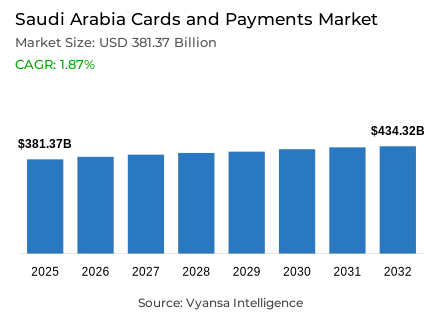
- Cards and Payments in Saudi Arabia is estimated at $ 381.37 Billion.
- The market size is expected to grow to $ 434.32 Billion by 2032.
- Market to register a CAGR of around 1.87% during 2026-32.
- Instrument Type Shares
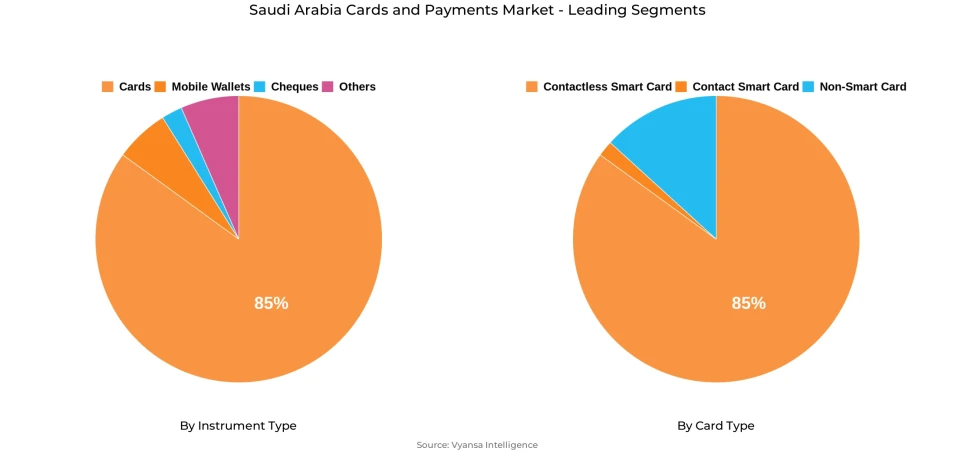
- Cards grabbed market share of 85%.
- Cards to witness a volume CAGR of around 3.69%.
- Competition
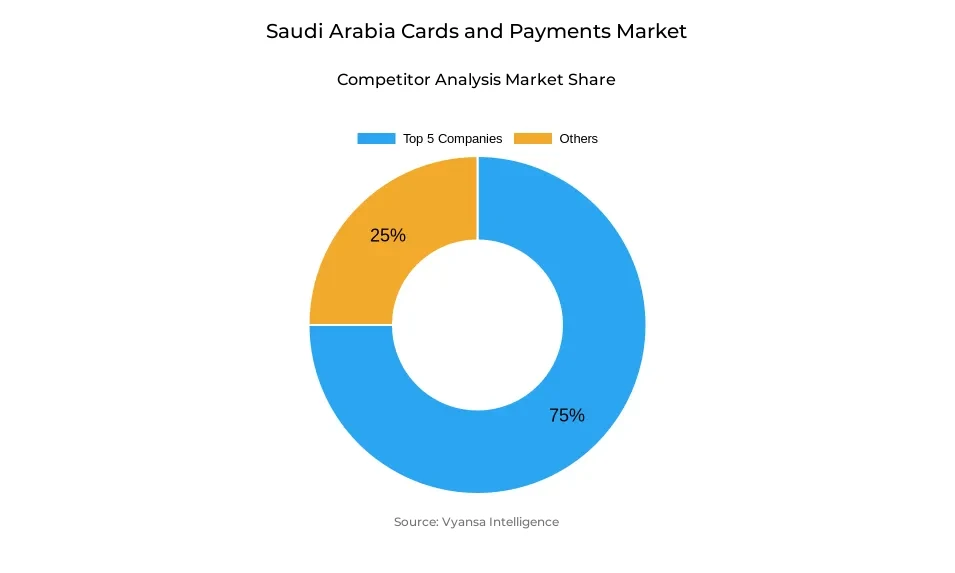
- More than 10 companies are actively engaged in producing Cards and Payments in Saudi Arabia.
- Top 5 companies acquired 75% of the market share.
- Bank Al Jazira, Saudi Awwal Bank, Saudi Investment Bank, Al Rajhi Banking & Investment Corp, Saudi National Bank SNB etc., are few of the top companies.
- Card Type
- Contactless Smart Card grabbed 85% of the market.
Saudi Arabia Cards and Payments Market Outlook
Saudi Arabia cards and payments market is set to grow robustly over the next few years, with the market worth USD 381.37 billion and set to hit USD 434.32 billion by 2032. This is driven by the government initiative to move to a cashless society, under Vision 2030, to achieve 70% of all transactions in non-cash terms. Growing end users acceptance of electronic payment cards, digital wallets, and contactless payments is fueling this move, aided by a strong digital payments infrastructure and an expanding merchant base for accepting electronic payments.
The popularity of contactless smart cards that capture 85% of the market captures the Saudi Arabia end users affinity for quick, secure, and convenient payment methods. Debit cards remain the leaders with efforts at financial inclusion coupled with pragmatic expenditure patterns, whereas Buy Now Pay Later (BNPL) platforms such as Tabby, Tamara, and KadiPay are increasing in popularity, particularly among young, technologically inclined end users. The services allow end users to pay in instalments for big-ticket purchases, complementing digital payments seamlessly.
Digital banking transformation is another major impetus, with challenger banks, neo-banks, and online banks speeding up innovation and enhancing financial access. Banks are concentrating on using technology for end users experience enhancement, such as next-generation branches, AI-based solutions, and linking with digital wallets. Tie-ups between international payment processors and domestic fintechs are also increasing access to next-generation credit card solutions and payment modes for individuals, SMEs, and e-commerce merchants.
With cards anticipated to see a volume CAGR of approximately 3.69%, Saudi Arabia payment market is becoming more digital, secure, and inclusive. Coupled with government support, high mobile and internet penetration, and a technology-driven population, the Kingdom is poised as a regional frontrunner in digital financial services. By 2032, the mass usage of contactless payments and digital banking is anticipated to further deplete cash usage and enhance Saudi Arabia fintech and e-commerce environment.
Saudi Arabia Cards and Payments Market Growth Driver
Government thrust towards a cashless economy
Strong initiatives by the Saudi government are propelling the country towards the transition from cash to e-payments. Regulations urging merchants to offer digital payment modes in conjunction with cash are streamlining the use of financial cards for end users. Simultaneously, initiatives strengthening the digital payment infrastructure of the country facilitate a more seamless and secure payment process, increasing end users' confidence in using cards.
This top-down strategy is boosting the growth of the card market and the number of transactions. As digital payments become increasingly convenient and secure, more and more individuals are turning to them, while cash consumption slowly diminishes for everyday transactions. The government priority for a cashless society remains the major driving force behind the future of payments in Saudi Arabia.
Saudi Arabia Cards and Payments Market Trend
Growing Use of Flexible Payment Solutions
Buy Now, Pay Later (BNPL) products are increasingly popular in Saudi Arabia as shoppers seek simpler ways to pay. BNPL enables the payment to be delayed and spread over weeks or months, which makes it easier to buy more expensive items without having to pay cash upfront. Digitally native end users, especially, are welcoming this digital-only methodology, a clear indication of a move towards more convenient and flexible forms of payment.
Innovative platforms like Tabby and KadiPay are leading the change by teaming up with many retailers and providing interest-free instalments if paid on time. Their expansion indicates a shift towards digital, end users-centric financial products. With increasing numbers of Saudis using BNPL, the payments ecosystem is changing, with end users increasingly demanding convenience, ease, and control over how they spend and manage money.
Unlock Market Intelligence
Explore the market potential with our data-driven report
Saudi Arabia Cards and Payments Market Opportunity
Development of Neo-Banks and Digital Wallets
The growth in the usage of neo-banks and digital wallets in Saudi Arabia will provide tremendous opportunities for the cards and payments market. With increasing end users looking for a alternative to conventional branch banking, these digital platforms are likely to be the go-to option for core financial services. The developments in cloud infrastructure and data residency laws will maximize the scalability and efficiency of digital platforms, making the experience easier and more dependable for the users.
This transition will also enable wider financial inclusion and convenience, especially among the tech-savvy young population. As e-retail, digital payments, and contactless card usage continue to grow, Saudi Arabia will further consolidate its position as a pre-eminent digital payments market. By tapping into these trends, payment providers and financial institutions can spur innovation, acquire new end users, and help the Kingdom fulfill its Vision 2030 target of an economy with no cash.
Unlock Market Intelligence
Explore the market potential with our data-driven report
Saudi Arabia Cards and Payments Market Segmentation Analysis
By Instrument Type
- Cards
- Mobile Wallets
- Cheques
- Others
The largest market share under the By Instrument Type segment is cards with 85% of the Saudi Arabia cards and payments market. Debit cards remain the most popular, backed by government plans for financial inclusion, end users preference for debt-free payments, and convenience spending culture. These considerations have rendered cards the most popular instrument for routine payments nationally.
With growing end users awareness and an increase in contactless payment technology, Saudi end users are increasingly shifting towards electronic payment from cash. The trend will help promote growth in cards, which will record a volume CAGR of approximately 3.69%. Ongoing innovation in card products and payment technologies will support their dominant place in the market.
Top Companies in Saudi Arabia Cards and Payments Market
The top companies operating in the market include Bank Al Jazira, Saudi Awwal Bank, Saudi Investment Bank, Al Rajhi Banking & Investment Corp, Saudi National Bank SNB, SABB, Riyad Bank, Arab National Bank, Banque Saudi Fransi, Alinma Bank, etc., are the top players operating in the Saudi Arabia Cards and Payments Market.
Frequently Asked Questions
Related Report
1. Market Segmentation
1.1. Research Scope
1.2. Research Methodology
1.3. Definitions and Assumptions
2. Executive Summary
3. Saudi Arabia Cards and Payments Market Policies, Regulations, and Standards
4. Saudi Arabia Cards and Payments Market Dynamics
4.1. Growth Factors
4.2. Challenges
4.3. Trends
4.4. Opportunities
5. Saudi Arabia Cards and Payments Market Statistics, 2022-2032F
5.1. Market Size & Growth Outlook
5.1.1. By Revenues in US$ Million
5.2. Market Segmentation & Growth Outlook
5.2.1. By Instrument Type
5.2.1.1. Cards- Market Insights and Forecast 2022-2032, USD Million
5.2.1.1.1. Debit Card- Market Insights and Forecast 2022-2032, USD Million
5.2.1.1.2. Charge Card- Market Insights and Forecast 2022-2032, USD Million
5.2.1.1.3. ATM Card- Market Insights and Forecast 2022-2032, USD Million
5.2.1.1.4. Pre-Paid Card- Market Insights and Forecast 2022-2032, USD Million
5.2.1.1.5. Credit Card- Market Insights and Forecast 2022-2032, USD Million
5.2.1.1.6. Store Card- Market Insights and Forecast 2022-2032, USD Million
5.2.1.2. Mobile Wallets- Market Insights and Forecast 2022-2032, USD Million
5.2.1.3. Cheques- Market Insights and Forecast 2022-2032, USD Million
5.2.1.4. Others- Market Insights and Forecast 2022-2032, USD Million
5.2.2. By Card Type
5.2.2.1. Contact Smart Card- Market Insights and Forecast 2022-2032, USD Million
5.2.2.2. Contactless Smart Card- Market Insights and Forecast 2022-2032, USD Million
5.2.2.3. Non-Smart Card- Market Insights and Forecast 2022-2032, USD Million
5.2.3. By Type of Payments
5.2.3.1. B2B- Market Insights and Forecast 2022-2032, USD Million
5.2.3.2. B2C- Market Insights and Forecast 2022-2032, USD Million
5.2.3.3. C2C- Market Insights and Forecast 2022-2032, USD Million
5.2.3.4. C2B- Market Insights and Forecast 2022-2032, USD Million
5.2.3.4.1. E-commerce Shopping- Market Insights and Forecast 2022-2032, USD Million
5.2.3.4.2. Payment at POS Terminals- Market Insights and Forecast 2022-2032, USD Million
5.2.4. By Transaction Type
5.2.4.1. Domestic- Market Insights and Forecast 2022-2032, USD Million
5.2.4.2. Foreign- Market Insights and Forecast 2022-2032, USD Million
5.2.5. By Application
5.2.5.1. Food & Groceries- Market Insights and Forecast 2022-2032, USD Million
5.2.5.2. Health & Pharmacies- Market Insights and Forecast 2022-2032, USD Million
5.2.5.3. Travel & Tourism- Market Insights and Forecast 2022-2032, USD Million
5.2.5.4. Hospitality- Market Insights and Forecast 2022-2032, USD Million
5.2.5.5. Others (Media & Entertainment)- Market Insights and Forecast 2022-2032, USD Million
5.2.6. By Competitors
5.2.6.1. Competition Characteristics
5.2.6.2. Market Share & Analysis
6. Saudi Arabia Cards Market Statistics, 2022-2032F
6.1. Market Size & Growth Outlook
6.1.1. By Revenues in US$ Million
6.2. Market Segmentation & Growth Outlook
6.2.1. By Card Type- Market Insights and Forecast 2022-2032, USD Million
6.2.2. By Type of Payments- Market Insights and Forecast 2022-2032, USD Million
6.2.3. By Transaction Type- Market Insights and Forecast 2022-2032, USD Million
6.2.4. By Application- Market Insights and Forecast 2022-2032, USD Million
7. Saudi Arabia Mobile Wallets Market Statistics, 2022-2032F
7.1. Market Size & Growth Outlook
7.1.1. By Revenues in US$ Million
7.2. Market Segmentation & Growth Outlook
7.2.1. By Type of Payments- Market Insights and Forecast 2022-2032, USD Million
7.2.2. By Transaction Type- Market Insights and Forecast 2022-2032, USD Million
7.2.3. By Application- Market Insights and Forecast 2022-2032, USD Million
8. Saudi Arabia Cheques Market Statistics, 2022-2032F
8.1. Market Size & Growth Outlook
8.1.1. By Revenues in US$ Million
8.2. Market Segmentation & Growth Outlook
8.2.1. By Type of Payments- Market Insights and Forecast 2022-2032, USD Million
8.2.2. By Transaction Type- Market Insights and Forecast 2022-2032, USD Million
8.2.3. By Application- Market Insights and Forecast 2022-2032, USD Million
9. Competitive Outlook
9.1. Company Profiles
9.1.1. Al Rajhi Banking & Investment Corp
9.1.1.1. Business Description
9.1.1.2. Product Portfolio
9.1.1.3. Collaborations & Alliances
9.1.1.4. Recent Developments
9.1.1.5. Financial Details
9.1.1.6. Others
9.1.2. Saudi National Bank (SNB)
9.1.2.1. Business Description
9.1.2.2. Product Portfolio
9.1.2.3. Collaborations & Alliances
9.1.2.4. Recent Developments
9.1.2.5. Financial Details
9.1.2.6. Others
9.1.3. SABB
9.1.3.1. Business Description
9.1.3.2. Product Portfolio
9.1.3.3. Collaborations & Alliances
9.1.3.4. Recent Developments
9.1.3.5. Financial Details
9.1.3.6. Others
9.1.4. Riyad Bank
9.1.4.1. Business Description
9.1.4.2. Product Portfolio
9.1.4.3. Collaborations & Alliances
9.1.4.4. Recent Developments
9.1.4.5. Financial Details
9.1.4.6. Others
9.1.5. Arab National Bank
9.1.5.1. Business Description
9.1.5.2. Product Portfolio
9.1.5.3. Collaborations & Alliances
9.1.5.4. Recent Developments
9.1.5.5. Financial Details
9.1.5.6. Others
9.1.6. Bank Al Jazira
9.1.6.1. Business Description
9.1.6.2. Product Portfolio
9.1.6.3. Collaborations & Alliances
9.1.6.4. Recent Developments
9.1.6.5. Financial Details
9.1.6.6. Others
9.1.7. Saudi Awwal Bank
9.1.7.1. Business Description
9.1.7.2. Product Portfolio
9.1.7.3. Collaborations & Alliances
9.1.7.4. Recent Developments
9.1.7.5. Financial Details
9.1.7.6. Others
9.1.8. Saudi Investment Bank
9.1.8.1. Business Description
9.1.8.2. Product Portfolio
9.1.8.3. Collaborations & Alliances
9.1.8.4. Recent Developments
9.1.8.5. Financial Details
9.1.8.6. Others
9.1.9. Banque Saudi Fransi
9.1.9.1. Business Description
9.1.9.2. Product Portfolio
9.1.9.3. Collaborations & Alliances
9.1.9.4. Recent Developments
9.1.9.5. Financial Details
9.1.9.6. Others
9.1.10. Alinma Bank
9.1.10.1. Business Description
9.1.10.2. Product Portfolio
9.1.10.3. Collaborations & Alliances
9.1.10.4. Recent Developments
9.1.10.5. Financial Details
9.1.10.6. Others
10. Disclaimer
| Segment | Sub-Segment |
|---|---|
| By Instrument Type |
|
| By Card Type |
|
| By Type of Payments |
|
| By Transaction Type |
|
| By Application |
|
Research Methodology
This study followed a structured approach comprising four key phases to assess the size and scope of the electro-oxidation market. The process began with thorough secondary research to collect data on the target market, related markets, and broader industry context. These findings, along with preliminary assumptions and estimates, were then validated through extensive primary research involving industry experts from across the value chain. To calculate the overall market size, both top-down and bottom-up methodologies were employed. Finally, market segmentation and data triangulation techniques were applied to refine and validate segment-level estimations.
Secondary Research
The secondary research phase involved gathering data from a wide range of credible and published sources. This step helped in identifying industry trends, defining market segmentation, and understanding the market landscape and value chain.
Sources consulted during this phase included:
- Company annual reports, investor presentations, and press releases
- Industry white papers and certified publications
- Trade directories and market-recognized databases
- Articles from authoritative authors and reputable journals
- Gold and silver standard websites
Secondary research was critical in mapping out the industry's value chain and monetary flow, identifying key market segments, understanding regional variations, and tracking significant industry developments.
Other key sources:
- Financial disclosures
- Industry associations and trade bodies
- News outlets and business magazines
- Academic journals and research studies
- Paid industry databases
Primary Research
To validate secondary data and gain deeper market insights, primary research was conducted with key stakeholders across both the supply and demand sides of the market.
On the demand side, participants included decision-makers and influencers from end-user industries—such as CIOs, CTOs, and CSOs—who provided first-hand perspectives on market needs, product usage, and future expectations.
On the supply side, interviews were conducted with manufacturers, industry associations, and institutional participants to gather insights into current offerings, product pipelines, and market challenges.
Primary interviews provided critical inputs such as:
- Market size and revenue data
- Product and service breakdowns
- Market forecasts
- Regional and application-specific trends
Stakeholders consulted included:
- Leading OEM and solution providers
- Channel and distribution partners
- End users across various applications
- Independent consultants and industry specialists
Market Size Estimation and Data Triangulation
- Identifying Key Market Participants (Secondary Research)
- Goal: To identify the major players or companies in the target market. This typically involves using publicly available data sources such as industry reports, market research publications, and financial statements of companies.
- Tools: Reports from firms like Gartner, Forrester, Euromonitor, Statista, IBISWorld, and others. Public financial statements, news articles, and press releases from top market players.
- Extracting Earnings of Key Market Participants
- Goal: To estimate the earnings generated from the product or service being analyzed. This step helps in understanding the revenue potential of each market player in a specific geography.
- Methods: Earnings data can be gathered from:
- Publicly available financial reports (for listed companies).
- Interviews and primary data sources from professionals, such as Directors, VPs, SVPs, etc. This is especially useful for understanding more nuanced, internal data that isn't publicly disclosed.
- Annual reports and investor presentations of key players.
- Data Collation and Development of a Relevant Data Model
- Goal: To collate inputs from both primary and secondary sources into a structured, data-driven model for market estimation. This model will incorporate key market KPIs and any independent variables relevant to the market.
- Key KPIs: These could include:
- Market size, growth rate, and demand drivers.
- Industry-specific metrics like market share, average revenue per customer (ARPC), or average deal size.
- External variables, such as economic growth rates, inflation rates, or commodity prices, that could affect the market.
- Data Modeling: Based on this data, the market forecasts are developed for the next 5 years. A combination of trend analysis, scenario modeling, and statistical regression might be used to generate projections.
- Scenario Analysis
- Goal: To test different assumptions and validate how sensitive the market is to changes in key variables (e.g., market demand, regulatory changes, technological disruptions).
- Types of Scenarios:
- Base Case: Based on current assumptions and historical data.
- Best-Case Scenario: Assuming favorable market conditions, regulatory environments, and technological advancements.
- Worst-Case Scenario: Accounting for adverse factors, such as economic downturns, stricter regulations, or unexpected disruptions.












