Romania Juice Market Report: Trends, Growth and Forecast (2026-2032)
By Category (100% Juice (Not from Concentrate, Reconstituted), Juice Drinks (up to 24% Juice), Nectars (High Concentration (40% to 50% fruit content), Medium Concentration (30% to 39% fruit content), Low Concentration (25% to 29% fruit content)), Vegetable Juice, Fruit and Vegetable Blends), By Nature (Conventional, Organic), By Packaging Material (Plastic, Glass, Metal, Others), By Packaging Type (PET Bottles, Aseptic Packages (Cartons), Glass Bottles, Metal Cans, Disposable Cups & Pouches), By Sales Channel (Off-Trade (Hypermarkets/ Supermarkets, Retail Outlets, Convenience Stores, Online Platforms), On-Trade) ... Read more

|
Major Players
|
Romania Juice Market Statistics and Insights, 2026
- Market Size Statistics
- Juice market size in Romania was estimated at USD 495 million in 2025.
- The market size is expected to grow to USD 625 million by 2032.
- Market to register a CAGR of around 3.39% during 2026-32.
- Category Shares
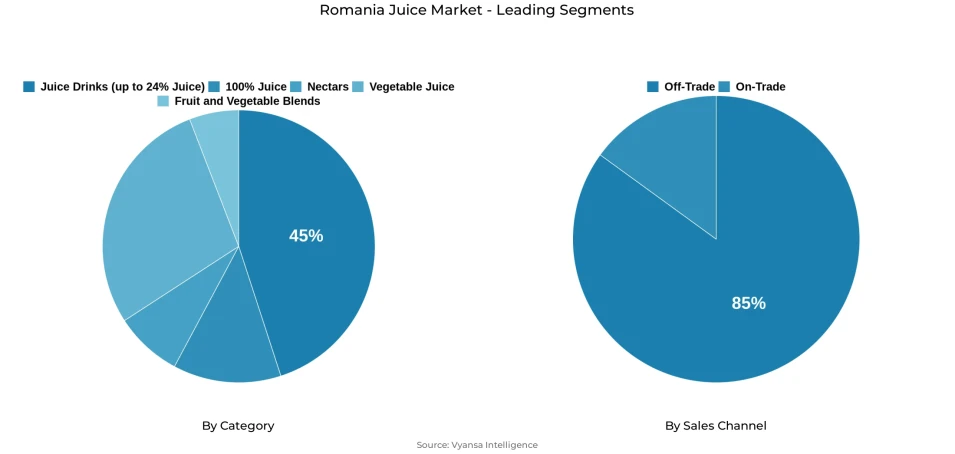
- Juice drinks (up to 24% juice) grabbed market share of 45%.
- Competition
- More than 20 companies are actively engaged in producing juice in Romania.
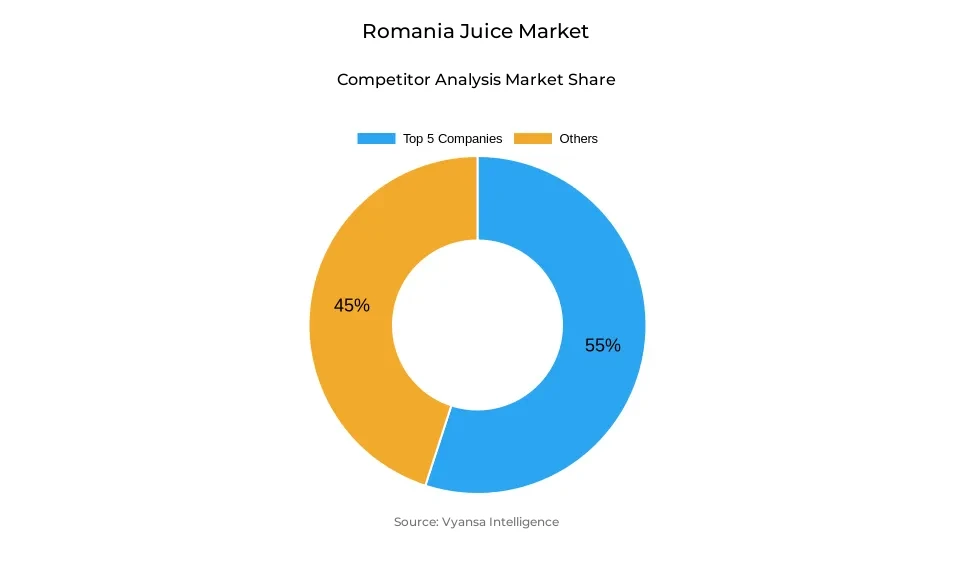
- Top 5 companies acquired around 55% of the market share.
- Cyrom Romania SRL, Carlsrom Beverages Co SRL, Fabrica de Lapte Brasov SA, Coca-Cola HBC Romania SRL, Tymbark-Maspex Romania SRL etc., are few of the top companies.
- Sales Channel
- Off-trade grabbed 85% of the market.
Romania Juice Market Outlook
The Romanian juice market is undergoing a strong growth trend as people are shifting towards less sugary carbonates and more natural and healthy beverages. The market is estimated to grow to USD 495 million in 2025 and USD 625 million in 2032 with a healthy CAGR of approximately 3.39% in the 2026-32 forecast period. This expansion is mostly driven by increasing wellness ambitions and a taxation climate that prefers 100% juices and nectars to highly sweetened products.
There is a major change in category dynamics, whereby the premium and functional products are gaining momentum. Although Juice Drinks (up to 24% Juice) continue to command a 45% market share, they are under attack by not-from-concentrate (NFC) 100% juices, which are considered the gold standard in purity. Innovation is booming, especially in functional lines like SlooP and Tedi, which now focus on the added value of immunity, digestion, and added vitamins to attract health-conscious parents and younger end user.
Tymbark-Maspex Romania dominates the competitive environment, and it retains its leadership by having a well-segmented portfolio and youth-focused marketing. Nevertheless, agile, local, and digital-first entrants are also emerging in the market, using regional sources of fruits and direct-to-end user (D2C) approaches. Sustainability is now a key pillar of operations and large companies like Coca-Cola HBC and Pepsi have invested in automated canning lines and solar energy to counter the increasing production and packaging expenses.
The market is still supported by retail sales, with 85% of the market being taken by Off-Trade channels. Hypermarkets like Kaufland and Carrefour are the pioneers, with large shelf space in family sizes and fresh squeezy-your-own stations. In the meantime, the introduction of the Deposit-Return System has created a new culture of recycling among the Romanians. The most rapidly expanding channel is e-commerce, which allows smaller manufacturers to access shoppers with niche, cold-pressed, and organic products.
Romania Juice Market Growth DriverSugar Tax Differentials Strengthening Juice’s Health-Perceived Positioning Versus Carbonates
Romania end user are increasingly moving out of sugary carbonated soft drinks and into beverages that are seen as more natural and healthier. This increased health awareness makes juice a moderate alternative that provides flavour and perceived nutritional benefits, especially where household budgets are limited. Juice has the advantage of being positioned between highly sweetened carbonated drinks and plain water, thus attracting health-conscious end user who want to have a cheap drink with so-called nutritional benefits.
This substitution pattern is supported by price signals. Romania imposes a non-harmonised excise duty on non-alcoholic beverages containing sugar in 2026 the duty on beverages with 5-8 grams of sugar per 100 ml is 48.4 lei per hectolitre, and the duty on beverages with over 8 grams of sugar per 100 ml is 72.6 lei per hectolitre, as per the Romanian Customs Authority (ANAF). Since carbonated beverages have higher chances of being classified under the taxed category, juice will have a better price-quality offer to end user who want to have healthier options without paying high premiums. This financial system thus establishes positive competitive advantage of the juice categories over the highly taxed carbonated substitutes in the price-sensitive end user market in Romania.
Romania Juice Market ChallengeElevated Inflation and Input Costs Compressing Producer Margins
The producers of juice in Romania are under severe pressure of costs increased taxation, energy and packaging costs, and general inflation raise the cost of production and sales faster than the end user are willing to accept the price rise. This puts a squeeze on profitability and forces brand owners to turn to promotions, portfolio optimisation and tight cost management to maintain competitive positioning. The cost pressures present a consistent margin constraint that restricts investment in innovation and brand-building activities.
Formal inflation statistics validate strain on operating budgets. The National Bank of Romania reported in its August 2025 Inflation Report that the average annual CPI inflation rate was around 5.1% in Q2 2025, and the harmonised inflation rate (HICP) was 5.3% in June 2025; annual CPI inflation was reported at 5.66% in June 2025. Energy, packaging, and transport costs are high in this environment, which limits the ability to pursue price-based growth strategies. Persistent inflation places structural limits on the pricing flexibility and profitability of manufacturers, requiring operational efficiency gains and strategic cost control to maintain market share in the inflationary economic environment of Romania.
Unlock Market Intelligence
Explore the market potential with our data-driven report
Romania Juice Market TrendDeposit-Return System Integration Embedding Recycling into Weekly Purchase Habits
The observable structural changes is the incorporation of recycling in the beverage purchasing behaviour. The Deposit-Return System (DRS) influences the end user behavior end user deposit empty containers to get financial rewards, and the level of sustainability increases with the frequency of going to the grocery store. This behavioural convergence alters the manner in which brands make packaging decisions and sustainability communication policies, making environmental responsibility a viable buying factor instead of an abstract marketing message.
The extent of this behavioural change is evidenced by government reporting. According to the Ministry of Environment of Romania, in March 2025 end user returned more than 348.8 million containers, which is more than 32,100 tonnes of PET bottles, glass bottles, and aluminium cans sent to the recycling facility; it also reported the installation of 192 new reverse-vending machines that month to increase access to collection. This supports the need to recycle packaging and plausible circular-economy assertions throughout the category. The DRS system maintains end user interest in packaging sustainability, making return behaviours a normal part of shopping missions and packaging recyclability a product attribute that is tangible and affects brand choice and end user confidence.
Romania Juice Market OpportunityCircular Packaging Compliance Emerging as a Strategic Brand Differentiator
Sustainability is a fundamental strategic tool brands that redesign their packaging to be circular and back it with plausible arguments earn the confidence of more environmentally conscious end user. This is not limited to marketing, the regulatory environment in Romania increases the environmental responsibility standards, allowing the first movers to convert compliance into brand resources in the 2026-2032 timeframe. Proactive sustainability positioning generates defensible competitive advantages by leading in the environment and aligning with regulations.
Opportunities of proactive players are emphasized by policy targets. Minimum annual DRS return targets are set by a Ministry of Environment justification note at 85% of glass and 90% of plastic and metal by 2026 (with lower targets of 2024-2025). Producers who match packaging design, sourcing of recycled content, and sustainability communication to these formal standards enhance credibility, minimize regulatory risk, and sustain quantifiable and auditable sustainability commitments. Circular packaging excellence helps brands to differentiate based on environmental responsibility, attract eco-conscious end user groups, and position themselves as leaders in the sustainability-oriented regulatory environment in Romania, which contributes to the creation of brand value over the long term.
Unlock Market Intelligence
Explore the market potential with our data-driven report
Romania Juice Market Segmentation Analysis
By Category
- 100% Juice
- Not from Concentrate
- Reconstituted
- Juice Drinks (up to 24% Juice)
- Nectars
- High Concentration (40% to 50% fruit content)
- Medium Concentration (30% to 39% fruit content)
- Low Concentration (25% to 29% fruit content)
- Vegetable Juice
- Fruit and Vegetable Blends
The segment has the highest share around the category in the Romania juice market, where Juice Drinks (up to 24% Juice) grabbed a market share of 45%. This segment maintains its lead due to its accessibility and the wide range of flavors that appeal to a broad end user base, especially value-conscious households. However, its dominance is being gradually challenged by a shift toward more natural alternatives, such as nectars and 100% juices, as end user become more educated about sugar content and nutritional value.
To counter declining interest in low-juice variants, manufacturers are focusing on reformulation and clean-label initiatives. For instance, Tymbark-Maspex has successfully expanded its "0% added sugar" ranges and introduced herbal-infused premium lines to retain health-conscious shoppers. While juice drinks remain the largest volume contributor for now, the future of the segment lies in balancing affordability with the growing demand for functional benefits and minimally processed ingredients.
By Sales Channel
- Off-Trade
- Hypermarkets/ Supermarkets
- Retail Outlets
- Convenience Stores
- Online Platforms
- On-Trade
The segment has the highest share around the Sales Channel is Off-Trade, which grabbed 85% of the market. This channel's dominance is supported by the strong presence of hypermarkets and discounters, which have become the go-to destinations for bulk household purchases and promotional deals. Retailers like Kaufland and Lidl have been instrumental in driving growth by expanding their private-label organic ranges, making healthier juice options more affordable for the average Romanian end user.
While traditional retail leads, the digital landscape is rapidly evolving. E-commerce has emerged as the most dynamic sales channel, particularly for direct-to-end user (D2C) brands like Naturo Juice. Digital platforms not only offer convenience but also allow for better integration of sustainability initiatives, such as collection services for DRS packaging. This shift toward omnichannel retail ensures that both premium functional juices and budget-friendly family packs remain highly accessible across the country.
List of Companies Covered in Romania Juice Market
The companies listed below are highly influential in the Romania juice market, with a significant market share and a strong impact on industry developments.
- Cyrom Romania SRL
- Carlsrom Beverages Co SRL
- Fabrica de Lapte Brasov SA
- Coca-Cola HBC Romania SRL
- Tymbark-Maspex Romania SRL
- Romaqua Group SA
- Quadrant-Amroq Beverages SA
- Parmalat Romania SA
- Carrefour Romania SA
- Lidl Discount SRL
Competitive Landscape
Romania juice market in 2025 is led by Tymbark Maspex Romania, which reinforces leadership through a broad, well segmented portfolio spanning mass, children’s, and premium functional offerings, supported by continuous flavour innovation and strong nationwide distribution. Rauch Romania is the most dynamic challenger, leveraging value positioning via Bravo and Happy Day while benefiting from nectar growth and expanded retail penetration. Private label is intensifying competition, particularly in natural and organic ranges, as retailers such as Mega Image and Lidl expand health oriented assortments. Indirect competition from carbonates is easing due to sugar taxation, strengthening juice’s relative appeal. Key differentiation opportunities lie in not from concentrate premiumisation, functional enrichment, youth focused branding, sustainable packaging aligned with DRS, and agile omnichannel expansion including direct to consumer models.
Frequently Asked Questions
Related Report
- Market Segmentation
- Research Scope
- Research Methodology
- Definitions and Assumptions
- Executive Summary
- Romania Juice Market Policies, Regulations, and Standards
- Romania Juice Market Dynamics
- Growth Factors
- Challenges
- Trends
- Opportunities
- Romania Juice Market Statistics, 2022-2032F
- Market Size & Growth Outlook
- By Revenues in USD Million
- By Quantity Sold in Million Litres
- Market Segmentation & Growth Outlook
- By Category
- 100% Juice- Market Insights and Forecast 2022-2032, USD Million
- Not from Concentrate- Market Insights and Forecast 2022-2032, USD Million
- Reconstituted- Market Insights and Forecast 2022-2032, USD Million
- Juice Drinks (up to 24% Juice)- Market Insights and Forecast 2022-2032, USD Million
- Nectars- Market Insights and Forecast 2022-2032, USD Million
- High Concentration (40% to 50% fruit content)- Market Insights and Forecast 2022-2032, USD Million
- Medium Concentration (30% to 39% fruit content)- Market Insights and Forecast 2022-2032, USD Million
- Low Concentration (25% to 29% fruit content)- Market Insights and Forecast 2022-2032, USD Million
- Vegetable Juice- Market Insights and Forecast 2022-2032, USD Million
- Fruit and Vegetable Blends- Market Insights and Forecast 2022-2032, USD Million
- 100% Juice- Market Insights and Forecast 2022-2032, USD Million
- By Nature
- Conventional- Market Insights and Forecast 2022-2032, USD Million
- Organic- Market Insights and Forecast 2022-2032, USD Million
- By Packaging Material
- Plastic- Market Insights and Forecast 2022-2032, USD Million
- Glass- Market Insights and Forecast 2022-2032, USD Million
- Metal- Market Insights and Forecast 2022-2032, USD Million
- Others- Market Insights and Forecast 2022-2032, USD Million
- By Packaging Type
- PET Bottles- Market Insights and Forecast 2022-2032, USD Million
- Aseptic Packages (Cartons)- Market Insights and Forecast 2022-2032, USD Million
- Glass Bottles- Market Insights and Forecast 2022-2032, USD Million
- Metal Cans- Market Insights and Forecast 2022-2032, USD Million
- Disposable Cups & Pouches- Market Insights and Forecast 2022-2032, USD Million
- By Sales Channel
- Off-Trade- Market Insights and Forecast 2022-2032, USD Million
- Hypermarkets/ Supermarkets - Market Insights and Forecast 2022-2032, USD Million
- Retail Outlets - Market Insights and Forecast 2022-2032, USD Million
- Convenience Stores- Market Insights and Forecast 2022-2032, USD Million
- Online Platforms- Market Insights and Forecast 2022-2032, USD Million
- On-Trade- Market Insights and Forecast 2022-2032, USD Million
- Off-Trade- Market Insights and Forecast 2022-2032, USD Million
- By Competitors
- Competition Characteristics
- Market Share & Analysis
- By Category
- Market Size & Growth Outlook
- Romania 100% Juice Market Statistics, 2022-2032
- Market Size & Growth Outlook
- By Revenues in USD Million
- By Quantity Sold in Million Litres
- Market Segmentation & Growth Outlook
- By Nature- Market Insights and Forecast 2022-2032, USD Million
- By Packaging Material- Market Insights and Forecast 2022-2032, USD Million
- By Packaging Type- Market Insights and Forecast 2022-2032, USD Million
- By Sales Channel- Market Insights and Forecast 2022-2032, USD Million
- Market Size & Growth Outlook
- Romania Juice Drinks (up to 24% Juice) Market Statistics, 2022-2032
- Market Size & Growth Outlook
- By Revenues in USD Million
- By Quantity Sold in Million Litres
- Market Segmentation & Growth Outlook
- By Nature- Market Insights and Forecast 2022-2032, USD Million
- By Packaging Material- Market Insights and Forecast 2022-2032, USD Million
- By Packaging Type- Market Insights and Forecast 2022-2032, USD Million
- By Sales Channel- Market Insights and Forecast 2022-2032, USD Million
- Market Size & Growth Outlook
- Romania Nectars Market Statistics, 2022-2032
- Market Size & Growth Outlook
- By Revenues in USD Million
- By Quantity Sold in Million Litres
- Market Segmentation & Growth Outlook
- By Nature- Market Insights and Forecast 2022-2032, USD Million
- By Packaging Material- Market Insights and Forecast 2022-2032, USD Million
- By Packaging Type- Market Insights and Forecast 2022-2032, USD Million
- By Sales Channel- Market Insights and Forecast 2022-2032, USD Million
- Market Size & Growth Outlook
- Romania Vegetable Juice Market Statistics, 2022-2032
- Market Size & Growth Outlook
- By Revenues in USD Million
- By Quantity Sold in Million Litres
- Market Segmentation & Growth Outlook
- By Nature- Market Insights and Forecast 2022-2032, USD Million
- By Packaging Material- Market Insights and Forecast 2022-2032, USD Million
- By Packaging Type- Market Insights and Forecast 2022-2032, USD Million
- By Sales Channel- Market Insights and Forecast 2022-2032, USD Million
- Market Size & Growth Outlook
- Romania Fruit and Vegetable Blends Market Statistics, 2022-2032
- Market Size & Growth Outlook
- By Revenues in USD Million
- By Quantity Sold in Million Litres
- Market Segmentation & Growth Outlook
- By Nature- Market Insights and Forecast 2022-2032, USD Million
- By Packaging Material- Market Insights and Forecast 2022-2032, USD Million
- By Packaging Type- Market Insights and Forecast 2022-2032, USD Million
- By Sales Channel- Market Insights and Forecast 2022-2032, USD Million
- Market Size & Growth Outlook
- Competitive Outlook
- Company Profiles
- Coca-Cola HBC Romania SRL
- Business Description
- Product Portfolio
- Collaborations & Alliances
- Recent Developments
- Financial Details
- Others
- Tymbark-Maspex Romania SRL
- Business Description
- Product Portfolio
- Collaborations & Alliances
- Recent Developments
- Financial Details
- Others
- Romaqua Group SA
- Business Description
- Product Portfolio
- Collaborations & Alliances
- Recent Developments
- Financial Details
- Others
- Quadrant-Amroq Beverages SA
- Business Description
- Product Portfolio
- Collaborations & Alliances
- Recent Developments
- Financial Details
- Others
- Parmalat Romania SA
- Business Description
- Product Portfolio
- Collaborations & Alliances
- Recent Developments
- Financial Details
- Others
- Cyrom Romania SRL
- Business Description
- Product Portfolio
- Collaborations & Alliances
- Recent Developments
- Financial Details
- Others
- Carlsrom Beverages Co SRL
- Business Description
- Product Portfolio
- Collaborations & Alliances
- Recent Developments
- Financial Details
- Others
- Fabrica de Lapte Brasov SA
- Business Description
- Product Portfolio
- Collaborations & Alliances
- Recent Developments
- Financial Details
- Others
- Carrefour Romania SA
- Business Description
- Product Portfolio
- Collaborations & Alliances
- Recent Developments
- Financial Details
- Others
- Lidl Discount SRL
- Business Description
- Product Portfolio
- Collaborations & Alliances
- Recent Developments
- Financial Details
- Others
- Coca-Cola HBC Romania SRL
- Company Profiles
- Disclaimer
| Segment | Sub-Segment |
|---|---|
| By Category |
|
| By Nature |
|
| By Packaging Material |
|
| By Packaging Type |
|
| By Sales Channel |
|
Research Methodology
This study followed a structured approach comprising four key phases to assess the size and scope of the electro-oxidation market. The process began with thorough secondary research to collect data on the target market, related markets, and broader industry context. These findings, along with preliminary assumptions and estimates, were then validated through extensive primary research involving industry experts from across the value chain. To calculate the overall market size, both top-down and bottom-up methodologies were employed. Finally, market segmentation and data triangulation techniques were applied to refine and validate segment-level estimations.
Secondary Research
The secondary research phase involved gathering data from a wide range of credible and published sources. This step helped in identifying industry trends, defining market segmentation, and understanding the market landscape and value chain.
Sources consulted during this phase included:
- Company annual reports, investor presentations, and press releases
- Industry white papers and certified publications
- Trade directories and market-recognized databases
- Articles from authoritative authors and reputable journals
- Gold and silver standard websites
Secondary research was critical in mapping out the industry's value chain and monetary flow, identifying key market segments, understanding regional variations, and tracking significant industry developments.
Other key sources:
- Financial disclosures
- Industry associations and trade bodies
- News outlets and business magazines
- Academic journals and research studies
- Paid industry databases
Primary Research
To validate secondary data and gain deeper market insights, primary research was conducted with key stakeholders across both the supply and demand sides of the market.
On the demand side, participants included decision-makers and influencers from end-user industries—such as CIOs, CTOs, and CSOs—who provided first-hand perspectives on market needs, product usage, and future expectations.
On the supply side, interviews were conducted with manufacturers, industry associations, and institutional participants to gather insights into current offerings, product pipelines, and market challenges.
Primary interviews provided critical inputs such as:
- Market size and revenue data
- Product and service breakdowns
- Market forecasts
- Regional and application-specific trends
Stakeholders consulted included:
- Leading OEM and solution providers
- Channel and distribution partners
- End users across various applications
- Independent consultants and industry specialists
Market Size Estimation and Data Triangulation
- Identifying Key Market Participants (Secondary Research)
- Goal: To identify the major players or companies in the target market. This typically involves using publicly available data sources such as industry reports, market research publications, and financial statements of companies.
- Tools: Reports from firms like Gartner, Forrester, Euromonitor, Statista, IBISWorld, and others. Public financial statements, news articles, and press releases from top market players.
- Extracting Earnings of Key Market Participants
- Goal: To estimate the earnings generated from the product or service being analyzed. This step helps in understanding the revenue potential of each market player in a specific geography.
- Methods: Earnings data can be gathered from:
- Publicly available financial reports (for listed companies).
- Interviews and primary data sources from professionals, such as Directors, VPs, SVPs, etc. This is especially useful for understanding more nuanced, internal data that isn't publicly disclosed.
- Annual reports and investor presentations of key players.
- Data Collation and Development of a Relevant Data Model
- Goal: To collate inputs from both primary and secondary sources into a structured, data-driven model for market estimation. This model will incorporate key market KPIs and any independent variables relevant to the market.
- Key KPIs: These could include:
- Market size, growth rate, and demand drivers.
- Industry-specific metrics like market share, average revenue per customer (ARPC), or average deal size.
- External variables, such as economic growth rates, inflation rates, or commodity prices, that could affect the market.
- Data Modeling: Based on this data, the market forecasts are developed for the next 5 years. A combination of trend analysis, scenario modeling, and statistical regression might be used to generate projections.
- Scenario Analysis
- Goal: To test different assumptions and validate how sensitive the market is to changes in key variables (e.g., market demand, regulatory changes, technological disruptions).
- Types of Scenarios:
- Base Case: Based on current assumptions and historical data.
- Best-Case Scenario: Assuming favorable market conditions, regulatory environments, and technological advancements.
- Worst-Case Scenario: Accounting for adverse factors, such as economic downturns, stricter regulations, or unexpected disruptions.












