Qatar Camel Milk Market Report: Trends, Growth and Forecast (2026-2032)
By Physical Form (Liquid Camel Milk, Camel Milk Powder, Concentrated/Condensed Camel Milk), By Processing Method (Raw/Unprocessed, Pasteurized, Ultra-High Temperature (UHT), Retort Processing, Fermented/Cultured), By Product Type (Plain/Natural, Flavoured, Fortified/Functional Variants), By Derivative Products (Fermented Camel Milk Products, Camel Milk Cheese, Camel Milk Ice Cream/Frozen Desserts, Camel Milk Powder (Consumer & Industrial Grade)), By Fat Content (Whole/Full-Fat, Reduced-Fat, Skim/Non-Fat), By Packaging Format (Aseptic Cartons, Bottles (Glass/PET/HDPE), Pouches/Sachets, Cans/Tins, Bulk Packaging (Drums, IBCs, Bag-in-Box)), By Sales Channel (Supermarkets/Hypermarkets, Convenience Stores, Specialty/Health Stores, Online Retail/Direct-to-Consumer, Foodservice, B2B Ingredient Supply), By End User (Household/Retail Consumers, Food & Beverage Manufacturers, Institutional/Specialty Nutrition Buyers), By Application (Food & Beverages, Nutrition & Nutraceuticals, Cosmetics & Personal Care, Pharmaceuticals, Others) ... Read more
|
Major Players
|
Qatar Camel Milk Market Statistics and Insights, 2026
- Market Size Statistics
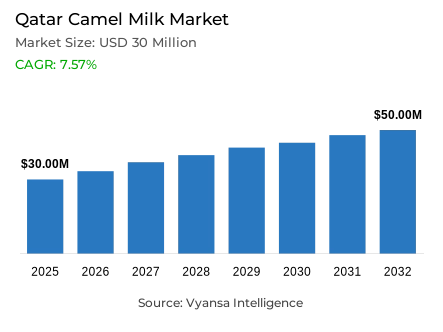
- Camel milk market size in Qatar was estimated at USD 30 million in 2025.
- The market size is expected to grow to USD 50 million by 2032.
- Market to register a CAGR of around 7.57% during 2026-32.
- Physical Form Shares
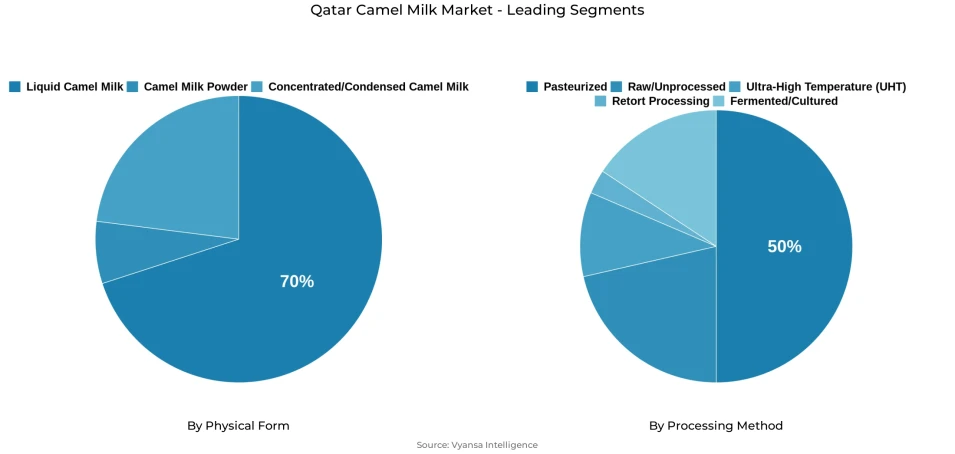
- Liquid camel milk grabbed market share of 70%.
- Competition
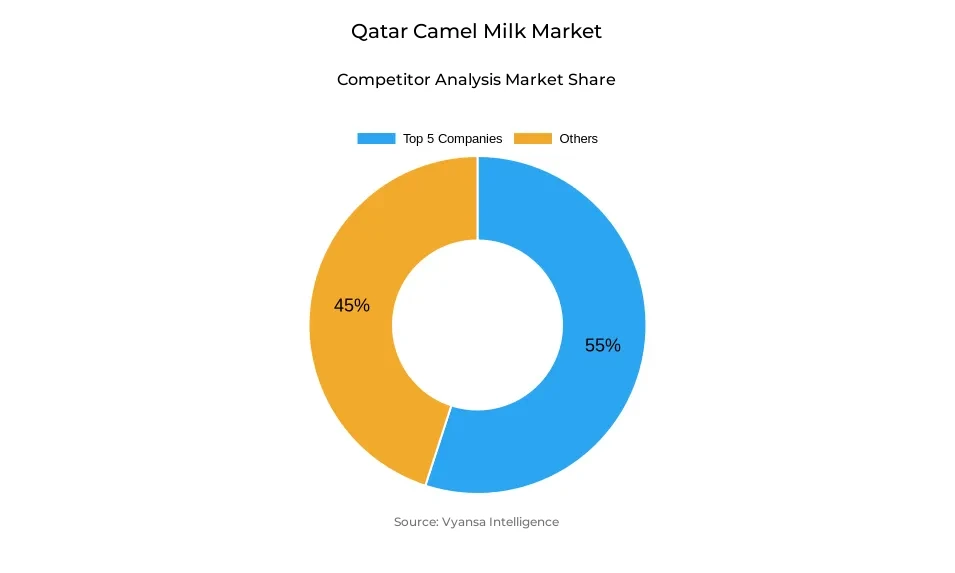
- Camel milk in Qatar is currently being catered to by more than 5 companies.
- Top 5 companies acquired around 55% of the market share.
- DromeDairy, Milk-Camel.com, Desert Farms, Camelicious, Al Ain Farms (Camelait) etc., are few of the top companies.
- Processing Method
- Pasteurized grabbed 50% of the market.
Qatar Camel Milk Market Outlook
The Qatar camel milk market size was valued at USD 30 million in 2025 and is projected to grow from USD 34.29 million in 2026 to USD 50 million by 2032, exhibiting a CAGR of 7.57% during the forecast period. Growth is mainly supported by rising awareness about preventive health and nutrition in the country. Increasing cases of noncommunicable diseases such as diabetes and cardiovascular conditions have encouraged people to focus more on everyday dietary choices that support long-term wellness. This shift toward healthier food options is expected to steadily support demand for naturally nutritious dairy alternatives in the coming years.
Growing health awareness is encouraging consumers to explore functional and natural food products, which is strengthening interest in camel milk across households and premium retail outlets. Many consumers consider it a nutrient-rich dairy option that fits well with wellness-oriented lifestyles. At the same time, the expansion of tourism and hospitality sectors is creating additional consumption channels through hotels, cafés, and airport retail outlets where locally produced specialty foods receive strong visibility and consumer attention.
Industry exhibitions and agri-food platforms are also helping improve product recognition and awareness. Events such as AgriteQ bring together producers, retailers, and hospitality businesses, allowing companies to showcase camel milk through sampling, demonstrations, and brand engagement. These platforms help build credibility for niche dairy categories and support wider consumer familiarity, which can gradually move the product from a niche offering toward broader adoption in Qatar’s evolving food ecosystem.
From a product perspective, liquid formats dominate industry sales, with Liquid Camel Milk accounting for nearly 70% share due to its convenience and compatibility with daily consumption habits. In terms of processing methods, Pasteurized Camel Milk holds about 50% share as it balances product freshness with food safety requirements and supports organized retail distribution systems. However, strict shelf-life regulations for dairy products in Qatar continue to create operational challenges, requiring efficient cold-chain logistics and faster retail turnover to maintain product quality and availability.
Qatar Camel Milk Market Growth DriverHealth-Oriented Dietary Awareness Supporting Demand
Increasing awareness about the management of daily health is becoming one of the key factors affecting the demand in the Qatar camel milk market. According to WHO EMRO (September 2025), non-communicable diseases, such as diabetes, cardiovascular disease, cancers, and chronic respiratory disease, contribute to nearly 72% of all deaths in Qatar. This has ensured that preventive nutrition has remained an integral part of the overall conversation in the country, thereby prompting end users to develop dietary habits that promote overall well-being. This has led the food and beverage landscape to increasingly shift toward products associated with natural ingredients and functional benefits.
In this context, camel milk is gaining recognition as a dairy option aligned with the country’s growing health and wellness consumption patterns. As the overall disease dynamics in the country continue to pose challenges, the overall demand for daily foods that are recognized for their ability to support better lifestyle management is prompting the overall acceptability of the product in the country. This shift is increasing the acceptance of camel milk across households, premium retail channels, and health-oriented purchase occasions in Qatar.
Qatar Camel Milk Market ChallengeStrict Shelf-Life Regulations Creating Distribution Hindering Market Growth
One of the key constraints affecting the overall operations in the Qatar camel milk market is the overall shelf-life framework for the storage of dairy products in the country. As per the regulations of the Ministry of Public Health in the country, the overall storage of certain types of dairy products in the country should be within the overall 10-day window for the storage of laban and drinks. In the context of the overall heat-treated fermented products, the overall storage should be within the 21-day window, while the overall storage of other types of dairy products should be within the 14-day window.
In the context of camel milk producers and distributors, the regulatory limits would further complicate the efficient movement of the product from the production stage to the retail outlets. Camel milk is usually sold as a chilled product that requires utmost freshness, which in turn requires efficient logistics in the cold chain movement of the product and quick product turnover in the retail outlets. Therefore, even if the demand for the product increases from the end consumers, the discipline in operations and logistics efficiency would continue to act as barriers in the expansion of the product in the Qatar market.
Unlock Market Intelligence
Explore the market potential with our data-driven report
Qatar Camel Milk Market TrendExpanding Agri-Food Platforms Increasing Product Visibility
One of the trends in the Qatar camel milk market is the awareness of premium and locally made foodstuffs, which has come into focus with the conduct of large-scale agri-food exhibitions and platforms. Exhibitions like AgriteQ have grown significantly in size and scope, which provide an ecosystem for the exhibition of agricultural innovations, food technologies, and premium foodstuffs. According to the Ministry of Municipality, the recently concluded AgriteQ exhibition in 2025 was the largest in the history of the exhibition, which had more than 300 exhibitors from more than 29 countries and more than 97,000 visitors, in addition to more than 50 forums and workshops.
These platforms are significant in the development of awareness and recognition for the market of niche dairy products such as camel milk. Premium dairy products often require strong educational and promotional engagement, including product demonstrations, sampling, and brand storytelling. Large industry exhibitions are beneficial to the producers, as they are able to engage with retailers, hospitality businesses, distributors, and end-users, thus promoting the product. The more these exhibitions grow in terms of scale and number of participants, the more the product will benefit in terms of recognition, moving it from a niche position in the dairy market to a more recognized product in Qatar’s evolving food market.
Qatar Camel Milk Market OpportunityExpanding Tourism and Trade Connectivity
Significantly, Qatar has strong international connectivity, including tourism access, which represents a strong opportunity for the Qatar camel milk market. This is because, according to the Ministry of Commerce and Industry, Qatar has direct air and sea routes to more than 180 markets, while it offers visa-free access to nationals of more than 100 countries. This represents a strong opportunity for Qatar to become a hub for international trade, tourism, hospitality, and business, which would open new avenues for premium food products that would benefit from international exposure.
Significantly, the camel milk market would benefit from these new avenues of international exposure, including new opportunities in the hospitality, tourism, and international business sectors. This is because premium hotels, cafes, stores, etc., are increasingly using Qatar-sourced products to attract international tourists to Qatar, especially food products that are authentic to Qatar. This would provide a strong opportunity to market camel milk, which would be perceived as a local product, especially to tourists who would be interested in consuming local products that are authentic to Qatar.
Unlock Market Intelligence
Explore the market potential with our data-driven report
Qatar Camel Milk Market Segmentation Analysis
By Physical Form
- Liquid Camel Milk
- Camel Milk Powder
- Concentrated/Condensed Camel Milk
The Liquid camel milk segment is the leading segment in the Qatar camel milk market under the Physical Form category, covering a significant portion of the market share at around 70%. This is because the liquid dairy products category is highly preferred in the country’s dietary pattern. The Liquid Camel Milk is highly compatible with the country’s regular consumption pattern. This is because the product is directly consumed without any need for preparation, making it highly compatible with the country’s regular consumption pattern. This is why the Liquid Camel Milk is the most purchased product in the country’s camel milk market.
The high performance of the Liquid Camel Milk is also attributed to the fact that the product is highly compatible with the country’s retail outlets and food outlets. Liquid camel milk can be easily placed alongside conventional dairy beverages in refrigerated retail shelves, improving product visibility and accessibility. This is why the Liquid Camel Milk is the leading product in the country’s camel milk market, making the liquid dairy products category the leading category in the country’s camel milk market.
By Processing Method
- Raw/Unprocessed
- Pasteurized
- Ultra-High Temperature (UHT)
- Retort Processing
- Fermented/Cultured
Under the Processing Method category, the leading segment in the Qatar camel milk market is the Pasteurized Camel Milk, covering a significant portion of the market share at around 50%. Pasteurization provides a controlled processing approach that eliminates harmful microorganisms while maintaining much of the milk’s natural characteristics. This is why the method is the leading category in the country’s camel milk market, given the fact that the method is highly compatible with the country’s safety standards for the production of dairy products.As a result, the method supports end-user confidence and aligns with regulatory requirements for dairy safety in Qatar.
Another factor that contributed to the supremacy of pasteurized camel milk is the fact that it is compatible with the organized retail system. For instance, the organized retail system, particularly the supermarkets and the new retail system in the dairy sector, tend to favor products that are able to maintain quality consistency and a predictable shelf life, and at the same time are able to provide a fresh milk image. In this regard, pasteurized camel milk is able to achieve this in a perfect way, and this contributed to its supremacy in the sector.
List of Companies Covered in Qatar Camel Milk Market
The companies listed below are highly influential in the Qatar camel milk market, with a significant market share and a strong impact on industry developments.
- DromeDairy
- Milk-Camel.com
- Desert Farms
- Camelicious
- Al Ain Farms (Camelait)
- Baladna
- Noug
- Aadvik Foods
Market News & Updates
- Baladna, 2026:
Baladna’s most significant verified update is its 11 February 2026 release of full-year 2025 results, which showed net profit rising to QR 538.8 million from QR 185.3 million in 2024, while its investor-relations page continues to position Baladna Food Industries as Qatar’s largest dairy and beverage producer supplying over 85% of the country’s fresh milk; in market terms, that combination of financial strength and dominant chilled-dairy scale increases Baladna’s ability to defend shelf space, fund route-to-market and cold-chain expansion, and shape pricing and consumer attention across adjacent premium-milk niches, including camel milk, inside Qatar.
- Milk-Camel.com, 2026:
The strongest current official signal from Milk-Camel.com is its live commercial disclosure showing Doha-based operations, camel milk sourced from select farms in Qatar, 6,000+ clients, direct customer support, wholesale inquiry capability, and international shipping to select countries; although this is not a dated 2026 press release, it still matters for the Qatar camel milk market because it shows a locally rooted specialist actively formalizing direct-to-consumer and potential B2B channels, which supports category visibility, consumer access, and premium positioning in a niche market where large-scale corporate announcements remain limited.
Frequently Asked Questions
Related Report
- Market Segmentation
- Research Scope
- Research Methodology
- Definitions and Assumptions
- Executive Summary
- Qatar Camel Milk Market Policies, Regulations, and Standards
- Qatar Camel Milk Market Dynamics
- Growth Factors
- Challenges
- Trends
- Opportunities
- Qatar Camel Milk Market Statistics, 2022-2032F
- Market Size & Growth Outlook
- By Revenues in USD Million
- By Volume (Million Liters)
- Market Segmentation & Growth Outlook
- By Physical Form
- Liquid Camel Milk- Market Insights and Forecast 2022-2032, USD Million
- Camel Milk Powder- Market Insights and Forecast 2022-2032, USD Million
- Concentrated/Condensed Camel Milk- Market Insights and Forecast 2022-2032, USD Million
- By Processing Method
- Raw/Unprocessed- Market Insights and Forecast 2022-2032, USD Million
- Pasteurized- Market Insights and Forecast 2022-2032, USD Million
- Ultra-High Temperature (UHT)- Market Insights and Forecast 2022-2032, USD Million
- Retort Processing- Market Insights and Forecast 2022-2032, USD Million
- Fermented/Cultured- Market Insights and Forecast 2022-2032, USD Million
- By Product Type
- Plain/Natural- Market Insights and Forecast 2022-2032, USD Million
- Flavoured- Market Insights and Forecast 2022-2032, USD Million
- Fortified/Functional Variants- Market Insights and Forecast 2022-2032, USD Million
- By Derivative Products
- Fermented Camel Milk Products- Market Insights and Forecast 2022-2032, USD Million
- Camel Milk Cheese- Market Insights and Forecast 2022-2032, USD Million
- Camel Milk Ice Cream/Frozen Desserts- Market Insights and Forecast 2022-2032, USD Million
- Camel Milk Powder (Consumer & Industrial Grade)- Market Insights and Forecast 2022-2032, USD Million
- By Fat Content
- Whole/Full-Fat- Market Insights and Forecast 2022-2032, USD Million
- Reduced-Fat- Market Insights and Forecast 2022-2032, USD Million
- Skim/Non-Fat- Market Insights and Forecast 2022-2032, USD Million
- By Packaging Format
- Aseptic Cartons- Market Insights and Forecast 2022-2032, USD Million
- Bottles (Glass/PET/HDPE)- Market Insights and Forecast 2022-2032, USD Million
- Pouches/Sachets- Market Insights and Forecast 2022-2032, USD Million
- Cans/Tins- Market Insights and Forecast 2022-2032, USD Million
- Bulk Packaging (Drums, IBCs, Bag-in-Box)- Market Insights and Forecast 2022-2032, USD Million
- By Sales Channel
- Supermarkets/Hypermarkets- Market Insights and Forecast 2022-2032, USD Million
- Convenience Stores- Market Insights and Forecast 2022-2032, USD Million
- Specialty/Health Stores- Market Insights and Forecast 2022-2032, USD Million
- Online Retail/Direct-to-Consumer- Market Insights and Forecast 2022-2032, USD Million
- Foodservice- Market Insights and Forecast 2022-2032, USD Million
- B2B Ingredient Supply- Market Insights and Forecast 2022-2032, USD Million
- By End User
- Household/Retail Consumers- Market Insights and Forecast 2022-2032, USD Million
- Food & Beverage Manufacturers- Market Insights and Forecast 2022-2032, USD Million
- Institutional/Specialty Nutrition Buyers- Market Insights and Forecast 2022-2032, USD Million
- By Application
- Food & Beverages- Market Insights and Forecast 2022-2032, USD Million
- Nutrition & Nutraceuticals- Market Insights and Forecast 2022-2032, USD Million
- Cosmetics & Personal Care- Market Insights and Forecast 2022-2032, USD Million
- Pharmaceuticals- Market Insights and Forecast 2022-2032, USD Million
- Others- Market Insights and Forecast 2022-2032, USD Million
- By Competitors
- Competition Characteristics
- Market Share & Analysis
- By Physical Form
- Market Size & Growth Outlook
- Qatar Liquid Camel Milk Market Statistics, 2022-2032
- Market Size & Growth Outlook
- By Revenues in USD Million
- By Volume (Million Liters)
- Market Segmentation & Growth Outlook
- By Processing Method- Market Insights and Forecast 2022-2032, USD Million
- By Product Type- Market Insights and Forecast 2022-2032, USD Million
- By Derivative Products- Market Insights and Forecast 2022-2032, USD Million
- By Fat Content- Market Insights and Forecast 2022-2032, USD Million
- By Packaging Format- Market Insights and Forecast 2022-2032, USD Million
- By Sales Channel- Market Insights and Forecast 2022-2032, USD Million
- By End User- Market Insights and Forecast 2022-2032, USD Million
- By Application- Market Insights and Forecast 2022-2032, USD Million
- Market Size & Growth Outlook
- Qatar Camel Milk Powder Market Statistics, 2022-2032
- Market Size & Growth Outlook
- By Revenues in USD Million
- By Volume (Million Liters)
- Market Segmentation & Growth Outlook
- By Processing Method- Market Insights and Forecast 2022-2032, USD Million
- By Product Type- Market Insights and Forecast 2022-2032, USD Million
- By Derivative Products- Market Insights and Forecast 2022-2032, USD Million
- By Fat Content- Market Insights and Forecast 2022-2032, USD Million
- By Packaging Format- Market Insights and Forecast 2022-2032, USD Million
- By Sales Channel- Market Insights and Forecast 2022-2032, USD Million
- By End User- Market Insights and Forecast 2022-2032, USD Million
- By Application- Market Insights and Forecast 2022-2032, USD Million
- Market Size & Growth Outlook
- Qatar Concentrated/Condensed Camel Milk Market Statistics, 2022-2032
- Market Size & Growth Outlook
- By Revenues in USD Million
- By Volume (Million Liters)
- Market Segmentation & Growth Outlook
- By Processing Method- Market Insights and Forecast 2022-2032, USD Million
- By Product Type- Market Insights and Forecast 2022-2032, USD Million
- By Derivative Products- Market Insights and Forecast 2022-2032, USD Million
- By Fat Content- Market Insights and Forecast 2022-2032, USD Million
- By Packaging Format- Market Insights and Forecast 2022-2032, USD Million
- By Sales Channel- Market Insights and Forecast 2022-2032, USD Million
- By End User- Market Insights and Forecast 2022-2032, USD Million
- By Application- Market Insights and Forecast 2022-2032, USD Million
- Market Size & Growth Outlook
- Competitive Outlook
- Company Profiles
- Camelicious
- Business Description
- Product Portfolio
- Collaborations & Alliances
- Recent Developments
- Financial Details
- Others
- Al Ain Farms (Camelait)
- Business Description
- Product Portfolio
- Collaborations & Alliances
- Recent Developments
- Financial Details
- Others
- Baladna
- Business Description
- Product Portfolio
- Collaborations & Alliances
- Recent Developments
- Financial Details
- Others
- Noug
- Business Description
- Product Portfolio
- Collaborations & Alliances
- Recent Developments
- Financial Details
- Others
- Aadvik Foods
- Business Description
- Product Portfolio
- Collaborations & Alliances
- Recent Developments
- Financial Details
- Others
- DromeDairy
- Business Description
- Product Portfolio
- Collaborations & Alliances
- Recent Developments
- Financial Details
- Others
- Milk-Camel.com
- Business Description
- Product Portfolio
- Collaborations & Alliances
- Recent Developments
- Financial Details
- Others
- Desert Farms
- Business Description
- Product Portfolio
- Collaborations & Alliances
- Recent Developments
- Financial Details
- Others
- Others
- Business Description
- Product Portfolio
- Collaborations & Alliances
- Recent Developments
- Financial Details
- Others
- Camelicious
- Company Profiles
- Disclaimer
| Segment | Sub-Segment |
|---|---|
| By Physical Form |
|
| By Processing Method |
|
| By Product Type |
|
| By Derivative Products |
|
| By Fat Content |
|
| By Packaging Format |
|
| By Sales Channel |
|
| By End User |
|
| By Application |
|
Research Methodology
This study followed a structured approach comprising four key phases to assess the size and scope of the electro-oxidation market. The process began with thorough secondary research to collect data on the target market, related markets, and broader industry context. These findings, along with preliminary assumptions and estimates, were then validated through extensive primary research involving industry experts from across the value chain. To calculate the overall market size, both top-down and bottom-up methodologies were employed. Finally, market segmentation and data triangulation techniques were applied to refine and validate segment-level estimations.
Secondary Research
The secondary research phase involved gathering data from a wide range of credible and published sources. This step helped in identifying industry trends, defining market segmentation, and understanding the market landscape and value chain.
Sources consulted during this phase included:
- Company annual reports, investor presentations, and press releases
- Industry white papers and certified publications
- Trade directories and market-recognized databases
- Articles from authoritative authors and reputable journals
- Gold and silver standard websites
Secondary research was critical in mapping out the industry's value chain and monetary flow, identifying key market segments, understanding regional variations, and tracking significant industry developments.
Other key sources:
- Financial disclosures
- Industry associations and trade bodies
- News outlets and business magazines
- Academic journals and research studies
- Paid industry databases
Primary Research
To validate secondary data and gain deeper market insights, primary research was conducted with key stakeholders across both the supply and demand sides of the market.
On the demand side, participants included decision-makers and influencers from end-user industries—such as CIOs, CTOs, and CSOs—who provided first-hand perspectives on market needs, product usage, and future expectations.
On the supply side, interviews were conducted with manufacturers, industry associations, and institutional participants to gather insights into current offerings, product pipelines, and market challenges.
Primary interviews provided critical inputs such as:
- Market size and revenue data
- Product and service breakdowns
- Market forecasts
- Regional and application-specific trends
Stakeholders consulted included:
- Leading OEM and solution providers
- Channel and distribution partners
- End users across various applications
- Independent consultants and industry specialists
Market Size Estimation and Data Triangulation
- Identifying Key Market Participants (Secondary Research)
- Goal: To identify the major players or companies in the target market. This typically involves using publicly available data sources such as industry reports, market research publications, and financial statements of companies.
- Tools: Reports from firms like Gartner, Forrester, Euromonitor, Statista, IBISWorld, and others. Public financial statements, news articles, and press releases from top market players.
- Extracting Earnings of Key Market Participants
- Goal: To estimate the earnings generated from the product or service being analyzed. This step helps in understanding the revenue potential of each market player in a specific geography.
- Methods: Earnings data can be gathered from:
- Publicly available financial reports (for listed companies).
- Interviews and primary data sources from professionals, such as Directors, VPs, SVPs, etc. This is especially useful for understanding more nuanced, internal data that isn't publicly disclosed.
- Annual reports and investor presentations of key players.
- Data Collation and Development of a Relevant Data Model
- Goal: To collate inputs from both primary and secondary sources into a structured, data-driven model for market estimation. This model will incorporate key market KPIs and any independent variables relevant to the market.
- Key KPIs: These could include:
- Market size, growth rate, and demand drivers.
- Industry-specific metrics like market share, average revenue per customer (ARPC), or average deal size.
- External variables, such as economic growth rates, inflation rates, or commodity prices, that could affect the market.
- Data Modeling: Based on this data, the market forecasts are developed for the next 5 years. A combination of trend analysis, scenario modeling, and statistical regression might be used to generate projections.
- Scenario Analysis
- Goal: To test different assumptions and validate how sensitive the market is to changes in key variables (e.g., market demand, regulatory changes, technological disruptions).
- Types of Scenarios:
- Base Case: Based on current assumptions and historical data.
- Best-Case Scenario: Assuming favorable market conditions, regulatory environments, and technological advancements.
- Worst-Case Scenario: Accounting for adverse factors, such as economic downturns, stricter regulations, or unexpected disruptions.












