Portugal Juice Market Report: Trends, Growth and Forecast (2026-2032)
By Category (100% Juice (Not from Concentrate, Reconstituted), Juice Drinks (up to 24% Juice), Nectars (High Concentration (40% to 50% fruit content), Medium Concentration (30% to 39% fruit content), Low Concentration (25% to 29% fruit content)), Vegetable Juice, Fruit and Vegetable Blends), By Nature (Conventional, Organic), By Packaging Material (Plastic, Glass, Metal, Others), By Packaging Type (PET Bottles, Aseptic Packages (Cartons), Glass Bottles, Metal Cans, Disposable Cups & Pouches), By Sales Channel (Off-Trade (Hypermarkets/ Supermarkets, Retail Outlets, Convenience Stores, Online Platforms), On-Trade) ... Read more

|
Major Players
|
Portugal Juice Market Statistics and Insights, 2026
- Market Size Statistics
- Juice market size in Portugal was estimated at USD 335 million in 2025.
- The market size is expected to grow to USD 360 million by 2032.
- Market to register a CAGR of around 1.03% during 2026-32.
- Category Shares
- Nectars grabbed market share of 55%.
- Competition
- More than 10 companies are actively engaged in producing juice in Portugal.
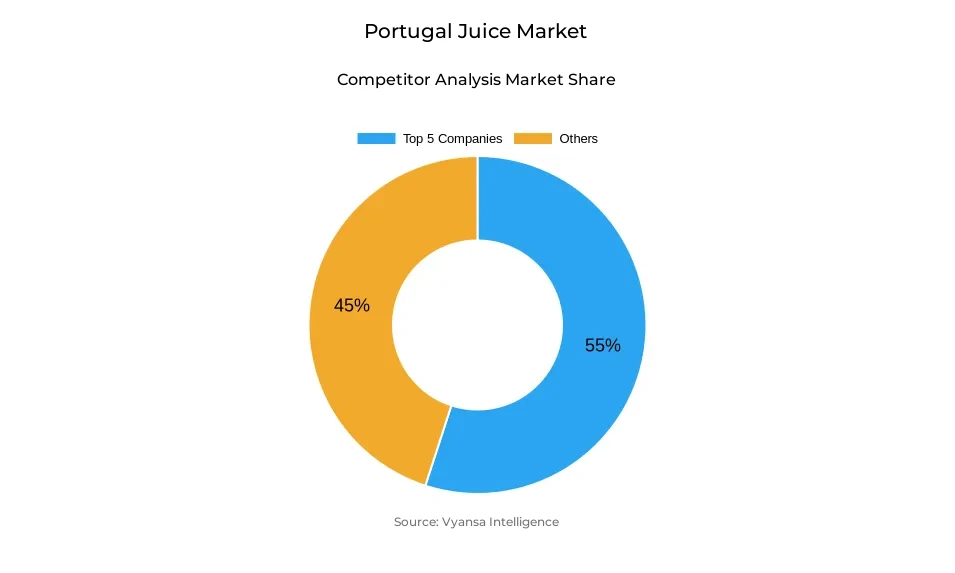
- Top 5 companies acquired around 55% of the market share.
- Ceres Fruit Juices (Pty) Ltd, GL Importacao e Exportacao SA, Tyrus SA, Sumol+Compal Distribuicao SA, Orangina Schweppes Portugal SA etc., are few of the top companies.
- Sales Channel
- Off-trade grabbed 70% of the market.
Portugal Juice Market Outlook
The Portugal juice market is now in a phase of great recalibration as end user weigh up budget sensitivity and a growing need of high-end, health-conscious products. The market is estimated to grow to USD 335 million in 2025 and to USD 360 million in 2032 with a CAGR of about 1.03% in the forecast period 2026-32. Despite the decrease in volume due to increasing prices, the value growth has been stable with shoppers becoming more focused on quality rather than quantity.
end user behaviour is moving towards personalisation and functional wellness. Instead of buying large packs of juices to serve the whole family, Portuguese end user are buying specialised juices that address certain needs like immunity, gut health, and energy. This logical buying strategy is creating a high demand of natural products that do not contain added sugar. Nectars still lead the category with a 55% market share, although the introduction of new textures and formats, including the new smoothie concepts, is changing the landscape.
Market leaders like Sumol + Compal have become dependent on sustainability and digital efficiency. The sector is quickly shifting to plastic-free alternatives, and there is a high focus on reusable glass and FSC-certified carton boxes. Also, the obligatory Deposit and Refund System (SDR), which will be in effect since January 2026, will radically alter the recycling behavior, although there will be a certain time when end user will have to adapt to the new extra expenses and the process of returns.
Traditional retail still controls sales, with Off-Trade channels taking 70% of the market. The main centers of juice sales are still the supermarkets like Continente, PingoDoce, and the fast-developing Mercadona because of their intensive weekly promotions. However, e-commerce is becoming the most rapidly expanding channel, which provides end user with an easy means of price comparison and household budgeting without the need to make the unnecessary purchases that are commonly caused by visiting the store.
Portugal Juice Market Growth DriverWellness-Oriented Premium Preferences Sustaining Functional Juice Demand
Portugal end user are increasingly buying fruit juice to meet certain health needs, as opposed to considering it a household commodity. This pattern continues to drive demand of natural and functional varieties, such as those that are positioned on immunity support, energy boosting, and gut-health benefits, despite buyers reducing their expenditure by buying smaller packages and fewer units. The resulting health-conscious consumption trends create favourable opportunities to high-end, functionally oriented juice formulations that satisfy desired wellness requirements, despite the economic limitations that limit the growth of the total volume.
Wellness priorities and this premium, functional shift are reinforced by public-health risk factors. According to OECD Health at a Glance 2025, 56% of adults in Portugal do not participate in physical activity enough, and the prevalence of self-reported obesity is 16%. These circumstances increase the demand of products that are viewed to be healthier and less added sugar, which keeps innovation relevant. The intersection of health consciousness and demands of functional nutrition creates a structural need of high-end juice that is framed around particular wellness advantages, allowing brands to capture value by targeting functional propositions, despite limited household budgets and lower purchase rates.
Portugal Juice Market ChallengeFood Inflation Intensifying Downtrading and Frequency Reduction
The volumes of juices are under pressure because households consider the category as discretionary and seek promotional deals or cheaper alternatives. end user purchase less per visit and divide their purchases, making it difficult to maintain volume and at the same time upgrade formulations and positioning on health attributes. This buying behavior poses a strategic conflict between volume defence and premiumisation goals, limiting the ability of manufacturers to maintain market share and enhance nutritional profiles.
Price sensitivity is still high due to inflation of basic necessities. In June 2025, the end user price index in Portugal stood at 2.4% per annum, and the index of unprocessed food increased to 4.7%, according to Government of Portugal Strategy and Studies Office data based on Instituto Nacional de Estatisticas. Shoppers reduce the frequency and pack size of juice when the staple prices increase more rapidly than the overall inflation. Differential food inflation exerts acute affordability constraints on the juice categories, forcing end user to focus on the essential food purchases and reduce discretionary expenditure on beverages that are viewed as non-essential in the household budgets.
Unlock Market Intelligence
Explore the market potential with our data-driven report
Portugal Juice Market Trend5G-Enabled Smart Manufacturing Strengthening Operational Competitiveness
Juice producers are also using digital tools to minimize downtime, strengthen quality control, and speed up product development. Smart-factory solutions, including 5G-based maintenance, facilitate real-time instructions on technical interventions, reduce production downtimes, and allow plants to work with smaller support teams. Digital manufacturing transformation provides the benefits of operational efficiency to support cost competitiveness and maintain quality consistency, which are becoming more important in price-sensitive markets.
The 5G infrastructure of Portugal already supports this transformation on a massive scale. According to ANACOM data published on its Portal 5G, the country had 13,954 installed 5G base stations at the end of the first quarter of 2025, distributed in all 308 municipalities and in 2,290 parishes, which is 74.1% of the parishes. This broad connectivity enables the broader use of automation and data-driven supply planning in beverage operations. The infrastructure preparedness places Portugal in a favorable position to digitalise its manufacturing, allowing juice manufacturers to adopt market 4.0 technologies that facilitate operational excellence, cost-effectiveness, and quality assurance as competitive advantages in an ever-challenging market environment.
Portugal Juice Market OpportunityRising E-Commerce Adoption Creating Scalable Paths for Functional Juice Growth
Retail e-commerce provides end user with more control over expenditure and removes the inconvenience of carrying heavy multipacks, which is consistent with the common juice-purchasing behavior. Online listings, bundles, and targeted promotions are feasible mechanisms to ensure planned purchases are made beyond impulse buying as shoppers compare prices and only buy the quantities they need. Online commerce promotes more considered buying behaviour, which facilitates basket optimisation and promotional responsiveness, which is specifically relevant to large, price-sensitive beverage categories.
Digital purchasing behaviour is deeply rooted to scale juice using omnichannel retailing strategies. According to the e-commerce report published by ANACOM, cited by the Directorate-General for Economic Activities, 49% of the resident population in Portugal made online purchases in the previous three months. This offers a chance to foster repeat buying through subscriptions, click-and-collect deals, and custom collections based on functional requirements. The penetration of e-commerce allows brands to build direct end user relationships, apply data-driven personalisation, and create value by creating convenience-focused formats and targeted wellness positioning that transcends traditional retail limitations.
Unlock Market Intelligence
Explore the market potential with our data-driven report
Portugal Juice Market Segmentation Analysis
By Category
- 100% Juice
- Not from Concentrate
- Reconstituted
- Juice Drinks (up to 24% Juice)
- Nectars
- High Concentration (40% to 50% fruit content)
- Medium Concentration (30% to 39% fruit content)
- Low Concentration (25% to 29% fruit content)
- Vegetable Juice
- Fruit and Vegetable Blends
The segment has the highest share around the category in the Portugal juice market, where Nectars grabbed a market share of 55%. This segment's dominance is fueled by its balance of fruit content and relative affordability compared to 100% pure juices. In 2025, while overall volumes declined due to inflation, nectars remained a staple for Portuguese families who view them as a standard part of their daily diet, often choosing leading brands like Compal for their trusted quality and diverse flavor options.
Despite the lead of nectars, juice drinks (up to 24% juice) have shown surprising resilience in volume terms as price-sensitive end user seek out cut-price promotions and private-label options. However, the long-term trend favors premiumization; manufacturers are increasingly launching nectars with added functional benefits, such as antioxidants and fresh-fruit textures. This shift ensures the nectar segment remains the most influential category as the market grows toward its 2032 value projection.

By Sales Channel
- Off-Trade
- Hypermarkets/ Supermarkets
- Retail Outlets
- Convenience Stores
- Online Platforms
- On-Trade
The segment has the highest share around the Sales Channel is Off-Trade, which grabbed 70% of the market. This high share is a testament to the strong "at-home" consumption culture in Portugal, where supermarkets and hypermarkets serve as the primary source for both bulk family purchases and personalized functional shots. Retailers like Mercadona have significantly boosted the market by exclusively carrying category leaders alongside their own private labels, providing high visibility for innovation.
While physical stores maintain the largest share, the digital landscape is the most dynamic. E-commerce is seeing a surge in popularity because it solves the logistical challenge of transporting heavy juice packs. Furthermore, online shopping allows the increasingly budget-conscious Portuguese end user to strictly control their spending by filtering for the best promotions. As the market moves toward 2032, the off-trade channel will remain the dominant force, increasingly supported by these sophisticated digital and delivery-focused platforms.
List of Companies Covered in Portugal Juice Market
The companies listed below are highly influential in the Portugal juice market, with a significant market share and a strong impact on industry developments.
- Ceres Fruit Juices (Pty) Ltd
- GL Importacao e Exportacao SA
- Tyrus SA
- Sumol+Compal Distribuicao SA
- Orangina Schweppes Portugal SA
- Sonae Modelo Continente Hipermercados SA
- JMDB - Representacao e Distribuicao de Marcas Lda
- Parmalat Portugal Produtos Alimentares SA
- Refrige SA - Sociedade Industrial de Refrigerantes
- Lactogal - Produtos Alimentares SA
Competitive Landscape
Portugal juice market is led by Sumol+Compal Distribuição, whose Compal brand drives category innovation through functional segmentation, premium fresh fruit positioning, and strong distribution, reinforcing leadership despite overall volume decline. The company is gaining share via continuous flavour launches and health oriented lines such as Compal Fresco Smoothies and Vital Anti Ox, targeting personalised consumption occasions. Private label and price led competitors exert pressure as budget conscious consumers trade down, particularly in juice drinks up to 24% juice, the most volume resilient segment. Indirect competition from other natural and functional beverages is intensifying amid health prioritisation. Key differentiation opportunities lie in no added sugar formulations, functional benefits such as immunity and gut health, sustainable packaging innovation, and digital retail optimisation to capture fragmented, value driven demand.
Frequently Asked Questions
Related Report
- Market Segmentation
- Research Scope
- Research Methodology
- Definitions and Assumptions
- Executive Summary
- Portugal Juice Market Policies, Regulations, and Standards
- Portugal Juice Market Dynamics
- Growth Factors
- Challenges
- Trends
- Opportunities
- Portugal Juice Market Statistics, 2022-2032F
- Market Size & Growth Outlook
- By Revenues in USD Million
- By Quantity Sold in Million Litres
- Market Segmentation & Growth Outlook
- By Category
- 100% Juice- Market Insights and Forecast 2022-2032, USD Million
- Not from Concentrate- Market Insights and Forecast 2022-2032, USD Million
- Reconstituted- Market Insights and Forecast 2022-2032, USD Million
- Juice Drinks (up to 24% Juice)- Market Insights and Forecast 2022-2032, USD Million
- Nectars- Market Insights and Forecast 2022-2032, USD Million
- High Concentration (40% to 50% fruit content)- Market Insights and Forecast 2022-2032, USD Million
- Medium Concentration (30% to 39% fruit content)- Market Insights and Forecast 2022-2032, USD Million
- Low Concentration (25% to 29% fruit content)- Market Insights and Forecast 2022-2032, USD Million
- Vegetable Juice- Market Insights and Forecast 2022-2032, USD Million
- Fruit and Vegetable Blends- Market Insights and Forecast 2022-2032, USD Million
- 100% Juice- Market Insights and Forecast 2022-2032, USD Million
- By Nature
- Conventional- Market Insights and Forecast 2022-2032, USD Million
- Organic- Market Insights and Forecast 2022-2032, USD Million
- By Packaging Material
- Plastic- Market Insights and Forecast 2022-2032, USD Million
- Glass- Market Insights and Forecast 2022-2032, USD Million
- Metal- Market Insights and Forecast 2022-2032, USD Million
- Others- Market Insights and Forecast 2022-2032, USD Million
- By Packaging Type
- PET Bottles- Market Insights and Forecast 2022-2032, USD Million
- Aseptic Packages (Cartons)- Market Insights and Forecast 2022-2032, USD Million
- Glass Bottles- Market Insights and Forecast 2022-2032, USD Million
- Metal Cans- Market Insights and Forecast 2022-2032, USD Million
- Disposable Cups & Pouches- Market Insights and Forecast 2022-2032, USD Million
- By Sales Channel
- Off-Trade- Market Insights and Forecast 2022-2032, USD Million
- Hypermarkets/ Supermarkets - Market Insights and Forecast 2022-2032, USD Million
- Retail Outlets - Market Insights and Forecast 2022-2032, USD Million
- Convenience Stores- Market Insights and Forecast 2022-2032, USD Million
- Online Platforms- Market Insights and Forecast 2022-2032, USD Million
- On-Trade- Market Insights and Forecast 2022-2032, USD Million
- Off-Trade- Market Insights and Forecast 2022-2032, USD Million
- By Competitors
- Competition Characteristics
- Market Share & Analysis
- By Category
- Market Size & Growth Outlook
- Portugal 100% Juice Market Statistics, 2022-2032
- Market Size & Growth Outlook
- By Revenues in USD Million
- By Quantity Sold in Million Litres
- Market Segmentation & Growth Outlook
- By Nature- Market Insights and Forecast 2022-2032, USD Million
- By Packaging Material- Market Insights and Forecast 2022-2032, USD Million
- By Packaging Type- Market Insights and Forecast 2022-2032, USD Million
- By Sales Channel- Market Insights and Forecast 2022-2032, USD Million
- Market Size & Growth Outlook
- Portugal Juice Drinks (up to 24% Juice) Market Statistics, 2022-2032
- Market Size & Growth Outlook
- By Revenues in USD Million
- By Quantity Sold in Million Litres
- Market Segmentation & Growth Outlook
- By Nature- Market Insights and Forecast 2022-2032, USD Million
- By Packaging Material- Market Insights and Forecast 2022-2032, USD Million
- By Packaging Type- Market Insights and Forecast 2022-2032, USD Million
- By Sales Channel- Market Insights and Forecast 2022-2032, USD Million
- Market Size & Growth Outlook
- Portugal Nectars Market Statistics, 2022-2032
- Market Size & Growth Outlook
- By Revenues in USD Million
- By Quantity Sold in Million Litres
- Market Segmentation & Growth Outlook
- By Nature- Market Insights and Forecast 2022-2032, USD Million
- By Packaging Material- Market Insights and Forecast 2022-2032, USD Million
- By Packaging Type- Market Insights and Forecast 2022-2032, USD Million
- By Sales Channel- Market Insights and Forecast 2022-2032, USD Million
- Market Size & Growth Outlook
- Portugal Vegetable Juice Market Statistics, 2022-2032
- Market Size & Growth Outlook
- By Revenues in USD Million
- By Quantity Sold in Million Litres
- Market Segmentation & Growth Outlook
- By Nature- Market Insights and Forecast 2022-2032, USD Million
- By Packaging Material- Market Insights and Forecast 2022-2032, USD Million
- By Packaging Type- Market Insights and Forecast 2022-2032, USD Million
- By Sales Channel- Market Insights and Forecast 2022-2032, USD Million
- Market Size & Growth Outlook
- Portugal Fruit and Vegetable Blends Market Statistics, 2022-2032
- Market Size & Growth Outlook
- By Revenues in USD Million
- By Quantity Sold in Million Litres
- Market Segmentation & Growth Outlook
- By Nature- Market Insights and Forecast 2022-2032, USD Million
- By Packaging Material- Market Insights and Forecast 2022-2032, USD Million
- By Packaging Type- Market Insights and Forecast 2022-2032, USD Million
- By Sales Channel- Market Insights and Forecast 2022-2032, USD Million
- Market Size & Growth Outlook
- Competitive Outlook
- Company Profiles
- Sumol Compal Distribuicao SA
- Business Description
- Product Portfolio
- Collaborations & Alliances
- Recent Developments
- Financial Details
- Others
- Orangina Schweppes Portugal SA
- Business Description
- Product Portfolio
- Collaborations & Alliances
- Recent Developments
- Financial Details
- Others
- Sonae Modelo Continente Hipermercados SA
- Business Description
- Product Portfolio
- Collaborations & Alliances
- Recent Developments
- Financial Details
- Others
- JMDB Representacao e Distribuicao de Marcas Lda
- Business Description
- Product Portfolio
- Collaborations & Alliances
- Recent Developments
- Financial Details
- Others
- Parmalat Portugal Produtos Alimentares SA
- Business Description
- Product Portfolio
- Collaborations & Alliances
- Recent Developments
- Financial Details
- Others
- Ceres Fruit Juices (Pty) Ltd
- Business Description
- Product Portfolio
- Collaborations & Alliances
- Recent Developments
- Financial Details
- Others
- GL Importacao e Exportacao SA
- Business Description
- Product Portfolio
- Collaborations & Alliances
- Recent Developments
- Financial Details
- Others
- Tyrus SA
- Business Description
- Product Portfolio
- Collaborations & Alliances
- Recent Developments
- Financial Details
- Others
- Refrige SA Sociedade Industrial de Refrigerantes
- Business Description
- Product Portfolio
- Collaborations & Alliances
- Recent Developments
- Financial Details
- Others
- Lactogal Produtos Alimentares SA
- Business Description
- Product Portfolio
- Collaborations & Alliances
- Recent Developments
- Financial Details
- Others
- Sumol Compal Distribuicao SA
- Company Profiles
- Disclaimer
| Segment | Sub-Segment |
|---|---|
| By Category |
|
| By Nature |
|
| By Packaging Material |
|
| By Packaging Type |
|
| By Sales Channel |
|
Research Methodology
This study followed a structured approach comprising four key phases to assess the size and scope of the electro-oxidation market. The process began with thorough secondary research to collect data on the target market, related markets, and broader industry context. These findings, along with preliminary assumptions and estimates, were then validated through extensive primary research involving industry experts from across the value chain. To calculate the overall market size, both top-down and bottom-up methodologies were employed. Finally, market segmentation and data triangulation techniques were applied to refine and validate segment-level estimations.
Secondary Research
The secondary research phase involved gathering data from a wide range of credible and published sources. This step helped in identifying industry trends, defining market segmentation, and understanding the market landscape and value chain.
Sources consulted during this phase included:
- Company annual reports, investor presentations, and press releases
- Industry white papers and certified publications
- Trade directories and market-recognized databases
- Articles from authoritative authors and reputable journals
- Gold and silver standard websites
Secondary research was critical in mapping out the industry's value chain and monetary flow, identifying key market segments, understanding regional variations, and tracking significant industry developments.
Other key sources:
- Financial disclosures
- Industry associations and trade bodies
- News outlets and business magazines
- Academic journals and research studies
- Paid industry databases
Primary Research
To validate secondary data and gain deeper market insights, primary research was conducted with key stakeholders across both the supply and demand sides of the market.
On the demand side, participants included decision-makers and influencers from end-user industries—such as CIOs, CTOs, and CSOs—who provided first-hand perspectives on market needs, product usage, and future expectations.
On the supply side, interviews were conducted with manufacturers, industry associations, and institutional participants to gather insights into current offerings, product pipelines, and market challenges.
Primary interviews provided critical inputs such as:
- Market size and revenue data
- Product and service breakdowns
- Market forecasts
- Regional and application-specific trends
Stakeholders consulted included:
- Leading OEM and solution providers
- Channel and distribution partners
- End users across various applications
- Independent consultants and industry specialists
Market Size Estimation and Data Triangulation
- Identifying Key Market Participants (Secondary Research)
- Goal: To identify the major players or companies in the target market. This typically involves using publicly available data sources such as industry reports, market research publications, and financial statements of companies.
- Tools: Reports from firms like Gartner, Forrester, Euromonitor, Statista, IBISWorld, and others. Public financial statements, news articles, and press releases from top market players.
- Extracting Earnings of Key Market Participants
- Goal: To estimate the earnings generated from the product or service being analyzed. This step helps in understanding the revenue potential of each market player in a specific geography.
- Methods: Earnings data can be gathered from:
- Publicly available financial reports (for listed companies).
- Interviews and primary data sources from professionals, such as Directors, VPs, SVPs, etc. This is especially useful for understanding more nuanced, internal data that isn't publicly disclosed.
- Annual reports and investor presentations of key players.
- Data Collation and Development of a Relevant Data Model
- Goal: To collate inputs from both primary and secondary sources into a structured, data-driven model for market estimation. This model will incorporate key market KPIs and any independent variables relevant to the market.
- Key KPIs: These could include:
- Market size, growth rate, and demand drivers.
- Industry-specific metrics like market share, average revenue per customer (ARPC), or average deal size.
- External variables, such as economic growth rates, inflation rates, or commodity prices, that could affect the market.
- Data Modeling: Based on this data, the market forecasts are developed for the next 5 years. A combination of trend analysis, scenario modeling, and statistical regression might be used to generate projections.
- Scenario Analysis
- Goal: To test different assumptions and validate how sensitive the market is to changes in key variables (e.g., market demand, regulatory changes, technological disruptions).
- Types of Scenarios:
- Base Case: Based on current assumptions and historical data.
- Best-Case Scenario: Assuming favorable market conditions, regulatory environments, and technological advancements.
- Worst-Case Scenario: Accounting for adverse factors, such as economic downturns, stricter regulations, or unexpected disruptions.












