Poland Water Pump Market Report: Trends, Growth and Forecast (2026-2032)
By Pump Type (Centrifugal Pumps (Overhung Pumps (Vertical Line, Horizontal End Suction), Split Case Pumps (Single/Two Stage, Multi Stage), Vertical Pumps (Turbine, Axial, Mixed Flow), Submersible Pumps (Solid Handling, Non-Solid Handling)), Positive Displacement Pump (Diaphragm Pumps, Piston Pumps, Gear Pumps, Lobe Pumps, Progressive Cavity Pumps, Screw Pumps, Vane Pumps, Peristaltic Pumps, Others)), By End User (Oil & Gas, Power, Residential, Agriculture & Irrigation, Commercial Building, HVAC, Chemical, Water & Wastewater, Food & Beverage, Others) ... Read more

|
Major Players
|
Poland Water Pump Market Statistics and Insights, 2026
- Market Size Statistics
- Water Pump in Poland is estimated at $ 475 Million.
- The market size is expected to grow to $ 545 Million by 2032.
- Market to register a CAGR of around 1.98% during 2026-32.
- Pump Type Segment
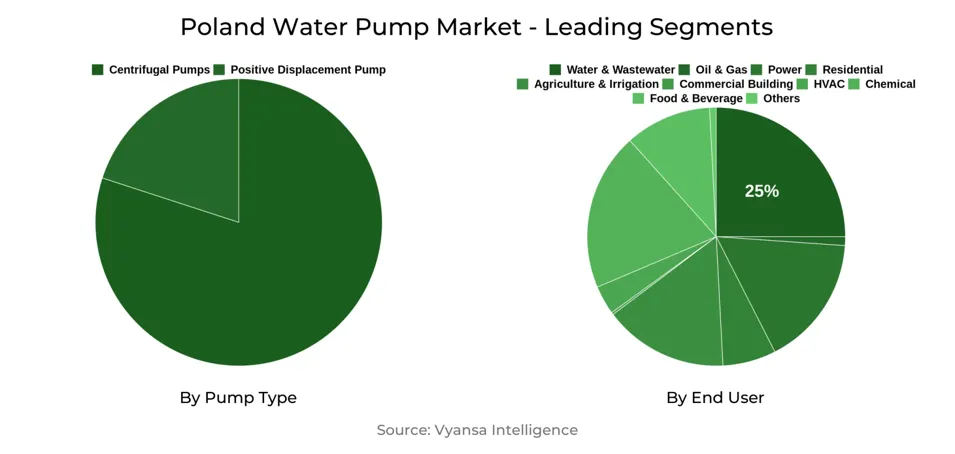
- Centrifugal Pumps continues to dominate the market.
- Competition
- More than 10 companies are actively engaged in producing Water Pump in Poland.
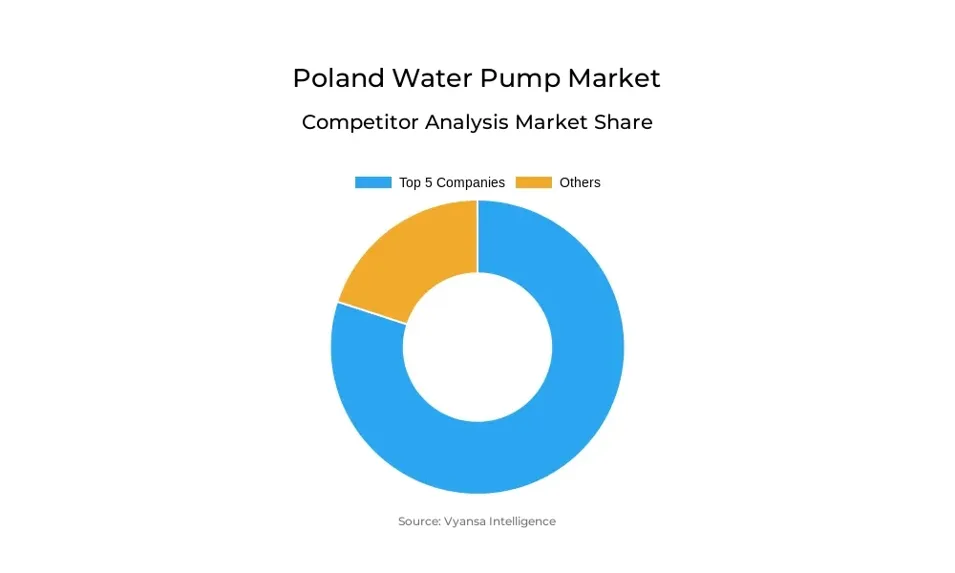
- Top 5 companies acquired the maximum share of the market.
- ITT, IDEX, Dover, Flowserve, Sulzer AG etc., are few of the top companies.
- End User
- Water & Wastewater grabbed 25% of the market.
Poland Water Pump Market Outlook
Poland water pump market worth $475 million is expected to grow consistently up to $545 million by 2032. The country's growing water infrastructure is a key driver for growth, with sewage networks growing by 4.3 thousand km in 2024 and wastewater connections by 112,000 units. Large facilities like Warsaw's Czajka Wastewater Treatment Plant reflect the size of operations, where centrifugal pumps with high capacities are crucial in dealing with flows of more than 435,000 m³ per day.
The Water & Wastewater segment leads the market with 25% share, mirroring Poland's efforts to achieve EU environmental regulations and increase treatment capacity. Even with more than 1,000 agglomerations without proper wastewater treatment, ongoing EU and government investment—almost PLN 30 billion in funding planned for 2021-2027—guarantees robust demand for effective pumping solutions. Large-scale modernization and construction of new facilities will also drive pump take-up.
Technology adoption is yet another major driver, with Polish industries and municipalities increasingly adopting smart water management systems. IoT-pumps facilitate real-time monitoring, leak detection, and predictive maintenance, curbing losses by as much as 30%. The digital transition boosts efficiency, cuts downtime, and fixes high energy costs which hinder industrial competitiveness.
Sustainability aims are also influencing future demand, with endeavors like blue-green infrastructure and the LIFE Pilica program encouraging the retention of stormwater, flood protection, and enhanced water quality. Combining infrastructure development, support funding, and technological innovation places centrifugal pumps and wastewater applications at the forefront of Poland's water pump market growth up to 2032.
Poland Water Pump Market Growth Driver
Poland's water infrastructure is still growing extensively, with sewage network length having risen by 4.3 thousand km (2.4%) in 2024 to 185.8 thousand km overall. Residential building sewage connections totaled 112.0 thousand pieces more (2.8%) during the same timeframe. Its growth generates a huge demand for water pumping systems in both municipal and residential usage.
The sheer size of the nation's water treatment plants is indicated by the scale of infrastructure requirements. Warsaw's Czajka Wastewater Treatment Plant, Poland's largest, treats 435,000 m³ of wastewater in a day under normal conditions and up to 515,000 m³ during peak flow. This is the level of large-scale operation that demands high-reliability, high-capacity pump systems to achieve unbroken water flow and treatment processes across the nation's growing urban regions.
Poland Water Pump Market Challenge
High energy prices seriously undermine the industrial competitiveness of Poland, with power prices during the first six months of 2024 being among the highest in Europe. Industries, including energy-intensive processes such as water treatment plants, are under increasing pressure from these high prices. Water pumping stations, as significant consumers of energy within treatment plants, experience the brunt of these increases in costs on operational levels.
Poland experiences severe labor shortages affecting over 80% of small and medium-sized enterprises, with manufacturing and construction sectors particularly impacted. The shortage spans critical roles including electricians, electromechanics, and electrical fitters essential for pump installation and maintenance. Additionally, unfilled job openings reached 112,000 in the first quarter of 2024, with projections indicating the labor shortfall could reach 1 million workers by 2025.
Unlock Market Intelligence
Explore the market potential with our data-driven report
Poland Water Pump Market Trend
Intelligent water management systems based on IoT technology are being adopted quickly across European markets, with IoT-based systems cutting water losses by as much as 30% by allowing real-time monitoring and leak detection. Poland's water industry is increasingly adopting digital technologies for increased operational efficiency and predictive maintenance. These systems allow for real-time data collection, analysis, and automated reaction to optimize pump performance and avoid failures.
Europe's digital water management environment features convergence of cloud-based monitoring, AI-supported predictive diagnostics, and pressure optimization technologies in real-time. Polish municipalities and industrial sites are deploying smart pump systems that talk to centralized control systems, enabling remote monitoring and automated optimization. This technological revolution revamps classic reactive maintenance strategies into proactive, data-drive operational tactics, which ensure maximum system reliability and reduce downtime.
Poland Water Pump Market Opportunity
Poland is provided large European Union funds for developing water infrastructure, with almost PLN 30 billion directed to water and sewage investments in the 2021-2027 budget plan. There is also extra funding provided by the National Fund for Environmental Protection and Water Management via initiatives such as FEnIKS and KPO for upgrading water treatment plants. All of these expenditures generate vast opportunities for pump makers and suppliers.
Blue-green infrastructure construction momentum builds throughout Polish towns, as 12 cities in Eastern Poland receive PLN 176.6 million in aggregate financing, with more than PLN 136.2 million provided by European Funds for water management systems in particular. Projects are geared toward water retention systems, stormwater management, and flood prevention where specialized pumping solutions are needed. The LIFE Pilica project, which runs from 2021 to 2030, targets enhanced water quality throughout the Pilica catchment as a display of long-term dedication to sustainable water infrastructure development.
| Report Coverage | Details |
|---|---|
| Market Forecast | 2026-32 |
| USD Value 2025 | $ 475 Million |
| USD Value 2032 | $ 545 Million |
| CAGR 2026-2032 | 1.98% |
| Largest Category | Centrifugal Pumps segment leads the market |
| Top Drivers | Rising Water Infrastructure Development Drives Growth |
| Top Challenges | Energy Costs and Labor Shortages Present Market Obstacles |
| Top Trends | Digital Transformation Revolutionizes Pump Operations |
| Top Opportunities | Green Infrastructure Investments Create Significant Growth Potential |
| Key Players | ITT, IDEX, Dover, Flowserve, Sulzer AG, KSB, Xylem, Grundfos, Ebara, SPX Flow and Others. |
Unlock Market Intelligence
Explore the market potential with our data-driven report
Poland Water Pump Market Segmentation Analysis
By Pump Type
- Centrifugal Pumps
- Positive Displacement Pump
The market share leader among pump types is Centrifugal Pumps, and it still leads the Poland water pump market. Centrifugal pumps have the largest share in installations in municipal water treatment plants, industrial plants, and household systems because of their efficiency, reliability, and versatility in operating at different flow rates and pressures.
These pumps specifically thrive in high-volume applications like the Czajka Wastewater Treatment Plant that treats hundreds of thousands of cubic meters every day. They gained widespread use based on successful performance in case of continuous operation, easier maintenance when compared to positive displacement options, and economical effectiveness in applications for transferring high volume water across Poland's growing infrastructure system.
By End User
- Oil & Gas
- Power
- Residential
- Agriculture & Irrigation
- Commercial Building
- HVAC
- Chemical
- Water & Wastewater
- Food & Beverage
- Others
The most dominant market segment under End User is Water & Wastewater applications. Water & Wastewater captured 25% of the market share, indicating the importance of the industry in Poland's infrastructure build and environmental adherence.
This supremacy indicates Poland's consistent support in achieving EU environmental standards and increasing treatment capacity nationwide. With more than 1,000 agglomerations without proper wastewater treatment facilities and the National Program of Municipal Wastewater Treatment encompassing more than 73% of plants, the growth potential is substantial. The industry enjoys sustained government investment, EU funds initiatives, and regulatory pressures leading to modernization of existing plants and the building of new treatment plants.
Top Companies in Poland Water Pump Market
The top companies operating in the market include ITT, IDEX, Dover, Flowserve, Sulzer AG, KSB, Xylem, Grundfos, Ebara, SPX Flow, etc., are the top players operating in the Poland Water Pump Market.
Frequently Asked Questions
Related Report
1. Market Segmentation
1.1. Research Scope
1.2. Research Methodology
1.3. Definitions and Assumptions
2. Executive Summary
3. Poland Water Pump Market Policies, Regulations, and Standards
4. Poland Water Pump Market Dynamics
4.1. Growth Factors
4.2. Challenges
4.3. Trends
4.4. Opportunities
5. Poland Water Pump Market Statistics, 2022-2032F
5.1. Market Size & Growth Outlook
5.1.1.By Revenues in US$ Million
5.1.2.By Units Sold in Million Units
5.2. Market Segmentation & Growth Outlook
5.2.1.By Pump Type
5.2.1.1. Centrifugal Pumps- Market Insights and Forecast 2022-2032, USD Million
5.2.1.1.1. Overhung Pumps- Market Insights and Forecast 2022-2032, USD Million
5.2.1.1.1.1. Vertical Line- Market Insights and Forecast 2022-2032, USD Million
5.2.1.1.1.2. Horizontal End Suction- Market Insights and Forecast 2022-2032, USD Million
5.2.1.1.2. Split Case Pumps- Market Insights and Forecast 2022-2032, USD Million
5.2.1.1.2.1. Single/Two Stage- Market Insights and Forecast 2022-2032, USD Million
5.2.1.1.2.2. Multi Stage- Market Insights and Forecast 2022-2032, USD Million
5.2.1.1.3. Vertical Pumps- Market Insights and Forecast 2022-2032, USD Million
5.2.1.1.3.1. Turbine- Market Insights and Forecast 2022-2032, USD Million
5.2.1.1.3.2. Axial- Market Insights and Forecast 2022-2032, USD Million
5.2.1.1.3.3. Mixed Flow- Market Insights and Forecast 2022-2032, USD Million
5.2.1.1.4. Submersible Pumps- Market Insights and Forecast 2022-2032, USD Million
5.2.1.1.4.1. Solid Handling- Market Insights and Forecast 2022-2032, USD Million
5.2.1.1.4.2. Non-Solid Handling- Market Insights and Forecast 2022-2032, USD Million
5.2.1.2. Positive Displacement Pump- Market Insights and Forecast 2022-2032, USD Million
5.2.1.2.1. Diaphragm Pumps- Market Insights and Forecast 2022-2032, USD Million
5.2.1.2.2. Piston Pumps- Market Insights and Forecast 2022-2032, USD Million
5.2.1.2.3. Gear Pumps- Market Insights and Forecast 2022-2032, USD Million
5.2.1.2.4. Lobe Pumps- Market Insights and Forecast 2022-2032, USD Million
5.2.1.2.5. Progressive Cavity Pumps- Market Insights and Forecast 2022-2032, USD Million
5.2.1.2.6. Screw Pumps- Market Insights and Forecast 2022-2032, USD Million
5.2.1.2.7. Vane Pumps- Market Insights and Forecast 2022-2032, USD Million
5.2.1.2.8. Peristaltic Pumps- Market Insights and Forecast 2022-2032, USD Million
5.2.1.2.9. Others- Market Insights and Forecast 2022-2032, USD Million
5.2.2.By End User
5.2.2.1. Oil & Gas- Market Insights and Forecast 2022-2032, USD Million
5.2.2.2. Power- Market Insights and Forecast 2022-2032, USD Million
5.2.2.3. Residential- Market Insights and Forecast 2022-2032, USD Million
5.2.2.4. Agriculture & Irrigation- Market Insights and Forecast 2022-2032, USD Million
5.2.2.5. Commercial Building- Market Insights and Forecast 2022-2032, USD Million
5.2.2.6. HVAC- Market Insights and Forecast 2022-2032, USD Million
5.2.2.7. Chemical- Market Insights and Forecast 2022-2032, USD Million
5.2.2.8. Water & Wastewater- Market Insights and Forecast 2022-2032, USD Million
5.2.2.9. Food & Beverage- Market Insights and Forecast 2022-2032, USD Million
5.2.2.10. Others- Market Insights and Forecast 2022-2032, USD Million
5.2.3.By Competitors
5.2.3.1. Competition Characteristics
5.2.3.2. Market Share & Analysis
6. Poland Centrifugal Pump Water Pump Market Statistics, 2022-2032F
6.1. Market Size & Growth Outlook
6.1.1.By Revenues in US$ Million
6.1.2.By Units Sold in Million Units
6.2. Market Segmentation & Growth Outlook
6.2.1.By Pump Type- Market Insights and Forecast 2022-2032, USD Million
6.2.2.By End User- Market Insights and Forecast 2022-2032, USD Million
7. Poland Positive Displacement Pump Water Pump Market Statistics, 2022-2032F
7.1. Market Size & Growth Outlook
7.1.1.By Revenues in US$ Million
7.1.2.By Units Sold in Million Units
7.2. Market Segmentation & Growth Outlook
7.2.1.By Pump Type- Market Insights and Forecast 2022-2032, USD Million
7.2.2.By End User- Market Insights and Forecast 2022-2032, USD Million
8. Competitive Outlook
8.1. Company Profiles
8.1.1.Flowserve
8.1.1.1. Business Description
8.1.1.2. Product Portfolio
8.1.1.3. Collaborations & Alliances
8.1.1.4. Recent Developments
8.1.1.5. Financial Details
8.1.1.6. Others
8.1.2.Sulzer AG
8.1.2.1. Business Description
8.1.2.2. Product Portfolio
8.1.2.3. Collaborations & Alliances
8.1.2.4. Recent Developments
8.1.2.5. Financial Details
8.1.2.6. Others
8.1.3.KSB
8.1.3.1. Business Description
8.1.3.2. Product Portfolio
8.1.3.3. Collaborations & Alliances
8.1.3.4. Recent Developments
8.1.3.5. Financial Details
8.1.3.6. Others
8.1.4.Xylem
8.1.4.1. Business Description
8.1.4.2. Product Portfolio
8.1.4.3. Collaborations & Alliances
8.1.4.4. Recent Developments
8.1.4.5. Financial Details
8.1.4.6. Others
8.1.5.Grundfos
8.1.5.1. Business Description
8.1.5.2. Product Portfolio
8.1.5.3. Collaborations & Alliances
8.1.5.4. Recent Developments
8.1.5.5. Financial Details
8.1.5.6. Others
8.1.6.ITT
8.1.6.1. Business Description
8.1.6.2. Product Portfolio
8.1.6.3. Collaborations & Alliances
8.1.6.4. Recent Developments
8.1.6.5. Financial Details
8.1.6.6. Others
8.1.7.IDEX
8.1.7.1. Business Description
8.1.7.2. Product Portfolio
8.1.7.3. Collaborations & Alliances
8.1.7.4. Recent Developments
8.1.7.5. Financial Details
8.1.7.6. Others
8.1.8.Dover
8.1.8.1. Business Description
8.1.8.2. Product Portfolio
8.1.8.3. Collaborations & Alliances
8.1.8.4. Recent Developments
8.1.8.5. Financial Details
8.1.8.6. Others
8.1.9.Ebara
8.1.9.1. Business Description
8.1.9.2. Product Portfolio
8.1.9.3. Collaborations & Alliances
8.1.9.4. Recent Developments
8.1.9.5. Financial Details
8.1.9.6. Others
8.1.10. SPX Flow
8.1.10.1. Business Description
8.1.10.2. Product Portfolio
8.1.10.3. Collaborations & Alliances
8.1.10.4. Recent Developments
8.1.10.5. Financial Details
8.1.10.6. Others
9. Disclaimer
| Segment | Sub-Segment |
|---|---|
| By Pump Type |
|
| By End User |
|
Research Methodology
This study followed a structured approach comprising four key phases to assess the size and scope of the electro-oxidation market. The process began with thorough secondary research to collect data on the target market, related markets, and broader industry context. These findings, along with preliminary assumptions and estimates, were then validated through extensive primary research involving industry experts from across the value chain. To calculate the overall market size, both top-down and bottom-up methodologies were employed. Finally, market segmentation and data triangulation techniques were applied to refine and validate segment-level estimations.
Secondary Research
The secondary research phase involved gathering data from a wide range of credible and published sources. This step helped in identifying industry trends, defining market segmentation, and understanding the market landscape and value chain.
Sources consulted during this phase included:
- Company annual reports, investor presentations, and press releases
- Industry white papers and certified publications
- Trade directories and market-recognized databases
- Articles from authoritative authors and reputable journals
- Gold and silver standard websites
Secondary research was critical in mapping out the industry's value chain and monetary flow, identifying key market segments, understanding regional variations, and tracking significant industry developments.
Other key sources:
- Financial disclosures
- Industry associations and trade bodies
- News outlets and business magazines
- Academic journals and research studies
- Paid industry databases
Primary Research
To validate secondary data and gain deeper market insights, primary research was conducted with key stakeholders across both the supply and demand sides of the market.
On the demand side, participants included decision-makers and influencers from end-user industries—such as CIOs, CTOs, and CSOs—who provided first-hand perspectives on market needs, product usage, and future expectations.
On the supply side, interviews were conducted with manufacturers, industry associations, and institutional participants to gather insights into current offerings, product pipelines, and market challenges.
Primary interviews provided critical inputs such as:
- Market size and revenue data
- Product and service breakdowns
- Market forecasts
- Regional and application-specific trends
Stakeholders consulted included:
- Leading OEM and solution providers
- Channel and distribution partners
- End users across various applications
- Independent consultants and industry specialists
Market Size Estimation and Data Triangulation
- Identifying Key Market Participants (Secondary Research)
- Goal: To identify the major players or companies in the target market. This typically involves using publicly available data sources such as industry reports, market research publications, and financial statements of companies.
- Tools: Reports from firms like Gartner, Forrester, Euromonitor, Statista, IBISWorld, and others. Public financial statements, news articles, and press releases from top market players.
- Extracting Earnings of Key Market Participants
- Goal: To estimate the earnings generated from the product or service being analyzed. This step helps in understanding the revenue potential of each market player in a specific geography.
- Methods: Earnings data can be gathered from:
- Publicly available financial reports (for listed companies).
- Interviews and primary data sources from professionals, such as Directors, VPs, SVPs, etc. This is especially useful for understanding more nuanced, internal data that isn't publicly disclosed.
- Annual reports and investor presentations of key players.
- Data Collation and Development of a Relevant Data Model
- Goal: To collate inputs from both primary and secondary sources into a structured, data-driven model for market estimation. This model will incorporate key market KPIs and any independent variables relevant to the market.
- Key KPIs: These could include:
- Market size, growth rate, and demand drivers.
- Industry-specific metrics like market share, average revenue per customer (ARPC), or average deal size.
- External variables, such as economic growth rates, inflation rates, or commodity prices, that could affect the market.
- Data Modeling: Based on this data, the market forecasts are developed for the next 5 years. A combination of trend analysis, scenario modeling, and statistical regression might be used to generate projections.
- Scenario Analysis
- Goal: To test different assumptions and validate how sensitive the market is to changes in key variables (e.g., market demand, regulatory changes, technological disruptions).
- Types of Scenarios:
- Base Case: Based on current assumptions and historical data.
- Best-Case Scenario: Assuming favorable market conditions, regulatory environments, and technological advancements.
- Worst-Case Scenario: Accounting for adverse factors, such as economic downturns, stricter regulations, or unexpected disruptions.












