South America Water & Wastewater Pump Market Report: Trends, Growth and Forecast (2026-2032)
Pump Type (Centrifugal Pumps (End Suction, Split Case, Vertical (Turbine, Axial Pump, Mixed Flow Pump), Submersible Pump), Positive Displacement Pumps (Progressing Cavity, Diaphragm, Gear Pump, Others)), Application (Water, Wastewater), End User (Industrial Water & Wastewater, Municipal Water & Wastewater), Country (Brazil, Argentina, Chile, Peru, Rest of South America) ... Read more
|
Major Players
|
South America Water & Wastewater Pump Market Statistics and Insights, 2026
- Market Size Statistics
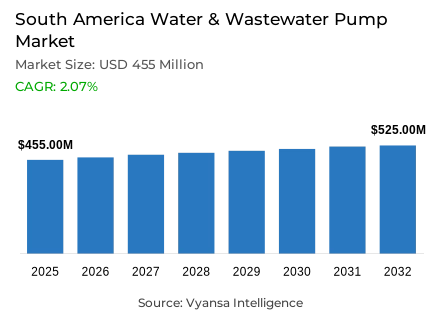
- South America water & wastewater pump market is estimated at USD 455 million in 2025.
- The market size is expected to grow to USD 525 million by 2032.
- Market to register a cagr of around 2.07% during 2026-32.
- Pump Type Shares
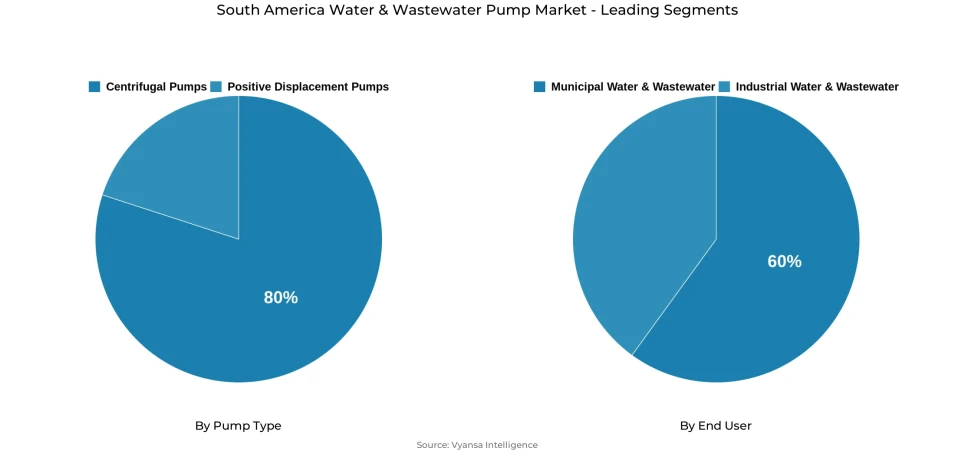
- Centrifugal pumps grabbed market share of 80%.
- Competition
- More than 10 companies are actively engaged in producing water & wastewater pump in South America.
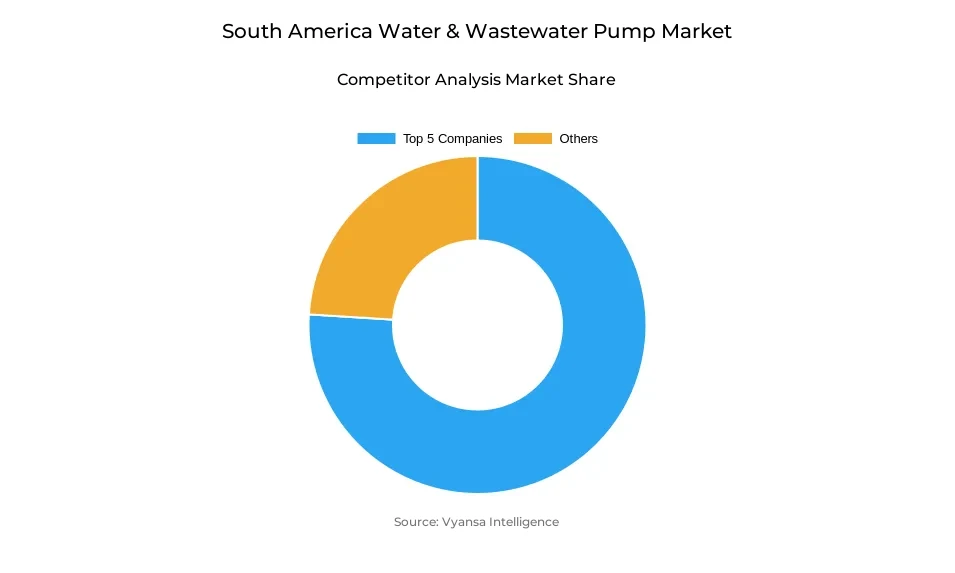
- Top 5 companies acquired the maximum share of the market.
- Xylem Inc.; KSB SE & Co. KGaA; Kirloskar Brothers Limited (KBL); Flowserve Corporation; Ebara Corporation etc., are few of the top companies.
- End User
- Municipal Water & Wastewater grabbed 60% of the market.
- Country
- Brazil leads with a 40% share of the South America market.
South America Water & Wastewater Pump Market Outlook
The South America Water & Wastewater Pump Market has a value of approximately USD 455 million in 2025 and is anticipated to grow to about USD 525 million in 2032, at a CAGR of nearly 2.07% from 2026–2032. Aging infrastructure in urban cities is forcing utilities to upgrade water and wastewater infrastructure with energy-efficient pump technologies. Only 21% of wastewater in Latin America and the Caribbean is treated safely, prompting governments to step up investments in scaling up treatment capacity and enhancing network reliability. Brazil's national sanitation plan, disbursing around USD 43 billion by 2033, is a central force behind this modernization process.
Pumping installations that have been decades old are still causing operational unreliability, with almost 45% of Brazil's urban networks being more than 20 years in service life. Maintenance issues, especially in municipalities where servicing schedules are irregular, add to the costs and impair performance even further. Combating such inefficiencies by way of predictive maintenance and condition-based monitoring is increasingly becoming imperative in ensuring system resilience and minimizing downtime in the region's utility networks.
Digitalization is also transforming pump performance management. In Chile, some 30% of large treatment facilities now use IoT-capable sensors to anticipate failures and lower downtime, while Ecuador's utilities estimate as much as 12% savings in energy from automated control systems. These technology investments are assisting utilities in reducing operating expenses and carbon footprints as well as enhancing service reliability.
Centrifugal pumps dominate 80% of the market due to their flexibility and minimal maintenance requirements. Municipal water and wastewater utilities account for approximately 60% of total demand, with an imperative to replace old systems and increase coverage in urban regions. Brazil holds a regional market leadership in excess of 40% supported by increasing infrastructure investments that improve operating sustainability and increase market growth.
South America Water & Wastewater Pump Market Growth Driver
Infrastructure Modernization Accelerates Market Expansion
South America's aging water and wastewater infrastructure forces utilities to focus on modernization efforts that incorporate energy-efficient pump systems. It was estimated by WHO in 2021 that only 21% of wastewater in the Caribbean and Latin America is treated safely, revealing a pressing necessity for network upgrades to increase coverage and public health improvements. With over 80% of its population currently living in urban centers, the current systems are under increasing pressure, compelling utilities to upgrade worn-out pumps and provide service continuity for burgeoning cities.
Government-backed sanitation investment further underpins this wave of modernization. Brazil's national plan for sanitation sees around USD 43 billion invested by 2033 to refurbish networks and provide new systems, with focus on leading-edge pump technologies that reduce leakage and increase treatment capacity, as reported by the Brazil Ministry of Infrastructure in 2023. Such funding is set to greatly enhance market growth and improve the operationally sustainable position of regional utilities.
South America Water & Wastewater Pump Market Challenge
Aging Infrastructure Undermines System Reliability
Long-standing pump installations pose serious operating problems throughout urban networks, reducing performance and reliability. The Brazil Ministry of Infrastructure in 2023 estimated that approximately 45% of the installed pumping sets in key cities are over 20 years old, resulting in repetitive failures and compromised efficiency. Such inefficiencies push maintenance costs that represent close to 15% of yearly running budgets, limiting funds for proactive upgrades.
Maintenance inconsistencies exacerbate these problems, with about 60% of municipalities experiencing inconsistent maintenance schedules, noted the Peru National Water Authority in 2022. Unplanned outages resulting from such neglect compromise environmental compliance and public health results. Overcoming such structural vulnerabilities through condition-based monitoring and predictive maintenance has emerged as a must for utilities seeking to attain system resilience and minimize expensive downtime.
Unlock Market Intelligence
Explore the market potential with our data-driven report
South America Water & Wastewater Pump Market Trend
Digital Technologies Reshape Operational Efficiency
Integration of IoT-capable systems is revolutionizing pump performance management in South America's water and wastewater networks. In Chile, about 30% of large treatment plants utilize real-time vibration and pressure sensors to anticipate breakdowns, decreasing downtime by up to 20%, states the Chile Water Council in 2024. The digital technologies enable operators to monitor anomalies remotely and improve pump operation without needing on-site visits.
In addition, cloud-based control systems facilitate advanced energy optimization. Ecuador's utilities indicate 10–12% of energy savings in pumping stations after implementing automated systems, leading to reduced operating expenditures and carbon emissions, the Ecuador Ministry of Energy said in 2023. The increased use of smart technologies makes digital integration a key driver of improved efficiency and reliability for the region's utility networks.
South America Water & Wastewater Pump Market Opportunity
Modular and Decentralized Solutions Drive Expansion Prospects
Rural and remote areas throughout South America present significant opportunity for decentralized pumping solutions that meet access inequities. Pilot projects in Bolivia illustrate the feasibility of modular, containerized pump systems, which have reduced installation time by 40% and lowered capital costs, based on the Bolivia Ministry of Environment and Water report of 2022. These movable units provide clean water effectively to underserved communities, especially where centralized infrastructure is limited.
Such initiatives are complementary to the larger development agenda of the region, as close to 15% of South America's rural populace remains without piped water. Public–private partnerships are playing a growing role in scaling this model, encouraging investment in off-grid water supply solutions. Widespread installation of these modular systems can greatly enhance service coverage and augment long-term infrastructure resilience.
South America Water & Wastewater Pump Market Country Analysis
By Country
- Brazil
- Argentina
- Chile
- Peru
- Rest of South America
Brazil is the largest contributor to the South America Water & Wastewater Pump Market with more than 40% of volume pumped water. This is because of its robust treatment facilities and huge government investments in sanitation schemes that favor high-end pumping technology, as per Brazil Ministry of Infrastructure in 2023. Its emphasis on leak reduction, energy conservation, and public–private partnerships remains firm to boost system efficacy and reliability.
Chile is also a leading market, as it has been enhanced by focused infrastructure upgrading in coastal and mining areas. Public-private sector collaboration has spearheaded 12% growth in pump station capacity since 2020, as cited by the Chile Water Council in 2024. Adoption of digital monitoring and automation technologies in the nation further makes it a focal point for innovation across South America's water and wastewater management sector.
Unlock Market Intelligence
Explore the market potential with our data-driven report
South America Water & Wastewater Pump Market Segmentation Analysis
By Pump Type
- Centrifugal Pumps
- Positive Displacement Pumps
Centrifugal pumps leads the South America Water & Wastewater Pump Market with share of around 80%, boosted by resilience to wide ranges of flow rates and low maintenance needs. Their extensive application in water supply and wastewater treatment applications ensures steady demand, particularly as municipalities require energy-efficient upgrades for old ones. Ongoing advancements in impeller design and durability of materials improved their lifecycle and robustness in tough operating conditions.
Positive displacement pumps, though holding a lesser proportion, are increasingly popular in targeted applications like sludge pumping and chemical dosing. Their accuracy of flow control and tolerance for fluctuating pressures make them appealing to industrial treatment processes. With governments focusing on improving treatment efficiency, implementation in wastewater treatment facilities is likely to increase as it supports the ongoing preeminence of centrifugal systems throughout urban water networks.
By End User
- Industrial Water & Wastewater
- Municipal Water & Wastewater
Municipal water and wastewater lead end user segmentation, with approximately 60% share. This pervasive presence is a result of the extensive sewer and water distribution systems in urban areas that must be constantly replaced, maintained, and increased in capacity. Utilities are spending billions to meet increasingly stringent discharge standards and keep up with accelerated population growth, creating ongoing demand for robust and energy-efficient pumping equipment capable of reliably delivering public services.
Industrial water and wastewater use is the most rapidly expanding end user sector at an estimated CAGR of 2.95%. Increased regulatory pressure against effluent treatment within mining and food processing sectors is driving the use of strong pumping systems with the ability to cater to corrosive or high-solid-content liquids. This industrial growth improves overall market diversity alongside South America's wider environmental sustainability agendas.
Various Market Players in South America Water & Wastewater Pump Market
The companies mentioned below are highly active in the South America water & wastewater pump market, occupying a considerable portion of the market and shaping industry progress.
- Xylem Inc.
- KSB SE & Co. KGaA
- Kirloskar Brothers Limited (KBL)
- Flowserve Corporation
- Ebara Corporation
- WILO SE
- Sulzer Limited
- Grundfos Holding A/S
- Franklin Electric
- Pentair PLC
Frequently Asked Questions
Related Report
1. Market Segmentation
1.1. Research Scope
1.2. Research Methodology
1.3. Definitions and Assumptions
2. Executive Summary
3. South America Water & Wastewater Pump Market Policies, Regulations, and Standards
4. South America Water & Wastewater Pump Market Dynamics
4.1. Growth Factors
4.2. Challenges
4.3. Trends
4.4. Opportunities
5. South America Water & Wastewater Pump Market Statistics, 2022-2032F
5.1. Market Size & Growth Outlook
5.1.1.By Revenues in US$ Million
5.2. Market Segmentation & Growth Outlook
5.2.1.By Pump Type
5.2.1.1. Centrifugal Pumps- Market Insights and Forecast 2022-2032, USD Million
5.2.1.1.1. End Suction- Market Insights and Forecast 2022-2032, USD Million
5.2.1.1.2. Split Case- Market Insights and Forecast 2022-2032, USD Million
5.2.1.1.3. Vertical- Market Insights and Forecast 2022-2032, USD Million
5.2.1.1.3.1. Turbine- Market Insights and Forecast 2022-2032, USD Million
5.2.1.1.3.2. Axial Pump- Market Insights and Forecast 2022-2032, USD Million
5.2.1.1.3.3. Mixed Flow Pump- Market Insights and Forecast 2022-2032, USD Million
5.2.1.1.4. Submersible Pump- Market Insights and Forecast 2022-2032, USD Million
5.2.1.2. Positive Displacement Pumps- Market Insights and Forecast 2022-2032, USD Million
5.2.1.2.1. Progressing Cavity- Market Insights and Forecast 2022-2032, USD Million
5.2.1.2.2. Diaphragm- Market Insights and Forecast 2022-2032, USD Million
5.2.1.2.3. Gear Pump- Market Insights and Forecast 2022-2032, USD Million
5.2.1.2.4. Others- Market Insights and Forecast 2022-2032, USD Million
5.2.2.By Application
5.2.2.1. Water- Market Insights and Forecast 2022-2032, USD Million
5.2.2.2. Wastewater- Market Insights and Forecast 2022-2032, USD Million
5.2.3.By End User
5.2.3.1. Industrial Water & Wastewater- Market Insights and Forecast 2022-2032, USD Million
5.2.3.2. Municipal Water & Wastewater- Market Insights and Forecast 2022-2032, USD Million
5.2.4.By Country
5.2.4.1. Brazil
5.2.4.2. Argentina
5.2.4.3. Chile
5.2.4.4. Peru
5.2.4.5. Rest of South America
5.2.5.By Competitors
5.2.5.1. Competition Characteristics
5.2.5.2. Market Share & Analysis
6. Brazil Water & Wastewater Pump Market Statistics, 2022-2032F
6.1. Market Size & Growth Outlook
6.1.1.By Revenues in US$ Million
6.2. Market Segmentation & Growth Outlook
6.2.1.By Pump Type- Market Insights and Forecast 2022-2032, USD Million
6.2.2.By Application- Market Insights and Forecast 2022-2032, USD Million
6.2.3.By End User- Market Insights and Forecast 2022-2032, USD Million
7. Argentina Water & Wastewater Pump Market Statistics, 2022-2032F
7.1. Market Size & Growth Outlook
7.1.1.By Revenues in US$ Million
7.2. Market Segmentation & Growth Outlook
7.2.1.By Pump Type- Market Insights and Forecast 2022-2032, USD Million
7.2.2.By Application- Market Insights and Forecast 2022-2032, USD Million
7.2.3.By End User- Market Insights and Forecast 2022-2032, USD Million
8. Chile Water & Wastewater Pump Market Statistics, 2022-2032F
8.1. Market Size & Growth Outlook
8.1.1.By Revenues in US$ Million
8.2. Market Segmentation & Growth Outlook
8.2.1.By Pump Type- Market Insights and Forecast 2022-2032, USD Million
8.2.2.By Application- Market Insights and Forecast 2022-2032, USD Million
8.2.3.By End User- Market Insights and Forecast 2022-2032, USD Million
9. Peru Water & Wastewater Pump Market Statistics, 2022-2032F
9.1. Market Size & Growth Outlook
9.1.1.By Revenues in US$ Million
9.2. Market Segmentation & Growth Outlook
9.2.1.By Pump Type- Market Insights and Forecast 2022-2032, USD Million
9.2.2.By Application- Market Insights and Forecast 2022-2032, USD Million
9.2.3.By End User- Market Insights and Forecast 2022-2032, USD Million
10. Competitive Outlook
10.1. Company Profiles
10.1.1. Flowserve Corporation
10.1.1.1. Business Description
10.1.1.2. Product Portfolio
10.1.1.3. Collaborations & Alliances
10.1.1.4. Recent Developments
10.1.1.5. Financial Details
10.1.1.6. Others
10.1.2. Ebara Corporation
10.1.2.1. Business Description
10.1.2.2. Product Portfolio
10.1.2.3. Collaborations & Alliances
10.1.2.4. Recent Developments
10.1.2.5. Financial Details
10.1.2.6. Others
10.1.3. WILO SE
10.1.3.1. Business Description
10.1.3.2. Product Portfolio
10.1.3.3. Collaborations & Alliances
10.1.3.4. Recent Developments
10.1.3.5. Financial Details
10.1.3.6. Others
10.1.4. Sulzer Limited
10.1.4.1. Business Description
10.1.4.2. Product Portfolio
10.1.4.3. Collaborations & Alliances
10.1.4.4. Recent Developments
10.1.4.5. Financial Details
10.1.4.6. Others
10.1.5. Grundfos Holding A/S
10.1.5.1. Business Description
10.1.5.2. Product Portfolio
10.1.5.3. Collaborations & Alliances
10.1.5.4. Recent Developments
10.1.5.5. Financial Details
10.1.5.6. Others
10.1.6. Xylem Inc.
10.1.6.1. Business Description
10.1.6.2. Product Portfolio
10.1.6.3. Collaborations & Alliances
10.1.6.4. Recent Developments
10.1.6.5. Financial Details
10.1.6.6. Others
10.1.7. KSB SE & Co. KGaA
10.1.7.1. Business Description
10.1.7.2. Product Portfolio
10.1.7.3. Collaborations & Alliances
10.1.7.4. Recent Developments
10.1.7.5. Financial Details
10.1.7.6. Others
10.1.8. Kirloskar Brothers Limited (KBL)
10.1.8.1. Business Description
10.1.8.2. Product Portfolio
10.1.8.3. Collaborations & Alliances
10.1.8.4. Recent Developments
10.1.8.5. Financial Details
10.1.8.6. Others
10.1.9. Franklin Electric
10.1.9.1. Business Description
10.1.9.2. Product Portfolio
10.1.9.3. Collaborations & Alliances
10.1.9.4. Recent Developments
10.1.9.5. Financial Details
10.1.9.6. Others
10.1.10. Pentair PLC
10.1.10.1.Business Description
10.1.10.2.Product Portfolio
10.1.10.3.Collaborations & Alliances
10.1.10.4.Recent Developments
10.1.10.5.Financial Details
10.1.10.6.Others
11. Disclaimer
| Segment | Sub-Segment |
|---|---|
| By Pump Type |
|
| By Application |
|
| By End User |
|
| By Country |
|
Research Methodology
This study followed a structured approach comprising four key phases to assess the size and scope of the electro-oxidation market. The process began with thorough secondary research to collect data on the target market, related markets, and broader industry context. These findings, along with preliminary assumptions and estimates, were then validated through extensive primary research involving industry experts from across the value chain. To calculate the overall market size, both top-down and bottom-up methodologies were employed. Finally, market segmentation and data triangulation techniques were applied to refine and validate segment-level estimations.
Secondary Research
The secondary research phase involved gathering data from a wide range of credible and published sources. This step helped in identifying industry trends, defining market segmentation, and understanding the market landscape and value chain.
Sources consulted during this phase included:
- Company annual reports, investor presentations, and press releases
- Industry white papers and certified publications
- Trade directories and market-recognized databases
- Articles from authoritative authors and reputable journals
- Gold and silver standard websites
Secondary research was critical in mapping out the industry's value chain and monetary flow, identifying key market segments, understanding regional variations, and tracking significant industry developments.
Other key sources:
- Financial disclosures
- Industry associations and trade bodies
- News outlets and business magazines
- Academic journals and research studies
- Paid industry databases
Primary Research
To validate secondary data and gain deeper market insights, primary research was conducted with key stakeholders across both the supply and demand sides of the market.
On the demand side, participants included decision-makers and influencers from end-user industries—such as CIOs, CTOs, and CSOs—who provided first-hand perspectives on market needs, product usage, and future expectations.
On the supply side, interviews were conducted with manufacturers, industry associations, and institutional participants to gather insights into current offerings, product pipelines, and market challenges.
Primary interviews provided critical inputs such as:
- Market size and revenue data
- Product and service breakdowns
- Market forecasts
- Regional and application-specific trends
Stakeholders consulted included:
- Leading OEM and solution providers
- Channel and distribution partners
- End users across various applications
- Independent consultants and industry specialists
Market Size Estimation and Data Triangulation
- Identifying Key Market Participants (Secondary Research)
- Goal: To identify the major players or companies in the target market. This typically involves using publicly available data sources such as industry reports, market research publications, and financial statements of companies.
- Tools: Reports from firms like Gartner, Forrester, Euromonitor, Statista, IBISWorld, and others. Public financial statements, news articles, and press releases from top market players.
- Extracting Earnings of Key Market Participants
- Goal: To estimate the earnings generated from the product or service being analyzed. This step helps in understanding the revenue potential of each market player in a specific geography.
- Methods: Earnings data can be gathered from:
- Publicly available financial reports (for listed companies).
- Interviews and primary data sources from professionals, such as Directors, VPs, SVPs, etc. This is especially useful for understanding more nuanced, internal data that isn't publicly disclosed.
- Annual reports and investor presentations of key players.
- Data Collation and Development of a Relevant Data Model
- Goal: To collate inputs from both primary and secondary sources into a structured, data-driven model for market estimation. This model will incorporate key market KPIs and any independent variables relevant to the market.
- Key KPIs: These could include:
- Market size, growth rate, and demand drivers.
- Industry-specific metrics like market share, average revenue per customer (ARPC), or average deal size.
- External variables, such as economic growth rates, inflation rates, or commodity prices, that could affect the market.
- Data Modeling: Based on this data, the market forecasts are developed for the next 5 years. A combination of trend analysis, scenario modeling, and statistical regression might be used to generate projections.
- Scenario Analysis
- Goal: To test different assumptions and validate how sensitive the market is to changes in key variables (e.g., market demand, regulatory changes, technological disruptions).
- Types of Scenarios:
- Base Case: Based on current assumptions and historical data.
- Best-Case Scenario: Assuming favorable market conditions, regulatory environments, and technological advancements.
- Worst-Case Scenario: Accounting for adverse factors, such as economic downturns, stricter regulations, or unexpected disruptions.












