Poland Juice Market Report: Trends, Growth and Forecast (2026-2032)
By Category (100% Juice (Not from Concentrate, Reconstituted), Juice Drinks (up to 24% Juice), Nectars (High Concentration (40% to 50% fruit content), Medium Concentration (30% to 39% fruit content), Low Concentration (25% to 29% fruit content)), Vegetable Juice, Fruit and Vegetable Blends), By Nature (Conventional, Organic), By Packaging Material (Plastic, Glass, Metal, Others), By Packaging Type (PET Bottles, Aseptic Packages (Cartons), Glass Bottles, Metal Cans, Disposable Cups & Pouches), By Sales Channel (Off-Trade (Hypermarkets/ Supermarkets, Retail Outlets, Convenience Stores, Online Platforms), On-Trade) ... Read more

|
Major Players
|
Poland Juice Market Statistics and Insights, 2026
- Market Size Statistics
- Juice market size in Poland was estimated at USD 1.52 billion in 2025.
- The market size is expected to grow to USD 1.64 billion by 2032.
- Market to register a CAGR of around 1.09% during 2026-32.
- Category Shares
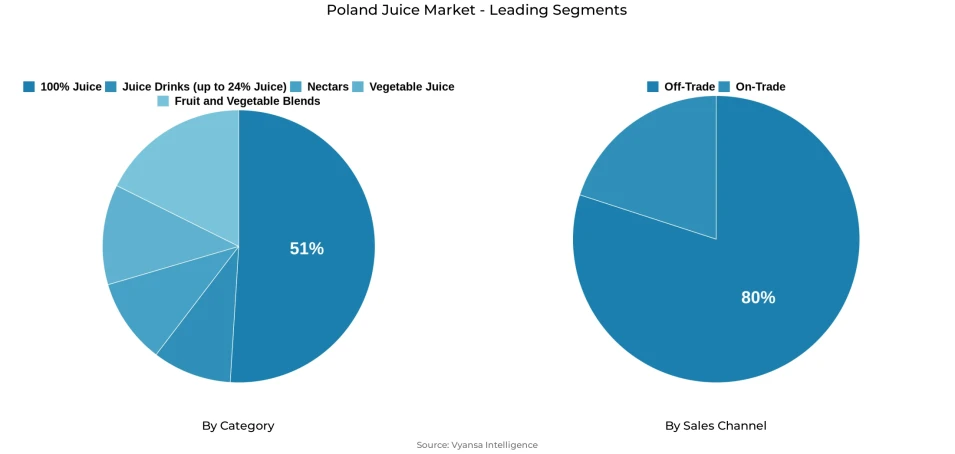
- 100% juice grabbed market share of 51%.
- Competition
- More than 20 companies are actively engaged in producing juice in Poland.
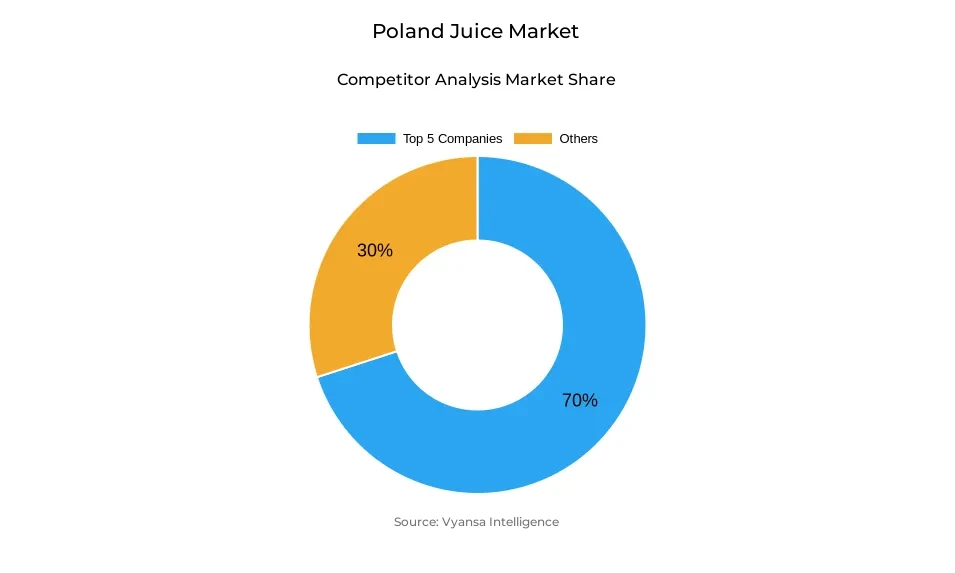
- Top 5 companies acquired around 70% of the market share.
- Lidl Sp zoo Sp k, Gospodarstwo Sadownicze Wincenty Krzyzak, Polmlek Sp zoo, MWS Sp zoo Sp k, Hortex Holding SA etc., are few of the top companies.
- Sales Channel
- Off-trade grabbed 80% of the market.
Poland Juice Market Outlook
The Poland juice market is currently in a phase of calculated recalibration, with the increasing cost of production and high inflation impacting end user buying power. The market is expected to increase to USD 1.64 billion in 2032 with a compound annual growth rate of approximately 1.09% in the 2026-32 forecast period, which has a 2025 value of about USD 1.52 billion. Although the value growth is positive, the volume sales are limited by the price increases and the transition to the alternative beverages that are viewed as healthier, including bottled water and functional drinks.
There is a major movement towards better-for-you, which is both end user-driven and regulation-driven. Starting in June 2026, the EU reduced-sugar fruit juice directive will require that products in this category have at least 30% less naturally occurring sugar. This will create a wave of innovation in an unexploited market segment. Currently, 100% Juice enjoys a leading market share of 51%, but it is experiencing a rising competition with snacks like fruit mousses, which are being seen as healthier and more concentrated substitute to the traditional juice.
The local giant MWS Sp zoo (Maspex Wadowice Grupa) dominates the competitive environment, with its Tymbark brand being a household favourite. With the assistance of the European Investment Bank, Maspex has significantly modernised its production facilities to increase energy efficiency and flexibility of operation. In the meantime, niche players like Bio Food are flourishing by serving the organic and clean label trend. These firms are also paying more attention to 100% natural ingredients and preservative-free formulations to meet the wellness desires of the modern Poland end user.
The sales dynamics have hit a critical juncture where off-trade channels have taken 80% of the market. Discount stores like Biedronka and Lidl will become the main sales channel in 2025, as they are actively expanding their networks to large cities and smaller towns. These retailers are able to appeal to price-sensitive end user with value-for-money own-label collections and competitive offers, and thus become the key entry point of juice brands until 2032.
Poland Juice Market Growth DriverInflation-Driven Trade-Down Supporting Affordable Juice Drink Demand
The Poland end user remain highly price sensitive, which makes low-priced soft drinks and own-label products more appealing. Statistics Poland stated that end user prices increased by 4.7% in December 2024 over the past year, and prices of food and non-alcoholic beverages rose by 4.8%. Eurostat also documents that Poland has had an average inflation rate of 4.4% in March 2025, thus maintaining strict household budgetary limits. This enduring inflationary climate strengthens value-based buying habits and supports price-based decision making within beverage segments.
The resultant price pressure is in favour of a substitution of higher-priced juices with lower-priced juice drinks with less fruit content since they have easier entry prices but are still viewed as more similar to juice than to carbonated beverages. The advantage of discounters is that end user will actively trade down; brands offering low packs and strong in-store promotions are the most resilient in the category. The growth of the value-retail channel and the infiltration of own-label brands provide favourable conditions to affordable juice drink formats, but at the same time, they present structural issues to the premium 100% juice positioning in the economically limited end user environment of Poland, which is characterised by the ongoing inflation and the conservative household spending habits.
Poland Juice Market ChallengeSugar Perception Eroding Juice’s Everyday Health Credibility
The health challenge of sugar make juice more and more hard to justify, especially when end user compare it to bottled water and functional drinks. According to OECD Health at a Glance 2025, the prevalence of obesity in Poland is self-reported at 19%, and 40% of the adult population is not physically active enough. These risk factors keep the population focused on calories and sugar content, which supports the idea that juice is not a daily healthy option that can be included in daily consumption habits.
This difficulty directly underpins end user switching behaviour, in which people cut down on the consumption of juice and shift to water, sports drinks, and other alternatives that are positioned as being lighter. Juice drinks that remain price competitive are under pressure as the category is still linked to sugar issues, and more stringent brand communication and product redesign is needed to protect shelf space and end user confidence. The perceived challenges of sugar present category headwinds, requiring strategic repositioning around reduced-sugar formulations, functional advantages, and open nutritional communication to maintain relevance in the Poland market, which is becoming more health-conscious in its beverage offerings.
Unlock Market Intelligence
Explore the market potential with our data-driven report
Poland Juice Market TrendEU-Led Reduced-Sugar Standards Accelerating Reformulation and Labelling Compliance
There is a distinct market change in the area of reformulation, with EU regulations narrowing the definition and labelling of fruit-juice products. EU Directive 2024/1438 creates a new category, which is called reduced-sugar fruit juice, and sets a minimum reduction requirement of 30% in naturally occurring sugars relative to standard juice. This regulatory framework encourages brand innovation to lower-sugar products instead of wide line extensions, thus establishing standardised category definitions that increase end user understanding.
Since Poland is complying with the EU composition rules, producers are modifying recipes, sourcing of ingredients and processing to meet the new definition. This uniformity of reduced-sugar claims on shelves enhances end user awareness of lower-sugar choices and heightens compliance demands on testing and label accuracy. The outcome is a structural shift to more explicit sugar positioning in the juice aisle. The regulatory-based reformulation trend establishes strategic product development, supply-chain realignment, and marketing communication requirements that are aligned with EU definitions, and at the same time, provides competitive benefits to early adopters who exhibit compliance preparedness and reduced-sugar innovation leadership.
Poland Juice Market OpportunityEnergy and Efficiency Investments Enabling Cost Resilience and Cleaner Production
Manufacturers can significantly reduce the pressure on costs by upgrading energy and resource efficiency, which will help them achieve pricing resilience and sustainability goals. European Investment Bank documents a 42 million-euro transaction with the Maspex Group to modernize production facilities, install photovoltaic panels, improve energy efficiency, and wastewater treatment facilities. This financing, according to the same release, is based on three EIB agreements with Maspex totaling 211 million euros, which highlights the strong institutional support of manufacturing modernisation.
This kind of investment is a direct response to the rising cost of production that is eating volumes and limiting innovation potential. Juice manufacturers can defend margins by cutting energy and water intensity and investing in specific reformulation, including reduced-sugar lines and affordability in discounter channels. It also enhances compliance preparedness since environmental and efficiency demands increase throughout EU supply chains. The opportunities of efficiency investment allow manufacturers to accomplish two goals: reducing operational costs to enable competitive prices and sustainability improvement to strengthen brand positioning, thus establishing defensible competitive advantages in the price-sensitive, regulation-intensive market environment in Poland.
Unlock Market Intelligence
Explore the market potential with our data-driven report
Poland Juice Market Segmentation Analysis
By Category
- 100% Juice
- Not from Concentrate
- Reconstituted
- Juice Drinks (up to 24% Juice)
- Nectars
- High Concentration (40% to 50% fruit content)
- Medium Concentration (30% to 39% fruit content)
- Low Concentration (25% to 29% fruit content)
- Vegetable Juice
- Fruit and Vegetable Blends
The segment has the highest share around the category in the Poland juice market, where 100% Juice grabbed a market share of 51%. This segment maintains its leadership because Poland end user traditionally associate 100% fruit content with high quality and better nutrition. However, the category is under pressure from rising raw material costs, which have led to higher unit prices. To stay relevant, brands are pivoting toward "not-from-concentrate" (NFC) and organic variants to justify these premium price points to health-conscious shoppers.
While 100% juice leads, juice drinks (up to 24% juice) have proven remarkably resilient because their lower juice content makes them less vulnerable to fruit price fluctuations. This makes them an attractive, low-cost alternative for budget-conscious families. Nevertheless, with the upcoming 2026 EU sugar reduction regulations, the 100% juice segment is expected to undergo significant reformulation, likely introducing more "reduced sugar" variants to maintain its dominant position against competing snacks like fruit mousses.
By Sales Channel
- Off-Trade
- Hypermarkets/ Supermarkets
- Retail Outlets
- Convenience Stores
- Online Platforms
- On-Trade
The segment has the highest share around the Sales Channel is Off-Trade, which grabbed 80% of the market. This overwhelming dominance is anchored by the rapid expansion of discounters, which have become the primary shopping destination for Poland households seeking value. Giants like Biedronka and Lidl have modernized their stores and expanded into smaller towns, offering a mix of leading brands like Tymbark alongside affordable private-label products that appeal to the nation's high level of price sensitivity.
Traditional convenience stores, while still significant, are losing ground to these larger discount formats that offer better pricing and a wider assortment of health-oriented juices. Furthermore, the convenience of one-stop shopping at a discounter aligns with the busy lifestyles of urban end user. As the market progresses toward 2032, the off-trade channel — specifically through discount outlets — will continue to be the main driver of juice volume, as end user prioritize affordability and promotional deals in a challenging economic climate.
List of Companies Covered in Poland Juice Market
The companies listed below are highly influential in the Poland juice market, with a significant market share and a strong impact on industry developments.
- Lidl Sp zoo Sp k
- Gospodarstwo Sadownicze Wincenty Krzyzak
- Polmlek Sp zoo
- MWS Sp zoo Sp k
- Hortex Holding SA
- Jeronimo Martins Polska SA
- Fortuna Sp zoo
- Victoria Cymes Sp zoo
- FoodCare Sp zoo
- Bracia Sadownicy Sp zoo
Competitive Landscape
Poland’s juice market in 2025 is led by Maspex Wadowice, whose Tymbark brand anchors a broad multi segment portfolio supported by scale, plant modernisation, and sustainability investments, reinforcing its dominant position despite category volume decline. Zywnosc Ekologiczna Bio Food is a growing niche challenger, capitalising on organic, clean label positioning aligned with health and wellness trends. Juice drinks up to 24% juice remain the most resilient segment, competing on price and perceived relative health versus carbonates, while higher fruit content juices face pressure from rising costs and sugar concerns. Indirect competition from bottled water, functional drinks, and fruit mousses is intensifying. Differentiation opportunities lie in reduced sugar reformulation ahead of EU regulation, organic premiumisation, and leveraging discounter expansion with strong private label partnerships.
Frequently Asked Questions
Related Report
- Market Segmentation
- Research Scope
- Research Methodology
- Definitions and Assumptions
- Executive Summary
- Poland Juice Market Policies, Regulations, and Standards
- Poland Juice Market Dynamics
- Growth Factors
- Challenges
- Trends
- Opportunities
- Poland Juice Market Statistics, 2022-2032F
- Market Size & Growth Outlook
- By Revenues in USD Million
- By Quantity Sold in Million Litres
- Market Segmentation & Growth Outlook
- By Category
- 100% Juice- Market Insights and Forecast 2022-2032, USD Million
- Not from Concentrate- Market Insights and Forecast 2022-2032, USD Million
- Reconstituted- Market Insights and Forecast 2022-2032, USD Million
- Juice Drinks (up to 24% Juice)- Market Insights and Forecast 2022-2032, USD Million
- Nectars- Market Insights and Forecast 2022-2032, USD Million
- High Concentration (40% to 50% fruit content)- Market Insights and Forecast 2022-2032, USD Million
- Medium Concentration (30% to 39% fruit content)- Market Insights and Forecast 2022-2032, USD Million
- Low Concentration (25% to 29% fruit content)- Market Insights and Forecast 2022-2032, USD Million
- Vegetable Juice- Market Insights and Forecast 2022-2032, USD Million
- Fruit and Vegetable Blends- Market Insights and Forecast 2022-2032, USD Million
- 100% Juice- Market Insights and Forecast 2022-2032, USD Million
- By Nature
- Conventional- Market Insights and Forecast 2022-2032, USD Million
- Organic- Market Insights and Forecast 2022-2032, USD Million
- By Packaging Material
- Plastic- Market Insights and Forecast 2022-2032, USD Million
- Glass- Market Insights and Forecast 2022-2032, USD Million
- Metal- Market Insights and Forecast 2022-2032, USD Million
- Others- Market Insights and Forecast 2022-2032, USD Million
- By Packaging Type
- PET Bottles- Market Insights and Forecast 2022-2032, USD Million
- Aseptic Packages (Cartons)- Market Insights and Forecast 2022-2032, USD Million
- Glass Bottles- Market Insights and Forecast 2022-2032, USD Million
- Metal Cans- Market Insights and Forecast 2022-2032, USD Million
- Disposable Cups & Pouches- Market Insights and Forecast 2022-2032, USD Million
- By Sales Channel
- Off-Trade- Market Insights and Forecast 2022-2032, USD Million
- Hypermarkets/ Supermarkets - Market Insights and Forecast 2022-2032, USD Million
- Retail Outlets - Market Insights and Forecast 2022-2032, USD Million
- Convenience Stores- Market Insights and Forecast 2022-2032, USD Million
- Online Platforms- Market Insights and Forecast 2022-2032, USD Million
- On-Trade- Market Insights and Forecast 2022-2032, USD Million
- Off-Trade- Market Insights and Forecast 2022-2032, USD Million
- By Competitors
- Competition Characteristics
- Market Share & Analysis
- By Category
- Market Size & Growth Outlook
- Poland 100% Juice Market Statistics, 2022-2032
- Market Size & Growth Outlook
- By Revenues in USD Million
- By Quantity Sold in Million Litres
- Market Segmentation & Growth Outlook
- By Nature- Market Insights and Forecast 2022-2032, USD Million
- By Packaging Material- Market Insights and Forecast 2022-2032, USD Million
- By Packaging Type- Market Insights and Forecast 2022-2032, USD Million
- By Sales Channel- Market Insights and Forecast 2022-2032, USD Million
- Market Size & Growth Outlook
- Poland Juice Drinks (up to 24% Juice) Market Statistics, 2022-2032
- Market Size & Growth Outlook
- By Revenues in USD Million
- By Quantity Sold in Million Litres
- Market Segmentation & Growth Outlook
- By Nature- Market Insights and Forecast 2022-2032, USD Million
- By Packaging Material- Market Insights and Forecast 2022-2032, USD Million
- By Packaging Type- Market Insights and Forecast 2022-2032, USD Million
- By Sales Channel- Market Insights and Forecast 2022-2032, USD Million
- Market Size & Growth Outlook
- Poland Nectars Market Statistics, 2022-2032
- Market Size & Growth Outlook
- By Revenues in USD Million
- By Quantity Sold in Million Litres
- Market Segmentation & Growth Outlook
- By Nature- Market Insights and Forecast 2022-2032, USD Million
- By Packaging Material- Market Insights and Forecast 2022-2032, USD Million
- By Packaging Type- Market Insights and Forecast 2022-2032, USD Million
- By Sales Channel- Market Insights and Forecast 2022-2032, USD Million
- Market Size & Growth Outlook
- Poland Vegetable Juice Market Statistics, 2022-2032
- Market Size & Growth Outlook
- By Revenues in USD Million
- By Quantity Sold in Million Litres
- Market Segmentation & Growth Outlook
- By Nature- Market Insights and Forecast 2022-2032, USD Million
- By Packaging Material- Market Insights and Forecast 2022-2032, USD Million
- By Packaging Type- Market Insights and Forecast 2022-2032, USD Million
- By Sales Channel- Market Insights and Forecast 2022-2032, USD Million
- Market Size & Growth Outlook
- Poland Fruit and Vegetable Blends Market Statistics, 2022-2032
- Market Size & Growth Outlook
- By Revenues in USD Million
- By Quantity Sold in Million Litres
- Market Segmentation & Growth Outlook
- By Nature- Market Insights and Forecast 2022-2032, USD Million
- By Packaging Material- Market Insights and Forecast 2022-2032, USD Million
- By Packaging Type- Market Insights and Forecast 2022-2032, USD Million
- By Sales Channel- Market Insights and Forecast 2022-2032, USD Million
- Market Size & Growth Outlook
- Competitive Outlook
- Company Profiles
- MWS Sp zoo Sp k
- Business Description
- Product Portfolio
- Collaborations & Alliances
- Recent Developments
- Financial Details
- Others
- Hortex Holding SA
- Business Description
- Product Portfolio
- Collaborations & Alliances
- Recent Developments
- Financial Details
- Others
- Jeronimo Martins Polska SA
- Business Description
- Product Portfolio
- Collaborations & Alliances
- Recent Developments
- Financial Details
- Others
- Fortuna Sp zoo
- Business Description
- Product Portfolio
- Collaborations & Alliances
- Recent Developments
- Financial Details
- Others
- Victoria Cymes Sp zoo
- Business Description
- Product Portfolio
- Collaborations & Alliances
- Recent Developments
- Financial Details
- Others
- Lidl Sp zoo Sp k
- Business Description
- Product Portfolio
- Collaborations & Alliances
- Recent Developments
- Financial Details
- Others
- Gospodarstwo Sadownicze Wincenty Krzyzak
- Business Description
- Product Portfolio
- Collaborations & Alliances
- Recent Developments
- Financial Details
- Others
- Polmlek Sp zoo
- Business Description
- Product Portfolio
- Collaborations & Alliances
- Recent Developments
- Financial Details
- Others
- FoodCare Sp zoo
- Business Description
- Product Portfolio
- Collaborations & Alliances
- Recent Developments
- Financial Details
- Others
- Bracia Sadownicy Sp zoo
- Business Description
- Product Portfolio
- Collaborations & Alliances
- Recent Developments
- Financial Details
- Others
- MWS Sp zoo Sp k
- Company Profiles
- Disclaimer
| Segment | Sub-Segment |
|---|---|
| By Category |
|
| By Nature |
|
| By Packaging Material |
|
| By Packaging Type |
|
| By Sales Channel |
|
Research Methodology
This study followed a structured approach comprising four key phases to assess the size and scope of the electro-oxidation market. The process began with thorough secondary research to collect data on the target market, related markets, and broader industry context. These findings, along with preliminary assumptions and estimates, were then validated through extensive primary research involving industry experts from across the value chain. To calculate the overall market size, both top-down and bottom-up methodologies were employed. Finally, market segmentation and data triangulation techniques were applied to refine and validate segment-level estimations.
Secondary Research
The secondary research phase involved gathering data from a wide range of credible and published sources. This step helped in identifying industry trends, defining market segmentation, and understanding the market landscape and value chain.
Sources consulted during this phase included:
- Company annual reports, investor presentations, and press releases
- Industry white papers and certified publications
- Trade directories and market-recognized databases
- Articles from authoritative authors and reputable journals
- Gold and silver standard websites
Secondary research was critical in mapping out the industry's value chain and monetary flow, identifying key market segments, understanding regional variations, and tracking significant industry developments.
Other key sources:
- Financial disclosures
- Industry associations and trade bodies
- News outlets and business magazines
- Academic journals and research studies
- Paid industry databases
Primary Research
To validate secondary data and gain deeper market insights, primary research was conducted with key stakeholders across both the supply and demand sides of the market.
On the demand side, participants included decision-makers and influencers from end-user industries—such as CIOs, CTOs, and CSOs—who provided first-hand perspectives on market needs, product usage, and future expectations.
On the supply side, interviews were conducted with manufacturers, industry associations, and institutional participants to gather insights into current offerings, product pipelines, and market challenges.
Primary interviews provided critical inputs such as:
- Market size and revenue data
- Product and service breakdowns
- Market forecasts
- Regional and application-specific trends
Stakeholders consulted included:
- Leading OEM and solution providers
- Channel and distribution partners
- End users across various applications
- Independent consultants and industry specialists
Market Size Estimation and Data Triangulation
- Identifying Key Market Participants (Secondary Research)
- Goal: To identify the major players or companies in the target market. This typically involves using publicly available data sources such as industry reports, market research publications, and financial statements of companies.
- Tools: Reports from firms like Gartner, Forrester, Euromonitor, Statista, IBISWorld, and others. Public financial statements, news articles, and press releases from top market players.
- Extracting Earnings of Key Market Participants
- Goal: To estimate the earnings generated from the product or service being analyzed. This step helps in understanding the revenue potential of each market player in a specific geography.
- Methods: Earnings data can be gathered from:
- Publicly available financial reports (for listed companies).
- Interviews and primary data sources from professionals, such as Directors, VPs, SVPs, etc. This is especially useful for understanding more nuanced, internal data that isn't publicly disclosed.
- Annual reports and investor presentations of key players.
- Data Collation and Development of a Relevant Data Model
- Goal: To collate inputs from both primary and secondary sources into a structured, data-driven model for market estimation. This model will incorporate key market KPIs and any independent variables relevant to the market.
- Key KPIs: These could include:
- Market size, growth rate, and demand drivers.
- Industry-specific metrics like market share, average revenue per customer (ARPC), or average deal size.
- External variables, such as economic growth rates, inflation rates, or commodity prices, that could affect the market.
- Data Modeling: Based on this data, the market forecasts are developed for the next 5 years. A combination of trend analysis, scenario modeling, and statistical regression might be used to generate projections.
- Scenario Analysis
- Goal: To test different assumptions and validate how sensitive the market is to changes in key variables (e.g., market demand, regulatory changes, technological disruptions).
- Types of Scenarios:
- Base Case: Based on current assumptions and historical data.
- Best-Case Scenario: Assuming favorable market conditions, regulatory environments, and technological advancements.
- Worst-Case Scenario: Accounting for adverse factors, such as economic downturns, stricter regulations, or unexpected disruptions.












