Philippines Small Cooking Appliances Market Report: Trends, Growth and Forecast (2026-2032)
By Appliances (Breadmakers, Coffee Machines (Standard Coffee Machines (Espresso Coffee Machines, Filter Coffee Machines), Pod Coffee Machines (Hard Pods, Soft Pods)), Coffee Mills, Fryers (Air Fryers, Oil Based Fryers), Electric Grills, Electric Steamers, Freestanding Hobs (Gas, Induction, Standard Electric, Mixed, Vitroceramic), Kettles, Rice Cookers, Slow Cookers, Others), By Sales Channel (Retail Offline (Grocery Retailers (Hypermarkets), Non-Grocery Retailers (General Merchandise Stores, Department Stores, Variety Stores, Appliances and Electronics Specialists, Home Products Specialists)), Retail Online) ... Read more

|
Major Players
|
Philippines Small Cooking Appliances Market Statistics and Insights, 2026
- Market Size Statistics
- Small cooking appliances market size in Philippines was valued at USD 200 million in 2025 and is estimated at USD 210 million in 2026.
- The market size is expected to grow to USD 225 million by 2032.
- Market to register a CAGR of around 1.7% during 2026-32.
- Appliances Shares
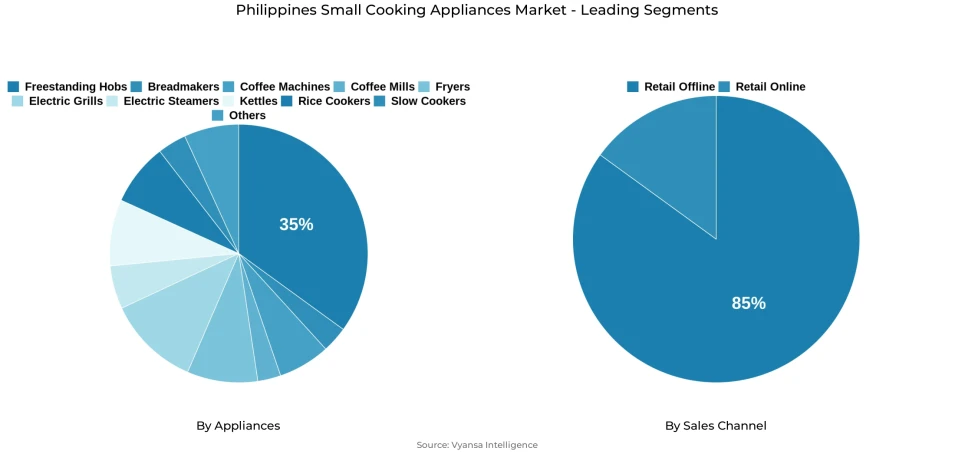
- Freestanding hobs grabbed market share of 35%.
- Competition
- More than 10 companies are actively engaged in producing small cooking appliances in Philippines.
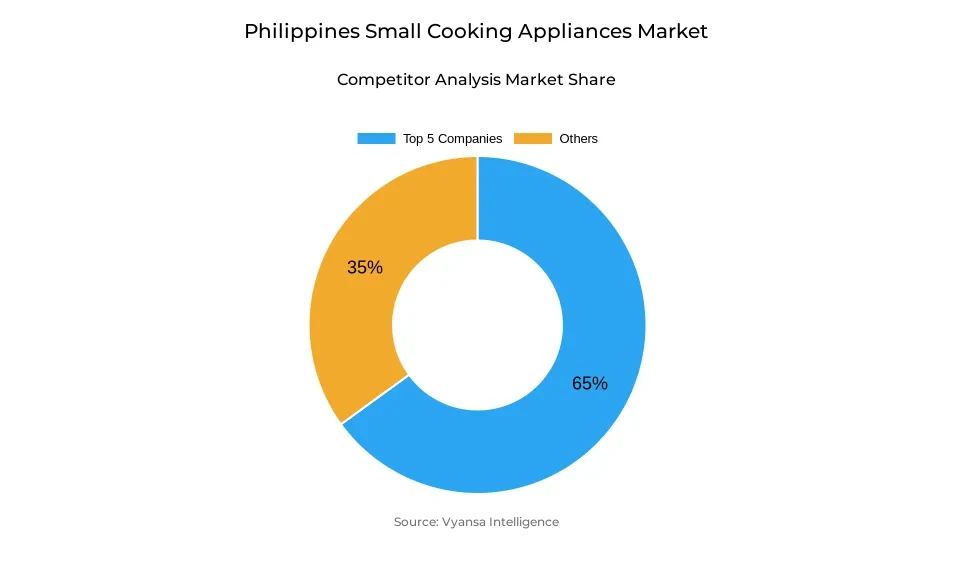
- Top 5 companies acquired around 65% of the market share.
- Union Global Marketing Corp, Philips Electronics & Lighting Inc, Black & Decker Asia Pacific Pte Ltd, Evergood Unlimited Corp, Hanabishi Philippines Inc etc., are few of the top companies.
- Sales Channel
- Retail offline grabbed 85% of the market.
Philippines Small Cooking Appliances Market Outlook
Philippines small cooking appliances market size was valued at USD 200 million in 2025 and is projected to grow from USD 210 million in 2026 to USD 225 million by 2032, exhibiting a CAGR of 1.7% during the forecast period. The increase is facilitated by the increase in consumer interest in healthier meal preparation, the growth of awareness of convenient home cooking solutions, and the increased visibility of newer appliance categories via both social media and online retail platforms.
Demand within small cooking appliances remains strongest in products that combine affordability, practicality, and everyday relevance. Freestanding hobs hold the highest share at 35%, supported by their lower unit price and strong suitability for low to middle income households. Air fryers are also attracting attention as consumers increasingly care about body weight, the quality of their diets, and the use of less oil in cooking, and social media is making these products more visible and comprehensible.
At the same time, the performance of small cooking appliances remains shaped by price sensitivity. Numerous consumers remain wary of spending on newer or more high end products, which continues to place cheaper entry level appliances in a better position than more expensive innovative models. Nevertheless, newer categories are gaining visibility through direct to consumer brands and e-commerce with low prices, regular discounts, and robust online promotion to reach more consumers nationwide.
Distribution continues to be led by physical stores, with retail offline accounting for 85% of the market. A lot of consumers still want to touch and feel the quality of the products, compare models, and make a purchase decision face to face, particularly when price and durability are the most important factors. At the same time, small cooking appliances are also seeing upgrade opportunities in categories such as rice cookers and multifunctional products, where added health, convenience, and compact design features are helping brands attract stronger consumer interest.
Philippines Small Cooking Appliances Market Growth DriverHealth-Focused Cooking Boosts Air Fryer Adoption
Healthier eating is becoming a strong demand driver for small cooking appliances in the Philippines. The consumers are increasingly concerned with body weight, quality of diet, and convenient meal preparation, and this keeps the air fryers in the limelight. This change is also facilitated by social media, where influencers and home cooks frequently post simple recipes and cooking tips that make air fryers seem viable, easy, and helpful in the daily life of the home.
This direction is supported by official health data. According to the 2024 Field Health Services Information System (FHSIS), 656,115 Filipinos have diabetes. This strengthens the consumer interest in appliances associated with less oil cooking and healthier food preparation. Air fryers are also enjoying this health background since they are being perceived as a convenient means of cooking meals with minimal oil consumption and still fitting into the hectic daily schedules.
Philippines Small Cooking Appliances Market ChallengePrice Sensitivity Limits Premium Product Uptake
One of the biggest challenges in the Philippines is price sensitivity. A large number of consumers remain wary of spending excessively on newer appliances, particularly in areas like air fryers and espresso machines where product familiarity remains immature. This explains the improved performance of low end models, whereas more expensive innovative products are experiencing slower adoption even though more people are becoming interested in healthier cooking and making coffee at home.
This pressure is reflected in official consumer sentiment data. In the BSP Q2 2025 Consumer Expectations Survey, the inflation rate diffusion index is 43.0 and the peso borrowing rate index is 26.1, with the central bank indicating that weaker confidence is associated with increased inflation and reduced household income. This atmosphere continues to make Filipino consumers preoccupied with low cost appliances and deals instead of high cost upgrades.
Unlock Market Intelligence
Explore the market potential with our data-driven report
Philippines Small Cooking Appliances Market TrendD2C and E-Commerce Are Reshaping Category Growth
Online retail and direct to consumer brands are a significant trend in the Philippines. Newer products like air fryers are being made known to people through low prices, regular discounts, and high social media activity by brands like Gaabor and Simplus. This is not only assisting newer categories of appliances to reach more consumers even in smaller cities but also altering the way buyers compare features, prices and promotions prior to purchase.
ICT data provided by the government promotes this change. A Philippine Statistics Authority (PSA) linked response on the Philippine government’s FOI portal states that 48.8% of households had internet connection in 2024, and two in every three individuals aged 10 years and over used the internet. This broader digital presence is assisting e-commerce and D2C brands to create awareness and speed up the adoption of appliances nationwide.
Philippines Small Cooking Appliances Market OpportunityUpgrade Demand Opens Room for Smart Kitchen Innovation
Philippines is experiencing a good opportunity in upgrade demand particularly in rice cookers and other multifunctional appliances that have health and convenience claims. Low sugar cooking, multiple settings, smartphone control, and compact design are some of the features that consumers are seeking in their products. This leaves room to newer brands to capture share fast, particularly when they are more functional and at a lower price than the local established brands.
Wider economic statistics substantiate this introduction. The World Bank reports that the Philippines records 5.7% GDP growth in 2024, while GDP per capita reaches USD 3,984.8. This rising economic environment is favorable to consumer readiness to upgrade their basic appliances to more feature enhanced models, particularly in those segments where product innovation is becoming simpler to compare via e-commerce and digital content.
Unlock Market Intelligence
Explore the market potential with our data-driven report
Philippines Small Cooking Appliances Market Segmentation Analysis
By Appliances
- Breadmakers
- Coffee Machines
- Standard Coffee Machines
- Espresso Coffee Machines
- Filter Coffee Machines
- Pod Coffee Machines
- Hard Pods
- Soft Pods
- Standard Coffee Machines
- Coffee Mills
- Fryers
- Air Fryers
- Oil Based Fryers
- Electric Grills
- Electric Steamers
- Freestanding Hobs
- Gas
- Induction
- Standard Electric
- Mixed
- Vitroceramic
- Kettles
- Rice Cookers
- Slow Cookers
- Others
The segment with the highest share under the appliance category is freestanding hobs, holding around 35% of the market. This market leadership is attributed to their low unit price and high appropriateness to the requirements of low to middle income families in the Philippines. They are more affordable, practical and convenient to use in daily cooking habits than built in hobs or cookers, which many consumers prefer.
Freestanding hobs are also significant since they are compatible with the local kitchen habits. Although households may upgrade to built in formats, a large number of households retain a freestanding hob to provide additional cooking flexibility. Their application is also supported by the popularity of dirty kitchens where families cook messier or smelly meals separately. This high practical value assists freestanding hobs to stay ahead of the category.
By Sales Channel
- Retail Offline
- Grocery Retailers
- Hypermarkets
- Non-Grocery Retailers
- General Merchandise Stores
- Department Stores
- Variety Stores
- Appliances and Electronics Specialists
- Home Products Specialists
- Grocery Retailers
- Retail Online
The segment with the highest share under the sales channel category is retail offline, accounting for around 85% of the market. The physical stores are the primary channel of purchase since a significant number of consumers still want to examine the quality of products, compare models, and make purchases in physical stores. This is particularly applicable to household appliances where cost, longevity, and instant knowledge on product characteristics play a significant role in the ultimate decision.
The offline channels also enjoy the fact that there are already local brands like Hanabishi and Imarflex that are already trusted by the Filipino households. Although e-commerce is gaining significance, the physical stores remain at the top since they offer direct product visibility, easier price comparison, and greater consumer confidence at the point of purchase.
List of Companies Covered in Philippines Small Cooking Appliances Market
The companies listed below are highly influential in the Philippines small cooking appliances market, with a significant market share and a strong impact on industry developments.
- Union Global Marketing Corp
- Philips Electronics & Lighting Inc
- Black & Decker Asia Pacific Pte Ltd
- Evergood Unlimited Corp
- Hanabishi Philippines Inc
- Northern Islands Co Inc
- Asahi Electric Mfg Corp
- Bertazzoni SpA
- Simplus Networks Pte Ltd
- United Gain Ltd
Competitive Landscape
In 2025, small cooking appliances in the Philippines recorded strong growth in retail volume terms, driven by rising health awareness, increasing adoption of air fryers supported by social media influence, and a growing coffee culture encouraging demand for coffee machines, while affordability and e-commerce expansion continued to shape purchasing behaviour, particularly with the rise of D2C brands offering low-priced products; within this evolving landscape, Evergood Unlimited Corp emerged as the leading player, while Hanabishi Philippines Inc followed closely, leveraging strong brand recognition, extensive distribution, and competitive pricing strategies to maintain their positions despite increasing competition from new entrants and digital-first brands.
Frequently Asked Questions
Related Report
- Market Segmentation
- Research Scope
- Research Methodology
- Definitions and Assumptions
- Executive Summary
- Philippines Small Cooking Appliances Market Policies, Regulations, and Standards
- Philippines Small Cooking Appliances Market Dynamics
- Growth Factors
- Challenges
- Trends
- Opportunities
- Philippines Small Cooking Appliances Market Statistics, 2022-2032F
- Market Size & Growth Outlook
- By Revenues in USD Million
- Market Segmentation & Growth Outlook
- By Appliances
- Breadmakers- Market Insights and Forecast 2022-2032, USD Million
- Coffee Machines- Market Insights and Forecast 2022-2032, USD Million
- Standard Coffee Machines- Market Insights and Forecast 2022-2032, USD Million
- Espresso Coffee Machines- Market Insights and Forecast 2022-2032, USD Million
- Filter Coffee Machines- Market Insights and Forecast 2022-2032, USD Million
- Pod Coffee Machines- Market Insights and Forecast 2022-2032, USD Million
- Hard Pods- Market Insights and Forecast 2022-2032, USD Million
- Soft Pods- Market Insights and Forecast 2022-2032, USD Million
- Standard Coffee Machines- Market Insights and Forecast 2022-2032, USD Million
- Coffee Mills- Market Insights and Forecast 2022-2032, USD Million
- Fryers- Market Insights and Forecast 2022-2032, USD Million
- Air Fryers- Market Insights and Forecast 2022-2032, USD Million
- Oil Based Fryers- Market Insights and Forecast 2022-2032, USD Million
- Electric Grills- Market Insights and Forecast 2022-2032, USD Million
- Electric Steamers- Market Insights and Forecast 2022-2032, USD Million
- Freestanding Hobs- Market Insights and Forecast 2022-2032, USD Million
- Gas- Market Insights and Forecast 2022-2032, USD Million
- Induction- Market Insights and Forecast 2022-2032, USD Million
- Standard Electric- Market Insights and Forecast 2022-2032, USD Million
- Mixed- Market Insights and Forecast 2022-2032, USD Million
- Vitroceramic- Market Insights and Forecast 2022-2032, USD Million
- Kettles- Market Insights and Forecast 2022-2032, USD Million
- Rice Cookers- Market Insights and Forecast 2022-2032, USD Million
- Slow Cookers- Market Insights and Forecast 2022-2032, USD Million
- Others- Market Insights and Forecast 2022-2032, USD Million
- By Sales Channel
- Retail Offline- Market Insights and Forecast 2022-2032, USD Million
- Grocery Retailers- Market Insights and Forecast 2022-2032, USD Million
- Hypermarkets- Market Insights and Forecast 2022-2032, USD Million
- Non-Grocery Retailers- Market Insights and Forecast 2022-2032, USD Million
- General Merchandise Stores- Market Insights and Forecast 2022-2032, USD Million
- Department Stores- Market Insights and Forecast 2022-2032, USD Million
- Variety Stores- Market Insights and Forecast 2022-2032, USD Million
- Appliances and Electronics Specialists- Market Insights and Forecast 2022-2032, USD Million
- Home Products Specialists- Market Insights and Forecast 2022-2032, USD Million
- Grocery Retailers- Market Insights and Forecast 2022-2032, USD Million
- Retail Online- Market Insights and Forecast 2022-2032, USD Million
- Retail Offline- Market Insights and Forecast 2022-2032, USD Million
- By Competitors
- Competition Characteristics
- Market Share & Analysis
- By Appliances
- Market Size & Growth Outlook
- Philippines Breadmakers Market Statistics, 2022-2032
- Market Size & Growth Outlook
- By Revenues in USD Million
- Market Segmentation & Growth Outlook
- By Sales Channel- Market Insights and Forecast 2022-2032, USD Million
- Market Size & Growth Outlook
- Philippines Coffee Machines Market Statistics, 2022-2032
- Market Size & Growth Outlook
- By Revenues in USD Million
- Market Segmentation & Growth Outlook
- By Sales Channel- Market Insights and Forecast 2022-2032, USD Million
- Market Size & Growth Outlook
- Philippines Coffee Mills Market Statistics, 2022-2032
- Market Size & Growth Outlook
- By Revenues in USD Million
- Market Segmentation & Growth Outlook
- By Sales Channel- Market Insights and Forecast 2022-2032, USD Million
- Market Size & Growth Outlook
- Philippines Fryers Market Statistics, 2022-2032
- Market Size & Growth Outlook
- By Revenues in USD Million
- Market Segmentation & Growth Outlook
- By Sales Channel- Market Insights and Forecast 2022-2032, USD Million
- Market Size & Growth Outlook
- Philippines Electric Grills Market Statistics, 2022-2032
- Market Size & Growth Outlook
- By Revenues in USD Million
- Market Segmentation & Growth Outlook
- By Sales Channel- Market Insights and Forecast 2022-2032, USD Million
- Market Size & Growth Outlook
- Philippines Electric Steamers Market Statistics, 2022-2032
- Market Size & Growth Outlook
- By Revenues in USD Million
- Market Segmentation & Growth Outlook
- By Sales Channel- Market Insights and Forecast 2022-2032, USD Million
- Market Size & Growth Outlook
- Philippines Freestanding Hobs Market Statistics, 2022-2032
- Market Size & Growth Outlook
- By Revenues in USD Million
- Market Segmentation & Growth Outlook
- By Sales Channel- Market Insights and Forecast 2022-2032, USD Million
- Market Size & Growth Outlook
- Philippines Kettles Market Statistics, 2022-2032
- Market Size & Growth Outlook
- By Revenues in USD Million
- Market Segmentation & Growth Outlook
- By Sales Channel- Market Insights and Forecast 2022-2032, USD Million
- Market Size & Growth Outlook
- Philippines Rice Cookers Market Statistics, 2022-2032
- Market Size & Growth Outlook
- By Revenues in USD Million
- Market Segmentation & Growth Outlook
- By Sales Channel- Market Insights and Forecast 2022-2032, USD Million
- Market Size & Growth Outlook
- Philippines Slow Cookers Market Statistics, 2022-2032
- Market Size & Growth Outlook
- By Revenues in USD Million
- Market Segmentation & Growth Outlook
- By Sales Channel- Market Insights and Forecast 2022-2032, USD Million
- Market Size & Growth Outlook
- Competitive Outlook
- Company Profiles
- Hanabishi Philippines Inc
- Business Description
- Product Portfolio
- Collaborations & Alliances
- Recent Developments
- Financial Details
- Others
- Northern Islands Co Inc
- Business Description
- Product Portfolio
- Collaborations & Alliances
- Recent Developments
- Financial Details
- Others
- Asahi Electric Mfg Corp
- Business Description
- Product Portfolio
- Collaborations & Alliances
- Recent Developments
- Financial Details
- Others
- Bertazzoni SpA
- Business Description
- Product Portfolio
- Collaborations & Alliances
- Recent Developments
- Financial Details
- Others
- Union Global Marketing Corp
- Business Description
- Product Portfolio
- Collaborations & Alliances
- Recent Developments
- Financial Details
- Others
- Philips Electronics & Lighting Inc
- Business Description
- Product Portfolio
- Collaborations & Alliances
- Recent Developments
- Financial Details
- Others
- Black & Decker Asia Pacific Pte Ltd
- Business Description
- Product Portfolio
- Collaborations & Alliances
- Recent Developments
- Financial Details
- Others
- Simplus Networks Pte Ltd
- Business Description
- Product Portfolio
- Collaborations & Alliances
- Recent Developments
- Financial Details
- Others
- United Gain Ltd
- Business Description
- Product Portfolio
- Collaborations & Alliances
- Recent Developments
- Financial Details
- Others
- Sharp (Phils) Corp
- Business Description
- Product Portfolio
- Collaborations & Alliances
- Recent Developments
- Financial Details
- Others
- Hanabishi Philippines Inc
- Company Profiles
- Disclaimer
| Segment | Sub-Segment |
|---|---|
| By Appliances |
|
| By Sales Channel |
|
Research Methodology
This study followed a structured approach comprising four key phases to assess the size and scope of the electro-oxidation market. The process began with thorough secondary research to collect data on the target market, related markets, and broader industry context. These findings, along with preliminary assumptions and estimates, were then validated through extensive primary research involving industry experts from across the value chain. To calculate the overall market size, both top-down and bottom-up methodologies were employed. Finally, market segmentation and data triangulation techniques were applied to refine and validate segment-level estimations.
Secondary Research
The secondary research phase involved gathering data from a wide range of credible and published sources. This step helped in identifying industry trends, defining market segmentation, and understanding the market landscape and value chain.
Sources consulted during this phase included:
- Company annual reports, investor presentations, and press releases
- Industry white papers and certified publications
- Trade directories and market-recognized databases
- Articles from authoritative authors and reputable journals
- Gold and silver standard websites
Secondary research was critical in mapping out the industry's value chain and monetary flow, identifying key market segments, understanding regional variations, and tracking significant industry developments.
Other key sources:
- Financial disclosures
- Industry associations and trade bodies
- News outlets and business magazines
- Academic journals and research studies
- Paid industry databases
Primary Research
To validate secondary data and gain deeper market insights, primary research was conducted with key stakeholders across both the supply and demand sides of the market.
On the demand side, participants included decision-makers and influencers from end-user industries—such as CIOs, CTOs, and CSOs—who provided first-hand perspectives on market needs, product usage, and future expectations.
On the supply side, interviews were conducted with manufacturers, industry associations, and institutional participants to gather insights into current offerings, product pipelines, and market challenges.
Primary interviews provided critical inputs such as:
- Market size and revenue data
- Product and service breakdowns
- Market forecasts
- Regional and application-specific trends
Stakeholders consulted included:
- Leading OEM and solution providers
- Channel and distribution partners
- End users across various applications
- Independent consultants and industry specialists
Market Size Estimation and Data Triangulation
- Identifying Key Market Participants (Secondary Research)
- Goal: To identify the major players or companies in the target market. This typically involves using publicly available data sources such as industry reports, market research publications, and financial statements of companies.
- Tools: Reports from firms like Gartner, Forrester, Euromonitor, Statista, IBISWorld, and others. Public financial statements, news articles, and press releases from top market players.
- Extracting Earnings of Key Market Participants
- Goal: To estimate the earnings generated from the product or service being analyzed. This step helps in understanding the revenue potential of each market player in a specific geography.
- Methods: Earnings data can be gathered from:
- Publicly available financial reports (for listed companies).
- Interviews and primary data sources from professionals, such as Directors, VPs, SVPs, etc. This is especially useful for understanding more nuanced, internal data that isn't publicly disclosed.
- Annual reports and investor presentations of key players.
- Data Collation and Development of a Relevant Data Model
- Goal: To collate inputs from both primary and secondary sources into a structured, data-driven model for market estimation. This model will incorporate key market KPIs and any independent variables relevant to the market.
- Key KPIs: These could include:
- Market size, growth rate, and demand drivers.
- Industry-specific metrics like market share, average revenue per customer (ARPC), or average deal size.
- External variables, such as economic growth rates, inflation rates, or commodity prices, that could affect the market.
- Data Modeling: Based on this data, the market forecasts are developed for the next 5 years. A combination of trend analysis, scenario modeling, and statistical regression might be used to generate projections.
- Scenario Analysis
- Goal: To test different assumptions and validate how sensitive the market is to changes in key variables (e.g., market demand, regulatory changes, technological disruptions).
- Types of Scenarios:
- Base Case: Based on current assumptions and historical data.
- Best-Case Scenario: Assuming favorable market conditions, regulatory environments, and technological advancements.
- Worst-Case Scenario: Accounting for adverse factors, such as economic downturns, stricter regulations, or unexpected disruptions.












