Philippines Juice Market Report: Trends, Growth and Forecast (2026-2032)
By Category (100% Juice (Not from Concentrate, Reconstituted), Juice Drinks (up to 24% Juice), Nectars (High Concentration (40% to 50% fruit content), Medium Concentration (30% to 39% fruit content), Low Concentration (25% to 29% fruit content)), Vegetable Juice, Fruit and Vegetable Blends), By Nature (Conventional, Organic), By Packaging Material (Plastic, Glass, Metal, Others), By Packaging Type (PET Bottles, Aseptic Packages (Cartons), Glass Bottles, Metal Cans, Disposable Cups & Pouches), By Sales Channel (Off-Trade (Hypermarkets/ Supermarkets, Retail Outlets, Convenience Stores, Online Platforms), On-Trade) ... Read more

|
Major Players
|
Philippines Juice Market Statistics and Insights, 2026
- Market Size Statistics
- Juice market size in Philippines was estimated at USD 785 million in 2025.
- The market size is expected to grow to USD 1.12 billion by 2032.
- Market to register a CAGR of around 5.21% during 2026-32.
- Category Shares
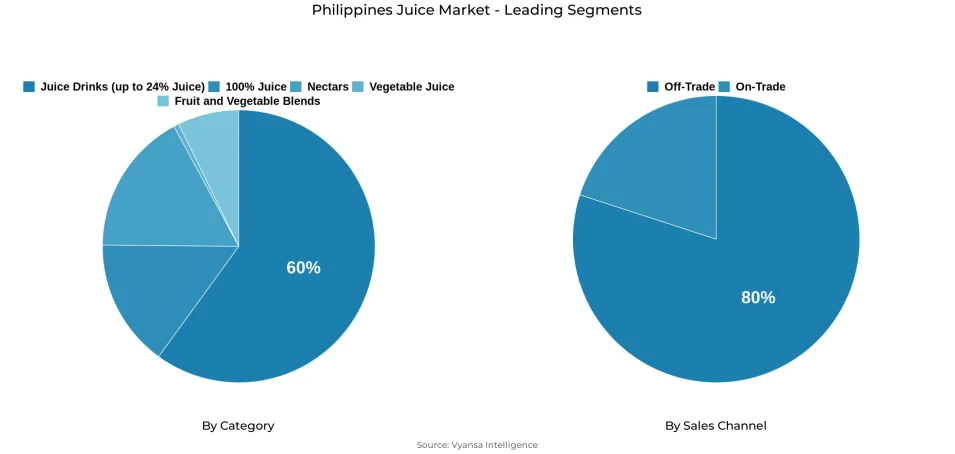
- Juice drinks (up to 24% juice) grabbed market share of 60%.
- Competition
- More than 15 companies are actively engaged in producing juice in Philippines.
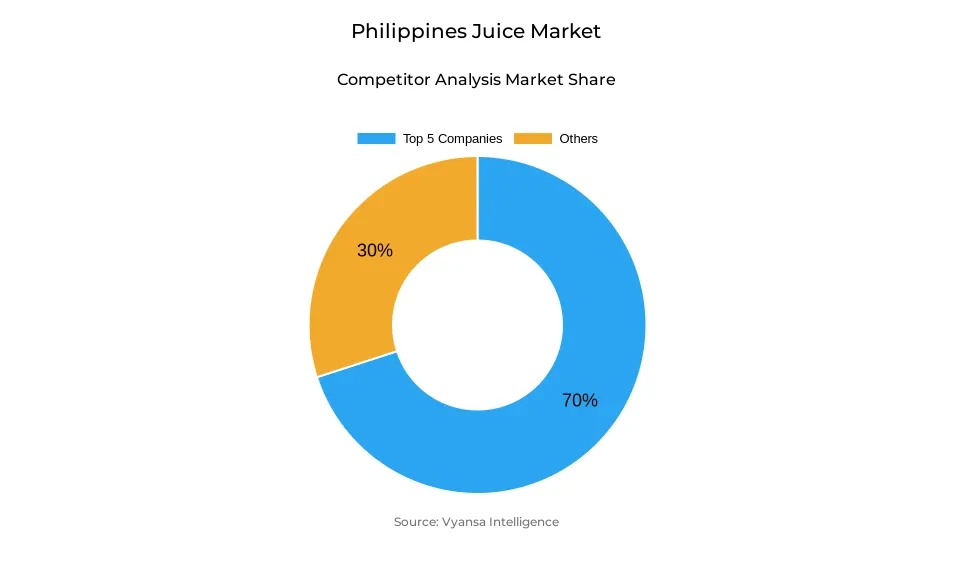
- Top 5 companies acquired around 70% of the market share.
- Ginebra San Miguel Inc, RFM Corp, Sappe Plc Co Ltd, Del Monte Philippines Inc, Zest-O Corp etc., are few of the top companies.
- Sales Channel
- Off-trade grabbed 80% of the market.
Philippines Juice Market Outlook
The Philippines juice market is undergoing a strong growth, which is caused by the increasing number of working-age population and the increased attention to health and wellness. The market is estimated to reach USD 785 million in 2025 and USD 1.12 billion in 2032 with a healthy CAGR of about 5.21% in the 2026-32 period. Although juice drinks continue to be the main volume driver because of their affordability, 100% juice is also making inroads with brands like Del Monte and Dole successfully marketing functional benefits like heart health and immunity.
One of the reasons behind this growth is the demographic sweet spot of the Philippines. By 2026, the nation will have a huge working-age population (approximately 67.1% of the total 116.8 million individuals), which is a colossal pool of time-starved, on-the-go end users. The success of new, functional juice products like C-Vitt (high Vitamin C) and Mogu Mogu, which frequently rely on pop-culture partnerships and distinctive flavours to appeal to younger, trendy end users, reflects this demographic change.
Competitive environment is characterized by the dominance of Del Monte Philippines that sustains the leadership with a wide range of heart-healthy pineapple juices and new citrus blends. In the meantime, Coca-Cola Beverages Philippines has become an active participant by using influencer marketing to make its MinuteMaid brand an aspirational lifestyle brand. Nevertheless, the industry is under mounting pressure due to fresh-juice and smoothie chains, including Jamba Juice and local competitors like Malaysia-based Being Juice, which focus on natural products and authenticity.
The Off-Trade channel remains dominant, with the large majority of sales. Although the traditional sari-sari stores still form the main distribution channel of the affordable, single-serve juice formats, the forecourt retailers are the most vibrant channel, which is capturing the demands of commuters and travellers. In the future, regulatory issues about sugar content could drive brands to more natural, less-sugary reformulations to retain their popularity in an increasingly health-conscious population.
Philippines Juice Market Growth DriverHealth Awareness Sustains Everyday Juice Demand
The increasing health and wellness consciousness keeps the juice relevant since most households consider it to be a better substitute to the carbonated soft drinks. According to the World Health Organization, non-communicable diseases cause 70% of all deaths in the Philippines, and cardiovascular disease causes about one in three deaths in this group; therefore, heart health and immunity continue to be the primary factors in the choice of beverages. This high disease burden creates structural pressure on beverages that are framed as health-oriented and consistent with preventive wellness concerns.
Brands protect prices and improve product mix by health-led communication and functional positioning, which helps to promote better value growth in retail. end users are demanding more natural beverage substitutes. Low-end juice products maintain appeal with flavour assortment and convenient pack designs, and incumbents use purity and heart-healthy positioning to position 100% juice as part of daily wellness. The health-based demand provides a favourable environment towards premium juice positioning and value development. Authentic functional benefits and open health communication can be used to attract health-conscious end users who are navigating beverage options in the chronic disease-prone end user environment of the Philippines.
Philippines Juice Market ChallengeFresh Chains and Meal Bundles Intensify Competition
Packaged juice is facing mounting competition in foodservice where ready-to-drink tea and carbonated beverages are being added to meal packages, thus diminishing the presence of juice at critical consumption events. This is an important dynamic since out-of-home eating is still active. According to the Philippine Statistics Authority, the accommodation and food-service activity increased by 10.4% in 2024, which supports the powerful impact of foodservice channels on the formation of beverage preferences and consumption patterns in the country.
At the same time, fresh-juice and smoothie chains are growing, which encourages natural, made-to-order positioning that directly competes with the packaged health propositions. New competitors and local brands establish stores and partner with celebrities to appeal to trend-following end users, forcing packaged-juice players to create more articulate health propositions, convenient formats, and competitive prices as they protect space in mainstream retail stores. Expanding foodservice channel and expanding fresh juice pose two competitive forces that demand strategic differentiation by authentic health positioning, format innovation, and price competitiveness to remain relevant in packaged-juice against more and more capable fresh-prepared substitutes.
Unlock Market Intelligence
Explore the market potential with our data-driven report
Philippines Juice Market TrendDigital-First Marketing Accelerates Brand Visibility
Philippine juice brands are increasingly turning to digital platforms to create awareness and trial, with back-to-school campaigns, influencer relationships, and celebrity relationships as key tactics to keep the brands visible in saturated soft-drink segments. This is a manifestation of the underlying changes in end user product discovery, as social platforms are being used as viable search engines of flavours, functionality, and daily usage occasions across demographic groups. Digital-first marketing is not only becoming a necessity, but also a complement in the competitive beverage environment.
According to World Bank data, 84% of the Philippine population accessed the internet in 2023, which means that brands can target particular moments and audiences with personalised content and promotions. On-the-go formats and new flavours are launched faster with the help of digital campaigns. Brands justify pricing by enhancing product mix and strengthening health cues with short-form video, creator-led reviews, and lifestyle stories. Digital trend is the essential shift in the end user engagement strategies, with the focus on platform-specific content, influencer authenticity, and personalised communication. Those brands with high digital marketing and strong networks of creators are well placed to stay relevant to end users and category active in the highly connected, trend-following market of the Philippines.
Philippines Juice Market OpportunityCoconut Water Expands Functional Growth
Natural and functional drinks have been experiencing a significant momentum, and coconut water is at the crossroads of hydration and health advantages. The Philippines has the supply base to scale this sub-category successfully. Coconut production is reported by the Department of Agriculture to be 14.77 1/2 metric tons in 2024, which is supporting the growth of packaged coconut water as processors invest in capacity and enhance supply reliability. The scale of domestic production generates competitive advantages to local manufacturers by providing access to raw-materials.
This opens up the possibility of brands to create on-the-go formats and functional positioning that fits daily wellness routines without sacrificing affordable price points. New processing plants and long-term value-chain relationships enhance the confidence to introduce more flavours, blends and multipacks. This would attract end users who want natural substitutes to ready-to-drink tea and carbonated drinks, and compete favorably with fresh smoothie chains with convenient shelf-stable products. The opportunity of coconut water allows brands to tap into domestic agricultural abundance, capitalise on functional hydration trends and position themselves differently in the wellness-oriented, price-sensitive beverage market in the Philippines, which is estimated to reach USD 1.12 billion by 2032.
Unlock Market Intelligence
Explore the market potential with our data-driven report
Philippines Juice Market Segmentation Analysis
By Category
- 100% Juice
- Not from Concentrate
- Reconstituted
- Juice Drinks (up to 24% Juice)
- Nectars
- High Concentration (40% to 50% fruit content)
- Medium Concentration (30% to 39% fruit content)
- Low Concentration (25% to 29% fruit content)
- Vegetable Juice
- Fruit and Vegetable Blends
The segment that has the largest share in the category division is Juice Drinks (up to 24% of juice), which has a market share of 60%. This leadership is largely due to the affordability of the segment and the wide range of flavours that attract wide Filipino household demographics. These beverages are refreshing, convenient, and perceived healthier substitutes to carbonates, and are affordable within the daily budgets of many end users. The volume anchor of the Philippines juice market is affordability and flavour diversity, which makes juice drinks.
Zest-O Corp and Del Monte are market leaders that have managed to retain this 60% share by innovation in local flavours and development of convenient packaging format. The segment shows a specific dynamism among younger age groups that are interested in new products and marketing campaigns that are energetic. This category will continue to be the volume anchor through the 2032 forecast period, although premium 100% juice options will continue to increase in value via specific health-led messaging and functional positioning. The combination of accessibility, flavour variety, and established distribution networks in juice drinks will guarantee volume leadership despite the changing end user health preferences and competitive premiumisation trends.
By Sales Channel
- Off-Trade
- Hypermarkets/ Supermarkets
- Retail Outlets
- Convenience Stores
- Online Platforms
- On-Trade
The segment that controls the largest portion of the sales channel division is the Off-Trade which controls 80% of the total market sales. Small local grocers, or sari-sari stores, continue to be the backbone of this channel, and are deeply rooted in Filipino communities. These neighbourhood stores are the main channels of the single-serve packs and small formats, which target price-sensitive customers who need to have an immediate refreshment. The 80% share indicates the extent to which these physical retail touchpoints are deeply embedded in the daily buying behavior of the population.
In addition to the conventional outlets, the off-trade channel is developing through the fast development of forecourt retailers in strategic positions along transport routes to access on-the-go markets, and thus are better suited to more premium, convenient juice formats. Although supermarkets and e-commerce are increasingly influential, the high visibility and accessibility of sari-sari stores and convenience outlets make off-trade channels the most powerful in the distribution of juices throughout the archipelago. The combination of community embeddedness, geographic accessibility, and format diversity of the channel forms a strong distribution base that facilitates extensive category penetration and serves both value-oriented and premium product segments with a wide range of retail touchpoints.
List of Companies Covered in Philippines Juice Market
The companies listed below are highly influential in the Philippines juice market, with a significant market share and a strong impact on industry developments.
- Ginebra San Miguel Inc
- RFM Corp
- Sappe Plc Co Ltd
- Del Monte Philippines Inc
- Zest-O Corp
- Pepsi-Cola Products Philippines Inc
- Coca-Cola Beverages Philippines Inc
- Cenmaco Inc
- Dole Philippines Inc
- Hermann Pfanner Getränke GmbH
Competitive Landscape
Philippines juice market is led by Del Monte Philippines, which maintains overall leadership across 100% juice and juice drinks through strong health-led positioning, flavour innovation, and nationwide sari-sari store distribution. Coca-Cola Beverages Philippines is the most dynamic challenger, leveraging influencer-driven marketing to expand Minute Maid Nutri+ and strengthen its appeal among younger, health-conscious consumers. Asia Brewery, with C-Vitt, competes in functional juice drinks, while Mogu Mogu drives engagement through limited editions and pop culture tie-ins. Indirect competition from RTD tea, carbonates, and expanding fresh juice and smoothie chains intensifies pressure. Key differentiation opportunities lie in fortified immunity propositions, lower-sugar reformulations ahead of potential labelling regulation, coconut water expansion, and stronger presence in fast-growing forecourt retail channels.
Frequently Asked Questions
Related Report
- Market Segmentation
- Research Scope
- Research Methodology
- Definitions and Assumptions
- Executive Summary
- Philippines Juice Market Policies, Regulations, and Standards
- Philippines Juice Market Dynamics
- Growth Factors
- Challenges
- Trends
- Opportunities
- Philippines Juice Market Statistics, 2022-2032F
- Market Size & Growth Outlook
- By Revenues in USD Million
- By Quantity Sold in Million Litres
- Market Segmentation & Growth Outlook
- By Category
- 100% Juice- Market Insights and Forecast 2022-2032, USD Million
- Not from Concentrate- Market Insights and Forecast 2022-2032, USD Million
- Reconstituted- Market Insights and Forecast 2022-2032, USD Million
- Juice Drinks (up to 24% Juice)- Market Insights and Forecast 2022-2032, USD Million
- Nectars- Market Insights and Forecast 2022-2032, USD Million
- High Concentration (40% to 50% fruit content)- Market Insights and Forecast 2022-2032, USD Million
- Medium Concentration (30% to 39% fruit content)- Market Insights and Forecast 2022-2032, USD Million
- Low Concentration (25% to 29% fruit content)- Market Insights and Forecast 2022-2032, USD Million
- Vegetable Juice- Market Insights and Forecast 2022-2032, USD Million
- Fruit and Vegetable Blends- Market Insights and Forecast 2022-2032, USD Million
- 100% Juice- Market Insights and Forecast 2022-2032, USD Million
- By Nature
- Conventional- Market Insights and Forecast 2022-2032, USD Million
- Organic- Market Insights and Forecast 2022-2032, USD Million
- By Packaging Material
- Plastic- Market Insights and Forecast 2022-2032, USD Million
- Glass- Market Insights and Forecast 2022-2032, USD Million
- Metal- Market Insights and Forecast 2022-2032, USD Million
- Others- Market Insights and Forecast 2022-2032, USD Million
- By Packaging Type
- PET Bottles- Market Insights and Forecast 2022-2032, USD Million
- Aseptic Packages (Cartons)- Market Insights and Forecast 2022-2032, USD Million
- Glass Bottles- Market Insights and Forecast 2022-2032, USD Million
- Metal Cans- Market Insights and Forecast 2022-2032, USD Million
- Disposable Cups & Pouches- Market Insights and Forecast 2022-2032, USD Million
- By Sales Channel
- Off-Trade- Market Insights and Forecast 2022-2032, USD Million
- Hypermarkets/ Supermarkets - Market Insights and Forecast 2022-2032, USD Million
- Retail Outlets - Market Insights and Forecast 2022-2032, USD Million
- Convenience Stores- Market Insights and Forecast 2022-2032, USD Million
- Online Platforms- Market Insights and Forecast 2022-2032, USD Million
- On-Trade- Market Insights and Forecast 2022-2032, USD Million
- Off-Trade- Market Insights and Forecast 2022-2032, USD Million
- By Competitors
- Competition Characteristics
- Market Share & Analysis
- By Category
- Market Size & Growth Outlook
- Philippines 100% Juice Market Statistics, 2022-2032
- Market Size & Growth Outlook
- By Revenues in USD Million
- By Quantity Sold in Million Litres
- Market Segmentation & Growth Outlook
- By Nature- Market Insights and Forecast 2022-2032, USD Million
- By Packaging Material- Market Insights and Forecast 2022-2032, USD Million
- By Packaging Type- Market Insights and Forecast 2022-2032, USD Million
- By Sales Channel- Market Insights and Forecast 2022-2032, USD Million
- Market Size & Growth Outlook
- Philippines Juice Drinks (up to 24% Juice) Market Statistics, 2022-2032
- Market Size & Growth Outlook
- By Revenues in USD Million
- By Quantity Sold in Million Litres
- Market Segmentation & Growth Outlook
- By Nature- Market Insights and Forecast 2022-2032, USD Million
- By Packaging Material- Market Insights and Forecast 2022-2032, USD Million
- By Packaging Type- Market Insights and Forecast 2022-2032, USD Million
- By Sales Channel- Market Insights and Forecast 2022-2032, USD Million
- Market Size & Growth Outlook
- Philippines Nectars Market Statistics, 2022-2032
- Market Size & Growth Outlook
- By Revenues in USD Million
- By Quantity Sold in Million Litres
- Market Segmentation & Growth Outlook
- By Nature- Market Insights and Forecast 2022-2032, USD Million
- By Packaging Material- Market Insights and Forecast 2022-2032, USD Million
- By Packaging Type- Market Insights and Forecast 2022-2032, USD Million
- By Sales Channel- Market Insights and Forecast 2022-2032, USD Million
- Market Size & Growth Outlook
- Philippines Vegetable Juice Market Statistics, 2022-2032
- Market Size & Growth Outlook
- By Revenues in USD Million
- By Quantity Sold in Million Litres
- Market Segmentation & Growth Outlook
- By Nature- Market Insights and Forecast 2022-2032, USD Million
- By Packaging Material- Market Insights and Forecast 2022-2032, USD Million
- By Packaging Type- Market Insights and Forecast 2022-2032, USD Million
- By Sales Channel- Market Insights and Forecast 2022-2032, USD Million
- Market Size & Growth Outlook
- Philippines Fruit and Vegetable Blends Market Statistics, 2022-2032
- Market Size & Growth Outlook
- By Revenues in USD Million
- By Quantity Sold in Million Litres
- Market Segmentation & Growth Outlook
- By Nature- Market Insights and Forecast 2022-2032, USD Million
- By Packaging Material- Market Insights and Forecast 2022-2032, USD Million
- By Packaging Type- Market Insights and Forecast 2022-2032, USD Million
- By Sales Channel- Market Insights and Forecast 2022-2032, USD Million
- Market Size & Growth Outlook
- Competitive Outlook
- Company Profiles
- Del Monte Philippines Inc
- Business Description
- Product Portfolio
- Collaborations & Alliances
- Recent Developments
- Financial Details
- Others
- Zest-O Corp
- Business Description
- Product Portfolio
- Collaborations & Alliances
- Recent Developments
- Financial Details
- Others
- Pepsi-Cola Products Philippines Inc
- Business Description
- Product Portfolio
- Collaborations & Alliances
- Recent Developments
- Financial Details
- Others
- Coca-Cola Beverages Philippines Inc
- Business Description
- Product Portfolio
- Collaborations & Alliances
- Recent Developments
- Financial Details
- Others
- Cenmaco Inc
- Business Description
- Product Portfolio
- Collaborations & Alliances
- Recent Developments
- Financial Details
- Others
- Ginebra San Miguel Inc
- Business Description
- Product Portfolio
- Collaborations & Alliances
- Recent Developments
- Financial Details
- Others
- RFM Corp
- Business Description
- Product Portfolio
- Collaborations & Alliances
- Recent Developments
- Financial Details
- Others
- Sappe Plc Co Ltd
- Business Description
- Product Portfolio
- Collaborations & Alliances
- Recent Developments
- Financial Details
- Others
- Dole Philippines Inc
- Business Description
- Product Portfolio
- Collaborations & Alliances
- Recent Developments
- Financial Details
- Others
- Pfanner Getränke GmbH Hermann
- Business Description
- Product Portfolio
- Collaborations & Alliances
- Recent Developments
- Financial Details
- Others
- Del Monte Philippines Inc
- Company Profiles
- Disclaimer
| Segment | Sub-Segment |
|---|---|
| By Category |
|
| By Nature |
|
| By Packaging Material |
|
| By Packaging Type |
|
| By Sales Channel |
|
Research Methodology
This study followed a structured approach comprising four key phases to assess the size and scope of the electro-oxidation market. The process began with thorough secondary research to collect data on the target market, related markets, and broader industry context. These findings, along with preliminary assumptions and estimates, were then validated through extensive primary research involving industry experts from across the value chain. To calculate the overall market size, both top-down and bottom-up methodologies were employed. Finally, market segmentation and data triangulation techniques were applied to refine and validate segment-level estimations.
Secondary Research
The secondary research phase involved gathering data from a wide range of credible and published sources. This step helped in identifying industry trends, defining market segmentation, and understanding the market landscape and value chain.
Sources consulted during this phase included:
- Company annual reports, investor presentations, and press releases
- Industry white papers and certified publications
- Trade directories and market-recognized databases
- Articles from authoritative authors and reputable journals
- Gold and silver standard websites
Secondary research was critical in mapping out the industry's value chain and monetary flow, identifying key market segments, understanding regional variations, and tracking significant industry developments.
Other key sources:
- Financial disclosures
- Industry associations and trade bodies
- News outlets and business magazines
- Academic journals and research studies
- Paid industry databases
Primary Research
To validate secondary data and gain deeper market insights, primary research was conducted with key stakeholders across both the supply and demand sides of the market.
On the demand side, participants included decision-makers and influencers from end-user industries—such as CIOs, CTOs, and CSOs—who provided first-hand perspectives on market needs, product usage, and future expectations.
On the supply side, interviews were conducted with manufacturers, industry associations, and institutional participants to gather insights into current offerings, product pipelines, and market challenges.
Primary interviews provided critical inputs such as:
- Market size and revenue data
- Product and service breakdowns
- Market forecasts
- Regional and application-specific trends
Stakeholders consulted included:
- Leading OEM and solution providers
- Channel and distribution partners
- End users across various applications
- Independent consultants and industry specialists
Market Size Estimation and Data Triangulation
- Identifying Key Market Participants (Secondary Research)
- Goal: To identify the major players or companies in the target market. This typically involves using publicly available data sources such as industry reports, market research publications, and financial statements of companies.
- Tools: Reports from firms like Gartner, Forrester, Euromonitor, Statista, IBISWorld, and others. Public financial statements, news articles, and press releases from top market players.
- Extracting Earnings of Key Market Participants
- Goal: To estimate the earnings generated from the product or service being analyzed. This step helps in understanding the revenue potential of each market player in a specific geography.
- Methods: Earnings data can be gathered from:
- Publicly available financial reports (for listed companies).
- Interviews and primary data sources from professionals, such as Directors, VPs, SVPs, etc. This is especially useful for understanding more nuanced, internal data that isn't publicly disclosed.
- Annual reports and investor presentations of key players.
- Data Collation and Development of a Relevant Data Model
- Goal: To collate inputs from both primary and secondary sources into a structured, data-driven model for market estimation. This model will incorporate key market KPIs and any independent variables relevant to the market.
- Key KPIs: These could include:
- Market size, growth rate, and demand drivers.
- Industry-specific metrics like market share, average revenue per customer (ARPC), or average deal size.
- External variables, such as economic growth rates, inflation rates, or commodity prices, that could affect the market.
- Data Modeling: Based on this data, the market forecasts are developed for the next 5 years. A combination of trend analysis, scenario modeling, and statistical regression might be used to generate projections.
- Scenario Analysis
- Goal: To test different assumptions and validate how sensitive the market is to changes in key variables (e.g., market demand, regulatory changes, technological disruptions).
- Types of Scenarios:
- Base Case: Based on current assumptions and historical data.
- Best-Case Scenario: Assuming favorable market conditions, regulatory environments, and technological advancements.
- Worst-Case Scenario: Accounting for adverse factors, such as economic downturns, stricter regulations, or unexpected disruptions.












