Philippines Beer Market Report: Trends, Growth and Forecast (2026-2032)
Product Type (Dark Beer (Ale, Sorghum Beer, Weissbier/Weizen/Wheat Beer), Lager (Flavoured/Mixed Lager, Standard Lager (Premium Lager (Domestic Premium Lager, Imported Premium Lager), Mid-Priced Lager (Domestic Mid-Priced Lager, Imported Mid-Priced Lager), Economy Lager (Domestic Economy Lager, Imported Economy Lager))), Non/Low Alcohol Beer (Low Alcohol Beer, Non Alcoholic Beer), Stout, Others (Porter, Malt etc.)), Production (Macro Brewery, Micro Brewery, Craft Brewery), Packaging Type (Bottles, Cans, Others), Sales Channel (On-Trade, Off-Trade) ... Read more
|
Major Players
|
Philippines Beer Market Statistics and Insights, 2026
- Market Size Statistics
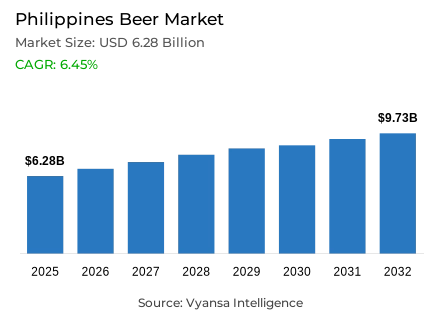
- Beer in Philippines is estimated at USD 6.28 billion.
- The market size is expected to grow to USD 9.73 billion by 2032.
- Market to register a cagr of around 6.45% during 2026-32.
- Product Type Shares
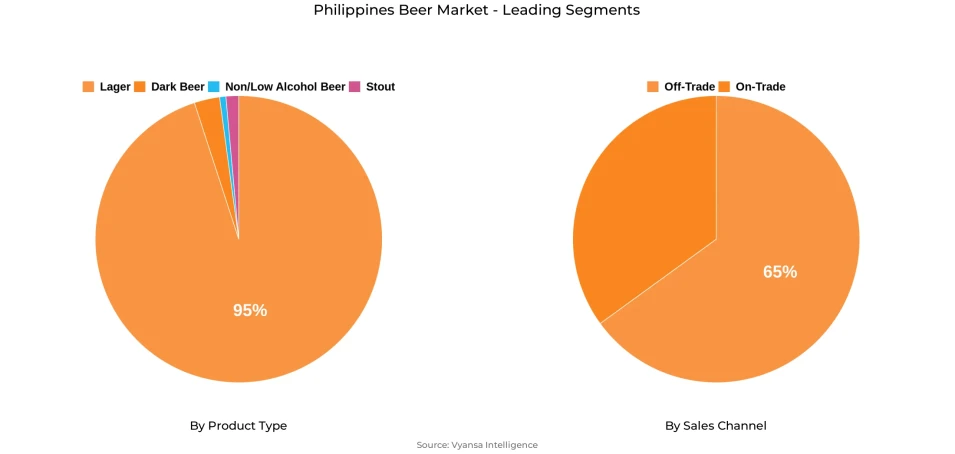
- Lager grabbed market share of 95%.
- Lager to witness a volume cagr of around 5.27%.
- Competition
- More than 5 companies are actively engaged in producing beer in Philippines.
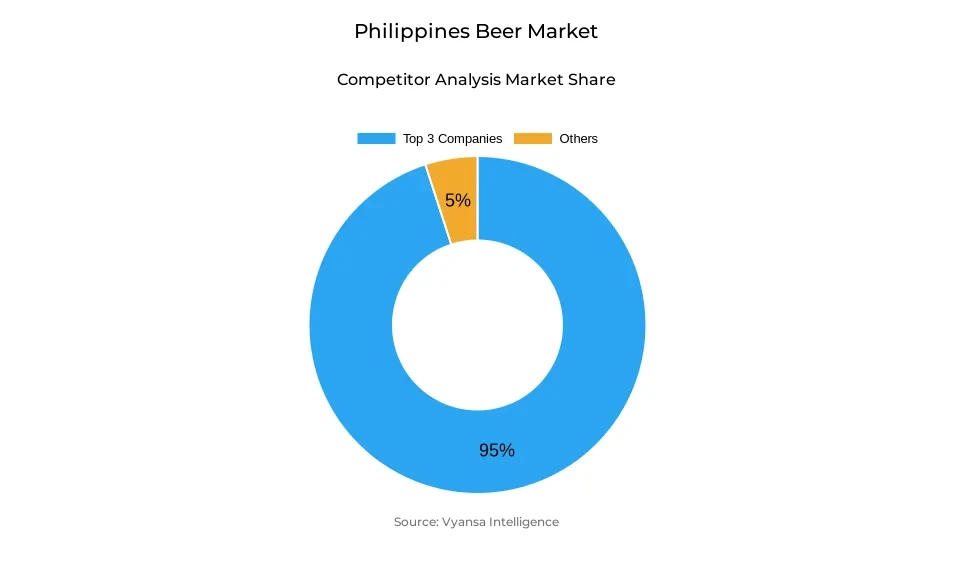
- Top 3 companies acquired around 95% of the market share.
- AB Heineken Philippines Inc; San Miguel Brewery Inc; Asia Brewery Inc etc., are few of the top companies.
- Sales Channel
- Off-trade grabbed 65% of the market.
Philippines Beer Market Outlook
The Philippines Beer market, at USD 6.28 billion in 2025, will grow to USD 9.73 billion by 2032, at a CAGR of around 6.45% between 2026–2032. The gradual growth of the market will be augmented by bettering economic conditions, a youth population, and active brand participation by large brewers. As events, social occasions, and tourism pick up pace, beer consumption will also improve, particularly as existing players step up their promotional and advertising activities.
Lager will remain the market leader, with a share of around 95% of the total sales, bolstered by the unrivaled brand equity and countrywide distribution networks of San Miguel Brewery Inc and Asia Brewery Inc, who collectively possess about 95% of the market share. Local mid-priced lager, dominated by San Miguel Pale Pilsen and Red Horse, will still be the cornerstone of the category, while premium lager—both local and imported—will take advantage as increased disposable incomes and premiumisation trends dominate end-user choices.
Increased middle class and new lifestyle trends will further propel on-premises drinking, while off-trade channels, which made up 65% of total sales, will continue to dominate as sari-sari stores and supermarkets retain their strength. Longer e-commerce platforms like San Miguel Beer Delivers will also increase product availability and convenience, especially in urban locations.
Innovation will be instrumental in underpinning long-term growth. Brewers will grow flavoured/mixed and non-alcoholic beer lines to target the sober curious and health-conscious end users. San Miguel Zero and Heineken 0.0 will drive capture of this new segment, as premium imports such as Asahi and Corona maintain their appeal for aspirational end users looking for variety and quality.
Philippines Beer Market Growth DriverEconomic Recovery and Growing Middle-Class Population Drive Beer Demand
The Philippines beer market remains in the grip of bettering economic prospects and increasing middle-class demand. As disposable incomes continue to rise, end users are increasingly spending more on spirits and reviving social drinking occasions at restaurants and bars. The resurgence in on-trade drinking, coupled with successful marketing by top brands Red Horse and San Miguel Pale Pilsen, further underpin sales around the country.
Besides, a thriving labour market and increased availability of products through powerful distribution networks are driving total consumption. San Miguel Brewery, which boasts an extensive range of low-priced beers, is able to meet varied local preferences. Domestic mid-prices lagers continue to lead beer sales in the Philippines, with more young professionals finding their way into the work space and having stronger purchasing power.
Philippines Beer Market TrendIncreasing Demand for Imported and Craft Beers by End Users
There is a discernible change in the Philippines Beer Market with end end users more and more demanding premium, imported, and craft beers. Imported lagers like Heineken, Asahi, and Corona Extra are making gains through greater marketing and increased exposure at modern retail channels. This is reflective of the evolving urban end users lifestyle that is demanding variety and wants to be able to experience global-grade beer consumption.
Meanwhile, craft beer is doing well in the on-trade channel as the premiumisation trend gains steam. Social end users and young professionals are willing to pay extra for unique and quality products. With robust distribution in supermarkets, convenience stores, and online, the popularity of imported and craft beers continues to gain strength nationwide.
Unlock Market Intelligence
Explore the market potential with our data-driven report
Philippines Beer Market OpportunityHealth-Conscious Innovation to Shape Future Portfolio Expansion
The increasing interest in health and wellness is a huge opportunity for breweries in the Philippines. As more end-end users adopt moderation in drinking, demand for low- and no-alcohol products will increase. San Miguel Zero and Heineken 0.0 are already cashing in on the trend, providing products which meet the tastes of the sober curious segment.
During the forecast period, brewers will invest in product innovation in non-alcoholic and flavoured/mixed lagers. Socialising younger demographics without excessive drinking will fuel this shift. Major players will be able to address a new segment of conscious end users and achieve long-term growth in the next few years by diversifying portfolios and encouraging healthy consumption.
Unlock Market Intelligence
Explore the market potential with our data-driven report
Philippines Beer Market Segmentation Analysis
By Product Type
- Dark Beer
- Lager
- Non/Low Alcohol Beer
- Stout
The segment with highest market share under Product Type in the Philippines Beer Market is Lager with a commanding around 95% share. Lager is the most popular type of beer throughout the nation, demonstrating its strong cultural affinity and extensive availability. Local mid-range lagers like San Miguel Pale Pilsen and Red Horse continue to be favored by local palates as they are affordable, smooth-tasting, and highly reputed brands. Supported by large-scale marketing efforts and pan-territory distribution, these lagers reach out to both the urban and rural markets, targeting diverse consumption occasions — from informal parties to celebrations.
The increase in popularity among premium and flavoured lagers is also supporting this segment's growth. Players like Heineken, Asahi, and Corona Extra are also increasing visibility through up-to-date retail and on-trade channels. Improved disposable income and larger product portfolios are leading to the growth of lager, with a volume CAGR of approximately 5.27% over the next several years, continuing its evident leadership position.
By Sales Channel
- On-Trade
- Off-Trade
The segment with highest market share under Sales Channel is the Off-Trade channel, which has a market share of approximately 65%. Off-trade leads mainly because of the widespread presence of sari-sari stores that form the critical neighbourhood outlets throughout the country. Such small local groceries provide convenience and affordability, allowing end end users to readily avail themselves of returnable glass bottles of well-known brands like Gold Eagle and Red Horse. San Miguel Brewery Inc. and Asia Brewery Inc.'s widespread distribution networks also enhance the availability of beer through these old-established channels.
Off-trade sales are also made up primarily by supermarkets and convenience stores, selling a broad range of domestic and imported lagers. Domestic beer prices remain affordable, and regular in-store promotions continue to drive off-trade consumption at home, while better economic conditions continue to build on firm off-trade demand throughout the Philippines.
List of Companies Covered in Philippines Beer Market
The companies listed below are highly influential in the Philippines beer market, with a significant market share and a strong impact on industry developments.
- AB Heineken Philippines Inc
- San Miguel Brewery Inc
- Asia Brewery Inc
Frequently Asked Questions
Related Report
1. Market Segmentation
1.1. Research Scope
1.2. Research Methodology
1.3. Definitions and Assumptions
2. Executive Summary
3. Phillipines Beer Market Policies, Regulations, and Standards
4. Phillipines Beer Market Dynamics
4.1. Growth Factors
4.2. Challenges
4.3. Trends
4.4. Opportunities
5. Phillipines Beer Market Statistics, 2022-2032F
5.1. Market Size & Growth Outlook
5.1.1.By Revenues in US$ Million
5.1.2.By Quantity Sold in Million Litres
5.2. Market Segmentation & Growth Outlook
5.2.1.By Product Type
5.2.1.1. Dark Beer- Market Insights and Forecast 2022-2032, USD Million
5.2.1.1.1. Ale- Market Insights and Forecast 2022-2032, USD Million
5.2.1.1.2. Sorghum Beer- Market Insights and Forecast 2022-2032, USD Million
5.2.1.1.3. Weissbier/Weizen/Wheat Beer- Market Insights and Forecast 2022-2032, USD Million
5.2.1.2. Lager- Market Insights and Forecast 2022-2032, USD Million
5.2.1.2.1. Flavoured/Mixed Lager- Market Insights and Forecast 2022-2032, USD Million
5.2.1.2.2. Standard Lager- Market Insights and Forecast 2022-2032, USD Million
5.2.1.2.2.1. Premium Lager- Market Insights and Forecast 2022-2032, USD Million
5.2.1.2.2.1.1. Domestic Premium Lager- Market Insights and Forecast 2022-2032, USD Million
5.2.1.2.2.1.2. Imported Premium Lager- Market Insights and Forecast 2022-2032, USD Million
5.2.1.2.2.2. Mid-Priced Lager- Market Insights and Forecast 2022-2032, USD Million
5.2.1.2.2.2.1. Domestic Mid-Priced Lager- Market Insights and Forecast 2022-2032, USD Million
5.2.1.2.2.2.2. Imported Mid-Priced Lager- Market Insights and Forecast 2022-2032, USD Million
5.2.1.2.2.3. Economy Lager- Market Insights and Forecast 2022-2032, USD Million
5.2.1.2.2.3.1. Domestic Economy Lager- Market Insights and Forecast 2022-2032, USD Million
5.2.1.2.2.3.2. Imported Economy Lager- Market Insights and Forecast 2022-2032, USD Million
5.2.1.3. Non/Low Alcohol Beer- Market Insights and Forecast 2022-2032, USD Million
5.2.1.3.1. Low Alcohol Beer- Market Insights and Forecast 2022-2032, USD Million
5.2.1.3.2. Non Alcoholic Beer- Market Insights and Forecast 2022-2032, USD Million
5.2.1.4. Stout- Market Insights and Forecast 2022-2032, USD Million
5.2.1.5. Others (Porter, Malt etc.) - Market Insights and Forecast 2022-2032, USD Million
5.2.2.By Production
5.2.2.1. Macro Brewery- Market Insights and Forecast 2022-2032, USD Million
5.2.2.2. Micro Brewery- Market Insights and Forecast 2022-2032, USD Million
5.2.2.3. Craft Brewery- Market Insights and Forecast 2022-2032, USD Million
5.2.3.By Packaging Type
5.2.3.1. Bottles- Market Insights and Forecast 2022-2032, USD Million
5.2.3.2. Cans- Market Insights and Forecast 2022-2032, USD Million
5.2.3.3. Others- Market Insights and Forecast 2022-2032, USD Million
5.2.4.By Sales Channel
5.2.4.1. On-Trade- Market Insights and Forecast 2022-2032, USD Million
5.2.4.2. Off-Trade- Market Insights and Forecast 2022-2032, USD Million
5.2.5.By Competitors
5.2.5.1. Competition Characteristics
5.2.5.2. Market Share & Analysis
6. Phillipines Dark Beer Market Statistics, 2022-2032F
6.1. Market Size & Growth Outlook
6.1.1.By Revenues in US$ Million
6.1.2.By Quantity Sold in Million Litres
6.2. Market Segmentation & Growth Outlook
6.2.1.By Product Type- Market Insights and Forecast 2022-2032, USD Million
6.2.2.By Production- Market Insights and Forecast 2022-2032, USD Million
6.2.3.By Packaging Type- Market Insights and Forecast 2022-2032, USD Million
6.2.4.By Sales Channel- Market Insights and Forecast 2022-2032, USD Million
7. Phillipines Lager Beer Market Statistics, 2022-2032F
7.1. Market Size & Growth Outlook
7.1.1.By Revenues in US$ Million
7.1.2.By Quantity Sold in Million Litres
7.2. Market Segmentation & Growth Outlook
7.2.1.By Product Type- Market Insights and Forecast 2022-2032, USD Million
7.2.2.By Production- Market Insights and Forecast 2022-2032, USD Million
7.2.3.By Packaging Type- Market Insights and Forecast 2022-2032, USD Million
7.2.4.By Sales Channel- Market Insights and Forecast 2022-2032, USD Million
8. Phillipines Non/Low Alcohol Beer Market Statistics, 2022-2032F
8.1. Market Size & Growth Outlook
8.1.1.By Revenues in US$ Million
8.1.2.By Quantity Sold in Million Litres
8.2. Market Segmentation & Growth Outlook
8.2.1.By Production- Market Insights and Forecast 2022-2032, USD Million
8.2.2.By Packaging Type- Market Insights and Forecast 2022-2032, USD Million
8.2.3.By Sales Channel- Market Insights and Forecast 2022-2032, USD Million
9. Phillipines Stout Beer Market Statistics, 2022-2032F
9.1. Market Size & Growth Outlook
9.1.1.By Revenues in US$ Million
9.1.2.By Quantity Sold in Million Litres
9.2. Market Segmentation & Growth Outlook
9.2.1.By Production- Market Insights and Forecast 2022-2032, USD Million
9.2.2.By Packaging Type- Market Insights and Forecast 2022-2032, USD Million
9.2.3.By Sales Channel- Market Insights and Forecast 2022-2032, USD Million
10. Competitive Outlook
10.1. Company Profiles
10.1.1. San Miguel Brewery Inc
10.1.1.1. Business Description
10.1.1.2. Product Portfolio
10.1.1.3. Collaborations & Alliances
10.1.1.4. Recent Developments
10.1.1.5. Financial Details
10.1.1.6. Others
10.1.2. Asia Brewery Inc
10.1.2.1. Business Description
10.1.2.2. Product Portfolio
10.1.2.3. Collaborations & Alliances
10.1.2.4. Recent Developments
10.1.2.5. Financial Details
10.1.2.6. Others
10.1.3. AB Heineken Philippines Inc
10.1.3.1. Business Description
10.1.3.2. Product Portfolio
10.1.3.3. Collaborations & Alliances
10.1.3.4. Recent Developments
10.1.3.5. Financial Details
10.1.3.6. Others
11. Disclaimer
| Segment | Sub-Segment |
|---|---|
| By Product Type |
|
| By Production |
|
| By Packaging Type |
|
| By Sales Channel |
|
Research Methodology
This study followed a structured approach comprising four key phases to assess the size and scope of the electro-oxidation market. The process began with thorough secondary research to collect data on the target market, related markets, and broader industry context. These findings, along with preliminary assumptions and estimates, were then validated through extensive primary research involving industry experts from across the value chain. To calculate the overall market size, both top-down and bottom-up methodologies were employed. Finally, market segmentation and data triangulation techniques were applied to refine and validate segment-level estimations.
Secondary Research
The secondary research phase involved gathering data from a wide range of credible and published sources. This step helped in identifying industry trends, defining market segmentation, and understanding the market landscape and value chain.
Sources consulted during this phase included:
- Company annual reports, investor presentations, and press releases
- Industry white papers and certified publications
- Trade directories and market-recognized databases
- Articles from authoritative authors and reputable journals
- Gold and silver standard websites
Secondary research was critical in mapping out the industry's value chain and monetary flow, identifying key market segments, understanding regional variations, and tracking significant industry developments.
Other key sources:
- Financial disclosures
- Industry associations and trade bodies
- News outlets and business magazines
- Academic journals and research studies
- Paid industry databases
Primary Research
To validate secondary data and gain deeper market insights, primary research was conducted with key stakeholders across both the supply and demand sides of the market.
On the demand side, participants included decision-makers and influencers from end-user industries—such as CIOs, CTOs, and CSOs—who provided first-hand perspectives on market needs, product usage, and future expectations.
On the supply side, interviews were conducted with manufacturers, industry associations, and institutional participants to gather insights into current offerings, product pipelines, and market challenges.
Primary interviews provided critical inputs such as:
- Market size and revenue data
- Product and service breakdowns
- Market forecasts
- Regional and application-specific trends
Stakeholders consulted included:
- Leading OEM and solution providers
- Channel and distribution partners
- End users across various applications
- Independent consultants and industry specialists
Market Size Estimation and Data Triangulation
- Identifying Key Market Participants (Secondary Research)
- Goal: To identify the major players or companies in the target market. This typically involves using publicly available data sources such as industry reports, market research publications, and financial statements of companies.
- Tools: Reports from firms like Gartner, Forrester, Euromonitor, Statista, IBISWorld, and others. Public financial statements, news articles, and press releases from top market players.
- Extracting Earnings of Key Market Participants
- Goal: To estimate the earnings generated from the product or service being analyzed. This step helps in understanding the revenue potential of each market player in a specific geography.
- Methods: Earnings data can be gathered from:
- Publicly available financial reports (for listed companies).
- Interviews and primary data sources from professionals, such as Directors, VPs, SVPs, etc. This is especially useful for understanding more nuanced, internal data that isn't publicly disclosed.
- Annual reports and investor presentations of key players.
- Data Collation and Development of a Relevant Data Model
- Goal: To collate inputs from both primary and secondary sources into a structured, data-driven model for market estimation. This model will incorporate key market KPIs and any independent variables relevant to the market.
- Key KPIs: These could include:
- Market size, growth rate, and demand drivers.
- Industry-specific metrics like market share, average revenue per customer (ARPC), or average deal size.
- External variables, such as economic growth rates, inflation rates, or commodity prices, that could affect the market.
- Data Modeling: Based on this data, the market forecasts are developed for the next 5 years. A combination of trend analysis, scenario modeling, and statistical regression might be used to generate projections.
- Scenario Analysis
- Goal: To test different assumptions and validate how sensitive the market is to changes in key variables (e.g., market demand, regulatory changes, technological disruptions).
- Types of Scenarios:
- Base Case: Based on current assumptions and historical data.
- Best-Case Scenario: Assuming favorable market conditions, regulatory environments, and technological advancements.
- Worst-Case Scenario: Accounting for adverse factors, such as economic downturns, stricter regulations, or unexpected disruptions.












