Peru Skin Care Market Report: Trends, Growth and Forecast (2025-2030)
By Product (Body Care, Facial Care, Hand Care, Skin Care Sets/Kits), By Category (Premium, Mass), By Gender (Men, Women, Unisex), By End User (Adults, Teenagers, Children), By Packaging (Tubes, Bottles, Jars, Others), By Sales Channel (Online, Offline) ... Read more

|
Major Players
|
Peru Skin Care Market Statistics, 2025
- Market Size Statistics
- Skin Care in Peru is estimated at $ 495 Million.
- The market size is expected to grow to $ 595 Million by 2030.
- Market to register a CAGR of around 3.11% during 2025-30.
- Product Shares
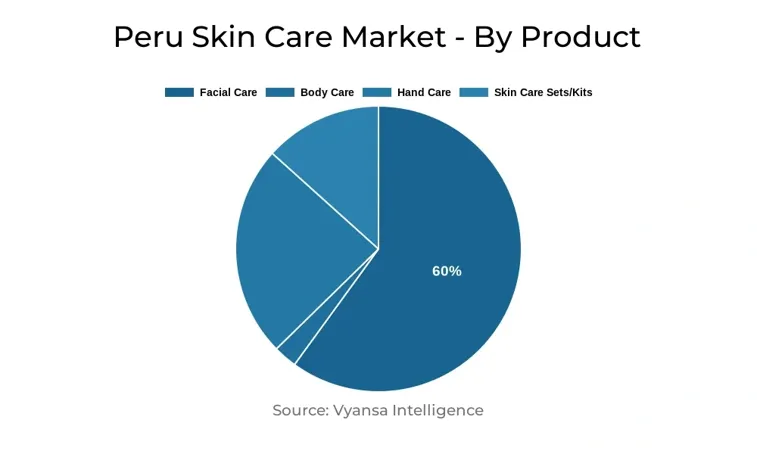
- Facial Care grabbed market share of 60%.
- Competition
- More than 15 companies are actively engaged in producing Skin Care in Peru.
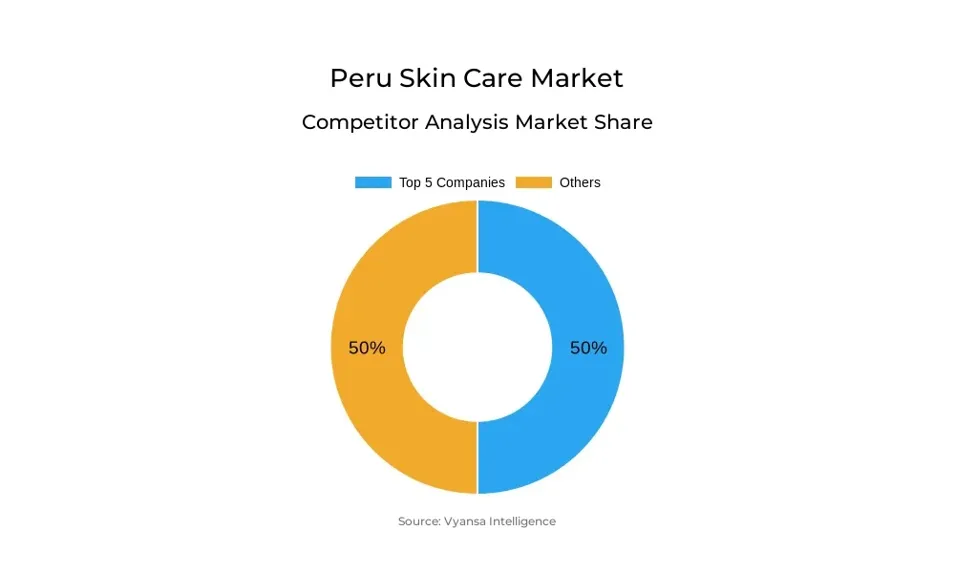
- Top 5 companies acquired 50% of the market share.
- Cetco SA, Johnson & Johnson del Perú SA, Omnilife SA de CV, Grupo, Beiersdorf SAC, L'Oréal Perú SA etc., are few of the top companies.
- Sales Channel
- Retail Offline grabbed 90% of the market.
Peru Skin Care Market Outlook
Peru skin care industry is anticipated to experience steady expansion from 2025 through 2030, fueled by growing consumer concern for skin health and wellness. With more women and men coming to recognize skin care as a key aspect of overall wellbeing, demand will likely grow across a range of product categories. The tendency to adopt holistic skin care regimens, both for the body and face, is expected to continue being robust in the forecast period.
Mass general-use body care will continue to lead as the largest segment because of its versatility and broad appeal. In contrast, luxury segments like anti-ageing and lip care are expected to develop at a fast pace, fueled by advancements in formulations and consumer increasing willingness to pay for targeted treatments. The trend of concentrated treatments such as serums is also likely to increase, given that they deliver perceptible outcomes and in many cases form part of edited facial care regimens endorsed by beauty experts and opinion leaders.
Sales will be helped by the increased demand for natural and environmentally friendly skin care products, particularly those with domestically sourced ingredients and green packaging. Brands emphasizing zero-waste initiatives, cruelty-free treatments, and high-performance dermocosmetic products will continue to gain more consumer attention.
The growth of specialist retail stores and ongoing investment in direct selling and online shopping will further stimulate market growth. In-store specialist advice, product sampling, and appealing online offers will be central to driving purchases. On balance, with strengthening economic conditions and increasing disposable incomes, the Peru skin care market is set for healthy development to 2030.
Peru Skin Care Market Growth Driver
Peru sales of skin care are predicted to increase steadily over 2025-30, with a boost from high consumer demand and active player involvement, particularly for advanced formulation and dermocosmetic products. Innovation will remain a core driver with firms employing new technologies to provide improved, more focused solutions across both premium and traditional offerings, underpinning growing demand for effective skin care.
In order to sustain this growth, brands are going to be spending on marketing initiatives that separately emphasize product benefits, active ingredients, and new technologies. These initiatives are intended to instill trust among consumers and propagate skin care as a key component of self-care. As per a survey, better economic conditions and increasing disposable incomes will also drive greater expenditure on good quality products. The high-end anti-ageing category will also witness the highest growth, with consumers increasingly looking for established, science-formulated remedies such as serums and concentrated treatments.
Peru Skin Care Market Trend
Facial treatments are poised to pick up pace in 2025-30, with growing visibility in retail as well as online channels. Social media platforms, especially Instagram and TikTok, continue to play a leading role, where beauty content influencers often post elaborate routines and tutorials. These step-by-step tutorials not only describe how products should be applied but also teach what the particular skin benefit of each product is, further increasing consumer interest.
Among facial care products, serums will likely continue to be a top priority, usually employed as part of multi-step routines instead of stand-alone treatments. For example, L'Oréal Paris has the Glycolic Bright! Routine against dark spots, La Roche-Posay its Anti-Ageing Routine with Hyalu B5 products and sun protection, and L'Bel its Nocturné Routine with cleansing gel, hydrating serum, and eye treatment. These influencer- and expert-approved, carefully curated product sets are inspiring consumers to crave more comprehensive and well-rounded skin care routines.
Unlock Market Intelligence
Explore the market potential with our data-driven report
Peru Skin Care Market Opportunity
The increasing number of specialist skin and sun care retail outlets is likely to underpin the ongoing expansion of Peru's skin care market over 2025-30. These stores, frequently refurbished from conventional design, increasingly highlight dermocosmetic products. They provide a variety of products that address care for the face, body, and other specific areas, with in-store personnel who are trained to offer expert advice on the basis of individual skin needs. This personalized assistance facilitates enhanced product choice, thus enhancing consumer satisfaction and loyalty to the brand.
As per a survey, market leaders like Mifarma are pushing this trend by remodeling their pharmacies into Mifarma Beauty stores with specialized Centro Dermocosmético spaces providing professional advice. Likewise, Natura is consolidating its brick-and-mortar presence even with its direct selling approach, while K'allma continues to open more stores with a deep emphasis on customer experience and personal advice on care.
| Report Coverage | Details |
|---|---|
| Market Forecast | 2025-30 |
| USD Value 2024 | $ 495 Million |
| USD Value 2030 | $ 595 Million |
| CAGR 2025-2030 | 3.11% |
| Largest Category | Facial Care segment leads with 60% market share |
| Top Drivers | Rising Demand for Advanced & Premium Skin Care Solutions |
| Top Trends | Growing Popularity of Multi-Step Facial Care Routines |
| Top Opportunities | Rising Presence of Specialised Skin Care Stores Enhancing Consumer Engagement |
| Key Players | Cetco SA, Johnson & Johnson del Perú SA, Omnilife SA de CV, Grupo, Beiersdorf SAC, L'Oréal Perú SA, Unique SA, Unilever Andina Perú SA, Natura Cosméticos SA, Productos Avon SA, Oriflame Perú SA and Others. |
Unlock Market Intelligence
Explore the market potential with our data-driven report
Peru Skin Care Market Segmentation Analysis
The most dominant segment in the sales channel by market share is Retail Offline, topped by Direct Selling, which held the pole position again in 2024 and consolidated its position further. Its deep-rooted history and the personalized assistance offered by beauty consultants have been crucial in keeping the loyalty and faith of consumers intact. Businesses such as Unique SA, Natura Cosméticos SA, and Cetco SA dominate the channel, with extensive catalogues covering body care and facial treatments. These businesses have continued to evolve, introducing focused products such as anti-ageing creams and serums, blemish control, hydration, and radiance—fuelling the prosperity of direct selling in Peru even further.
Simultaneously, Retail E-commerce, while maintaining a lesser portion, experienced encouraging growth over the same timeframe. Based on a survey, this avenue drew consumers who had familiarization with the products they sought and were drawn in by recurring online promotions. Virtual sales events like Cyber and WOW Days presented compelling offers, especially for high-end or premium skincare products, that helped e-commerce build momentum within the Peru market.
Top Companies in Peru Skin Care Market
The top companies operating in the market include Cetco SA, Johnson & Johnson del Perú SA, Omnilife SA de CV, Grupo, Beiersdorf SAC, L'Oréal Perú SA, Unique SA, Unilever Andina Perú SA, Natura Cosméticos SA, Productos Avon SA, Oriflame Perú SA, etc., are the top players operating in the Peru Skin Care Market.
Frequently Asked Questions
Related Report
1. Market Segmentation
1.1. Research Scope
1.2. Research Methodology
1.3. Definitions and Assumptions
2. Executive Summary
3. Peru Skin Care Market Policies, Regulations, and Standards
4. Peru Skin Care Market Dynamics
4.1. Growth Factors
4.2. Challenges
4.3. Trends
4.4. Opportunities
5. Peru Skin Care Market Statistics, 2020-2030F
5.1. Market Size & Growth Outlook
5.1.1.By Revenues in US$ Million
5.2. Market Segmentation & Growth Outlook
5.2.1.By Product
5.2.1.1. Body Care- Market Insights and Forecast 2020-2030, USD Million
5.2.1.1.1. Firming Body Care- Market Insights and Forecast 2020-2030, USD Million
5.2.1.1.2. General Purpose Body Care- Market Insights and Forecast 2020-2030, USD Million
5.2.1.2. Facial Care- Market Insights and Forecast 2020-2030, USD Million
5.2.1.2.1. Acne Treatments- Market Insights and Forecast 2020-2030, USD Million
5.2.1.2.2. Face Masks- Market Insights and Forecast 2020-2030, USD Million
5.2.1.2.3. Facial Cleansers- Market Insights and Forecast 2020-2030, USD Million
5.2.1.2.3.1. Liquid- Market Insights and Forecast 2020-2030, USD Million
5.2.1.2.3.2. Cream- Market Insights and Forecast 2020-2030, USD Million
5.2.1.2.3.3. Gel- Market Insights and Forecast 2020-2030, USD Million
5.2.1.2.3.4. Bar Cleansers- Market Insights and Forecast 2020-2030, USD Million
5.2.1.2.3.5. Facial Cleansing Wipes- Market Insights and Forecast 2020-2030, USD Million
5.2.1.2.4. Moisturisers and Treatments- Market Insights and Forecast 2020-2030, USD Million
5.2.1.2.4.1. Basic Moisturisers- Market Insights and Forecast 2020-2030, USD Million
5.2.1.2.4.2. Anti-Agers- Market Insights and Forecast 2020-2030, USD Million
5.2.1.2.5. Lip Care- Market Insights and Forecast 2020-2030, USD Million
5.2.1.2.6. Toners- Market Insights and Forecast 2020-2030, USD Million
5.2.1.3. Hand Care- Market Insights and Forecast 2020-2030, USD Million
5.2.1.4. Skin Care Sets/Kits- Market Insights and Forecast 2020-2030, USD Million
5.2.2.By Category
5.2.2.1. Premium- Market Insights and Forecast 2020-2030, USD Million
5.2.2.2. Mass- Market Insights and Forecast 2020-2030, USD Million
5.2.3.By Gender
5.2.3.1. Men- Market Insights and Forecast 2020-2030, USD Million
5.2.3.2. Women- Market Insights and Forecast 2020-2030, USD Million
5.2.3.3. Unisex- Market Insights and Forecast 2020-2030, USD Million
5.2.4.By End User
5.2.4.1. Adults- Market Insights and Forecast 2020-2030, USD Million
5.2.4.2. Teenagers- Market Insights and Forecast 2020-2030, USD Million
5.2.4.3. Children- Market Insights and Forecast 2020-2030, USD Million
5.2.5.By Packaging
5.2.5.1. Tubes- Market Insights and Forecast 2020-2030, USD Million
5.2.5.2. Bottles- Market Insights and Forecast 2020-2030, USD Million
5.2.5.3. Jars- Market Insights and Forecast 2020-2030, USD Million
5.2.5.4. Others- Market Insights and Forecast 2020-2030, USD Million
5.2.6.By Sales Channel
5.2.6.1. Online- Market Insights and Forecast 2020-2030, USD Million
5.2.6.2. Offline- Market Insights and Forecast 2020-2030, USD Million
5.2.7.By Competitors
5.2.7.1. Competition Characteristics
5.2.7.2. Market Share & Analysis
6. Peru Body Care Market Statistics, 2020-2030F
6.1. Market Size & Growth Outlook
6.1.1.By Revenues in US$ Million
6.2. Market Segmentation & Growth Outlook
6.2.1.By Product- Market Insights and Forecast 2020-2030, USD Million
6.2.2.By Category- Market Insights and Forecast 2020-2030, USD Million
6.2.3.By Gender- Market Insights and Forecast 2020-2030, USD Million
6.2.4.By End User- Market Insights and Forecast 2020-2030, USD Million
6.2.5.By Packaging- Market Insights and Forecast 2020-2030, USD Million
6.2.6.By Sales Channel- Market Insights and Forecast 2020-2030, USD Million
7. Peru Facial Care Market Statistics, 2020-2030F
7.1. Market Size & Growth Outlook
7.1.1.By Revenues in US$ Million
7.2. Market Segmentation & Growth Outlook
7.2.1.By Product- Market Insights and Forecast 2020-2030, USD Million
7.2.2.By Category- Market Insights and Forecast 2020-2030, USD Million
7.2.3.By Gender- Market Insights and Forecast 2020-2030, USD Million
7.2.4.By End User- Market Insights and Forecast 2020-2030, USD Million
7.2.5.By Packaging- Market Insights and Forecast 2020-2030, USD Million
7.2.6.By Sales Channel- Market Insights and Forecast 2020-2030, USD Million
8. Peru Hand Care Market Statistics, 2020-2030F
8.1. Market Size & Growth Outlook
8.1.1.By Revenues in US$ Million
8.2. Market Segmentation & Growth Outlook
8.2.1.By Category- Market Insights and Forecast 2020-2030, USD Million
8.2.2.By Gender- Market Insights and Forecast 2020-2030, USD Million
8.2.3.By End User- Market Insights and Forecast 2020-2030, USD Million
8.2.4.By Packaging- Market Insights and Forecast 2020-2030, USD Million
8.2.5.By Sales Channel- Market Insights and Forecast 2020-2030, USD Million
9. Peru Skin Care Sets/Kits Market Statistics, 2020-2030F
9.1. Market Size & Growth Outlook
9.1.1.By Revenues in US$ Million
9.2. Market Segmentation & Growth Outlook
9.2.1.By Category- Market Insights and Forecast 2020-2030, USD Million
9.2.2.By Gender- Market Insights and Forecast 2020-2030, USD Million
9.2.3.By End User- Market Insights and Forecast 2020-2030, USD Million
9.2.4.By Packaging- Market Insights and Forecast 2020-2030, USD Million
9.2.5.By Sales Channel- Market Insights and Forecast 2020-2030, USD Million
10. Competitive Outlook
10.1. Company Profiles
10.1.1. Beiersdorf SAC
10.1.1.1. Business Description
10.1.1.2. Product Portfolio
10.1.1.3. Collaborations & Alliances
10.1.1.4. Recent Developments
10.1.1.5. Financial Details
10.1.1.6. Others
10.1.2. L'Oréal Perú SA
10.1.2.1. Business Description
10.1.2.2. Product Portfolio
10.1.2.3. Collaborations & Alliances
10.1.2.4. Recent Developments
10.1.2.5. Financial Details
10.1.2.6. Others
10.1.3. Unique SA
10.1.3.1. Business Description
10.1.3.2. Product Portfolio
10.1.3.3. Collaborations & Alliances
10.1.3.4. Recent Developments
10.1.3.5. Financial Details
10.1.3.6. Others
10.1.4. Unilever Andina Perú SA
10.1.4.1. Business Description
10.1.4.2. Product Portfolio
10.1.4.3. Collaborations & Alliances
10.1.4.4. Recent Developments
10.1.4.5. Financial Details
10.1.4.6. Others
10.1.5. Natura Cosméticos SA
10.1.5.1. Business Description
10.1.5.2. Product Portfolio
10.1.5.3. Collaborations & Alliances
10.1.5.4. Recent Developments
10.1.5.5. Financial Details
10.1.5.6. Others
10.1.6. Cetco SA
10.1.6.1. Business Description
10.1.6.2. Product Portfolio
10.1.6.3. Collaborations & Alliances
10.1.6.4. Recent Developments
10.1.6.5. Financial Details
10.1.6.6. Others
10.1.7. Johnson & Johnson del Perú SA
10.1.7.1. Business Description
10.1.7.2. Product Portfolio
10.1.7.3. Collaborations & Alliances
10.1.7.4. Recent Developments
10.1.7.5. Financial Details
10.1.7.6. Others
10.1.8. Omnilife SA de CV, Grupo
10.1.8.1. Business Description
10.1.8.2. Product Portfolio
10.1.8.3. Collaborations & Alliances
10.1.8.4. Recent Developments
10.1.8.5. Financial Details
10.1.8.6. Others
10.1.9. Productos Avon SA
10.1.9.1. Business Description
10.1.9.2. Product Portfolio
10.1.9.3. Collaborations & Alliances
10.1.9.4. Recent Developments
10.1.9.5. Financial Details
10.1.9.6. Others
10.1.10. Oriflame Perú SA
10.1.10.1.Business Description
10.1.10.2.Product Portfolio
10.1.10.3.Collaborations & Alliances
10.1.10.4.Recent Developments
10.1.10.5.Financial Details
10.1.10.6.Others
11. Disclaimer
| Segment | Sub-Segment |
|---|---|
| By Product |
|
| By Category |
|
| By Gender |
|
| By End User |
|
| By Packaging |
|
| By Sales Channel |
|
Research Methodology
This study followed a structured approach comprising four key phases to assess the size and scope of the electro-oxidation market. The process began with thorough secondary research to collect data on the target market, related markets, and broader industry context. These findings, along with preliminary assumptions and estimates, were then validated through extensive primary research involving industry experts from across the value chain. To calculate the overall market size, both top-down and bottom-up methodologies were employed. Finally, market segmentation and data triangulation techniques were applied to refine and validate segment-level estimations.
Secondary Research
The secondary research phase involved gathering data from a wide range of credible and published sources. This step helped in identifying industry trends, defining market segmentation, and understanding the market landscape and value chain.
Sources consulted during this phase included:
- Company annual reports, investor presentations, and press releases
- Industry white papers and certified publications
- Trade directories and market-recognized databases
- Articles from authoritative authors and reputable journals
- Gold and silver standard websites
Secondary research was critical in mapping out the industry's value chain and monetary flow, identifying key market segments, understanding regional variations, and tracking significant industry developments.
Other key sources:
- Financial disclosures
- Industry associations and trade bodies
- News outlets and business magazines
- Academic journals and research studies
- Paid industry databases
Primary Research
To validate secondary data and gain deeper market insights, primary research was conducted with key stakeholders across both the supply and demand sides of the market.
On the demand side, participants included decision-makers and influencers from end-user industries—such as CIOs, CTOs, and CSOs—who provided first-hand perspectives on market needs, product usage, and future expectations.
On the supply side, interviews were conducted with manufacturers, industry associations, and institutional participants to gather insights into current offerings, product pipelines, and market challenges.
Primary interviews provided critical inputs such as:
- Market size and revenue data
- Product and service breakdowns
- Market forecasts
- Regional and application-specific trends
Stakeholders consulted included:
- Leading OEM and solution providers
- Channel and distribution partners
- End users across various applications
- Independent consultants and industry specialists
Market Size Estimation and Data Triangulation
- Identifying Key Market Participants (Secondary Research)
- Goal: To identify the major players or companies in the target market. This typically involves using publicly available data sources such as industry reports, market research publications, and financial statements of companies.
- Tools: Reports from firms like Gartner, Forrester, Euromonitor, Statista, IBISWorld, and others. Public financial statements, news articles, and press releases from top market players.
- Extracting Earnings of Key Market Participants
- Goal: To estimate the earnings generated from the product or service being analyzed. This step helps in understanding the revenue potential of each market player in a specific geography.
- Methods: Earnings data can be gathered from:
- Publicly available financial reports (for listed companies).
- Interviews and primary data sources from professionals, such as Directors, VPs, SVPs, etc. This is especially useful for understanding more nuanced, internal data that isn't publicly disclosed.
- Annual reports and investor presentations of key players.
- Data Collation and Development of a Relevant Data Model
- Goal: To collate inputs from both primary and secondary sources into a structured, data-driven model for market estimation. This model will incorporate key market KPIs and any independent variables relevant to the market.
- Key KPIs: These could include:
- Market size, growth rate, and demand drivers.
- Industry-specific metrics like market share, average revenue per customer (ARPC), or average deal size.
- External variables, such as economic growth rates, inflation rates, or commodity prices, that could affect the market.
- Data Modeling: Based on this data, the market forecasts are developed for the next 5 years. A combination of trend analysis, scenario modeling, and statistical regression might be used to generate projections.
- Scenario Analysis
- Goal: To test different assumptions and validate how sensitive the market is to changes in key variables (e.g., market demand, regulatory changes, technological disruptions).
- Types of Scenarios:
- Base Case: Based on current assumptions and historical data.
- Best-Case Scenario: Assuming favorable market conditions, regulatory environments, and technological advancements.
- Worst-Case Scenario: Accounting for adverse factors, such as economic downturns, stricter regulations, or unexpected disruptions.












