Oman Pharmaceutical Logistics Market Report: Trends, Growth and Forecast (2026-2032)
By Service Type (Transportation (Road, Air, Sea), Warehousing & Storage, Packaging & Value-Added Services, Inventory Management, Monitoring & Visibility, Reverse & Recall Logistics), By Temperature Requirement (Cold Chain Logistics, Non-Cold Chain / Ambient Logistics), By Product Type (Conventional Pharmaceuticals (Prescription Drugs, OTC Drugs), Biologics & Biosimilars, Vaccines, Blood & Plasma-Derived Products, Advanced Therapy Medicinal Products, Others), By End User (Pharmaceutical Manufacturers, Pharmaceutical Importers, Distributors & Wholesalers, Hospitals & Clinics, Retail Pharmacies, Others) ... Read more
|
Major Players
|
Oman Pharmaceutical Logistics Market Overview
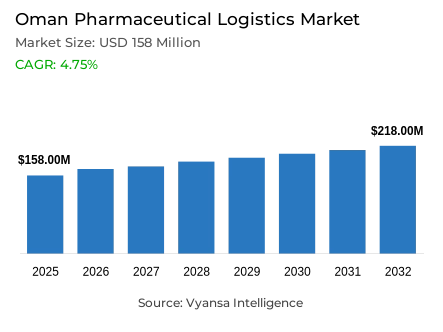
The pharmaceutical logistics market covers transportation, warehousing, cold-chain management, inventory monitoring and distribution services supporting medicines, vaccines, biologics and other pharmaceutical products across Oman. The market is supported by import-dependent medicine supply, expanding domestic pharmaceutical production and growing requirements for reliable temperature-controlled handling, storage and last-mile delivery. These factors are expected to support steady market expansion during 2026–2032 at a CAGR of 4.75%.
Key Highlights of the Oman Pharmaceutical Logistics Market
- The Oman pharmaceutical logistics marketwas valued at USD 158 million in 2025, and the 2026 market size is USD 165 million.
- The market is projected to reach USD 218 million by 2032, indicating a 4.75% CAGR during 2026–2032.
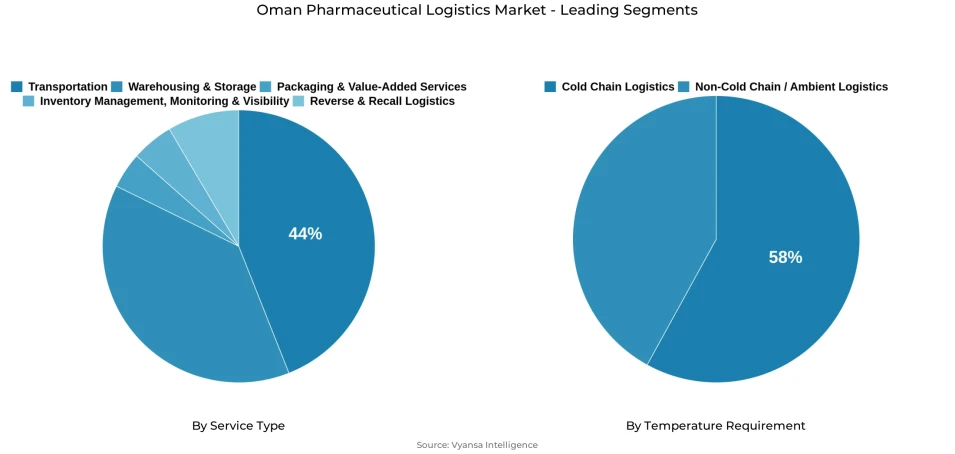
- Cold Chain Logistics accounted for 58% of the market in 2026
- Cold Chain Logistics is also the fastest-growing segment, expanding at a 5.92% CAGR during 2026–2032.
- Transportation held a 44% market share in 2026.
- Additionally, Warehousing & Storage is expected to grow at a CAGR of 5.35% during 2026–2032.
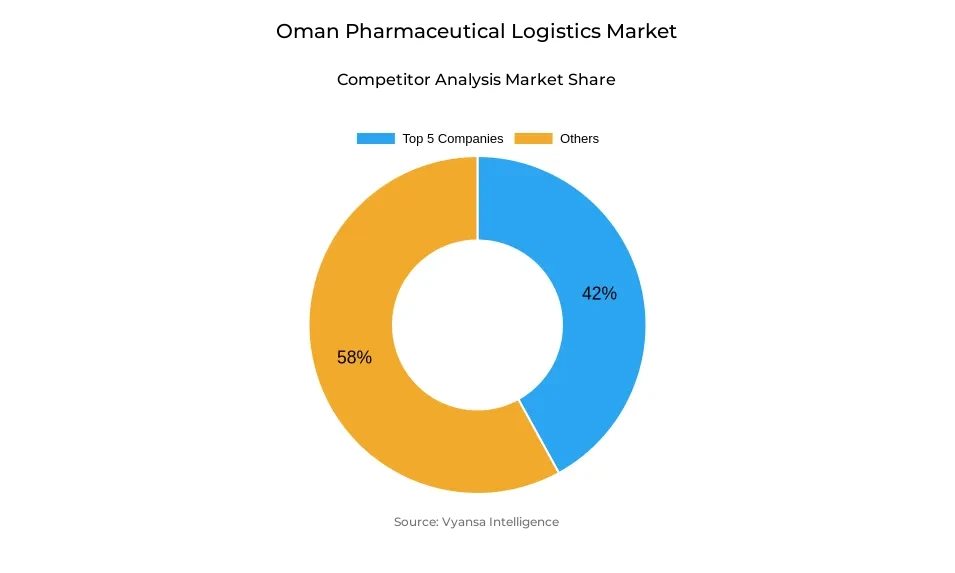
- The industry is moderately fragmented, with the top five companies accounting for 42% of market revenue
The Oman pharmaceutical logistics market is supported by a sizeable import-dependent pharmaceutical supply chain, expanding domestic manufacturing, and increasing investment in specialized storage infrastructure.
Import concentration also shapes logistics flows. The UAE and Qatar together accounted for about 57.6% of Oman's pharmaceutical imports in 2025, with import values of USD 289.1 million and USD 184.3 million, respectively. India contributed another USD 35.9 million, highlighting the importance of regional road freight, international air cargo, customs handling, and temperature-controlled distribution networks.
Demand is further supported by public-sector pharmaceutical procurement. Oman's Ministry of Health reported average annual expenditure of approximately USD 286 million on medicines and medical supplies during 2021–2026. Meanwhile, purchases from national pharmaceutical companies under the 2026–2027 unified procurement tenders increased 150% to OMR 18.65 million, while the number of covered items more than doubled from 75 to 154, supporting greater domestic supply-chain activity.
Infrastructure investment is strengthening the market's logistics capacity. In April 2026, OPAZ approved a RO 1.2 million advanced pharmaceutical warehouse at Khazaen Economic City, adding dedicated storage capacity within a logistics-connected industrial hub.
Overall, transportation, pharmaceutical warehousing, cold-chain handling, inventory management, and last-mile distribution are expected to remain core market activities as Oman balances pharmaceutical imports with growing domestic production.
Surveys and Key Insights
Oman's Ministry of Health reported in its 2025–2026 press statement that more than 13,500 pharmaceutical shipments were processed through customs and 1,612 inspection visits were conducted at pharmaceutical institutions. For the Oman pharmaceutical logistics market, the customs volume demonstrates the operational importance of regulated inbound handling, while the inspection activity reinforces the need for traceable storage, documentation, and distribution processes once medicines enter the national supply chain.
Government Regulations Shaping the Oman Pharmaceutical Logistics Market
Oman’s pharmaceutical logistics framework is increasingly shaped by localization incentives and tighter regulated handling. In August 2026, the MOH and OPAZ introduced advance-purchase commitments covering up to 30% of pharmaceutical requirements, alongside price preferences of up to 30% for locally manufactured medicines and 20% for secondary packaging. The package also includes customs exemptions on raw materials and equipment, tax incentives, and investment support across 13 pharmaceutical projects, encouraging logistics capacity around domestic production.
At the operational level, the drug safety center regulates product registration, pharmaceutical warehouses, and medicine import, export, re-export, and transit activities. Standard pharmaceutical registration requires 360 working days, while qualifying fast-track applications can be processed within 60 working days. In 2026, the India–Oman CEPA additionally introduced zero-duty access for finished medicines, vaccines and core APIs and a 90-working-day authorization pathway for qualifying reference-market-approved products. Together, these measures increase the importance of compliant documentation, licensed storage, and faster customs coordination.
Oman Pharmaceutical Logistics Market Drivers
Expansion of Local Pharmaceutical Manufacturing Is Creating Recurring Logistics Demand Across Oman
Oman’s localization strategy is expanding the physical pharmaceutical supply chain that logistics providers must serve. In 2026, the Ministry of Health reported 20 operational medical factories, including seven pharmaceutical factories and two pharmaceutical raw-material facilities, while another 18 projects were under construction, including 11 pharmaceutical factories and one raw-material facility. Each additional production site creates recurring inbound flows of APIs, excipients, and packaging, followed by compliant storage and outbound medicine distribution.
The manufacturing pipeline is also becoming commercially deeper. The Ministry of Health reported in 2026 that six medical factories were newly licensed in 2025, 16 products underwent technology transfer or full domestic manufacture during 2025, and 94 preparations were being produced through contract manufacturing. This broadens logistics requirements beyond finished-product imports toward production-linked inventory, factory replenishment, warehousing, and scheduled distribution.
Procurement is reinforcing this shift. Oman news agency reported in 2026 that purchases from national companies increased 150% to RO 18.65 million in 2025, while purchased Omani medicine items rose 105%. National companies also accounted for 44% of bids across 154 pharmaceutical items. As government purchasing increasingly connects with domestic production, the Oman pharmaceutical logistics market gains a more predictable base of factory-to-warehouse and warehouse-to-healthcare distribution demand.
Oman Pharmaceutical Logistics Market Limitations
Continued Dependence on Imported Medicines Exposes Pharmaceutical Supply Chains to External Disruptions
Oman remains materially dependent on external pharmaceutical supply chains despite accelerating localization. In 2026, the Ministry of Health reported that purchases from national companies represented only 9% of the unified national pharmaceutical procurement tender for 2026–2027, although this was up from 5% in the previous tender cycle. This means imported medicines continue to account for most procurement, keeping pharmaceutical logistics exposed to international production, freight-capacity, and route disruptions.
The risk is significant enough that the ministry is directly coordinating with domestic manufacturers to localize strategic-stock items and reduce dependence on external supply chains during crises. Import exposure requires distributors and logistics providers to maintain alternative sourcing routes, higher safety stocks and more flexible inbound transport arrangements to protect medicine availability when regional shipping or air-freight networks are disrupted.
Import handling also carries strict operational requirements. The drug safety center requires commercial invoices, certificates of analysis and pharmaceutical registration certificates for customs release, with additional documentation for biological and controlled products. More than 13,500 pharmaceutical shipments were processed through customs in the latest Ministry reporting, illustrating the continuing scale of regulated inbound flows. For the Oman pharmaceutical logistics market, this dependence increases documentation, inventory-buffer and contingency-planning costs while preserving exposure to disruptions beyond domestic operators’ control.
Oman Pharmaceutical Logistics Market Recent Trends
Pharmaceutical Manufacturing Is Concentrating Around Integrated Industrial and Logistics Zones
Pharmaceutical investment in Oman is increasingly concentrating within dedicated industrial and logistics ecosystems rather than developing as isolated production sites. Khazaen Economic City’s 2024 annual report shows that its dedicated pharma city had attracted about USD 200 million in investment and was structured around pharmaceutical and medical-supply factories, advanced laboratories, research centres, and dedicated medicine storage, distribution and import facilities. This creates a concentrated demand base for specialized pharmaceutical logistics.
The location strengthens this model. Khazaen is around 30 minutes from Muscat International Airport and Suwaiq port and approximately two hours from Sohar Port, while about 80% of Oman’s population can be reached within two hours by road. This allows manufacturers to position production, inventory and distribution near major national and international transport corridors, reducing unnecessary transfers between dispersed facilities.
The clustering pattern extends beyond Khazaen. OPAZ confirms pharmaceutical investments within both Sohar Free Zone and Salalah Free Zone, linking medicine production with export-oriented ports, customs infrastructure and industrial services. For the Oman pharmaceutical logistics market, this supports a hub-based operating model where logistics providers can concentrate warehousing, cold-chain capacity and freight coordination close to pharmaceutical producers, improving asset utilization and creating recurring factory-linked logistics demand.
AI-Based Predictive Analytics Is Transforming Pharmaceutical Inventory Planning and Stock Availability
AI-based forecasting becomes valuable when pharmaceutical distributors combine demand history, stock position, shelf life and shipment status to identify likely shortages before they occur. It can also flag slow-moving inventory and products approaching expiry. In the Oman Pharmaceutical Logistics Market, the commercial value is improved availability with less avoidable waste, particularly for products requiring close inventory discipline.
The digital foundation is becoming clearer. Oman's drug safety center requires wholesale medical stores to maintain digital inventory records with batch and manufacturer data and traceability from receipt through distribution. Asyad's technology strategy also identifies track-and-trace, IoT, automated warehouses and AI-based algorithms as logistics tools that can improve performance. These capabilities create the data layer on which predictive inventory planning can operate.
Adoption will depend on clean master data, integration between warehouse and enterprise systems, disciplined scanning and staff able to act on forecasts. Smaller distributors may begin with rule-based alerts, while larger networks can use predictive models across multiple warehouses. For the Oman Pharmaceutical Logistics Industry, suppliers connecting forecasting with replenishment, expiry management and shipment visibility can differentiate on service reliability and inventory outcomes rather than transport capacity alone.
Oman Pharmaceutical Logistics Market Future Opportunities
Expansion of Pharmaceutical Exports Can Position Oman as a Regional Cold-Chain and Distribution Hub
Oman’s expanding pharmaceutical manufacturing base creates an opportunity to move beyond import substitution toward export-oriented logistics. Opal bio pharma’s biological medicines and vaccine facility at Khazaen was explicitly designed with international exports in mind. Oman news agency reported that the USD 156.05 million second phase would support Oman’s entry onto the global vaccine-production map and create opportunities to export pharmaceutical products internationally.
Existing trade patterns strengthen the commercial case. NCSI’s 2026 statistical year book reported that 57.8% of Oman’s non-oil exports in 2025 went to GCC countries, demonstrating established regional trade corridors. Sohar free zone also provides shipping access toward the Middle East, Indian subcontinent and East Africa. Exporting vaccines, biologics and specialty medicines through these corridors would create higher-value requirements for validated cold storage, international forwarding, shipment monitoring and customs coordination.
For the Oman pharmaceutical logistics market, the opportunity extends beyond additional shipment volumes. Export-oriented pharmaceutical producers require temperature-qualified packaging, controlled warehousing, multimodal connections and contingency routing from factory to destination market. Logistics providers that build export-ready cold-chain networks and international distribution partnerships can capture recurring revenue while supporting Oman’s transition from a predominantly importing pharmaceutical market toward a regional production and distribution platform.
Unlock Market Intelligence
Explore the market potential with our data-driven report
Oman Pharmaceutical Logistics Market Segmentation Analysis
By Temperature Requirement
- Cold Chain Logistics
- Non-Cold Chain / Ambient Logistics
Cold Chain Logistics Leads and Records the Fastest Growth as Temperature-Sensitive Pharmaceutical Handling Expands
Cold chain logistics accounted for 58% of the market in 2026, making it the leading temperature-requirement segment. Its dominance reflects the strict handling needs of vaccines, biologics, selected specialty medicines and other temperature-sensitive pharmaceutical products. Maintaining controlled conditions during transport, storage and distribution reduces the risk of product degradation and supports reliable delivery to hospitals, pharmacies and healthcare facilities.
Cold chain logistics is also the fastest-growing segment, expanding at a 5.92% CAGR during 2026–2032. Unlike categories where leadership and growth shift between different segments, cold chain benefits from both an established demand base and increasing requirements for specialized pharmaceutical handling. Greater use of temperature-sensitive products raises demand for refrigerated storage, validated transportation, continuous monitoring and controlled handoffs across the supply chain.
By Service Type
- Transportation
- Road
- Air
- Sea
- Warehousing & Storage
- Packaging & Value-Added Services
- Inventory Management, Monitoring & Visibility
- Reverse & Recall Logistics
Transportation Leads Core Execution While Warehousing & Storage Gains Strategic Weight
While temperature requirements determine the handling conditions needed to preserve pharmaceutical products, service type defines the logistics functions involved in transporting, storing, and managing products across the supply chain. Transportation accounted for a 44% share in 2026, making it the leading service type. Recurring inbound shipments, inter-warehouse transfers, and deliveries to pharmacies, hospitals, clinics, and other healthcare facilities support its dominance. Transportation therefore remains essential across both cold-chain and ambient pharmaceutical distribution.
Warehousing & Storage is the fastest-growing service type, projected to expand at a 5.35% CAGR during 2026–2032. Growth is driven by increasing requirements for safety-stock management, inventory segregation based on temperature and handling conditions, and secure product storage before final distribution. In Oman, Asyad’s warehousing capabilities include ambient, chilled, and frozen storage, supported by warehouse-management systems that enhance inventory visibility and shelf-life monitoring. These capabilities highlight the growing importance of specialized storage infrastructure in supporting pharmaceutical and medical-supply logistics.
Unlock Market Intelligence
Explore the market potential with our data-driven report
Oman Pharmaceutical Logistics Market Competitive Landscape
The Oman pharmaceutical logistics industry is moderately fragmented, with the top five companies accounting for 42% of market revenue. Competitive advantage increasingly depends on reliable temperature handling, documentation, warehouse capability and delivery coverage, and the companies in the market include, Asyad Logistics, Muscat Pharmacy & Stores LLC, DHL Global Forwarding, Oman Air S.A.O.C. (Oman Air Cargo – WY Pharma) and Bahwan Healthcare Centre LLC.
Key Companies in the Oman Pharmaceutical Logistics Market
- Asyad Logistics
- Muscat Pharmacy & Stores LLC
- DHL Global Forwarding
- Oman Air S.A.O.C. (Oman Air Cargo – WY Pharma)
- Bahwan Healthcare Centre LLC
- Ibn Sina Pharmacy LLC
- Al Madina Logistics Services Company SAOC
- Gulf Agency Company (Oman) LLC (GAC Oman)
- NAQEL Express – Oman
- Aramex Muscat / Aramex
Recent Developments in the Oman Pharmaceutical Logistics Market
- April 26, 2026: OPAZ signed an investment agreement for Overseas Investment to establish an advanced pharmaceutical warehouse at Khazaen Economic City with an investment of RO 1.2 million. The dedicated facility adds new pharmaceutical storage capacity inside a major industrial and logistics node, strengthening the physical warehousing base available to medicine supply chains in Oman.
- April 22, 2026: Oman's Ministry of Health announced the inauguration of Izz Pharma in Nizwa. The facility has annual production capacity exceeding 18 million units and is intended to supply domestic needs, creating recurring inbound material, inventory, warehousing and outbound distribution requirements for locally manufactured pharmaceutical products.
Frequently Asked Questions
Related Report
- Market Segmentation
- Research Scope
- Research Methodology
- Definitions and Assumptions
- Executive Summary
- Oman Pharmaceutical Logistics Market Policies, Regulations, and Standards
- Oman Pharmaceutical Logistics Market Dynamics
- Growth Factors
- Challenges
- Trends
- Opportunities
- Oman Pharmaceutical Logistics Market Statistics, 2022-2032F
- Market Size & Growth Outlook
- By Revenues in USD Million
- Market Segmentation & Growth Outlook
- By Service Type
- Transportation- Market Insights and Forecast 2022-2032, USD Million
- Road- Market Insights and Forecast 2022-2032, USD Million
- Air- Market Insights and Forecast 2022-2032, USD Million
- Sea- Market Insights and Forecast 2022-2032, USD Million
- Warehousing & Storage- Market Insights and Forecast 2022-2032, USD Million
- Packaging & Value-Added Services- Market Insights and Forecast 2022-2032, USD Million
- Inventory Management, Monitoring & Visibility- Market Insights and Forecast 2022-2032, USD Million
- Reverse & Recall Logistics- Market Insights and Forecast 2022-2032, USD Million
- Transportation- Market Insights and Forecast 2022-2032, USD Million
- By Temperature Requirement
- Cold Chain Logistics- Market Insights and Forecast 2022-2032, USD Million
- Non-Cold Chain / Ambient Logistics- Market Insights and Forecast 2022-2032, USD Million
- By Product Type
- Conventional Pharmaceuticals- Market Insights and Forecast 2022-2032, USD Million
- Prescription Drugs- Market Insights and Forecast 2022-2032, USD Million
- OTC Drugs- Market Insights and Forecast 2022-2032, USD Million
- Biologics & Biosimilars- Market Insights and Forecast 2022-2032, USD Million
- Vaccines- Market Insights and Forecast 2022-2032, USD Million
- Blood & Plasma-Derived Products- Market Insights and Forecast 2022-2032, USD Million
- Advanced Therapy Medicinal Products- Market Insights and Forecast 2022-2032, USD Million
- Others- Market Insights and Forecast 2022-2032, USD Million
- Conventional Pharmaceuticals- Market Insights and Forecast 2022-2032, USD Million
- By End User
- Pharmaceutical Manufacturers- Market Insights and Forecast 2022-2032, USD Million
- Pharmaceutical Importers, Distributors & Wholesalers- Market Insights and Forecast 2022-2032, USD Million
- Hospitals & Clinics- Market Insights and Forecast 2022-2032, USD Million
- Retail Pharmacies- Market Insights and Forecast 2022-2032, USD Million
- Others- Market Insights and Forecast 2022-2032, USD Million
- By Competitors
- Competition Characteristics
- Market Share & Analysis
- By Service Type
- Market Size & Growth Outlook
- Oman Transportation Market Statistics, 2022-2032
- Market Size & Growth Outlook
- By Revenues in USD Million
- Market Segmentation & Growth Outlook
- By Temperature Requirement- Market Insights and Forecast 2022-2032, USD Million
- By Product Type- Market Insights and Forecast 2022-2032, USD Million
- By Mode of Transportation- Market Insights and Forecast 2022-2032, USD Million
- By End User- Market Insights and Forecast 2022-2032, USD Million
- Market Size & Growth Outlook
- Oman Warehousing & Storage Market Statistics, 2022-2032
- Market Size & Growth Outlook
- By Revenues in USD Million
- Market Segmentation & Growth Outlook
- By Temperature Requirement- Market Insights and Forecast 2022-2032, USD Million
- By Product Type- Market Insights and Forecast 2022-2032, USD Million
- By Mode of Transportation- Market Insights and Forecast 2022-2032, USD Million
- By End User- Market Insights and Forecast 2022-2032, USD Million
- Market Size & Growth Outlook
- Oman Packaging & Value-Added Services Market Statistics, 2022-2032
- Market Size & Growth Outlook
- By Revenues in USD Million
- Market Segmentation & Growth Outlook
- By Temperature Requirement- Market Insights and Forecast 2022-2032, USD Million
- By Product Type- Market Insights and Forecast 2022-2032, USD Million
- By Mode of Transportation- Market Insights and Forecast 2022-2032, USD Million
- By End User- Market Insights and Forecast 2022-2032, USD Million
- Market Size & Growth Outlook
- Oman Inventory Management, Monitoring & Visibility Market Statistics, 2022-2032
- Market Size & Growth Outlook
- By Revenues in USD Million
- Market Segmentation & Growth Outlook
- By Temperature Requirement- Market Insights and Forecast 2022-2032, USD Million
- By Product Type- Market Insights and Forecast 2022-2032, USD Million
- By Mode of Transportation- Market Insights and Forecast 2022-2032, USD Million
- By End User- Market Insights and Forecast 2022-2032, USD Million
- Market Size & Growth Outlook
- Oman Reverse & Recall Logistics Market Statistics, 2022-2032
- Market Size & Growth Outlook
- By Revenues in USD Million
- Market Segmentation & Growth Outlook
- By Temperature Requirement- Market Insights and Forecast 2022-2032, USD Million
- By Product Type- Market Insights and Forecast 2022-2032, USD Million
- By Mode of Transportation- Market Insights and Forecast 2022-2032, USD Million
- By End User- Market Insights and Forecast 2022-2032, USD Million
- Market Size & Growth Outlook
- Competitive Outlook
- Company Profiles
- Asyad Logistics LLC
- Business Description
- Product Portfolio
- Collaborations & Alliances
- Recent Developments
- Financial Details
- Others
- Muscat Pharmacy & Stores LLC
- Business Description
- Product Portfolio
- Collaborations & Alliances
- Recent Developments
- Financial Details
- Others
- Oman Air S.A.O.C. (WY Pharma)
- Business Description
- Product Portfolio
- Collaborations & Alliances
- Recent Developments
- Financial Details
- Others
- DHL Global Forwarding & Co. LLC
- Business Description
- Product Portfolio
- Collaborations & Alliances
- Recent Developments
- Financial Details
- Others
- AL MADINA LOGISTIC SERVICES COMPANY (SAOC)
- Business Description
- Product Portfolio
- Collaborations & Alliances
- Recent Developments
- Financial Details
- Others
- Aramex Logistics LLC / Aramex Muscat LLC (Aramex)
- Business Description
- Product Portfolio
- Collaborations & Alliances
- Recent Developments
- Financial Details
- Others
- Ibn Sina Pharmacy LLC
- Business Description
- Product Portfolio
- Collaborations & Alliances
- Recent Developments
- Financial Details
- Others
- Bahwan Healthcare Centre LLC
- Business Description
- Product Portfolio
- Collaborations & Alliances
- Recent Developments
- Financial Details
- Others
- Gulf Agency Company (Oman) LLC
- Business Description
- Product Portfolio
- Collaborations & Alliances
- Recent Developments
- Financial Details
- Others
- Naqel Co Oman Branch (NAQEL Express)
- Business Description
- Product Portfolio
- Collaborations & Alliances
- Recent Developments
- Financial Details
- Others
- Asyad Logistics LLC
- Company Profiles
- Disclaimer
| Segment | Sub-Segment |
|---|---|
| By Service Type |
|
| By Temperature Requirement |
|
| By Product Type |
|
| By End User |
|
Research Methodology
This study followed a structured approach comprising four key phases to assess the size and scope of the electro-oxidation market. The process began with thorough secondary research to collect data on the target market, related markets, and broader industry context. These findings, along with preliminary assumptions and estimates, were then validated through extensive primary research involving industry experts from across the value chain. To calculate the overall market size, both top-down and bottom-up methodologies were employed. Finally, market segmentation and data triangulation techniques were applied to refine and validate segment-level estimations.
Secondary Research
The secondary research phase involved gathering data from a wide range of credible and published sources. This step helped in identifying industry trends, defining market segmentation, and understanding the market landscape and value chain.
Sources consulted during this phase included:
- Company annual reports, investor presentations, and press releases
- Industry white papers and certified publications
- Trade directories and market-recognized databases
- Articles from authoritative authors and reputable journals
- Gold and silver standard websites
Secondary research was critical in mapping out the industry's value chain and monetary flow, identifying key market segments, understanding regional variations, and tracking significant industry developments.
Other key sources:
- Financial disclosures
- Industry associations and trade bodies
- News outlets and business magazines
- Academic journals and research studies
- Paid industry databases
Primary Research
To validate secondary data and gain deeper market insights, primary research was conducted with key stakeholders across both the supply and demand sides of the market.
On the demand side, participants included decision-makers and influencers from end-user industries—such as CIOs, CTOs, and CSOs—who provided first-hand perspectives on market needs, product usage, and future expectations.
On the supply side, interviews were conducted with manufacturers, industry associations, and institutional participants to gather insights into current offerings, product pipelines, and market challenges.
Primary interviews provided critical inputs such as:
- Market size and revenue data
- Product and service breakdowns
- Market forecasts
- Regional and application-specific trends
Stakeholders consulted included:
- Leading OEM and solution providers
- Channel and distribution partners
- End users across various applications
- Independent consultants and industry specialists
Market Size Estimation and Data Triangulation
- Identifying Key Market Participants (Secondary Research)
- Goal: To identify the major players or companies in the target market. This typically involves using publicly available data sources such as industry reports, market research publications, and financial statements of companies.
- Tools: Reports from firms like Gartner, Forrester, Euromonitor, Statista, IBISWorld, and others. Public financial statements, news articles, and press releases from top market players.
- Extracting Earnings of Key Market Participants
- Goal: To estimate the earnings generated from the product or service being analyzed. This step helps in understanding the revenue potential of each market player in a specific geography.
- Methods: Earnings data can be gathered from:
- Publicly available financial reports (for listed companies).
- Interviews and primary data sources from professionals, such as Directors, VPs, SVPs, etc. This is especially useful for understanding more nuanced, internal data that isn't publicly disclosed.
- Annual reports and investor presentations of key players.
- Data Collation and Development of a Relevant Data Model
- Goal: To collate inputs from both primary and secondary sources into a structured, data-driven model for market estimation. This model will incorporate key market KPIs and any independent variables relevant to the market.
- Key KPIs: These could include:
- Market size, growth rate, and demand drivers.
- Industry-specific metrics like market share, average revenue per customer (ARPC), or average deal size.
- External variables, such as economic growth rates, inflation rates, or commodity prices, that could affect the market.
- Data Modeling: Based on this data, the market forecasts are developed for the next 5 years. A combination of trend analysis, scenario modeling, and statistical regression might be used to generate projections.
- Scenario Analysis
- Goal: To test different assumptions and validate how sensitive the market is to changes in key variables (e.g., market demand, regulatory changes, technological disruptions).
- Types of Scenarios:
- Base Case: Based on current assumptions and historical data.
- Best-Case Scenario: Assuming favorable market conditions, regulatory environments, and technological advancements.
- Worst-Case Scenario: Accounting for adverse factors, such as economic downturns, stricter regulations, or unexpected disruptions.












