Global Medical Device Cleaning Market Report: Trends, Growth and Forecast (2027-2033)
By Product Type (Cleaning Agents (Enzymatic Cleaners, Non-Enzymatic Detergents, Pre-Cleaning Sprays & Foams, Others), Cleaning Consumables (Cleaning Wipes & Cloths, Cleaning Brushes & Channel-Cleaning Accessories, Sponges & Swabs, Others), Cleaning Equipment (Ultrasonic Cleaners, Washer-Disinfectors, Automated Endoscope Reprocessors, Other Automated Cleaning Systems)), By Device Type (Surgical Instruments, Endoscopes, Dental Instruments, Ultrasound Probes, Respiratory & Anesthesia Equipment, Other Reusable Medical Devices), By Region (North America, South America, Europe, Middle East and Africa, Asia Pacific) ... Read more
|
Major Players
|
Medical Device Cleaning Market Overview
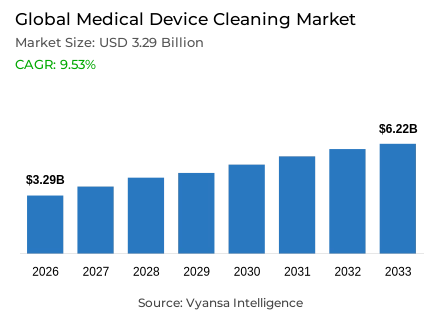
Medical device cleaning covers the chemistries, consumables, and automated systems used to remove blood, tissue, biofilm, and other contamination from reusable medical devices before disinfection or sterilization. Hospitals, central sterile services departments, endoscopy units, dental facilities and reprocessing providers consume these products across repeated instrument cycles. The medical device cleaning market is forecast to grow at a CAGR of 9.53% during 2027-2033.
Key Highlights of the Medical Device Cleaning Market
- The medical device cleaning market was valued at USD 3.29 billion in 2026 and is estimated at USD 3.60 billion in 2026 and is projected to reach USD 6.22 billion by 2032.
- The market is forecast to expand at an overall CAGR of 9.53% between 2027 and 2033 based on the supplied market sizing framework.
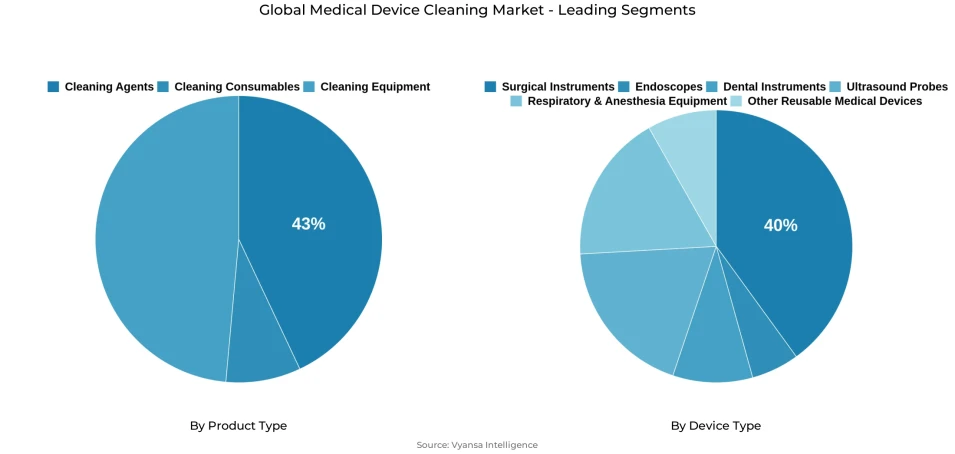
- Under product type, cleaning agents hold the leading position with a 43.00% share of total market revenue in the 2026 base year.
- Cleaning equipment is the fastest-growing Product Type segment, expanding at a CAGR of 10.88% during the 2027-2033 forecast period.
- Under device type, surgical instruments account for the largest revenue contribution, holding a 40.00% share of the market in 2026.
- Endoscopes represent the fastest-growing Device Type segment, recording an 11.70% CAGR across the 2027-2033 forecast period.
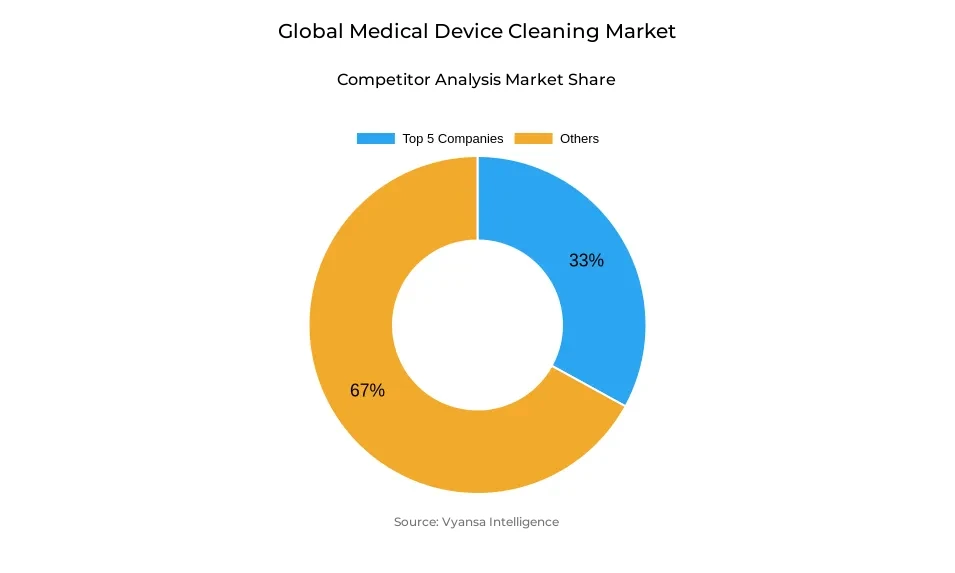
- The industry is moderately fragmented, with the five leading companies collectively accounting for 33.00% of total market revenue in 2026.
The medical device cleaning market is being supported by the growing volume of medical procedures, continued use of reusable instruments, and the need to reduce contamination risks before disinfection or sterilization. In the United States, the AHRQ reported that hospital-owned facilities recorded an estimated 13.5 million ambulatory surgery encounters in 2023, up 9% from 12.4 million in 2022, indicating a substantial and expanding pool of procedures requiring appropriate instrument reprocessing.
The infection-prevention requirement is reinforced by recent CDC data. Its 2024 National and State Healthcare-Associated Infections Progress Report found that acute-care hospitals achieved a 9% reduction in CLABSIs, 10% reduction in CAUTIs, 4% reduction in colon-surgery SSIs, and 11% reduction in hospital-onset C. difficile infections compared with 2023. Nevertheless, abdominal-hysterectomy SSIs increased 8%, demonstrating that infection-prevention requirements remain relevant despite overall progress.
Cleaning is particularly important because the FDA states that inadequate cleaning can leave blood, tissue, and biological debris on reusable devices, potentially allowing microorganisms to survive subsequent disinfection or sterilization. The FDA also identifies increasingly complex device designs, including long narrow lumens, hinges, valves, and non-disassemblable components, as factors that can make effective reprocessing more difficult.
Consequently, demand is shifting toward validated enzymatic and non-enzymatic cleaners, automated washer-disinfectors, ultrasonic cleaning systems, and standardized reprocessing workflows, particularly as healthcare facilities seek consistent cleaning outcomes while managing growing procedural volumes and increasingly complex reusable devices.
Medical Device Cleaning Market Drivers
Expanding Surgical Access and Procedure Throughput Increase Recurring Reusable Device Cleaning Cycles
Demand for medical device cleaning is directly tied to the number of reusable devices returning from procedures rather than only to the number of instruments originally purchased. A surgical instrument may circulate through cleaning and reprocessing repeatedly during its usable life, with each procedure creating another requirement for detergent, pre-cleaning, brushing, ultrasonic processing, or washer-disinfector capacity. Higher procedure throughput therefore creates recurring demand throughout the cleaning workflow.
The 2025 update to the Lancet Commission on Global Surgery estimated that unmet surgical need remains at least 160 million operations annually. These procedures should not be treated as existing cleaning volume, but they indicate the scale of procedural activity that could gradually enter healthcare systems as surgical capacity improves. Each additional procedure performed using reusable instrumentation creates another cleaning and reprocessing cycle that hospitals must accommodate before those devices can return to clinical use.
The commercial impact becomes strongest where procedure growth exceeds existing reprocessing capacity. Hospitals must either raise utilization of current cleaning departments, consume more chemistry and accessories per operating period or invest in additional automated cleaning equipment. This makes procedure expansion a recurring demand mechanism rather than a one-time equipment stimulus, supporting continued expenditure across both consumable and capital cleaning categories through the forecast period.
Medical Device Cleaning Market Challenges
Increasing Device Complexity and Validation Requirements Raise the Cost and Difficulty of Consistent Medical Device Cleaning
Reusable medical devices increasingly contain narrow channels, lumens, joints, delicate surfaces, and internal geometries that cannot be processed through one universal cleaning workflow. Hospitals and reprocessing providers must match detergents, brushes, racks, connectors, mechanical action, and cycle parameters to the design and material characteristics of individual device groups. This increases both the technical burden and the cost of achieving consistent cleaning across increasingly complex reusable-device inventories.
The cleaning burden is becoming more demanding as reusable devices incorporate narrower channels, more complex internal surfaces and sensitive materials. During 2025 and 2026, updated international cleaning and washer-disinfector guidance placed greater emphasis on validated processes, routine monitoring and matching cleaning methods to specific device designs. For hospitals, this means cleaning cannot be standardized across every instrument type, increasing reliance on compatible detergents, specialized accessories and validated automated workflows.
The consequence is higher cleaning expenditure rather than lower reprocessing activity. Facilities increasingly require compatible chemistries, channel-cleaning accessories, validated automated cycles and documented monitoring systems. Companies capable of demonstrating device compatibility and supporting workflow qualification gain an advantage over generic product providers, while hospitals face greater complexity in maintaining reliable reprocessing across expanding instrument portfolios.
Medical Device Cleaning Market Recent Trends
Adaptive Automated Cleaning Systems Are Raising Reprocessing Throughput While Reducing Resource Use and Manual Handling
Automated cleaning equipment is shifting from standardized fixed-resource cycles toward systems capable of adjusting water, detergent and operating parameters according to the load being processed. This matters because sterile-processing departments are constrained by chamber capacity, staff handling and available utilities. Load-responsive filling, automated chemical dosing and connected monitoring allow hospitals to increase consistency while reducing unnecessary resource consumption during repetitive instrument-cleaning cycles.
Getinge introduced its Aquadis 44 washer-disinfector in November 2025 with adaptive water filling that adjusts water and detergent according to the load. The company reports potential savings of up to 50% in water, 30% in detergent and 20% in energy compared with its earlier 46-4 system. These improvements demonstrate how newer equipment can lower resource consumption per cycle while maintaining automated reprocessing capacity.
The purchasing decision is therefore moving beyond chamber size and basic cycle completion. Hospitals increasingly compare equipment according to usable throughput, resource consumption, connectivity, traceability and staff interaction. Manufacturers capable of combining intelligent equipment with compatible chemistry, monitoring and service should benefit as facilities replace older systems with cleaning platforms designed around lifecycle productivity rather than individual machine performance alone.
Healthcare Facilities Are Consolidating Cleaning Purchases into Integrated Reprocessing Workflows and Lifecycle Supplier Relationships
Healthcare facilities are increasingly treating cleaning equipment, chemistry, validation, maintenance, and documentation as parts of one reprocessing workflow rather than separate purchases. A washer-disinfector or endoscope reprocessor cannot deliver reliable throughput without compatible consumables, qualification, preventive maintenance, and staff support. Procurement is therefore gradually shifting from purchasing isolated capital equipment toward maintaining a complete cleaning capability throughout the equipment lifecycle.
The shift is visible in Ecolab's revised Pay As You Go Endo Bundle introduced in Australia and New Zealand in November 2025. The model combines automated endoscope reprocessors and drying cabinets with validation, documentation, installation qualification, preventive maintenance, service and training while reducing the requirement for conventional upfront capital expenditure. It demonstrates how equipment access can increasingly be packaged with the services necessary to keep reprocessing operational.
This model increases the importance of supplier uptime, local service coverage and predictable consumable availability. Hospitals with constrained capital budgets gain another route to access automated reprocessing capacity, while suppliers build recurring relationships extending beyond initial equipment installation. The market consequently gains a lifecycle revenue layer as cleaning capability becomes the procurement unit rather than the washer or endoscope reprocessor alone.
Medical Device Cleaning Market Future Opportunities
Modular CSSD Automation Retrofits Open New Revenue Without Requiring Complete Department Replacement
Many Central Sterile Services Departments already operate functioning washers, sterilizers and other processing equipment, but staff continue to spend substantial time transferring racks, loading equipment, moving carts and coordinating queues between processing stages. Complete department replacement is expensive and disruptive. This creates an opportunity to automate the movement and coordination around existing equipment rather than requiring hospitals to rebuild their entire sterile-processing infrastructure.
Getinge introduced Automatiq in December 2025 as a modular automation family combining robotics, conveyor systems and workflow software for sterile reprocessing. Its Automatiq Envoy system can transport, load and unload wash carts and racks between stations, while central software coordinates their movement. Getinge subsequently reported receiving its first customer orders, providing evidence that modular CSSD automation is progressing beyond demonstration-stage development.
The commercial opportunity lies in retrofitting automation around the large installed base of existing reprocessing equipment. Manufacturers with established CSSD relationships can add robotics, conveyors, automatic loading and orchestration software without waiting for full department replacement cycles. Hospitals gain additional material-handling capacity and lower repetitive labor requirements, while suppliers create incremental equipment, software and service revenue from infrastructure already in operation
Unlock Market Intelligence
Explore the market potential with our data-driven report
Medical Device Cleaning Market Segmentation Analysis
By Product Type
- Cleaning Agents
- Enzymatic Cleaners
- Non Enzymatic Detergents
- Pre Cleaning Sprays and Foams
- Others
- Cleaning Consumables
- Cleaning Wipes and Cloths
- Cleaning Brushes and Channel Cleaning Accessories
- Sponges and Swabs
- Others
- Cleaning Equipment
- Ultrasonic Cleaners
- Washer Disinfectors
- Automated Endoscope Reprocessors
- Other Automated Cleaning Systems
Cleaning Agents Lead with 43% Share as Recurring Reprocessing Sustains Chemistry Consumption
Cleaning agents lead product revenue because detergents, enzymatic formulations and pre-cleaning chemistries are consumed repeatedly instead of remaining installed for several years. Every returned instrument load can create another dosing requirement, so chemistry consumption follows procedure and reprocessing volume more closely than capital replacement cycles. Suppliers also formulate cleaning agents around different soil types and device materials, preventing one chemistry from replacing every application. This recurring-use model should preserve the segment's leading position unless automated equipment spending materially outpaces cycle-related chemistry consumption.
Cleaning Equipment grows faster at a 10.88% CAGR during 2027-2033 as facilities replace manual or older washer capacity with standardized automated systems. Market access evidence shows the direction: Health Canada first issued the VISION 1300 Series cart and utensil washer-disinfector family licence on October 22, 2025, followed by the AMSCO 7000 Series washer-disinfector family on November 3, 2025. These additions expand qualified automated cleaning configurations and reinforce why equipment can grow faster from a smaller capital base even while Cleaning Agents retain greater recurring revenue.
By Device Type
- Surgical Instruments
- Endoscopes
- Dental Instruments
- Ultrasound Probes
- Respiratory and Anesthesia Equipment
- Other Reusable Medical Devices
Surgical Instruments Hold 40% Share as High Procedure Volumes Sustain Reprocessing Demand
Surgical instruments lead device-related cleaning revenue because hospitals circulate large instrument inventories through repeated operating-room procedures, creating continual demand for pre-treatment, manual cleaning, ultrasonic cleaning, detergents, racks and washer-disinfector capacity. The category also spans basic instruments and complex minimally invasive tools, giving sterile-processing departments a broader recurring workload than device groups tied to narrower clinical specialties. The industry should retain this concentration while reusable surgical sets remain central to hospital procedure workflows and continue returning repeatedly for decontamination.
Endoscopes grow faster at an 11.70% CAGR during 2027-2033 because internal channels and moisture-sensitive construction require specialized cleaning and reprocessing infrastructure. In January 2026, SteelcoBelimed AG completed an endoscopy-department equipment renewal at James Cook University Hospital using one- to three-level washer-disinfectors and its One-Time Connection System. In August 2026, Olympus Corporation launched the ENDOEYE FLEX 3D flexible-tip videoscope with 4K, 3D and infrared imaging, adding another technically sophisticated reusable scope configuration to the clinical installed base. Endoscopes therefore expand faster than the broader, more mature surgical-instrument cleaning base.
Unlock Market Intelligence
Explore the market potential with our data-driven report
Medical Device Cleaning Market Regional Analysis
North America leads the market with a 37.00% share in 2026. The region's position is supported by mature hospital infrastructure, extensive sterile-processing departments and a large reusable-device installed base that generates recurring chemistry, accessory and equipment-service requirements. The United States also continues to attract reprocessing supply investment, with established manufacturers operating broad washing, endoscope-reprocessing and surgical-instrument cleaning portfolios for hospitals and ambulatory facilities.
Asia Pacific is the fastest-growing regional market, expanding at an 11.79% CAGR during 2027–2033. The opportunity combines expanding procedural capacity with modernization of endoscopy and sterile-processing infrastructure. At the 2025 Vietnam Gastroenterology and Endoscopy Congress, Olympus Medical Systems Vietnam showcased the OER-5 endoscope reprocessor alongside its clinical endoscopy systems, demonstrating that reprocessing equipment is entering the same professional investment and training environment as procedure technology. That pairing supports faster consumption of dedicated cleaning equipment, chemistry and service in emerging Asian hospital systems.

Medical Device Cleaning Market Competitive Landscape
The industry is moderately fragmented, with the five leading participants holding a combined 33.00% share of total revenue in 2026. The top companies in the market include STERIS plc, Getinge AB, Ecolab Inc, Steelco, Belimed AG, and ASP Global Manufacturing GmbH.
Key Companies in the Medical Device Cleaning Market
- STERIS plc
- Getinge AB
- Ecolab Inc
- SteelcoBelimed AG
- ASP Global Manufacturing GmbH
- Olympus Corporation
- Wassenburg Medical BV
- B Braun SE
- Chemische Fabrik Dr Weigert GmbH and Co KG
- CISA Production SRL
- Tuttnauer Ltd
- Ruhof Corporation
- Metrex Research LLC
- Borer Chemie AG
- Schülke and Mayr GmbH
Company Profiling
The following five companies represent the principal participants selected for profiling in the industry.
STERIS plc: STERIS supplies surgical-instrument cleaning chemistries, ultrasonic systems, washer-disinfectors, endoscope-reprocessing equipment, racks and sterile-processing workflow solutions. In August 2026, the company announced a USD 600 million, 600,000-square-foot formulated-chemistries manufacturing and distribution Center of Excellence in North Carolina, representing its largest single-site manufacturing investment. The facility is intended to expand production and distribution infrastructure supporting its infection-prevention and formulated-chemistry portfolio.
Getinge AB: Getinge supplies washer-disinfectors, ultrasonic cleaning systems, detergents, dosing equipment, endoscope reprocessors and broader sterile-processing workflow technology. Its latest major cleaning innovation is the Aquadis Endo 110, launched in June 2026. The automated endoscope reprocessor operates with a 20-minute standard cycle and provides up to 36% greater processing capacity than previous models, targeting faster endoscope turnaround and improved department productivity.
Ecolab Inc: Ecolab participates through healthcare cleaning chemistry, endoscope-reprocessing equipment, validation, servicing and infection-prevention support. In November 2025, its healthcare business introduced a revised Pay As You Go Endo Bundle combining automated endoscope reprocessors, drying cabinets, validation, documentation, preventive maintenance, service and training. The model extends Ecolab's role from supplying cleaning products toward providing a complete reprocessing capability under a recurring service arrangement.
SteelcoBelimed AG: SteelcoBelimed supplies washer-disinfectors, endoscope-reprocessing equipment, automation, consumables and integrated sterile-processing systems. Its operating network includes five production and R&D locations across Switzerland, Italy and Slovenia and more than 47,000 installations globally. In May 2026, the company introduced Steri Case, a closed system designed for washing and liquid chemical sterilization of endoscopes while maintaining continuous leak testing throughout processing.
ASP Global Manufacturing GmbH: ASP participates in medical-device cleaning through infection-prevention and reprocessing products, with particular relevance to flexible endoscopes and other high-risk reusable devices. In June 2026, ASP launched CIDEZYME BIOCLEAN enzymatic detergent for manual flexible-endoscope cleaning and physical biofilm removal before subsequent disinfection or sterilization. The development expands ASP's participation further upstream into the cleaning stage of endoscope reprocessing.
Recent Developments in the Medical Device Cleaning Market
- May 2026: Wassenburg Medical relocated its headquarters to a new facility in Elst, the Netherlands, with expanded production and warehouse space. The investment strengthens the physical infrastructure supporting its pre-cleaning, automated washing, drying, transport and traceability portfolio for endoscope reprocessing.
Frequently Asked Questions
Related Report
- Market Segmentation
- Research Scope
- Research Methodology
- Definitions and Assumptions
- Executive Summary
- Global Medical Device Cleaning Market Policies, Regulations, and Standards
- Global Medical Device Cleaning Market Dynamics
- Growth Factors
- Challenges
- Trends
- Opportunities
- Global Medical Device Cleaning Market Statistics, 2023-2033F
- Market Size & Growth Outlook
- By Revenues in USD Million
- Market Segmentation & Growth Outlook
- By Product Type
- Cleaning Agents- Market Insights and Forecast 2023-2033, USD Million
- Enzymatic Cleaners- Market Insights and Forecast 2023-2033, USD Million
- Non-Enzymatic Detergents- Market Insights and Forecast 2023-2033, USD Million
- Pre-Cleaning Sprays & Foams- Market Insights and Forecast 2023-2033, USD Million
- Others- Market Insights and Forecast 2023-2033, USD Million
- Cleaning Consumables- Market Insights and Forecast 2023-2033, USD Million
- Cleaning Wipes & Cloths- Market Insights and Forecast 2023-2033, USD Million
- Cleaning Brushes & Channel-Cleaning Accessories- Market Insights and Forecast 2023-2033, USD Million
- Sponges & Swabs- Market Insights and Forecast 2023-2033, USD Million
- Others- Market Insights and Forecast 2023-2033, USD Million
- Cleaning Equipment- Market Insights and Forecast 2023-2033, USD Million
- Ultrasonic Cleaners- Market Insights and Forecast 2023-2033, USD Million
- Washer-Disinfectors- Market Insights and Forecast 2023-2033, USD Million
- Automated Endoscope Reprocessors- Market Insights and Forecast 2023-2033, USD Million
- Other Automated Cleaning Systems- Market Insights and Forecast 2023-2033, USD Million
- Cleaning Agents- Market Insights and Forecast 2023-2033, USD Million
- By Device Type
- Surgical Instruments- Market Insights and Forecast 2023-2033, USD Million
- Endoscopes- Market Insights and Forecast 2023-2033, USD Million
- Dental Instruments- Market Insights and Forecast 2023-2033, USD Million
- Ultrasound Probes- Market Insights and Forecast 2023-2033, USD Million
- Respiratory & Anesthesia Equipment- Market Insights and Forecast 2023-2033, USD Million
- Other Reusable Medical Devices- Market Insights and Forecast 2023-2033, USD Million
- By Region
- North America
- South America
- Europe
- Middle East and Africa
- Asia Pacific
- By Competitors
- Competition Characteristics
- Market Share & Analysis
- By Product Type
- Market Size & Growth Outlook
- North America Medical Device Cleaning Market Statistics, 2023-2033F
- Market Size & Growth Outlook
- By Revenues in USD Million
- Market Segmentation & Growth Outlook
- By Product Type- Market Insights and Forecast 2023-2033, USD Million
- By Device Type- Market Insights and Forecast 2023-2033, USD Million
- By Country
- The US
- Canada
- Mexico
- The US Medical Device Cleaning Market Statistics, 2023-2033F
- Market Size & Growth Outlook
- By Revenues in USD Million
- Market Segmentation & Growth Outlook
- By Product Type- Market Insights and Forecast 2023-2033, USD Million
- By Device Type- Market Insights and Forecast 2023-2033, USD Million
- Market Size & Growth Outlook
- Canada Medical Device Cleaning Market Statistics, 2023-2033F
- Market Size & Growth Outlook
- By Revenues in USD Million
- Market Segmentation & Growth Outlook
- By Product Type- Market Insights and Forecast 2023-2033, USD Million
- By Device Type- Market Insights and Forecast 2023-2033, USD Million
- Market Size & Growth Outlook
- Mexico Medical Device Cleaning Market Statistics, 2023-2033F
- Market Size & Growth Outlook
- By Revenues in USD Million
- Market Segmentation & Growth Outlook
- By Product Type- Market Insights and Forecast 2023-2033, USD Million
- By Device Type- Market Insights and Forecast 2023-2033, USD Million
- Market Size & Growth Outlook
- Market Size & Growth Outlook
- South America Medical Device Cleaning Market Statistics, 2023-2033F
- Market Size & Growth Outlook
- By Revenues in USD Million
- Market Segmentation & Growth Outlook
- By Product Type- Market Insights and Forecast 2023-2033, USD Million
- By Device Type- Market Insights and Forecast 2023-2033, USD Million
- By Country
- Brazil
- Argentina
- Chile
- Rest of South America
- Brazil Medical Device Cleaning Market Statistics, 2023-2033F
- Market Size & Growth Outlook
- By Revenues in USD Million
- Market Segmentation & Growth Outlook
- By Product Type- Market Insights and Forecast 2023-2033, USD Million
- By Device Type- Market Insights and Forecast 2023-2033, USD Million
- Market Size & Growth Outlook
- Argentina Medical Device Cleaning Market Statistics, 2023-2033F
- Market Size & Growth Outlook
- By Revenues in USD Million
- Market Segmentation & Growth Outlook
- By Product Type- Market Insights and Forecast 2023-2033, USD Million
- By Device Type- Market Insights and Forecast 2023-2033, USD Million
- Market Size & Growth Outlook
- Chile Medical Device Cleaning Market Statistics, 2023-2033F
- Market Size & Growth Outlook
- By Revenues in USD Million
- Market Segmentation & Growth Outlook
- By Product Type- Market Insights and Forecast 2023-2033, USD Million
- By Device Type- Market Insights and Forecast 2023-2033, USD Million
- Market Size & Growth Outlook
- Market Size & Growth Outlook
- Europe Medical Device Cleaning Market Statistics, 2023-2033F
- Market Size & Growth Outlook
- By Revenues in USD Million
- Market Segmentation & Growth Outlook
- By Product Type- Market Insights and Forecast 2023-2033, USD Million
- By Device Type- Market Insights and Forecast 2023-2033, USD Million
- By Country
- Germany
- The UK
- France
- Italy
- Spain
- BENELUX
- Nordics
- Rest of Europe
- Germany Medical Device Cleaning Market Statistics, 2023-2033F
- Market Size & Growth Outlook
- By Revenues in USD Million
- Market Segmentation & Growth Outlook
- By Product Type- Market Insights and Forecast 2023-2033, USD Million
- By Device Type- Market Insights and Forecast 2023-2033, USD Million
- Market Size & Growth Outlook
- The UK Medical Device Cleaning Market Statistics, 2023-2033F
- Market Size & Growth Outlook
- By Revenues in USD Million
- Market Segmentation & Growth Outlook
- By Product Type- Market Insights and Forecast 2023-2033, USD Million
- By Device Type- Market Insights and Forecast 2023-2033, USD Million
- Market Size & Growth Outlook
- France Medical Device Cleaning Market Statistics, 2023-2033F
- Market Size & Growth Outlook
- By Revenues in USD Million
- Market Segmentation & Growth Outlook
- By Product Type- Market Insights and Forecast 2023-2033, USD Million
- By Device Type- Market Insights and Forecast 2023-2033, USD Million
- Market Size & Growth Outlook
- Italy Medical Device Cleaning Market Statistics, 2023-2033F
- Market Size & Growth Outlook
- By Revenues in USD Million
- Market Segmentation & Growth Outlook
- By Product Type- Market Insights and Forecast 2023-2033, USD Million
- By Device Type- Market Insights and Forecast 2023-2033, USD Million
- Market Size & Growth Outlook
- Spain Medical Device Cleaning Market Statistics, 2023-2033F
- Market Size & Growth Outlook
- By Revenues in USD Million
- Market Segmentation & Growth Outlook
- By Product Type- Market Insights and Forecast 2023-2033, USD Million
- By Device Type- Market Insights and Forecast 2023-2033, USD Million
- Market Size & Growth Outlook
- BENELUX Medical Device Cleaning Market Statistics, 2023-2033F
- Market Size & Growth Outlook
- By Revenues in USD Million
- Market Segmentation & Growth Outlook
- By Product Type- Market Insights and Forecast 2023-2033, USD Million
- By Device Type- Market Insights and Forecast 2023-2033, USD Million
- Market Size & Growth Outlook
- Nordics Medical Device Cleaning Market Statistics, 2023-2033F
- Market Size & Growth Outlook
- By Revenues in USD Million
- Market Segmentation & Growth Outlook
- By Product Type- Market Insights and Forecast 2023-2033, USD Million
- By Device Type- Market Insights and Forecast 2023-2033, USD Million
- Market Size & Growth Outlook
- Market Size & Growth Outlook
- Middle East and Africa Medical Device Cleaning Market Statistics, 2023-2033F
- Market Size & Growth Outlook
- By Revenues in USD Million
- Market Segmentation & Growth Outlook
- By Product Type- Market Insights and Forecast 2023-2033, USD Million
- By Device Type- Market Insights and Forecast 2023-2033, USD Million
- By Country
- UAE
- Saudi Arabia
- South Africa
- Turkey
- Rest of Middle East & Africa
- UAE Medical Device Cleaning Market Statistics, 2023-2033F
- Market Size & Growth Outlook
- By Revenues in USD Million
- Market Segmentation & Growth Outlook
- By Product Type- Market Insights and Forecast 2023-2033, USD Million
- By Device Type- Market Insights and Forecast 2023-2033, USD Million
- Market Size & Growth Outlook
- Saudi Arabia Medical Device Cleaning Market Statistics, 2023-2033F
- Market Size & Growth Outlook
- By Revenues in USD Million
- Market Segmentation & Growth Outlook
- By Product Type- Market Insights and Forecast 2023-2033, USD Million
- By Device Type- Market Insights and Forecast 2023-2033, USD Million
- Market Size & Growth Outlook
- South Africa Medical Device Cleaning Market Statistics, 2023-2033F
- Market Size & Growth Outlook
- By Revenues in USD Million
- Market Segmentation & Growth Outlook
- By Product Type- Market Insights and Forecast 2023-2033, USD Million
- By Device Type- Market Insights and Forecast 2023-2033, USD Million
- Market Size & Growth Outlook
- Turkey Medical Device Cleaning Market Statistics, 2023-2033F
- Market Size & Growth Outlook
- By Revenues in USD Million
- Market Segmentation & Growth Outlook
- By Product Type- Market Insights and Forecast 2023-2033, USD Million
- By Device Type- Market Insights and Forecast 2023-2033, USD Million
- Market Size & Growth Outlook
- Market Size & Growth Outlook
- Asia Pacific Medical Device Cleaning Market Statistics, 2023-2033F
- Market Size & Growth Outlook
- By Revenues in USD Million
- Market Segmentation & Growth Outlook
- By Product Type- Market Insights and Forecast 2023-2033, USD Million
- By Device Type- Market Insights and Forecast 2023-2033, USD Million
- By Country
- China
- India
- Japan
- South Korea
- Australia
- Southeast Asia
- Rest of Asia Pacific
- China Medical Device Cleaning Market Statistics, 2023-2033F
- Market Size & Growth Outlook
- By Revenues in USD Million
- Market Segmentation & Growth Outlook
- By Product Type- Market Insights and Forecast 2023-2033, USD Million
- By Device Type- Market Insights and Forecast 2023-2033, USD Million
- Market Size & Growth Outlook
- India Medical Device Cleaning Market Statistics, 2023-2033F
- Market Size & Growth Outlook
- By Revenues in USD Million
- Market Segmentation & Growth Outlook
- By Product Type- Market Insights and Forecast 2023-2033, USD Million
- By Device Type- Market Insights and Forecast 2023-2033, USD Million
- Market Size & Growth Outlook
- Japan Medical Device Cleaning Market Statistics, 2023-2033F
- Market Size & Growth Outlook
- By Revenues in USD Million
- Market Segmentation & Growth Outlook
- By Product Type- Market Insights and Forecast 2023-2033, USD Million
- By Device Type- Market Insights and Forecast 2023-2033, USD Million
- Market Size & Growth Outlook
- South Korea Medical Device Cleaning Market Statistics, 2023-2033F
- Market Size & Growth Outlook
- By Revenues in USD Million
- Market Segmentation & Growth Outlook
- By Product Type- Market Insights and Forecast 2023-2033, USD Million
- By Device Type- Market Insights and Forecast 2023-2033, USD Million
- Market Size & Growth Outlook
- Australia Medical Device Cleaning Market Statistics, 2023-2033F
- Market Size & Growth Outlook
- By Revenues in USD Million
- Market Segmentation & Growth Outlook
- By Product Type- Market Insights and Forecast 2023-2033, USD Million
- By Device Type- Market Insights and Forecast 2023-2033, USD Million
- Market Size & Growth Outlook
- Southeast Asia Medical Device Cleaning Market Statistics, 2023-2033F
- Market Size & Growth Outlook
- By Revenues in USD Million
- Market Segmentation & Growth Outlook
- By Product Type- Market Insights and Forecast 2023-2033, USD Million
- By Device Type- Market Insights and Forecast 2023-2033, USD Million
- Market Size & Growth Outlook
- Market Size & Growth Outlook
- Competitive Outlook
- Company Profiles
- STERIS plc (including brands)
- Business Description
- Product Portfolio
- Collaborations & Alliances
- Recent Developments
- Financial Details
- Others
- Getinge AB
- Business Description
- Product Portfolio
- Collaborations & Alliances
- Recent Developments
- Financial Details
- Others
- Ecolab Inc. (including brands)
- Business Description
- Product Portfolio
- Collaborations & Alliances
- Recent Developments
- Financial Details
- Others
- SteelcoBelimed AG (including brands)
- Business Description
- Product Portfolio
- Collaborations & Alliances
- Recent Developments
- Financial Details
- Others
- ASP Global Manufacturing GmbH (ASP)
- Business Description
- Product Portfolio
- Collaborations & Alliances
- Recent Developments
- Financial Details
- Others
- Olympus Corporation
- Business Description
- Product Portfolio
- Collaborations & Alliances
- Recent Developments
- Financial Details
- Others
- Wassenburg Medical B.V.
- Business Description
- Product Portfolio
- Collaborations & Alliances
- Recent Developments
- Financial Details
- Others
- B. Braun SE
- Business Description
- Product Portfolio
- Collaborations & Alliances
- Recent Developments
- Financial Details
- Others
- Chemische Fabrik Dr. Weigert GmbH & Co. KG (neodisher®)
- Business Description
- Product Portfolio
- Collaborations & Alliances
- Recent Developments
- Financial Details
- Others
- CISA Production S.R.L. (Cisa Group)
- Business Description
- Product Portfolio
- Collaborations & Alliances
- Recent Developments
- Financial Details
- Others
- Tuttnauer Ltd.
- Business Description
- Product Portfolio
- Collaborations & Alliances
- Recent Developments
- Financial Details
- Others
- Ruhof Corporation
- Business Description
- Product Portfolio
- Collaborations & Alliances
- Recent Developments
- Financial Details
- Others
- Metrex Research LLC
- Business Description
- Product Portfolio
- Collaborations & Alliances
- Recent Developments
- Financial Details
- Others
- Borer Chemie AG (deconex®)
- Business Description
- Product Portfolio
- Collaborations & Alliances
- Recent Developments
- Financial Details
- Others
- Schülke & Mayr GmbH (including brands)
- Business Description
- Product Portfolio
- Collaborations & Alliances
- Recent Developments
- Financial Details
- Others
- STERIS plc (including brands)
- Company Profiles
- Disclaimer
| Segment | Sub-Segment |
|---|---|
| By Product Type |
|
| By Device Type |
|
| By Region |
|
Research Methodology
This study followed a structured approach comprising four key phases to assess the size and scope of the electro-oxidation market. The process began with thorough secondary research to collect data on the target market, related markets, and broader industry context. These findings, along with preliminary assumptions and estimates, were then validated through extensive primary research involving industry experts from across the value chain. To calculate the overall market size, both top-down and bottom-up methodologies were employed. Finally, market segmentation and data triangulation techniques were applied to refine and validate segment-level estimations.
Secondary Research
The secondary research phase involved gathering data from a wide range of credible and published sources. This step helped in identifying industry trends, defining market segmentation, and understanding the market landscape and value chain.
Sources consulted during this phase included:
- Company annual reports, investor presentations, and press releases
- Industry white papers and certified publications
- Trade directories and market-recognized databases
- Articles from authoritative authors and reputable journals
- Gold and silver standard websites
Secondary research was critical in mapping out the industry's value chain and monetary flow, identifying key market segments, understanding regional variations, and tracking significant industry developments.
Other key sources:
- Financial disclosures
- Industry associations and trade bodies
- News outlets and business magazines
- Academic journals and research studies
- Paid industry databases
Primary Research
To validate secondary data and gain deeper market insights, primary research was conducted with key stakeholders across both the supply and demand sides of the market.
On the demand side, participants included decision-makers and influencers from end-user industries—such as CIOs, CTOs, and CSOs—who provided first-hand perspectives on market needs, product usage, and future expectations.
On the supply side, interviews were conducted with manufacturers, industry associations, and institutional participants to gather insights into current offerings, product pipelines, and market challenges.
Primary interviews provided critical inputs such as:
- Market size and revenue data
- Product and service breakdowns
- Market forecasts
- Regional and application-specific trends
Stakeholders consulted included:
- Leading OEM and solution providers
- Channel and distribution partners
- End users across various applications
- Independent consultants and industry specialists
Market Size Estimation and Data Triangulation
- Identifying Key Market Participants (Secondary Research)
- Goal: To identify the major players or companies in the target market. This typically involves using publicly available data sources such as industry reports, market research publications, and financial statements of companies.
- Tools: Reports from firms like Gartner, Forrester, Euromonitor, Statista, IBISWorld, and others. Public financial statements, news articles, and press releases from top market players.
- Extracting Earnings of Key Market Participants
- Goal: To estimate the earnings generated from the product or service being analyzed. This step helps in understanding the revenue potential of each market player in a specific geography.
- Methods: Earnings data can be gathered from:
- Publicly available financial reports (for listed companies).
- Interviews and primary data sources from professionals, such as Directors, VPs, SVPs, etc. This is especially useful for understanding more nuanced, internal data that isn't publicly disclosed.
- Annual reports and investor presentations of key players.
- Data Collation and Development of a Relevant Data Model
- Goal: To collate inputs from both primary and secondary sources into a structured, data-driven model for market estimation. This model will incorporate key market KPIs and any independent variables relevant to the market.
- Key KPIs: These could include:
- Market size, growth rate, and demand drivers.
- Industry-specific metrics like market share, average revenue per customer (ARPC), or average deal size.
- External variables, such as economic growth rates, inflation rates, or commodity prices, that could affect the market.
- Data Modeling: Based on this data, the market forecasts are developed for the next 5 years. A combination of trend analysis, scenario modeling, and statistical regression might be used to generate projections.
- Scenario Analysis
- Goal: To test different assumptions and validate how sensitive the market is to changes in key variables (e.g., market demand, regulatory changes, technological disruptions).
- Types of Scenarios:
- Base Case: Based on current assumptions and historical data.
- Best-Case Scenario: Assuming favorable market conditions, regulatory environments, and technological advancements.
- Worst-Case Scenario: Accounting for adverse factors, such as economic downturns, stricter regulations, or unexpected disruptions.












