US Medical Disposables Market Report: Trends, Growth and Forecast (2026-2032)
By Product Type (Wound Management Products (Advanced Wound Care, Traditional Wound Care, Surgical Wound Care), Drug Delivery Products (Inhalers, Injection Devices, Transdermal Patches, Others), Diagnostic & Laboratory Disposables (Pipettes & Tips, Tubes & Containers, Cell Culture & Imaging Consumables, Specimen Collection & Transport Consumables, Others), Dialysis Disposables (Dialysis Catheters, Dialysis Needles, Peritoneal Dialysis Consumables), Incontinence Products (Absorbent Products, Urinary Catheters & Drainage Bags, Others), Respiratory Disposables (Respiratory Tubes, Oxygen Masks & Cannulas, Resuscitators, Others), Sterilization Supplies (Sterilization Indicators, Sterilization Packaging & Accessories), Nonwoven Disposables (Surgical Drapes, Disposable Gowns, Others), Disposable Masks (Surgical & Procedure Masks, Respirator Masks, Others), Disposable Eye Protection, Disposable Gloves (Examination Gloves, Surgical Gloves), Hand Sanitizers, Others), By Raw Material (Plastics, Nonwoven Materials, Rubber & Elastomers, Paper & Paperboard, Metals, Glass, Others), By End User (Hospitals, Home Healthcare, Outpatient & Primary Care Facilities, Others) ... Read more

|
Major Players
|
US Medical Disposables Market Overview
Medical disposables are single-use clinical products, including gloves, drapes and gowns, needles and syringes, catheters, wound dressings and diagnostic sampling devices, consumed once per patient encounter to maintain sterility across procedural and diagnostic care. Hospitals, clinics, diagnostic laboratories, long-term care facilities and home healthcare providers consume them across surgical, infusion, specimen-collection and wound-management occasions. The US medical disposables market is projected to grow at a CAGR of 6.88% between 2027 and 2033.
Key Highlights of the US Medical Disposables Market
- The US medical disposables market was valued at USD 79.29 billion in 2026, estimated at USD 84.75 billion in 2027, and forecast to reach USD 126.32 billion by 2033.
- The market is forecast to expand at a compound annual growth rate of 6.88% across the 2027 to 2033 forecast period.
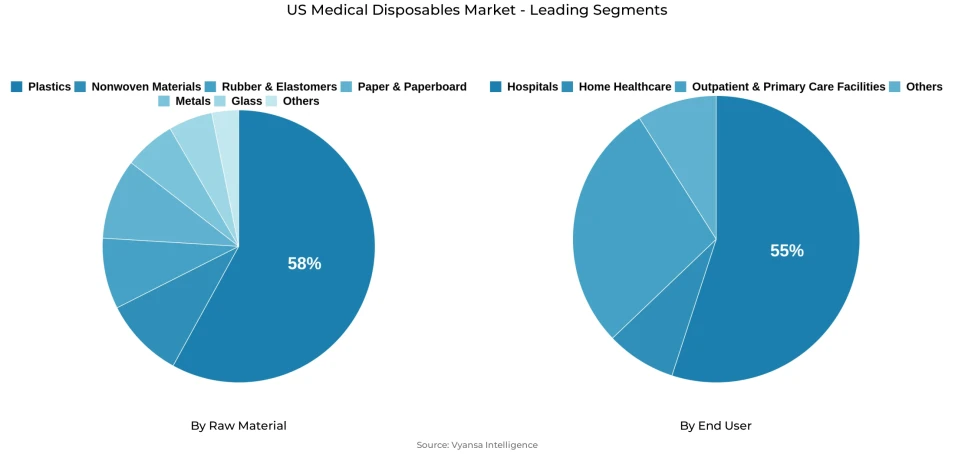
- Among raw material, plastics are the leading segment with a 58% share in 2026.
- Nonwoven materials are the fastest-growing raw material segment, expanding at an 9.25% CAGR across 2027 to 2033.
- By end user, Hospitals led the market with a 55.00% share in 2026.
- Home Healthcare is the fastest-growing end-user segment, expanding at a CAGR of 13.43% between 2027 and 2033.
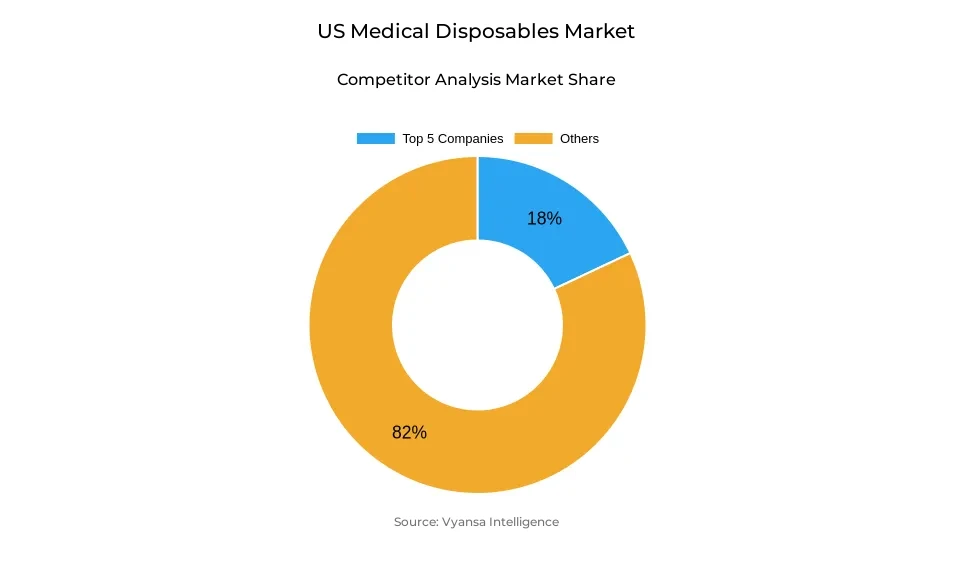
- The market structure is fragmented, with the top five companies holding a combined 18.00% share of total industry revenue as of 2026.
The United States medical disposables market is supported by the country's substantial healthcare expenditure, extensive clinical infrastructure and recurring consumption of single-use medical products. Its applications extend across surgical procedures, diagnostic testing, medication administration, infection prevention and continuing patient care.
The broader healthcare expenditure environment provides a substantial foundation for market development. According to projections published by the centers for medicare & medicaid services in June 2026, US national healthcare expenditure reached an estimated USD 5.7 trillion in 2025, increasing 7.3% from the previous year. Expenditure is projected to approach USD 9 trillion by 2034. Although these figures cover the entire healthcare system rather than medical disposables specifically, they demonstrate the considerable financial scale of the industry purchasing these products.
Changes in clinical service delivery and pharmaceutical logistics are also expanding the range of settings requiring disposable medical products. Under the 2026 outpatient reimbursement framework, Medicare began removing 285 procedures from its inpatient-only list and added 289 procedures to the ambulatory surgical center covered-procedures list. These changes give eligible procedures additional opportunities to be performed outside conventional inpatient departments, increasing the importance of distribution networks capable of supplying multiple healthcare settings.
The market's development is further reflected in supplier infrastructure investment. In March 2026, Medline announced construction of a 1.2-million-square-foot distribution center in Midlothian, Texas, scheduled to become operational during the second quarter of 2027. The facility will expand the company's existing network of 45 US distribution centers, demonstrating continued investment in medical-supply distribution capacity.
Through 2033, demand should remain supported by recurring clinical consumption, expanding healthcare expenditure, and greater access to medical treatment across different care settings. Manufacturers and distributors capable of combining extensive product portfolios with dependable national availability can strengthen their participation in the market.
US Medical Disposables Market Government Compliance
US medical-device manufacturing requirements changed materially in February 2026 when the FDA's updated quality-management framework became effective. Manufacturers must maintain stronger and more internationally aligned controls across production, suppliers, and quality documentation. For disposable-product companies, this directly influences whether manufacturing lines and product changes can qualify for commercial supply rather than functioning only as an administrative requirement.
Federal shortage-reporting requirements create a second commercial effect by requiring manufacturers to notify the FDA of qualifying production interruptions and permanent discontinuations. This gives hospitals and distributors earlier visibility into supply risks and allows them to qualify alternative products before a shortage becomes more severe.
Manufacturers with established quality systems, reliable sterilization and redundant production are therefore better positioned to retain institutional demand. Compliance does not itself increase disposable consumption, but it can determine which suppliers maintain access when competing products encounter quality or supply disruptions.
US Medical Disposables Market Drivers
Expanding Procedure Throughput Directly Increases Recurring Disposable Consumption
Every surgery, injection, catheter placement, specimen draw and wound-care episode creates a requirement for products that generally cannot be reused between patients. Disposable demand therefore rises with clinical activity rather than following equipment-replacement cycles. Hospitals and ambulatory surgical centers continuously replenish catheters, syringes, needles, drapes, dressings and procedure packs as treatment volumes accumulate.
The 2026 Medicare outpatient framework covers approximately 4,000 hospitals and 6,000 ambulatory surgical centers, illustrating the scale of the active procedural network consuming disposable products. The importance of this figure is not the payment framework itself but the large number of treatment sites where every additional procedure creates another replenishment requirement.
Through the forecast period, continued outpatient procedure growth should distribute disposable demand across a broader facility base while hospitals retain complex and high-intensity cases. This makes procedure throughput one of the strongest direct demand mechanisms for the market because incremental clinical activity converts immediately into recurring product consumption.
US Medical Disposables Market Challenges
Product Shortages and Quality Failures Increase Supply and Qualification Risk
Many medical disposables are difficult to replace immediately once incorporated into a clinical workflow. Sterility requirements, dimensions, material specifications and user familiarity can all require evaluation before hospitals accept an alternative product. A failure affecting a major supplier can therefore remove meaningful qualified inventory and interrupt procedures even when competing products technically exist.
The FDA's 2026 shortage list continued to include several procedure-critical disposable categories, including biopsy needles and angiographic syringes. Product recalls during 2025 and 2026 further demonstrated how manufacturing or sterility issues can remove inventory with limited notice, forcing hospitals to conserve stock or qualify substitute suppliers.
Health systems are responding through dual sourcing and larger safety inventories for selected products. This increases the value of manufacturing redundancy and quality consistency, directing demand toward suppliers that can demonstrate dependable supply rather than simply offering the lowest unit cost.
US Medical Disposables Market Recent Trends
Procedure-Specific Kits Are Replacing Part-by-Part Supply Preparation
Hospitals and ambulatory surgical centers are increasingly replacing individual supply picking with standardized procedure kits containing the disposables required for specific clinical workflows. Instead of staff gathering drapes, syringes, dressings and other items separately before each case, suppliers can configure products around repeatable procedures, reducing preparation time and missing-item risk.
Medline strengthened this model in 2025 through Pack 360 Analysis, which uses procedure-level supply-utilization information to help healthcare facilities redesign surgical packs around actual consumption. This allows unnecessary items to be removed and frequently used products to be standardized rather than relying on historical kit configurations.
The commercial effect is a shift from buying many individually managed components toward fewer higher-volume configurations. Hospitals gain greater preparation consistency and inventory visibility, while suppliers can become more deeply embedded in procedure workflows through customized kits and recurring replenishment contracts.
AI, Robotics and Automated Fulfillment Are Transforming Medical Disposable Distribution
Medical-disposable distribution is becoming more technology-intensive as demand spreads across hospitals, ambulatory facilities and patient homes. Smaller and more frequent orders are harder to fulfill economically through traditional warehouse processes, creating greater use of robotics, automated picking and AI-supported inventory management to maintain speed and accuracy while controlling fulfillment cost.
Cardinal Health provides a clear example through its at-Home Solutions distribution network. Its newer facilities use robotics, automated conveyors and AI-supported warehouse management to coordinate inventory, labor and order fulfillment. Its Fort Worth center was designed to handle around 10,000 patient packages per day, demonstrating how automation is being used to scale direct-to-patient medical-supply distribution rather than simply adding warehouse capacity.
This technology reduces the operating penalty associated with fragmented orders and allows distributors to serve more non-acute and home-based customers without proportional labor growth. Through the forecast period, AI-led inventory planning, robotics and automated fulfillment should become increasingly important competitive capabilities as disposable consumption becomes more geographically dispersed.
US Medical Disposables Market Future Opportunities
Domestic Production of Shortage-Sensitive Disposables Creates a Supply-Assurance Opportunity
Syringes, needles and vascular-access products offer a clear domestic manufacturing opportunity because supply interruptions can immediately affect treatment while replacement products require qualification. Creating additional US capacity allows manufacturers to offer hospitals and distributors greater continuity in categories where offshore concentration or single-site disruption can create substantial procurement risk.
BD's US manufacturing expansion demonstrates this opportunity. In 2025, the company increased domestic capacity for safety-engineered injection products by more than 40% and conventional syringes by more than 50%, adding hundreds of millions of units of annual output.
The strongest commercial route is not simply adding capacity for spot-market sales. Manufacturers can use qualified domestic production to secure longer-term supply relationships with hospitals, distributors and ambulatory providers that increasingly value continuity alongside unit price. Supply assurance therefore becomes a revenue differentiator rather than only an operational safeguard.
Unlock Market Intelligence
Explore the market potential with our data-driven report
US Medical Disposables Market Segmentation Analysis
By Raw Material
- Plastics
- Rubber & Elastomers
- Nonwoven Materials
- Paper & Cellulose
- Metals
- Glass
- Others
Plastics Lead Raw Material Demand While Nonwoven Materials Record the Fastest Growth
Plastics dominate the US medical disposables industry by raw material, accounting for an estimated 58% of the market share in 2026. Their extensive utilization in syringes, catheters, intravenous components, diagnostic consumables, and other single-use medical products supports substantial demand across healthcare facilities. Their cost-effectiveness, manufacturing flexibility, compatibility with sterilization processes, and suitability for large-scale production reinforce their widespread adoption. Additionally, advancements in medical-grade polymers and growing demand for disposable healthcare products continue to strengthen the segment's dominant position.
Nonwoven materials are projected to be the fastest-growing raw material segment in the US medical disposables market, with a CAGR of 9.25% during 2027–2033. Their increasing utilization in surgical gowns, drapes, protective apparel, sterilization wraps, and wound dressings supports expanding demand across hospitals and outpatient facilities. Growing emphasis on infection prevention, increasing surgical procedures, and demand for advanced protective materials are encouraging manufacturers to develop specialized nonwoven products. Established manufacturers, including Medline and Cardinal Health, maintain extensive surgical disposable portfolios, supporting the segment's continued expansion.
By End User:
- Hospitals
- General & Specialty Clinics
- Diagnostic & Laboratory Facilities
- Long-Term Care Facilities
- Home Healthcare
- Other Healthcare Settings
Hospitals Retain End User Leadership with 55% Share Through High Procedure Intensity
Hospitals account for 55.00% of market demand in 2026 because they concentrate surgery, emergency care, inpatient treatment, intensive care and high-volume diagnostics within the same setting. One hospital procedure can consume several disposable categories simultaneously, giving acute-care institutions a substantially larger disposable basket than lower-acuity facilities.
Distribution investment continues to reflect this large institutional demand base, while separate networks are being added for products moving directly to patients. Hospitals should therefore remain the dominant end user because the most procedure-intensive and complex care continues to be concentrated within acute facilities.
Home Healthcare is the fastest-growing End User at a 13.43% CAGR during 2027 to 2033 as wound care, diabetes management, continence care and other chronic-treatment products increasingly reach patients outside hospitals. Its faster growth reflects expansion from a smaller installed consumption base rather than weakening hospital demand.
Unlock Market Intelligence
Explore the market potential with our data-driven report
US Medical Disposables Market Competitive Landscape
The market is fragmented, with the top five companies holding a combined 18.00% share of total industry revenue in 2026, reflecting extensive participation from national distributors, specialized device manufacturers and regional suppliers across the product and end-user categories tracked in this report. Medline Industries LP, Cardinal Health Inc, McKesson Medical-Surgical Inc, Becton Dickinson and Company and Solventum Corporation lead the competitive set.
Key Companies in the US Medical Disposables Market
- Medline Industries LP
- Cardinal Health Inc
- McKesson Medical-Surgical Inc
- Becton Dickinson and Company
- Solventum Corporation
- Baxter International Inc
- B Braun Medical Inc
- Smith & Nephew plc
- ICU Medical Inc
- Teleflex Incorporated
- Boston Scientific Corporation
- Henry Schein Inc
Recent Developments in the US Medical Disposables Market
- March 2026: Baxter launched an automated IV line-labeling solution designed to standardize bedside identification and reduce errors associated with infusion-line management. The development adds a technology layer around conventional IV disposables and reflects growing hospital interest in products that improve workflow and infection-prevention processes.
- October 2025: B. Braun expanded its vascular-access portfolio with a central venous catheter incorporating infection-reduction features for high-risk patients. The launch reinforces continued movement toward differentiated catheter products that compete through clinical performance rather than basic unit pricing.
Frequently Asked Questions
Related Report
- Market Segmentation
- Research Scope
- Research Methodology
- Definitions and Assumptions
- Executive Summary
- US Medical Disposables Market Policies, Regulations, and Standards
- US Medical Disposables Market Dynamics
- Growth Factors
- Challenges
- Trends
- Opportunities
- US Medical Disposables Market Statistics, 2023-2033F
- Market Size & Growth Outlook
- By Revenues in USD Million
- Market Segmentation & Growth Outlook
- By Product Type
- Wound Management Products- Market Insights and Forecast 2023-2033, USD Million
- Advanced Wound Care- Market Insights and Forecast 2023-2033, USD Million
- Traditional Wound Care- Market Insights and Forecast 2023-2033, USD Million
- Surgical Wound Care- Market Insights and Forecast 2023-2033, USD Million
- Drug Delivery Products- Market Insights and Forecast 2023-2033, USD Million
- Inhalers- Market Insights and Forecast 2023-2033, USD Million
- Injection Devices- Market Insights and Forecast 2023-2033, USD Million
- Transdermal Patches- Market Insights and Forecast 2023-2033, USD Million
- Others- Market Insights and Forecast 2023-2033, USD Million
- Diagnostic & Laboratory Disposables- Market Insights and Forecast 2023-2033, USD Million
- Pipettes & Tips- Market Insights and Forecast 2023-2033, USD Million
- Tubes & Containers- Market Insights and Forecast 2023-2033, USD Million
- Cell Culture & Imaging Consumables- Market Insights and Forecast 2023-2033, USD Million
- Specimen Collection & Transport Consumables- Market Insights and Forecast 2023-2033, USD Million
- Others- Market Insights and Forecast 2023-2033, USD Million
- Dialysis Disposables- Market Insights and Forecast 2023-2033, USD Million
- Dialysis Catheters- Market Insights and Forecast 2023-2033, USD Million
- Dialysis Needles- Market Insights and Forecast 2023-2033, USD Million
- Peritoneal Dialysis Consumables- Market Insights and Forecast 2023-2033, USD Million
- Incontinence Products- Market Insights and Forecast 2023-2033, USD Million
- Absorbent Products- Market Insights and Forecast 2023-2033, USD Million
- Urinary Catheters & Drainage Bags- Market Insights and Forecast 2023-2033, USD Million
- Others- Market Insights and Forecast 2023-2033, USD Million
- Respiratory Disposables- Market Insights and Forecast 2023-2033, USD Million
- Respiratory Tubes- Market Insights and Forecast 2023-2033, USD Million
- Oxygen Masks & Cannulas- Market Insights and Forecast 2023-2033, USD Million
- Resuscitators- Market Insights and Forecast 2023-2033, USD Million
- Others- Market Insights and Forecast 2023-2033, USD Million
- Sterilization Supplies- Market Insights and Forecast 2023-2033, USD Million
- Sterilization Indicators- Market Insights and Forecast 2023-2033, USD Million
- Sterilization Packaging & Accessories- Market Insights and Forecast 2023-2033, USD Million
- Nonwoven Disposables- Market Insights and Forecast 2023-2033, USD Million
- Surgical Drapes- Market Insights and Forecast 2023-2033, USD Million
- Disposable Gowns- Market Insights and Forecast 2023-2033, USD Million
- Others- Market Insights and Forecast 2023-2033, USD Million
- Disposable Masks- Market Insights and Forecast 2023-2033, USD Million
- Surgical & Procedure Masks- Market Insights and Forecast 2023-2033, USD Million
- Respirator Masks- Market Insights and Forecast 2023-2033, USD Million
- Others- Market Insights and Forecast 2023-2033, USD Million
- Disposable Eye Protection- Market Insights and Forecast 2023-2033, USD Million
- Disposable Gloves- Market Insights and Forecast 2023-2033, USD Million
- Examination Gloves- Market Insights and Forecast 2023-2033, USD Million
- Surgical Gloves- Market Insights and Forecast 2023-2033, USD Million
- Hand Sanitizers- Market Insights and Forecast 2023-2033, USD Million
- Others- Market Insights and Forecast 2023-2033, USD Million
- Wound Management Products- Market Insights and Forecast 2023-2033, USD Million
- By Raw Material
- Plastics- Market Insights and Forecast 2023-2033, USD Million
- Nonwoven Materials- Market Insights and Forecast 2023-2033, USD Million
- Rubber & Elastomers- Market Insights and Forecast 2023-2033, USD Million
- Paper & Paperboard- Market Insights and Forecast 2023-2033, USD Million
- Metals- Market Insights and Forecast 2023-2033, USD Million
- Glass- Market Insights and Forecast 2023-2033, USD Million
- Others- Market Insights and Forecast 2023-2033, USD Million
- By End User
- Hospitals- Market Insights and Forecast 2023-2033, USD Million
- Home Healthcare- Market Insights and Forecast 2023-2033, USD Million
- Outpatient & Primary Care Facilities- Market Insights and Forecast 2023-2033, USD Million
- Others- Market Insights and Forecast 2023-2033, USD Million
- By Competitors
- Competition Characteristics
- Market Share & Analysis
- By Product Type
- Market Size & Growth Outlook
- US Wound Management Disposables Market Statistics, 2023-2033
- Market Size & Growth Outlook
- By Revenues in USD Million
- Market Segmentation & Growth Outlook
- By Raw Material- Market Insights and Forecast 2023-2033, USD Million
- By End Use- Market Insights and Forecast 2023-2033, USD Million
- Market Size & Growth Outlook
- US Drug Delivery Products Disposables Market Statistics, 2023-2033
- Market Size & Growth Outlook
- By Revenues in USD Million
- Market Segmentation & Growth Outlook
- By Raw Material- Market Insights and Forecast 2023-2033, USD Million
- By End Use- Market Insights and Forecast 2023-2033, USD Million
- Market Size & Growth Outlook
- US Diagnostic & Laboratory Disposables Market Statistics, 2023-2033
- Market Size & Growth Outlook
- By Revenues in USD Million
- Market Segmentation & Growth Outlook
- By Raw Material- Market Insights and Forecast 2023-2033, USD Million
- By End Use- Market Insights and Forecast 2023-2033, USD Million
- Market Size & Growth Outlook
- US Dialysis Disposables Market Statistics, 2023-2033
- Market Size & Growth Outlook
- By Revenues in USD Million
- Market Segmentation & Growth Outlook
- By Raw Material- Market Insights and Forecast 2023-2033, USD Million
- By End Use- Market Insights and Forecast 2023-2033, USD Million
- Market Size & Growth Outlook
- US Incontinence Products Market Statistics, 2023-2033
- Market Size & Growth Outlook
- By Revenues in USD Million
- Market Segmentation & Growth Outlook
- By Raw Material- Market Insights and Forecast 2023-2033, USD Million
- By End Use- Market Insights and Forecast 2023-2033, USD Million
- Market Size & Growth Outlook
- US Respiratory Disposables Market Statistics, 2023-2033
- Market Size & Growth Outlook
- By Revenues in USD Million
- Market Segmentation & Growth Outlook
- By Raw Material- Market Insights and Forecast 2023-2033, USD Million
- By End Use- Market Insights and Forecast 2023-2033, USD Million
- Market Size & Growth Outlook
- US Sterilization Supplies Disposables Market Statistics, 2023-2033
- Market Size & Growth Outlook
- By Revenues in USD Million
- Market Segmentation & Growth Outlook
- By Raw Material- Market Insights and Forecast 2023-2033, USD Million
- By End Use- Market Insights and Forecast 2023-2033, USD Million
- Market Size & Growth Outlook
- US Nonwoven Disposables Market Statistics, 2023-2033
- Market Size & Growth Outlook
- By Revenues in USD Million
- Market Segmentation & Growth Outlook
- By Raw Material- Market Insights and Forecast 2023-2033, USD Million
- By End Use- Market Insights and Forecast 2023-2033, USD Million
- Market Size & Growth Outlook
- US Disposable Masks Market Statistics, 2023-2033
- Market Size & Growth Outlook
- By Revenues in USD Million
- Market Segmentation & Growth Outlook
- By Raw Material- Market Insights and Forecast 2023-2033, USD Million
- By End Use- Market Insights and Forecast 2023-2033, USD Million
- Market Size & Growth Outlook
- US Disposable Eye Protection Market Statistics, 2023-2033
- Market Size & Growth Outlook
- By Revenues in USD Million
- Market Segmentation & Growth Outlook
- By Raw Material- Market Insights and Forecast 2023-2033, USD Million
- By End Use- Market Insights and Forecast 2023-2033, USD Million
- Market Size & Growth Outlook
- US Disposable Gloves Market Statistics, 2023-2033
- Market Size & Growth Outlook
- By Revenues in USD Million
- Market Segmentation & Growth Outlook
- By Raw Material- Market Insights and Forecast 2023-2033, USD Million
- By End Use- Market Insights and Forecast 2023-2033, USD Million
- Market Size & Growth Outlook
- US Hand Sanitizers Disposables Market Statistics, 2023-2033
- Market Size & Growth Outlook
- By Revenues in USD Million
- Market Segmentation & Growth Outlook
- By Raw Material- Market Insights and Forecast 2023-2033, USD Million
- By End Use- Market Insights and Forecast 2023-2033, USD Million
- Market Size & Growth Outlook
- US Others Market Statistics, 2023-2033
- Market Size & Growth Outlook
- By Revenues in USD Million
- Market Segmentation & Growth Outlook
- By Raw Material- Market Insights and Forecast 2023-2033, USD Million
- By End Use- Market Insights and Forecast 2023-2033, USD Million
- Market Size & Growth Outlook
- Competitive Outlook
- Company Profiles
- Medline Industries, LP
- Business Description
- Product Portfolio
- Collaborations & Alliances
- Recent Developments
- Financial Details
- Others
- Cardinal Health, Inc.
- Business Description
- Product Portfolio
- Collaborations & Alliances
- Recent Developments
- Financial Details
- Others
- McKesson Medical-Surgical Inc.
- Business Description
- Product Portfolio
- Collaborations & Alliances
- Recent Developments
- Financial Details
- Others
- Becton, Dickinson and Company
- Business Description
- Product Portfolio
- Collaborations & Alliances
- Recent Developments
- Financial Details
- Others
- Solventum Corporation
- Business Description
- Product Portfolio
- Collaborations & Alliances
- Recent Developments
- Financial Details
- Others
- Baxter Healthcare Corporation
- Business Description
- Product Portfolio
- Collaborations & Alliances
- Recent Developments
- Financial Details
- Others
- B. Braun Medical Inc.
- Business Description
- Product Portfolio
- Collaborations & Alliances
- Recent Developments
- Financial Details
- Others
- Henry Schein, Inc.
- Business Description
- Product Portfolio
- Collaborations & Alliances
- Recent Developments
- Financial Details
- Others
- Smith & Nephew, Inc.
- Business Description
- Product Portfolio
- Collaborations & Alliances
- Recent Developments
- Financial Details
- Others
- ICU Medical, Inc.
- Business Description
- Product Portfolio
- Collaborations & Alliances
- Recent Developments
- Financial Details
- Others
- Medline Industries, LP
- Company Profiles
- Disclaimer
| Segment | Sub-Segment |
|---|---|
| By Product Type |
|
| By Raw Material |
|
| By End User |
|
Research Methodology
This study followed a structured approach comprising four key phases to assess the size and scope of the electro-oxidation market. The process began with thorough secondary research to collect data on the target market, related markets, and broader industry context. These findings, along with preliminary assumptions and estimates, were then validated through extensive primary research involving industry experts from across the value chain. To calculate the overall market size, both top-down and bottom-up methodologies were employed. Finally, market segmentation and data triangulation techniques were applied to refine and validate segment-level estimations.
Secondary Research
The secondary research phase involved gathering data from a wide range of credible and published sources. This step helped in identifying industry trends, defining market segmentation, and understanding the market landscape and value chain.
Sources consulted during this phase included:
- Company annual reports, investor presentations, and press releases
- Industry white papers and certified publications
- Trade directories and market-recognized databases
- Articles from authoritative authors and reputable journals
- Gold and silver standard websites
Secondary research was critical in mapping out the industry's value chain and monetary flow, identifying key market segments, understanding regional variations, and tracking significant industry developments.
Other key sources:
- Financial disclosures
- Industry associations and trade bodies
- News outlets and business magazines
- Academic journals and research studies
- Paid industry databases
Primary Research
To validate secondary data and gain deeper market insights, primary research was conducted with key stakeholders across both the supply and demand sides of the market.
On the demand side, participants included decision-makers and influencers from end-user industries—such as CIOs, CTOs, and CSOs—who provided first-hand perspectives on market needs, product usage, and future expectations.
On the supply side, interviews were conducted with manufacturers, industry associations, and institutional participants to gather insights into current offerings, product pipelines, and market challenges.
Primary interviews provided critical inputs such as:
- Market size and revenue data
- Product and service breakdowns
- Market forecasts
- Regional and application-specific trends
Stakeholders consulted included:
- Leading OEM and solution providers
- Channel and distribution partners
- End users across various applications
- Independent consultants and industry specialists
Market Size Estimation and Data Triangulation
- Identifying Key Market Participants (Secondary Research)
- Goal: To identify the major players or companies in the target market. This typically involves using publicly available data sources such as industry reports, market research publications, and financial statements of companies.
- Tools: Reports from firms like Gartner, Forrester, Euromonitor, Statista, IBISWorld, and others. Public financial statements, news articles, and press releases from top market players.
- Extracting Earnings of Key Market Participants
- Goal: To estimate the earnings generated from the product or service being analyzed. This step helps in understanding the revenue potential of each market player in a specific geography.
- Methods: Earnings data can be gathered from:
- Publicly available financial reports (for listed companies).
- Interviews and primary data sources from professionals, such as Directors, VPs, SVPs, etc. This is especially useful for understanding more nuanced, internal data that isn't publicly disclosed.
- Annual reports and investor presentations of key players.
- Data Collation and Development of a Relevant Data Model
- Goal: To collate inputs from both primary and secondary sources into a structured, data-driven model for market estimation. This model will incorporate key market KPIs and any independent variables relevant to the market.
- Key KPIs: These could include:
- Market size, growth rate, and demand drivers.
- Industry-specific metrics like market share, average revenue per customer (ARPC), or average deal size.
- External variables, such as economic growth rates, inflation rates, or commodity prices, that could affect the market.
- Data Modeling: Based on this data, the market forecasts are developed for the next 5 years. A combination of trend analysis, scenario modeling, and statistical regression might be used to generate projections.
- Scenario Analysis
- Goal: To test different assumptions and validate how sensitive the market is to changes in key variables (e.g., market demand, regulatory changes, technological disruptions).
- Types of Scenarios:
- Base Case: Based on current assumptions and historical data.
- Best-Case Scenario: Assuming favorable market conditions, regulatory environments, and technological advancements.
- Worst-Case Scenario: Accounting for adverse factors, such as economic downturns, stricter regulations, or unexpected disruptions.












