North America Software-Defined Vehicle Platforms Market Report: Trends, Growth and Forecast (2026-2032)
By Component (Software, Services), By Software Application Domain (ADAS & Autonomous Driving Software, Infotainment & Digital Cockpit Software, Powertrain Control Software, Chassis & Vehicle Dynamics Software, Body & Comfort Software, Cross-Vehicle Enablers (Platform Infrastructure) (Vehicle OS & Middleware, OTA Update Management, Cybersecurity, DevOps & Toolchains)), By Deployment Mode (On-Board (Embedded), Cloud-Based, Hybrid (On-Board + Cloud)), By End-User (Automotive OEMs, Tier-1 Suppliers, Fleet Operators & Mobility Service Providers), By Vehicle Type (Passenger Vehicles, Commercial Vehicles), By Country (The US, Canada, Mexico) ... Read more
|
Major Players
|
North America Software-Defined Vehicle Platforms Market Statistics and Insights, 2026
- Market Size Statistics
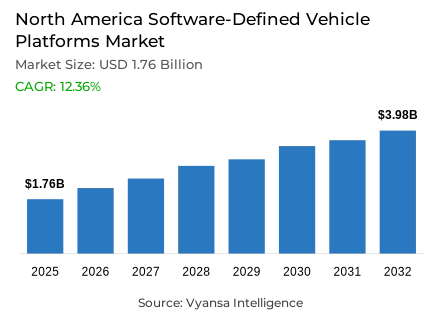
- Software-defined vehicle platforms market size in North America was valued at USD 1.76 billion in 2025 and is estimated at USD 1.89 billion in 2026.
- The market size is expected to grow to USD 3.98 billion by 2032.
- Market to register a CAGR of around 12.36% during 2026-32.
- Software Application Domain Shares
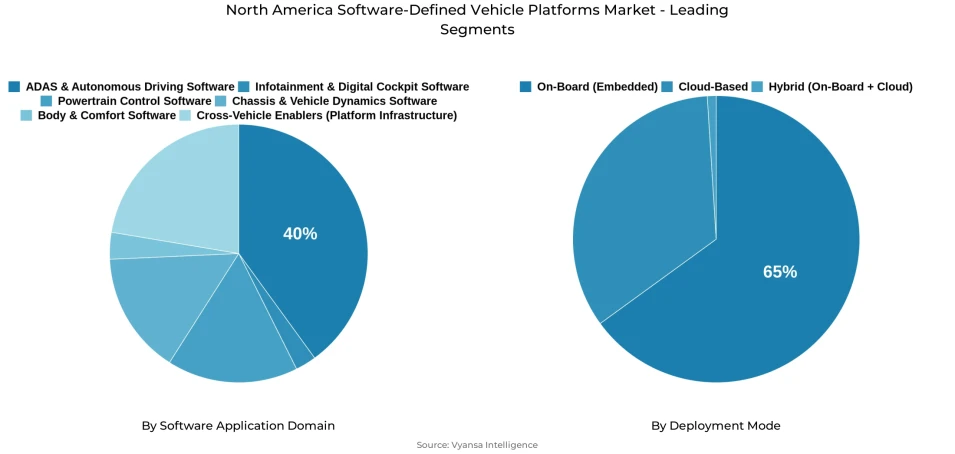
- Adas & autonomous driving software grabbed market share of 40%.
- Competition
- Software-defined vehicle platforms in North America is currently being catered to by more than 10 companies.
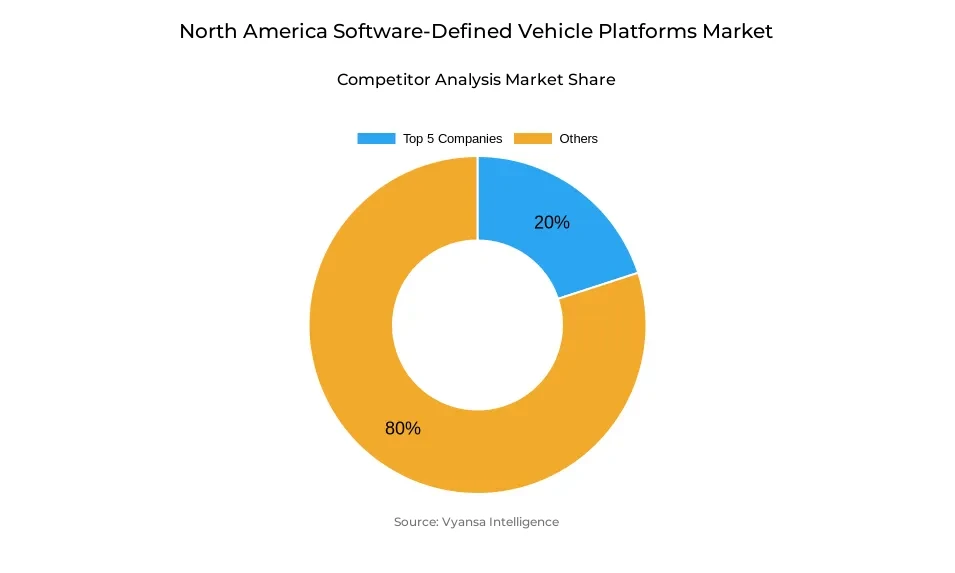
- Top 5 companies acquired around 20% of the market share in 2026.
- Aptiv PLC, AUMOVIO SE, Tesla Inc., NVIDIA Corporation, Qualcomm Technologies Inc. (Snapdragon Digital Chassis) etc., are few of the top companies.
- Deployment Mode
- On-Board (Embedded) grabbed 65% of the market.
- Country
- The US leads with a 85% share of the North America market.
North America Software-Defined Vehicle Platforms Market Outlook
Software-led vehicle architecture is becoming a core planning layer for automakers, semiconductor suppliers, middleware vendors, cloud providers, and fleet operators. North America software-defined vehicle (SDV) platforms market was valued at USD 1.76 billion in 2025 and is projected to grow from USD 1.89 billion in 2026 to USD 3.98 billion by 2032, exhibiting a CAGR of 12.36% during 2026-32. The North America software-defined vehicle (SDV) platforms industry covers vehicle OS, automotive middleware, OTA software updates, ADAS software platform, digital cockpit software, cybersecurity, and vehicle-to-cloud platform capabilities.
OEM software roadmaps are being shaped by centralized E/E architecture, zonal vehicle architecture, and high-performance vehicle compute as vehicle functions move from isolated ECUs toward updateable software layers. GM reported in 2025 that more than 4.5 million vehicles can receive over-the-air vehicle system updates, with about 2 million added annually and 1.6 million receiving coordinated software updates last year. The North America software-defined vehicle (SDV) platforms market gains momentum from this installed software-update base.
Industrial impact is shifting from one-time vehicle engineering toward continuous lifecycle control, secure OTA updates, cloud-native automotive software, and supplier-integrated DevOps for automotive. North America software-defined vehicle (SDV) platforms industry demand is tied to shorter software release cycles, lower module complexity, faster validation, and compliance readiness. The North America software-defined vehicle (SDV) platforms market strengthens procurement visibility because OEMs increasingly evaluate software portability, safety certification, and data-governance capability alongside hardware sourcing.
Centralized compute investment, connected vehicle compliance, and AI-enabled driver assistance are setting the 2026 trajectory. North America software-defined vehicle (SDV) platforms industry participants are prioritizing embedded deployment, automotive cybersecurity, software bill of materials discipline, and vehicle software stack consolidation. The North America software-defined vehicle (SDV) platforms market is therefore moving toward platform-led competition, where OEMs, Tier-1 suppliers, chipmakers, and cloud providers compete on integration speed, update reliability, safety validation, and scalable regional delivery.
North America Software-Defined Vehicle Platforms Market Growth Driver
Software-Centric Vehicle Demand Rewires OEM Roadmaps
OEM demand for continuously upgradeable vehicles is accelerating platform adoption as software moves deeper into safety, propulsion, cockpit, and connectivity functions. North America software-defined vehicle (SDV) platforms market growth is supported by automakers seeking common software foundations that reduce fragmented ECU development, improve feature deployment, and extend vehicle functionality after production. This shift strengthens demand for embedded software, middleware, compute silicon, OTA orchestration, cybersecurity assurance, and validation services.
Ford stated in 2025 that faster over-the-air software updates are central to its vehicle software vision, while BlueCruise availability pages show eligible vehicles receive newer versions through OTA software updates. North America software-defined vehicle (SDV) platforms industry suppliers benefit as OEMs move from isolated feature launches toward scalable update pipelines, supporting recurring software procurement and higher platform stickiness across passenger and commercial vehicle programs.
North America Software-Defined Vehicle Platforms Market Challenge
Compliance Burden Tightens Software Supply Chains
Software supply-chain compliance is becoming a major scaling bottleneck as connected vehicles depend on multi-country code bases, wireless modules, ADS software, and supplier-maintained update pipelines. North America software-defined vehicle (SDV) platforms market participants must verify software origin, development control, maintenance responsibility, and cybersecurity governance before production release. This increases validation workload, lengthens sourcing cycles, raises participation barriers for smaller platform providers, and complicates cross-border integration planning.
The U.S. Bureau of Industry and Security issued a 2025 final rule prohibiting certain Vehicle Connectivity System hardware and covered software linked to China or Russia in connected vehicles. North America software-defined vehicle (SDV) platforms industry suppliers face tighter due diligence across automated driving software, telematics, cellular modules, and cloud-connected components, which can delay model launches and reshape vendor selection.
Unlock Market Intelligence
Explore the market potential with our data-driven report
North America Software-Defined Vehicle Platforms Market Trend
Centralized Compute Moves From Concept to Production
Centralized vehicle computing is reshaping supplier positioning as OEMs move toward fewer, more capable controllers that can coordinate safety, autonomy, cockpit, and propulsion workloads. North America software-defined vehicle (SDV) platforms market demand is strengthening around domain controllers, zonal controllers, automotive Ethernet, and AI-ready processors because software release speed increasingly depends on architecture simplification rather than isolated ECU additions.
Bosch announced in 2025 that it would integrate NVIDIA DRIVE AGX Thor into its next-generation ADAS compute platform, with the platform optimized for advanced transformer models, large language models, and generative AI workloads. This supports higher-performance in-vehicle compute procurement and strengthens competitive positioning for suppliers that can combine silicon, safety-certified software, and system integration.
North America Software-Defined Vehicle Platforms Market Opportunity
Cloud-Edge Toolchains Open New Supplier Routes
Cloud-based engineering environments are opening underpenetrated opportunities for platform providers, DevOps vendors, simulation specialists, and cybersecurity suppliers serving OEM software factories. North America software-defined vehicle (SDV) platforms market expansion increasingly depends on virtual validation, digital twin workflows, data orchestration, and continuous integration pipelines that allow teams to test vehicle software before physical prototype availability. North America software-defined vehicle (SDV) platforms industry suppliers can improve demand capture through cloud-edge interoperability.
AWS reported in 2026 that Kiro, AWS Security Agent, and AWS DevOps Agent can support software-defined vehicle development needs, while its vehicle-quality work highlights connected vehicle data, software-defined architectures, and AI/ML services. These tools improve development velocity, quality monitoring, and supplier access to OEM engineering workflows.
North America Software-Defined Vehicle Platforms Market Country Analysis
By Country
- The US
- Canada
- Mexico
The US holds 85% share by country, supported by large vehicle parc, OEM software investment, technology supplier density, advanced driver-assistance deployment, and regulatory pressure around connected vehicle software. High installed vehicle volume improves the commercial case for OTA updates, vehicle diagnostics, software subscriptions, and connected vehicle data platforms. It also gives domestic OEMs and suppliers a larger base for validating SDV functions at scale.
Federal Highway Administration data shows 297.5 million motor vehicles registered in the U.S. in 2024, creating the region’s deepest addressable base for connected and software-upgradeable vehicle functions. This vehicle base strengthens demand for embedded platforms, cloud-connected diagnostics, cybersecurity compliance tools, and software lifecycle services across OEM, Tier-1, and fleet channels.
Unlock Market Intelligence
Explore the market potential with our data-driven report
North America Software-Defined Vehicle Platforms Market Segmentation Analysis
By Software Application Domain
- ADAS & Autonomous Driving Software
- Infotainment & Digital Cockpit Software
- Powertrain Control Software
- Chassis & Vehicle Dynamics Software
- Body & Comfort Software
- Cross-Vehicle Enablers (Platform Infrastructure)
- Vehicle OS & Middleware
- OTA Update Management
- Cybersecurity
- DevOps & Toolchains
ADAS & Autonomous Driving Software holds 40% share under software application domain because safety-critical automation demands high-value software, sensor fusion, perception algorithms, real-time decision logic, and validation-intensive deployment. North America software-defined vehicle (SDV) platforms market demand is concentrated in ADAS because OEMs must integrate camera, radar, lidar, compute, software, and cybersecurity into systems that improve safety while supporting differentiated vehicle functionality.
NHTSA finalized a 2024 rule requiring all new passenger cars and light trucks to meet automatic emergency braking requirements, including stopping and avoiding contact with a vehicle ahead at speeds up to 62 miles per hour. This strengthens ADAS software procurement, validation demand, and embedded safety-system integration across vehicle platforms.
By Deployment Mode
- On-Board (Embedded)
- Cloud-Based
- Hybrid (On-Board + Cloud)
On-Board (Embedded) holds 65% share under deployment mode because vehicle-control, ADAS, autonomous driving, braking, steering, powertrain, and cockpit functions require low latency, functional safety, and fail-operational behavior inside the vehicle. North America software-defined vehicle (SDV) platforms market adoption therefore remains anchored in embedded compute, while cloud platforms support development, diagnostics, fleet analytics, and lifecycle management around the vehicle. North America software-defined vehicle (SDV) platforms industry suppliers must balance edge processing with cloud coordination.
GM’s 2025 centralized platform plan places intelligence in a liquid-cooled central compute unit linked to three aggregators through a high-speed Ethernet backbone, enabling real-time subsystem coordination. The architecture is designed for electric and internal-combustion vehicles, supporting scalable embedded deployment across broad production programs.
Various Market Players in North America Software-Defined Vehicle Platforms Market
The companies mentioned below are highly active in the North America software-defined vehicle platforms market, occupying a considerable portion of the market and shaping industry progress.
- Aptiv PLC
- AUMOVIO SE
- Tesla Inc.
- NVIDIA Corporation
- Qualcomm Technologies Inc. (Snapdragon Digital Chassis)
- BlackBerry Limited (QNX)
- Vector North America Inc.
- Robert Bosch LLC (Bosch Mobility)
- General Motors Holdings LLC
- Ford Motor Company
- Rivian Automotive LLC
- Amazon Web Services Inc.
Market News & Updates
- Qualcomm Technologies Inc., 2026:
Qualcomm expanded Snapdragon Digital Chassis with stronger centralized compute, cockpit, and ADAS platform capabilities. Snapdragon Ride Flex supports digital cockpit and ADAS workloads on one system-on-chip and is deployed in mass-produced vehicle programs. The update supports North American SDV adoption across in-vehicle compute, AI cockpit features, and driver-assistance software platforms.
- Rivian Automotive LLC, 2025:
Rivian unveiled custom silicon, a next-generation autonomy platform, and deeper AI integration for its vehicle software roadmap. The update adds a dedicated autonomy processor and new software-led architecture for future Rivian vehicles. It supports North American SDV adoption across embedded compute, autonomous driving software, OTA-enabled features, and AI-defined vehicle experiences.
Frequently Asked Questions
Related Report
- Market Segmentation
- Research Scope
- Research Methodology
- Definitions and Assumptions
- Executive Summary
- North America Software-Defined Vehicle (SDV) Platforms Market Policies, Regulations, and Standards
- North America Software-Defined Vehicle (SDV) Platforms Market Dynamics
- Growth Factors
- Challenges
- Trends
- Opportunities
- North America Software-Defined Vehicle (SDV) Platforms Market Statistics, 2022-2032F
- Market Size & Growth Outlook
- By Revenues in USD Million
- Market Segmentation & Growth Outlook
- By Component
- Software- Market Insights and Forecast 2022-2032, USD Million
- Services- Market Insights and Forecast 2022-2032, USD Million
- By Software Application Domain
- ADAS & Autonomous Driving Software- Market Insights and Forecast 2022-2032, USD Million
- Infotainment & Digital Cockpit Software- Market Insights and Forecast 2022-2032, USD Million
- Powertrain Control Software- Market Insights and Forecast 2022-2032, USD Million
- Chassis & Vehicle Dynamics Software- Market Insights and Forecast 2022-2032, USD Million
- Body & Comfort Software- Market Insights and Forecast 2022-2032, USD Million
- Cross-Vehicle Enablers (Platform Infrastructure)- Market Insights and Forecast 2022-2032, USD Million
- Vehicle OS & Middleware- Market Insights and Forecast 2022-2032, USD Million
- OTA Update Management- Market Insights and Forecast 2022-2032, USD Million
- Cybersecurity- Market Insights and Forecast 2022-2032, USD Million
- DevOps & Toolchains- Market Insights and Forecast 2022-2032, USD Million
- By Deployment Mode
- On-Board (Embedded)- Market Insights and Forecast 2022-2032, USD Million
- Cloud-Based- Market Insights and Forecast 2022-2032, USD Million
- Hybrid (On-Board + Cloud)- Market Insights and Forecast 2022-2032, USD Million
- By End-User
- Automotive OEMs- Market Insights and Forecast 2022-2032, USD Million
- Tier-1 Suppliers- Market Insights and Forecast 2022-2032, USD Million
- Fleet Operators & Mobility Service Providers- Market Insights and Forecast 2022-2032, USD Million
- By Vehicle Type
- Passenger Vehicles- Market Insights and Forecast 2022-2032, USD Million
- Commercial Vehicles- Market Insights and Forecast 2022-2032, USD Million
- By Country
- The US
- Canada
- Mexico
- By Competitors
- Competition Characteristics
- Market Share & Analysis
- By Component
- Market Size & Growth Outlook
- The US Software-Defined Vehicle (SDV) Platforms Market Statistics, 2022-2032F
- Market Size & Growth Outlook
- By Revenues in USD Million
- Market Segmentation & Growth Outlook
- By Component- Market Insights and Forecast 2022-2032, USD Million
- By Software Application Domain- Market Insights and Forecast 2022-2032, USD Million
- By Deployment Mode- Market Insights and Forecast 2022-2032, USD Million
- By End-User- Market Insights and Forecast 2022-2032, USD Million
- By Vehicle Type- Market Insights and Forecast 2022-2032, USD Million
- Market Size & Growth Outlook
- Canada Software-Defined Vehicle (SDV) Platforms Market Statistics, 2022-2032F
- Market Size & Growth Outlook
- By Revenues in USD Million
- Market Segmentation & Growth Outlook
- By Component- Market Insights and Forecast 2022-2032, USD Million
- By Software Application Domain- Market Insights and Forecast 2022-2032, USD Million
- By Deployment Mode- Market Insights and Forecast 2022-2032, USD Million
- By End-User- Market Insights and Forecast 2022-2032, USD Million
- By Vehicle Type- Market Insights and Forecast 2022-2032, USD Million
- Market Size & Growth Outlook
- Mexico Software-Defined Vehicle (SDV) Platforms Market Statistics, 2022-2032F
- Market Size & Growth Outlook
- By Revenues in USD Million
- Market Segmentation & Growth Outlook
- By Component- Market Insights and Forecast 2022-2032, USD Million
- By Software Application Domain- Market Insights and Forecast 2022-2032, USD Million
- By Deployment Mode- Market Insights and Forecast 2022-2032, USD Million
- By End-User- Market Insights and Forecast 2022-2032, USD Million
- By Vehicle Type- Market Insights and Forecast 2022-2032, USD Million
- Market Size & Growth Outlook
- Competitive Outlook
- Company Profiles
- Semiconductor & Computing Platform Providers
- NVIDIA Corporation
- Business Description
- Service Portfolio
- Collaborations & Alliances
- Recent Developments
- Financial Details
- Others
- Qualcomm Technologies Inc. (Snapdragon Digital Chassis)
- Business Description
- Service Portfolio
- Collaborations & Alliances
- Recent Developments
- Financial Details
- Others
- NVIDIA Corporation
- Vehicle OS, Middleware & Enabler Platform Providers
- BlackBerry Limited (QNX)
- Business Description
- Service Portfolio
- Collaborations & Alliances
- Recent Developments
- Financial Details
- Others
- Vector North America Inc.
- Business Description
- Service Portfolio
- Collaborations & Alliances
- Recent Developments
- Financial Details
- Others
- BlackBerry Limited (QNX)
- Tier-1 Suppliers with SDV Platform Capabilities
- Robert Bosch LLC (Bosch Mobility)
- Business Description
- Service Portfolio
- Collaborations & Alliances
- Recent Developments
- Financial Details
- Others
- Aptiv PLC
- Business Description
- Service Portfolio
- Collaborations & Alliances
- Recent Developments
- Financial Details
- Others
- AUMOVIO SE
- Business Description
- Service Portfolio
- Collaborations & Alliances
- Recent Developments
- Financial Details
- Others
- Robert Bosch LLC (Bosch Mobility)
- OEMs with Proprietary SDV Platforms
- Tesla Inc.
- Business Description
- Service Portfolio
- Collaborations & Alliances
- Recent Developments
- Financial Details
- Others
- General Motors Holdings LLC
- Business Description
- Service Portfolio
- Collaborations & Alliances
- Recent Developments
- Financial Details
- Others
- Ford Motor Company
- Business Description
- Service Portfolio
- Collaborations & Alliances
- Recent Developments
- Financial Details
- Others
- Rivian Automotive LLC
- Business Description
- Service Portfolio
- Collaborations & Alliances
- Recent Developments
- Financial Details
- Others
- Tesla Inc.
- Cloud & Technology Platform Providers
- Amazon Web Services Inc.
- Business Description
- Service Portfolio
- Collaborations & Alliances
- Recent Developments
- Financial Details
- Others
- Amazon Web Services Inc.
- Semiconductor & Computing Platform Providers
- Company Profiles
- Disclaimer
| Segment | Sub-Segment |
|---|---|
| By Component |
|
| By Software Application Domain |
|
| By Deployment Mode |
|
| By End-User |
|
| By Vehicle Type |
|
| By Country |
|
Research Methodology
This study followed a structured approach comprising four key phases to assess the size and scope of the electro-oxidation market. The process began with thorough secondary research to collect data on the target market, related markets, and broader industry context. These findings, along with preliminary assumptions and estimates, were then validated through extensive primary research involving industry experts from across the value chain. To calculate the overall market size, both top-down and bottom-up methodologies were employed. Finally, market segmentation and data triangulation techniques were applied to refine and validate segment-level estimations.
Secondary Research
The secondary research phase involved gathering data from a wide range of credible and published sources. This step helped in identifying industry trends, defining market segmentation, and understanding the market landscape and value chain.
Sources consulted during this phase included:
- Company annual reports, investor presentations, and press releases
- Industry white papers and certified publications
- Trade directories and market-recognized databases
- Articles from authoritative authors and reputable journals
- Gold and silver standard websites
Secondary research was critical in mapping out the industry's value chain and monetary flow, identifying key market segments, understanding regional variations, and tracking significant industry developments.
Other key sources:
- Financial disclosures
- Industry associations and trade bodies
- News outlets and business magazines
- Academic journals and research studies
- Paid industry databases
Primary Research
To validate secondary data and gain deeper market insights, primary research was conducted with key stakeholders across both the supply and demand sides of the market.
On the demand side, participants included decision-makers and influencers from end-user industries—such as CIOs, CTOs, and CSOs—who provided first-hand perspectives on market needs, product usage, and future expectations.
On the supply side, interviews were conducted with manufacturers, industry associations, and institutional participants to gather insights into current offerings, product pipelines, and market challenges.
Primary interviews provided critical inputs such as:
- Market size and revenue data
- Product and service breakdowns
- Market forecasts
- Regional and application-specific trends
Stakeholders consulted included:
- Leading OEM and solution providers
- Channel and distribution partners
- End users across various applications
- Independent consultants and industry specialists
Market Size Estimation and Data Triangulation
- Identifying Key Market Participants (Secondary Research)
- Goal: To identify the major players or companies in the target market. This typically involves using publicly available data sources such as industry reports, market research publications, and financial statements of companies.
- Tools: Reports from firms like Gartner, Forrester, Euromonitor, Statista, IBISWorld, and others. Public financial statements, news articles, and press releases from top market players.
- Extracting Earnings of Key Market Participants
- Goal: To estimate the earnings generated from the product or service being analyzed. This step helps in understanding the revenue potential of each market player in a specific geography.
- Methods: Earnings data can be gathered from:
- Publicly available financial reports (for listed companies).
- Interviews and primary data sources from professionals, such as Directors, VPs, SVPs, etc. This is especially useful for understanding more nuanced, internal data that isn't publicly disclosed.
- Annual reports and investor presentations of key players.
- Data Collation and Development of a Relevant Data Model
- Goal: To collate inputs from both primary and secondary sources into a structured, data-driven model for market estimation. This model will incorporate key market KPIs and any independent variables relevant to the market.
- Key KPIs: These could include:
- Market size, growth rate, and demand drivers.
- Industry-specific metrics like market share, average revenue per customer (ARPC), or average deal size.
- External variables, such as economic growth rates, inflation rates, or commodity prices, that could affect the market.
- Data Modeling: Based on this data, the market forecasts are developed for the next 5 years. A combination of trend analysis, scenario modeling, and statistical regression might be used to generate projections.
- Scenario Analysis
- Goal: To test different assumptions and validate how sensitive the market is to changes in key variables (e.g., market demand, regulatory changes, technological disruptions).
- Types of Scenarios:
- Base Case: Based on current assumptions and historical data.
- Best-Case Scenario: Assuming favorable market conditions, regulatory environments, and technological advancements.
- Worst-Case Scenario: Accounting for adverse factors, such as economic downturns, stricter regulations, or unexpected disruptions.












