North America EV Battery Thermal Management Market Report: Trends, Growth and Forecast (2026-2032)
By System (Active Systems, Passive Systems, Hybrid Systems), By Application (Electric Passenger Cars, Light Electric Commercial Vehicles, Electric Truck, Electric Bus), By EV Type (Battery Electric Vehicles (BEV), Plug-In Hybrid Electric Vehicles (PHEV), Hybrid Electric Vehicles (HEV)), By Technology (Air Cooling, Liquid Cooling, Phase Change Material (PCM), Refrigerant-Based Cooling, Thermoelectric Cooling), By Battery Chemistry (NMC, NCA, LFP, Solid State, Others), By Battery Pack Design (Cell-to-Module, Cell-to-Pack (CTP), Cell-to-Chassis (CTC)), By Cooling Architecture (Direct Cooling, Indirect Cooling), By Component (Cooling Plates, Fans & Blowers, Pumps, Heat Exchangers, Sensors & Controllers, Thermal Interface Materials, Others), By Country (The US, Canada, Mexico, Rest of North America) ... Read more
|
Major Players
|
North America EV Battery Thermal Management Market Statistics and Insights, 2026
- Market Size Statistics
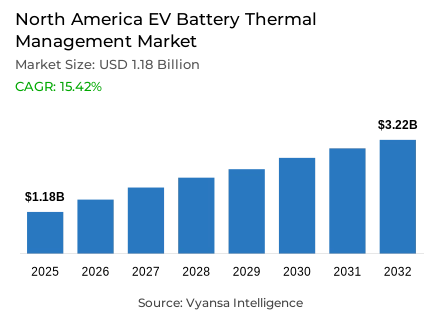
- Ev battery thermal management market size in North America was valued at USD 1.18 billion in 2025 and is estimated at USD 1.32 billion in 2026.
- The market size is expected to grow to USD 3.22 billion by 2032.
- Market to register a CAGR of around 15.42% during 2026-32.
- System Shares
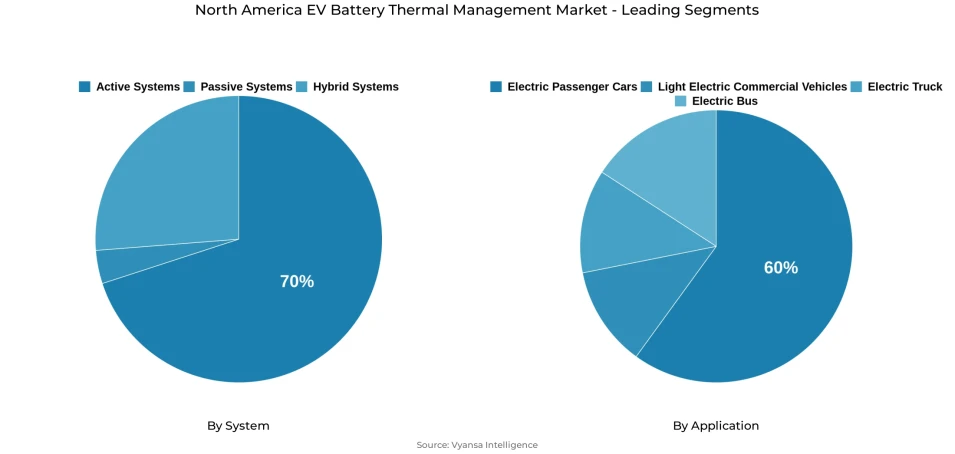
- Active systems grabbed market share of 70%.
- Competition
- More than 10 companies are actively engaged in producing ev battery thermal management in North America.
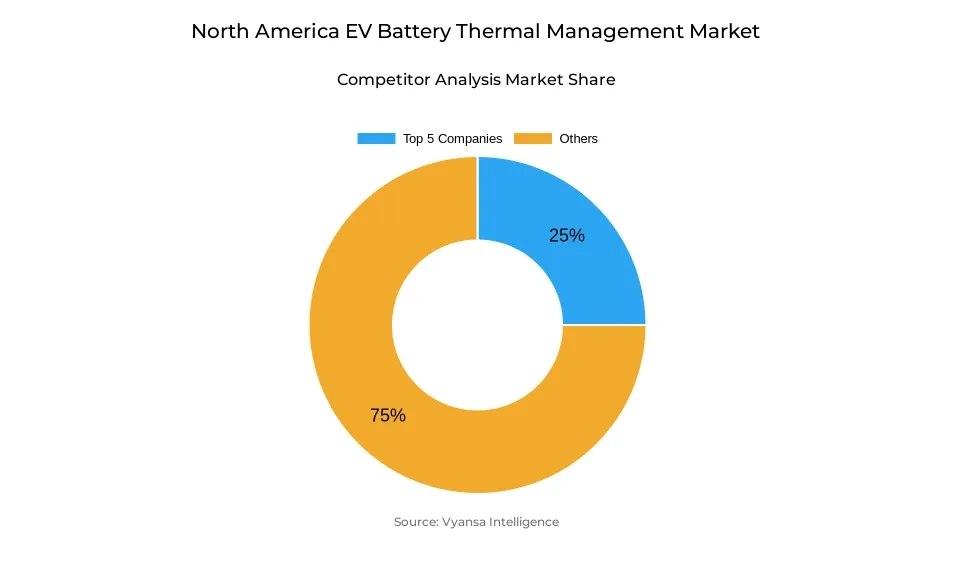
- Top 5 companies acquired around 25% of the market share in 2026.
- Gentherm Incorporated, DENSO Corporation, Valeo SE, Hanon Systems, MAHLE GmbH etc., are few of the top companies.
- Application
- Electric Passenger Cars grabbed 60% of the market.
- Country
- The US leads with a 81% share of the North America market.
North America EV Battery Thermal Management Market Outlook
The North America EV Battery Thermal Management Market size was valued at USD 1.18 billion in 2025 and is projected to grow from USD 1.32 billion in 2026 to USD 3.22 billion by 2032, exhibiting a CAGR of 15.42% during the forecast period. Market growth is being supported by accelerating electric vehicle adoption, expanding battery manufacturing investments, and increasing emphasis on battery safety, charging performance, and operational efficiency. Thermal management systems have become a critical component of modern electric vehicles as manufacturers focus on maintaining optimal battery temperatures under varying operating conditions.
Significant investments across the electric vehicle value chain continue to strengthen demand for advanced battery cooling and heating technologies. According to the US Department of Energy, more than USD 150 billion in announced private-sector investments have been directed toward battery and EV supply chain projects in the United States since 2021. The expansion of battery production facilities and EV manufacturing operations is increasing the need for sophisticated thermal management solutions that enhance battery durability and performance.
Active Systems account for 70% of the System segment, while Electric Passenger Cars represent 60% of the Application segment. These shares highlight the growing preference for advanced thermal control technologies capable of delivering precise temperature regulation, thermal runaway prevention, and enhanced charging efficiency. As battery energy density increases and charging speeds improve, effective thermal management is becoming increasingly important across vehicle platforms.
The EV Battery Thermal Management Market is benefiting from continued innovation in liquid cooling technologies, refrigerant-based systems, intelligent thermal controls, and battery monitoring solutions. Growing electrification initiatives, expanding charging infrastructure, and advancements in battery technologies are expected to support sustained demand for thermal management systems throughout the forecast period.
North America EV Battery Thermal Management Market Growth Driver
Expanding Electric Vehicle Adoption Accelerates Demand
Rising electric vehicle deployment continues to strengthen growth across the EV Battery Thermal Management Market. According to the International Energy Agency (IEA), electric car sales in the United States exceeded 1.6 million units in 2024, reflecting continued momentum in vehicle electrification and consumer adoption. Growing sales volumes are increasing the number of battery-powered vehicles requiring advanced temperature control systems to ensure safety, reliability, and performance.
The EV Battery Thermal Management Market benefits directly from increasing demand for longer driving ranges, faster charging capabilities, and improved battery durability. Thermal management solutions help maintain optimal battery operating temperatures, reduce performance degradation, and support consistent charging efficiency. As automakers continue expanding electric vehicle portfolios across passenger and commercial segments, demand for advanced battery cooling and heating systems is expected to remain strong.
North America EV Battery Thermal Management Market Challenge
System Cost and Design Complexity Remain Key Challenges
Managing system cost and engineering complexity continues to present challenges for the EV battery thermal management market. According to the US Department of Energy, battery packs remain the most expensive component within electric vehicles, significantly influencing overall vehicle costs. The integration of advanced thermal management technologies further adds to manufacturing complexity and development expenses.
The EV battery thermal management market must balance performance, safety, efficiency, and affordability while meeting increasingly demanding battery requirements. Components such as cooling plates, heat exchangers, thermal interface materials, sensors, pumps, and electronic controllers contribute to higher system costs and design challenges. Manufacturers must continuously optimize thermal architectures to improve battery protection without significantly increasing vehicle weight, energy consumption, or production costs.
Unlock Market Intelligence
Explore the market potential with our data-driven report
North America EV Battery Thermal Management Market Trend
Emerging Charging Infrastructure Expansion Trends
Expansion of EV charging infrastructure is becoming a key trend in the US EV battery thermal management market. According to the US Department of Energy's Drive Electric USA program, the number of public EV charging stations in the United States increased from approximately 31,000 in 2020 to more than 80,000 in 2025. The rapid growth of charging infrastructure reflects the country's continued focus on accelerating EV adoption and supporting a larger electric vehicle fleet.
The EV battery thermal management market is benefiting from this trend as growing EV deployment increases the need for advanced thermal management systems that maintain battery performance, efficiency, and safety. Fast-charging applications generate higher thermal loads within battery packs, creating greater demand for liquid cooling, refrigerant-based cooling, and other advanced thermal technologies. As charging networks continue to expand nationwide, adoption of sophisticated battery thermal management solutions is expected to increase across passenger and commercial EV segments.
North America EV Battery Thermal Management Market Opportunity
Expanding Battery Manufacturing Investments Create Growth Opportunities
Growing investments in domestic battery manufacturing are creating substantial opportunities for the US EV battery thermal management market. According to the US Department of Energy's 2021–2024 Four-Year Review of Supply Chains for the Advanced Batteries Sector, the Bipartisan Infrastructure Law (BIL), Inflation Reduction Act (IRA), and Section 301 tariffs have helped spur more than USD 150 billion in battery manufacturing investments, creating more than 100,000 jobs across the United States.
The EV battery thermal management market stands to benefit from this large-scale expansion of battery production capacity. Increasing investment in battery manufacturing facilities is driving demand for advanced thermal technologies that improve battery performance, extend battery life, enhance safety, and support fast-charging capabilities. As battery production continues to scale and new manufacturing projects come online, demand for innovative thermal management solutions is expected to strengthen across the EV value chain.
North America EV Battery Thermal Management Market Country Analysis
By Country
- The US
- Canada
- Mexico
- Rest of North America
The US represents the leading country with a market share of 81% in the regional EV battery thermal management market, supported by strong investments in electric vehicle manufacturing, battery production, charging infrastructure development, and supply chain localization initiatives. The country's expanding EV ecosystem continues to create favorable conditions for the adoption of advanced battery thermal management technologies across passenger and commercial vehicle segments.
According to Argonne National Laboratory, battery manufacturing projects announced across the United States continue to expand domestic battery production capabilities and strengthen the country's position within the global EV supply chain. Growing investments in battery manufacturing, EV production facilities, and supporting infrastructure are increasing demand for advanced thermal management systems that enhance battery efficiency, safety, durability, and charging performance. These developments continue to reinforce the country's leadership position within the regional industry.
Unlock Market Intelligence
Explore the market potential with our data-driven report
North America EV Battery Thermal Management Market Segmentation Analysis
By System
- Active Systems
- Passive Systems
- Hybrid Systems
Active Systems account for 70% of the system segment, making them the leading category within the EV battery thermal management market. The segment's dominance is supported by its ability to provide precise temperature control through liquid cooling systems, refrigerant-based technologies, integrated heating systems, and intelligent thermal management platforms. These capabilities are essential for maintaining battery performance across varying operating and environmental conditions.
The EV battery thermal management market continues to favor active thermal solutions because they improve battery efficiency, support fast-charging performance, extend battery lifespan, and enhance vehicle safety. As battery energy densities increase and vehicle performance expectations rise, demand for advanced active thermal management technologies is expected to remain significantly higher than alternative thermal control approaches.
By Application
- Electric Passenger Cars
- Light Electric Commercial Vehicles
- Electric Truck
- Electric Bus
Electric Passenger Cars represent 60% of the application segment, establishing them as the largest application category within the EV battery thermal management market. Strong consumer adoption of electric passenger vehicles, coupled with increasing availability of new EV models, continues to support demand for battery cooling and heating technologies designed to optimize vehicle performance and range.
The EV battery thermal management market benefits from the critical role thermal systems play in passenger vehicles, particularly during fast charging, high-performance driving conditions, and extreme weather environments. Effective temperature regulation helps maintain battery efficiency, improve safety, and extend battery lifespan. As passenger EV adoption continues to accelerate, the segment is expected to remain the primary source of demand for advanced thermal management solutions.
Various Market Players in North America EV Battery Thermal Management Market
The companies mentioned below are highly active in the North America ev battery thermal management market, occupying a considerable portion of the market and shaping industry progress.
- Gentherm Incorporated
- DENSO Corporation
- Valeo SE
- Hanon Systems
- MAHLE GmbH
- Modine Manufacturing Company
- BorgWarner Inc.
- Dana Incorporated
- Robert Bosch GmbH
- VOSS Automotive GmbH
- Hutchinson SA (TotalEnergies SE)
- ABC Technologies Holdings Inc. (including brands)
Market News & Updates
- Gentherm Incorporated, 2026:
Gentherm introduced its next-generation battery thermal management technologies for electric vehicles during 2026, expanding its portfolio of advanced thermal solutions designed to improve battery performance, charging efficiency, and vehicle range. The company highlighted innovations in liquid-based thermal management systems and integrated thermal architectures that help maintain optimal battery operating temperatures under varying environmental and driving conditions. The development strengthens Gentherm's position in North America's growing EV thermal management market.
- BorgWarner Inc., 2025:
BorgWarner secured new business awards during 2025 for its battery thermal management technologies, including advanced coolant heaters and battery cooling solutions for electric vehicle platforms. The company's thermal management systems are designed to improve battery efficiency, support fast charging performance, and enhance overall EV reliability. The development expands BorgWarner's electrification portfolio and supports increasing EV production across North America.
Frequently Asked Questions
Related Report
- Market Segmentation
- Research Scope
- Research Methodology
- Definitions and Assumptions
- Executive Summary
- North America EV Battery Thermal Management Market Policies, Regulations, and Standards
- North America EV Battery Thermal Management Market Dynamics
- Growth Factors
- Challenges
- Trends
- Opportunities
- North America EV Battery Thermal Management Market Statistics, 2022-2032F
- Market Size & Growth Outlook
- By Revenues in USD Million
- Market Segmentation & Growth Outlook
- By System
- Active Systems- Market Insights and Forecast 2022-2032, USD Million
- Passive Systems- Market Insights and Forecast 2022-2032, USD Million
- Hybrid Systems- Market Insights and Forecast 2022-2032, USD Million
- By Application
- Electric Passenger Cars- Market Insights and Forecast 2022-2032, USD Million
- Light Electric Commercial Vehicles- Market Insights and Forecast 2022-2032, USD Million
- Electric Truck- Market Insights and Forecast 2022-2032, USD Million
- Electric Bus- Market Insights and Forecast 2022-2032, USD Million
- By EV Type
- Battery Electric Vehicles (BEV)- Market Insights and Forecast 2022-2032, USD Million
- Plug-In Hybrid Electric Vehicles (PHEV)- Market Insights and Forecast 2022-2032, USD Million
- Hybrid Electric Vehicles (HEV)- Market Insights and Forecast 2022-2032, USD Million
- By Technology
- Air Cooling- Market Insights and Forecast 2022-2032, USD Million
- Liquid Cooling- Market Insights and Forecast 2022-2032, USD Million
- Phase Change Material (PCM)- Market Insights and Forecast 2022-2032, USD Million
- Refrigerant-Based Cooling- Market Insights and Forecast 2022-2032, USD Million
- Thermoelectric Cooling- Market Insights and Forecast 2022-2032, USD Million
- By Battery Chemistry
- NMC- Market Insights and Forecast 2022-2032, USD Million
- NCA- Market Insights and Forecast 2022-2032, USD Million
- LFP- Market Insights and Forecast 2022-2032, USD Million
- Solid State- Market Insights and Forecast 2022-2032, USD Million
- Others- Market Insights and Forecast 2022-2032, USD Million
- By Battery Pack Design
- Cell-to-Module- Market Insights and Forecast 2022-2032, USD Million
- Cell-to-Pack (CTP)- Market Insights and Forecast 2022-2032, USD Million
- Cell-to-Chassis (CTC)- Market Insights and Forecast 2022-2032, USD Million
- By Cooling Architecture
- Direct Cooling- Market Insights and Forecast 2022-2032, USD Million
- Indirect Cooling- Market Insights and Forecast 2022-2032, USD Million
- By Component
- Cooling Plates- Market Insights and Forecast 2022-2032, USD Million
- Fans & Blowers- Market Insights and Forecast 2022-2032, USD Million
- Pumps- Market Insights and Forecast 2022-2032, USD Million
- Heat Exchangers- Market Insights and Forecast 2022-2032, USD Million
- Sensors & Controllers- Market Insights and Forecast 2022-2032, USD Million
- Thermal Interface Materials- Market Insights and Forecast 2022-2032, USD Million
- Others- Market Insights and Forecast 2022-2032, USD Million
- By Country
- The US
- Canada
- Mexico
- Rest of North America
- By Competitors
- Competition Characteristics
- Market Share & Analysis
- By System
- Market Size & Growth Outlook
- The US EV Battery Thermal Management Market Statistics, 2022-2032F
- Market Size & Growth Outlook
- By Revenues in USD Million
- Market Segmentation & Growth Outlook
- By System- Market Insights and Forecast 2022-2032, USD Million
- By Application- Market Insights and Forecast 2022-2032, USD Million
- By EV Type- Market Insights and Forecast 2022-2032, USD Million
- By Technology- Market Insights and Forecast 2022-2032, USD Million
- By Battery Chemistry- Market Insights and Forecast 2022-2032, USD Million
- By Battery Pack Design- Market Insights and Forecast 2022-2032, USD Million
- By Cooling Architecture- Market Insights and Forecast 2022-2032, USD Million
- By Component- Market Insights and Forecast 2022-2032, USD Million
- Market Size & Growth Outlook
- Canada EV Battery Thermal Management Market Statistics, 2022-2032F
- Market Size & Growth Outlook
- By Revenues in USD Million
- Market Segmentation & Growth Outlook
- By System- Market Insights and Forecast 2022-2032, USD Million
- By Application- Market Insights and Forecast 2022-2032, USD Million
- By EV Type- Market Insights and Forecast 2022-2032, USD Million
- By Technology- Market Insights and Forecast 2022-2032, USD Million
- By Battery Chemistry- Market Insights and Forecast 2022-2032, USD Million
- By Battery Pack Design- Market Insights and Forecast 2022-2032, USD Million
- By Cooling Architecture- Market Insights and Forecast 2022-2032, USD Million
- By Component- Market Insights and Forecast 2022-2032, USD Million
- Market Size & Growth Outlook
- Mexico EV Battery Thermal Management Market Statistics, 2022-2032F
- Market Size & Growth Outlook
- By Revenues in USD Million
- Market Segmentation & Growth Outlook
- By System- Market Insights and Forecast 2022-2032, USD Million
- By Application- Market Insights and Forecast 2022-2032, USD Million
- By EV Type- Market Insights and Forecast 2022-2032, USD Million
- By Technology- Market Insights and Forecast 2022-2032, USD Million
- By Battery Chemistry- Market Insights and Forecast 2022-2032, USD Million
- By Battery Pack Design- Market Insights and Forecast 2022-2032, USD Million
- By Cooling Architecture- Market Insights and Forecast 2022-2032, USD Million
- By Component- Market Insights and Forecast 2022-2032, USD Million
- Market Size & Growth Outlook
- Competitive Outlook
- Company Profiles
- Hanon Systems
- Business Description
- Product Portfolio
- Collaborations & Alliances
- Recent Developments
- Financial Details
- Others
- MAHLE GmbH
- Business Description
- Product Portfolio
- Collaborations & Alliances
- Recent Developments
- Financial Details
- Others
- Modine Manufacturing Company
- Business Description
- Product Portfolio
- Collaborations & Alliances
- Recent Developments
- Financial Details
- Others
- BorgWarner Inc.
- Business Description
- Product Portfolio
- Collaborations & Alliances
- Recent Developments
- Financial Details
- Others
- Dana Incorporated
- Business Description
- Product Portfolio
- Collaborations & Alliances
- Recent Developments
- Financial Details
- Others
- Gentherm Incorporated
- Business Description
- Product Portfolio
- Collaborations & Alliances
- Recent Developments
- Financial Details
- Others
- DENSO Corporation
- Business Description
- Product Portfolio
- Collaborations & Alliances
- Recent Developments
- Financial Details
- Others
- Valeo SE
- Business Description
- Product Portfolio
- Collaborations & Alliances
- Recent Developments
- Financial Details
- Others
- Robert Bosch GmbH
- Business Description
- Product Portfolio
- Collaborations & Alliances
- Recent Developments
- Financial Details
- Others
- VOSS Automotive GmbH
- Business Description
- Product Portfolio
- Collaborations & Alliances
- Recent Developments
- Financial Details
- Others
- Hutchinson SA (TotalEnergies SE)
- Business Description
- Product Portfolio
- Collaborations & Alliances
- Recent Developments
- Financial Details
- Others
- ABC Technologies Holdings Inc. (including brands)
- Business Description
- Product Portfolio
- Collaborations & Alliances
- Recent Developments
- Financial Details
- Others
- Hanon Systems
- Company Profiles
- Disclaimer
| Segment | Sub-Segment |
|---|---|
| By System |
|
| By Application |
|
| By EV Type |
|
| By Technology |
|
| By Battery Chemistry |
|
| By Battery Pack Design |
|
| By Cooling Architecture |
|
| By Component |
|
| By Country |
|
Research Methodology
This study followed a structured approach comprising four key phases to assess the size and scope of the electro-oxidation market. The process began with thorough secondary research to collect data on the target market, related markets, and broader industry context. These findings, along with preliminary assumptions and estimates, were then validated through extensive primary research involving industry experts from across the value chain. To calculate the overall market size, both top-down and bottom-up methodologies were employed. Finally, market segmentation and data triangulation techniques were applied to refine and validate segment-level estimations.
Secondary Research
The secondary research phase involved gathering data from a wide range of credible and published sources. This step helped in identifying industry trends, defining market segmentation, and understanding the market landscape and value chain.
Sources consulted during this phase included:
- Company annual reports, investor presentations, and press releases
- Industry white papers and certified publications
- Trade directories and market-recognized databases
- Articles from authoritative authors and reputable journals
- Gold and silver standard websites
Secondary research was critical in mapping out the industry's value chain and monetary flow, identifying key market segments, understanding regional variations, and tracking significant industry developments.
Other key sources:
- Financial disclosures
- Industry associations and trade bodies
- News outlets and business magazines
- Academic journals and research studies
- Paid industry databases
Primary Research
To validate secondary data and gain deeper market insights, primary research was conducted with key stakeholders across both the supply and demand sides of the market.
On the demand side, participants included decision-makers and influencers from end-user industries—such as CIOs, CTOs, and CSOs—who provided first-hand perspectives on market needs, product usage, and future expectations.
On the supply side, interviews were conducted with manufacturers, industry associations, and institutional participants to gather insights into current offerings, product pipelines, and market challenges.
Primary interviews provided critical inputs such as:
- Market size and revenue data
- Product and service breakdowns
- Market forecasts
- Regional and application-specific trends
Stakeholders consulted included:
- Leading OEM and solution providers
- Channel and distribution partners
- End users across various applications
- Independent consultants and industry specialists
Market Size Estimation and Data Triangulation
- Identifying Key Market Participants (Secondary Research)
- Goal: To identify the major players or companies in the target market. This typically involves using publicly available data sources such as industry reports, market research publications, and financial statements of companies.
- Tools: Reports from firms like Gartner, Forrester, Euromonitor, Statista, IBISWorld, and others. Public financial statements, news articles, and press releases from top market players.
- Extracting Earnings of Key Market Participants
- Goal: To estimate the earnings generated from the product or service being analyzed. This step helps in understanding the revenue potential of each market player in a specific geography.
- Methods: Earnings data can be gathered from:
- Publicly available financial reports (for listed companies).
- Interviews and primary data sources from professionals, such as Directors, VPs, SVPs, etc. This is especially useful for understanding more nuanced, internal data that isn't publicly disclosed.
- Annual reports and investor presentations of key players.
- Data Collation and Development of a Relevant Data Model
- Goal: To collate inputs from both primary and secondary sources into a structured, data-driven model for market estimation. This model will incorporate key market KPIs and any independent variables relevant to the market.
- Key KPIs: These could include:
- Market size, growth rate, and demand drivers.
- Industry-specific metrics like market share, average revenue per customer (ARPC), or average deal size.
- External variables, such as economic growth rates, inflation rates, or commodity prices, that could affect the market.
- Data Modeling: Based on this data, the market forecasts are developed for the next 5 years. A combination of trend analysis, scenario modeling, and statistical regression might be used to generate projections.
- Scenario Analysis
- Goal: To test different assumptions and validate how sensitive the market is to changes in key variables (e.g., market demand, regulatory changes, technological disruptions).
- Types of Scenarios:
- Base Case: Based on current assumptions and historical data.
- Best-Case Scenario: Assuming favorable market conditions, regulatory environments, and technological advancements.
- Worst-Case Scenario: Accounting for adverse factors, such as economic downturns, stricter regulations, or unexpected disruptions.












