Namibia Industrial Gases Market Report: Trends, Growth and Forecast (2026-2032)
By Gas Type (Oxygen, Nitrogen, Carbon Dioxide, Argon, Acetylene, Hydrogen, Helium, Others), By Supply Mode (Packaged/Cylinder, Merchant Bulk Liquid, On-Site Generation, Others), By Application (Combustion and Process Oxygen, Welding and Metal Fabrication, Inerting Blanketing and Heat Treating, Cryogenics and Liquefaction, Chemical Synthesis and Hydrogenation, Purging and Purifications, Analytical and Calibration), By End-user Industry (Mining & Mineral Processing, Manufacturing & Metal Fabrication, Food & Beverage, Healthcare, Energy & Utilities, Construction, Agriculture, Others) ... Read more
|
Major Players
|
Namibia Industrial Gases Market Overview
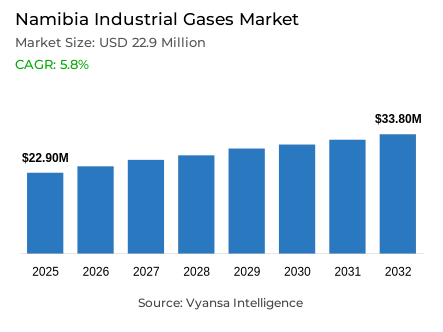
The industrial gases market covers oxygen, nitrogen, carbon dioxide, argon, acetylene, hydrogen, helium, and specialty gases supplied to industrial and institutional users. These gases support mineral processing, metal fabrication, food processing, healthcare, construction, utilities, and emerging energy applications. Demand for industrial gases in Namibia is forecast to expand at a 5.80% CAGR during 2026-2032, supported by mining activity, offshore petroleum appraisal, wider local distribution, and investment in hydrogen-based industrial projects that broaden the country’s gas consumption base.
Key Highlights of the Namibia Industrial Gases Market
- The Namibia industrial gases market was valued at USD 22.90 million in 2025 and rose to USD 24.10 million in 2026 and is forecast to reach USD 33.80 million by 2032.
- The market represented a 5.80% CAGR during the forecasted period of 2026-2032.
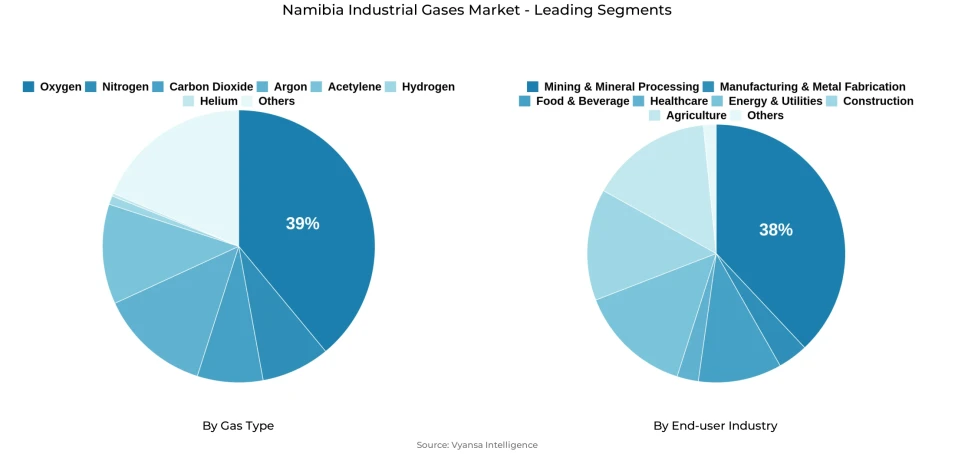
- Oxygen is the leading product type, accounting for 39% of market value in 2026.
- However, hydrogen is the fastest-growing product type, with a 13.20% CAGR during 2026-2032.
- Mining & mineral processing leads end-user demand with a 38% share in 2026.
- Additionally, energy & utilities is the fastest-growing end-user category, with a 10.33% CAGR during 2026-2032.
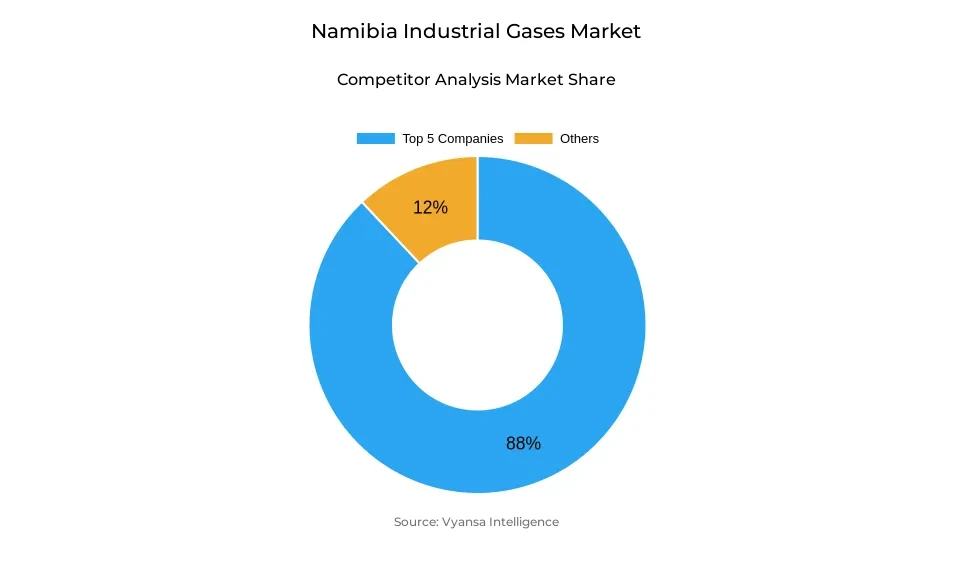
- The top five companies account for 88% of the market in 2026, indicating a highly consolidated supplier structure.
The industrial gases market in Namibia is supported by the country’s mining-intensive economy, expanding mineral processing activities, healthcare requirements, and emerging green industrialization projects. Mining and quarrying contributed approximately 13.3% of Namibia’s GDP in 2024, while mineral products accounted for around 61% of merchandise exports, creating sustained demand for oxygen, nitrogen, argon, carbon dioxide, and specialty gases used in mineral processing, welding, cutting, and maintenance operations. Namibia also produced approximately 12% of global uranium output in 2024, while uranium production reached 1,832 tonnes of U₃O₈ in 2025, strengthening the requirement for industrial gases across mining and processing facilities.
The market is also gaining a new demand avenue from green hydrogen and green-iron projects. HyIron’s Oshivela facility began producing green hydrogen in March 2025 using a 12 MW electrolyzer, targeting 15,000 tonnes of direct-reduced iron annually in its initial phase. In addition, Cleanergy’s Walvis Bay facility uses a 5 MW electrolyzer, while the planned Hyphen project includes 1.5 GW of electrolyzer capacity in Phase I, indicating significant long-term potential for hydrogen and associated industrial-gas infrastructure.
Overall, these industrial, mining, healthcare, and clean-energy applications provide a diversified foundation for continued growth in Namibia’s industrial gases demand.
Government Regulations Shaping the Namibia Industrial Gases Market
The Namibia industrial gases market is directly impacted by government regulations covering the manufacture, importation, storage, transportation, handling, sale, and use of hazardous and compressed gases. The Hazardous Substances Ordinance, 1974 (Ordinance No. 14 of 1974) is a key regulatory framework, as it provides controls for substances that may be toxic, corrosive, irritant, flammable, or capable of generating pressure. For industrial-gas companies, compliance can therefore involve appropriate packaging, labeling, storage, transportation, handling, and disposal procedures for applicable gases such as oxygen, nitrogen, acetylene, hydrogen, and carbon dioxide.
The Labour Act, 2007 (Act No. 11 of 2007) further affects industrial-gas operations by requiring employers to maintain safe working conditions and manage risks associated with hazardous substances. Companies need to implement appropriate personal protective equipment (PPE), worker training, safety procedures, supervision, and emergency controls, particularly at filling plants, warehouses, and customer delivery sites.
Environmental compliance is governed by the Environmental Management Act, 2007 (Act No. 7 of 2007). Industrial facilities involved in the manufacturing, storage, handling, or processing of hazardous substances may require an Environmental Clearance Certificate (ECC) before commencing relevant activities. This can directly influence the establishment or expansion of industrial-gas production and storage facilities.
In addition, the Atmospheric Pollution Prevention Ordinance, 1976 regulates emissions of noxious or offensive gases from applicable industrial activities. Collectively, these requirements increase operating costs through investments in safety infrastructure, cylinder handling, employee training, environmental assessments, labeling, and hazardous-material transportation controls, while creating higher compliance barriers for new market entrants.
Namibia Industrial Gases Market Drivers
Offshore Appraisal Expands Demand for Operational and Specialty Gases
Offshore oil and gas appraisal is creating a new industrial demand channel for Namibia’s expanding industrial gas industry. Exploration and appraisal campaigns require nitrogen for inerting, purging, pressure-related operations, and equipment preparation, while oxygen, acetylene, argon, and specialty mixtures support fabrication, maintenance, repair, and testing across shore bases and marine support activities. As drilling programmes progress from exploration toward appraisal, gas consumption can become recurring because each well mobilises contractors, vessels, workshops, and technical services that require controlled gas supply.
In December 2025, TotalEnergies agreed to acquire a 40% operated interest in PEL83, including the Mopane discovery, and announced an exploration and appraisal campaign of three wells over two years, with the first planned for 2026. TotalEnergies will also carry part of Galp’s appraisal expenditure. This programme expands the operating footprint around offshore discoveries and directly increases requirements for reliable gas logistics, cylinder availability, welding support, inerting services, maintenance, and specialty gases serving contractors linked to offshore operations in Namibia.
Namibia Industrial Gases Market Restraints
Import Dependence and Long-Distance Logistics Raise Delivered Costs
Dependence on imported cryogenic gases and long-distance distribution restrains the market by raising delivered costs and increasing exposure to logistics interruptions. Namibia’s dispersed demand centres make bulk transport, cylinder rotation, storage, and refill economics challenging, particularly for customers located far from major depots. Smaller users can face additional rental, handling, and delivery costs, while suppliers must hold sufficient inventory to absorb transport delays. These conditions favour larger distributors with established logistics and can constrain price competition nationwide.
In 2024, the EpiC project and Clinton Health Access Initiative reported that liquid oxygen used in Namibia was imported from South Africa, contributing to high delivery and distribution costs. Their assessment also identified expensive tank refills, equipment rentals, cylinder supply disruptions, and uneven oxygen infrastructure. Although the study focused on medical oxygen, the logistics constraint is directly relevant to cryogenic gas distribution more broadly. Higher transport exposure can pressure margins, delay replenishment, and discourage smaller customers from adopting bulk supply.
Namibia Industrial Gases Market Recent Trends
Local Availability and Faster Cylinder Turnaround Gain Importance
Industrial buyers are placing greater value on locally available gases, faster cylinder turnaround, and supply models that reduce dependence on distant bulk sources. This shifts purchasing decisions beyond headline gas prices toward total delivered cost, stock security, and response time. Coastal workshops, marine operators, fabricators, and service companies particularly benefit from nearby refill or exchange capability because work schedules can change quickly. Namibia’s local industrial gas industry is therefore seeing stronger commercial value in decentralised distribution and application-focused logistics nationally.
By 2026, Benguella enterprises in Walvis Bay were providing medical oxygen refilling and cylinder services while acting as a Wilhelmsen Ships service provider for marine gases and cylinder exchange. This coastal service model illustrates how suppliers are positioning gas availability closer to marine, repair, and port users rather than relying only on inland distribution. Faster exchange cycles can reduce customer downtime, improve cylinder utilisation, and strengthen competition around service reliability, especially where gas volumes are too small for bulk installations.
PEM Electrolysis Establishes a New Hydrogen Supply Pathway
PEM electrolysis is introducing a new production pathway for hydrogen within the Namibia Industrial Gases Market. Instead of obtaining hydrogen through conventional fossil-based routes or long-distance supply, renewable electricity can split water into hydrogen and oxygen close to the point of use. This supports modular production, reduces transport dependence for selected applications, and links industrial gas supply with renewable-power availability. The technology is commercially relevant because hydrogen can serve mobility, power generation, industrial processes, and future derivative production over time.
In September 2025, Cleanergy Solutions Namibia opened its solar-powered green hydrogen production and refuelling facility at Walvis Bay. The project uses an off-grid electrolyser, with environmental documentation describing a 5 MW PEM system paired with solar generation. Hydrogen produced on site is already being applied to dual-fuel road vehicles, off-road equipment, and power generation. This demonstrates a locally operated gas-production model that could broaden technical capability, create new offtake applications, and accelerate supplier expertise in hydrogen storage, handling, and refuelling.
Namibia Industrial Gases Market Future Opportunities
Green Iron Creates a New Industrial Gas Offtake Channel
Hydrogen-based mineral processing creates a future opportunity to move industrial gas demand beyond conventional welding, healthcare, and fabrication uses. Green iron projects require hydrogen as a reducing agent and can also create supporting needs for oxygen, nitrogen, argon, maintenance gases, storage systems, and technical services. For Namibia’s developing industrial gas industry, this creates potential for larger, longer-duration offtake relationships tied to industrial plants rather than only cylinder-based demand, while supporting new local capabilities in gas handling and process integration locally.
In April 2025, HyIron officially opened the Oshivela green iron project in Namibia. The company’s project design targets first-phase production of 15,000 tonnes of direct reduced iron annually using renewable electricity and green hydrogen, with larger expansion under evaluation. If hydrogen-based metallurgy scales, gas suppliers can capture value through bulk supply support, storage, backup gases, equipment, purity management, and technical services. This would deepen links between the Namibia industrial gases industry and domestic mineral beneficiation commercially over the forecast period.
Unlock Market Intelligence
Explore the market potential with our data-driven report
Namibia Industrial Gases Market Segmentation Analysis
By Product Type
- Oxygen
- Nitrogen
- Carbon Dioxide
- Argon
- Acetylene
- Hydrogen
- Helium
- Other Industrial & Specialty Gases
Oxygen Leads While Hydrogen Expands Fastest
Oxygen leads the product-type segmentation with a 39% share in 2026 because it serves the broadest set of recurring applications. Mining and mineral processing use oxygen in combustion and processing, while fabrication depends on it for cutting, heating, and welding. Hospitals also require medical oxygen, widening the demand base beyond industry. Its availability in cylinders and bulk formats supports users with different consumption levels nationally, giving oxygen stronger utilisation breadth than nitrogen, argon, acetylene, carbon dioxide, helium, or specialty gases.
Hydrogen is the fastest-growing product segment, with a 13.20% CAGR during 2026-2032. Its expansion is being driven by emerging green hydrogen production, mobility applications, low-carbon industrial processing, and planned hydrogen-derived products rather than the mature welding and healthcare uses supporting oxygen. Although hydrogen starts from a smaller commercial base, new electrolyser projects and industrial pilots can create sizeable incremental demand. This gives the segment a faster growth profile as Namibia builds technical capability around production, storage, refuelling, and industrial use.
By End-user Industry
- Mining & Mineral Processing
- Manufacturing & Metal Fabrication
- Food & Beverage
- Healthcare
- Energy & Utilities
- Construction
- Agriculture
- Others
Mining Dominates While Energy Applications Accelerate
Mining & mineral processing leads end-user demand with a 38% share in 2026. Namibia’s mining operations require dependable gases for cutting, welding, maintenance, fabrication, laboratory work, process control, and selected metallurgical applications. Mines also operate remote equipment fleets and processing facilities where supply interruptions can affect production, making reliable cylinder and bulk logistics commercially important. The segment’s combination of continuous operations, maintenance intensity, and large industrial sites gives it a broader gas-consumption base than construction, agriculture, healthcare, or food processing.
Energy & utilities is the fastest-growing end-user segment, expanding at a 10.33% CAGR during 2026-2032. Growth is supported by green hydrogen projects, renewable-powered electrolysis, emerging ammonia production, and energy infrastructure that requires gas handling, storage, commissioning, maintenance, and safety services. Unlike mining, which already provides a large established demand base, energy projects are adding new gas applications from a smaller starting point. Namibia’s local industrial gas industry can therefore gain revenue as these projects move from demonstration toward commercial operation.
Unlock Market Intelligence
Explore the market potential with our data-driven report
Namibia Industrial Gases Market Competitive Landscape
The Namibia industrial gases market is highly consolidated, with the top five companies accounting for 88% of market value in 2026. The top 5 companies comprise IGL (Pty) Limited T/A Afrox Namibia, Air Liquide Namibia (Pty) Ltd, Industrial Gas Namibia, Kryo Investments Namibia (Pty) Ltd, and Blue Themes Energy Proprietary Limited.
Key Companies in the Namibia Industrial Gases Market
- IGL (Pty) Limited T/A Afrox Namibia
- Air Liquide Namibia (Pty) Ltd
- Industrial Gas Namibia CC
- Kryo Investments Namibia (Pty) Ltd
- Blue Themes Energy Proprietary Limited
- Benguella Enterprises (Pty) Ltd
- Air Gas Healthcare Namibia (Pty) Ltd
- Air Products South Africa (Pty) Ltd
- Wilhelmsen Ships Service
- Ray-Mal Engineering
Recent Developments in the Namibia Industrial Gases Market
- In December 2025, the African Development Bank approved a US$10 million facility for Hyphen Hydrogen Energy to advance engineering work for its planned green ammonia project in Namibia. The programme includes large-scale electrolyser capacity and supporting infrastructure, creating a future platform for hydrogen production, storage, technical services, and industrial gas handling.
- In May 2025, Daures Green Hydrogen Village confirmed that its pilot phase was complete and that hydrogen and ammonia equipment was being installed and commissioned, with local fertiliser production targeted for late 2026. The project opens another downstream use for locally produced hydrogen and ammonia while linking gas production with agriculture and industrialisation.
Frequently Asked Questions
Related Report
- Market Segmentation
- Research Scope
- Research Methodology
- Definitions and Assumptions
- Executive Summary
- Namibia Industrial Gases Market Policies, Regulations, and Standards
- Namibia Industrial Gases Market Dynamics
- Growth Factors
- Challenges
- Trends
- Opportunities
- Namibia Industrial Gases Market Statistics, 2022-2032F
- Market Size & Growth Outlook
- By Revenues in USD Million
- Market Segmentation & Growth Outlook
- By Gas Type
- Oxygen- Market Insights and Forecast 2022-2032, USD Million
- Nitrogen- Market Insights and Forecast 2022-2032, USD Million
- Carbon Dioxide- Market Insights and Forecast 2022-2032, USD Million
- Argon- Market Insights and Forecast 2022-2032, USD Million
- Acetylene- Market Insights and Forecast 2022-2032, USD Million
- Hydrogen- Market Insights and Forecast 2022-2032, USD Million
- Helium- Market Insights and Forecast 2022-2032, USD Million
- Others- Market Insights and Forecast 2022-2032, USD Million
- By Supply Mode
- Packaged/Cylinder- Market Insights and Forecast 2022-2032, USD Million
- Merchant Bulk Liquid- Market Insights and Forecast 2022-2032, USD Million
- On-Site Generation- Market Insights and Forecast 2022-2032, USD Million
- Others- Market Insights and Forecast 2022-2032, USD Million
- By Application
- Combustion and Process Oxygen- Market Insights and Forecast 2022-2032, USD Million
- Welding and Metal Fabrication- Market Insights and Forecast 2022-2032, USD Million
- Inerting Blanketing and Heat Treating- Market Insights and Forecast 2022-2032, USD Million
- Cryogenics and Liquefaction- Market Insights and Forecast 2022-2032, USD Million
- Chemical Synthesis and Hydrogenation- Market Insights and Forecast 2022-2032, USD Million
- Purging and Purifications- Market Insights and Forecast 2022-2032, USD Million
- Analytical and Calibration- Market Insights and Forecast 2022-2032, USD Million
- By End-user Industry
- Mining & Mineral Processing- Market Insights and Forecast 2022-2032, USD Million
- Manufacturing & Metal Fabrication- Market Insights and Forecast 2022-2032, USD Million
- Food & Beverage- Market Insights and Forecast 2022-2032, USD Million
- Healthcare- Market Insights and Forecast 2022-2032, USD Million
- Energy & Utilities- Market Insights and Forecast 2022-2032, USD Million
- Construction- Market Insights and Forecast 2022-2032, USD Million
- Agriculture- Market Insights and Forecast 2022-2032, USD Million
- Others- Market Insights and Forecast 2022-2032, USD Million
- By Competitors
- Competition Characteristics
- Market Share & Analysis
- By Gas Type
- Market Size & Growth Outlook
- Namibia Industrial Oxygen Market Statistics, 2022-2032
- Market Size & Growth Outlook
- By Revenues in USD Million
- Market Segmentation & Growth Outlook
- By Product Type- Market Insights and Forecast 2022-2032, USD Million
- By Mode of Supply- Market Insights and Forecast 2022-2032, USD Million
- By End-user Industry- Market Insights and Forecast 2022-2032, USD Million
- Market Size & Growth Outlook
- Namibia Industrial Nitrogen Market Statistics, 2022-2032
- Market Size & Growth Outlook
- By Revenues in USD Million
- Market Segmentation & Growth Outlook
- By Product Type- Market Insights and Forecast 2022-2032, USD Million
- By Mode of Supply- Market Insights and Forecast 2022-2032, USD Million
- By End-user Industry- Market Insights and Forecast 2022-2032, USD Million
- Market Size & Growth Outlook
- Namibia Industrial Carbon Dioxide Market Statistics, 2022-2032
- Market Size & Growth Outlook
- By Revenues in USD Million
- Market Segmentation & Growth Outlook
- By Product Type- Market Insights and Forecast 2022-2032, USD Million
- By Mode of Supply- Market Insights and Forecast 2022-2032, USD Million
- By End-user Industry- Market Insights and Forecast 2022-2032, USD Million
- Market Size & Growth Outlook
- Namibia Industrial Argon Market Statistics, 2022-2032
- Market Size & Growth Outlook
- By Revenues in USD Million
- Market Segmentation & Growth Outlook
- By Product Type- Market Insights and Forecast 2022-2032, USD Million
- By Mode of Supply- Market Insights and Forecast 2022-2032, USD Million
- By End-user Industry- Market Insights and Forecast 2022-2032, USD Million
- Market Size & Growth Outlook
- Namibia Industrial Acetylene Market Statistics, 2022-2032
- Market Size & Growth Outlook
- By Revenues in USD Million
- Market Segmentation & Growth Outlook
- By Product Type- Market Insights and Forecast 2022-2032, USD Million
- By Mode of Supply- Market Insights and Forecast 2022-2032, USD Million
- By End-user Industry- Market Insights and Forecast 2022-2032, USD Million
- Market Size & Growth Outlook
- Namibia Industrial Hydrogen Market Statistics, 2022-2032
- Market Size & Growth Outlook
- By Revenues in USD Million
- Market Segmentation & Growth Outlook
- By Product Type- Market Insights and Forecast 2022-2032, USD Million
- By Mode of Supply- Market Insights and Forecast 2022-2032, USD Million
- By End-user Industry- Market Insights and Forecast 2022-2032, USD Million
- Market Size & Growth Outlook
- Namibia Industrial Helium Market Statistics, 2022-2032
- Market Size & Growth Outlook
- By Revenues in USD Million
- Market Segmentation & Growth Outlook
- By Product Type- Market Insights and Forecast 2022-2032, USD Million
- By Mode of Supply- Market Insights and Forecast 2022-2032, USD Million
- By End-user Industry- Market Insights and Forecast 2022-2032, USD Million
- Market Size & Growth Outlook
- Namibia Other Industrial & Specialty Gases Market Statistics, 2022-2032
- Market Size & Growth Outlook
- By Revenues in USD Million
- Market Segmentation & Growth Outlook
- By Product Type- Market Insights and Forecast 2022-2032, USD Million
- By Mode of Supply- Market Insights and Forecast 2022-2032, USD Million
- By End-user Industry- Market Insights and Forecast 2022-2032, USD Million
- Market Size & Growth Outlook
- Competitive Outlook
- Company Profiles
- IGL (Pty) Limited T/A Afrox Namibia
- Business Description
- Product Portfolio
- Collaborations & Alliances
- Recent Developments
- Financial Details
- Others
- Air Liquide Namibia (Pty) Ltd
- Business Description
- Product Portfolio
- Collaborations & Alliances
- Recent Developments
- Financial Details
- Others
- Industrial Gas Namibia CC (IGN)
- Business Description
- Product Portfolio
- Collaborations & Alliances
- Recent Developments
- Financial Details
- Others
- Kryo Investments Namibia (Pty) Ltd
- Business Description
- Product Portfolio
- Collaborations & Alliances
- Recent Developments
- Financial Details
- Others
- Blue Themes Energy (Pty) Ltd
- Business Description
- Product Portfolio
- Collaborations & Alliances
- Recent Developments
- Financial Details
- Others
- Benguella Enterprises (Pty) Ltd
- Business Description
- Product Portfolio
- Collaborations & Alliances
- Recent Developments
- Financial Details
- Others
- Air Gas Healthcare Namibia (Pty) Ltd
- Business Description
- Product Portfolio
- Collaborations & Alliances
- Recent Developments
- Financial Details
- Others
- Air Products South Africa (Pty) Ltd
- Business Description
- Product Portfolio
- Collaborations & Alliances
- Recent Developments
- Financial Details
- Others
- Wilhelmsen Ships Service
- Business Description
- Product Portfolio
- Collaborations & Alliances
- Recent Developments
- Financial Details
- Others
- Ray-Mal Engineering
- Business Description
- Product Portfolio
- Collaborations & Alliances
- Recent Developments
- Financial Details
- Others
- IGL (Pty) Limited T/A Afrox Namibia
- Company Profiles
- Disclaimer
| Segment | Sub-Segment |
|---|---|
| By Gas Type |
|
| By Supply Mode |
|
| By Application |
|
| By End-user Industry |
|
Research Methodology
This study followed a structured approach comprising four key phases to assess the size and scope of the electro-oxidation market. The process began with thorough secondary research to collect data on the target market, related markets, and broader industry context. These findings, along with preliminary assumptions and estimates, were then validated through extensive primary research involving industry experts from across the value chain. To calculate the overall market size, both top-down and bottom-up methodologies were employed. Finally, market segmentation and data triangulation techniques were applied to refine and validate segment-level estimations.
Secondary Research
The secondary research phase involved gathering data from a wide range of credible and published sources. This step helped in identifying industry trends, defining market segmentation, and understanding the market landscape and value chain.
Sources consulted during this phase included:
- Company annual reports, investor presentations, and press releases
- Industry white papers and certified publications
- Trade directories and market-recognized databases
- Articles from authoritative authors and reputable journals
- Gold and silver standard websites
Secondary research was critical in mapping out the industry's value chain and monetary flow, identifying key market segments, understanding regional variations, and tracking significant industry developments.
Other key sources:
- Financial disclosures
- Industry associations and trade bodies
- News outlets and business magazines
- Academic journals and research studies
- Paid industry databases
Primary Research
To validate secondary data and gain deeper market insights, primary research was conducted with key stakeholders across both the supply and demand sides of the market.
On the demand side, participants included decision-makers and influencers from end-user industries—such as CIOs, CTOs, and CSOs—who provided first-hand perspectives on market needs, product usage, and future expectations.
On the supply side, interviews were conducted with manufacturers, industry associations, and institutional participants to gather insights into current offerings, product pipelines, and market challenges.
Primary interviews provided critical inputs such as:
- Market size and revenue data
- Product and service breakdowns
- Market forecasts
- Regional and application-specific trends
Stakeholders consulted included:
- Leading OEM and solution providers
- Channel and distribution partners
- End users across various applications
- Independent consultants and industry specialists
Market Size Estimation and Data Triangulation
- Identifying Key Market Participants (Secondary Research)
- Goal: To identify the major players or companies in the target market. This typically involves using publicly available data sources such as industry reports, market research publications, and financial statements of companies.
- Tools: Reports from firms like Gartner, Forrester, Euromonitor, Statista, IBISWorld, and others. Public financial statements, news articles, and press releases from top market players.
- Extracting Earnings of Key Market Participants
- Goal: To estimate the earnings generated from the product or service being analyzed. This step helps in understanding the revenue potential of each market player in a specific geography.
- Methods: Earnings data can be gathered from:
- Publicly available financial reports (for listed companies).
- Interviews and primary data sources from professionals, such as Directors, VPs, SVPs, etc. This is especially useful for understanding more nuanced, internal data that isn't publicly disclosed.
- Annual reports and investor presentations of key players.
- Data Collation and Development of a Relevant Data Model
- Goal: To collate inputs from both primary and secondary sources into a structured, data-driven model for market estimation. This model will incorporate key market KPIs and any independent variables relevant to the market.
- Key KPIs: These could include:
- Market size, growth rate, and demand drivers.
- Industry-specific metrics like market share, average revenue per customer (ARPC), or average deal size.
- External variables, such as economic growth rates, inflation rates, or commodity prices, that could affect the market.
- Data Modeling: Based on this data, the market forecasts are developed for the next 5 years. A combination of trend analysis, scenario modeling, and statistical regression might be used to generate projections.
- Scenario Analysis
- Goal: To test different assumptions and validate how sensitive the market is to changes in key variables (e.g., market demand, regulatory changes, technological disruptions).
- Types of Scenarios:
- Base Case: Based on current assumptions and historical data.
- Best-Case Scenario: Assuming favorable market conditions, regulatory environments, and technological advancements.
- Worst-Case Scenario: Accounting for adverse factors, such as economic downturns, stricter regulations, or unexpected disruptions.












