GCC Biocides Market Report: Trends, Growth and Forecast (2026-2032)
By Type (Oxidizing Biocides (Halogen Compounds, Other Oxidizing Biocides), Non-Oxidizing Biocides (Metallic Compounds, Quaternary Ammonium Compounds, Organosulfur Compounds, Glutaraldehyde, Organic Acids, Phenolic Compounds, Others)), By Application (Water Treatment (Municipal Water Treatment, Industrial Water Treatment (Oil & Gas, Power Generation, Pulp & Paper, Mining), Recreational Water (Swimming Pools), Other Water Treatment Applications), Industrial & Institutional Cleaning and Home Care, Wood Preservatives, Paints & Coatings (Marine Coatings, Other Paint & Coating Applications), Other Applications), By Country (Saudi Arabia, The UAE, Qatar, Kuwait, Oman, Bahrain) ... Read more
|
Major Players
|
GCC Biocides Market Overview
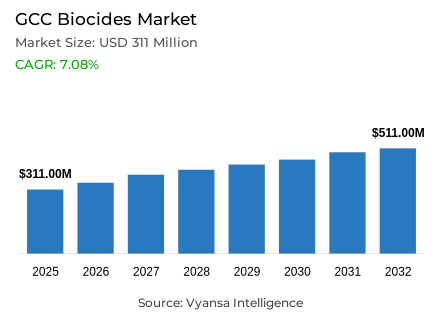
Biocides are oxidizing and non-oxidizing chemistries used across the GCC to control bacteria, fungi, algae, and biofilm in water and industrial systems. Desalination and wastewater operators, industrial plants, oil and gas facilities, cleaning-product manufacturers, and coatings companies consume these products to protect water quality, equipment performance, and product stability. The GCC biocides market is projected to grow at a CAGR of 7.08% between 2026 and 2032.
Key Highlights of the GCC Biocides Market
- The GCC biocides market was valued at USD 311 million in 2025 and is estimated at USD 339 million in 2026, reaching USD 511 million by 2032.
- The market is forecast to expand at a compound annual growth rate of 7.08% between 2026 and 2032.
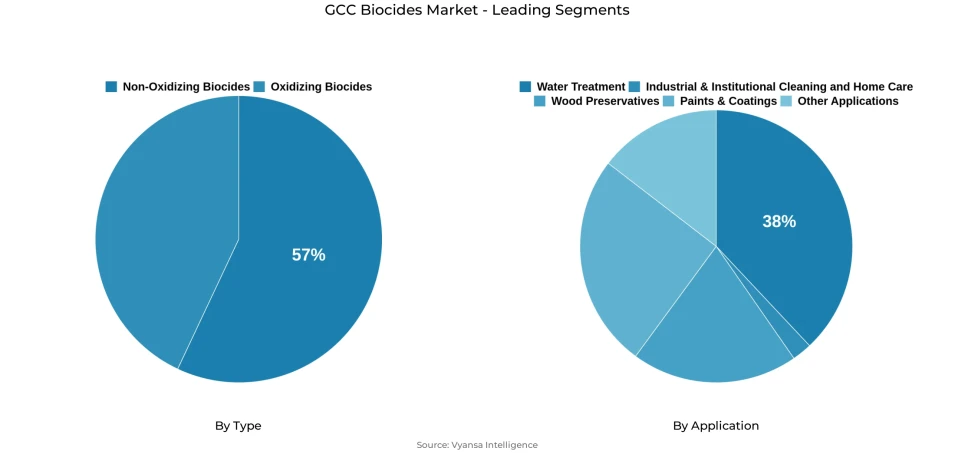
- By type, non-oxidizing biocides led the market with a 57% share in 2026.
- Oxidizing biocides are the fastest-growing type, expanding at a CAGR of 7.89% between 2026 and 2032.
- By application, water treatment led the market with a 38% share in 2026.
- Water Treatment is also the fastest-growing application, expanding at a CAGR of 7.99% between 2026 and 2032.
- The market is moderately fragmented, with the top five companies holding a combined 39% share.
The GCC biocides market is underpinned by the region’s structurally high dependence on desalination, wastewater treatment and water reuse, creating recurring microbial-control requirements across continuously operated treatment assets. Saudi Arabia alone had 16 million m³/day of desalination production capacity in 2026, up from 9 million m³/day in 2016, while its water system includes 36 seawater desalination plants and 160 advanced wastewater-treatment plants. This expanding asset base provides a substantial recurring demand pool for biocides used to control microbial growth, biofouling and operational degradation.
Infrastructure expansion is also translating into measurable treatment-capacity additions. In 2024, Saudi Arabia’s National Water Company completed 118 water and sanitation projects, investing more than SAR 5.57 billion (USD 1.48 billion) and adding 478,000 m³/day of wastewater-treatment capacity. Meanwhile, Saudi Arabia’s contracted portfolio includes more than 10 million m³/day of desalination capacity and over 1.24 million m³/day of wastewater-treatment capacity.
Demand is consequently shifting toward performance-driven microbial control, particularly where fouling can affect membrane efficiency, cleaning frequency and treatment reliability. Through the forecast period, increasing desalination output, wastewater reuse and industrial water treatment should expand both the installed base requiring biocides and the treatment intensity per facility, supporting recurring demand for application-specific formulations, efficient dosing and membrane-compatible microbial-control solutions.
GCC Biocides Market Drivers
Expansion of Desalination Infrastructure Drives Recurring Biocide Demand
Desalination remains the strongest structural demand driver because biocides are consumed throughout the operating life of water-treatment assets rather than only during plant construction. Seawater intake, pre-treatment, reverse osmosis systems, storage and distribution are all exposed to bacterial growth and biofilm formation, making microbial control necessary to maintain water quality, membrane performance and treatment reliability. Each addition to desalination capacity therefore increases the installed infrastructure requiring recurring biocide dosing.
Saudi Arabia's desalinated-water production capacity reached approximately 16 million m³/day in 2025, while around 85% of the population was covered by the water-distribution network. The volume moving through this infrastructure creates a large and recurring microbial-control requirement across production and downstream distribution.
The demand effect extends beyond the initial increase in water output. Larger desalination networks create more membranes, pipelines, storage systems and treatment points that must remain microbiologically stable throughout operation. Continued investment in water-security infrastructure therefore expands the recurring consumption base for biocides, supporting market demand independently of short-term industrial production cycles.
GCC Biocides Market Challenges
High Treatment-Cost Scrutiny Raises the Performance Threshold for Biocide Procurement
The main challenge is not a lack of need for microbial control, but increasing pressure on utilities and industrial operators to achieve that control with lower operating expenditure. Biocides form part of a much wider treatment cost that includes energy, membranes water and wastewater treatment, pumping, cleaning, maintenance and water transmission. As operators attempt to reduce the total cost of treated water, chemical programs face greater scrutiny over dose efficiency and measurable operating benefit.
This pressure is particularly visible in Saudi Arabia, where high water-production and transmission costs remain an important sector concern. In October 2025, the country set a target to reduce water-production costs by 50% by 2035. This increases the incentive for utilities to reduce chemical overfeed, unnecessary cleaning and treatment programs that cannot demonstrate an operational return.
For the biocides market, this limits the ability of suppliers to increase revenue simply through greater chemical volume. Procurement is likely to favour products capable of achieving microbial control at optimized dosage while reducing fouling, cleaning frequency or operational disruption. The challenge therefore puts pressure on commodity formulations and raises the qualification threshold for suppliers, making treatment performance increasingly important to converting underlying microbial-control requirements into market value.
GCC Biocides Market Recent Trends
Increasing Integration of Biocides in Oil & Gas Production Operations
Biocide demand across the GCC is increasingly supported by oil and gas operations in addition to municipal water infrastructure. Microbial activity in injection water, produced water and reservoirs can contribute to microbiologically influenced corrosion, sulfide generation, biofilm formation and reservoir fouling. Biocides are consequently used through water flooding, well treatment, produced-water handling and asset-protection programs, creating recurring industrial consumption linked to hydrocarbon production.
The scale of the underlying energy infrastructure is continuing to expand. Aramco is targeting an approximately 80% increase in sales-gas production capacity by 2030 compared with 2021, supported by projects including Jafurah and the Tanajib Gas Plant. Qatar is simultaneously expanding liquefied natural gas capacity from 77 million tonnes per annum to 142 million tonnes per annum by the end of 2030, while ADNOC is targeting crude-production capacity of 5 million barrels per day by 2027.
This expansion increases the number and scale of production systems where microbial activity can affect asset integrity and hydrocarbon output. It therefore broadens the GCC biocides market beyond its dominant desalination base and increases recurring consumption across upstream production, water injection, produced-water management and gas-processing operations. For suppliers, oil and gas provides a second major industrial demand pool where treatment reliability and asset protection support continued biocide expenditure.
Automated Dosing and Real-Time Monitoring Are Shifting Biocide Treatment Toward Performance-Based Programs
Biocide treatment is moving from fixed chemical-dosing schedules toward systems that adjust treatment according to operating conditions. This is important because microbial-control requirements change with water chemistry, flow rates, temperature, and biological loading. Fixed dosing can therefore either under-treat the system or consume more chemistry than necessary, both of which increase operating cost.
Current treatment platforms increasingly combine chemistry with automated monitoring and dose control. Ecolab's 3D TRASAR systems monitor operating parameters in real time and can automatically control both oxidizing and non-oxidizing biocide feed. Kemira's KemConnect DEX similarly combines automated disinfection with online process monitoring and adjustable chemical dosing under changing treatment conditions.
The effect on the GCC market is a gradual shift in what end users purchase. Utilities and industrial operators are moving from buying biocide chemistry alone toward treatment programs that combine chemistry, equipment, data, and application support. This increases the value attached to dose efficiency and measurable microbial-control performance while reducing dependence on simple volume-based chemical consumption. Suppliers able to integrate biocides with monitoring and automated dosing can therefore capture a larger portion of treatment expenditure even when customers are simultaneously trying to control total chemical usage.
GCC Biocides Market Future Opportunities
Construction Expansion Creates an Opportunity for In-Can Preservation in Paints, Coatings and Construction Formulations
Paints, coatings, polymer emulsions, adhesives and other water-based construction formulations create a distinct growth opportunity outside the GCC's traditional water-treatment demand base. Aqueous formulations provide conditions in which bacteria, fungi and yeast can develop during manufacturing and storage, requiring in-can preservatives to protect product stability, shelf life and finished-product performance.
The opportunity is supported by continued construction activity across major GCC markets. Dubai Municipality issued 10,776 building permits in the first quarter of 2026, 12% more than a year earlier. Saudi Arabia also recorded a 9.3% year-on-year increase in construction-sector operating revenue in October 2025, while the number of building permits issued during that month increased 27.5%.
Construction activity creates downstream demand for paints, coatings, adhesives, sealants, plasters and related formulations, several of which require microbial preservation when produced in aqueous form. The opportunity for biocide suppliers is therefore not simply higher building activity, but deeper participation in the formulation value chain through preservatives designed for water-based products, low effective dosage and compatibility with changing coating requirements. This allows the GCC biocides market to capture additional demand from construction-linked formulated products and reduces its dependence on water treatment and oil and gas as the principal sources of future expansion.
Unlock Market Intelligence
Explore the market potential with our data-driven report
GCC Biocides Market Segmentation Analysis
By Type
- Oxidizing Biocides
- Halogen Compounds
- Other Oxidizing Biocides
- Non-Oxidizing Biocides
- Metallic Compounds
- Quaternary Ammonium Compounds
- Organosulfur Compounds
- Glutaraldehyde
- Organic Acids
- Phenolic Compounds
- Others
Non-Oxidizing Biocides Lead While Oxidizing Biocides Grow Fastest
Non-Oxidizing Biocides lead type-based demand with a 57% market share in 2026 because they are suited to applications requiring sustained microbial control without the aggressive oxidation associated with conventional disinfectants. This is particularly important in reverse osmosis and nanofiltration systems, where membrane compatibility and controlled biofouling treatment influence chemical selection. Their wider use across industrial water circuits and formulated-product preservation further expands the installed consumption base. In October 2025, LANXESS introduced Neolone PH Max, combining phenoxyethanol with pelargonic acid to improve antimicrobial performance at equivalent dosing and extend non-oxidizing preservation options for water-containing formulations.
Oxidizing Biocides are forecast to grow at a CAGR of 7.89% between 2026 and 2032, making them the fastest-growing type as wastewater disinfection, process sanitation and rapid microbial-control applications expand. Unlike non-oxidizing products that derive their position from an established installed base, oxidizing biocides benefit from applications where rapid kill and subsequent chemical breakdown are operational priorities. In April 2026, Arxada introduced Geogard NEU, a neutral-pH product-protection system effective from use levels beginning at 0.03%, illustrating continued development of high-efficiency microbial-control formulations. Oxidizing biocides therefore grow faster as GCC treatment systems increasingly combine continuous biofouling control with targeted rapid-disinfection stages.
By Application
- Water Treatment
- Municipal Water Treatment
- Industrial Water Treatment
- Oil & Gas
- Power Generation
- Pulp & Paper
- Mining
- Recreational Water Swimming Pools
- Other Water Treatment Applications
- Industrial & Institutional Cleaning and Home Care
- Wood Preservatives
- Paints & Coatings
- Marine Coatings
- Other Paint & Coating Applications
- Other Applications
Water Treatment Leads and Remains the Fastest Growing Application
Water Treatment leads application-based demand with a 38% market share in 2026 because desalination, wastewater treatment, industrial cooling systems and treated-water reuse create continuous microbial-control requirements across the GCC. Biocides are consumed throughout intake treatment, reverse osmosis systems, process-water loops and wastewater infrastructure, giving the application a broader recurring consumption base than preservation-focused uses such as coatings or cleaning formulations. In September 2025, Arxada launched Peragreen 26WW for medium and large municipal wastewater systems, with the technology capable of reducing chemical use by approximately 20% to 25% by eliminating conventional chlorination and dechlorination stages.
Water Treatment is also forecast to be the fastest-growing application at a CAGR of 7.99% between 2026 and 2032 as desalination capacity, wastewater reuse and storage infrastructure continue expanding simultaneously. In May 2025, Kemira advanced its KemConnect DEX platform with an Environmental Protection Agency-registered core ingredient, combining chlorine-free performic-acid chemistry with automated data-driven dosing for wastewater treatment. Unlike mature preservation applications, water treatment gains new recurring consumption points every time additional desalination capacity, reuse infrastructure or water-storage assets enter operation. This infrastructure-linked expansion allows Water Treatment to retain both its leading position and the strongest growth outlook.
Unlock Market Intelligence
Explore the market potential with our data-driven report
GCC Biocides Market Regional Analysis
Saudi Arabia Leads While Qatar Grows Fastest
Saudi Arabia leads the GCC biocides industry with a 51% share in 2026, supported by the scale of its desalination, municipal water, industrial processing and oil and gas infrastructure. Its large installed desalination base creates continuous microbial-control requirements across pretreatment, membrane systems, finished-water storage and distribution. New capacity is reinforcing this position. In February 2025, Ras Mohaisen first water desalination company signed a water-purchase agreement for a reverse osmosis facility with capacity of up to 300,000 m³/day together with approximately 600,000 m³ of potable-water storage, adding further treatment and storage volumes requiring microbial control.
Qatar is forecast to grow at a CAGR of 8.98% between 2026 and 2032, making it the fastest-growing GCC country. Its opportunity is increasingly connected with wastewater reuse, treated-water storage and redistribution rather than desalination alone. New reservoirs and seasonal storage infrastructure extend treatment requirements beyond wastewater plants into storage and transfer networks, creating additional consumption points for disinfection and microbial-control chemistry. Qatar therefore grows faster from a smaller base as new water infrastructure expands the number of applications requiring routine biocide dosing.
GCC Biocides Market Competitive Landscape
The GCC biocides industry is moderately fragmented, with the five largest companies holding a combined 39% share. LANXESS AG holds the leading position among the identified suppliers, followed by Ecolab Inc., BASF SE, Arxada AG and Nouryon Chemicals Holding B.V. Competition is increasingly shaped by water-treatment expertise, membrane compatibility, application support and the ability to combine microbial-control chemistry with monitoring and dosing capabilities.
Key Companies in the GCC Biocides Market
- LANXESS AG
- Ecolab Inc.
- BASF SE
- Arxada AG
- Nouryon Chemicals Holding B.V.
- Dow Inc.
- Clariant International Ltd.
- Kemira Oyj
- Solvay S.A.
- Veolia Environnement S.A.
Company Profiling
The following profiles cover the five leading companies shaping product supply, water-treatment capabilities and competitive positioning in the market.
LANXESS AG: LANXESS AG, headquartered in Cologne Germany, participates in the market through microbial-control products used across membrane water treatment, industrial hygiene and formulated-product preservation. The company operates across 32 countries and supplies specialized chemistries including DBNPA-based solutions for reverse osmosis and nanofiltration biofouling control. Specific biocide production capacity is not publicly disclosed. LANXESS operates as a technology-led microbial-control supplier with particular strength in membrane-compatible treatment chemistry.
Ecolab Inc.: Ecolab Inc., headquartered in St. Paul Minnesota, participates in the market through water-treatment chemistry, microbial-control services and digital monitoring platforms used across industrial water, cooling and wastewater systems. The company operates in more than 170 countries with approximately 48,000 associates, giving it one of the broadest service networks among the identified suppliers. Dedicated biocide production capacity is not publicly disclosed. Ecolab operates as a technology-led water-treatment specialist combining chemistry with monitoring, dosing and operational support.
BASF SE: BASF SE, headquartered in Ludwigshafen Germany, participates in the market through microbial-control and water-treatment chemicals including its Protectol GA 24 glutaraldehyde product, which contains 24% active glutaraldehyde and serves water treatment, oil and gas and industrial applications. BASF operates 234 production sites across 93 countries, although dedicated biocide capacity is not publicly disclosed. The company operates as a broad-portfolio chemical manufacturer with large-scale production capabilities and established access to industrial end-user markets.
Arxada AG: Arxada AG, headquartered in Basel Switzerland, participates in the market through microbial-control technologies used in professional hygiene, paints and coatings, home and personal care, material protection and water treatment. The company operates 24 manufacturing sites and 14 research and development centres globally. Dedicated GCC biocide capacity is not publicly disclosed. Arxada operates as a specialist preservation and microbial-control supplier, supported by a portfolio spanning industrial protection, formulated products and water-related applications.
Nouryon Chemicals Holding B.V.: Nouryon Chemicals Holding B.V. participates in the market through specialty ingredients serving industrial, institutional and consumer cleaning formulations and related microbial-control applications. The company operates more than 8,000 employees, 63 manufacturing sites and 14 innovation centres across its global specialty-chemicals network. Dedicated biocide manufacturing capacity is not publicly disclosed. Nouryon operates as a broad specialty-chemistry supplier whose manufacturing scale and formulation expertise support cleaning and industrial customers across multiple GCC end-use sectors.
Recent Developments in the GCC Biocides Market
- March 2026: BASF Transfers Aseptrol Chlorine-Dioxide Technology Portfolio to Oxidium: BASF SE and Oxidium Technologies LLC announced an agreement under which Oxidium would acquire BASF’s Aseptrol chlorine-dioxide technology portfolio for water purification and disinfection. The portfolio includes established formulations, labels and regulatory approvals. The transaction is relevant to GCC biocide demand because chlorine-dioxide solutions are used for microbial control in water-treatment and industrial applications, supporting the availability of specialized disinfection technologies for the region’s expanding water-treatment infrastructure.
- June 2026: Arxada AG entered a strategic agreement with Clorox Healthcare to incorporate Quanticare technology into HyperOxi Disinfecting Wipes. The technology provides daily sporicidal disinfection against Clostridioides difficile in four minutes, while offering shorter contact times against several other organisms. The development demonstrates continued competition around faster microbial kill, surface compatibility and simplified professional disinfection, raising performance expectations across institutional biocide applications.
Frequently Asked Questions
Related Report
- Market Segmentation
- Research Scope
- Research Methodology
- Definitions and Assumptions
- Executive Summary
- GCC Biocides Market Policies, Regulations, and Standards
- GCC Biocides Market Dynamics
- Growth Factors
- Challenges
- Trends
- Opportunities
- GCC Biocides Market Statistics, 2022-2032F
- Market Size & Growth Outlook
- By Revenues in USD Million
- By Quantity Sold (Thousand Tons)
- Market Segmentation & Growth Outlook
- By Type
- Oxidizing Biocides- Market Insights and Forecast 2022-2032, USD Million & Thousand Tons
- Halogen Compounds- Market Insights and Forecast 2022-2032, USD Million & Thousand Tons
- Other Oxidizing Biocides- Market Insights and Forecast 2022-2032, USD Million & Thousand Tons
- Non-Oxidizing Biocides- Market Insights and Forecast 2022-2032, USD Million & Thousand Tons
- Metallic Compounds- Market Insights and Forecast 2022-2032, USD Million & Thousand Tons
- Quaternary Ammonium Compounds- Market Insights and Forecast 2022-2032, USD Million & Thousand Tons
- Organosulfur Compounds- Market Insights and Forecast 2022-2032, USD Million & Thousand Tons
- Glutaraldehyde- Market Insights and Forecast 2022-2032, USD Million & Thousand Tons
- Organic Acids- Market Insights and Forecast 2022-2032, USD Million & Thousand Tons
- Phenolic Compounds- Market Insights and Forecast 2022-2032, USD Million & Thousand Tons
- Others- Market Insights and Forecast 2022-2032, USD Million & Thousand Tons
- Oxidizing Biocides- Market Insights and Forecast 2022-2032, USD Million & Thousand Tons
- By Application
- Water Treatment- Market Insights and Forecast 2022-2032, USD Million & Thousand Tons
- Municipal Water Treatment- Market Insights and Forecast 2022-2032, USD Million & Thousand Tons
- Industrial Water Treatment- Market Insights and Forecast 2022-2032, USD Million & Thousand Tons
- Oil & Gas- Market Insights and Forecast 2022-2032, USD Million & Thousand Tons
- Power Generation- Market Insights and Forecast 2022-2032, USD Million & Thousand Tons
- Pulp & Paper- Market Insights and Forecast 2022-2032, USD Million & Thousand Tons
- Mining- Market Insights and Forecast 2022-2032, USD Million & Thousand Tons
- Recreational Water (Swimming Pools)- Market Insights and Forecast 2022-2032, USD Million & Thousand Tons
- Other Water Treatment Applications- Market Insights and Forecast 2022-2032, USD Million & Thousand Tons
- Industrial & Institutional Cleaning and Home Care- Market Insights and Forecast 2022-2032, USD Million & Thousand Tons
- Wood Preservatives- Market Insights and Forecast 2022-2032, USD Million & Thousand Tons
- Paints & Coatings- Market Insights and Forecast 2022-2032, USD Million & Thousand Tons
- Marine Coatings- Market Insights and Forecast 2022-2032, USD Million & Thousand Tons
- Other Paint & Coating Applications- Market Insights and Forecast 2022-2032, USD Million & Thousand Tons
- Other Applications- Market Insights and Forecast 2022-2032, USD Million & Thousand Tons
- Water Treatment- Market Insights and Forecast 2022-2032, USD Million & Thousand Tons
- By Country
- Saudi Arabia
- The UAE
- Qatar
- Kuwait
- Oman
- Bahrain
- By Competitors
- Competition Characteristics
- Market Share & Analysis
- By Type
- Market Size & Growth Outlook
- Saudi Arabia Biocides Market Statistics, 2022-2032F
- Market Size & Growth Outlook
- By Revenues in USD Million
- By Quantity Sold (Thousand Tons)
- Market Segmentation & Growth Outlook
- By Type- Market Insights and Forecast 2022-2032, USD Million & Thousand Tons
- By Application- Market Insights and Forecast 2022-2032, USD Million & Thousand Tons
- Market Size & Growth Outlook
- The UAE Biocides Market Statistics, 2022-2032F
- Market Size & Growth Outlook
- By Revenues in USD Million
- By Quantity Sold (Thousand Tons)
- Market Segmentation & Growth Outlook
- By Type- Market Insights and Forecast 2022-2032, USD Million & Thousand Tons
- By Application- Market Insights and Forecast 2022-2032, USD Million & Thousand Tons
- Market Size & Growth Outlook
- Qatar Biocides Market Statistics, 2022-2032F
- Market Size & Growth Outlook
- By Revenues in USD Million
- By Quantity Sold (Thousand Tons)
- Market Segmentation & Growth Outlook
- By Type- Market Insights and Forecast 2022-2032, USD Million & Thousand Tons
- By Application- Market Insights and Forecast 2022-2032, USD Million & Thousand Tons
- Market Size & Growth Outlook
- Kuwait Biocides Market Statistics, 2022-2032F
- Market Size & Growth Outlook
- By Revenues in USD Million
- By Quantity Sold (Thousand Tons)
- Market Segmentation & Growth Outlook
- By Type- Market Insights and Forecast 2022-2032, USD Million & Thousand Tons
- By Application- Market Insights and Forecast 2022-2032, USD Million & Thousand Tons
- Market Size & Growth Outlook
- Oman Biocides Market Statistics, 2022-2032F
- Market Size & Growth Outlook
- By Revenues in USD Million
- By Quantity Sold (Thousand Tons)
- Market Segmentation & Growth Outlook
- By Type- Market Insights and Forecast 2022-2032, USD Million & Thousand Tons
- By Application- Market Insights and Forecast 2022-2032, USD Million & Thousand Tons
- Market Size & Growth Outlook
- Competitive Outlook
- Company Profiles
- LANXESS AG
- Business Description
- Product Portfolio
- Collaborations & Alliances
- Recent Developments
- Financial Details
- Others
- Ecolab Inc.
- Business Description
- Product Portfolio
- Collaborations & Alliances
- Recent Developments
- Financial Details
- Others
- BASF SE
- Business Description
- Product Portfolio
- Collaborations & Alliances
- Recent Developments
- Financial Details
- Others
- Arxada AG
- Business Description
- Product Portfolio
- Collaborations & Alliances
- Recent Developments
- Financial Details
- Others
- Nouryon Chemicals Holding B.V.
- Business Description
- Product Portfolio
- Collaborations & Alliances
- Recent Developments
- Financial Details
- Others
- Dow Inc.
- Business Description
- Product Portfolio
- Collaborations & Alliances
- Recent Developments
- Financial Details
- Others
- Clariant International Ltd.
- Business Description
- Product Portfolio
- Collaborations & Alliances
- Recent Developments
- Financial Details
- Others
- Kemira Oyj
- Business Description
- Product Portfolio
- Collaborations & Alliances
- Recent Developments
- Financial Details
- Others
- Solvay S.A.
- Business Description
- Product Portfolio
- Collaborations & Alliances
- Recent Developments
- Financial Details
- Others
- Veolia Environnement S.A.
- Business Description
- Product Portfolio
- Collaborations & Alliances
- Recent Developments
- Financial Details
- Others
- LANXESS AG
- Company Profiles
- Disclaimer
| Segment | Sub-Segment |
|---|---|
| By Type |
|
| By Application |
|
| By Country |
|
Research Methodology
This study followed a structured approach comprising four key phases to assess the size and scope of the electro-oxidation market. The process began with thorough secondary research to collect data on the target market, related markets, and broader industry context. These findings, along with preliminary assumptions and estimates, were then validated through extensive primary research involving industry experts from across the value chain. To calculate the overall market size, both top-down and bottom-up methodologies were employed. Finally, market segmentation and data triangulation techniques were applied to refine and validate segment-level estimations.
Secondary Research
The secondary research phase involved gathering data from a wide range of credible and published sources. This step helped in identifying industry trends, defining market segmentation, and understanding the market landscape and value chain.
Sources consulted during this phase included:
- Company annual reports, investor presentations, and press releases
- Industry white papers and certified publications
- Trade directories and market-recognized databases
- Articles from authoritative authors and reputable journals
- Gold and silver standard websites
Secondary research was critical in mapping out the industry's value chain and monetary flow, identifying key market segments, understanding regional variations, and tracking significant industry developments.
Other key sources:
- Financial disclosures
- Industry associations and trade bodies
- News outlets and business magazines
- Academic journals and research studies
- Paid industry databases
Primary Research
To validate secondary data and gain deeper market insights, primary research was conducted with key stakeholders across both the supply and demand sides of the market.
On the demand side, participants included decision-makers and influencers from end-user industries—such as CIOs, CTOs, and CSOs—who provided first-hand perspectives on market needs, product usage, and future expectations.
On the supply side, interviews were conducted with manufacturers, industry associations, and institutional participants to gather insights into current offerings, product pipelines, and market challenges.
Primary interviews provided critical inputs such as:
- Market size and revenue data
- Product and service breakdowns
- Market forecasts
- Regional and application-specific trends
Stakeholders consulted included:
- Leading OEM and solution providers
- Channel and distribution partners
- End users across various applications
- Independent consultants and industry specialists
Market Size Estimation and Data Triangulation
- Identifying Key Market Participants (Secondary Research)
- Goal: To identify the major players or companies in the target market. This typically involves using publicly available data sources such as industry reports, market research publications, and financial statements of companies.
- Tools: Reports from firms like Gartner, Forrester, Euromonitor, Statista, IBISWorld, and others. Public financial statements, news articles, and press releases from top market players.
- Extracting Earnings of Key Market Participants
- Goal: To estimate the earnings generated from the product or service being analyzed. This step helps in understanding the revenue potential of each market player in a specific geography.
- Methods: Earnings data can be gathered from:
- Publicly available financial reports (for listed companies).
- Interviews and primary data sources from professionals, such as Directors, VPs, SVPs, etc. This is especially useful for understanding more nuanced, internal data that isn't publicly disclosed.
- Annual reports and investor presentations of key players.
- Data Collation and Development of a Relevant Data Model
- Goal: To collate inputs from both primary and secondary sources into a structured, data-driven model for market estimation. This model will incorporate key market KPIs and any independent variables relevant to the market.
- Key KPIs: These could include:
- Market size, growth rate, and demand drivers.
- Industry-specific metrics like market share, average revenue per customer (ARPC), or average deal size.
- External variables, such as economic growth rates, inflation rates, or commodity prices, that could affect the market.
- Data Modeling: Based on this data, the market forecasts are developed for the next 5 years. A combination of trend analysis, scenario modeling, and statistical regression might be used to generate projections.
- Scenario Analysis
- Goal: To test different assumptions and validate how sensitive the market is to changes in key variables (e.g., market demand, regulatory changes, technological disruptions).
- Types of Scenarios:
- Base Case: Based on current assumptions and historical data.
- Best-Case Scenario: Assuming favorable market conditions, regulatory environments, and technological advancements.
- Worst-Case Scenario: Accounting for adverse factors, such as economic downturns, stricter regulations, or unexpected disruptions.












