US Recycled Polyester Market Report: Trends, Growth and Forecast (2026-2032)
By Product (Cotton Spinning Material, Filling Material, Non-woven, Other Products), By Application (Apparel, Home Textiles, Automotive Interior, Construction Material, Healthcare & Hygiene, Other Applications), By Region (West, Midwest, South, North, Northeast) ... Read more
|
Major Players
|
US Recycled Polyester Market Statistics and Insights, 2026
- Market Size Statistics
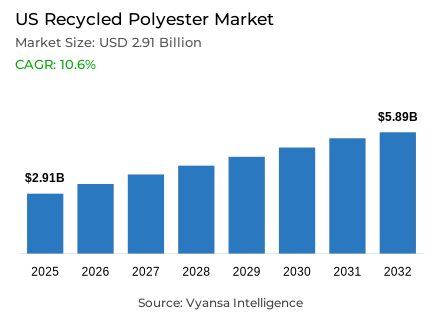
- Recycled polyester market size in US was valued at USD 2.91 billion in 2025 and is estimated at USD 3.32 billion in 2026.
- The market size is expected to grow to USD 5.89 billion by 2032.
- Market to register a CAGR of around 10.6% during 2026-32.
- Product Shares
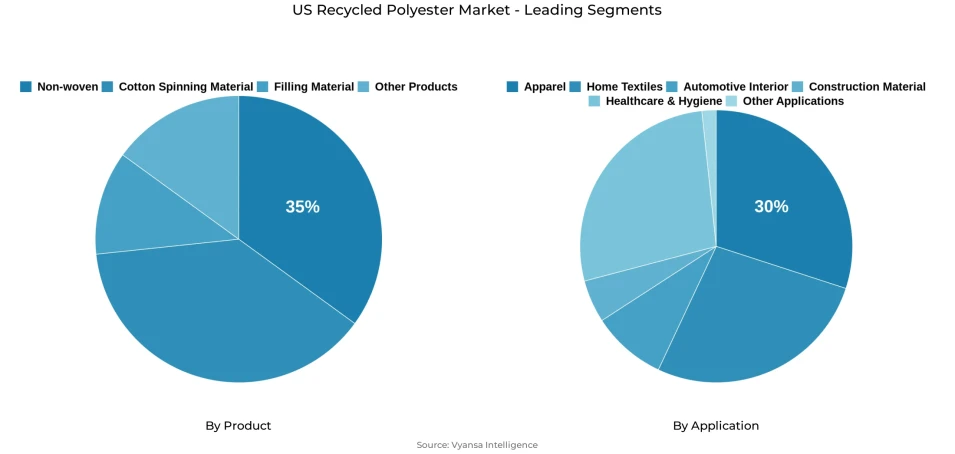
- Non-woven grabbed market share of 35%.
- Competition
- More than 10 companies are actively engaged in producing recycled polyester in US.
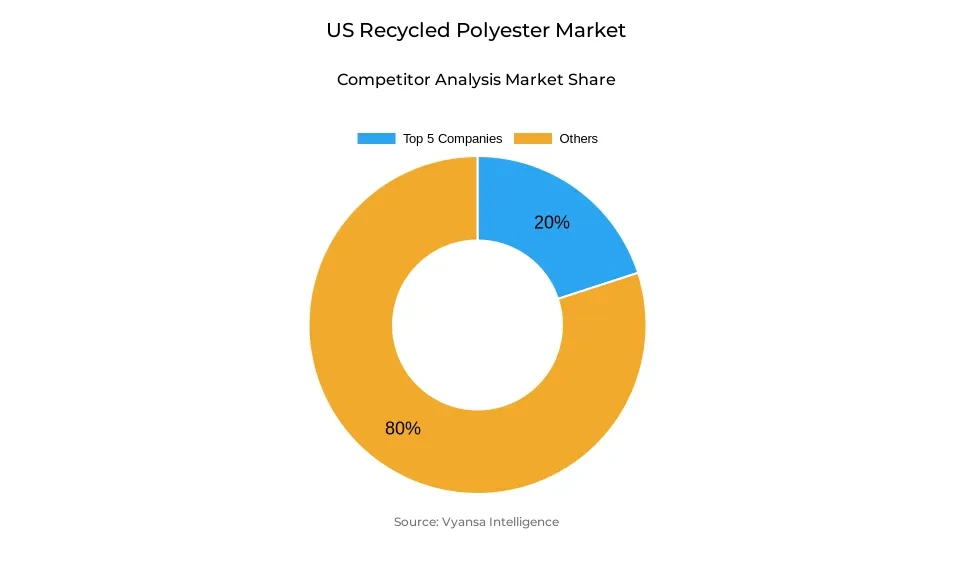
- Top 5 companies acquired around 20% of the market share in 2026.
- Evergreen Recycling LLC, Custom Polymers Inc., Plastipak Holdings Inc. (including brands), Indorama Ventures Public Company Limited (including brands), Unifi Inc. etc., are few of the top companies.
- Application
- Apparel grabbed 30% of the market.
US Recycled Polyester Market Outlook
The US recycled polyester market size was valued at USD 2.91 billion in 2025 and is projected to grow from USD 3.32 billion in 2026 to USD 5.89 billion by 2032, exhibiting a CAGR of 10.6% during the forecast period. The market is expanding due to rising demand for sustainable textile materials, increasing corporate sustainability commitments, and growing adoption of recycled content across apparel, packaging, and industrial applications. Manufacturers are increasingly utilizing recycled polyester fibers to reduce dependence on virgin petrochemical-based materials and support circular economy objectives.
The United States continues to strengthen its recycling ecosystem through investments in PET collection infrastructure, recycling facilities, and advanced material recovery technologies. Growing awareness regarding plastic waste reduction and environmental responsibility is encouraging broader adoption of recycled polyester across multiple end-use industries. In addition, increasing interest in fiber-to-fiber recycling and closed-loop textile systems is supporting the development of a more circular textile value chain.
Among product categories, Non-woven accounts for 35% of the market. The segment benefits from extensive use of recycled polyester fibers in filtration products, geotextiles, automotive components, hygiene products, and industrial fabrics. The recycled polyester market continues to witness growing demand for non-woven materials due to their versatility, durability, and sustainability advantages.
Based on application, Apparel holds 30% of the market. Growing incorporation of recycled polyester into sportswear, outdoor apparel, fashion garments, and performance textiles continues to support segment growth. The recycled polyester market benefits from increasing consumer preference for sustainable clothing and rising commitments from brands to incorporate recycled materials into their product portfolios.
US Recycled Polyester Market Growth Driver
PET Bottle Recovery Supports Recycled Feedstock Availability
The availability of recyclable PET materials remains a key growth driver for the recycled polyester market. According to the National Association for PET Container Resources (NAPCOR), the US PET bottle recycling rate reached 30.2% in 2024. The recovery of PET bottles provides an important source of feedstock for recycled polyester production and supports the development of circular material supply chains.
The recycled polyester market benefits from established PET collection and recycling networks that supply recovered materials for fiber manufacturing. As sustainability initiatives continue expanding across the textile, packaging, and consumer goods industries, demand for recycled PET feedstock is expected to strengthen further.
US Recycled Polyester Market Challenge
Feedstock Constraints and Recycled Content Gaps Limit Circularity
Maintaining sufficient feedstock availability remains a challenge for the recycled polyester market. According to the National Association for PET Container Resources (NAPCOR), the average post-consumer recycled PET content in US PET bottles and jars reached 15.9% in 2024, indicating continued reliance on virgin resin across packaging applications.
The recycled polyester market also faces challenges related to textile waste collection, material traceability, and scaling textile-to-textile recycling systems. Competition for recycled PET feedstock among packaging, fiber, and industrial applications can create supply constraints and increase raw material costs. These factors continue to influence the availability and affordability of recycled polyester production inputs.
Unlock Market Intelligence
Explore the market potential with our data-driven report
US Recycled Polyester Market Trend
Transition Toward Textile-to-Textile Recycling Technologies
The adoption of advanced recycling technologies is becoming a prominent trend across the recycled polyester market. Industry participants are increasingly investing in fiber-to-fiber recycling, chemical polyester recycling, molecular recycling, and PET depolymerization technologies to reduce dependence on bottle-derived feedstocks and improve textile circularity.
The recycled polyester market is benefiting from growing investments in closed-loop recycling systems capable of converting post-consumer textile waste into high-quality recycled polyester fibers. As apparel brands seek to strengthen circular fashion initiatives and reduce textile waste, advanced recycling technologies are expected to play a larger role in supporting sustainable fiber production and improving resource efficiency across the textile supply chain.
US Recycled Polyester Market Opportunity
Sustainability Commitments Expand Market Potential
Growing demand for sustainable materials is creating significant opportunities for the recycled polyester market. According to the Textile Exchange Materials Market Report 2024, recycled polyester accounted for approximately 13.6% of global polyester production. The increasing adoption of recycled fibers reflects stronger sustainability commitments across apparel, home textiles, packaging, and industrial applications.
The recycled polyester market is well positioned to benefit from expanding recycled content requirements, circular economy initiatives, and corporate environmental, social, and governance (ESG) programs. Continued investments in recycling infrastructure, advanced material recovery technologies, and circular textile systems are expected to create long-term opportunities across the recycled polyester value chain.
Unlock Market Intelligence
Explore the market potential with our data-driven report
US Recycled Polyester Market Segmentation Analysis
By Product
- Cotton Spinning Material
- Filling Material
- Non-woven
- Other Products
The segment with the highest share around the product category is non-woven, accounting for 35% of the market. The segment maintains its leading position due to widespread utilization in filtration systems, hygiene products, automotive components, geotextiles, and industrial fabrics. Recycled polyester fibers offer durability, strength, and performance characteristics that support their adoption across non-woven applications.
The recycled polyester market continues to witness increasing demand for Non-woven materials as manufacturers seek sustainable alternatives while maintaining product functionality and performance standards. The segment remains a major contributor to recycled polyester consumption across multiple industries.
By Application
- Apparel
- Home Textiles
- Automotive Interior
- Construction Material
- Healthcare & Hygiene
- Other Applications
The segment with the highest share around the application category is apparel, accounting for 30% of the market. The segment benefits from increasing adoption of recycled polyester in sportswear, fashion apparel, outdoor clothing, and performance garments. Growing consumer awareness regarding sustainability and circular fashion continues to support demand for recycled fiber-based products.
The recycled polyester market continues to experience strong demand from apparel manufacturers as brands strengthen recycled content commitments and expand sustainable product offerings. The integration of recycled polyester into clothing production is expected to remain a key growth avenue throughout the forecast period.
List of Companies Covered in US Recycled Polyester Market
The companies listed below are highly influential in the US recycled polyester market, with a significant market share and a strong impact on industry developments.
- Evergreen Recycling LLC
- Custom Polymers Inc.
- Plastipak Holdings Inc. (including brands)
- Indorama Ventures Public Company Limited (including brands)
- Unifi Inc.
- Alpek Polyester USA LLC
- Phoenix Technologies International LLC
- CarbonLite Industries LLC
- Republic Services Inc. (including brands)
- Waste Management Inc. (including brands)
Market News & Updates
- Unifi Inc., 2025:
Unifi expanded the commercialization of its REPREVE® recycled polyester fiber portfolio, introducing new textile solutions containing recycled content sourced from post-consumer plastic bottles. The company continued expanding partnerships with apparel and textile brands to increase the adoption of recycled polyester materials across fashion, sportswear, and performance textile applications. The development strengthens the circular polyester value chain and supports growing demand for sustainable fibers in the United States.
- Indorama Ventures Public Company Limited, 2025:
Indorama Ventures strengthened its textile-to-textile recycling platform through its partnership with Zhejiang Jiaren New Materials, supporting the expansion of chemical recycling technologies capable of converting post-consumer textile waste into recycled polyester raw materials. The initiative enhances global recycled polyester supply capabilities and supports circular textile manufacturing for apparel and textile applications, including the North American market.
Frequently Asked Questions
Related Report
- Market Segmentation
- Research Scope
- Research Methodology
- Definitions and Assumptions
- Executive Summary
- The US Recycled Polyester Market Policies, Regulations, and Standards
- The US Recycled Polyester Production (Kiloton) Trend 2022-2032
- The US Recycled Polyester Production (Kiloton) Trend By Product
- Cotton Spinning Material
- Filling Material
- Non-woven
- Company Wise Production Plants and Statistics
- Installed Production Capacity
- Actual Production
- Planned Production Target
- The US Recycled Polyester Production (Kiloton) Trend By Product
- The US Recycled Polyester Pricing Analysis 2022-2032
- The US Recycled Polyester Pricing Trend (USD/Kiloton) 2022-2032
- The US Recycled Polyester Pricing Trend (USD/Kiloton) By Product 2022-2032
- Cotton Spinning Material
- Filling Material
- Non-woven
- The US Recycled Polyester Market Dynamics
- Growth Factors
- Challenges
- Trends
- Opportunities
- The US Recycled Polyester Market Statistics, 2022-2032F
- Market Size & Growth Outlook
- By Revenues in USD Million
- By Quantity Sold in Kilotons
- Market Segmentation & Growth Outlook
- By Product
- Cotton Spinning Material- Market Insights and Forecast 2022-2032, USD Million
- Filling Material- Market Insights and Forecast 2022-2032, USD Million
- Non-woven- Market Insights and Forecast 2022-2032, USD Million
- Other Products- Market Insights and Forecast 2022-2032, USD Million
- By Application
- Apparel- Market Insights and Forecast 2022-2032, USD Million
- Home Textiles- Market Insights and Forecast 2022-2032, USD Million
- Automotive Interior- Market Insights and Forecast 2022-2032, USD Million
- Construction Material- Market Insights and Forecast 2022-2032, USD Million
- Healthcare & Hygiene- Market Insights and Forecast 2022-2032, USD Million
- Other Applications- Market Insights and Forecast 2022-2032, USD Million
- By Region
- West- Market Insights and Forecast 2022-2032, USD Million
- Midwest- Market Insights and Forecast 2022-2032, USD Million
- South- Market Insights and Forecast 2022-2032, USD Million
- North- Market Insights and Forecast 2022-2032, USD Million
- Northeast- Market Insights and Forecast 2022-2032, USD Million
- By Competitors
- Competition Characteristics
- Market Share & Analysis
- By Product
- Market Size & Growth Outlook
- The US Cotton Spinning Material Market Statistics, 2022-2032
- Market Size & Growth Outlook
- By Revenues in USD Million
- By Quantity Sold in Kilotons
- Market Segmentation & Growth Outlook
- By Application- Market Insights and Forecast 2022-2032, USD Million
- By Region- Market Insights and Forecast 2022-2032, USD Million
- Market Size & Growth Outlook
- The US Filling Material Market Statistics, 2022-2032
- Market Size & Growth Outlook
- By Revenues in USD Million
- By Quantity Sold in Kilotons
- Market Segmentation & Growth Outlook
- By Application- Market Insights and Forecast 2022-2032, USD Million
- By Region- Market Insights and Forecast 2022-2032, USD Million
- Market Size & Growth Outlook
- The US Non-woven Market Statistics, 2022-2032
- Market Size & Growth Outlook
- By Revenues in USD Million
- By Quantity Sold in Kilotons
- Market Segmentation & Growth Outlook
- By Application- Market Insights and Forecast 2022-2032, USD Million
- By Region- Market Insights and Forecast 2022-2032, USD Million
- Market Size & Growth Outlook
- The US Other Products Market Statistics, 2022-2032
- Market Size & Growth Outlook
- By Revenues in USD Million
- By Quantity Sold in Kilotons
- Market Segmentation & Growth Outlook
- By Application- Market Insights and Forecast 2022-2032, USD Million
- By Region- Market Insights and Forecast 2022-2032, USD Million
- Market Size & Growth Outlook
- Competitive Outlook
- Company Profiles
- Indorama Ventures Public Company Limited (including brands)
- Business Description
- Product Portfolio
- Collaborations & Alliances
- Recent Developments
- Financial Details
- Others
- Unifi Inc.
- Business Description
- Product Portfolio
- Collaborations & Alliances
- Recent Developments
- Financial Details
- Others
- Alpek Polyester USA LLC
- Business Description
- Product Portfolio
- Collaborations & Alliances
- Recent Developments
- Financial Details
- Others
- Phoenix Technologies International LLC
- Business Description
- Product Portfolio
- Collaborations & Alliances
- Recent Developments
- Financial Details
- Others
- CarbonLite Industries LLC
- Business Description
- Product Portfolio
- Collaborations & Alliances
- Recent Developments
- Financial Details
- Others
- Evergreen Recycling LLC
- Business Description
- Product Portfolio
- Collaborations & Alliances
- Recent Developments
- Financial Details
- Others
- Custom Polymers Inc.
- Business Description
- Product Portfolio
- Collaborations & Alliances
- Recent Developments
- Financial Details
- Others
- Plastipak Holdings Inc. (including brands)
- Business Description
- Product Portfolio
- Collaborations & Alliances
- Recent Developments
- Financial Details
- Others
- Republic Services Inc. (including brands)
- Business Description
- Product Portfolio
- Collaborations & Alliances
- Recent Developments
- Financial Details
- Others
- Waste Management Inc. (including brands)
- Business Description
- Product Portfolio
- Collaborations & Alliances
- Recent Developments
- Financial Details
- Others
- Indorama Ventures Public Company Limited (including brands)
- Company Profiles
- Disclaimer
| Segment | Sub-Segment |
|---|---|
| By Product |
|
| By Application |
|
| By Region |
|
Research Methodology
This study followed a structured approach comprising four key phases to assess the size and scope of the electro-oxidation market. The process began with thorough secondary research to collect data on the target market, related markets, and broader industry context. These findings, along with preliminary assumptions and estimates, were then validated through extensive primary research involving industry experts from across the value chain. To calculate the overall market size, both top-down and bottom-up methodologies were employed. Finally, market segmentation and data triangulation techniques were applied to refine and validate segment-level estimations.
Secondary Research
The secondary research phase involved gathering data from a wide range of credible and published sources. This step helped in identifying industry trends, defining market segmentation, and understanding the market landscape and value chain.
Sources consulted during this phase included:
- Company annual reports, investor presentations, and press releases
- Industry white papers and certified publications
- Trade directories and market-recognized databases
- Articles from authoritative authors and reputable journals
- Gold and silver standard websites
Secondary research was critical in mapping out the industry's value chain and monetary flow, identifying key market segments, understanding regional variations, and tracking significant industry developments.
Other key sources:
- Financial disclosures
- Industry associations and trade bodies
- News outlets and business magazines
- Academic journals and research studies
- Paid industry databases
Primary Research
To validate secondary data and gain deeper market insights, primary research was conducted with key stakeholders across both the supply and demand sides of the market.
On the demand side, participants included decision-makers and influencers from end-user industries—such as CIOs, CTOs, and CSOs—who provided first-hand perspectives on market needs, product usage, and future expectations.
On the supply side, interviews were conducted with manufacturers, industry associations, and institutional participants to gather insights into current offerings, product pipelines, and market challenges.
Primary interviews provided critical inputs such as:
- Market size and revenue data
- Product and service breakdowns
- Market forecasts
- Regional and application-specific trends
Stakeholders consulted included:
- Leading OEM and solution providers
- Channel and distribution partners
- End users across various applications
- Independent consultants and industry specialists
Market Size Estimation and Data Triangulation
- Identifying Key Market Participants (Secondary Research)
- Goal: To identify the major players or companies in the target market. This typically involves using publicly available data sources such as industry reports, market research publications, and financial statements of companies.
- Tools: Reports from firms like Gartner, Forrester, Euromonitor, Statista, IBISWorld, and others. Public financial statements, news articles, and press releases from top market players.
- Extracting Earnings of Key Market Participants
- Goal: To estimate the earnings generated from the product or service being analyzed. This step helps in understanding the revenue potential of each market player in a specific geography.
- Methods: Earnings data can be gathered from:
- Publicly available financial reports (for listed companies).
- Interviews and primary data sources from professionals, such as Directors, VPs, SVPs, etc. This is especially useful for understanding more nuanced, internal data that isn't publicly disclosed.
- Annual reports and investor presentations of key players.
- Data Collation and Development of a Relevant Data Model
- Goal: To collate inputs from both primary and secondary sources into a structured, data-driven model for market estimation. This model will incorporate key market KPIs and any independent variables relevant to the market.
- Key KPIs: These could include:
- Market size, growth rate, and demand drivers.
- Industry-specific metrics like market share, average revenue per customer (ARPC), or average deal size.
- External variables, such as economic growth rates, inflation rates, or commodity prices, that could affect the market.
- Data Modeling: Based on this data, the market forecasts are developed for the next 5 years. A combination of trend analysis, scenario modeling, and statistical regression might be used to generate projections.
- Scenario Analysis
- Goal: To test different assumptions and validate how sensitive the market is to changes in key variables (e.g., market demand, regulatory changes, technological disruptions).
- Types of Scenarios:
- Base Case: Based on current assumptions and historical data.
- Best-Case Scenario: Assuming favorable market conditions, regulatory environments, and technological advancements.
- Worst-Case Scenario: Accounting for adverse factors, such as economic downturns, stricter regulations, or unexpected disruptions.












