Global MLOps & AI Lifecycle Management Market Report: Trends, Growth and Forecast (2026-2032)
By Component (Platform/Solution, Services (Professional Services, Managed Services)), By Lifecycle Stage (Data Preparation, Model Training, Model Deployment, Model Monitoring, Model Governance, GenAI/LLMOps Management), By Model Type (Traditional Machine Learning Models, Deep Learning Models, Generative AI/LLMs, Computer Vision Models, Natural Language Processing Models), By Deployment Mode (Cloud-Based, On-Premises, Hybrid), By Organization Size (Large Enterprises, Small & Medium Enterprises), By End User (BFSI, IT & Telecom, Healthcare, Retail & E-Commerce, Manufacturing, Government & Public Sector, Media & Entertainment, Others), By Region (North America, South America, Europe, Middle East & Africa, Asia Pacific) ... Read more
|
Major Players
|
Global MLOps & AI Lifecycle Management Market Statistics and Insights, 2026
- Market Size Statistics
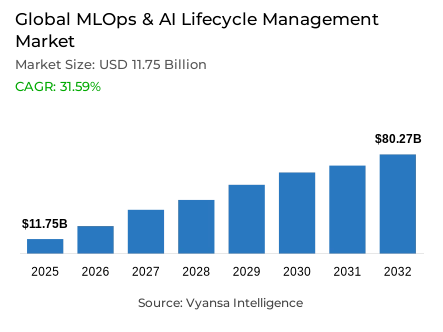
- Mlops & ai lifecycle management market size in Global was valued at USD 11.75 billion in 2025 and is estimated at USD 22.5 billion in 2026.
- The market size is expected to grow to USD 80.27 billion by 2032.
- Market to register a CAGR of around 31.59% during 2026-32.
- Lifecycle Stage Shares
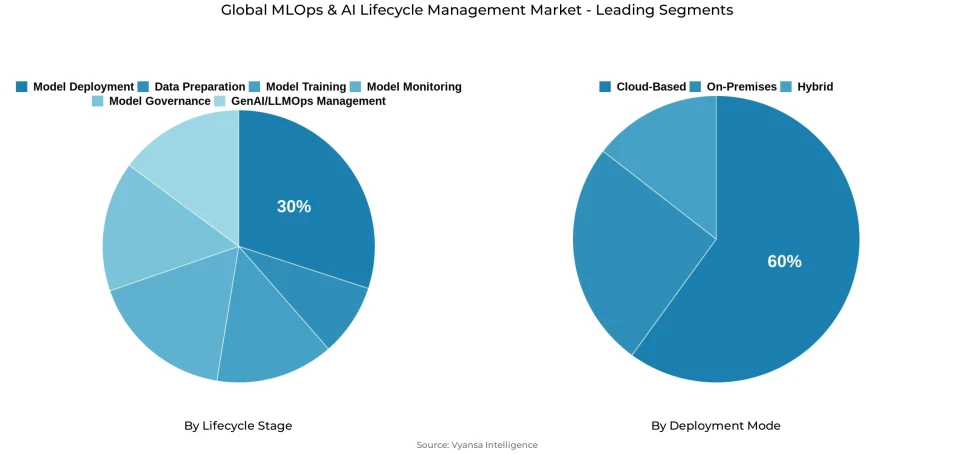
- Model deployment grabbed market share of 30%.
- Competition
- More than 20 companies are actively engaged in producing mlops & ai lifecycle management.
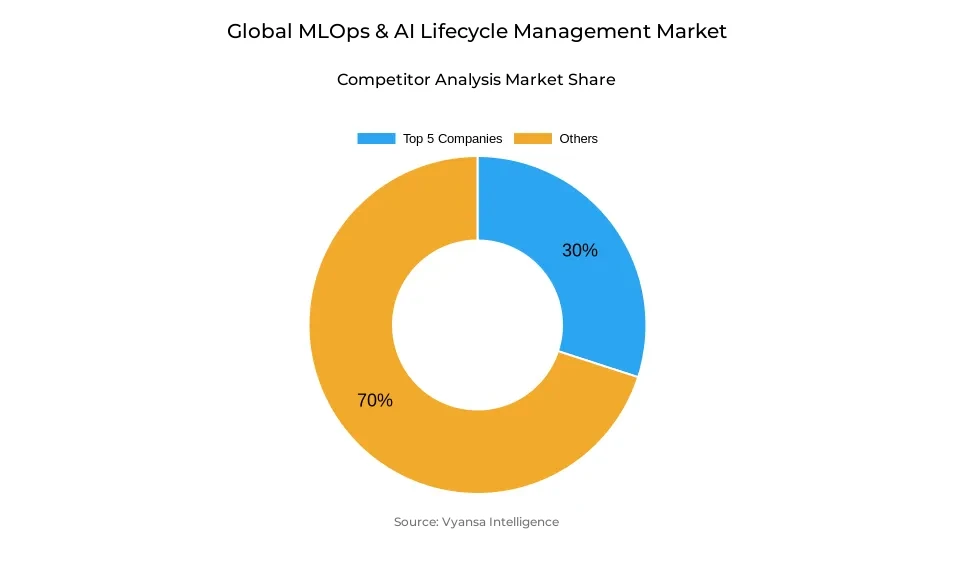
- Top 5 companies acquired around 30% of the market share.
- Dataiku, DataRobot, Snowflake, Microsoft, Amazon Web Services etc., are few of the top companies.
- Deployment Mode
- Cloud-based grabbed 60% of the market.
- Region
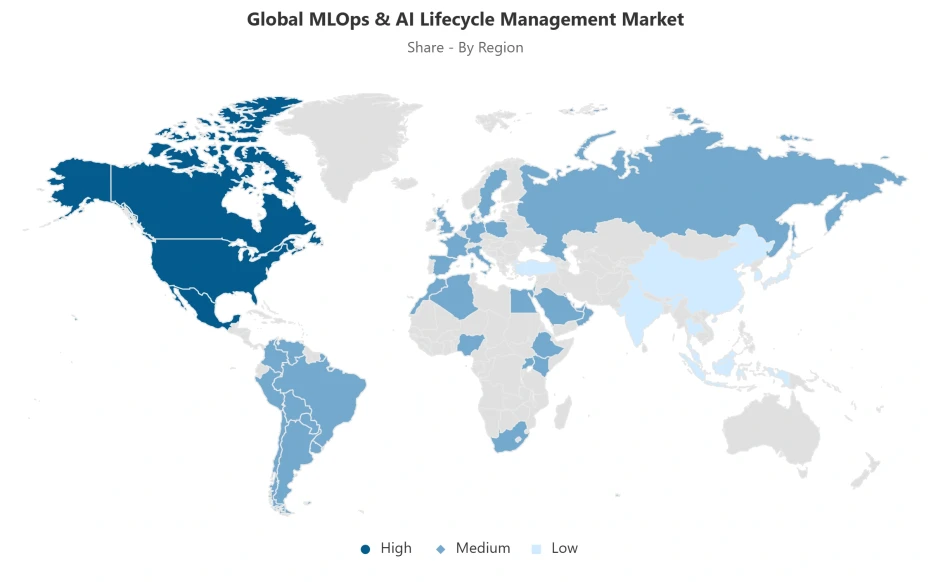
- North America leads with a 45% share of the global market.
Global MLOps & AI Lifecycle Management Market Outlook
Production-grade AI adoption is reshaping the Global MLOps & AI lifecycle management market, which was valued at USD 11.75 billion in 2025 and is projected to grow from USD 22.5 billion in 2026 to USD 80.27 billion by 2032, at a CAGR of 31.59%. Demand is shaped by MLOps platforms, AI lifecycle management market workflows, model registries, experiment tracking, feature stores, ML pipeline automation, model monitoring tools, and governed deployment systems that move AI from development into applications, APIs, cloud infrastructure, and enterprise workflows.
Stanford HAI reports that 78% of organizations used AI in 2024, up from 55% in 2023, while generative AI use in at least one business function rose from 33% to 71%. Therefore, enterprises need repeatable systems for model versioning, CI/CD for machine learning, data drift monitoring, prompt lifecycle management, LLM monitoring, and AI model governance across BFSI, healthcare, telecom, manufacturing, retail, government, software engineering, and customer service use cases.
Model Deployment leads the Lifecycle Stage category with 30% share, reflecting the priority given to moving trained models into stable production systems. Deployment workflows include automated release pipelines, endpoint management, rollback controls, containerized serving, validation workflows, runtime observability, and approval logs. Cloud-Based deployment holds 60% share, as scalable compute, managed storage, collaborative development, distributed serving, and centralized monitoring remain easier to coordinate through cloud environments.
North America leads with 45% share, supported by advanced cloud infrastructure, enterprise software maturity, AI investment, and early use of production AI systems. Hence, regional demand remains tied to enterprise MLOps, cloud-based deployment, LLMOps platforms, model monitoring, AI deployment automation, and governed lifecycle control. Through 2032, the Global MLOps & AI lifecycle management market remains linked with standardized AI operations, monitored production models, scalable cloud workflows, and accountable AI lifecycle execution across enterprise environments.
Global MLOps & AI Lifecycle Management Market Growth Driver
Production-Scale AI Strengthens Operational Demand
Production-scale AI remains the strongest driver, as enterprises move beyond proof-of-concept projects into operational AI systems. Data science and engineering teams now deploy models into fraud detection, credit scoring, predictive maintenance, medical imaging analytics, supply-chain planning, customer support automation, code generation, document intelligence, personalization engines, and GenAI copilots. Therefore, demand for machine learning operations market tools rises as each production model requires data preparation, training, deployment, monitoring, retraining, documentation, governance, and retirement workflows across one controlled lifecycle.
Stanford HAI reports that generative AI attracted USD 33.9 billion in global private investment in 2024, an 18.7% increase from 2023. This strengthens demand for GenAI lifecycle management, as LLM applications need prompt management, retrieval-augmented generation workflows, vector database integration, model routing, token-cost tracking, guardrails, response monitoring, and LLM evaluation. Hence, lifecycle platforms are becoming necessary where AI teams need deployment consistency, model drift detection, data drift monitoring, approval workflows, and runtime evidence. The driver remains tied to operational repeatability, monitored AI behavior, secure deployment, and controlled model performance across production workflows.
Global MLOps & AI Lifecycle Management Market Challenge
Governance, Risk, and Trust Slow Enterprise Rollouts
The main challenge in the Global MLOps & AI lifecycle management market is the governance burden around production AI. Models can drift, generate biased outputs, expose sensitive data, degrade in performance, produce unsafe responses, or behave differently after connecting with real users and business systems. Therefore, AI teams must coordinate with legal, cybersecurity, data governance, compliance, risk, procurement, and business owners before deployment. This slows rollout in BFSI, healthcare, insurance, public sector, telecom, and critical infrastructure, where traceability and accountability are mandatory.
NIST’s July 2024 Generative AI Profile helps organizations manage trustworthiness considerations in the design, development, use, and evaluation of AI systems. This is relevant because AI model management now requires controls across training data, model evaluation, deployment approvals, access permissions, runtime monitoring, incident response, and post-deployment governance. However, GenAI adds further complexity through hallucination, prompt injection, toxic output, data exposure, retrieval errors, copyright uncertainty, and uncontrolled agent behavior. The challenge remains tied to secure architecture, audit evidence, model cards, approval history, monitoring dashboards, and governance workflows that prove AI systems remain controlled after deployment.
Unlock Market Intelligence
Explore the market potential with our data-driven report
Global MLOps & AI Lifecycle Management Market Trend
LLMOps Expands the Lifecycle Stack
The strongest trend is the expansion of MLOps into LLMOps platforms and GenAI lifecycle management. Traditional systems focused on data pipelines, model training, experiment tracking, feature stores, model registries, deployment automation, and model monitoring. However, generative AI introduces new requirements across prompt lifecycle management, LLM monitoring, retrieval-augmented generation evaluation, vector database workflows, model routing, guardrails, token-cost tracking, output quality scoring, and foundation model governance. Therefore, the category is shifting into a broader AI lifecycle control layer.
OECD reports that AI firms accounted for 61% of global venture capital investment in 2025, equal to USD 258.7 billion out of USD 427.1 billion. This investment concentration is accelerating tooling around model infrastructure, observability, governance, deployment automation, and LLM operations. Hence, AI lifecycle platforms need to monitor factuality, relevance, groundedness, safety, prompt behavior, context retrieval accuracy, user feedback, response latency, and cost per interaction. The trend remains tied to unified lifecycle systems that manage traditional ML, deep learning, computer vision, NLP, and generative AI under one operating model.
Global MLOps & AI Lifecycle Management Market Opportunity
Responsible AI Compliance Supports Governed Deployment
Responsible AI compliance creates the clearest opportunity, as organizations need platforms that document how models are developed, validated, approved, deployed, monitored, and updated. As AI enters regulated, customer-facing, and mission-critical workflows, enterprises require lifecycle systems that combine model deployment, model governance, LLMOps, audit logs, access controls, explainability integration, risk classification, monitoring, and compliance reporting. Therefore, governed deployment becomes central in BFSI, healthcare, insurance, government, telecom, manufacturing, and critical infrastructure.
The European Commission states that the EU AI Act entered into force on 1 August 2024 and aims to support responsible AI development and deployment. This creates a direct need for AI inventories, documentation workflows, model risk classification, human oversight records, monitoring evidence, and audit-ready reporting. Hence, AI deployment automation must operate with governance controls, not only release speed. World Bank guidance also links effective AI ecosystems with connectivity, compute, context, and competency. In this setting, lifecycle platforms support enterprise readiness by connecting models with data pipelines, cloud infrastructure, business context, governance processes, and technical teams.
Global MLOps & AI Lifecycle Management Market Regional Analysis
By Region
- North America
- South America
- Europe
- Middle East & Africa
- Asia Pacific
North America leads with 45% share of the Global MLOps & AI lifecycle management market, supported by strong AI investment, mature cloud infrastructure, advanced enterprise software adoption, leading AI platform vendors, and early production deployment across regulated and data-intensive sectors. The region remains a major adoption center for enterprise MLOps solutions, model monitoring tools, model registries, experiment tracking platforms, LLMOps tools, AI governance workflows, and cloud-based lifecycle platforms.
IMF projects global growth at 3.1% in 2026 and 3.2% in 2027, creating a business environment where enterprises continue to prioritize productivity, automation, and digital efficiency. Hence, North American organizations across BFSI, healthcare, software, telecom, retail, and public sector use lifecycle platforms to standardize AI deployment, manage model risk, monitor production systems, and govern cloud-based operations. The regional outlook remains tied to cloud infrastructure depth, AI software maturity, production model scale, GenAI adoption, and governance expectations across enterprise AI environments.
Unlock Market Intelligence
Explore the market potential with our data-driven report
Global MLOps & AI Lifecycle Management Market Segmentation Analysis
By Lifecycle Stage
- Data Preparation
- Model Training
- Model Deployment
- Model Monitoring
- Model Governance
- GenAI/LLMOps Management
The segment with the highest share under Lifecycle Stage is Model Deployment, holding 30% of the Global MLOps & AI lifecycle management market. This segment leads as deployment is the point where a trained model becomes part of a working business system. A model inside a notebook, offline repository, or experiment environment has limited operational use until it moves into APIs, applications, decision engines, cloud endpoints, customer portals, or GenAI workflows.
Model deployment software supports CI/CD pipelines, model serving infrastructure, approval gates, endpoint monitoring, containerized deployment, model registry integration, access management, rollback logic, and retraining triggers. Therefore, deployment remains the lifecycle stage where engineering control, governance evidence, and runtime monitoring intersect. In GenAI workflows, deployment also includes prompt templates, retrieval pipelines, model routing, guardrails, and output monitoring. This keeps deployment demand tied to reliable release management, scalable inference, validation discipline, and production AI stability across enterprise systems.
By Deployment Mode
- Cloud-Based
- On-Premises
- Hybrid
The segment with the highest share under Deployment Mode is Cloud-Based, holding 60% of the Global MLOps & AI lifecycle management market. Cloud deployment leads as enterprises need elastic compute, managed storage, scalable inference, centralized monitoring, and shared development environments. Cloud MLOps platforms allow distributed data science, engineering, governance, and business teams to manage experiments, models, pipelines, monitoring dashboards, and deployment workflows through a common operating layer.
IEA reports that data centers accounted for around 1.5% of global electricity consumption in 2024, equal to 415 TWh. This shows the infrastructure scale behind cloud-based AI deployment. Therefore, scalable AI operations require lifecycle tools that manage compute use, model performance, inference cost, monitoring, and governance controls across expanding AI workloads. Cloud-based platforms remain tied to experiment tracking, model registry management, LLM inference, model observability, and governance workflows. However, wider cloud use also requires stronger identity controls, security policies, region management, and cost visibility.
Market Players in Global MLOps & AI Lifecycle Management Market
These market players maintain a significant presence in the Global mlops & ai lifecycle management market and contribute to its ongoing evolution.
- Dataiku
- DataRobot
- Snowflake
- Microsoft
- Amazon Web Services
- Google Cloud
- Databricks
- IBM
- SAS
- NVIDIA
- Palantir
- Domino Data Lab
- Weights & Biases
- H2O.ai
- Neptune.ai
Market News & Updates
- Microsoft, Year 1:
Microsoft made Evaluations, Monitoring, and Tracing in Microsoft Foundry generally available in March 2026. The release adds lifecycle controls for AI applications, including evaluation workflows, production monitoring, trace visibility, token tracking, latency measurement, and quality scoring. The update supports model and GenAI application management across development, deployment, and monitoring stages.
- Databricks, Year 2:
Databricks launched MLflow 3.0 in June 2025 for generative AI experimentation, observability, and governance. The release adds tracing, LLM judge-based quality measurement, expert feedback, version tracking, and production monitoring. The update expands MLflow from experiment tracking into a broader lifecycle platform for GenAI and LLMOps workflows.
Frequently Asked Questions
Related Report
- Market Segmentation
- Research Scope
- Research Methodology
- Definitions and Assumptions
- Executive Summary
- Global MLOps & AI Lifecycle Management Market Policies, Regulations, and Standards
- Global MLOps & AI Lifecycle Management Market Dynamics
- Growth Factors
- Challenges
- Trends
- Opportunities
- Global MLOps & AI Lifecycle Management Market Statistics, 2022-2032F
- Market Size & Growth Outlook
- By Revenues in USD Million
- Market Segmentation & Growth Outlook
- By Component
- Platform/Solution- Market Insights and Forecast 2022-2032, USD Million
- Services- Market Insights and Forecast 2022-2032, USD Million
- Professional Services- Market Insights and Forecast 2022-2032, USD Million
- Managed Services- Market Insights and Forecast 2022-2032, USD Million
- By Lifecycle Stage
- Data Preparation- Market Insights and Forecast 2022-2032, USD Million
- Model Training- Market Insights and Forecast 2022-2032, USD Million
- Model Deployment- Market Insights and Forecast 2022-2032, USD Million
- Model Monitoring- Market Insights and Forecast 2022-2032, USD Million
- Model Governance- Market Insights and Forecast 2022-2032, USD Million
- GenAI/LLMOps Management- Market Insights and Forecast 2022-2032, USD Million
- By Model Type
- Traditional Machine Learning Models- Market Insights and Forecast 2022-2032, USD Million
- Deep Learning Models- Market Insights and Forecast 2022-2032, USD Million
- Generative AI/LLMs- Market Insights and Forecast 2022-2032, USD Million
- Computer Vision Models- Market Insights and Forecast 2022-2032, USD Million
- Natural Language Processing Models- Market Insights and Forecast 2022-2032, USD Million
- By Deployment Mode
- Cloud-Based- Market Insights and Forecast 2022-2032, USD Million
- On-Premises- Market Insights and Forecast 2022-2032, USD Million
- Hybrid- Market Insights and Forecast 2022-2032, USD Million
- By Organization Size
- Large Enterprises- Market Insights and Forecast 2022-2032, USD Million
- Small & Medium Enterprises- Market Insights and Forecast 2022-2032, USD Million
- By End User
- BFSI- Market Insights and Forecast 2022-2032, USD Million
- IT & Telecom- Market Insights and Forecast 2022-2032, USD Million
- Healthcare- Market Insights and Forecast 2022-2032, USD Million
- Retail & E-Commerce- Market Insights and Forecast 2022-2032, USD Million
- Manufacturing- Market Insights and Forecast 2022-2032, USD Million
- Government & Public Sector- Market Insights and Forecast 2022-2032, USD Million
- Media & Entertainment- Market Insights and Forecast 2022-2032, USD Million
- Others- Market Insights and Forecast 2022-2032, USD Million
- By Region
- North America
- South America
- Europe
- Middle East & Africa
- Asia Pacific
- By Competitors
- Competition Characteristics
- Market Share & Analysis
- By Component
- Market Size & Growth Outlook
- North America MLOps & AI Lifecycle Management Market Statistics, 2022-2032F
- Market Size & Growth Outlook
- By Revenues in USD Million
- Market Segmentation & Growth Outlook
- By Component- Market Insights and Forecast 2022-2032, USD Million
- By Lifecycle Stage- Market Insights and Forecast 2022-2032, USD Million
- By Model Type- Market Insights and Forecast 2022-2032, USD Million
- By Deployment Mode- Market Insights and Forecast 2022-2032, USD Million
- By Organization Size- Market Insights and Forecast 2022-2032, USD Million
- By End User- Market Insights and Forecast 2022-2032, USD Million
- By Country
- The US
- Canada
- Mexico
- Rest of North America
- The US MLOps & AI Lifecycle Management Market Statistics, 2022-2032F
- Market Size & Growth Outlook
- By Revenues in USD Million
- Market Segmentation & Growth Outlook
- By Component- Market Insights and Forecast 2022-2032, USD Million
- By Lifecycle Stage- Market Insights and Forecast 2022-2032, USD Million
- By Model Type- Market Insights and Forecast 2022-2032, USD Million
- By Deployment Mode- Market Insights and Forecast 2022-2032, USD Million
- By Organization Size- Market Insights and Forecast 2022-2032, USD Million
- By End User- Market Insights and Forecast 2022-2032, USD Million
- Market Size & Growth Outlook
- Canada MLOps & AI Lifecycle Management Market Statistics, 2022-2032F
- Market Size & Growth Outlook
- By Revenues in USD Million
- Market Segmentation & Growth Outlook
- By Component- Market Insights and Forecast 2022-2032, USD Million
- By Lifecycle Stage- Market Insights and Forecast 2022-2032, USD Million
- By Model Type- Market Insights and Forecast 2022-2032, USD Million
- By Deployment Mode- Market Insights and Forecast 2022-2032, USD Million
- By Organization Size- Market Insights and Forecast 2022-2032, USD Million
- By End User- Market Insights and Forecast 2022-2032, USD Million
- Market Size & Growth Outlook
- Mexico MLOps & AI Lifecycle Management Market Statistics, 2022-2032F
- Market Size & Growth Outlook
- By Revenues in USD Million
- Market Segmentation & Growth Outlook
- By Component- Market Insights and Forecast 2022-2032, USD Million
- By Lifecycle Stage- Market Insights and Forecast 2022-2032, USD Million
- By Model Type- Market Insights and Forecast 2022-2032, USD Million
- By Deployment Mode- Market Insights and Forecast 2022-2032, USD Million
- By Organization Size- Market Insights and Forecast 2022-2032, USD Million
- By End User- Market Insights and Forecast 2022-2032, USD Million
- Market Size & Growth Outlook
- Market Size & Growth Outlook
- South America MLOps & AI Lifecycle Management Market Statistics, 2022-2032F
- Market Size & Growth Outlook
- By Revenues in USD Million
- Market Segmentation & Growth Outlook
- By Component- Market Insights and Forecast 2022-2032, USD Million
- By Lifecycle Stage- Market Insights and Forecast 2022-2032, USD Million
- By Model Type- Market Insights and Forecast 2022-2032, USD Million
- By Deployment Mode- Market Insights and Forecast 2022-2032, USD Million
- By Organization Size- Market Insights and Forecast 2022-2032, USD Million
- By End User- Market Insights and Forecast 2022-2032, USD Million
- By Country
- Brazil
- Argentina
- Rest of South America
- Brazil MLOps & AI Lifecycle Management Market Statistics, 2022-2032F
- Market Size & Growth Outlook
- By Revenues in USD Million
- Market Segmentation & Growth Outlook
- By Component- Market Insights and Forecast 2022-2032, USD Million
- By Lifecycle Stage- Market Insights and Forecast 2022-2032, USD Million
- By Model Type- Market Insights and Forecast 2022-2032, USD Million
- By Deployment Mode- Market Insights and Forecast 2022-2032, USD Million
- By Organization Size- Market Insights and Forecast 2022-2032, USD Million
- By End User- Market Insights and Forecast 2022-2032, USD Million
- Market Size & Growth Outlook
- Argentina MLOps & AI Lifecycle Management Market Statistics, 2022-2032F
- Market Size & Growth Outlook
- By Revenues in USD Million
- Market Segmentation & Growth Outlook
- By Component- Market Insights and Forecast 2022-2032, USD Million
- By Lifecycle Stage- Market Insights and Forecast 2022-2032, USD Million
- By Model Type- Market Insights and Forecast 2022-2032, USD Million
- By Deployment Mode- Market Insights and Forecast 2022-2032, USD Million
- By Organization Size- Market Insights and Forecast 2022-2032, USD Million
- By End User- Market Insights and Forecast 2022-2032, USD Million
- Market Size & Growth Outlook
- Market Size & Growth Outlook
- Europe MLOps & AI Lifecycle Management Market Statistics, 2022-2032F
- Market Size & Growth Outlook
- By Revenues in USD Million
- Market Segmentation & Growth Outlook
- By Component- Market Insights and Forecast 2022-2032, USD Million
- By Lifecycle Stage- Market Insights and Forecast 2022-2032, USD Million
- By Model Type- Market Insights and Forecast 2022-2032, USD Million
- By Deployment Mode- Market Insights and Forecast 2022-2032, USD Million
- By Organization Size- Market Insights and Forecast 2022-2032, USD Million
- By End User- Market Insights and Forecast 2022-2032, USD Million
- By Country
- Germany
- The UK
- France
- Italy
- Spain
- Rest of Europe
- Germany MLOps & AI Lifecycle Management Market Statistics, 2022-2032F
- Market Size & Growth Outlook
- By Revenues in USD Million
- Market Segmentation & Growth Outlook
- By Component- Market Insights and Forecast 2022-2032, USD Million
- By Lifecycle Stage- Market Insights and Forecast 2022-2032, USD Million
- By Model Type- Market Insights and Forecast 2022-2032, USD Million
- By Deployment Mode- Market Insights and Forecast 2022-2032, USD Million
- By Organization Size- Market Insights and Forecast 2022-2032, USD Million
- By End User- Market Insights and Forecast 2022-2032, USD Million
- Market Size & Growth Outlook
- The UK MLOps & AI Lifecycle Management Market Statistics, 2022-2032F
- Market Size & Growth Outlook
- By Revenues in USD Million
- Market Segmentation & Growth Outlook
- By Component- Market Insights and Forecast 2022-2032, USD Million
- By Lifecycle Stage- Market Insights and Forecast 2022-2032, USD Million
- By Model Type- Market Insights and Forecast 2022-2032, USD Million
- By Deployment Mode- Market Insights and Forecast 2022-2032, USD Million
- By Organization Size- Market Insights and Forecast 2022-2032, USD Million
- By End User- Market Insights and Forecast 2022-2032, USD Million
- Market Size & Growth Outlook
- France MLOps & AI Lifecycle Management Market Statistics, 2022-2032F
- Market Size & Growth Outlook
- By Revenues in USD Million
- Market Segmentation & Growth Outlook
- By Component- Market Insights and Forecast 2022-2032, USD Million
- By Lifecycle Stage- Market Insights and Forecast 2022-2032, USD Million
- By Model Type- Market Insights and Forecast 2022-2032, USD Million
- By Deployment Mode- Market Insights and Forecast 2022-2032, USD Million
- By Organization Size- Market Insights and Forecast 2022-2032, USD Million
- By End User- Market Insights and Forecast 2022-2032, USD Million
- Market Size & Growth Outlook
- Italy MLOps & AI Lifecycle Management Market Statistics, 2022-2032F
- Market Size & Growth Outlook
- By Revenues in USD Million
- Market Segmentation & Growth Outlook
- By Component- Market Insights and Forecast 2022-2032, USD Million
- By Lifecycle Stage- Market Insights and Forecast 2022-2032, USD Million
- By Model Type- Market Insights and Forecast 2022-2032, USD Million
- By Deployment Mode- Market Insights and Forecast 2022-2032, USD Million
- By Organization Size- Market Insights and Forecast 2022-2032, USD Million
- By End User- Market Insights and Forecast 2022-2032, USD Million
- Market Size & Growth Outlook
- Spain MLOps & AI Lifecycle Management Market Statistics, 2022-2032F
- Market Size & Growth Outlook
- By Revenues in USD Million
- Market Segmentation & Growth Outlook
- By Component- Market Insights and Forecast 2022-2032, USD Million
- By Lifecycle Stage- Market Insights and Forecast 2022-2032, USD Million
- By Model Type- Market Insights and Forecast 2022-2032, USD Million
- By Deployment Mode- Market Insights and Forecast 2022-2032, USD Million
- By Organization Size- Market Insights and Forecast 2022-2032, USD Million
- By End User- Market Insights and Forecast 2022-2032, USD Million
- Market Size & Growth Outlook
- Market Size & Growth Outlook
- Middle East & Africa MLOps & AI Lifecycle Management Market Statistics, 2022-2032F
- Market Size & Growth Outlook
- By Revenues in USD Million
- Market Segmentation & Growth Outlook
- By Component- Market Insights and Forecast 2022-2032, USD Million
- By Lifecycle Stage- Market Insights and Forecast 2022-2032, USD Million
- By Model Type- Market Insights and Forecast 2022-2032, USD Million
- By Deployment Mode- Market Insights and Forecast 2022-2032, USD Million
- By Organization Size- Market Insights and Forecast 2022-2032, USD Million
- By End User- Market Insights and Forecast 2022-2032, USD Million
- By Country
- The UAE
- Saudi Arabia
- South Africa
- Egypt
- Rest of Middle East and Africa
- The UAE MLOps & AI Lifecycle Management Market Statistics, 2022-2032F
- Market Size & Growth Outlook
- By Revenues in USD Million
- Market Segmentation & Growth Outlook
- By Component- Market Insights and Forecast 2022-2032, USD Million
- By Lifecycle Stage- Market Insights and Forecast 2022-2032, USD Million
- By Model Type- Market Insights and Forecast 2022-2032, USD Million
- By Deployment Mode- Market Insights and Forecast 2022-2032, USD Million
- By Organization Size- Market Insights and Forecast 2022-2032, USD Million
- By End User- Market Insights and Forecast 2022-2032, USD Million
- Market Size & Growth Outlook
- Saudi Arabia MLOps & AI Lifecycle Management Market Statistics, 2022-2032F
- Market Size & Growth Outlook
- By Revenues in USD Million
- Market Segmentation & Growth Outlook
- By Component- Market Insights and Forecast 2022-2032, USD Million
- By Lifecycle Stage- Market Insights and Forecast 2022-2032, USD Million
- By Model Type- Market Insights and Forecast 2022-2032, USD Million
- By Deployment Mode- Market Insights and Forecast 2022-2032, USD Million
- By Organization Size- Market Insights and Forecast 2022-2032, USD Million
- By End User- Market Insights and Forecast 2022-2032, USD Million
- Market Size & Growth Outlook
- South Africa MLOps & AI Lifecycle Management Market Statistics, 2022-2032F
- Market Size & Growth Outlook
- By Revenues in USD Million
- Market Segmentation & Growth Outlook
- By Component- Market Insights and Forecast 2022-2032, USD Million
- By Lifecycle Stage- Market Insights and Forecast 2022-2032, USD Million
- By Model Type- Market Insights and Forecast 2022-2032, USD Million
- By Deployment Mode- Market Insights and Forecast 2022-2032, USD Million
- By Organization Size- Market Insights and Forecast 2022-2032, USD Million
- By End User- Market Insights and Forecast 2022-2032, USD Million
- Market Size & Growth Outlook
- Egypt MLOps & AI Lifecycle Management Market Statistics, 2022-2032F
- Market Size & Growth Outlook
- By Revenues in USD Million
- Market Segmentation & Growth Outlook
- By Component- Market Insights and Forecast 2022-2032, USD Million
- By Lifecycle Stage- Market Insights and Forecast 2022-2032, USD Million
- By Model Type- Market Insights and Forecast 2022-2032, USD Million
- By Deployment Mode- Market Insights and Forecast 2022-2032, USD Million
- By Organization Size- Market Insights and Forecast 2022-2032, USD Million
- By End User- Market Insights and Forecast 2022-2032, USD Million
- Market Size & Growth Outlook
- Market Size & Growth Outlook
- Asia Pacific MLOps & AI Lifecycle Management Market Statistics, 2022-2032F
- Market Size & Growth Outlook
- By Revenues in USD Million
- Market Segmentation & Growth Outlook
- By Component- Market Insights and Forecast 2022-2032, USD Million
- By Lifecycle Stage- Market Insights and Forecast 2022-2032, USD Million
- By Model Type- Market Insights and Forecast 2022-2032, USD Million
- By Deployment Mode- Market Insights and Forecast 2022-2032, USD Million
- By Organization Size- Market Insights and Forecast 2022-2032, USD Million
- By End User- Market Insights and Forecast 2022-2032, USD Million
- By Country
- China
- India
- Japan
- South Korea
- Australia
- Indonesia
- Rest of Asia Pacific
- China MLOps & AI Lifecycle Management Market Statistics, 2022-2032F
- Market Size & Growth Outlook
- By Revenues in USD Million
- Market Segmentation & Growth Outlook
- By Component- Market Insights and Forecast 2022-2032, USD Million
- By Lifecycle Stage- Market Insights and Forecast 2022-2032, USD Million
- By Model Type- Market Insights and Forecast 2022-2032, USD Million
- By Deployment Mode- Market Insights and Forecast 2022-2032, USD Million
- By Organization Size- Market Insights and Forecast 2022-2032, USD Million
- By End User- Market Insights and Forecast 2022-2032, USD Million
- Market Size & Growth Outlook
- India MLOps & AI Lifecycle Management Market Statistics, 2022-2032F
- Market Size & Growth Outlook
- By Revenues in USD Million
- Market Segmentation & Growth Outlook
- By Component- Market Insights and Forecast 2022-2032, USD Million
- By Lifecycle Stage- Market Insights and Forecast 2022-2032, USD Million
- By Model Type- Market Insights and Forecast 2022-2032, USD Million
- By Deployment Mode- Market Insights and Forecast 2022-2032, USD Million
- By Organization Size- Market Insights and Forecast 2022-2032, USD Million
- By End User- Market Insights and Forecast 2022-2032, USD Million
- Market Size & Growth Outlook
- Japan MLOps & AI Lifecycle Management Market Statistics, 2022-2032F
- Market Size & Growth Outlook
- By Revenues in USD Million
- Market Segmentation & Growth Outlook
- By Component- Market Insights and Forecast 2022-2032, USD Million
- By Lifecycle Stage- Market Insights and Forecast 2022-2032, USD Million
- By Model Type- Market Insights and Forecast 2022-2032, USD Million
- By Deployment Mode- Market Insights and Forecast 2022-2032, USD Million
- By Organization Size- Market Insights and Forecast 2022-2032, USD Million
- By End User- Market Insights and Forecast 2022-2032, USD Million
- Market Size & Growth Outlook
- South Korea MLOps & AI Lifecycle Management Market Statistics, 2022-2032F
- Market Size & Growth Outlook
- By Revenues in USD Million
- Market Segmentation & Growth Outlook
- By Component- Market Insights and Forecast 2022-2032, USD Million
- By Lifecycle Stage- Market Insights and Forecast 2022-2032, USD Million
- By Model Type- Market Insights and Forecast 2022-2032, USD Million
- By Deployment Mode- Market Insights and Forecast 2022-2032, USD Million
- By Organization Size- Market Insights and Forecast 2022-2032, USD Million
- By End User- Market Insights and Forecast 2022-2032, USD Million
- Market Size & Growth Outlook
- Australia MLOps & AI Lifecycle Management Market Statistics, 2022-2032F
- Market Size & Growth Outlook
- By Revenues in USD Million
- Market Segmentation & Growth Outlook
- By Component- Market Insights and Forecast 2022-2032, USD Million
- By Lifecycle Stage- Market Insights and Forecast 2022-2032, USD Million
- By Model Type- Market Insights and Forecast 2022-2032, USD Million
- By Deployment Mode- Market Insights and Forecast 2022-2032, USD Million
- By Organization Size- Market Insights and Forecast 2022-2032, USD Million
- By End User- Market Insights and Forecast 2022-2032, USD Million
- Market Size & Growth Outlook
- Indonesia MLOps & AI Lifecycle Management Market Statistics, 2022-2032F
- Market Size & Growth Outlook
- By Revenues in USD Million
- Market Segmentation & Growth Outlook
- By Component- Market Insights and Forecast 2022-2032, USD Million
- By Lifecycle Stage- Market Insights and Forecast 2022-2032, USD Million
- By Model Type- Market Insights and Forecast 2022-2032, USD Million
- By Deployment Mode- Market Insights and Forecast 2022-2032, USD Million
- By Organization Size- Market Insights and Forecast 2022-2032, USD Million
- By End User- Market Insights and Forecast 2022-2032, USD Million
- Market Size & Growth Outlook
- Market Size & Growth Outlook
- Competitive Outlook
- Company Profiles
- Microsoft
- Business Description
- Product Portfolio
- Collaborations & Alliances
- Recent Developments
- Financial Details
- Others
- Amazon Web Services
- Business Description
- Product Portfolio
- Collaborations & Alliances
- Recent Developments
- Financial Details
- Others
- Google Cloud
- Business Description
- Product Portfolio
- Collaborations & Alliances
- Recent Developments
- Financial Details
- Others
- Databricks
- Business Description
- Product Portfolio
- Collaborations & Alliances
- Recent Developments
- Financial Details
- Others
- IBM
- Business Description
- Product Portfolio
- Collaborations & Alliances
- Recent Developments
- Financial Details
- Others
- Dataiku
- Business Description
- Product Portfolio
- Collaborations & Alliances
- Recent Developments
- Financial Details
- Others
- DataRobot
- Business Description
- Product Portfolio
- Collaborations & Alliances
- Recent Developments
- Financial Details
- Others
- Snowflake
- Business Description
- Product Portfolio
- Collaborations & Alliances
- Recent Developments
- Financial Details
- Others
- SAS
- Business Description
- Product Portfolio
- Collaborations & Alliances
- Recent Developments
- Financial Details
- Others
- NVIDIA
- Business Description
- Product Portfolio
- Collaborations & Alliances
- Recent Developments
- Financial Details
- Others
- Palantir
- Business Description
- Product Portfolio
- Collaborations & Alliances
- Recent Developments
- Financial Details
- Others
- Domino Data Lab
- Business Description
- Product Portfolio
- Collaborations & Alliances
- Recent Developments
- Financial Details
- Others
- Weights & Biases
- Business Description
- Product Portfolio
- Collaborations & Alliances
- Recent Developments
- Financial Details
- Others
- H2O.ai
- Business Description
- Product Portfolio
- Collaborations & Alliances
- Recent Developments
- Financial Details
- Others
- Neptune.ai
- Business Description
- Product Portfolio
- Collaborations & Alliances
- Recent Developments
- Financial Details
- Others
- Microsoft
- Company Profiles
- Disclaimer
| Segment | Sub-Segment |
|---|---|
| By Component |
|
| By Lifecycle Stage |
|
| By Model Type |
|
| By Deployment Mode |
|
| By Organization Size |
|
| By End User |
|
| By Region |
|
Research Methodology
This study followed a structured approach comprising four key phases to assess the size and scope of the electro-oxidation market. The process began with thorough secondary research to collect data on the target market, related markets, and broader industry context. These findings, along with preliminary assumptions and estimates, were then validated through extensive primary research involving industry experts from across the value chain. To calculate the overall market size, both top-down and bottom-up methodologies were employed. Finally, market segmentation and data triangulation techniques were applied to refine and validate segment-level estimations.
Secondary Research
The secondary research phase involved gathering data from a wide range of credible and published sources. This step helped in identifying industry trends, defining market segmentation, and understanding the market landscape and value chain.
Sources consulted during this phase included:
- Company annual reports, investor presentations, and press releases
- Industry white papers and certified publications
- Trade directories and market-recognized databases
- Articles from authoritative authors and reputable journals
- Gold and silver standard websites
Secondary research was critical in mapping out the industry's value chain and monetary flow, identifying key market segments, understanding regional variations, and tracking significant industry developments.
Other key sources:
- Financial disclosures
- Industry associations and trade bodies
- News outlets and business magazines
- Academic journals and research studies
- Paid industry databases
Primary Research
To validate secondary data and gain deeper market insights, primary research was conducted with key stakeholders across both the supply and demand sides of the market.
On the demand side, participants included decision-makers and influencers from end-user industries—such as CIOs, CTOs, and CSOs—who provided first-hand perspectives on market needs, product usage, and future expectations.
On the supply side, interviews were conducted with manufacturers, industry associations, and institutional participants to gather insights into current offerings, product pipelines, and market challenges.
Primary interviews provided critical inputs such as:
- Market size and revenue data
- Product and service breakdowns
- Market forecasts
- Regional and application-specific trends
Stakeholders consulted included:
- Leading OEM and solution providers
- Channel and distribution partners
- End users across various applications
- Independent consultants and industry specialists
Market Size Estimation and Data Triangulation
- Identifying Key Market Participants (Secondary Research)
- Goal: To identify the major players or companies in the target market. This typically involves using publicly available data sources such as industry reports, market research publications, and financial statements of companies.
- Tools: Reports from firms like Gartner, Forrester, Euromonitor, Statista, IBISWorld, and others. Public financial statements, news articles, and press releases from top market players.
- Extracting Earnings of Key Market Participants
- Goal: To estimate the earnings generated from the product or service being analyzed. This step helps in understanding the revenue potential of each market player in a specific geography.
- Methods: Earnings data can be gathered from:
- Publicly available financial reports (for listed companies).
- Interviews and primary data sources from professionals, such as Directors, VPs, SVPs, etc. This is especially useful for understanding more nuanced, internal data that isn't publicly disclosed.
- Annual reports and investor presentations of key players.
- Data Collation and Development of a Relevant Data Model
- Goal: To collate inputs from both primary and secondary sources into a structured, data-driven model for market estimation. This model will incorporate key market KPIs and any independent variables relevant to the market.
- Key KPIs: These could include:
- Market size, growth rate, and demand drivers.
- Industry-specific metrics like market share, average revenue per customer (ARPC), or average deal size.
- External variables, such as economic growth rates, inflation rates, or commodity prices, that could affect the market.
- Data Modeling: Based on this data, the market forecasts are developed for the next 5 years. A combination of trend analysis, scenario modeling, and statistical regression might be used to generate projections.
- Scenario Analysis
- Goal: To test different assumptions and validate how sensitive the market is to changes in key variables (e.g., market demand, regulatory changes, technological disruptions).
- Types of Scenarios:
- Base Case: Based on current assumptions and historical data.
- Best-Case Scenario: Assuming favorable market conditions, regulatory environments, and technological advancements.
- Worst-Case Scenario: Accounting for adverse factors, such as economic downturns, stricter regulations, or unexpected disruptions.












