Malaysia Skin Care Market Report: Trends, Growth and Forecast (2025-2030)
By Product (Body Care, Facial Care, Hand Care, Skin Care Sets/Kits), By Category (Premium, Mass), By Gender (Men, Women, Unisex), By End User (Adults, Teenagers, Children), By Packaging (Tubes, Bottles, Jars, Others), By Sales Channel (Online, Offline) ... Read more

|
Major Players
|
Malaysia Skin Care Market Statistics, 2025
- Market Size Statistics
- Skin Care in Malaysia is estimated at $ 1.37 Billion.
- The market size is expected to grow to $ 2.41 Billion by 2030.
- Market to register a CAGR of around 9.87% during 2025-30.
- Product Shares
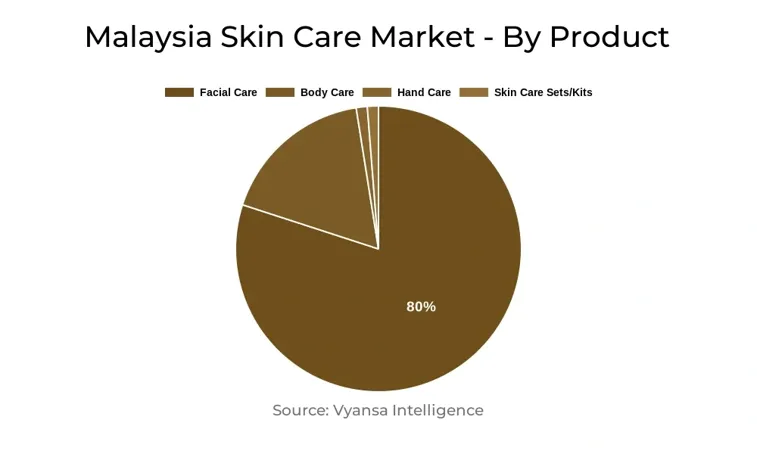
- Facial Care grabbed market share of 80%.
- Competition
- More than 20 companies are actively engaged in producing Skin Care in Malaysia.
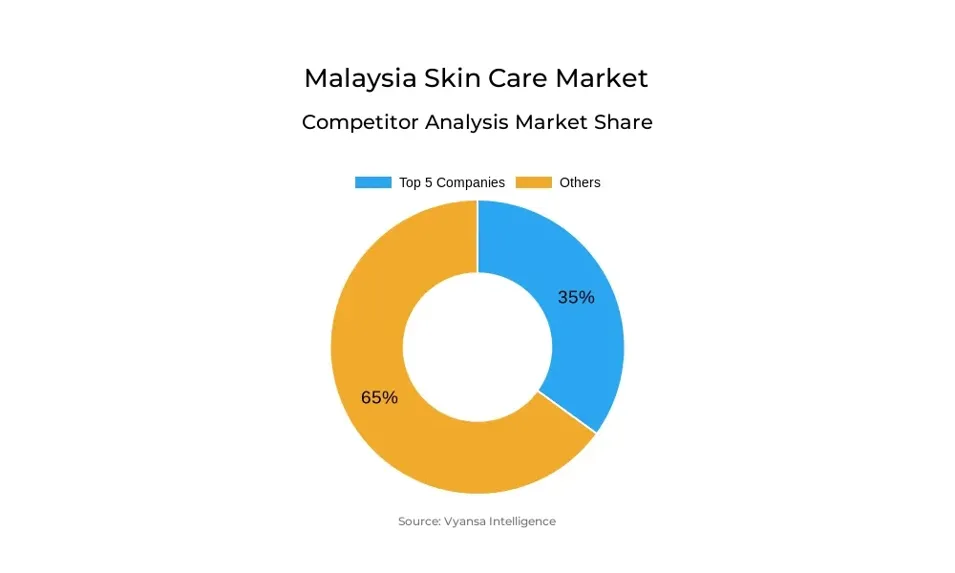
- Top 5 companies acquired 35% of the market share.
- Wipro Unza (M) Sdn Bhd, Beiersdorf Malaysia Sdn Bhd, Amway (M) Sdn Bhd, Procter & Gamble (M) Sdn Bhd, L'Oréal (M) Sdn Bhd etc., are few of the top companies.
- Sales Channel
- Retail Offline grabbed 85% of the market.
Malaysia Skin Care Market Outlook
Malaysia skin care market will continue its high growth pace during 2025-2030 with increased consumer involvement in active beauty habits. Both mass and premium brands will continue to fuel demand, especially in facial care driven by anti-ageing products. Anti-agers are being increasingly included in the routines of young consumers early on, indicating a sharp desire for preventive care. Brands are likely to address this increasing demand through science-based and innovative formulations.
Body care is also poised to see substantial growth, as Malaysians broaden their interest beyond facial care. Skincare players such as serum-enriched body lotions with built-in sun protection and vitamin benefits are now popular. This category has huge development opportunity, with additional brands likely to introduce specially targeted body solutions. Local and global players are likely to counter by extending body care portfolios and investing in product research and development.
Retail channels are expected to transform with a greater emphasis on concept stores, customized consultations, and omnichannel strategies. Department stores will remain attractive to premium customers, while health and personal care chains like Watsons and Guardian are expected to introduce new brands and develop services such as in-store skin analysis, e.g., analyzing the skin of customers to provide them with suitable products to use at home. E-commerce will continue to solidify its base, particularly with platforms selling popular South Korean and Japanese beauty products.
The forecast also identifies important trends that are influencing the market, such as increasing demand for dermatologically proven skin care through scientifically attested ingredients, and an increased interest in sustainability. Plant-based ingredients and sustainable packaging by brands will appeal more to environmentally aware consumers, reinforcing the move towards more environmentally friendly processes in the Malaysian skin care market.
Malaysia Skin Care Market Growth Driver
The market for dermocosmetic and dermatological ingredients to care for the skin is anticipated to grow substantially, fueled by the rising popularity of ingredient-specific products. More brands are entering this market due to more consumer trust in scientifically supported solutions. Ingredients such as retinol, niacinamide, thiamidol, ceramide, hyaluronic acid, peptides, and melasyl are receiving broad recognition due to their performance, with consumers increasingly aware through available information and clear labelling.
This change is also seen in product launches and innovations, as per a recent survey. For example, L'Oréal introduced La Roche-Posay's Mela B3 Serum, which has been marketed as a dark spots intense concentrate. Deciem's The Ordinary brand in Malaysia also focuses on individual actives such as niacinamide 10% + zinc 1% and retinol 0.2% in squalene, addressing an increasing group of users looking for targeted, performance-driven skin care.
Malaysia Skin Care Market Trend
The increasing popularity of K-beauty is influencing the skin care and colour cosmetics segment in Malaysia. K-pop culture is highly driving this trend, with young consumers particularly eager to emulate the beauty regime of their idol South Korean pop stars and celebrities. With more South Korean brands entering the Malaysian market, the influence of K-beauty will be even more pronounced in the future.
Likewise, J-beauty is making inroads, driving up the retail value of Japanese skin care brands in the market. The increase in stores specializing in imported brands validates this growth. For example, Ainz & Tulpe has opened a new store at Pavilion Bukit Jalil during the review period, providing high-end Japanese beauty products including Ayura with a big emphasis on skin care.
Unlock Market Intelligence
Explore the market potential with our data-driven report
Malaysia Skin Care Market Opportunity
Increased consciousness regarding environmental causes is compelling skin care companies to make production and packaging more sustainable. In Malaysia, this trend is increasingly becoming apparent with companies such as R+B formulating skin care products based on plant-derived ingredients, including upcycled food waste like coffee grounds. Utilization of naturally occurring ingredients like lemongrass, orange, and grapefruit oil is also adding to this trend, as consumers increasingly demand clean-label and environmentally responsible products.
Further, refill pack availability is changing the way shoppers interact with skin care. Companies like Kiehl's and L'Occitane now provide options to refill items like Kiehl's Ultra Facial Cream and L'Occitane Immortelle Reset Serum. These moves reduce plastic consumption and save consumers money by avoiding new packaging—abetting the marketplace's move toward more sustainable consumption habits.
| Report Coverage | Details |
|---|---|
| Market Forecast | 2025-30 |
| USD Value 2024 | $ 1.37 Billion |
| USD Value 2030 | $ 2.41 Billion |
| CAGR 2025-2030 | 9.87% |
| Largest Category | Facial Care segment leads with 80% market share |
| Top Drivers | Surging Demand for Science-Backed Formulations Driving Market Growth |
| Top Trends | Surging Influence of K-Beauty and J-Beauty Cultures |
| Top Opportunities | Rising Emphasis on Sustainable Packaging and Ingredient Innovation |
| Key Players | Wipro Unza (M) Sdn Bhd, Beiersdorf Malaysia Sdn Bhd, Amway (M) Sdn Bhd, Procter & Gamble (M) Sdn Bhd, L'Oréal (M) Sdn Bhd, Nu Skin (M) Sdn Bhd, Estée Lauder Malaysia Sdn Bhd, Shiseido Malaysia Sdn Bhd, Ginvera Marketing Enterprise Sdn Bhd, Mary Kay (M) Sdn Bhd and Others. |
Unlock Market Intelligence
Explore the market potential with our data-driven report
Malaysia Skin Care Market Segmentation Analysis
The most lucrative segment within the sales channel in terms of market share is retail offline, which led the Malaysia Skin Care Market in 2024. Department stores had the biggest single share, with a vast array of premium and super premium skin care brands such as Clé de Peau Beauté, Albion, Pola, La Mer, and Dr Barbara Sturm. These retails, including the recently opened Seibu at The Exchange TRX, appealed to consumers with high-end beauty counters and upgraded shopping experiences. In addition, health and personal care outlets like Watsons and Guardian also picked up share by launching exclusive brands like Glad2Glow and Make Prem.
Further, e-commerce further increased its retail value share as most skin care brand owners made investments on the internet for creating better online-offline synergy. Online portals like Stylevana.com, which are popular for providing South Korean brands like Some by Mi, Anua, and Cos De BAHA, facilitated the developing omnichannel strategy in the marketplace.
Top Companies in Malaysia Skin Care Market
The top companies operating in the market include Wipro Unza (M) Sdn Bhd, Beiersdorf Malaysia Sdn Bhd, Amway (M) Sdn Bhd, Procter & Gamble (M) Sdn Bhd, L'Oréal (M) Sdn Bhd, Nu Skin (M) Sdn Bhd, Estée Lauder Malaysia Sdn Bhd, Shiseido Malaysia Sdn Bhd, Ginvera Marketing Enterprise Sdn Bhd, Mary Kay (M) Sdn Bhd, etc., are the top players operating in the Malaysia Skin Care Market.
Frequently Asked Questions
Related Report
1. Market Segmentation
1.1. Research Scope
1.2. Research Methodology
1.3. Definitions and Assumptions
2. Executive Summary
3. Malaysia Skin Care Market Policies, Regulations, and Standards
4. Malaysia Skin Care Market Dynamics
4.1. Growth Factors
4.2. Challenges
4.3. Trends
4.4. Opportunities
5. Malaysia Skin Care Market Statistics, 2020-2030F
5.1. Market Size & Growth Outlook
5.1.1.By Revenues in US$ Million
5.2. Market Segmentation & Growth Outlook
5.2.1.By Product
5.2.1.1. Body Care- Market Insights and Forecast 2020-2030, USD Million
5.2.1.1.1. Firming Body Care- Market Insights and Forecast 2020-2030, USD Million
5.2.1.1.2. General Purpose Body Care- Market Insights and Forecast 2020-2030, USD Million
5.2.1.2. Facial Care- Market Insights and Forecast 2020-2030, USD Million
5.2.1.2.1. Acne Treatments- Market Insights and Forecast 2020-2030, USD Million
5.2.1.2.2. Face Masks- Market Insights and Forecast 2020-2030, USD Million
5.2.1.2.3. Facial Cleansers- Market Insights and Forecast 2020-2030, USD Million
5.2.1.2.3.1. Liquid- Market Insights and Forecast 2020-2030, USD Million
5.2.1.2.3.2. Cream- Market Insights and Forecast 2020-2030, USD Million
5.2.1.2.3.3. Gel- Market Insights and Forecast 2020-2030, USD Million
5.2.1.2.3.4. Bar Cleansers- Market Insights and Forecast 2020-2030, USD Million
5.2.1.2.3.5. Facial Cleansing Wipes- Market Insights and Forecast 2020-2030, USD Million
5.2.1.2.4. Moisturisers and Treatments- Market Insights and Forecast 2020-2030, USD Million
5.2.1.2.4.1. Basic Moisturisers- Market Insights and Forecast 2020-2030, USD Million
5.2.1.2.4.2. Anti-Agers- Market Insights and Forecast 2020-2030, USD Million
5.2.1.2.5. Lip Care- Market Insights and Forecast 2020-2030, USD Million
5.2.1.2.6. Toners- Market Insights and Forecast 2020-2030, USD Million
5.2.1.3. Hand Care- Market Insights and Forecast 2020-2030, USD Million
5.2.1.4. Skin Care Sets/Kits- Market Insights and Forecast 2020-2030, USD Million
5.2.2.By Category
5.2.2.1. Premium- Market Insights and Forecast 2020-2030, USD Million
5.2.2.2. Mass- Market Insights and Forecast 2020-2030, USD Million
5.2.3.By Gender
5.2.3.1. Men- Market Insights and Forecast 2020-2030, USD Million
5.2.3.2. Women- Market Insights and Forecast 2020-2030, USD Million
5.2.3.3. Unisex- Market Insights and Forecast 2020-2030, USD Million
5.2.4.By End User
5.2.4.1. Adults- Market Insights and Forecast 2020-2030, USD Million
5.2.4.2. Teenagers- Market Insights and Forecast 2020-2030, USD Million
5.2.4.3. Children- Market Insights and Forecast 2020-2030, USD Million
5.2.5.By Packaging
5.2.5.1. Tubes- Market Insights and Forecast 2020-2030, USD Million
5.2.5.2. Bottles- Market Insights and Forecast 2020-2030, USD Million
5.2.5.3. Jars- Market Insights and Forecast 2020-2030, USD Million
5.2.5.4. Others- Market Insights and Forecast 2020-2030, USD Million
5.2.6.By Sales Channel
5.2.6.1. Online- Market Insights and Forecast 2020-2030, USD Million
5.2.6.2. Offline- Market Insights and Forecast 2020-2030, USD Million
5.2.7.By Competitors
5.2.7.1. Competition Characteristics
5.2.7.2. Market Share & Analysis
6. Malaysia Body Care Market Statistics, 2020-2030F
6.1. Market Size & Growth Outlook
6.1.1.By Revenues in US$ Million
6.2. Market Segmentation & Growth Outlook
6.2.1.By Product- Market Insights and Forecast 2020-2030, USD Million
6.2.2.By Category- Market Insights and Forecast 2020-2030, USD Million
6.2.3.By Gender- Market Insights and Forecast 2020-2030, USD Million
6.2.4.By End User- Market Insights and Forecast 2020-2030, USD Million
6.2.5.By Packaging- Market Insights and Forecast 2020-2030, USD Million
6.2.6.By Sales Channel- Market Insights and Forecast 2020-2030, USD Million
7. Malaysia Facial Care Market Statistics, 2020-2030F
7.1. Market Size & Growth Outlook
7.1.1.By Revenues in US$ Million
7.2. Market Segmentation & Growth Outlook
7.2.1.By Product- Market Insights and Forecast 2020-2030, USD Million
7.2.2.By Category- Market Insights and Forecast 2020-2030, USD Million
7.2.3.By Gender- Market Insights and Forecast 2020-2030, USD Million
7.2.4.By End User- Market Insights and Forecast 2020-2030, USD Million
7.2.5.By Packaging- Market Insights and Forecast 2020-2030, USD Million
7.2.6.By Sales Channel- Market Insights and Forecast 2020-2030, USD Million
8. Malaysia Hand Care Market Statistics, 2020-2030F
8.1. Market Size & Growth Outlook
8.1.1.By Revenues in US$ Million
8.2. Market Segmentation & Growth Outlook
8.2.1.By Category- Market Insights and Forecast 2020-2030, USD Million
8.2.2.By Gender- Market Insights and Forecast 2020-2030, USD Million
8.2.3.By End User- Market Insights and Forecast 2020-2030, USD Million
8.2.4.By Packaging- Market Insights and Forecast 2020-2030, USD Million
8.2.5.By Sales Channel- Market Insights and Forecast 2020-2030, USD Million
9. Malaysia Skin Care Sets/Kits Market Statistics, 2020-2030F
9.1. Market Size & Growth Outlook
9.1.1.By Revenues in US$ Million
9.2. Market Segmentation & Growth Outlook
9.2.1.By Category- Market Insights and Forecast 2020-2030, USD Million
9.2.2.By Gender- Market Insights and Forecast 2020-2030, USD Million
9.2.3.By End User- Market Insights and Forecast 2020-2030, USD Million
9.2.4.By Packaging- Market Insights and Forecast 2020-2030, USD Million
9.2.5.By Sales Channel- Market Insights and Forecast 2020-2030, USD Million
10. Competitive Outlook
10.1. Company Profiles
10.1.1. Procter & Gamble (M) Sdn Bhd
10.1.1.1. Business Description
10.1.1.2. Product Portfolio
10.1.1.3. Collaborations & Alliances
10.1.1.4. Recent Developments
10.1.1.5. Financial Details
10.1.1.6. Others
10.1.2. L'Oréal (M) Sdn Bhd
10.1.2.1. Business Description
10.1.2.2. Product Portfolio
10.1.2.3. Collaborations & Alliances
10.1.2.4. Recent Developments
10.1.2.5. Financial Details
10.1.2.6. Others
10.1.3. Nu Skin (M) Sdn Bhd
10.1.3.1. Business Description
10.1.3.2. Product Portfolio
10.1.3.3. Collaborations & Alliances
10.1.3.4. Recent Developments
10.1.3.5. Financial Details
10.1.3.6. Others
10.1.4. Estée Lauder Malaysia Sdn Bhd
10.1.4.1. Business Description
10.1.4.2. Product Portfolio
10.1.4.3. Collaborations & Alliances
10.1.4.4. Recent Developments
10.1.4.5. Financial Details
10.1.4.6. Others
10.1.5. Shiseido Malaysia Sdn Bhd
10.1.5.1. Business Description
10.1.5.2. Product Portfolio
10.1.5.3. Collaborations & Alliances
10.1.5.4. Recent Developments
10.1.5.5. Financial Details
10.1.5.6. Others
10.1.6. Wipro Unza (M) Sdn Bhd
10.1.6.1. Business Description
10.1.6.2. Product Portfolio
10.1.6.3. Collaborations & Alliances
10.1.6.4. Recent Developments
10.1.6.5. Financial Details
10.1.6.6. Others
10.1.7. Beiersdorf Malaysia Sdn Bhd
10.1.7.1. Business Description
10.1.7.2. Product Portfolio
10.1.7.3. Collaborations & Alliances
10.1.7.4. Recent Developments
10.1.7.5. Financial Details
10.1.7.6. Others
10.1.8. Amway (M) Sdn Bhd
10.1.8.1. Business Description
10.1.8.2. Product Portfolio
10.1.8.3. Collaborations & Alliances
10.1.8.4. Recent Developments
10.1.8.5. Financial Details
10.1.8.6. Others
10.1.9. Ginvera Marketing Enterprise Sdn Bhd
10.1.9.1. Business Description
10.1.9.2. Product Portfolio
10.1.9.3. Collaborations & Alliances
10.1.9.4. Recent Developments
10.1.9.5. Financial Details
10.1.9.6. Others
10.1.10. Mary Kay (M) Sdn Bhd
10.1.10.1.Business Description
10.1.10.2.Product Portfolio
10.1.10.3.Collaborations & Alliances
10.1.10.4.Recent Developments
10.1.10.5.Financial Details
10.1.10.6.Others
11. Disclaimer
| Segment | Sub-Segment |
|---|---|
| By Product |
|
| By Category |
|
| By Gender |
|
| By End User |
|
| By Packaging |
|
| By Sales Channel |
|
Research Methodology
This study followed a structured approach comprising four key phases to assess the size and scope of the electro-oxidation market. The process began with thorough secondary research to collect data on the target market, related markets, and broader industry context. These findings, along with preliminary assumptions and estimates, were then validated through extensive primary research involving industry experts from across the value chain. To calculate the overall market size, both top-down and bottom-up methodologies were employed. Finally, market segmentation and data triangulation techniques were applied to refine and validate segment-level estimations.
Secondary Research
The secondary research phase involved gathering data from a wide range of credible and published sources. This step helped in identifying industry trends, defining market segmentation, and understanding the market landscape and value chain.
Sources consulted during this phase included:
- Company annual reports, investor presentations, and press releases
- Industry white papers and certified publications
- Trade directories and market-recognized databases
- Articles from authoritative authors and reputable journals
- Gold and silver standard websites
Secondary research was critical in mapping out the industry's value chain and monetary flow, identifying key market segments, understanding regional variations, and tracking significant industry developments.
Other key sources:
- Financial disclosures
- Industry associations and trade bodies
- News outlets and business magazines
- Academic journals and research studies
- Paid industry databases
Primary Research
To validate secondary data and gain deeper market insights, primary research was conducted with key stakeholders across both the supply and demand sides of the market.
On the demand side, participants included decision-makers and influencers from end-user industries—such as CIOs, CTOs, and CSOs—who provided first-hand perspectives on market needs, product usage, and future expectations.
On the supply side, interviews were conducted with manufacturers, industry associations, and institutional participants to gather insights into current offerings, product pipelines, and market challenges.
Primary interviews provided critical inputs such as:
- Market size and revenue data
- Product and service breakdowns
- Market forecasts
- Regional and application-specific trends
Stakeholders consulted included:
- Leading OEM and solution providers
- Channel and distribution partners
- End users across various applications
- Independent consultants and industry specialists
Market Size Estimation and Data Triangulation
- Identifying Key Market Participants (Secondary Research)
- Goal: To identify the major players or companies in the target market. This typically involves using publicly available data sources such as industry reports, market research publications, and financial statements of companies.
- Tools: Reports from firms like Gartner, Forrester, Euromonitor, Statista, IBISWorld, and others. Public financial statements, news articles, and press releases from top market players.
- Extracting Earnings of Key Market Participants
- Goal: To estimate the earnings generated from the product or service being analyzed. This step helps in understanding the revenue potential of each market player in a specific geography.
- Methods: Earnings data can be gathered from:
- Publicly available financial reports (for listed companies).
- Interviews and primary data sources from professionals, such as Directors, VPs, SVPs, etc. This is especially useful for understanding more nuanced, internal data that isn't publicly disclosed.
- Annual reports and investor presentations of key players.
- Data Collation and Development of a Relevant Data Model
- Goal: To collate inputs from both primary and secondary sources into a structured, data-driven model for market estimation. This model will incorporate key market KPIs and any independent variables relevant to the market.
- Key KPIs: These could include:
- Market size, growth rate, and demand drivers.
- Industry-specific metrics like market share, average revenue per customer (ARPC), or average deal size.
- External variables, such as economic growth rates, inflation rates, or commodity prices, that could affect the market.
- Data Modeling: Based on this data, the market forecasts are developed for the next 5 years. A combination of trend analysis, scenario modeling, and statistical regression might be used to generate projections.
- Scenario Analysis
- Goal: To test different assumptions and validate how sensitive the market is to changes in key variables (e.g., market demand, regulatory changes, technological disruptions).
- Types of Scenarios:
- Base Case: Based on current assumptions and historical data.
- Best-Case Scenario: Assuming favorable market conditions, regulatory environments, and technological advancements.
- Worst-Case Scenario: Accounting for adverse factors, such as economic downturns, stricter regulations, or unexpected disruptions.












