Global Light Commercial Vehicle Market Report: Trends, Growth and Forecast (2026-2032)
By Vehicle Type (Panel Vans, Pickup Trucks, Chassis Cabs and Cutaways, Crew Vans, Passenger Vans and Minibuses, Mini Trucks, Refrigerated and Insulated Vans, Three-Wheel Light Commercial Vehicles, Others), By Propulsion Type (Diesel, Gasoline, Electric, Hybrid, CNG and Alternative Fuel, Others), By Payload Capacity (Below 1 Ton, 1 Ton to 2 Tons, Above 2 Tons), By Application (Transportation and Logistics, Retail and E-Commerce Delivery, Construction and Infrastructure, Service and Utility Operations, Public Sector and Municipal Services, Passenger Transport, Healthcare and Emergency Services, Agriculture and Farming, Cold Chain and Refrigerated Transport, Others), By Sales Channel (OEM Direct and Fleet Sales, Authorized Dealers and Distributors, Rental and Leasing, Fleet Management and Leasing Companies, Others), By Region (North America, South America, Europe, Middle East and Africa, Asia Pacific) ... Read more
|
Major Players
|
Global Light Commercial Vehicle Market Statistics and Insights, 2026
- Market Size Statistics
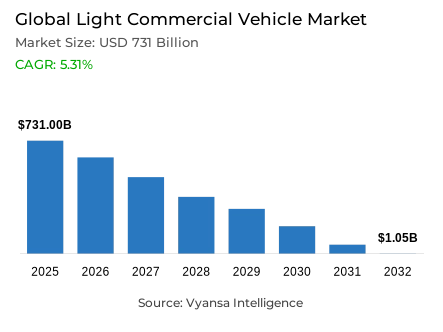
- Light Commercial Vehicle market size was valued at USD 731 billion in 2025 and is estimated at USD 777 billion in 2026.
- The market size is expected to grow to USD 1.05 trillion by 2032.
- Market to register a CAGR of around 5.31% during 2026-32.
- Vehicle Type Shares
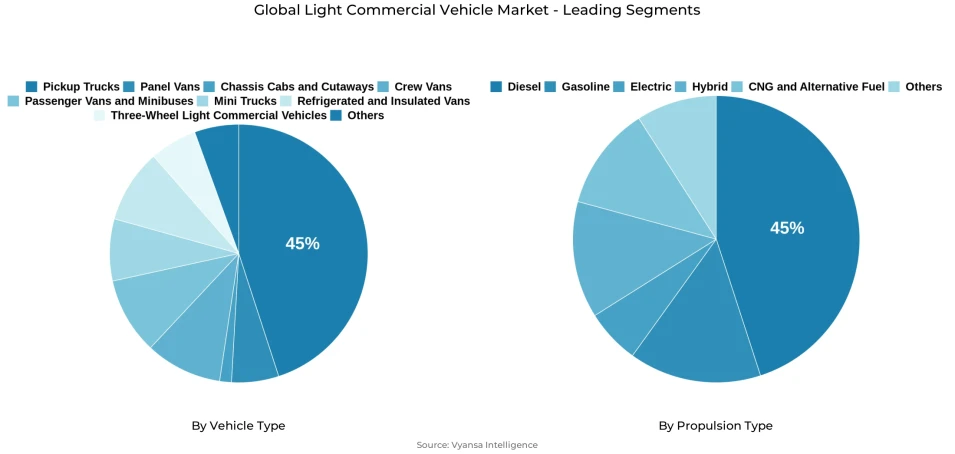
- Pickup trucks grabbed market share of 45%.
- Competition
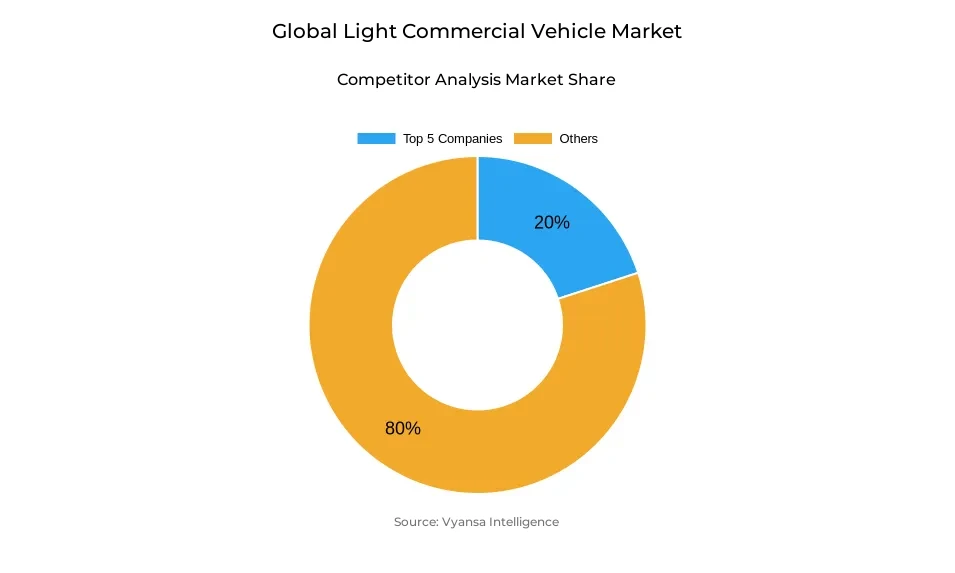
- More than 25 companies are actively engaged in producing light commercial vehicle.
- Top 5 companies acquired around 20% of the market share.
- Mercedes-Benz Group AG (Mercedes-Benz Vans), Renault Group (Renault SAS), Isuzu Motors Limited, Ford Motor Company, General Motors Company etc., are few of the top companies.
- Propulsion Type
- Diesel grabbed 45% of the market.
- Region
- Asia Pacific leads with a 35% share of the global market.
Global Light Commercial Vehicle Market Outlook
Global light commercial vehicle market is valued at USD 731 billion in 2025 and USD 777 billion in 2026, with a forecast value of USD 1.05 trillion by 2032 at a CAGR of 5.31% from 2026 to 2032. It covers pickup trucks, vans, chassis cabs, minibuses, and related light-duty platforms used by logistics operators, trades, utilities, small businesses, public agencies, and fleet owners across recurring transport cycles and regulated freight services.
Urban freight density, construction service mobility, e-commerce delivery, and municipal fleet renewal are sustaining procurement activity across the global light commercial vehicle industry. OICA reported 20,898,694 light commercial vehicles produced worldwide in 2024, confirming the scale of production capacity supporting replacement demand, regional sourcing, and platform localization. Electrification remains selective rather than uniform, with operators balancing payload, route length, charging availability, residual-value risk, depot charging, and driver scheduling.
Economic impact is concentrated in fleet uptime, SME transport productivity, dealer networks, bodybuilder demand, and component sourcing. Fleet purchasing directly affects chassis supply, telematics integration, refrigerated bodies, maintenance networks, financing models, and procurement planning across distribution and service chains resilience. The sector also influences last-mile cost structures because vehicle choice determines delivery frequency, payload utilization, fuel exposure, and compliance with urban access restrictions, especially in dense metropolitan freight corridors with stricter operating rules.
The 2026 trajectory shows disciplined growth, with OEMs aligning diesel, hybrid, and battery-electric offerings around fleet economics rather than headline electrification. Global light commercial vehicle market demand is shifting toward connected commercial vehicle technology, LCV fleet procurement, commercial vehicle leasing trends, and route-specific battery electric van adoption. The global light commercial vehicle industry is therefore positioned around mixed-powertrain portfolios, regional assembly resilience, service-led supplier differentiation, disciplined platform investment for commercial users, and stronger aftersales coverage across both urban and rural routes and depots.
Global Light Commercial Vehicle Market Growth Driver
Last-Mile Freight Density Strengthens Fleet Procurement
Last-mile delivery intensity is strengthening the procurement case for compact, high-uptime commercial platforms that can operate across dense routes, fragmented stops, and time-sensitive service windows. Global light commercial vehicle market growth is therefore closely tied to e-commerce fulfillment, courier networks, service trades, food distribution, and municipal work applications that require frequent dispatch rather than heavy payload specialization, especially across urban logistics vehicle demand corridors.
Amazon reported that it has more than 30,000 custom electric delivery vans operating across the U.S. and additional vans deployed in Europe, highlighting how high-volume delivery networks are converting route density into fleet electrification demand. This supports the global light commercial vehicle industry by widening adoption of purpose-built vans, charging-compatible depot models, telematics-led routing, and OEM fleet service packages, while also steadily strengthening demand for commercial van market forecast visibility among leasing companies, bodybuilders, and component suppliers planning production schedules and localized aftermarket capacity.
Global Light Commercial Vehicle Market Challenge
Cost and Infrastructure Frictions Delay Fleet Renewal
Cost discipline and utilization risk are slowing replacement decisions where operators face uncertain freight demand, higher compliance expectations, and uneven charging readiness. Global light commercial vehicle market expansion remains exposed to financing constraints, depot adaptation costs, battery payload trade-offs, and service downtime concerns linked to maintenance planning, particularly when smaller fleets cannot absorb experimental technology or long payback cycles.
ACEA reported that EU new van registrations declined 8.8% in 2025, signalling a softer commercial vehicle purchasing environment despite ongoing operational need. This pressure affects the global light commercial vehicle industry by delaying scheduled fleet renewal, narrowing dealer order visibility, inventory planning, and forcing OEMs to maintain diesel, hybrid, and electric variants simultaneously. Procurement teams are prioritizing proven lifecycle economics over rapid powertrain shifts, which can slow adoption of zero-emission commercial vans where incentives, charging access, and residual-value confidence remain inconsistent across markets, especially for low-margin operators managing route variability.
Unlock Market Intelligence
Explore the market potential with our data-driven report
Global Light Commercial Vehicle Market Trend
Connected Platforms Reshape Fleet Control
Connected fleet operations are becoming a procurement differentiator as operators demand visibility into driver behaviour, vehicle health, charging events, and mixed-powertrain productivity. Global light commercial vehicle market trends now extend beyond vehicle acquisition to software-enabled uptime, route optimization, predictive maintenance, and centralized cost control across distributed depots and subcontracted delivery networks, especially among fleets managing both diesel vans and battery electric van adoption.
Ford stated that Ford Pro E-Telematics integrates with Ford Pro Telematics so internal-combustion and all-electric vehicles can be managed through the same dashboard, while non-Ford vehicles can be connected through a plug-in device. This shift strengthens the global light commercial vehicle industry by making connected commercial vehicle technology part of strong supplier differentiation, improving advanced fleet telematics in LCVs, supporting maintenance planning, compliance reporting, and raising expectations for OEMs to bundle vehicles, charging, service data, and analytics into recurring commercial fleet contracts across large and mid-sized operators.
Global Light Commercial Vehicle Market Opportunity
Electrified Fleet Access Expands Supplier Scope
Route-specific fleet electrification remains underpenetrated in small and mid-sized commercial fleets worldwide, creating space for OEMs, leasing firms, charging providers, energy partners, and upfitters to package vehicles with depot planning, maintenance, financing, insurance, and route analytics. Global light commercial vehicle market growth opportunities are strongest where predictable daily route mileage, urban access rules, and brand-led logistics commitments support operational uptake without compromising payload and range reliability, driver productivity, or service continuity.
Rivian announced in February 2025 that it opened sales of its commercial van to fleets of all sizes in the U.S., expanding access beyond a single anchor customer and enabling broader procurement trials. This improves demand capture for electric light commercial vehicle market participants by widening addressable fleet categories, supporting dealer and direct-sales models, and encouraging suppliers to localize batteries, bodies, software, service tools, and charging services around last-mile delivery vehicle market requirements, residual-value planning, and fleet training.
Global Light Commercial Vehicle Market Regional Analysis

By Region
- North America
- South America
- Europe
- Middle East and Africa
- Asia Pacific
Asia Pacific leads with a 35% share, supported by dense urban logistics, expanding small-business transport, strong commercial vehicle production ecosystems, and high use of compact trucks and vans across construction, agriculture, retail, and local distribution and municipal service routes. Global light commercial vehicle market activity in the region benefits from domestic OEM scale, broad regional dealer networks, price-sensitive procurement, and rapid fleet replacement across emerging economies.
OICA reported 4,862,647 light commercial vehicles produced in Asia-Oceania in 2024, with China producing 2,029,329 units and India 641,558 units. The China Association of Automobile Manufacturers also reported 2025 commercial vehicle production of 4.261 million units and sales of 4.296 million units, strengthening regional supply-chain confidence. These operating bases support global light commercial vehicle market expansion through localized high-volume manufacturing, export readiness, supplier depth, component availability, and competitive lifecycle pricing across diesel, gasoline, hybrid, and electric platforms.
Unlock Market Intelligence
Explore the market potential with our data-driven report
Global Light Commercial Vehicle Market Segmentation Analysis
By Vehicle Type
- Panel Vans
- Pickup Trucks
- Chassis Cabs and Cutaways
- Crew Vans
- Passenger Vans and Minibuses
- Mini Trucks
- Refrigerated and Insulated Vans
- Three-Wheel Light Commercial Vehicles
- Others
Pickup trucks lead by vehicle type with a 45% share, supported by high operational versatility across construction trades, agriculture, retail distribution, municipal service, and utility maintenance. Global light commercial vehicle market demand for pickups is reinforced by towing capability, open-bed cargo flexibility, crew-cab and chassis availability, and strong suitability for mixed business and personal-use cycles in markets where road networks and jobsite access favour robust light-duty platforms.
U.S. Department of Energy data from the 2024 EPA Automotive Trends Report shows light-duty trucks, including pickups, sport utility vehicles, and vans, accounted for 63.3% of new U.S. light-duty vehicle production. While this is not a direct market-share proxy for pickups, it confirms manufacturing priority toward truck-body architectures. This supports the global light commercial vehicle industry through platform scale, parts commonality, upfitting demand, dealer coverage, service availability, and pickup truck fleet demand among contractors, logistics firms, and regional public-service operators.
By Propulsion Type
- Diesel
- Gasoline
- Electric
- Hybrid
- CNG and Alternative Fuel
- Others
Diesel leads by propulsion type with a 45% share because fleet buyers continue to prioritize range, payload consistency, refueling speed, residual-value familiarity, and wide, established maintenance coverage. Global light commercial vehicle market propulsion decisions remain grounded in practical duty-cycle economics, especially for long daily routes, construction and utility trades, rural distribution, refrigerated light commercial vehicles, and operators without reliable depot charging infrastructure.
ACEA reported 1,168,561 diesel van registrations in the EU in 2025, showing that diesel remains a major procurement choice even as electrified vans gain visibility in regulated urban corridors. This supports the global light commercial vehicle industry by keeping engine, transmission, fuel-system, and aftertreatment supply chains active, while pushing OEMs to improve emissions compliance and fuel efficiency. Diesel demand also shapes LCV payload capacity segmentation because heavier duty cycles still require dependable operating range and fast turnaround across multi-stop commercial routes and mixed urban-rural delivery networks.
Market Players in Global Light Commercial Vehicle Market
These market players maintain a significant presence in the Global light commercial vehicle market and contribute to its ongoing evolution.
- Mercedes-Benz Group AG (Mercedes-Benz Vans)
- Renault Group (Renault SAS)
- Isuzu Motors Limited
- Ford Motor Company
- General Motors Company
- Stellantis N.V.
- Toyota Motor Corporation
- Volkswagen AG (Volkswagen Commercial Vehicles)
- Nissan Motor Co. Ltd.
- Beiqi Foton Motor Co. Ltd. (FOTON)
- SAIC Motor Corporation Limited
- Tata Motors Limited
- Mahindra & Mahindra Limited
- Iveco Group N.V. (IVECO)
- Great Wall Motor Company Limited (GWM)
Market News & Updates
- Volkswagen AG (Volkswagen Commercial Vehicles), 2026:
Renault presented the new Trafic Van E-Tech electric at Solutrans 2025 as the first Renault vehicle based on a software-defined vehicle architecture by Ampere. The model features 800V fast-charging technology and up to 450 km WLTP range, with production planned from late 2026. The update expands Renault’s electric light commercial vehicle roadmap.
- Renault Group (Renault SAS), 2025:
Volkswagen Commercial Vehicles introduced the optimized e-Transporter with intelligent 4Motion all-wheel drive availability from the beginning of 2026. The update strengthens Volkswagen’s electric van offering for fleet operators needing traction, all-weather capability, and practical commercial use across delivery, service, and utility applications. It supports wider electric LCV adoption in operational fleet environments.
Frequently Asked Questions
Related Report
- Market Segmentation
- Research Scope
- Research Methodology
- Definitions and Assumptions
- Executive Summary
- Global Light Commercial Vehicle Market Policies, Regulations, and Standards
- Global Light Commercial Vehicle Production (Thousand Units) Trend 2022-2032
- Global Light Commercial Vehicle Production (Thousand Units) Trend By Vehicle Type
- Panel Vans
- Pickup Trucks
- Chassis Cabs and Cutaways
- Crew Vans
- Passenger Vans and Minibuses
- Mini Trucks
- Refrigerated and Insulated Vans
- Three-Wheel Light Commercial Vehicles
- Company Wise Production Plants and Statistics
- Installed Production Capacity
- Actual Production
- Planned Production Target
- Global Light Commercial Vehicle Production (Thousand Units) Trend By Vehicle Type
- Global Light Commercial Vehicle Pricing Analysis 2022-2032
- Global Light Commercial Vehicle Pricing Trend (USD/Thousand Units) 2022-2032
- Global Light Commercial Vehicle Pricing Trend (USD/Thousand Units) By Regions 2022-2032
- North America
- South America
- Europe
- Middle East and Africa
- Asia Pacific
- Global Light Commercial Vehicle Pricing Trend (USD/Thousand Units) By Vehicle Type 2022-2032
- Panel Vans
- Pickup Trucks
- Chassis Cabs and Cutaways
- Crew Vans
- Passenger Vans and Minibuses
- Mini Trucks
- Refrigerated and Insulated Vans
- Three-Wheel Light Commercial Vehicles
- Global Light Commercial Vehicle Market Dynamics
- Growth Factors
- Challenges
- Trends
- Opportunities
- Global Light Commercial Vehicle Market Statistics, 2022-2032F
- Market Size & Growth Outlook
- By Revenues in USD Million
- By Unit Sold in Thousand Units
- Market Segmentation & Growth Outlook
- By Vehicle Type
- Panel Vans- Market Insights and Forecast 2022-2032, USD Million
- Pickup Trucks- Market Insights and Forecast 2022-2032, USD Million
- Chassis Cabs and Cutaways- Market Insights and Forecast 2022-2032, USD Million
- Crew Vans- Market Insights and Forecast 2022-2032, USD Million
- Passenger Vans and Minibuses- Market Insights and Forecast 2022-2032, USD Million
- Mini Trucks- Market Insights and Forecast 2022-2032, USD Million
- Refrigerated and Insulated Vans- Market Insights and Forecast 2022-2032, USD Million
- Three-Wheel Light Commercial Vehicles- Market Insights and Forecast 2022-2032, USD Million
- Others- Market Insights and Forecast 2022-2032, USD Million
- By Propulsion Type
- Diesel- Market Insights and Forecast 2022-2032, USD Million
- Gasoline- Market Insights and Forecast 2022-2032, USD Million
- Electric- Market Insights and Forecast 2022-2032, USD Million
- Hybrid- Market Insights and Forecast 2022-2032, USD Million
- CNG and Alternative Fuel- Market Insights and Forecast 2022-2032, USD Million
- Others- Market Insights and Forecast 2022-2032, USD Million
- By Payload Capacity
- Below 1 Ton- Market Insights and Forecast 2022-2032, USD Million
- 1 Ton to 2 Tons- Market Insights and Forecast 2022-2032, USD Million
- Above 2 Tons- Market Insights and Forecast 2022-2032, USD Million
- By Application
- Transportation and Logistics- Market Insights and Forecast 2022-2032, USD Million
- Retail and E-Commerce Delivery- Market Insights and Forecast 2022-2032, USD Million
- Construction and Infrastructure- Market Insights and Forecast 2022-2032, USD Million
- Service and Utility Operations- Market Insights and Forecast 2022-2032, USD Million
- Public Sector and Municipal Services- Market Insights and Forecast 2022-2032, USD Million
- Passenger Transport- Market Insights and Forecast 2022-2032, USD Million
- Healthcare and Emergency Services- Market Insights and Forecast 2022-2032, USD Million
- Agriculture and Farming- Market Insights and Forecast 2022-2032, USD Million
- Cold Chain and Refrigerated Transport- Market Insights and Forecast 2022-2032, USD Million
- Others- Market Insights and Forecast 2022-2032, USD Million
- By Sales Channel
- OEM Direct and Fleet Sales- Market Insights and Forecast 2022-2032, USD Million
- Authorized Dealers and Distributors- Market Insights and Forecast 2022-2032, USD Million
- Rental and Leasing- Market Insights and Forecast 2022-2032, USD Million
- Fleet Management and Leasing Companies- Market Insights and Forecast 2022-2032, USD Million
- Others- Market Insights and Forecast 2022-2032, USD Million
- By Region
- North America
- South America
- Europe
- Middle East and Africa
- Asia Pacific
- By Competitors
- Competition Characteristics
- Market Share & Analysis
- By Vehicle Type
- Market Size & Growth Outlook
- North America Light Commercial Vehicle Market Statistics, 2022-2032F
- Market Size & Growth Outlook
- By Revenues in USD Million
- By Unit Sold in Thousand Units
- Market Segmentation & Growth Outlook
- By Vehicle Type- Market Insights and Forecast 2022-2032, USD Million
- By Propulsion Type- Market Insights and Forecast 2022-2032, USD Million
- By Payload Capacity- Market Insights and Forecast 2022-2032, USD Million
- By Application- Market Insights and Forecast 2022-2032, USD Million
- By Sales Channel- Market Insights and Forecast 2022-2032, USD Million
- By Country
- The US
- Canada
- Mexico
- Rest of North America
- The US Light Commercial Vehicle Market Statistics, 2022-2032F
- Market Size & Growth Outlook
- By Revenues in USD Million
- By Unit Sold in Thousand Units
- Market Segmentation & Growth Outlook
- By Vehicle Type- Market Insights and Forecast 2022-2032, USD Million
- By Propulsion Type- Market Insights and Forecast 2022-2032, USD Million
- By Payload Capacity- Market Insights and Forecast 2022-2032, USD Million
- By Application- Market Insights and Forecast 2022-2032, USD Million
- By Sales Channel- Market Insights and Forecast 2022-2032, USD Million
- Market Size & Growth Outlook
- Canada Light Commercial Vehicle Market Statistics, 2022-2032F
- Market Size & Growth Outlook
- By Revenues in USD Million
- By Unit Sold in Thousand Units
- Market Segmentation & Growth Outlook
- By Vehicle Type- Market Insights and Forecast 2022-2032, USD Million
- By Propulsion Type- Market Insights and Forecast 2022-2032, USD Million
- By Payload Capacity- Market Insights and Forecast 2022-2032, USD Million
- By Application- Market Insights and Forecast 2022-2032, USD Million
- By Sales Channel- Market Insights and Forecast 2022-2032, USD Million
- Market Size & Growth Outlook
- Mexico Light Commercial Vehicle Market Statistics, 2022-2032F
- Market Size & Growth Outlook
- By Revenues in USD Million
- By Unit Sold in Thousand Units
- Market Segmentation & Growth Outlook
- By Vehicle Type- Market Insights and Forecast 2022-2032, USD Million
- By Propulsion Type- Market Insights and Forecast 2022-2032, USD Million
- By Payload Capacity- Market Insights and Forecast 2022-2032, USD Million
- By Application- Market Insights and Forecast 2022-2032, USD Million
- By Sales Channel- Market Insights and Forecast 2022-2032, USD Million
- Market Size & Growth Outlook
- Market Size & Growth Outlook
- South America Light Commercial Vehicle Market Statistics, 2022-2032F
- Market Size & Growth Outlook
- By Revenues in USD Million
- By Unit Sold in Thousand Units
- Market Segmentation & Growth Outlook
- By Vehicle Type- Market Insights and Forecast 2022-2032, USD Million
- By Propulsion Type- Market Insights and Forecast 2022-2032, USD Million
- By Payload Capacity- Market Insights and Forecast 2022-2032, USD Million
- By Application- Market Insights and Forecast 2022-2032, USD Million
- By Sales Channel- Market Insights and Forecast 2022-2032, USD Million
- By Country
- Brazil
- Argentina
- Colombia
- Rest of South America
- Brazil Light Commercial Vehicle Market Statistics, 2022-2032F
- Market Size & Growth Outlook
- By Revenues in USD Million
- By Unit Sold in Thousand Units
- Market Segmentation & Growth Outlook
- By Vehicle Type- Market Insights and Forecast 2022-2032, USD Million
- By Propulsion Type- Market Insights and Forecast 2022-2032, USD Million
- By Payload Capacity- Market Insights and Forecast 2022-2032, USD Million
- By Application- Market Insights and Forecast 2022-2032, USD Million
- By Sales Channel- Market Insights and Forecast 2022-2032, USD Million
- Market Size & Growth Outlook
- Argentina Light Commercial Vehicle Market Statistics, 2022-2032F
- Market Size & Growth Outlook
- By Revenues in USD Million
- By Unit Sold in Thousand Units
- Market Segmentation & Growth Outlook
- By Vehicle Type- Market Insights and Forecast 2022-2032, USD Million
- By Propulsion Type- Market Insights and Forecast 2022-2032, USD Million
- By Payload Capacity- Market Insights and Forecast 2022-2032, USD Million
- By Application- Market Insights and Forecast 2022-2032, USD Million
- By Sales Channel- Market Insights and Forecast 2022-2032, USD Million
- Market Size & Growth Outlook
- Colombia Light Commercial Vehicle Market Statistics, 2022-2032F
- Market Size & Growth Outlook
- By Revenues in USD Million
- By Unit Sold in Thousand Units
- Market Segmentation & Growth Outlook
- By Vehicle Type- Market Insights and Forecast 2022-2032, USD Million
- By Propulsion Type- Market Insights and Forecast 2022-2032, USD Million
- By Payload Capacity- Market Insights and Forecast 2022-2032, USD Million
- By Application- Market Insights and Forecast 2022-2032, USD Million
- By Sales Channel- Market Insights and Forecast 2022-2032, USD Million
- Market Size & Growth Outlook
- Market Size & Growth Outlook
- Europe Light Commercial Vehicle Market Statistics, 2022-2032F
- Market Size & Growth Outlook
- By Revenues in USD Million
- By Unit Sold in Thousand Units
- Market Segmentation & Growth Outlook
- By Vehicle Type- Market Insights and Forecast 2022-2032, USD Million
- By Propulsion Type- Market Insights and Forecast 2022-2032, USD Million
- By Payload Capacity- Market Insights and Forecast 2022-2032, USD Million
- By Application- Market Insights and Forecast 2022-2032, USD Million
- By Sales Channel- Market Insights and Forecast 2022-2032, USD Million
- By Country
- Germany
- France
- The UK
- Italy
- Spain
- Russia
- Rest of Europe
- Germany Light Commercial Vehicle Market Statistics, 2022-2032F
- Market Size & Growth Outlook
- By Revenues in USD Million
- By Unit Sold in Thousand Units
- Market Segmentation & Growth Outlook
- By Vehicle Type- Market Insights and Forecast 2022-2032, USD Million
- By Propulsion Type- Market Insights and Forecast 2022-2032, USD Million
- By Payload Capacity- Market Insights and Forecast 2022-2032, USD Million
- By Application- Market Insights and Forecast 2022-2032, USD Million
- By Sales Channel- Market Insights and Forecast 2022-2032, USD Million
- Market Size & Growth Outlook
- France Light Commercial Vehicle Market Statistics, 2022-2032F
- Market Size & Growth Outlook
- By Revenues in USD Million
- By Unit Sold in Thousand Units
- Market Segmentation & Growth Outlook
- By Vehicle Type- Market Insights and Forecast 2022-2032, USD Million
- By Propulsion Type- Market Insights and Forecast 2022-2032, USD Million
- By Payload Capacity- Market Insights and Forecast 2022-2032, USD Million
- By Application- Market Insights and Forecast 2022-2032, USD Million
- By Sales Channel- Market Insights and Forecast 2022-2032, USD Million
- Market Size & Growth Outlook
- The UK Light Commercial Vehicle Market Statistics, 2022-2032F
- Market Size & Growth Outlook
- By Revenues in USD Million
- By Unit Sold in Thousand Units
- Market Segmentation & Growth Outlook
- By Vehicle Type- Market Insights and Forecast 2022-2032, USD Million
- By Propulsion Type- Market Insights and Forecast 2022-2032, USD Million
- By Payload Capacity- Market Insights and Forecast 2022-2032, USD Million
- By Application- Market Insights and Forecast 2022-2032, USD Million
- By Sales Channel- Market Insights and Forecast 2022-2032, USD Million
- Market Size & Growth Outlook
- Italy Light Commercial Vehicle Market Statistics, 2022-2032F
- Market Size & Growth Outlook
- By Revenues in USD Million
- By Unit Sold in Thousand Units
- Market Segmentation & Growth Outlook
- By Vehicle Type- Market Insights and Forecast 2022-2032, USD Million
- By Propulsion Type- Market Insights and Forecast 2022-2032, USD Million
- By Payload Capacity- Market Insights and Forecast 2022-2032, USD Million
- By Application- Market Insights and Forecast 2022-2032, USD Million
- By Sales Channel- Market Insights and Forecast 2022-2032, USD Million
- Market Size & Growth Outlook
- Spain Light Commercial Vehicle Market Statistics, 2022-2032F
- Market Size & Growth Outlook
- By Revenues in USD Million
- By Unit Sold in Thousand Units
- Market Segmentation & Growth Outlook
- By Vehicle Type- Market Insights and Forecast 2022-2032, USD Million
- By Propulsion Type- Market Insights and Forecast 2022-2032, USD Million
- By Payload Capacity- Market Insights and Forecast 2022-2032, USD Million
- By Application- Market Insights and Forecast 2022-2032, USD Million
- By Sales Channel- Market Insights and Forecast 2022-2032, USD Million
- Market Size & Growth Outlook
- Russia Light Commercial Vehicle Market Statistics, 2022-2032F
- Market Size & Growth Outlook
- By Revenues in USD Million
- By Unit Sold in Thousand Units
- Market Segmentation & Growth Outlook
- By Vehicle Type- Market Insights and Forecast 2022-2032, USD Million
- By Propulsion Type- Market Insights and Forecast 2022-2032, USD Million
- By Payload Capacity- Market Insights and Forecast 2022-2032, USD Million
- By Application- Market Insights and Forecast 2022-2032, USD Million
- By Sales Channel- Market Insights and Forecast 2022-2032, USD Million
- Market Size & Growth Outlook
- Market Size & Growth Outlook
- Middle East and Africa Light Commercial Vehicle Market Statistics, 2022-2032F
- Market Size & Growth Outlook
- By Revenues in USD Million
- By Unit Sold in Thousand Units
- Market Segmentation & Growth Outlook
- By Vehicle Type- Market Insights and Forecast 2022-2032, USD Million
- By Propulsion Type- Market Insights and Forecast 2022-2032, USD Million
- By Payload Capacity- Market Insights and Forecast 2022-2032, USD Million
- By Application- Market Insights and Forecast 2022-2032, USD Million
- By Sales Channel- Market Insights and Forecast 2022-2032, USD Million
- By Country
- Saudi Arabia
- The UAE
- South Africa
- Iran
- Rest of Middle East and Africa
- Saudi Arabia Light Commercial Vehicle Market Statistics, 2022-2032F
- Market Size & Growth Outlook
- By Revenues in USD Million
- By Unit Sold in Thousand Units
- Market Segmentation & Growth Outlook
- By Vehicle Type- Market Insights and Forecast 2022-2032, USD Million
- By Propulsion Type- Market Insights and Forecast 2022-2032, USD Million
- By Payload Capacity- Market Insights and Forecast 2022-2032, USD Million
- By Application- Market Insights and Forecast 2022-2032, USD Million
- By Sales Channel- Market Insights and Forecast 2022-2032, USD Million
- Market Size & Growth Outlook
- The UAE Light Commercial Vehicle Market Statistics, 2022-2032F
- Market Size & Growth Outlook
- By Revenues in USD Million
- By Unit Sold in Thousand Units
- Market Segmentation & Growth Outlook
- By Vehicle Type- Market Insights and Forecast 2022-2032, USD Million
- By Propulsion Type- Market Insights and Forecast 2022-2032, USD Million
- By Payload Capacity- Market Insights and Forecast 2022-2032, USD Million
- By Application- Market Insights and Forecast 2022-2032, USD Million
- By Sales Channel- Market Insights and Forecast 2022-2032, USD Million
- Market Size & Growth Outlook
- South Africa Light Commercial Vehicle Market Statistics, 2022-2032F
- Market Size & Growth Outlook
- By Revenues in USD Million
- By Unit Sold in Thousand Units
- Market Segmentation & Growth Outlook
- By Vehicle Type- Market Insights and Forecast 2022-2032, USD Million
- By Propulsion Type- Market Insights and Forecast 2022-2032, USD Million
- By Payload Capacity- Market Insights and Forecast 2022-2032, USD Million
- By Application- Market Insights and Forecast 2022-2032, USD Million
- By Sales Channel- Market Insights and Forecast 2022-2032, USD Million
- Market Size & Growth Outlook
- Iran Light Commercial Vehicle Market Statistics, 2022-2032F
- Market Size & Growth Outlook
- By Revenues in USD Million
- By Unit Sold in Thousand Units
- Market Segmentation & Growth Outlook
- By Vehicle Type- Market Insights and Forecast 2022-2032, USD Million
- By Propulsion Type- Market Insights and Forecast 2022-2032, USD Million
- By Payload Capacity- Market Insights and Forecast 2022-2032, USD Million
- By Application- Market Insights and Forecast 2022-2032, USD Million
- By Sales Channel- Market Insights and Forecast 2022-2032, USD Million
- Market Size & Growth Outlook
- Market Size & Growth Outlook
- Asia Pacific Light Commercial Vehicle Market Statistics, 2022-2032F
- Market Size & Growth Outlook
- By Revenues in USD Million
- By Unit Sold in Thousand Units
- Market Segmentation & Growth Outlook
- By Vehicle Type- Market Insights and Forecast 2022-2032, USD Million
- By Propulsion Type- Market Insights and Forecast 2022-2032, USD Million
- By Payload Capacity- Market Insights and Forecast 2022-2032, USD Million
- By Application- Market Insights and Forecast 2022-2032, USD Million
- By Sales Channel- Market Insights and Forecast 2022-2032, USD Million
- By Country
- China
- India
- Japan
- South Korea
- Indonesia
- Thailand
- Vietnam
- Rest of Asia Pacific
- China Light Commercial Vehicle Market Statistics, 2022-2032F
- Market Size & Growth Outlook
- By Revenues in USD Million
- By Unit Sold in Thousand Units
- Market Segmentation & Growth Outlook
- By Vehicle Type- Market Insights and Forecast 2022-2032, USD Million
- By Propulsion Type- Market Insights and Forecast 2022-2032, USD Million
- By Payload Capacity- Market Insights and Forecast 2022-2032, USD Million
- By Application- Market Insights and Forecast 2022-2032, USD Million
- By Sales Channel- Market Insights and Forecast 2022-2032, USD Million
- Market Size & Growth Outlook
- India Light Commercial Vehicle Market Statistics, 2022-2032F
- Market Size & Growth Outlook
- By Revenues in USD Million
- By Unit Sold in Thousand Units
- Market Segmentation & Growth Outlook
- By Vehicle Type- Market Insights and Forecast 2022-2032, USD Million
- By Propulsion Type- Market Insights and Forecast 2022-2032, USD Million
- By Payload Capacity- Market Insights and Forecast 2022-2032, USD Million
- By Application- Market Insights and Forecast 2022-2032, USD Million
- By Sales Channel- Market Insights and Forecast 2022-2032, USD Million
- Market Size & Growth Outlook
- Japan Light Commercial Vehicle Market Statistics, 2022-2032F
- Market Size & Growth Outlook
- By Revenues in USD Million
- By Unit Sold in Thousand Units
- Market Segmentation & Growth Outlook
- By Vehicle Type- Market Insights and Forecast 2022-2032, USD Million
- By Propulsion Type- Market Insights and Forecast 2022-2032, USD Million
- By Payload Capacity- Market Insights and Forecast 2022-2032, USD Million
- By Application- Market Insights and Forecast 2022-2032, USD Million
- By Sales Channel- Market Insights and Forecast 2022-2032, USD Million
- Market Size & Growth Outlook
- South Korea Light Commercial Vehicle Market Statistics, 2022-2032F
- Market Size & Growth Outlook
- By Revenues in USD Million
- By Unit Sold in Thousand Units
- Market Segmentation & Growth Outlook
- By Vehicle Type- Market Insights and Forecast 2022-2032, USD Million
- By Propulsion Type- Market Insights and Forecast 2022-2032, USD Million
- By Payload Capacity- Market Insights and Forecast 2022-2032, USD Million
- By Application- Market Insights and Forecast 2022-2032, USD Million
- By Sales Channel- Market Insights and Forecast 2022-2032, USD Million
- Market Size & Growth Outlook
- Indonesia Light Commercial Vehicle Market Statistics, 2022-2032F
- Market Size & Growth Outlook
- By Revenues in USD Million
- By Unit Sold in Thousand Units
- Market Segmentation & Growth Outlook
- By Vehicle Type- Market Insights and Forecast 2022-2032, USD Million
- By Propulsion Type- Market Insights and Forecast 2022-2032, USD Million
- By Payload Capacity- Market Insights and Forecast 2022-2032, USD Million
- By Application- Market Insights and Forecast 2022-2032, USD Million
- By Sales Channel- Market Insights and Forecast 2022-2032, USD Million
- Market Size & Growth Outlook
- Thailand Light Commercial Vehicle Market Statistics, 2022-2032F
- Market Size & Growth Outlook
- By Revenues in USD Million
- By Unit Sold in Thousand Units
- Market Segmentation & Growth Outlook
- By Vehicle Type- Market Insights and Forecast 2022-2032, USD Million
- By Propulsion Type- Market Insights and Forecast 2022-2032, USD Million
- By Payload Capacity- Market Insights and Forecast 2022-2032, USD Million
- By Application- Market Insights and Forecast 2022-2032, USD Million
- By Sales Channel- Market Insights and Forecast 2022-2032, USD Million
- Market Size & Growth Outlook
- Vietnam Light Commercial Vehicle Market Statistics, 2022-2032F
- Market Size & Growth Outlook
- By Revenues in USD Million
- By Unit Sold in Thousand Units
- Market Segmentation & Growth Outlook
- By Vehicle Type- Market Insights and Forecast 2022-2032, USD Million
- By Propulsion Type- Market Insights and Forecast 2022-2032, USD Million
- By Payload Capacity- Market Insights and Forecast 2022-2032, USD Million
- By Application- Market Insights and Forecast 2022-2032, USD Million
- By Sales Channel- Market Insights and Forecast 2022-2032, USD Million
- Market Size & Growth Outlook
- Market Size & Growth Outlook
- Competitive Outlook
- Company Profiles
- Ford Motor Company
- Business Description
- Product Portfolio
- Collaborations & Alliances
- Recent Developments
- Financial Details
- Others
- General Motors Company
- Business Description
- Product Portfolio
- Collaborations & Alliances
- Recent Developments
- Financial Details
- Others
- Stellantis N.V.
- Business Description
- Product Portfolio
- Collaborations & Alliances
- Recent Developments
- Financial Details
- Others
- Toyota Motor Corporation
- Business Description
- Product Portfolio
- Collaborations & Alliances
- Recent Developments
- Financial Details
- Others
- Volkswagen AG (Volkswagen Commercial Vehicles)
- Business Description
- Product Portfolio
- Collaborations & Alliances
- Recent Developments
- Financial Details
- Others
- Mercedes-Benz Group AG (Mercedes-Benz Vans)
- Business Description
- Product Portfolio
- Collaborations & Alliances
- Recent Developments
- Financial Details
- Others
- Renault Group (Renault SAS)
- Business Description
- Product Portfolio
- Collaborations & Alliances
- Recent Developments
- Financial Details
- Others
- Isuzu Motors Limited
- Business Description
- Product Portfolio
- Collaborations & Alliances
- Recent Developments
- Financial Details
- Others
- Nissan Motor Co. Ltd.
- Business Description
- Product Portfolio
- Collaborations & Alliances
- Recent Developments
- Financial Details
- Others
- Beiqi Foton Motor Co. Ltd. (FOTON)
- Business Description
- Product Portfolio
- Collaborations & Alliances
- Recent Developments
- Financial Details
- Others
- SAIC Motor Corporation Limited
- Business Description
- Product Portfolio
- Collaborations & Alliances
- Recent Developments
- Financial Details
- Others
- Tata Motors Limited
- Business Description
- Product Portfolio
- Collaborations & Alliances
- Recent Developments
- Financial Details
- Others
- Mahindra & Mahindra Limited
- Business Description
- Product Portfolio
- Collaborations & Alliances
- Recent Developments
- Financial Details
- Others
- Iveco Group N.V. (IVECO)
- Business Description
- Product Portfolio
- Collaborations & Alliances
- Recent Developments
- Financial Details
- Others
- Great Wall Motor Company Limited (GWM)
- Business Description
- Product Portfolio
- Collaborations & Alliances
- Recent Developments
- Financial Details
- Others
- Ford Motor Company
- Company Profiles
- Disclaimer
| Segment | Sub-Segment |
|---|---|
| By Vehicle Type |
|
| By Propulsion Type |
|
| By Payload Capacity |
|
| By Application |
|
| By Sales Channel |
|
| By Region |
|
Research Methodology
This study followed a structured approach comprising four key phases to assess the size and scope of the electro-oxidation market. The process began with thorough secondary research to collect data on the target market, related markets, and broader industry context. These findings, along with preliminary assumptions and estimates, were then validated through extensive primary research involving industry experts from across the value chain. To calculate the overall market size, both top-down and bottom-up methodologies were employed. Finally, market segmentation and data triangulation techniques were applied to refine and validate segment-level estimations.
Secondary Research
The secondary research phase involved gathering data from a wide range of credible and published sources. This step helped in identifying industry trends, defining market segmentation, and understanding the market landscape and value chain.
Sources consulted during this phase included:
- Company annual reports, investor presentations, and press releases
- Industry white papers and certified publications
- Trade directories and market-recognized databases
- Articles from authoritative authors and reputable journals
- Gold and silver standard websites
Secondary research was critical in mapping out the industry's value chain and monetary flow, identifying key market segments, understanding regional variations, and tracking significant industry developments.
Other key sources:
- Financial disclosures
- Industry associations and trade bodies
- News outlets and business magazines
- Academic journals and research studies
- Paid industry databases
Primary Research
To validate secondary data and gain deeper market insights, primary research was conducted with key stakeholders across both the supply and demand sides of the market.
On the demand side, participants included decision-makers and influencers from end-user industries—such as CIOs, CTOs, and CSOs—who provided first-hand perspectives on market needs, product usage, and future expectations.
On the supply side, interviews were conducted with manufacturers, industry associations, and institutional participants to gather insights into current offerings, product pipelines, and market challenges.
Primary interviews provided critical inputs such as:
- Market size and revenue data
- Product and service breakdowns
- Market forecasts
- Regional and application-specific trends
Stakeholders consulted included:
- Leading OEM and solution providers
- Channel and distribution partners
- End users across various applications
- Independent consultants and industry specialists
Market Size Estimation and Data Triangulation
- Identifying Key Market Participants (Secondary Research)
- Goal: To identify the major players or companies in the target market. This typically involves using publicly available data sources such as industry reports, market research publications, and financial statements of companies.
- Tools: Reports from firms like Gartner, Forrester, Euromonitor, Statista, IBISWorld, and others. Public financial statements, news articles, and press releases from top market players.
- Extracting Earnings of Key Market Participants
- Goal: To estimate the earnings generated from the product or service being analyzed. This step helps in understanding the revenue potential of each market player in a specific geography.
- Methods: Earnings data can be gathered from:
- Publicly available financial reports (for listed companies).
- Interviews and primary data sources from professionals, such as Directors, VPs, SVPs, etc. This is especially useful for understanding more nuanced, internal data that isn't publicly disclosed.
- Annual reports and investor presentations of key players.
- Data Collation and Development of a Relevant Data Model
- Goal: To collate inputs from both primary and secondary sources into a structured, data-driven model for market estimation. This model will incorporate key market KPIs and any independent variables relevant to the market.
- Key KPIs: These could include:
- Market size, growth rate, and demand drivers.
- Industry-specific metrics like market share, average revenue per customer (ARPC), or average deal size.
- External variables, such as economic growth rates, inflation rates, or commodity prices, that could affect the market.
- Data Modeling: Based on this data, the market forecasts are developed for the next 5 years. A combination of trend analysis, scenario modeling, and statistical regression might be used to generate projections.
- Scenario Analysis
- Goal: To test different assumptions and validate how sensitive the market is to changes in key variables (e.g., market demand, regulatory changes, technological disruptions).
- Types of Scenarios:
- Base Case: Based on current assumptions and historical data.
- Best-Case Scenario: Assuming favorable market conditions, regulatory environments, and technological advancements.
- Worst-Case Scenario: Accounting for adverse factors, such as economic downturns, stricter regulations, or unexpected disruptions.












