Kazakhstan Dermatologicals Market Report: Trends, Growth and Forecast (2026-2032)
By Category (Medicated Shampoos, Topical Antifungals, Vaginal Antifungals, Hair Loss Treatments, Nappy (Diaper) Rash Treatments, Antiparasitics/Lice (Head and Body) Treatments, Antipruritics, Cold Sore Treatments, Haemorrhoid Treatments, Paediatric Dermatologicals, Topical Allergy Remedies/Antihistamines, Topical Germicidals/Antiseptics), By Dispensing Status (Prescription-based Drugs, Over-the-counter Drugs), By Route of Administration (Topical Administration, Oral Administration, Parenteral Administration), By Drug Type (Branded, Generics), By Skin Condition (Acne, Dermatitis, Psoriasis, Skin Cancer, Rosacea, Alopecia, Fungal Infections, Others), By End User (Hospitals, Cosmetic Centers, Dermatology Clinics, Homecare, Others), By Sales Channel (Retail Offline, Retail Online) ... Read more
|
Major Players
|
Kazakhstan Dermatologicals Market Statistics and Insights, 2026
- Market Size Statistics
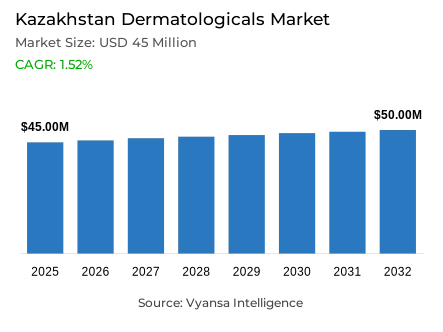
- Dermatologicals in Kazakhstan is estimated at USD 45 million in 2025.
- The market size is expected to grow to USD 50 million by 2032.
- Market to register a cagr of around 1.52% during 2026-32.
- Category Shares
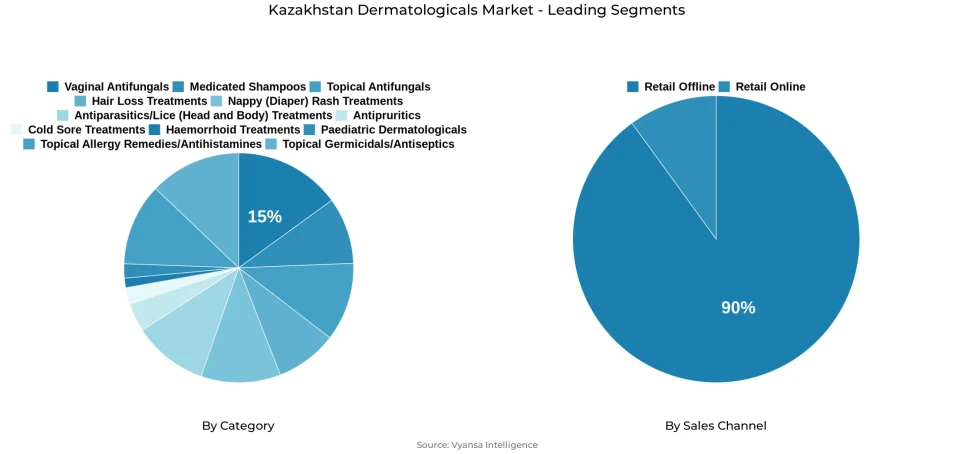
- Vaginal antifungals grabbed market share of 15%.
- Competition
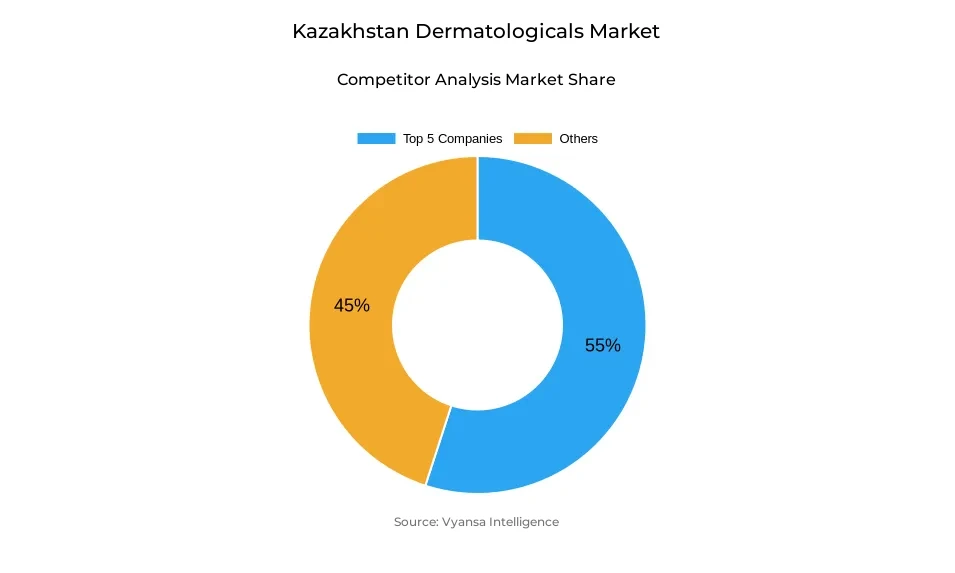
- More than 20 companies are actively engaged in producing dermatologicals in Kazakhstan.
- Top 5 companies acquired around 55% of the market share.
- Kusum Healthcare Pvt Ltd; Sandoz Industrial Products GmbH; Teva Pharmaceutical Industries Ltd; Bayer Kaz TOO; GSK Consumer Healthcare etc., are few of the top companies.
- Sales Channel
- Retail offline grabbed 90% of the market.
Kazakhstan Dermatologicals Market Outlook
Kazakhstan dermalogical market will show steady, continued growth due to both growing awareness of skin health as well as a resurgence in active outdoor lifestyles following the pandemic lockdowns. In 2025, the total addressable market was approximately $45 million and it is projected at $50 million in 2032 with compound annual growth rate CAGR of 1.52%.enduser education concerning the various types of skin conditions continues to stimulate demand for various dermalogical products due to substantial marketing efforts from leading multinational manufacturers. In 2025, retail offline channels captured roughly 90% of the dermalogical marketplace, and they will likely continue to dominate to a large extent, as endusers tend to rely on pharmacies and health food stores for guidance from professionals about which products to purchase.
The favourable demographic characteristics, including an ageing population as well as relatively high birth rates, will drive the growth of several product categories, such as treatments for nappy rash or antipruritics. In 2025, the vaginal antifungal market represented 15% of the market and the anticipated growth rate will be strong due to increasing awareness of vaginal health among females as well as increasing frequency of fungal infections related to geographical locations, lifestyles, and commodities.
Many endusers are expected to migrate toward economy-priced alternatives due to potential economic uncertainty. However, growth projections for the various product categories remain substantially positive overall. Hair loss products will experience considerable long-term growth due in part to increasing incidence as a result of exposure to stress, pollution, and poor nutrition. While currently medicated shampoos only represent a small portion of the dermalogical marketplace, new product launches are being developed in anticipation of building enduser interest. Image consciousness, particularly among younger generations, will result in increased acceptance of specialised products.
Finally, the vast majority of dermalogical product categories are expected to realise significant compound annual growth rates throughout the forecast period as self-care behavioural patterns are expected to trend positively. Moreover, as the knowledge regarding dermatological advice and education becomes disseminated through physicians, pharmacists, and digital education platforms, endusers will alleviate issues related to skin health by proactively addressing these problems with dermalogicals on a day-to-day basis.
Kazakhstan Dermatologicals Market Growth Driver
Favourable Demographics and Rising Skin-Health Awareness
Kazakhstan dermatological market is witnessing growth in both value and volume, supported by population expansion and heightened awareness of skin health and appearance-related concerns. In 2024, sales increased notably as more individuals resumed active lifestyles and faced greater exposure to environmental factors such as solar radiation, air pollution, and wind, all contributing to higher incidences of skin issues. Rising image consciousness and the desire for clearer skin are further stimulating demand, while expanded marketing initiatives and improved pharmacist guidance have enhanced public understanding of dermatological conditions, boosting uptake of targeted solutions such as antifungals, nappy rash creams, and treatments for irritation and sensitivity.
Market demand is additionally reinforced by Kazakhstan’s relatively young population, even as the country undergoes gradual demographic aging driven by longer life expectancy. According to the World Bank, Kazakhstan’s population stands at about 20.6 million, with an estimated life expectancy of 74–75 years, indicating sustained and growing need for dermatological care. The Bureau of National Statistics reports that the population reached 20,286,084 as of January 1, 2025—an annual increase of approximately 252,000 people—underscoring the continued expansion of the end-user base for dermatological products.
Kazakhstan Dermatologicals Market Challenge
Inflation-Driven Price Sensitivity and enduser Downtrading
A fundamental challenge confronting the Kazakhstan dermatologicals market is economic pressure and the resulting enduser migration toward lower-priced alternatives. Although multinational brands including Bayer Kaz, GSK enduser Healthcare, and Nizhpharm Kazakhstan maintain enduser trust for efficacy and enjoy substantial brand equity. Elevated inflation has eroded purchasing power, compelling a growing proportion of endusers to seek more affordable options, including Turkish-origin brands and potential local market entrants, which threatens the premium positioning of established players and necessitates more compelling value proposition articulation.
Official economic data confirm this inflationary environment. The Bureau of National Statistics has revealed that March 2025, year-on-year inflation for endusers stands at 10%, with April 2025 year-on-year inflation showing a rise in price growth reaching 10.7%, marking the first time in approximately 18 months that the Philippines has recorded the highest inflation rate of 10.7% or higher. The increases in price growth have been especially visible in food, non-food, and paid services. Persistently double-digit inflation levels lead to heightened price sensitivity and are likely to increase the rate at which endusers down-trade from high-end to lower-end products such as vaginal antifungals and daily skin care products. Lower-priced brands will continue to capture further shares of their category markets while some of the established multinational companies face a number of structural constraints that limit their ability to maintain volume and value shares while continuing to protect profit margins.
Unlock Market Intelligence
Explore the market potential with our data-driven report
Kazakhstan Dermatologicals Market Trend
Growing Burden of Environment- and Lifestyle-Linked Dermatological Conditions
Increased dermatological illness related to environmental pollution and the modern-day lifestyle is the most apparent trend. These growing numbers of conditions, including hair loss, nappy rash, hemorrhoids, and other various skin-related issues, are due to the interaction of stress, anxiety, dietary imbalance, lack of exercise, with environmental pollutants and a harsher climate. Due to the increase in these dermatological illnesses, there is a greater need for hair loss treatment, as well as hemorrhoid medications, nappy rash creams, etc., leading to the growth of the local producers like Santo, who are now producing medicated shampoos to address this issue for men and women.
Kazakhstan's economic development approach also supports this trend. According to the World Bank, Kazakhstan's economy is primarily dependant on extractive industries like oil, gas, and mining, which all contribute to the level of air and environmental pollution. The scientific analysis of Kazakhstan's air indicates that the concentration of PM2.5 and other pollutants in large urban areas are frequently above the World Health Organisation's guidelines for safe levels. This leads to a higher prevalence of respiratory problems and heart disease and has resulted in long-term exposure of the population to these environmental irritants, which is why the long-term outlook for dermatological conditions and over-the-counter products will grow to meet this demand.
Kazakhstan Dermatologicals Market Opportunity
Population Growth and Elevated Birth Rates Driving Paediatric and Intimate Care Segments
A significant opportunity resides in paediatric dermatology and intimate-care segments, particularly nappy rash treatments and vaginal antifungals. Nappy rash products are projected to demonstrate positive volume and value growth, supported by population expansion and persistently elevated birth rates, as parents typically prioritise child-related purchases and, when budgets permit, select higher-quality solutions. This positions nappy rash and other paediatric treatments for sustained expansion as awareness of infant skin health and the importance of gentle, specialised formulations continues to increase.
Demographic data substantiate this opportunity. World Bank and United Nations-compiled statistics indicate Kazakhstan's crude birth rate in recent years measures in the high-teens per 1,000 population, significantly exceeding levels typical of advanced economies, while total population has surpassed 20 million and continues expanding. This combination of robust natural population increase and overall demographic expansion supports ongoing demand for child-focused dermatological products, particularly nappy rash and gentle paediatric skin-care lines.Concurrently, haemorrhoid treatments, hair loss products, and vaginal antifungals are expected to record accelerated growth, driven by stress exposure, dietary factors, and environmental conditions. With medical professionals actively recommending vaginal antifungals and awareness of their therapeutic effectiveness rising, even economy-positioned options within this category can capitalise on growing enduser knowledge and unmet healthcare needs
Unlock Market Intelligence
Explore the market potential with our data-driven report
Kazakhstan Dermatologicals Market Segmentation Analysis
By Category
- Medicated Shampoos
- Topical Antifungals
- Vaginal Antifungals
- Hair Loss Treatments
- Nappy (Diaper) Rash Treatments
- Antiparasitics/Lice (Head and Body) Treatments
- Antipruritics
- Cold Sore Treatments
- Haemorrhoid Treatments
- Paediatric Dermatologicals
- Topical Allergy Remedies/Antihistamines
- Topical Germicidals/Antiseptics
The segment with highest market share under Category is Vaginal antifungals with the share about 15% of the Kazakhstan dermatologicals market. Demand for these products continues rising attributable to increasing awareness of intimate health issues and guidance provided by physicians and pharmacists. Environmental pollution, stress exposure, and lifestyle behaviours are contributing to higher incidences of vaginal infections, establishing this category as an essential component of dermatological care for numerous female endusers. As knowledge of appropriate treatment protocols expands, endusers demonstrate increasing willingness to purchase reliable antifungal solutions.
Throughout 2026-2032, vaginal antifungals are expected to maintain strong growth momentum, supported by growing cultural openness toward discussing intimate health matters and rising interest in accessible treatment options. Economic uncertainty may additionally shift demand toward more affordable alternatives, expanding the economy segment. These trends collectively reinforce the prominence of vaginal antifungals within the dermatologicals landscape.
By Sales Channel
- Retail Offline
- Retail Online
The segment with highest market share under Sales Channel is retail offline channels with share of around 90% of the Kazakhstan dermatologicals market. Pharmacies and health and personal care stores remain primary purchase locations, offering trusted professional advice and convenient access to both domestic and international dermatological brands. These outlets prove especially valued in categories where endusers seek safety assurance, efficacy validation, and proper usage guidance, including vaginal antifungals, haemorrhoid treatments, and nappy rash solutions.
Offline retail dominance is further supported by Kazakhstan's preference for in-person consultations and the substantial presence of pharmacy chains across urban and rural regions. While online channels demonstrate gradual growth, offline outlets maintain market leadership attributable to established enduser trust, product authenticity assurance, and purchase convenience. This ensures retail offline remains the core distribution channel.
List of Companies Covered in Kazakhstan Dermatologicals Market
The companies listed below are highly influential in the Kazakhstan dermatologicals market, with a significant market share and a strong impact on industry developments.
- Kusum Healthcare Pvt Ltd
- Sandoz Industrial Products GmbH
- Teva Pharmaceutical Industries Ltd
- Bayer Kaz TOO
- GSK Consumer Healthcare
- Nizhpharm Kazakhstan TOO
- Egis OAO
- Bouchara-Recordati SAS
- Dina + OOO
- Shansharov-Pharm TOO
Competitive Landscape
Kazakhstan's dermatologicals market in 2024 is led by well-established multinational corporations, with Bayer Kaz, GSK enduser Healthcare, and Nizhpharm Kazakhstan maintaining market dominance through first-mover advantages, strong brand trust, extensive distribution availability, and sustained advertising across television, print, and digital channels. Their reputation for superior therapeutic efficacy continues to differentiate them from domestic and regional competitors. However, economic pressures following the pandemic period and persistent inflationary conditions have accelerated the emergence of lower-priced alternatives, particularly Turkish-origin brands that appeal to cost-conscious enduser segments. Interest in emerging categories such as hair loss treatments is additionally attracting new market investment, with manufacturers including Santo preparing dedicated product launches. This evolving composition of premium global market leaders and expanding value-driven challengers is intensifying competitive dynamics across Kazakhstan's dermatologicals landscape.
Frequently Asked Questions
Related Report
1. Market Segmentation
1.1. Research Scope
1.2. Research Methodology
1.3. Definitions and Assumptions
2. Executive Summary
3. Kazakhstan Dermatologicals Market Policies, Regulations, and Standards
4. Kazakhstan Dermatologicals Market Dynamics
4.1. Growth Factors
4.2. Challenges
4.3. Trends
4.4. Opportunities
5. Kazakhstan Dermatologicals Market Statistics, 2022-2032F
5.1. Market Size & Growth Outlook
5.1.1.By Revenues in USD Million
5.2. Market Segmentation & Growth Outlook
5.2.1.By Category
5.2.1.1. Medicated Shampoos- Market Insights and Forecast 2022-2032, USD Million
5.2.1.2. Topical Antifungals- Market Insights and Forecast 2022-2032, USD Million
5.2.1.3. Vaginal Antifungals- Market Insights and Forecast 2022-2032, USD Million
5.2.1.4. Hair Loss Treatments- Market Insights and Forecast 2022-2032, USD Million
5.2.1.5. Nappy (Diaper) Rash Treatments- Market Insights and Forecast 2022-2032, USD Million
5.2.1.6. Antiparasitics/Lice (Head and Body) Treatments- Market Insights and Forecast 2022-2032, USD Million
5.2.1.7. Antipruritics- Market Insights and Forecast 2022-2032, USD Million
5.2.1.8. Cold Sore Treatments- Market Insights and Forecast 2022-2032, USD Million
5.2.1.9. Haemorrhoid Treatments- Market Insights and Forecast 2022-2032, USD Million
5.2.1.10. Paediatric Dermatologicals- Market Insights and Forecast 2022-2032, USD Million
5.2.1.11. Topical Allergy Remedies/Antihistamines- Market Insights and Forecast 2022-2032, USD Million
5.2.1.12. Topical Germicidals/Antiseptics- Market Insights and Forecast 2022-2032, USD Million
5.2.2.By Dispensing Status
5.2.2.1. Prescription-based Drugs- Market Insights and Forecast 2022-2032, USD Million
5.2.2.2. Over-the-counter Drugs- Market Insights and Forecast 2022-2032, USD Million
5.2.3.By Route of Administration
5.2.3.1. Topical Administration- Market Insights and Forecast 2022-2032, USD Million
5.2.3.2. Oral Administration- Market Insights and Forecast 2022-2032, USD Million
5.2.3.3. Parenteral Administration- Market Insights and Forecast 2022-2032, USD Million
5.2.4.By Drug Type
5.2.4.1. Branded- Market Insights and Forecast 2022-2032, USD Million
5.2.4.2. Generics- Market Insights and Forecast 2022-2032, USD Million
5.2.5.By Skin Condition
5.2.5.1. Acne- Market Insights and Forecast 2022-2032, USD Million
5.2.5.2. Dermatitis- Market Insights and Forecast 2022-2032, USD Million
5.2.5.3. Psoriasis- Market Insights and Forecast 2022-2032, USD Million
5.2.5.4. Skin Cancer- Market Insights and Forecast 2022-2032, USD Million
5.2.5.5. Rosacea- Market Insights and Forecast 2022-2032, USD Million
5.2.5.6. Alopecia- Market Insights and Forecast 2022-2032, USD Million
5.2.5.7. Fungal Infections- Market Insights and Forecast 2022-2032, USD Million
5.2.5.8. Others- Market Insights and Forecast 2022-2032, USD Million
5.2.6.By End User
5.2.6.1. Hospitals- Market Insights and Forecast 2022-2032, USD Million
5.2.6.2. Cosmetic Centers- Market Insights and Forecast 2022-2032, USD Million
5.2.6.3. Dermatology Clinics- Market Insights and Forecast 2022-2032, USD Million
5.2.6.4. Homecare- Market Insights and Forecast 2022-2032, USD Million
5.2.6.5. Others- Market Insights and Forecast 2022-2032, USD Million
5.2.7.By Sales Channel
5.2.7.1. Retail Offline- Market Insights and Forecast 2022-2032, USD Million
5.2.7.2. Retail Online- Market Insights and Forecast 2022-2032, USD Million
5.2.8.By Competitors
5.2.8.1. Competition Characteristics
5.2.8.2. Market Share & Analysis
6. Kazakhstan Medicated Shampoos Market Statistics, 2022-2032
6.1. Market Size & Growth Outlook
6.1.1.By Revenues in USD Million
6.2. Market Segmentation & Growth Outlook
6.2.1.By Dispensing Status- Market Insights and Forecast 2022-2032, USD Million
6.2.2.By Route of Administration- Market Insights and Forecast 2022-2032, USD Million
6.2.3.By Drug Type- Market Insights and Forecast 2022-2032, USD Million
6.2.4.By Skin Condition- Market Insights and Forecast 2022-2032, USD Million
6.2.5.By End User- Market Insights and Forecast 2022-2032, USD Million
6.2.6.By Sales Channel- Market Insights and Forecast 2022-2032, USD Million
7. Kazakhstan Topical Antifungals Market Statistics, 2022-2032
7.1. Market Size & Growth Outlook
7.1.1.By Revenues in USD Million
7.2. Market Segmentation & Growth Outlook
7.2.1.By Dispensing Status- Market Insights and Forecast 2022-2032, USD Million
7.2.2.By Route of Administration- Market Insights and Forecast 2022-2032, USD Million
7.2.3.By Drug Type- Market Insights and Forecast 2022-2032, USD Million
7.2.4.By Skin Condition- Market Insights and Forecast 2022-2032, USD Million
7.2.5.By End User- Market Insights and Forecast 2022-2032, USD Million
7.2.6.By Sales Channel- Market Insights and Forecast 2022-2032, USD Million
8. Kazakhstan Vaginal Antifungals Market Statistics, 2022-2032
8.1. Market Size & Growth Outlook
8.1.1.By Revenues in USD Million
8.2. Market Segmentation & Growth Outlook
8.2.1.By Dispensing Status- Market Insights and Forecast 2022-2032, USD Million
8.2.2.By Route of Administration- Market Insights and Forecast 2022-2032, USD Million
8.2.3.By Drug Type- Market Insights and Forecast 2022-2032, USD Million
8.2.4.By Skin Condition- Market Insights and Forecast 2022-2032, USD Million
8.2.5.By End User- Market Insights and Forecast 2022-2032, USD Million
8.2.6.By Sales Channel- Market Insights and Forecast 2022-2032, USD Million
9. Kazakhstan Hair Loss Treatments Market Statistics, 2022-2032
9.1. Market Size & Growth Outlook
9.1.1.By Revenues in USD Million
9.2. Market Segmentation & Growth Outlook
9.2.1.By Dispensing Status- Market Insights and Forecast 2022-2032, USD Million
9.2.2.By Route of Administration- Market Insights and Forecast 2022-2032, USD Million
9.2.3.By Drug Type- Market Insights and Forecast 2022-2032, USD Million
9.2.4.By Skin Condition- Market Insights and Forecast 2022-2032, USD Million
9.2.5.By End User- Market Insights and Forecast 2022-2032, USD Million
9.2.6.By Sales Channel- Market Insights and Forecast 2022-2032, USD Million
10. Kazakhstan Nappy (Diaper) Rash Treatments Market Statistics, 2022-2032
10.1. Market Size & Growth Outlook
10.1.1. By Revenues in USD Million
10.2. Market Segmentation & Growth Outlook
10.2.1. By Dispensing Status- Market Insights and Forecast 2022-2032, USD Million
10.2.2. By Route of Administration- Market Insights and Forecast 2022-2032, USD Million
10.2.3. By Drug Type- Market Insights and Forecast 2022-2032, USD Million
10.2.4. By Skin Condition- Market Insights and Forecast 2022-2032, USD Million
10.2.5. By End User- Market Insights and Forecast 2022-2032, USD Million
10.2.6. By Sales Channel- Market Insights and Forecast 2022-2032, USD Million
11. Kazakhstan Antiparasitics/Lice (Head and Body) Treatments Market Statistics, 2022-2032
11.1. Market Size & Growth Outlook
11.1.1. By Revenues in USD Million
11.2. Market Segmentation & Growth Outlook
11.2.1. By Dispensing Status- Market Insights and Forecast 2022-2032, USD Million
11.2.2. By Route of Administration- Market Insights and Forecast 2022-2032, USD Million
11.2.3. By Drug Type- Market Insights and Forecast 2022-2032, USD Million
11.2.4. By Skin Condition- Market Insights and Forecast 2022-2032, USD Million
11.2.5. By End User- Market Insights and Forecast 2022-2032, USD Million
11.2.6. By Sales Channel- Market Insights and Forecast 2022-2032, USD Million
12. Kazakhstan Antipruritics Market Statistics, 2022-2032
12.1. Market Size & Growth Outlook
12.1.1. By Revenues in USD Million
12.2. Market Segmentation & Growth Outlook
12.2.1. By Dispensing Status- Market Insights and Forecast 2022-2032, USD Million
12.2.2. By Route of Administration- Market Insights and Forecast 2022-2032, USD Million
12.2.3. By Drug Type- Market Insights and Forecast 2022-2032, USD Million
12.2.4. By Skin Condition- Market Insights and Forecast 2022-2032, USD Million
12.2.5. By End User- Market Insights and Forecast 2022-2032, USD Million
12.2.6. By Sales Channel- Market Insights and Forecast 2022-2032, USD Million
13. Kazakhstan Cold Sore Treatments Market Statistics, 2022-2032
13.1. Market Size & Growth Outlook
13.1.1. By Revenues in USD Million
13.2. Market Segmentation & Growth Outlook
13.2.1. By Dispensing Status- Market Insights and Forecast 2022-2032, USD Million
13.2.2. By Route of Administration- Market Insights and Forecast 2022-2032, USD Million
13.2.3. By Drug Type- Market Insights and Forecast 2022-2032, USD Million
13.2.4. By Skin Condition- Market Insights and Forecast 2022-2032, USD Million
13.2.5. By End User- Market Insights and Forecast 2022-2032, USD Million
13.2.6. By Sales Channel- Market Insights and Forecast 2022-2032, USD Million
14. Kazakhstan Haemorrhoid Treatments Market Statistics, 2022-2032
14.1. Market Size & Growth Outlook
14.1.1. By Revenues in USD Million
14.2. Market Segmentation & Growth Outlook
14.2.1. By Dispensing Status- Market Insights and Forecast 2022-2032, USD Million
14.2.2. By Route of Administration- Market Insights and Forecast 2022-2032, USD Million
14.2.3. By Drug Type- Market Insights and Forecast 2022-2032, USD Million
14.2.4. By Skin Condition- Market Insights and Forecast 2022-2032, USD Million
14.2.5. By End User- Market Insights and Forecast 2022-2032, USD Million
14.2.6. By Sales Channel- Market Insights and Forecast 2022-2032, USD Million
15. Kazakhstan Paediatric Dermatologicals Market Statistics, 2022-2032
15.1. Market Size & Growth Outlook
15.1.1. By Revenues in USD Million
15.2. Market Segmentation & Growth Outlook
15.2.1. By Dispensing Status- Market Insights and Forecast 2022-2032, USD Million
15.2.2. By Route of Administration- Market Insights and Forecast 2022-2032, USD Million
15.2.3. By Drug Type- Market Insights and Forecast 2022-2032, USD Million
15.2.4. By Skin Condition- Market Insights and Forecast 2022-2032, USD Million
15.2.5. By End User- Market Insights and Forecast 2022-2032, USD Million
15.2.6. By Sales Channel- Market Insights and Forecast 2022-2032, USD Million
16. Kazakhstan Topical Allergy Remedies/Antihistamines Market Statistics, 2022-2032
16.1. Market Size & Growth Outlook
16.1.1. By Revenues in USD Million
16.2. Market Segmentation & Growth Outlook
16.2.1. By Dispensing Status- Market Insights and Forecast 2022-2032, USD Million
16.2.2. By Route of Administration- Market Insights and Forecast 2022-2032, USD Million
16.2.3. By Drug Type- Market Insights and Forecast 2022-2032, USD Million
16.2.4. By Skin Condition- Market Insights and Forecast 2022-2032, USD Million
16.2.5. By End User- Market Insights and Forecast 2022-2032, USD Million
16.2.6. By Sales Channel- Market Insights and Forecast 2022-2032, USD Million
17. Kazakhstan Topical Germicidals/Antiseptics Market Statistics, 2022-2032
17.1. Market Size & Growth Outlook
17.1.1. By Revenues in USD Million
17.2. Market Segmentation & Growth Outlook
17.2.1. By Dispensing Status- Market Insights and Forecast 2022-2032, USD Million
17.2.2. By Route of Administration- Market Insights and Forecast 2022-2032, USD Million
17.2.3. By Drug Type- Market Insights and Forecast 2022-2032, USD Million
17.2.4. By Skin Condition- Market Insights and Forecast 2022-2032, USD Million
17.2.5. By End User- Market Insights and Forecast 2022-2032, USD Million
17.2.6. By Sales Channel- Market Insights and Forecast 2022-2032, USD Million
18. Competitive Outlook
18.1. Company Profiles
18.1.1. Bayer Kaz TOO
18.1.1.1. Business Description
18.1.1.2. Product Portfolio
18.1.1.3. Collaborations & Alliances
18.1.1.4. Recent Developments
18.1.1.5. Financial Details
18.1.1.6. Others
18.1.2. GSK Consumer Healthcare
18.1.2.1. Business Description
18.1.2.2. Product Portfolio
18.1.2.3. Collaborations & Alliances
18.1.2.4. Recent Developments
18.1.2.5. Financial Details
18.1.2.6. Others
18.1.3. Nizhpharm Kazakhstan TOO
18.1.3.1. Business Description
18.1.3.2. Product Portfolio
18.1.3.3. Collaborations & Alliances
18.1.3.4. Recent Developments
18.1.3.5. Financial Details
18.1.3.6. Others
18.1.4. Egis OAO
18.1.4.1. Business Description
18.1.4.2. Product Portfolio
18.1.4.3. Collaborations & Alliances
18.1.4.4. Recent Developments
18.1.4.5. Financial Details
18.1.4.6. Others
18.1.5. Bouchara-Recordati SAS, Laboratories
18.1.5.1. Business Description
18.1.5.2. Product Portfolio
18.1.5.3. Collaborations & Alliances
18.1.5.4. Recent Developments
18.1.5.5. Financial Details
18.1.5.6. Others
18.1.6. Kusum Healthcare Pvt Ltd
18.1.6.1. Business Description
18.1.6.2. Product Portfolio
18.1.6.3. Collaborations & Alliances
18.1.6.4. Recent Developments
18.1.6.5. Financial Details
18.1.6.6. Others
18.1.7. Sandoz Industrial Products GmbH
18.1.7.1. Business Description
18.1.7.2. Product Portfolio
18.1.7.3. Collaborations & Alliances
18.1.7.4. Recent Developments
18.1.7.5. Financial Details
18.1.7.6. Others
18.1.8. Teva Pharmaceutical Industries Ltd
18.1.8.1. Business Description
18.1.8.2. Product Portfolio
18.1.8.3. Collaborations & Alliances
18.1.8.4. Recent Developments
18.1.8.5. Financial Details
18.1.8.6. Others
18.1.9. Dina + OOO
18.1.9.1. Business Description
18.1.9.2. Product Portfolio
18.1.9.3. Collaborations & Alliances
18.1.9.4. Recent Developments
18.1.9.5. Financial Details
18.1.9.6. Others
18.1.10. Shansharov-Pharm TOO
18.1.10.1.Business Description
18.1.10.2.Product Portfolio
18.1.10.3.Collaborations & Alliances
18.1.10.4.Recent Developments
18.1.10.5.Financial Details
18.1.10.6.Others
19. Disclaimer
| Segment | Sub-Segment |
|---|---|
| By Category |
|
| By Dispensing Status |
|
| By Route of Administration |
|
| By Drug Type |
|
| By Skin Condition |
|
| By End User |
|
| By Sales Channel |
|
Research Methodology
This study followed a structured approach comprising four key phases to assess the size and scope of the electro-oxidation market. The process began with thorough secondary research to collect data on the target market, related markets, and broader industry context. These findings, along with preliminary assumptions and estimates, were then validated through extensive primary research involving industry experts from across the value chain. To calculate the overall market size, both top-down and bottom-up methodologies were employed. Finally, market segmentation and data triangulation techniques were applied to refine and validate segment-level estimations.
Secondary Research
The secondary research phase involved gathering data from a wide range of credible and published sources. This step helped in identifying industry trends, defining market segmentation, and understanding the market landscape and value chain.
Sources consulted during this phase included:
- Company annual reports, investor presentations, and press releases
- Industry white papers and certified publications
- Trade directories and market-recognized databases
- Articles from authoritative authors and reputable journals
- Gold and silver standard websites
Secondary research was critical in mapping out the industry's value chain and monetary flow, identifying key market segments, understanding regional variations, and tracking significant industry developments.
Other key sources:
- Financial disclosures
- Industry associations and trade bodies
- News outlets and business magazines
- Academic journals and research studies
- Paid industry databases
Primary Research
To validate secondary data and gain deeper market insights, primary research was conducted with key stakeholders across both the supply and demand sides of the market.
On the demand side, participants included decision-makers and influencers from end-user industries—such as CIOs, CTOs, and CSOs—who provided first-hand perspectives on market needs, product usage, and future expectations.
On the supply side, interviews were conducted with manufacturers, industry associations, and institutional participants to gather insights into current offerings, product pipelines, and market challenges.
Primary interviews provided critical inputs such as:
- Market size and revenue data
- Product and service breakdowns
- Market forecasts
- Regional and application-specific trends
Stakeholders consulted included:
- Leading OEM and solution providers
- Channel and distribution partners
- End users across various applications
- Independent consultants and industry specialists
Market Size Estimation and Data Triangulation
- Identifying Key Market Participants (Secondary Research)
- Goal: To identify the major players or companies in the target market. This typically involves using publicly available data sources such as industry reports, market research publications, and financial statements of companies.
- Tools: Reports from firms like Gartner, Forrester, Euromonitor, Statista, IBISWorld, and others. Public financial statements, news articles, and press releases from top market players.
- Extracting Earnings of Key Market Participants
- Goal: To estimate the earnings generated from the product or service being analyzed. This step helps in understanding the revenue potential of each market player in a specific geography.
- Methods: Earnings data can be gathered from:
- Publicly available financial reports (for listed companies).
- Interviews and primary data sources from professionals, such as Directors, VPs, SVPs, etc. This is especially useful for understanding more nuanced, internal data that isn't publicly disclosed.
- Annual reports and investor presentations of key players.
- Data Collation and Development of a Relevant Data Model
- Goal: To collate inputs from both primary and secondary sources into a structured, data-driven model for market estimation. This model will incorporate key market KPIs and any independent variables relevant to the market.
- Key KPIs: These could include:
- Market size, growth rate, and demand drivers.
- Industry-specific metrics like market share, average revenue per customer (ARPC), or average deal size.
- External variables, such as economic growth rates, inflation rates, or commodity prices, that could affect the market.
- Data Modeling: Based on this data, the market forecasts are developed for the next 5 years. A combination of trend analysis, scenario modeling, and statistical regression might be used to generate projections.
- Scenario Analysis
- Goal: To test different assumptions and validate how sensitive the market is to changes in key variables (e.g., market demand, regulatory changes, technological disruptions).
- Types of Scenarios:
- Base Case: Based on current assumptions and historical data.
- Best-Case Scenario: Assuming favorable market conditions, regulatory environments, and technological advancements.
- Worst-Case Scenario: Accounting for adverse factors, such as economic downturns, stricter regulations, or unexpected disruptions.












