Japan Skin Care Market Report: Trends, Growth and Forecast (2025-2030)
By Product (Body Care, Facial Care, Hand Care, Skin Care Sets/Kits), By Category (Premium, Mass), By Gender (Men, Women, Unisex), By End User (Adults, Teenagers, Children), By Packaging (Tubes, Bottles, Jars, Others), By Sales Channel (Online, Offline) ... Read more

|
Major Players
|
Japan Skin Care Market Statistics, 2025
- Market Size Statistics
- Skin Care in Japan is estimated at $ 14.38 Billion.
- The market size is expected to grow to $ 15.24 Billion by 2030.
- Market to register a CAGR of around 0.97% during 2025-30.
- Product Shares
- Facial Care grabbed market share of 90%.
- Competition
- More than 20 companies are actively engaged in producing Skin Care in Japan.
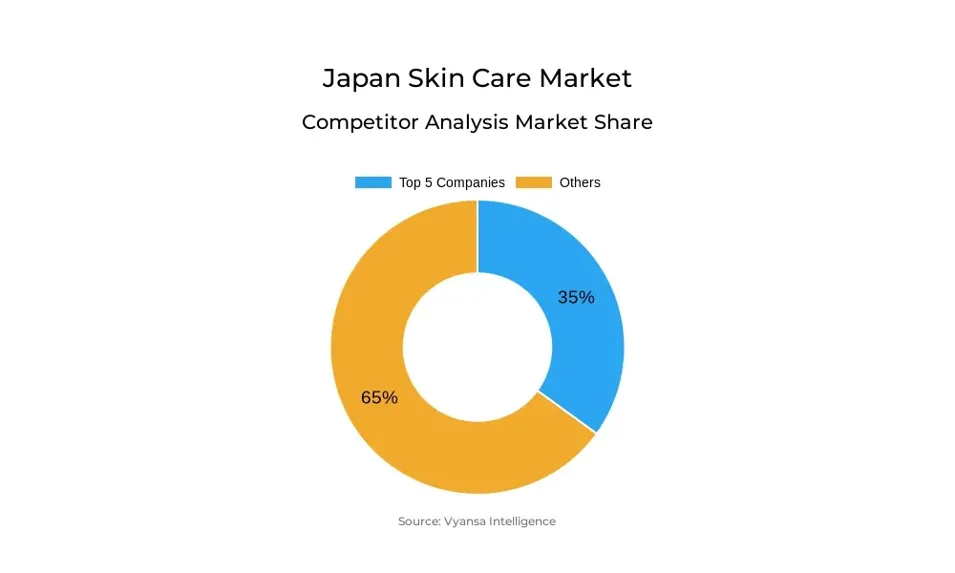
- Top 5 companies acquired 35% of the market share.
- Kanebo Cosmetics Inc, DHC Corp, Pola Inc, Shiseido Co Ltd, Kosé Corp etc., are few of the top companies.
- Sales Channel
- Retail Offline grabbed 75% of the market.
Japan Skin Care Market Outlook
Japan skin care market is set to experience steady growth between 2025–2030 with increased demand for high-efficacy and targeted care products. While inbound tourism is unlikely to return to pre-pandemic levels, domestic consumption continues to be strong, particularly in facial care, anti-ageing, and special care products such as face masks. Luxury brands should outstrip mass products, underpinned by strengthening unit prices and demand for more sophisticated formulations. Increasing interest in hand care and specific products for eyes and lips also demonstrates the move toward specialist treatment.
Medical aesthetics is at the forefront of product innovation. With South Korea's influence, consumers are increasingly looking for skin care regimens that deliver professional-level results at home. To capitalize on this trend, brands are introducing products that mimic treatments such as microneedling, thread lifting, and peeling. National and international brands alike are including medical actives like glutathione and vitamin C in their products to cater to this increasing demand.
With the increase in sensitive skin issues, driven by environmental stressors such as pollution, UV radiation, and global warming, demand for dermocosmetics is also being driven. Players that provide mild yet efficient solutions, like low-irritation pore care and products for safeguarding the skin barrier, are going to gain even more momentum. Meanwhile, inner beauty is increasingly gaining relevance, and supplements and functional ingredients are now being incorporated into skin care routines.
Lastly, high-tech personalisation is becoming a dominant trend. Brands are investing in skin analysis technology and bespoke formulations to suit personal needs. From AI-based suggestions to products made from iPS cells, innovation is enabling brands to differentiate themselves and win over health-conscious, results-oriented consumers.
Japan Skin Care Market Trend
An increasing trend in the skin care market in Japan is the melding of inner and outer beauty, as consumers increasingly recognize the connection between overall health and skin. With increased fascination with gut health and immune system support, companies are creating products that penetrate beyond the surface to treat internal drivers of appearance. For instance, in July 2024, Shiseido added Ultimune Probiotic Powder to promote gut and immune health, while Kosé debuted Nu+Rhythm in September 2024, a series that is centered on skin and mucous membrane nutrients.
In March 2025, Tokiwa Pharmaceutical launched GLASOON, a line that integrates serums, creams, and supplements, demonstrating the increased synergy between skin care and wellness. This trend is being led by heightened consumer desire for comprehensive solutions as well as greater understanding of how optimal nutrition and internal wellness affect the skin.
Japan Skin Care Market Opportunity
Japan is experiencing surging demand for sophisticated personalised skin care as consumer tastes become more discerning. Brands with accurate skin analysis and customized solutions are becoming increasingly popular, which enables them to differentiate themselves in a crowded market. For example, Shiseido's brand ÍPSA incorporates a skin-measuring device that scans more than 52 characteristics, enabling the brand to suggest products based on individual requirements. Such personalisation not just enhances customer satisfaction but also creates greater brand allegiance.
Kosé's premium range Cosme Decorté AQ, as per a survey, launched a cleansing serum created through quantum computing, fusing luxury and innovation. In a first-of-its-kind move that started in August 2024, Kosé collaborated with hospitals to develop beauty products through the use of iPS cells of customers. Targeting the initial 30, this is a move towards ultra-personalized solutions. Other brands are likely to follow suit with similar technology to keep pace with evolving consumer preferences.
Unlock Market Intelligence
Explore the market potential with our data-driven report
| Report Coverage | Details |
|---|---|
| Market Forecast | 2025-30 |
| USD Value 2024 | $ 14.38 Billion |
| USD Value 2030 | $ 15.24 Billion |
| CAGR 2025-2030 | 0.97% |
| Largest Category | Facial Care segment leads with 90% market share |
| Top Trends | Rising Adoption of Holistic Beauty Solutions |
| Top Opportunities | Growing Scope for High-Tech Personalisation |
| Key Players | Kanebo Cosmetics Inc, DHC Corp, Pola Inc, Shiseido Co Ltd, Kosé Corp, Kao Corp, Rohto Pharmaceutical Co Ltd, Fancl Corp, Nivea-Kao Co Ltd, P&G Japan Ltd, The and Others. |
Unlock Market Intelligence
Explore the market potential with our data-driven report
Japan Skin Care Market Segmentation Analysis
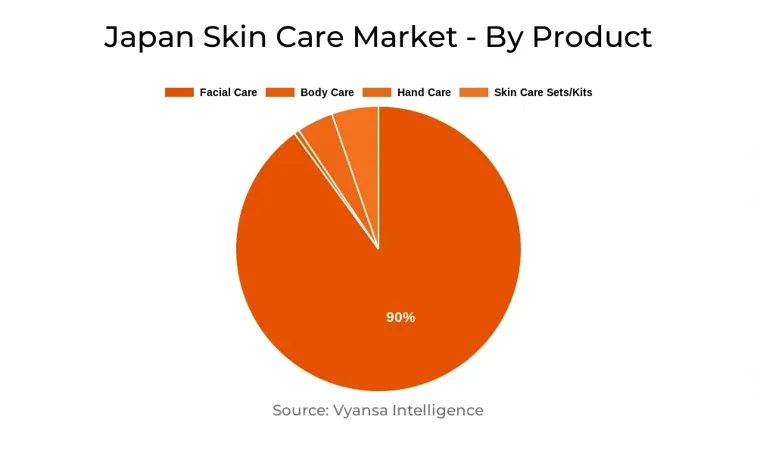
The most prominent market share segment in terms of product type within the Japan Skin Care Market is Facial Care, which continued to reign supreme in 2024 and is forecast to dominate in 2025-30. This is largely because of increasing consumer demand for self-care and solution-based products such as face masks and anti-aging products. Companies like Lululun broadened their base with new product introductions and increased regular users. Even those conventional body care brands such as Ayura and Rohto Pharmaceutical's CareCera moved into facial care, reflecting the increasing emphasis on this category. Lip care also gained popularity fueled by products with skin care benefits presented by brands including Mentholatum, Nivea, and Curel.
Based on a survey, the growth in medical aesthetics has even boosted the facial care category. Borrowing ideas Popular in South Korea such as lasers and needling are now being infused in home-use products. VT Cosmetics and Momotanijuntenkan introduced new products with microneedles and lifting effects, whereas Premier Anti-Aging brought Lalaskin with advanced ingredients such as glutathione and vitamin C. The trend reflects the focus on getting professional-like results using home skin care.
Top Companies in Japan Skin Care Market
The top companies operating in the market include Kanebo Cosmetics Inc, DHC Corp, Pola Inc, Shiseido Co Ltd, Kosé Corp, Kao Corp, Rohto Pharmaceutical Co Ltd, Fancl Corp, Nivea-Kao Co Ltd, P&G Japan Ltd, The, etc., are the top players operating in the Japan Skin Care Market.
Frequently Asked Questions
Related Report
1. Market Segmentation
1.1. Research Scope
1.2. Research Methodology
1.3. Definitions and Assumptions
2. Executive Summary
3. Japan Skin Care Market Policies, Regulations, and Standards
4. Japan Skin Care Market Dynamics
4.1. Growth Factors
4.2. Challenges
4.3. Trends
4.4. Opportunities
5. Japan Skin Care Market Statistics, 2020-2030F
5.1. Market Size & Growth Outlook
5.1.1.By Revenues in US$ Million
5.2. Market Segmentation & Growth Outlook
5.2.1.By Product
5.2.1.1. Body Care- Market Insights and Forecast 2020-2030, USD Million
5.2.1.1.1. Firming Body Care- Market Insights and Forecast 2020-2030, USD Million
5.2.1.1.2. General Purpose Body Care- Market Insights and Forecast 2020-2030, USD Million
5.2.1.2. Facial Care- Market Insights and Forecast 2020-2030, USD Million
5.2.1.2.1. Acne Treatments- Market Insights and Forecast 2020-2030, USD Million
5.2.1.2.2. Face Masks- Market Insights and Forecast 2020-2030, USD Million
5.2.1.2.3. Facial Cleansers- Market Insights and Forecast 2020-2030, USD Million
5.2.1.2.3.1. Liquid- Market Insights and Forecast 2020-2030, USD Million
5.2.1.2.3.2. Cream- Market Insights and Forecast 2020-2030, USD Million
5.2.1.2.3.3. Gel- Market Insights and Forecast 2020-2030, USD Million
5.2.1.2.3.4. Bar Cleansers- Market Insights and Forecast 2020-2030, USD Million
5.2.1.2.3.5. Facial Cleansing Wipes- Market Insights and Forecast 2020-2030, USD Million
5.2.1.2.4. Moisturisers and Treatments- Market Insights and Forecast 2020-2030, USD Million
5.2.1.2.4.1. Basic Moisturisers- Market Insights and Forecast 2020-2030, USD Million
5.2.1.2.4.2. Anti-Agers- Market Insights and Forecast 2020-2030, USD Million
5.2.1.2.5. Lip Care- Market Insights and Forecast 2020-2030, USD Million
5.2.1.2.6. Toners- Market Insights and Forecast 2020-2030, USD Million
5.2.1.3. Hand Care- Market Insights and Forecast 2020-2030, USD Million
5.2.1.4. Skin Care Sets/Kits- Market Insights and Forecast 2020-2030, USD Million
5.2.2.By Category
5.2.2.1. Premium- Market Insights and Forecast 2020-2030, USD Million
5.2.2.2. Mass- Market Insights and Forecast 2020-2030, USD Million
5.2.3.By Gender
5.2.3.1. Men- Market Insights and Forecast 2020-2030, USD Million
5.2.3.2. Women- Market Insights and Forecast 2020-2030, USD Million
5.2.3.3. Unisex- Market Insights and Forecast 2020-2030, USD Million
5.2.4.By End User
5.2.4.1. Adults- Market Insights and Forecast 2020-2030, USD Million
5.2.4.2. Teenagers- Market Insights and Forecast 2020-2030, USD Million
5.2.4.3. Children- Market Insights and Forecast 2020-2030, USD Million
5.2.5.By Packaging
5.2.5.1. Tubes- Market Insights and Forecast 2020-2030, USD Million
5.2.5.2. Bottles- Market Insights and Forecast 2020-2030, USD Million
5.2.5.3. Jars- Market Insights and Forecast 2020-2030, USD Million
5.2.5.4. Others- Market Insights and Forecast 2020-2030, USD Million
5.2.6.By Sales Channel
5.2.6.1. Online- Market Insights and Forecast 2020-2030, USD Million
5.2.6.2. Offline- Market Insights and Forecast 2020-2030, USD Million
5.2.7.By Competitors
5.2.7.1. Competition Characteristics
5.2.7.2. Market Share & Analysis
6. Japan Body Care Market Statistics, 2020-2030F
6.1. Market Size & Growth Outlook
6.1.1.By Revenues in US$ Million
6.2. Market Segmentation & Growth Outlook
6.2.1.By Product- Market Insights and Forecast 2020-2030, USD Million
6.2.2.By Category- Market Insights and Forecast 2020-2030, USD Million
6.2.3.By Gender- Market Insights and Forecast 2020-2030, USD Million
6.2.4.By End User- Market Insights and Forecast 2020-2030, USD Million
6.2.5.By Packaging- Market Insights and Forecast 2020-2030, USD Million
6.2.6.By Sales Channel- Market Insights and Forecast 2020-2030, USD Million
7. Japan Facial Care Market Statistics, 2020-2030F
7.1. Market Size & Growth Outlook
7.1.1.By Revenues in US$ Million
7.2. Market Segmentation & Growth Outlook
7.2.1.By Product- Market Insights and Forecast 2020-2030, USD Million
7.2.2.By Category- Market Insights and Forecast 2020-2030, USD Million
7.2.3.By Gender- Market Insights and Forecast 2020-2030, USD Million
7.2.4.By End User- Market Insights and Forecast 2020-2030, USD Million
7.2.5.By Packaging- Market Insights and Forecast 2020-2030, USD Million
7.2.6.By Sales Channel- Market Insights and Forecast 2020-2030, USD Million
8. Japan Hand Care Market Statistics, 2020-2030F
8.1. Market Size & Growth Outlook
8.1.1.By Revenues in US$ Million
8.2. Market Segmentation & Growth Outlook
8.2.1.By Category- Market Insights and Forecast 2020-2030, USD Million
8.2.2.By Gender- Market Insights and Forecast 2020-2030, USD Million
8.2.3.By End User- Market Insights and Forecast 2020-2030, USD Million
8.2.4.By Packaging- Market Insights and Forecast 2020-2030, USD Million
8.2.5.By Sales Channel- Market Insights and Forecast 2020-2030, USD Million
9. Japan Skin Care Sets/Kits Market Statistics, 2020-2030F
9.1. Market Size & Growth Outlook
9.1.1.By Revenues in US$ Million
9.2. Market Segmentation & Growth Outlook
9.2.1.By Category- Market Insights and Forecast 2020-2030, USD Million
9.2.2.By Gender- Market Insights and Forecast 2020-2030, USD Million
9.2.3.By End User- Market Insights and Forecast 2020-2030, USD Million
9.2.4.By Packaging- Market Insights and Forecast 2020-2030, USD Million
9.2.5.By Sales Channel- Market Insights and Forecast 2020-2030, USD Million
10. Competitive Outlook
10.1. Company Profiles
10.1.1. Shiseido Co Ltd
10.1.1.1. Business Description
10.1.1.2. Product Portfolio
10.1.1.3. Collaborations & Alliances
10.1.1.4. Recent Developments
10.1.1.5. Financial Details
10.1.1.6. Others
10.1.2. Kosé Corp
10.1.2.1. Business Description
10.1.2.2. Product Portfolio
10.1.2.3. Collaborations & Alliances
10.1.2.4. Recent Developments
10.1.2.5. Financial Details
10.1.2.6. Others
10.1.3. Kao Corp
10.1.3.1. Business Description
10.1.3.2. Product Portfolio
10.1.3.3. Collaborations & Alliances
10.1.3.4. Recent Developments
10.1.3.5. Financial Details
10.1.3.6. Others
10.1.4. Rohto Pharmaceutical Co Ltd
10.1.4.1. Business Description
10.1.4.2. Product Portfolio
10.1.4.3. Collaborations & Alliances
10.1.4.4. Recent Developments
10.1.4.5. Financial Details
10.1.4.6. Others
10.1.5. Fancl Corp
10.1.5.1. Business Description
10.1.5.2. Product Portfolio
10.1.5.3. Collaborations & Alliances
10.1.5.4. Recent Developments
10.1.5.5. Financial Details
10.1.5.6. Others
10.1.6. Kanebo Cosmetics Inc
10.1.6.1. Business Description
10.1.6.2. Product Portfolio
10.1.6.3. Collaborations & Alliances
10.1.6.4. Recent Developments
10.1.6.5. Financial Details
10.1.6.6. Others
10.1.7. DHC Corp
10.1.7.1. Business Description
10.1.7.2. Product Portfolio
10.1.7.3. Collaborations & Alliances
10.1.7.4. Recent Developments
10.1.7.5. Financial Details
10.1.7.6. Others
10.1.8. Pola Inc
10.1.8.1. Business Description
10.1.8.2. Product Portfolio
10.1.8.3. Collaborations & Alliances
10.1.8.4. Recent Developments
10.1.8.5. Financial Details
10.1.8.6. Others
10.1.9. Nivea-Kao Co Ltd
10.1.9.1. Business Description
10.1.9.2. Product Portfolio
10.1.9.3. Collaborations & Alliances
10.1.9.4. Recent Developments
10.1.9.5. Financial Details
10.1.9.6. Others
10.1.10. P&G Japan Ltd, The
10.1.10.1.Business Description
10.1.10.2.Product Portfolio
10.1.10.3.Collaborations & Alliances
10.1.10.4.Recent Developments
10.1.10.5.Financial Details
10.1.10.6.Others
11. Disclaimer
| Segment | Sub-Segment |
|---|---|
| By Product |
|
| By Category |
|
| By Gender |
|
| By End User |
|
| By Packaging |
|
| By Sales Channel |
|
Research Methodology
This study followed a structured approach comprising four key phases to assess the size and scope of the electro-oxidation market. The process began with thorough secondary research to collect data on the target market, related markets, and broader industry context. These findings, along with preliminary assumptions and estimates, were then validated through extensive primary research involving industry experts from across the value chain. To calculate the overall market size, both top-down and bottom-up methodologies were employed. Finally, market segmentation and data triangulation techniques were applied to refine and validate segment-level estimations.
Secondary Research
The secondary research phase involved gathering data from a wide range of credible and published sources. This step helped in identifying industry trends, defining market segmentation, and understanding the market landscape and value chain.
Sources consulted during this phase included:
- Company annual reports, investor presentations, and press releases
- Industry white papers and certified publications
- Trade directories and market-recognized databases
- Articles from authoritative authors and reputable journals
- Gold and silver standard websites
Secondary research was critical in mapping out the industry's value chain and monetary flow, identifying key market segments, understanding regional variations, and tracking significant industry developments.
Other key sources:
- Financial disclosures
- Industry associations and trade bodies
- News outlets and business magazines
- Academic journals and research studies
- Paid industry databases
Primary Research
To validate secondary data and gain deeper market insights, primary research was conducted with key stakeholders across both the supply and demand sides of the market.
On the demand side, participants included decision-makers and influencers from end-user industries—such as CIOs, CTOs, and CSOs—who provided first-hand perspectives on market needs, product usage, and future expectations.
On the supply side, interviews were conducted with manufacturers, industry associations, and institutional participants to gather insights into current offerings, product pipelines, and market challenges.
Primary interviews provided critical inputs such as:
- Market size and revenue data
- Product and service breakdowns
- Market forecasts
- Regional and application-specific trends
Stakeholders consulted included:
- Leading OEM and solution providers
- Channel and distribution partners
- End users across various applications
- Independent consultants and industry specialists
Market Size Estimation and Data Triangulation
- Identifying Key Market Participants (Secondary Research)
- Goal: To identify the major players or companies in the target market. This typically involves using publicly available data sources such as industry reports, market research publications, and financial statements of companies.
- Tools: Reports from firms like Gartner, Forrester, Euromonitor, Statista, IBISWorld, and others. Public financial statements, news articles, and press releases from top market players.
- Extracting Earnings of Key Market Participants
- Goal: To estimate the earnings generated from the product or service being analyzed. This step helps in understanding the revenue potential of each market player in a specific geography.
- Methods: Earnings data can be gathered from:
- Publicly available financial reports (for listed companies).
- Interviews and primary data sources from professionals, such as Directors, VPs, SVPs, etc. This is especially useful for understanding more nuanced, internal data that isn't publicly disclosed.
- Annual reports and investor presentations of key players.
- Data Collation and Development of a Relevant Data Model
- Goal: To collate inputs from both primary and secondary sources into a structured, data-driven model for market estimation. This model will incorporate key market KPIs and any independent variables relevant to the market.
- Key KPIs: These could include:
- Market size, growth rate, and demand drivers.
- Industry-specific metrics like market share, average revenue per customer (ARPC), or average deal size.
- External variables, such as economic growth rates, inflation rates, or commodity prices, that could affect the market.
- Data Modeling: Based on this data, the market forecasts are developed for the next 5 years. A combination of trend analysis, scenario modeling, and statistical regression might be used to generate projections.
- Scenario Analysis
- Goal: To test different assumptions and validate how sensitive the market is to changes in key variables (e.g., market demand, regulatory changes, technological disruptions).
- Types of Scenarios:
- Base Case: Based on current assumptions and historical data.
- Best-Case Scenario: Assuming favorable market conditions, regulatory environments, and technological advancements.
- Worst-Case Scenario: Accounting for adverse factors, such as economic downturns, stricter regulations, or unexpected disruptions.












