Japan Menstrual Care Market Report: Trends, Growth and Forecast (2026-2032)
By Product Type (Pantyliners, Tampons (Applicator Tampons, Digital Tampons), Towels (Standard Towels (Standard Towels with Wings, Standard Towels Without Wings), Slim/Thin/Ultra-Thin Towels (Slim/Thin/Ultra-Thin Towels with Wings, Slim/Thin/Ultra-Thin Towels Without Wings)), Intimate Wipes, Menstrual Cups, Period Underwear), By Nature (Disposable, Reusable), By Age Group (Up to 18 Years, 19-30 Years, 31-40 Years, 40 Years and Above), By Sales Channel (Retail Offline, Retail Online) ... Read more

|
Major Players
|
Japan Menstrual Care Market Statistics and Insights, 2026
- Market Size Statistics
- Menstrual care in Japan is estimated at USD 700 million in 2025.
- The market size is expected to grow to USD 755 million by 2032.
- Market to register a cagr of around 1.09% during 2026-32.
- Product Type Shares
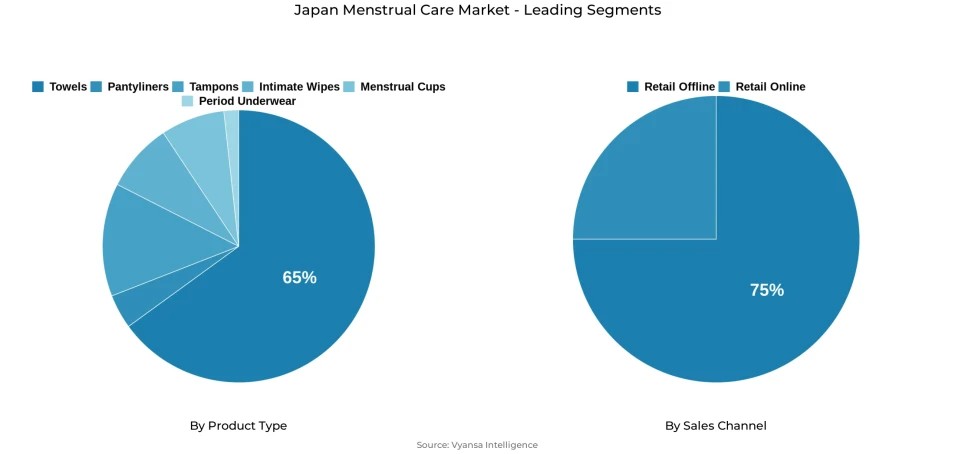
- Towels grabbed market share of 65%.
- Competition
- More than 5 companies are actively engaged in producing menstrual care in Japan.
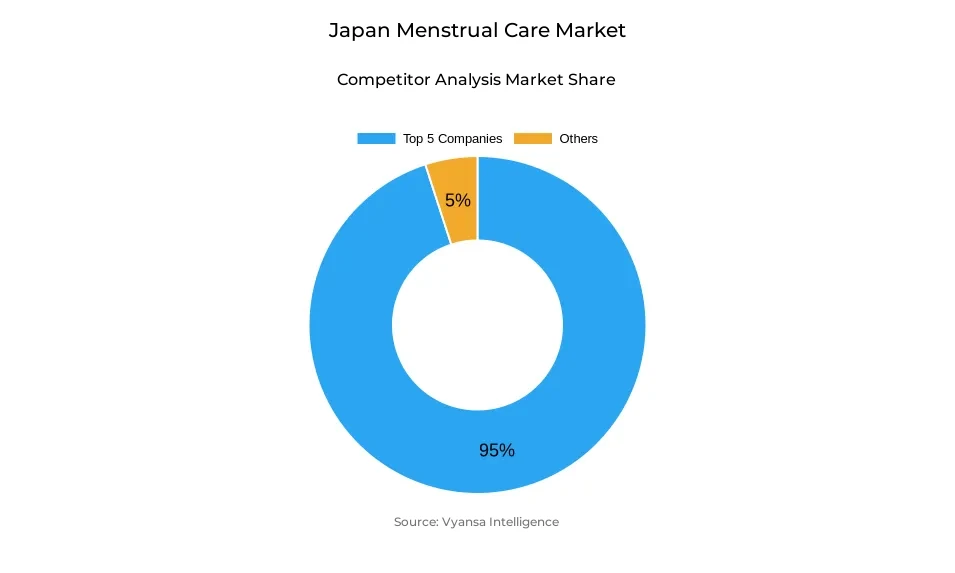
- Top 5 companies acquired around 95% of the market share.
- Kobayashi Pharmaceutical Co Ltd; Procter & Gamble Japan KK; Daio Paper Corp; Unicharm Corp; Kao Corp etc., are few of the top companies.
- Sales Channel
- Retail offline grabbed 75% of the market.
Japan Menstrual Care Market Outlook
Japan menstrual care market is set to increase consistently within the period of forecast with the market estimated to stand at 700 million dollars in 2025 and projected to increase to 755 million dollars by 2032 with the CAGR at about 1.09. It is expected to broaden its retail value although the volume sales will fall due to the old age population in the menstrual period and the prevalence of contraceptives. The increased unit prices and the change towards the high value-added product will assist to keep the market at steady levels and contribute to the growth in revenues.
Towels are the product that is leading the market share (65%). Slim/thin/ultra-thin models are likely to keep on gaining popularity because it is convenient, discrete and fits in active lifestyles. Regular towels can experience a falling turnover, whereas new products like flushable Synchro Fit pads and ovulation indicator pantyliners will most probably contribute to incremental growth. Niche products, such as pantyliners and reusable products, are expected to continue to be relevant as women demand daily hygiene and alternative products that are sustainable.
The retail offline channels will persist and will occupy 75 percent of these sales with the health and beauty specialists being the main outlets. MatsukiyoCocokara & Co drugstores will be likely to maintain their leadership position by using their networks, house-label services, and in-store experiences. The e-commerce will experience a moderate growth offering convenience and discretion to end user who would like to have their necessities delivered to their homes.
In the future, premium femtech and femcare will be an important factor in support of the market. The consumer engagement will be catalyzed by company efforts like Unicharm and Kao like ovulation-tracking products and programs at their workplace. The emphasis on innovation, comfort, and inclusivity is likely to win the loyalty and incremental growth in the market that is conditioned by the demographic changes and increasing needs of end user.
Japan Menstrual Care Market Growth DriverYen Depreciation and Inflation Maintain Value Growth.
The Japan Menstrual Care Market is still expanding in terms of retail current value although its volume has dropped slightly due to the macroeconomic factors. The yen is also very weak, and its value is approximately 151.4 JPY/USD in 2024 and 109.8 in 2021. This debasing, along with the escalation in inflation, causes an increase in the price of units of the necessities, such as menstrual care supplies. In 2024, consumer prices are increasing more than 2 percent, one of the long periods in decades of constant inflation.
The high cost plus the ease of movement after the pandemic and a back-to-office workforce make Japan women buy lightweight, thin, slim, and ultra-thin towels to stay comfortable and be discrete throughout the day. The products address the increasing need of portable and hygienic products that are used when commuting, socially and at workplace.
Japan Menstrual Care Market ChallengeFalling Consumer Base as a Result of Aging and Low Birth Rate.
Japan’s declining birth rate and rapidly ageing population are resulting in a shrinking addressable base for menstrual care products.. The number of women of reproductive age is estimated to reduce to UAD 21 million in 2030 as opposed to USD 24 million in 2024, which narrows the number of end user. This population trend puts companies in stress to develop high value products to ensure profitability.
Furthermore, the increase in the cost of production in the wake of high inflation makes it difficult to make the products affordable in addition to satisfying quality and comfort standards. Manufacturers need to strike a balance of cost, innovation, and accessibility on the market to sail through the effects of the decreasing population on the long-term demand of products.
Unlock Market Intelligence
Explore the market potential with our data-driven report
Japan Menstrual Care Market TrendFemtech and Health-Centered Solutions Moving Product Innovation.
The Japan menstrual care market is changing due to the integration of health and technologies. An estimated loss of JPY 2.76 trillion is experienced every year due to menstrual disorders and other associated health problems, which points to the possibility of femtech solutions. Such products as ovulation indicators pantyliners and apps to track their cycles are becoming popular, especially with younger women who are more technologically inclined.
The innovations assist in personal health management, and it provides hormonal balance, irregularities in cycle and overall wellness tracking. The solutions associated with Femtech are improved user experiences that increase brand loyalty, as they match the health-oriented lifestyles. The shift indicates a gradual increase in the acceptance of digital health tools and personalised care solutions in Japan.
Japan Menstrual Care Market OpportunityInnovative and sustainable solutions to the growth in the future.
Sustainability and inclusivity at the workplace will establish opportunities to grow. Programs by the government to attain sustainable consumption and waste management will facilitate the use of reusable pads and flushable products. B2B programs to offices, hotels, hospitals and care facilities will offer product high value adoption possibilities.
Other programs such as Workplace Laurier by Kao will include menstrual care products in the office space to create inclusive environments, catering to urgent menstrual needs and taking care of the employees wellbeing. Brands based on culturally specific solutions (like olive oil-based towels on sensitive skin) will be noticed as products that use natural ingredients. These plans will integrate the innovation, sustainability and social responsibility to grow in the long term.
Unlock Market Intelligence
Explore the market potential with our data-driven report
Japan Menstrual Care Market Segmentation Analysis
By Product Type
- Pantyliners
- Tampons
- Applicator Tampons
- Digital Tampons
- Towels
- Standard Towels
- Standard Towels with Wings
- Standard Towels Without Wings
- Slim/Thin/Ultra-Thin Towels
- Slim/Thin/Ultra-Thin Towels with Wings
- Slim/Thin/Ultra-Thin Towels Without Wings
- Standard Towels
- Intimate Wipes
- Menstrual Cups
- Period Underwear
The segment with the highest share under the product type in the Japan Menstrual Care Market is Towels, accounting for around 65% of the market. Towels remain the most widely used menstrual care product due to their convenience, reliability, and familiarity across all age groups. Slim, thin, and ultra-thin towels are gaining popularity, particularly among younger and more active end user who prefer discreet, comfortable, and lightweight options for daytime use, while standard towels are still chosen for overnight protection.
Despite increasing interest in reusable products such as washable pants and other femtech solutions, towels continue to dominate in value terms. Manufacturers focus on innovation within disposable products, including advanced absorption features, ergonomic designs, and eco-friendly materials, ensuring towels remain the mainstay of menstrual care in Japan. This approach supports both consumer convenience and premiumisation strategies, keeping towels at the forefront of the market.
By Sales Channel
- Retail Offline
- Retail Online
The segment with the highest share under the sales channel in the Japan Menstrual Care Market is Retail Offline, holding around 75% of the market. Physical stores, including drugstores, pharmacies, and supermarkets, remain the preferred shopping destination for menstrual care products, as end user value immediate availability, expert guidance, and the ability to compare options before purchasing. Health and beauty specialists, in particular, dominate distribution by offering a wide selection of products, including private labels and premium lines.
While e-commerce continues to grow steadily due to convenience, home delivery, and discreet purchasing, offline retail maintains its dominance due to consumer habits and trust in established store-based channels. Supermarkets remain essential for regular purchases, while pharmacies provide personalised recommendations, reinforcing offline retail as the primary channel for menstrual care in Japan.
List of Companies Covered in Japan Menstrual Care Market
The companies listed below are highly influential in the Japan menstrual care market, with a significant market share and a strong impact on industry developments.
- Kobayashi Pharmaceutical Co Ltd
- Procter & Gamble Japan KK
- Daio Paper Corp
- Unicharm Corp
- Kao Corp
Competitive Landscape
Japan Menstrual Care Market remains highly competitive, led by Unicharm Corp, which maintains dominance through its wide Sofy portfolio and continuous innovation in femcare and femtech solutions, including products like Synchro Fit and digital health tools such as the Sofy Be app. The company’s focus on functionality, convenience, and lifecycle-based women’s health support strengthens its market leadership. Daio Paper Corp also recorded strong value growth, supported by logistics optimisation and collaborative distribution initiatives. Meanwhile, Kao is reshaping competition through its shift toward B2B partnerships, expanding menstrual care accessibility in workplaces under the Workplace Laurier initiative. These strategic moves innovation, diversification, and channel expansion—collectively define Japan’s evolving competitive landscape.
Frequently Asked Questions
Related Report
1. Market Segmentation
1.1. Research Scope
1.2. Research Methodology
1.3. Definitions and Assumptions
2. Executive Summary
3. Japan Menstrual Care Market Policies, Regulations, and Standards
4. Japan Menstrual Care Market Dynamics
4.1. Growth Factors
4.2. Challenges
4.3. Trends
4.4. Opportunities
5. Japan Menstrual Care Market Statistics, 2022-2032F
5.1. Market Size & Growth Outlook
5.1.1.By Revenues in USD Million
5.2. Market Segmentation & Growth Outlook
5.2.1.By Product Type
5.2.1.1. Pantyliners- Market Insights and Forecast 2022-2032, USD Million
5.2.1.2. Tampons- Market Insights and Forecast 2022-2032, USD Million
5.2.1.2.1. Applicator Tampons- Market Insights and Forecast 2022-2032, USD Million
5.2.1.2.2. Digital Tampons- Market Insights and Forecast 2022-2032, USD Million
5.2.1.3. Towels- Market Insights and Forecast 2022-2032, USD Million
5.2.1.3.1. Standard Towels- Market Insights and Forecast 2022-2032, USD Million
5.2.1.3.1.1. Standard Towels with Wings- Market Insights and Forecast 2022-2032, USD Million
5.2.1.3.1.2. Standard Towels Without Wings- Market Insights and Forecast 2022-2032, USD Million
5.2.1.3.2. Slim/Thin/Ultra-Thin Towels- Market Insights and Forecast 2022-2032, USD Million
5.2.1.3.2.1. Slim/Thin/Ultra-Thin Towels with Wings- Market Insights and Forecast 2022-2032, USD Million
5.2.1.3.2.2. Slim/Thin/Ultra-Thin Towels Without Wings- Market Insights and Forecast 2022-2032, USD Million
5.2.1.4. Intimate Wipes- Market Insights and Forecast 2022-2032, USD Million
5.2.1.5. Menstrual Cups- Market Insights and Forecast 2022-2032, USD Million
5.2.1.6. Period Underwear- Market Insights and Forecast 2022-2032, USD Million
5.2.2.By Nature
5.2.2.1. Disposable- Market Insights and Forecast 2022-2032, USD Million
5.2.2.2. Reusable- Market Insights and Forecast 2022-2032, USD Million
5.2.3.By Age Group
5.2.3.1. Up to 18 Years- Market Insights and Forecast 2022-2032, USD Million
5.2.3.2. 19-30 Years- Market Insights and Forecast 2022-2032, USD Million
5.2.3.3. 31-40 Years- Market Insights and Forecast 2022-2032, USD Million
5.2.3.4. 40 Years and Above- Market Insights and Forecast 2022-2032, USD Million
5.2.4.By Sales Channel
5.2.4.1. Retail Offline- Market Insights and Forecast 2022-2032, USD Million
5.2.4.2. Retail Online- Market Insights and Forecast 2022-2032, USD Million
5.2.5.By Competitors
5.2.5.1. Competition Characteristics
5.2.5.2. Market Share & Analysis
6. Japan Pantyliners Menstrual Care Market Statistics, 2022-2032
6.1. Market Size & Growth Outlook
6.1.1.By Revenues in USD Million
6.2. Market Segmentation & Growth Outlook
6.2.1.By Nature- Market Insights and Forecast 2022-2032, USD Million
6.2.2.By Age Group- Market Insights and Forecast 2022-2032, USD Million
6.2.3.By Sales Channel- Market Insights and Forecast 2022-2032, USD Million
7. Japan Tampons Menstrual Care Market Statistics, 2022-2032
7.1. Market Size & Growth Outlook
7.1.1.By Revenues in USD Million
7.2. Market Segmentation & Growth Outlook
7.2.1.By Product Type- Market Insights and Forecast 2022-2032, USD Million
7.2.2.By Nature- Market Insights and Forecast 2022-2032, USD Million
7.2.3.By Age Group- Market Insights and Forecast 2022-2032, USD Million
7.2.4.By Sales Channel- Market Insights and Forecast 2022-2032, USD Million
8. Japan Towels Menstrual Care Market Statistics, 2022-2032
8.1. Market Size & Growth Outlook
8.1.1.By Revenues in USD Million
8.2. Market Segmentation & Growth Outlook
8.2.1.By Product Type- Market Insights and Forecast 2022-2032, USD Million
8.2.2.By Nature- Market Insights and Forecast 2022-2032, USD Million
8.2.3.By Age Group- Market Insights and Forecast 2022-2032, USD Million
8.2.4.By Sales Channel- Market Insights and Forecast 2022-2032, USD Million
9. Japan Intimate Wipes Market Statistics, 2022-2032
9.1. Market Size & Growth Outlook
9.1.1.By Revenues in USD Million
9.2. Market Segmentation & Growth Outlook
9.2.1.By Nature- Market Insights and Forecast 2022-2032, USD Million
9.2.2.By Age Group- Market Insights and Forecast 2022-2032, USD Million
9.2.3.By Sales Channel- Market Insights and Forecast 2022-2032, USD Million
10. Japan Menstrual Cups Menstrual Care Market Statistics, 2022-2032
10.1. Market Size & Growth Outlook
10.1.1. By Revenues in USD Million
10.2. Market Segmentation & Growth Outlook
10.2.1. By Nature- Market Insights and Forecast 2022-2032, USD Million
10.2.2. By Age Group- Market Insights and Forecast 2022-2032, USD Million
10.2.3. By Sales Channel- Market Insights and Forecast 2022-2032, USD Million
11. Japan Period Underwear Menstrual Care Market Statistics, 2022-2032
11.1. Market Size & Growth Outlook
11.1.1. By Revenues in USD Million
11.2. Market Segmentation & Growth Outlook
11.2.1. By Nature- Market Insights and Forecast 2022-2032, USD Million
11.2.2. By Age Group- Market Insights and Forecast 2022-2032, USD Million
11.2.3. By Sales Channel- Market Insights and Forecast 2022-2032, USD Million
12. Competitive Outlook
12.1. Company Profiles
12.1.1. Unicharm Corp
12.1.1.1. Business Description
12.1.1.2. Product Portfolio
12.1.1.3. Collaborations & Alliances
12.1.1.4. Recent Developments
12.1.1.5. Financial Details
12.1.1.6. Others
12.1.2. Kao Corp
12.1.2.1. Business Description
12.1.2.2. Product Portfolio
12.1.2.3. Collaborations & Alliances
12.1.2.4. Recent Developments
12.1.2.5. Financial Details
12.1.2.6. Others
12.1.3. Daio Paper Corp
12.1.3.1. Business Description
12.1.3.2. Product Portfolio
12.1.3.3. Collaborations & Alliances
12.1.3.4. Recent Developments
12.1.3.5. Financial Details
12.1.3.6. Others
12.1.4. Kobayashi Pharmaceutical Co Ltd
12.1.4.1. Business Description
12.1.4.2. Product Portfolio
12.1.4.3. Collaborations & Alliances
12.1.4.4. Recent Developments
12.1.4.5. Financial Details
12.1.4.6. Others
12.1.5. Procter & Gamble Japan KK
12.1.5.1. Business Description
12.1.5.2. Product Portfolio
12.1.5.3. Collaborations & Alliances
12.1.5.4. Recent Developments
12.1.5.5. Financial Details
12.1.5.6. Others
13. Disclaimer
| Segment | Sub-Segment |
|---|---|
| By Product Type |
|
| By Nature |
|
| By Age Group |
|
| By Sales Channel |
|
Research Methodology
This study followed a structured approach comprising four key phases to assess the size and scope of the electro-oxidation market. The process began with thorough secondary research to collect data on the target market, related markets, and broader industry context. These findings, along with preliminary assumptions and estimates, were then validated through extensive primary research involving industry experts from across the value chain. To calculate the overall market size, both top-down and bottom-up methodologies were employed. Finally, market segmentation and data triangulation techniques were applied to refine and validate segment-level estimations.
Secondary Research
The secondary research phase involved gathering data from a wide range of credible and published sources. This step helped in identifying industry trends, defining market segmentation, and understanding the market landscape and value chain.
Sources consulted during this phase included:
- Company annual reports, investor presentations, and press releases
- Industry white papers and certified publications
- Trade directories and market-recognized databases
- Articles from authoritative authors and reputable journals
- Gold and silver standard websites
Secondary research was critical in mapping out the industry's value chain and monetary flow, identifying key market segments, understanding regional variations, and tracking significant industry developments.
Other key sources:
- Financial disclosures
- Industry associations and trade bodies
- News outlets and business magazines
- Academic journals and research studies
- Paid industry databases
Primary Research
To validate secondary data and gain deeper market insights, primary research was conducted with key stakeholders across both the supply and demand sides of the market.
On the demand side, participants included decision-makers and influencers from end-user industries—such as CIOs, CTOs, and CSOs—who provided first-hand perspectives on market needs, product usage, and future expectations.
On the supply side, interviews were conducted with manufacturers, industry associations, and institutional participants to gather insights into current offerings, product pipelines, and market challenges.
Primary interviews provided critical inputs such as:
- Market size and revenue data
- Product and service breakdowns
- Market forecasts
- Regional and application-specific trends
Stakeholders consulted included:
- Leading OEM and solution providers
- Channel and distribution partners
- End users across various applications
- Independent consultants and industry specialists
Market Size Estimation and Data Triangulation
- Identifying Key Market Participants (Secondary Research)
- Goal: To identify the major players or companies in the target market. This typically involves using publicly available data sources such as industry reports, market research publications, and financial statements of companies.
- Tools: Reports from firms like Gartner, Forrester, Euromonitor, Statista, IBISWorld, and others. Public financial statements, news articles, and press releases from top market players.
- Extracting Earnings of Key Market Participants
- Goal: To estimate the earnings generated from the product or service being analyzed. This step helps in understanding the revenue potential of each market player in a specific geography.
- Methods: Earnings data can be gathered from:
- Publicly available financial reports (for listed companies).
- Interviews and primary data sources from professionals, such as Directors, VPs, SVPs, etc. This is especially useful for understanding more nuanced, internal data that isn't publicly disclosed.
- Annual reports and investor presentations of key players.
- Data Collation and Development of a Relevant Data Model
- Goal: To collate inputs from both primary and secondary sources into a structured, data-driven model for market estimation. This model will incorporate key market KPIs and any independent variables relevant to the market.
- Key KPIs: These could include:
- Market size, growth rate, and demand drivers.
- Industry-specific metrics like market share, average revenue per customer (ARPC), or average deal size.
- External variables, such as economic growth rates, inflation rates, or commodity prices, that could affect the market.
- Data Modeling: Based on this data, the market forecasts are developed for the next 5 years. A combination of trend analysis, scenario modeling, and statistical regression might be used to generate projections.
- Scenario Analysis
- Goal: To test different assumptions and validate how sensitive the market is to changes in key variables (e.g., market demand, regulatory changes, technological disruptions).
- Types of Scenarios:
- Base Case: Based on current assumptions and historical data.
- Best-Case Scenario: Assuming favorable market conditions, regulatory environments, and technological advancements.
- Worst-Case Scenario: Accounting for adverse factors, such as economic downturns, stricter regulations, or unexpected disruptions.












