Japan Iris Recognition Market Report: Trends, Growth and Forecast (2026-2032)
By Component (Hardware, Software), By Product Type (Iris Scanners, Access Control & Time Attendance Terminals, Border Control Kiosks/eGates, Smartphones, Embedded/OEM Iris Modules, Others), By Application (Identity Management & Access Control, Border Control & Immigration, Time Monitoring, E-Payment, Others), By End Use (Government, Military & Defense, BFSI, Healthcare, Consumer Electronics, Travel & Immigration, Automotive, Others) ... Read more
|
Major Players
|
Japan Iris Recognition Market Statistics and Insights, 2026
- Market Size Statistics
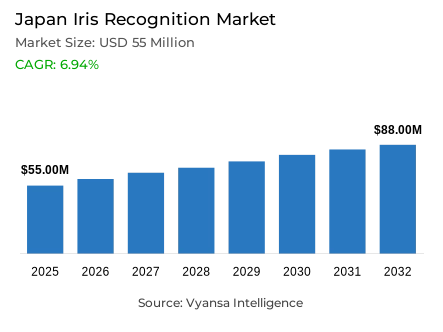
- Iris recognition market size in Japan was valued at USD 55 million in 2025 and is estimated at USD 61 million in 2026.
- The market size is expected to grow to USD 88 million by 2032.
- Market to register a CAGR of around 6.94% during 2026-32.
- Application Shares
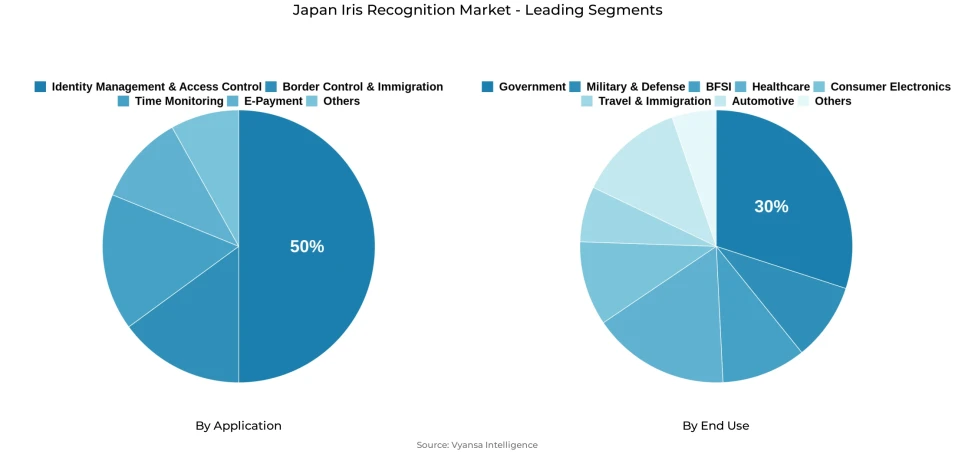
- Identity management & access control grabbed market share of 50%.
- Competition
- Iris recognition in Japan is currently being catered to by more than 10 companies.
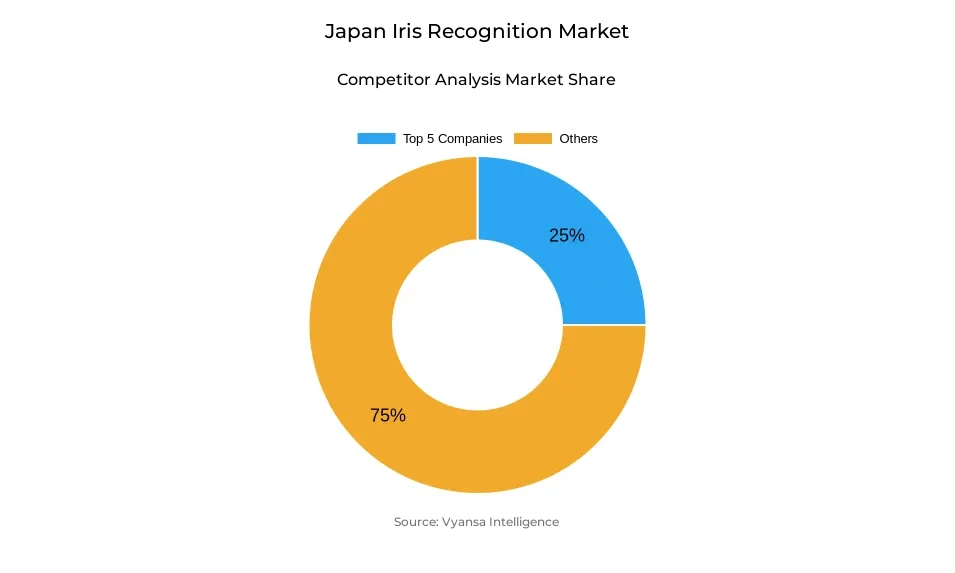
- Top 5 companies acquired around 25% of the market share in 2026.
- Marubeni Corporation, Sanwa Computer Co. Ltd., Crittec Japan Co. Ltd., NEC Corporation (Bio-IDiom), IDEMIA Japan KK etc., are few of the top companies.
- End Use
- Government grabbed 30% of the market.
Japan Iris Recognition Market Outlook
Global biometric security spending is shifting toward high assurance, contactless identity controls across government, enterprise, transport, healthcare, and financial environments. Within this setting, the Japan iris recognition market covers iris scanners, biometric software, access terminals, eGates, embedded modules, and identity verification platforms. The Japan iris recognition market was valued at USD 55 million in 2025 and is projected to reach USD 61 million in 2026 and USD 88 million by 2032, expanding at 6.94% during 2026-32.
Demand acceleration is supported by Japan’s digital identity infrastructure, airport automation, regulated facility security, and enterprise access modernization. Digital Agency states that My Number Card supports identity verification both in person and online across public and private use cases. This creates a stronger operating base for biometric identity management, where the Japan iris recognition industry benefits from higher acceptance of secure digital credentials, biometric authentication, and passwordless access frameworks.
Economic impact is concentrated in procurement visibility, system integration, and high-security workflow efficiency. Government agencies, financial institutions, healthcare operators, cleanroom manufacturers, and travel facilities require authentication that reduces credential loss, strengthens auditability, and supports compliance. Competitive positioning in the Japan iris recognition market is therefore shaped by accuracy, liveness detection, privacy governance, device availability, and integration strength across access control and identity management systems.
Supplier strategy is moving toward compact multimodal devices, software development kits, and local deployment partnerships. NEC, IDEMIA Japan KK, HID Global Corporation, THALES DIS JAPAN KK, and Swallow Incubate Co., Ltd. hold stronger positioning due to biometric technology depth and Japan presence. The Japan iris recognition industry is expected to prioritize government authentication, immigration processing, critical infrastructure, and enterprise access deployments through 2026, with adoption momentum supported by secure identity modernization rather than broad consumer replacement. and measurable gains in operational assurance across regulated sites and high-volume service points.
Japan Iris Recognition Market Growth Driver
Secure Identity Demand is Resetting Procurement Priorities
High-security access requirements in public services, financial onboarding, laboratories, and controlled manufacturing sites are increasing demand for contactless biometric identification. Passwords, cards, and PINs remain exposed to loss, sharing, and administrative friction, while iris biometric authentication offers durable identity binding. The Japan iris recognition market gains from this shift as buyers prioritize non-contact access control, audit trails, and stronger fraud prevention.
Digital Agency’s 2026 dashboard describes My Number Card as an identification card enabling secure identity verification in person and online, across public and private sectors. That national identity layer strengthens procurement confidence for advanced biometric verification systems, since agencies and enterprises already operate around formal identity credentials. The Japan iris recognition industry benefits because iris-based access control can extend that trust model into buildings, terminals, cleanrooms, and high-security service environments. Procurement teams also favor systems that minimize physical contact while preserving enrollment control and facility-level accountability across multi-site operations.
Japan Iris Recognition Market Challenge
Compliance Friction Slows Biometric Rollout
Privacy compliance and biometric-template governance create the strongest adoption bottleneck for high-assurance deployments. Iris patterns cannot be reset like passwords, so buyers require strict consent workflows, retention policies, encryption, and breach-response controls before scaling procurement. The iris recognition market in Japan therefore faces longer sales cycles in BFSI, healthcare, and government-linked environments where personal data risk assessment directly affects vendor selection.
Personal Information Protection Commission listed a January 2026 system reform policy under the triennial review of the Act on the Protection of Personal Information. That policy direction increases compliance scrutiny for advanced identity systems, especially where biometric templates support authentication or access decisions. The Japan iris recognition industry must absorb higher documentation, governance, and audit requirements, which can raise integration costs and slow smaller supplier participation. Vendors with transparent security architecture and local support are better placed to convert pilots into repeatable deployments across regulated facilities in Japan nationwide.
Unlock Market Intelligence
Explore the market potential with our data-driven report
Japan Iris Recognition Market Trend
Multimodal Authentication Moves Toward Operational Scale
Multimodal biometric authentication is shifting iris systems from standalone checkpoints toward integrated identity platforms. Combining face and iris signals improves assurance where masks, goggles, lighting variation, or high-throughput movement complicate single-factor recognition. The Japan iris recognition market is therefore moving toward compact modules, biometric SDKs, edge processing, and system designs that connect secure identity authentication with existing access-control infrastructure.
NEC reported in 2025 that its face and iris multimodal recognition can connect to customer computers and tablet devices while covering 10 million to 100 million users. This technology direction reduces device-size barriers and improves deployment flexibility for enterprise, border control, and citizen ID operations. The Japan iris recognition industry gains competitive depth as local suppliers package iris image capture with AI biometric recognition and platform integration. Interoperability also supports vendor differentiation as buyers seek biometric identity management that works across fixed terminals, mobile devices, and enterprise security systems more securely.
Japan Iris Recognition Market Opportunity
Digital ID Infrastructure Opens New Integration Channels
Smartphone-linked identity verification opens an underpenetrated channel for software vendors, OEM module suppliers, and access-control integrators. As identity credentials move into mobile environments, organizations can evaluate iris recognition technology for high-risk authentication layers where device biometrics alone may not satisfy assurance needs. The iris recognition market in Japan can capture demand through SDK licensing, embedded modules, and enterprise identity orchestration.
Digital Agency stated in January 2026 that Smartphone My Number Card lets users add My Number Card functions to iPhones and Androids and use biometrics such as face or fingerprint for identity verification. This policy-backed mobile identity pathway supports future procurement for stronger biometric verification, especially in banking, healthcare, public services, and secure facility access. The Japan iris recognition industry can improve demand capture by aligning iris liveness detection with mobile and hybrid identity workflows. Suppliers that document template security and API compatibility will be better positioned for institutional procurement.
Unlock Market Intelligence
Explore the market potential with our data-driven report
Japan Iris Recognition Market Segmentation Analysis
By Application
- Identity Management & Access Control
- Border Control & Immigration
- Time Monitoring
- E-Payment
- Others
Identity Management & Access Control leads by application with 50% share because iris-based authentication directly addresses facility security, user accountability, and credential replacement. Demand is concentrated in offices, laboratories, manufacturing sites, data rooms, and controlled environments where non-contact access and reliable audit logs matter. The Japan iris recognition market benefits from this use case because buyers can link biometric access decisions to entry records and workforce authorization.
Sanwa Computer documented a December 2024 pharmaceutical manufacturing deployment using iris recognition for two entry-control doors and one entry-exit-control door, with around 50 registered users. The case highlights cleanroom operating logic: gloves, protective clothing, and goggles limit fingerprint and facial recognition reliability, while iris recognition supports hands-free entry. This strengthens segment leadership by proving operational fit in regulated, hygiene-sensitive, and high-compliance facilities. For suppliers, integration with attendance, visitor management, and door controllers converts hardware sales into higher-value system projects with recurring support revenue potential.
By End Use
- Government
- Military & Defense
- BFSI
- Healthcare
- Consumer Electronics
- Travel & Immigration
- Automotive
- Others
Government leads by end use with 30% share as public agencies require identity assurance for citizen services, immigration workflows, law enforcement access points, and secured administrative facilities. Public-sector demand favors biometric systems that support accountability, strong enrollment controls, and long-term credential reliability. The iris recognition market in Japan therefore remains anchored in institutional procurement rather than discretionary consumer uptake.
Digital Agency’s June 2026 private-sector guidance states that Japanese Public Key Infrastructure uses My Number Card for identity verification and provides introduction details for service deployment. That identity infrastructure strengthens public-sector and regulated-service demand by normalizing certified verification models. The Japan iris recognition industry benefits when government and government-linked operators extend secure digital identity expectations into physical access, border processing, and sensitive service environments. It also favors vendors that can document privacy governance, interoperability, local support, and lifecycle maintenance for large identity programs without materially disrupting existing systems or approved budgets.
List of Companies Covered in Japan Iris Recognition Market
The companies listed below are highly influential in the Japan iris recognition market, with a significant market share and a strong impact on industry developments.
- Marubeni Corporation
- Sanwa Computer Co. Ltd.
- Crittec Japan Co. Ltd.
- NEC Corporation (Bio-IDiom)
- IDEMIA Japan KK
- HID Global Corporation
- THALES DIS JAPAN KK
- Swallow Incubate Co. Ltd. (PASTA)
- Takenaka Engineering Co. Ltd.
- OPN Co. Ltd.
Market News & Updates
- NEC Corporation (Bio-IDiom), 2025:
NEC developed a walk-through face and iris multimodal biometric authentication technology in Tokyo. The technology verifies people while they are walking and combines face and iris recognition for faster identity checks. The update supports contactless access control, secure facility entry, and high-throughput identity verification use cases in Japan.
Frequently Asked Questions
Related Report
- Market Segmentation
- Research Scope
- Research Methodology
- Definitions and Assumptions
- Executive Summary
- Japan Iris Recognition Market Policies, Regulations, and Standards
- Japan Iris Recognition Market Dynamics
- Growth Factors
- Challenges
- Trends
- Opportunities
- Japan Iris Recognition Market Statistics, 2022-2032F
- Market Size & Growth Outlook
- By Revenues in USD Million
- Market Segmentation & Growth Outlook
- By Component
- Hardware- Market Insights and Forecast 2022-2032, USD Million
- Software- Market Insights and Forecast 2022-2032, USD Million
- By Product Type
- Iris Scanners- Market Insights and Forecast 2022-2032, USD Million
- Access Control & Time Attendance Terminals- Market Insights and Forecast 2022-2032, USD Million
- Border Control Kiosks/eGates- Market Insights and Forecast 2022-2032, USD Million
- Smartphones- Market Insights and Forecast 2022-2032, USD Million
- Embedded/OEM Iris Modules- Market Insights and Forecast 2022-2032, USD Million
- Others- Market Insights and Forecast 2022-2032, USD Million
- By Application
- Identity Management & Access Control- Market Insights and Forecast 2022-2032, USD Million
- Border Control & Immigration- Market Insights and Forecast 2022-2032, USD Million
- Time Monitoring- Market Insights and Forecast 2022-2032, USD Million
- E-Payment- Market Insights and Forecast 2022-2032, USD Million
- Others- Market Insights and Forecast 2022-2032, USD Million
- By End Use
- Government- Market Insights and Forecast 2022-2032, USD Million
- Military & Defense- Market Insights and Forecast 2022-2032, USD Million
- BFSI- Market Insights and Forecast 2022-2032, USD Million
- Healthcare- Market Insights and Forecast 2022-2032, USD Million
- Consumer Electronics- Market Insights and Forecast 2022-2032, USD Million
- Travel & Immigration- Market Insights and Forecast 2022-2032, USD Million
- Automotive- Market Insights and Forecast 2022-2032, USD Million
- Others- Market Insights and Forecast 2022-2032, USD Million
- By Competitors
- Competition Characteristics
- Market Share & Analysis
- By Component
- Market Size & Growth Outlook
- Japan Identity Management & Access Control Market Statistics, 2022-2032
- Market Size & Growth Outlook
- By Revenues in USD Million
- Market Segmentation & Growth Outlook
- By Product Type- Market Insights and Forecast 2022-2032, USD Million
- By Application- Market Insights and Forecast 2022-2032, USD Million
- By End Use- Market Insights and Forecast 2022-2032, USD Million
- Market Size & Growth Outlook
- Japan Border Control & Immigration Market Statistics, 2022-2032
- Market Size & Growth Outlook
- By Revenues in USD Million
- Market Segmentation & Growth Outlook
- By Product Type- Market Insights and Forecast 2022-2032, USD Million
- By Application- Market Insights and Forecast 2022-2032, USD Million
- By End Use- Market Insights and Forecast 2022-2032, USD Million
- Market Size & Growth Outlook
- Japan Time Monitoring Market Statistics, 2022-2032
- Market Size & Growth Outlook
- By Revenues in USD Million
- Market Segmentation & Growth Outlook
- By Product Type- Market Insights and Forecast 2022-2032, USD Million
- By Application- Market Insights and Forecast 2022-2032, USD Million
- By End Use- Market Insights and Forecast 2022-2032, USD Million
- Market Size & Growth Outlook
- Japan E-Payment Market Statistics, 2022-2032
- Market Size & Growth Outlook
- By Revenues in USD Million
- Market Segmentation & Growth Outlook
- By Product Type- Market Insights and Forecast 2022-2032, USD Million
- By Application- Market Insights and Forecast 2022-2032, USD Million
- By End Use- Market Insights and Forecast 2022-2032, USD Million
- Market Size & Growth Outlook
- Competitive Outlook
- Company Profiles
- NEC Corporation (Bio-IDiom)
- Business Description
- Product Portfolio
- Collaborations & Alliances
- Recent Developments
- Financial Details
- Others
- IDEMIA Japan KK
- Business Description
- Product Portfolio
- Collaborations & Alliances
- Recent Developments
- Financial Details
- Others
- HID Global Corporation
- Business Description
- Product Portfolio
- Collaborations & Alliances
- Recent Developments
- Financial Details
- Others
- THALES DIS JAPAN KK
- Business Description
- Product Portfolio
- Collaborations & Alliances
- Recent Developments
- Financial Details
- Others
- Swallow Incubate Co. Ltd. (PASTA)
- Business Description
- Product Portfolio
- Collaborations & Alliances
- Recent Developments
- Financial Details
- Others
- Marubeni Corporation
- Business Description
- Product Portfolio
- Collaborations & Alliances
- Recent Developments
- Financial Details
- Others
- Sanwa Computer Co. Ltd.
- Business Description
- Product Portfolio
- Collaborations & Alliances
- Recent Developments
- Financial Details
- Others
- Crittec Japan Co. Ltd.
- Business Description
- Product Portfolio
- Collaborations & Alliances
- Recent Developments
- Financial Details
- Others
- Takenaka Engineering Co. Ltd.
- Business Description
- Product Portfolio
- Collaborations & Alliances
- Recent Developments
- Financial Details
- Others
- OPN Co. Ltd.
- Business Description
- Product Portfolio
- Collaborations & Alliances
- Recent Developments
- Financial Details
- Others
- NEC Corporation (Bio-IDiom)
- Company Profiles
- Disclaimer
| Segment | Sub-Segment |
|---|---|
| By Component |
|
| By Product Type |
|
| By Application |
|
| By End Use |
|
Research Methodology
This study followed a structured approach comprising four key phases to assess the size and scope of the electro-oxidation market. The process began with thorough secondary research to collect data on the target market, related markets, and broader industry context. These findings, along with preliminary assumptions and estimates, were then validated through extensive primary research involving industry experts from across the value chain. To calculate the overall market size, both top-down and bottom-up methodologies were employed. Finally, market segmentation and data triangulation techniques were applied to refine and validate segment-level estimations.
Secondary Research
The secondary research phase involved gathering data from a wide range of credible and published sources. This step helped in identifying industry trends, defining market segmentation, and understanding the market landscape and value chain.
Sources consulted during this phase included:
- Company annual reports, investor presentations, and press releases
- Industry white papers and certified publications
- Trade directories and market-recognized databases
- Articles from authoritative authors and reputable journals
- Gold and silver standard websites
Secondary research was critical in mapping out the industry's value chain and monetary flow, identifying key market segments, understanding regional variations, and tracking significant industry developments.
Other key sources:
- Financial disclosures
- Industry associations and trade bodies
- News outlets and business magazines
- Academic journals and research studies
- Paid industry databases
Primary Research
To validate secondary data and gain deeper market insights, primary research was conducted with key stakeholders across both the supply and demand sides of the market.
On the demand side, participants included decision-makers and influencers from end-user industries—such as CIOs, CTOs, and CSOs—who provided first-hand perspectives on market needs, product usage, and future expectations.
On the supply side, interviews were conducted with manufacturers, industry associations, and institutional participants to gather insights into current offerings, product pipelines, and market challenges.
Primary interviews provided critical inputs such as:
- Market size and revenue data
- Product and service breakdowns
- Market forecasts
- Regional and application-specific trends
Stakeholders consulted included:
- Leading OEM and solution providers
- Channel and distribution partners
- End users across various applications
- Independent consultants and industry specialists
Market Size Estimation and Data Triangulation
- Identifying Key Market Participants (Secondary Research)
- Goal: To identify the major players or companies in the target market. This typically involves using publicly available data sources such as industry reports, market research publications, and financial statements of companies.
- Tools: Reports from firms like Gartner, Forrester, Euromonitor, Statista, IBISWorld, and others. Public financial statements, news articles, and press releases from top market players.
- Extracting Earnings of Key Market Participants
- Goal: To estimate the earnings generated from the product or service being analyzed. This step helps in understanding the revenue potential of each market player in a specific geography.
- Methods: Earnings data can be gathered from:
- Publicly available financial reports (for listed companies).
- Interviews and primary data sources from professionals, such as Directors, VPs, SVPs, etc. This is especially useful for understanding more nuanced, internal data that isn't publicly disclosed.
- Annual reports and investor presentations of key players.
- Data Collation and Development of a Relevant Data Model
- Goal: To collate inputs from both primary and secondary sources into a structured, data-driven model for market estimation. This model will incorporate key market KPIs and any independent variables relevant to the market.
- Key KPIs: These could include:
- Market size, growth rate, and demand drivers.
- Industry-specific metrics like market share, average revenue per customer (ARPC), or average deal size.
- External variables, such as economic growth rates, inflation rates, or commodity prices, that could affect the market.
- Data Modeling: Based on this data, the market forecasts are developed for the next 5 years. A combination of trend analysis, scenario modeling, and statistical regression might be used to generate projections.
- Scenario Analysis
- Goal: To test different assumptions and validate how sensitive the market is to changes in key variables (e.g., market demand, regulatory changes, technological disruptions).
- Types of Scenarios:
- Base Case: Based on current assumptions and historical data.
- Best-Case Scenario: Assuming favorable market conditions, regulatory environments, and technological advancements.
- Worst-Case Scenario: Accounting for adverse factors, such as economic downturns, stricter regulations, or unexpected disruptions.












