Italy Water Pump Market Report: Trends, Growth and Forecast (2026-2032)
By Pump Type (Centrifugal Pumps (Overhung Pumps (Vertical Line, Horizontal End Suction), Split Case Pumps (Single/Two Stage, Multi Stage), Vertical Pumps (Turbine, Axial, Mixed Flow), Submersible Pumps (Solid Handling, Non-Solid Handling)), Positive Displacement Pump (Diaphragm Pumps, Piston Pumps, Gear Pumps, Lobe Pumps, Progressive Cavity Pumps, Screw Pumps, Vane Pumps, Peristaltic Pumps, Others)), By End User (Oil & Gas, Power, Residential, Agriculture & Irrigation, Commercial Building, HVAC, Chemical, Water & Wastewater, Food & Beverage, Others) ... Read more
|
Major Players
|
Italy Water Pump Market Statistics and Insights, 2026
- Market Size Statistics
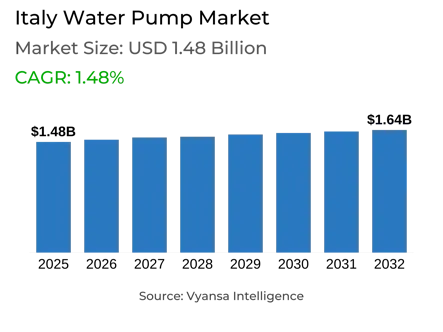
- Water Pump in Italy is estimated at $ 1.48 Billion.
- The market size is expected to grow to $ 1.64 Billion by 2032.
- Market to register a CAGR of around 1.48% during 2026-32.
- Pump Type Segment
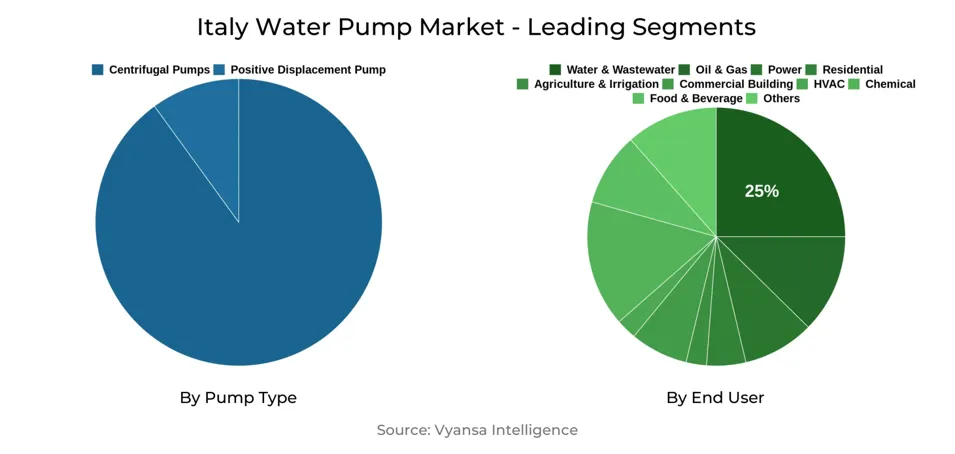
- Centrifugal Pumps continues to dominate the market.
- Competition
- More than 10 companies are actively engaged in producing Water Pump in Italy.
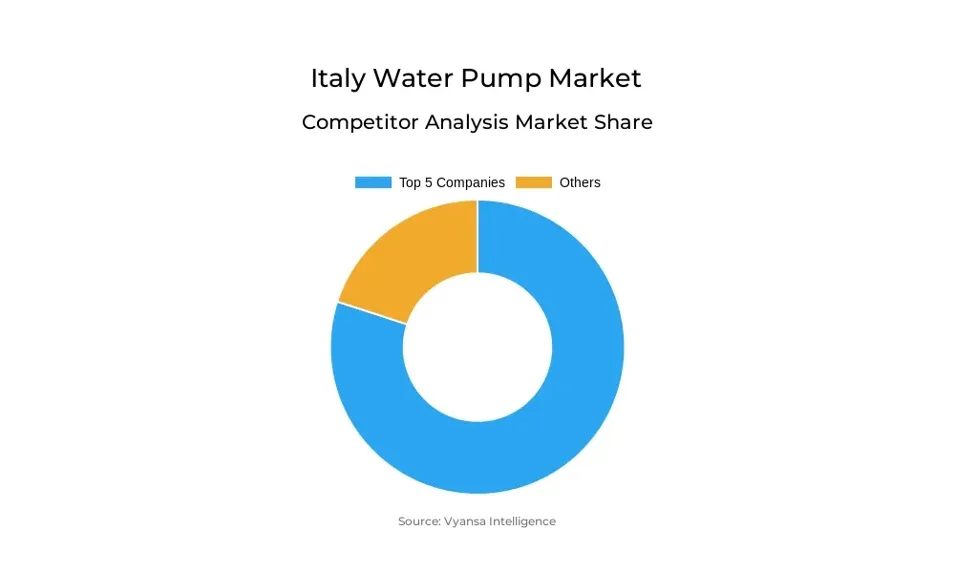
- Top 5 companies acquired the maximum share of the market.
- ITT, IDEX, Dover, Flowserve, Sulzer AG etc., are few of the top companies.
- End User
- Water & Wastewater grabbed 25% of the market.
Italy Water Pump Market Outlook
The Italy water pump market is worth $1.48 billion in 2026 and will grow gradually to $1.64 billion by 2032. Drivers come from the dire need for modernization of Italy's aged water infrastructure, where almost 42% of potable water is lost through leaks and more than 60% of networks are older than 30 years. Government programs like the €12.4 billion National Plan for Infrastructure Interventions, as well as doubling of investment by operators to €65 per capita in 2023, are driving robust demand for sophisticated pumping technologies in municipal, industrial, and agricultural applications.
Yet EU environmental regulations pose challenges to market players. Italy has to align with the EU Drinking Water Directive, which demands monitoring of 48 quality parameters. New Legislative Decree 102/2025 also introduces rules on water contact materials' certification, enforcing it from 2026. These standards add compliance expenses but also promote innovation in certification-ready, high-quality pumping equipment.
Meanwhile, intelligent water management technologies are transforming the industry. Utilities are installing 100,000+ sensors on 110,000 km of networks, leveraging IoT and analytics to detect leaks, do predictive analysis, and optimize pressure. Regulatory connections between performance and tariffs under ARERA also drive faster adoption of smart pumps, cloud platforms, and AI-driven diagnostics for better efficiency and less non-revenue water.
Market segmentation-wise, centrifugal pumps continue to dominate because they are reliable and ideal for Italy's water supply, irrigation, and wastewater systems. By end user, the Water & Wastewater segment takes the lead with 25% market share, as infrastructure developments continue. In contrast, the Fire segment is the fastest-growing segment with a CAGR of 4.73%, driven by stringent safety rules. Generally, modernization, digitalization, and compliance with regulations will steer consistent market growth until 2032.
Italy Water Pump Market Growth Driver
Italy's outdated water infrastructure is providing a large growth potential for water pumps. Italy's water distribution system loses a staggering 42% of drinking water due to leaks, with 60% of the infrastructure in operation for more than 30 years. Such gargantuan water wastage equivalent to satisfying the needs of 43 million people every year has necessitated high-priority infrastructure upgradation efforts.
Government action involves the National Plan for Infrastructure Interventions and for the Water Sector Safety, with 418 project proposals valued at €12.4 billion to enhance water infrastructure robustness. Investment ability among water service operators has also doubled from €33 per capita in 2012 to €65 per capita in 2023, a 99% increase over 11 years. Such significant investment in the infrastructure directly stimulates demand for high-tech water pumping solutions in municipal, industrial, and agricultural applications.
Italy Water Pump Market Challenge
Harsh EU environmental laws impose considerable compliance burdens on Italian water pump producers and consumers. The EU Drinking Water Directive calls for Member States to guarantee wholesome and clean drinking water, with 48 microbiological, chemical, and indicator parameters for continuous monitoring. Italy is subjected to continuous enforcement procedures with the European Commission referring certain regions to the Court of Justice for failure to comply with standards for arsenic and fluoride.
Further, the new Legislative Decree 102/2025 of EU Directive 2020/2184 imposes rigorous certification measures on water contact materials. Local health authorities will start market surveillance from December 2026, including document verification, conformity checks, and product sampling. These regulatory constraints raise operating expenses for pump manufacturers and users, possibly limiting market expansion while requiring investment in compliance technology and certification processes.
Unlock Market Intelligence
Explore the market potential with our data-driven report
Italy Water Pump Market Trend
Intelligent water management solutions are revolutionizing Italy's water pumping industry with IoT integration and analytics. Italian utilities are installing wireless ultrasonic smart meters to monitor consumption in real-time, allowing rapid leakage detection, and minimizing non-revenue water loss. The Smart Water Management System (SWMS) platform now caters to more than 30 operators managing 110,000 km of water networks with 100,000+ sensors.
ARERA's technical quality regulation binds tariffs to six performance indicators of utilities, such as water losses and supply continuity, fueling the adoption of smart pumping technologies. These computerized systems incorporate physical-mathematical models for predictive analysis, GIS-based maps, and IoT connectivity for real-time operation optimization. The intersection of cloud-based monitoring, AI-driven diagnostics, and pressure optimization accelerates intelligent water management in Italy's utility landscape.
Italy Water Pump Market Opportunity
Italy's widespread agricultural industry offers enormous opportunities for water pump upgrading. Italy boasts around 2.65 million hectares of irrigated land, or 68% of the irrigable land and 20% of all agricultural land. The agricultural sector uses 61% of all water used by Italy, with industry using 21% (around 5.5 billion m³ per year).
Existing inefficiency in irrigation through canals and non-localized methods creates a demand for efficient pumping systems. Government encourages modernization of irrigation via various modes of water supply based on crop requirements and specific reuse technologies for industrial sectors. A mere 4% of wastewater is reused as opposed to the viable 23%, which suggests huge potential expansion for water recycling pump systems. The emphasis on water savings and sustainable farming fosters investment in energy-saving, precision irrigation pumping systems throughout Italy's varied agricultural provinces.
| Report Coverage | Details |
|---|---|
| Market Forecast | 2026-32 |
| USD Value 2025 | $ 1.48 Billion |
| USD Value 2032 | $ 1.64 Billion |
| CAGR 2026-2032 | 1.48% |
| Largest Category | Centrifugal Pumps segment leads the market |
| Top Drivers | Infrastructure Modernization Spurring Growth |
| Top Challenges | Environmental Compliance Costs Strain Market |
| Top Trends | Traction Towards Digital Water Management Systems Integration |
| Top Opportunities | Agricultural Irrigation Efficiency Upgrades |
| Key Players | ITT, IDEX, Dover, Flowserve, Sulzer AG, KSB, Xylem, Grundfos, Ebara, SPX Flow and Others. |
Unlock Market Intelligence
Explore the market potential with our data-driven report
Italy Water Pump Market Segmentation Analysis
By Pump Type
- Centrifugal Pumps
- Positive Displacement Pump
The Centrifugal Pump segment also boasts the largest market share under the category of Pump Type. Centrifugal pumps remain the top choice in the Italian water pump industry because they are applicable to various uses and are highly efficient. The pumps are used over agricultural irrigation, municipal water supplies, and industrial applications because they are simple and dependable.
Centrifugal pumps' dominance is due to their ability to perform high-flow, low-to-medium pressure applications common in Italy's water works. They find their niche in water distribution systems, sewage treatment plants, and irrigation systems where steady flow rates are critical. Their popularity is supported by existing maintenance networks and operational experience among Italian technicians and engineers.
By End User
- Oil & Gas
- Power
- Residential
- Agriculture & Irrigation
- Commercial Building
- HVAC
- Chemical
- Water & Wastewater
- Food & Beverage
- Others
The Water & Wastewater division holds the largest market share within the End User category. Water & Wastewater captured 25% of the market and is the largest end-user market for water pumps in Italy. This is an indication of the essential infrastructure demand arising from Italy's deteriorating water distribution network and regulatory compliance demands.
The Fire segment is the most rapidly growing end-user segment with a CAGR of 4.73%. Its growth is triggered by tighter fire safety codes for industrial, commercial, and residential applications. Italy's FM Approved fire pump manufacturers, which supply units ranging from 500 to 5,000 GPM capacity, fuel this growing end-user market segment. The growing emphasis on safety standards and building code compliance fuels consistent demand for fire protection pumping systems throughout Italy's varied industrial base.
Top Companies in Italy Water Pump Market
The top companies operating in the market include ITT, IDEX, Dover, Flowserve, Sulzer AG, KSB, Xylem, Grundfos, Ebara, SPX Flow, etc., are the top players operating in the Italy Water Pump Market.
Frequently Asked Questions
Related Report
1. Market Segmentation
1.1. Research Scope
1.2. Research Methodology
1.3. Definitions and Assumptions
2. Executive Summary
3. Italy Water Pump Market Policies, Regulations, and Standards
4. Italy Water Pump Market Dynamics
4.1. Growth Factors
4.2. Challenges
4.3. Trends
4.4. Opportunities
5. Italy Water Pump Market Statistics, 2022-2032F
5.1. Market Size & Growth Outlook
5.1.1.By Revenues in US$ Million
5.1.2.By Units Sold in Million Units
5.2. Market Segmentation & Growth Outlook
5.2.1.By Pump Type
5.2.1.1. Centrifugal Pumps- Market Insights and Forecast 2022-2032, USD Million
5.2.1.1.1. Overhung Pumps- Market Insights and Forecast 2022-2032, USD Million
5.2.1.1.1.1. Vertical Line- Market Insights and Forecast 2022-2032, USD Million
5.2.1.1.1.2. Horizontal End Suction- Market Insights and Forecast 2022-2032, USD Million
5.2.1.1.2. Split Case Pumps- Market Insights and Forecast 2022-2032, USD Million
5.2.1.1.2.1. Single/Two Stage- Market Insights and Forecast 2022-2032, USD Million
5.2.1.1.2.2. Multi Stage- Market Insights and Forecast 2022-2032, USD Million
5.2.1.1.3. Vertical Pumps- Market Insights and Forecast 2022-2032, USD Million
5.2.1.1.3.1. Turbine- Market Insights and Forecast 2022-2032, USD Million
5.2.1.1.3.2. Axial- Market Insights and Forecast 2022-2032, USD Million
5.2.1.1.3.3. Mixed Flow- Market Insights and Forecast 2022-2032, USD Million
5.2.1.1.4. Submersible Pumps- Market Insights and Forecast 2022-2032, USD Million
5.2.1.1.4.1. Solid Handling- Market Insights and Forecast 2022-2032, USD Million
5.2.1.1.4.2. Non-Solid Handling- Market Insights and Forecast 2022-2032, USD Million
5.2.1.2. Positive Displacement Pump- Market Insights and Forecast 2022-2032, USD Million
5.2.1.2.1. Diaphragm Pumps- Market Insights and Forecast 2022-2032, USD Million
5.2.1.2.2. Piston Pumps- Market Insights and Forecast 2022-2032, USD Million
5.2.1.2.3. Gear Pumps- Market Insights and Forecast 2022-2032, USD Million
5.2.1.2.4. Lobe Pumps- Market Insights and Forecast 2022-2032, USD Million
5.2.1.2.5. Progressive Cavity Pumps- Market Insights and Forecast 2022-2032, USD Million
5.2.1.2.6. Screw Pumps- Market Insights and Forecast 2022-2032, USD Million
5.2.1.2.7. Vane Pumps- Market Insights and Forecast 2022-2032, USD Million
5.2.1.2.8. Peristaltic Pumps- Market Insights and Forecast 2022-2032, USD Million
5.2.1.2.9. Others- Market Insights and Forecast 2022-2032, USD Million
5.2.2.By End User
5.2.2.1. Oil & Gas- Market Insights and Forecast 2022-2032, USD Million
5.2.2.2. Power- Market Insights and Forecast 2022-2032, USD Million
5.2.2.3. Residential- Market Insights and Forecast 2022-2032, USD Million
5.2.2.4. Agriculture & Irrigation- Market Insights and Forecast 2022-2032, USD Million
5.2.2.5. Commercial Building- Market Insights and Forecast 2022-2032, USD Million
5.2.2.6. HVAC- Market Insights and Forecast 2022-2032, USD Million
5.2.2.7. Chemical- Market Insights and Forecast 2022-2032, USD Million
5.2.2.8. Water & Wastewater- Market Insights and Forecast 2022-2032, USD Million
5.2.2.9. Food & Beverage- Market Insights and Forecast 2022-2032, USD Million
5.2.2.10. Others- Market Insights and Forecast 2022-2032, USD Million
5.2.3.By Competitors
5.2.3.1. Competition Characteristics
5.2.3.2. Market Share & Analysis
6. Italy Centrifugal Pump Water Pump Market Statistics, 2022-2032F
6.1. Market Size & Growth Outlook
6.1.1.By Revenues in US$ Million
6.1.2.By Units Sold in Million Units
6.2. Market Segmentation & Growth Outlook
6.2.1.By Pump Type- Market Insights and Forecast 2022-2032, USD Million
6.2.2.By End User- Market Insights and Forecast 2022-2032, USD Million
7. Italy Positive Displacement Pump Water Pump Market Statistics, 2022-2032F
7.1. Market Size & Growth Outlook
7.1.1.By Revenues in US$ Million
7.1.2.By Units Sold in Million Units
7.2. Market Segmentation & Growth Outlook
7.2.1.By Pump Type- Market Insights and Forecast 2022-2032, USD Million
7.2.2.By End User- Market Insights and Forecast 2022-2032, USD Million
8. Competitive Outlook
8.1. Company Profiles
8.1.1.Flowserve
8.1.1.1. Business Description
8.1.1.2. Product Portfolio
8.1.1.3. Collaborations & Alliances
8.1.1.4. Recent Developments
8.1.1.5. Financial Details
8.1.1.6. Others
8.1.2.Sulzer AG
8.1.2.1. Business Description
8.1.2.2. Product Portfolio
8.1.2.3. Collaborations & Alliances
8.1.2.4. Recent Developments
8.1.2.5. Financial Details
8.1.2.6. Others
8.1.3.KSB
8.1.3.1. Business Description
8.1.3.2. Product Portfolio
8.1.3.3. Collaborations & Alliances
8.1.3.4. Recent Developments
8.1.3.5. Financial Details
8.1.3.6. Others
8.1.4.Xylem
8.1.4.1. Business Description
8.1.4.2. Product Portfolio
8.1.4.3. Collaborations & Alliances
8.1.4.4. Recent Developments
8.1.4.5. Financial Details
8.1.4.6. Others
8.1.5.Grundfos
8.1.5.1. Business Description
8.1.5.2. Product Portfolio
8.1.5.3. Collaborations & Alliances
8.1.5.4. Recent Developments
8.1.5.5. Financial Details
8.1.5.6. Others
8.1.6.ITT
8.1.6.1. Business Description
8.1.6.2. Product Portfolio
8.1.6.3. Collaborations & Alliances
8.1.6.4. Recent Developments
8.1.6.5. Financial Details
8.1.6.6. Others
8.1.7.IDEX
8.1.7.1. Business Description
8.1.7.2. Product Portfolio
8.1.7.3. Collaborations & Alliances
8.1.7.4. Recent Developments
8.1.7.5. Financial Details
8.1.7.6. Others
8.1.8.Dover
8.1.8.1. Business Description
8.1.8.2. Product Portfolio
8.1.8.3. Collaborations & Alliances
8.1.8.4. Recent Developments
8.1.8.5. Financial Details
8.1.8.6. Others
8.1.9.Ebara
8.1.9.1. Business Description
8.1.9.2. Product Portfolio
8.1.9.3. Collaborations & Alliances
8.1.9.4. Recent Developments
8.1.9.5. Financial Details
8.1.9.6. Others
8.1.10. SPX Flow
8.1.10.1. Business Description
8.1.10.2. Product Portfolio
8.1.10.3. Collaborations & Alliances
8.1.10.4. Recent Developments
8.1.10.5. Financial Details
8.1.10.6. Others
9. Disclaimer
| Segment | Sub-Segment |
|---|---|
| By Pump Type |
|
| By End User |
|
Research Methodology
This study followed a structured approach comprising four key phases to assess the size and scope of the electro-oxidation market. The process began with thorough secondary research to collect data on the target market, related markets, and broader industry context. These findings, along with preliminary assumptions and estimates, were then validated through extensive primary research involving industry experts from across the value chain. To calculate the overall market size, both top-down and bottom-up methodologies were employed. Finally, market segmentation and data triangulation techniques were applied to refine and validate segment-level estimations.
Secondary Research
The secondary research phase involved gathering data from a wide range of credible and published sources. This step helped in identifying industry trends, defining market segmentation, and understanding the market landscape and value chain.
Sources consulted during this phase included:
- Company annual reports, investor presentations, and press releases
- Industry white papers and certified publications
- Trade directories and market-recognized databases
- Articles from authoritative authors and reputable journals
- Gold and silver standard websites
Secondary research was critical in mapping out the industry's value chain and monetary flow, identifying key market segments, understanding regional variations, and tracking significant industry developments.
Other key sources:
- Financial disclosures
- Industry associations and trade bodies
- News outlets and business magazines
- Academic journals and research studies
- Paid industry databases
Primary Research
To validate secondary data and gain deeper market insights, primary research was conducted with key stakeholders across both the supply and demand sides of the market.
On the demand side, participants included decision-makers and influencers from end-user industries—such as CIOs, CTOs, and CSOs—who provided first-hand perspectives on market needs, product usage, and future expectations.
On the supply side, interviews were conducted with manufacturers, industry associations, and institutional participants to gather insights into current offerings, product pipelines, and market challenges.
Primary interviews provided critical inputs such as:
- Market size and revenue data
- Product and service breakdowns
- Market forecasts
- Regional and application-specific trends
Stakeholders consulted included:
- Leading OEM and solution providers
- Channel and distribution partners
- End users across various applications
- Independent consultants and industry specialists
Market Size Estimation and Data Triangulation
- Identifying Key Market Participants (Secondary Research)
- Goal: To identify the major players or companies in the target market. This typically involves using publicly available data sources such as industry reports, market research publications, and financial statements of companies.
- Tools: Reports from firms like Gartner, Forrester, Euromonitor, Statista, IBISWorld, and others. Public financial statements, news articles, and press releases from top market players.
- Extracting Earnings of Key Market Participants
- Goal: To estimate the earnings generated from the product or service being analyzed. This step helps in understanding the revenue potential of each market player in a specific geography.
- Methods: Earnings data can be gathered from:
- Publicly available financial reports (for listed companies).
- Interviews and primary data sources from professionals, such as Directors, VPs, SVPs, etc. This is especially useful for understanding more nuanced, internal data that isn't publicly disclosed.
- Annual reports and investor presentations of key players.
- Data Collation and Development of a Relevant Data Model
- Goal: To collate inputs from both primary and secondary sources into a structured, data-driven model for market estimation. This model will incorporate key market KPIs and any independent variables relevant to the market.
- Key KPIs: These could include:
- Market size, growth rate, and demand drivers.
- Industry-specific metrics like market share, average revenue per customer (ARPC), or average deal size.
- External variables, such as economic growth rates, inflation rates, or commodity prices, that could affect the market.
- Data Modeling: Based on this data, the market forecasts are developed for the next 5 years. A combination of trend analysis, scenario modeling, and statistical regression might be used to generate projections.
- Scenario Analysis
- Goal: To test different assumptions and validate how sensitive the market is to changes in key variables (e.g., market demand, regulatory changes, technological disruptions).
- Types of Scenarios:
- Base Case: Based on current assumptions and historical data.
- Best-Case Scenario: Assuming favorable market conditions, regulatory environments, and technological advancements.
- Worst-Case Scenario: Accounting for adverse factors, such as economic downturns, stricter regulations, or unexpected disruptions.












