Indonesia Electric Two Wheelers Market Report: Trends, Growth and Forecast (2026-2032)
By Type (Electric Motorcycles, Electric Scooters), By Battery Type (Nickel Metal Hybrid Batteries, Sealed Lead Acid Batteries, Lithium-Ion Batteries), By Drive Type (Hub Drive Motor, Mid Drive Motor), By Voltage (<48V, 48-60V, 61-72V, 73-96V, 96V), By Peak Power (<3 kW, 3-6 kW, 7-10 kW, 10 kW), By Battery Technology (Removable, Non-Removable), By Motor Placement (Hub Type, Chassis Mounted), By Region (Sumatra, Java, Kalimantan, Sulawesi, Others) ... Read more
|
Major Players
|
Indonesia Electric Two Wheelers Market Statistics and Insights, 2026
- Market Size Statistics
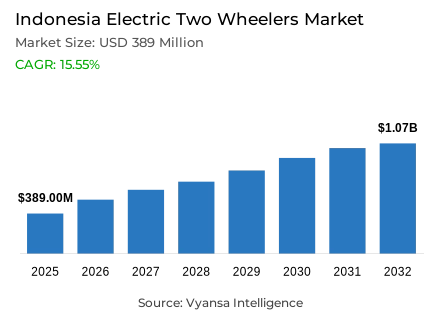
- Electric two wheelers market size in Indonesia was valued at USD 389 million in 2025 and is estimated at USD 442 million in 2026.
- The market size is expected to grow to USD 1.07 billion by 2032.
- Market to register a CAGR of around 15.55% during 2026-32.
- Type Shares
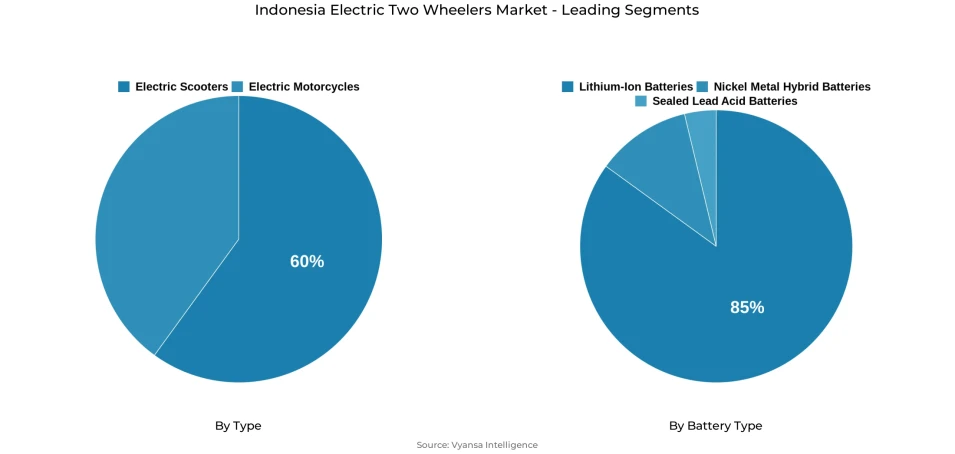
- Electric scooters grabbed market share of 60%.
- Competition
- More than 10 companies are actively engaged in producing electric two wheelers in Indonesia.
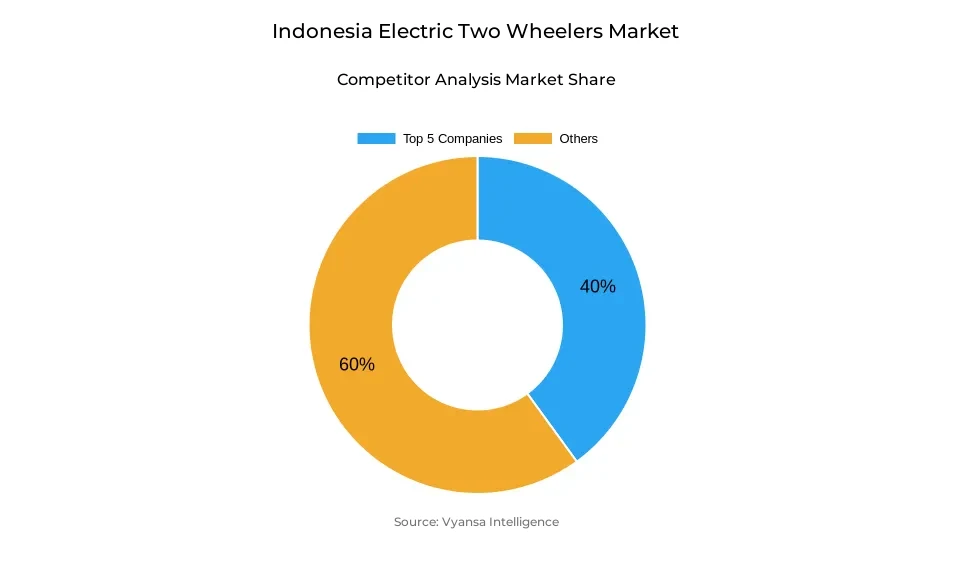
- Top 5 companies acquired around 40% of the market share.
- PT Volta Indonesia Semesta, PT Smoot Motor Indonesia, PT Juara Bike (Selis), PT Hartono Istana Teknologi (Polytron), PT Ilectra Motor Group (ALVA) etc., are few of the top companies.
- Battery Type
- Lithium-ion batteries grabbed 85% of the market.
Indonesia Electric Two Wheelers Market Outlook
The indonesia electric two wheelers market size was valued at USD 389 million in 2025 and is projected to grow from USD 442 million in 2026 to USD 1.07 billion by 2032, exhibiting a CAGR of 15.55% during the forecast period. The market is expanding as indonesia’s motorcycle-based mobility system begins shifting from fuel-dependent commuting toward lower-operating-cost electric mobility.
electric two wheelers in indonesia include electric scooters, electric motorcycles, battery-powered motorcycles, fixed-battery models, swappable-battery models, conversion kits, lithium-ion battery packs, chargers, hub drive motor systems, mid drive motor models, electric motor controllers, and connected fleet-support systems. Demand exists because two wheelers are central to urban mobility, daily commuting, delivery activity, ride-hailing, small-business movement, and short-distance travel.
The indonesia e-2W market is commercially strongest where vehicle price, battery quality, charging access, battery swapping infrastructure, aftersales service, and running-cost savings improve together. electric two wheelers become practical when riders can reduce fuel dependence without facing long charging delays, weak service access, or uncertainty around battery replacement.
The electric scooter market in indonesia remains positive but execution-sensitive. Growth is supported by EV subsidies, local EV manufacturing, lithium-ion batteries, battery swapping, electric motorcycle conversion, and delivery fleet electrification. However, adoption depends on consistent incentives, charging density, battery warranty, resale confidence, workshop capacity, and clear consumer economics across indonesia’s high-volume motorcycle base.
Indonesia Electric Two Wheelers Market Growth Driver
Fuel Savings and Subsidy-Led Adoption Strengthen Demand
The indonesia electric two wheelers market is primarily driven by motorcycle electrification and fuel cost reduction across a large gasoline two-wheeler base. indonesia’s Cabinet Secretariat reported in 2026 that the country has more than 120 million gasoline-powered motorcycles and that the government is preparing measures to convert gasoline vehicles into EVs, focusing on motorcycles. This establishes a large replacement and conversion pool for electric motorcycles and commuter electric scooters.
electric two wheelers in indonesia are also gaining support from visible subsidy-led adoption. Kemenperin-reported data show subsidized electric motorcycle distribution reached 30,083 units by 27 May 2024, equal to 60.1% of the 2024 target of 50,000 units and already above the 2023 total of 11,532 units. The demand chain is clear: EV subsidies reduce the upfront price gap, more riders test battery-powered motorcycles, and higher usage encourages investment in charging, service, and battery ecosystems.
Indonesia Electric Two Wheelers Market Challenge
Charging Access and Price Gap Still Restrain Scale
The indonesia e-2W market continues to face adoption barriers from charging infrastructure gaps, affordability concerns, service network limitations, and battery swapping readiness. ASEAN’s 2024 Light Electric Vehicle Guidelines state that indonesia’s relatively low fossil-fuel price reduces the appeal of operating-cost savings from light EVs versus ICE vehicles, while battery-swapping and fast-charging infrastructure remain limited. This affects rider confidence because purchase decisions depend on price, charging time, battery reliability, and service access.
The electric motorcycle market in indonesia is constrained by practical daily-use concerns. Commuters and delivery riders need predictable range, charging access near home or work, quick battery support, and repair availability. If charging is inconvenient or battery replacement costs are unclear, gasoline motorcycles remain easier to use. Adoption therefore depends on stable incentives, dealer support, battery warranties, dense charging infrastructure, and urban battery swapping infrastructure.
Unlock Market Intelligence
Explore the market potential with our data-driven report
Indonesia Electric Two Wheelers Market Trend
Battery Swapping Moves from Roadmap to Implementation
The indonesia electric two wheelers market is shifting toward swappable batteries and dedicated two-wheeler charging infrastructure. PLN-backed updates reported that, by March 2025, indonesia had 9,956 charging stations for two wheelers and 2,240 public battery swap stations. This matters because electric scooters, ride-hailing vehicles, and delivery fleets need faster energy replenishment than slow home charging can provide.
electric two wheelers in indonesia benefit from battery swapping because riders can exchange depleted battery packs instead of waiting for charging. This format fits dense-city commuting, food delivery, courier work, and fleet operations where vehicle uptime affects earning capacity. Product design is also moving toward lithium-ion batteries, battery management systems, connected electric scooters, mobile apps, service-center integration, and battery traceability. The trend shifts the market from standalone vehicle sales toward energy-access ecosystems.
Indonesia Electric Two Wheelers Market Opportunity
Retrofit Pathway Opens Long-Term Conversion Potential
The indonesia e-2W market has a focused opportunity in electric motorcycle conversion, although it remains an early-stage pathway rather than proven mass-scale demand. ANTARA reported from indonesia’s Ministry of Energy and Mineral Resources that conversion incentives were granted for 1,111 gasoline motorcycles in 2024, compared with 145 units in 2023, and that the ministry provides Rp10 million per converted motorcycle unit. This shows progress, but the volume remains small against indonesia’s gasoline motorcycle base.
The opportunity is relevant because conversion targets riders who already own motorcycles. Retrofit demand can support electric drivetrain systems, BLDC motor units, motor controllers, battery packs, wiring systems, certification, approved workshops, and aftersales service. Scaling depends on lower conversion cost, battery safety, warranty clarity, workshop capacity, and consumer trust. Market upside improves when conversion becomes cheaper and easier than replacing a working gasoline motorcycle with a new electric two wheeler.
Unlock Market Intelligence
Explore the market potential with our data-driven report
Indonesia Electric Two Wheelers Market Segmentation Analysis
By Type
- Electric Motorcycles
- Electric Scooters
The segment with the highest share under the Type category in the indonesia electric two wheelers market is Electric Scooters, holding around 60% of the market. Electric scooters lead because indonesia’s urban two-wheeler usage is concentrated around short-distance commuting, food delivery, ride-hailing, errands, and dense-city travel. Their step-through design, automatic operation, compact size, lower riding barrier, and compatibility with swappable batteries make them more suitable for mass adoption.
electric two wheelers in indonesia also include electric motorcycles and battery-powered motorcycles for riders seeking higher road speed, longer range, and stronger vehicle presence. However, motorcycles remain behind in broad adoption because scooters fit everyday urban use more effectively. Scooter formats also work better with battery swapping, fleet deployment, and low-maintenance ownership. Future demand strengthens as local brands improve range, pricing, battery warranty, charging compatibility, and aftersales coverage across major indonesian cities.
By Battery Type
- Nickel Metal Hybrid Batteries
- Sealed Lead Acid Batteries
- Lithium-Ion Batteries
The segment with the highest share under the Battery Type category in the indonesia e-2W market is Lithium-Ion Batteries, holding around 85% of the market. Lithium-ion batteries lead because electric two wheelers need lighter packs, stronger energy density, better range performance, faster charging potential, and battery management system compatibility. These characteristics directly affect rider confidence because battery weight, charging time, real-world range, and battery life shape ownership experience.
Electric scooters and electric motorcycles increasingly depend on battery packs that support swappable formats, smart diagnostics, battery leasing, connected service models, and fleet monitoring. Fixed batteries remain relevant where home charging is sufficient, while swappable batteries are more suitable for high-utilization users. Sealed lead-acid batteries remain structurally weaker because higher weight, lower usable energy density, and shorter replacement cycles reduce suitability for modern urban electric two wheelers.
List of Companies Covered in Indonesia Electric Two Wheelers Market
The companies listed below are highly influential in the Indonesia electric two wheelers market, with a significant market share and a strong impact on industry developments.
- PT Volta Indonesia Semesta
- PT Smoot Motor Indonesia
- PT Juara Bike (Selis)
- PT Hartono Istana Teknologi (Polytron)
- PT Ilectra Motor Group (ALVA)
- PT Gesits Motor Nusantara
- PT Terang Dunia Internusa Tbk (United E-Motor)
- PT Triangle Motorindo (Viar Motor Indonesia)
- PT Uwinfly Indonesia Industries
- Yadea Group Holdings Ltd. (Yadea Indonesia)
Market News & Updates
- PT Ilectra Motor Group/ALVA, 2026:
ALVA released the ALVA N3 Next Gen in February 2026 for Indonesia’s electric two-wheeler market. The model adds improved performance, efficiency, comfort, a newer battery with up to 4-year warranty, Boost Charge capability for 50% charging in 20 minutes, Hill Start Assist, and Hill Descent Assist. The update expands ALVA’s daily urban electric motorcycle lineup.
- PT Terang Dunia Internusa Tbk/United E-Motor, 2026:
United E-Motor presented its 2026 electric motorcycle lineup during IIMS and BCA Expoversary in February 2026. The update included the official RX6000 launch, described by the company as the first electric motorcycle capable of charging at SPKLU, along with models such as TX3000, TX1800, T1800, MX1200, MT1500, and C2000.
Frequently Asked Questions
Related Report
- Market Segmentation
- Research Scope
- Research Methodology
- Definitions and Assumptions
- Executive Summary
- Indonesia Electric Two Wheelers Market Policies, Regulations, and Standards
- Indonesia Electric Two Wheelers Market Dynamics
- Growth Factors
- Challenges
- Trends
- Opportunities
- Indonesia Electric Two Wheelers Market Statistics, 2022-2032F
- Market Size & Growth Outlook
- By Revenues in USD Million
- By Units Sold (Thousand Units)
- Market Segmentation & Growth Outlook
- By Type
- Electric Motorcycles- Market Insights and Forecast 2022-2032, USD Million
- Electric Scooters- Market Insights and Forecast 2022-2032, USD Million
- By Battery Type
- Nickel Metal Hybrid Batteries- Market Insights and Forecast 2022-2032, USD Million
- Sealed Lead Acid Batteries- Market Insights and Forecast 2022-2032, USD Million
- Lithium-Ion Batteries- Market Insights and Forecast 2022-2032, USD Million
- By Drive Type
- Hub Drive Motor- Market Insights and Forecast 2022-2032, USD Million
- Mid Drive Motor- Market Insights and Forecast 2022-2032, USD Million
- By Voltage
- <48V- Market Insights and Forecast 2022-2032, USD Million
- 48-60V- Market Insights and Forecast 2022-2032, USD Million
- 61-72V- Market Insights and Forecast 2022-2032, USD Million
- 73-96V- Market Insights and Forecast 2022-2032, USD Million
- 96V- Market Insights and Forecast 2022-2032, USD Million
- By Peak Power
- <3 kW- Market Insights and Forecast 2022-2032, USD Million
- 3-6 kW- Market Insights and Forecast 2022-2032, USD Million
- 7-10 kW- Market Insights and Forecast 2022-2032, USD Million
- 10 kW- Market Insights and Forecast 2022-2032, USD Million
- By Battery Technology
- Removable- Market Insights and Forecast 2022-2032, USD Million
- Non-Removable- Market Insights and Forecast 2022-2032, USD Million
- By Motor Placement
- Hub Type- Market Insights and Forecast 2022-2032, USD Million
- Chassis Mounted- Market Insights and Forecast 2022-2032, USD Million
- By Region
- Sumatra- Market Insights and Forecast 2022-2032, USD Million
- Java- Market Insights and Forecast 2022-2032, USD Million
- Kalimantan- Market Insights and Forecast 2022-2032, USD Million
- Sulawesi- Market Insights and Forecast 2022-2032, USD Million
- Others- Market Insights and Forecast 2022-2032, USD Million
- By Competitors
- Competition Characteristics
- Market Share & Analysis
- By Type
- Market Size & Growth Outlook
- Indonesia Electric Motorcycles Market Statistics, 2022-2032
- Market Size & Growth Outlook
- By Revenues in USD Million
- By Units Sold (Thousand Units)
- Market Segmentation & Growth Outlook
- By Battery Type- Market Insights and Forecast 2022-2032, USD Million
- By Drive Type- Market Insights and Forecast 2022-2032, USD Million
- By Voltage- Market Insights and Forecast 2022-2032, USD Million
- By Peak Power- Market Insights and Forecast 2022-2032, USD Million
- By Battery Technology- Market Insights and Forecast 2022-2032, USD Million
- By Motor Placement- Market Insights and Forecast 2022-2032, USD Million
- By Region- Market Insights and Forecast 2022-2032, USD Million
- Market Size & Growth Outlook
- Indonesia Electric Scooters Market Statistics, 2022-2032
- Market Size & Growth Outlook
- By Revenues in USD Million
- By Units Sold (Thousand Units)
- Market Segmentation & Growth Outlook
- By Battery Type- Market Insights and Forecast 2022-2032, USD Million
- By Drive Type- Market Insights and Forecast 2022-2032, USD Million
- By Voltage- Market Insights and Forecast 2022-2032, USD Million
- By Peak Power- Market Insights and Forecast 2022-2032, USD Million
- By Battery Technology- Market Insights and Forecast 2022-2032, USD Million
- By Motor Placement- Market Insights and Forecast 2022-2032, USD Million
- By Region- Market Insights and Forecast 2022-2032, USD Million
- Market Size & Growth Outlook
- Competitive Outlook
- Company Profiles
- PT Hartono Istana Teknologi (Polytron)
- Business Description
- Product Portfolio
- Collaborations & Alliances
- Recent Developments
- Financial Details
- Others
- PT Ilectra Motor Group (ALVA)
- Business Description
- Product Portfolio
- Collaborations & Alliances
- Recent Developments
- Financial Details
- Others
- PT Gesits Motor Nusantara
- Business Description
- Product Portfolio
- Collaborations & Alliances
- Recent Developments
- Financial Details
- Others
- PT Terang Dunia Internusa Tbk (United E-Motor)
- Business Description
- Product Portfolio
- Collaborations & Alliances
- Recent Developments
- Financial Details
- Others
- PT Triangle Motorindo (Viar Motor Indonesia)
- Business Description
- Product Portfolio
- Collaborations & Alliances
- Recent Developments
- Financial Details
- Others
- PT Volta Indonesia Semesta
- Business Description
- Product Portfolio
- Collaborations & Alliances
- Recent Developments
- Financial Details
- Others
- PT Smoot Motor Indonesia
- Business Description
- Product Portfolio
- Collaborations & Alliances
- Recent Developments
- Financial Details
- Others
- PT Juara Bike (Selis)
- Business Description
- Product Portfolio
- Collaborations & Alliances
- Recent Developments
- Financial Details
- Others
- PT Uwinfly Indonesia Industries
- Business Description
- Product Portfolio
- Collaborations & Alliances
- Recent Developments
- Financial Details
- Others
- Yadea Group Holdings Ltd. (Yadea Indonesia)
- Business Description
- Product Portfolio
- Collaborations & Alliances
- Recent Developments
- Financial Details
- Others
- PT Hartono Istana Teknologi (Polytron)
- Company Profiles
- Disclaimer
| Segment | Sub-Segment |
|---|---|
| By Type |
|
| By Battery Type |
|
| By Drive Type |
|
| By Voltage |
|
| By Peak Power |
|
| By Battery Technology |
|
| By Motor Placement |
|
| By Region |
|
Research Methodology
This study followed a structured approach comprising four key phases to assess the size and scope of the electro-oxidation market. The process began with thorough secondary research to collect data on the target market, related markets, and broader industry context. These findings, along with preliminary assumptions and estimates, were then validated through extensive primary research involving industry experts from across the value chain. To calculate the overall market size, both top-down and bottom-up methodologies were employed. Finally, market segmentation and data triangulation techniques were applied to refine and validate segment-level estimations.
Secondary Research
The secondary research phase involved gathering data from a wide range of credible and published sources. This step helped in identifying industry trends, defining market segmentation, and understanding the market landscape and value chain.
Sources consulted during this phase included:
- Company annual reports, investor presentations, and press releases
- Industry white papers and certified publications
- Trade directories and market-recognized databases
- Articles from authoritative authors and reputable journals
- Gold and silver standard websites
Secondary research was critical in mapping out the industry's value chain and monetary flow, identifying key market segments, understanding regional variations, and tracking significant industry developments.
Other key sources:
- Financial disclosures
- Industry associations and trade bodies
- News outlets and business magazines
- Academic journals and research studies
- Paid industry databases
Primary Research
To validate secondary data and gain deeper market insights, primary research was conducted with key stakeholders across both the supply and demand sides of the market.
On the demand side, participants included decision-makers and influencers from end-user industries—such as CIOs, CTOs, and CSOs—who provided first-hand perspectives on market needs, product usage, and future expectations.
On the supply side, interviews were conducted with manufacturers, industry associations, and institutional participants to gather insights into current offerings, product pipelines, and market challenges.
Primary interviews provided critical inputs such as:
- Market size and revenue data
- Product and service breakdowns
- Market forecasts
- Regional and application-specific trends
Stakeholders consulted included:
- Leading OEM and solution providers
- Channel and distribution partners
- End users across various applications
- Independent consultants and industry specialists
Market Size Estimation and Data Triangulation
- Identifying Key Market Participants (Secondary Research)
- Goal: To identify the major players or companies in the target market. This typically involves using publicly available data sources such as industry reports, market research publications, and financial statements of companies.
- Tools: Reports from firms like Gartner, Forrester, Euromonitor, Statista, IBISWorld, and others. Public financial statements, news articles, and press releases from top market players.
- Extracting Earnings of Key Market Participants
- Goal: To estimate the earnings generated from the product or service being analyzed. This step helps in understanding the revenue potential of each market player in a specific geography.
- Methods: Earnings data can be gathered from:
- Publicly available financial reports (for listed companies).
- Interviews and primary data sources from professionals, such as Directors, VPs, SVPs, etc. This is especially useful for understanding more nuanced, internal data that isn't publicly disclosed.
- Annual reports and investor presentations of key players.
- Data Collation and Development of a Relevant Data Model
- Goal: To collate inputs from both primary and secondary sources into a structured, data-driven model for market estimation. This model will incorporate key market KPIs and any independent variables relevant to the market.
- Key KPIs: These could include:
- Market size, growth rate, and demand drivers.
- Industry-specific metrics like market share, average revenue per customer (ARPC), or average deal size.
- External variables, such as economic growth rates, inflation rates, or commodity prices, that could affect the market.
- Data Modeling: Based on this data, the market forecasts are developed for the next 5 years. A combination of trend analysis, scenario modeling, and statistical regression might be used to generate projections.
- Scenario Analysis
- Goal: To test different assumptions and validate how sensitive the market is to changes in key variables (e.g., market demand, regulatory changes, technological disruptions).
- Types of Scenarios:
- Base Case: Based on current assumptions and historical data.
- Best-Case Scenario: Assuming favorable market conditions, regulatory environments, and technological advancements.
- Worst-Case Scenario: Accounting for adverse factors, such as economic downturns, stricter regulations, or unexpected disruptions.












